Leveraging Thought Leadership Live featuring Bill Sherman
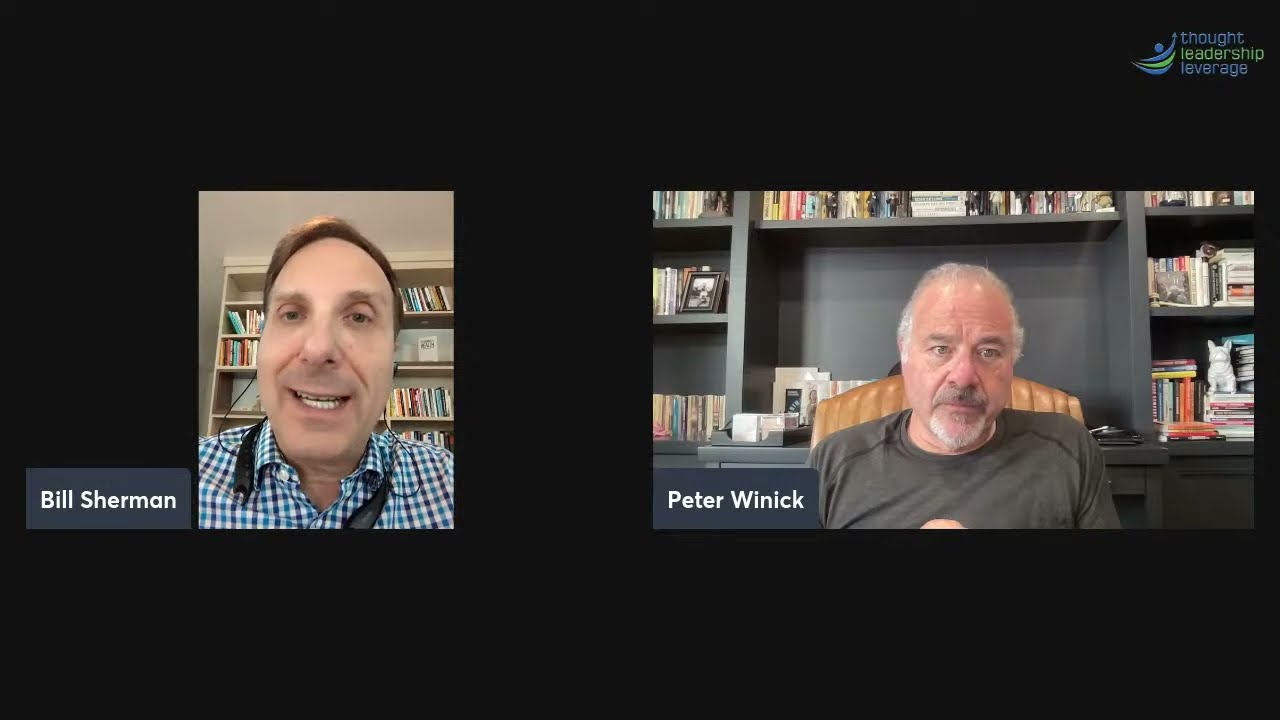
Bill Sherman and Peter Winick discuss how thought leaders scale from one-off keynotes to enterprise programs. They emphasize research-backed models, clear language that can be licensed, and delivery methods like train-the-trainer that maintain quality. Tying ideas to measurable outcomes like NPS or retention matters more than chasing trends.
Chapters
And welcome, welcome, welcome. This is Peter Winick. I'm the founder and CEO at Thought Leadership Leverage, and you're joining us on this LinkedIn Live, which is an extension of our podcast, which is Leveraging Thought Leadership. And today my guest is none other than our COO, Bill Sherman. So welcome, Bill. It's just you and me today.
Yeah, it's good to be here. Cool.
So we're kind of doing a state of thought leadership from an enterprise perspective today, and what is it, sharing some things that we've seen, which would hopefully be helpful to folks. So I want to hand it to Bill to start sort of at the— you think of this as a pyramid— what are the basics, the fundamentals in terms of frameworks and models that are needed so that you can successfully embed your thought leadership into large organizations?
So one of the things that we've long believed, and I've seen a trend amplifying in the marketplace, is the demand for content which is not based on instinct or gut, but is really well-researched, supported, and validated, right? And so It's sort of like 2 lines crossing. You can get to a certain point in thought leadership by putting out your opinions, but at some point when you're trying to reach at an enterprise scale, your audience says, well, do you think or do you know? And—
Well, stay there for a minute, because I think one of the things here that's interesting, if we start to double-click on that, is, well, what does it take to be a successful keynoter? Charisma is one of the ingredients. And oftentimes people that have the scales and the model and all those things might not have the chops to make it on stage. But inversely, the people that have the charisma and that stage energy might not have what they need to under the hood to succeed at scale. So it's a bit of a—
Well, and think about the general ways into business thought leadership. You might be an academic. You might be speaking, going into keynoting. You could be a workshop facilitator who develops an expertise. There are a number of paths into this. You could be a consultant or running a boutique consultancy. All of those are ways into thought leadership. Some of them rely on charisma more than— or gravitas more than they do specific research, right?
Exactly.
And so you need to be balanced between the research and the understanding of the business. And it doesn't have to be that you understand an industry to the 6th decimal, but what it is, is you need to speak business fluently and be able to translate your idea to what an executive cares about. What impact are you able to make measurably Either to revenue or to the ideas and goals, say if you're a nonprofit, for example, and your client that you're trying to serve is a nonprofit. And that's why I come back to this concept of what are your models, what are your frameworks, have you validated them? Do you know that what you're trying to achieve works? And how do you know?
And the reason that's important from the enterprise side is what an organization wants. One of the things they want when they're investing significant dollars in your thought leadership is for it to say what it does, right?
Uh-huh.
And to have a consistent way to put that work out there so that everybody's working off the same language, the models, the definitions, et cetera. So even when you look at things like culture, as an example, ask 10 people what culture means, you probably get 11 answers. If as a thought leader, that's your space, one of the critical things you have to say is when I talk about culture, I define that as the norms or the whatever that happen in an organization, right? You have a clear definition. So everybody sort of is centered on that.
Well, and I think there's a classic tendency. You get a senior leader or an executive who reads an article in HBR or one of the management journals, and then maybe a book, falls in love with an idea, and then all of a sudden is either handing out copies of the book to their senior leadership team or walking over to their head of talent development and saying, hey, let's get this idea throughout the organization. This is great. And everybody who receives that copy of the book Looks at it, turns it maybe 45 degrees or 90 degrees and goes, how do we integrate this? How do we make sure this works at scale and not, you know, mess up what we're already doing, right? Because it's sort of like changing the aircraft engine in flight.
So if you could maybe define and give an example of a good framework, a good model, And what we mean when we talk about validation.
Yeah. So let's talk about models because they come in different forms. So one that I think a lot of people are familiar with would be Stephen Covey's 7 Habits of Highly Effective People. It's a list of 7 behaviors, you know, start with the end in mind, sharpen the saw. Those are things Which are discrete behaviors that you can remember and apply in multiple situations. Other models come from academia. So we talk a lot about emotional intelligence.
Mm-hmm.
That's actually a research academic model that comes out of a 2 by 2 matrix, which says, okay, you need to be emotionally intelligent. You need to be aware of your own emotions. And able to regulate them. And then you have to be aware of another's emotions and be able to respond to them. Okay. That framework is simple enough that you can explain it like I did here for both of them in less than 60 seconds. You can go, okay, there's something there. Interesting. If I'm on the user side, I need an aha that I can apply within, you know, context. I'm in the meeting and I'm leading a team or I'm doing a one-on-one. I need to be able to apply that insight without having to open up, you know, a business book or a workbook that in a workshop that I participated. It's got to be simple, clear, memorable. And in many ways, thought leadership is the art of that translation of complex ideas into the simple, actionable, and usable.
Yep.
Validation is one of those steps. And so a validated model is much like designing and building a ruler or a yardstick or taking measurements and blueprints, right? So you want to be able to make the claim, if you're selling a yardstick, that it's actually 36 inches, that all of the incremental little hash lines are in the right place so that when people apply the yardstick, it does as it performs as promised, right? The same here. If you say, hey, based on my model of culture, There are 4 things that matter or 5 things that matter. Are those the most important things? Are those the ones that are relative or essential? Okay. And if you're changing your model on a frequent basis, or you say, oh, I had a new insight, there aren't 5, there are 6, and 2 of them have changed out. you lose trust, you lose the credibility. Just if you say, hey, I've got a Yardstick 2.0 that's new and improved.
Yeah.
What was wrong with the first one, right?
Got it.
And it's about collecting data, it's about analyzing that data, and then being able to say the claims that I'm making for measurement and the things that I'm saying that are important are actually what matters. And we've seen the shift increasingly to a much more data-driven organization. Every year the enterprise is saying, especially if we're going to scale an idea, it's got to be measurable. It's got to be tied to business outcomes.
Yep. So that's basically table stakes. So said another way, if you don't have a solid model, if you don't have the frameworks and it's not validated, When you're lucky enough to potentially have a conversation with a large-scale buyer, think Fortune 1000 company or something, you're out, right? They're going to be asking a couple of questions and say, oh, well, where did you come up with that framework from? Oh, you know, it's kind of what I believe, you know, or it's just—
Or I have an assessment or an organizational diagnostic either to measure skills within individuals, etc. Well, does this work? You know, are the questions the right questions? Is the feedback report based on gut instinct or science?
Yep. So then, so if we go up to the next level, let's assume you've got that, right? Because if you don't, you're out, right? Now the next step is, what does it take to win at scale from an enterprise level? So to me, you have to understand, from my perspective, you have to understand, well, there's a significant difference between the needs and desires of the economic buyer and the user. And all too often what we see in our work is that the thought leader is so focused on the end user, think the reader in the book, the butt in the seat in the classroom, the whatever, that this concept of there's this other layer of an economic buyer that has totally different desires and needs isn't even on their radar. So what are they looking for? They're looking for, does this scale? Right? If, you know, if Bill is the greatest guy in the world on culture, but nothing's documented and there isn't anything scalable, etc., that might make for an interesting conversation or a keynote. But I can't— if, you know, if my job entails how do I develop the capabilities of 30,000 people in my organization, he's out, right? So it's got to be—
Well, and let me interject here for a second. Great ideas may be exceptional ideas. You may have the best idea. It's not—
Your audio's pausing, Bill.
What? Am I back?
Yeah, now you're back. Sorry about that. So you said great ideas and then your audio—
Yeah, yeah. Great ideas are not guaranteed to scale on their own. They need to be designed to scale. Because if you have a great idea but no way of scaling it, it's gonna sit on the shelf. Great ideas just don't take flight.
Yep. So you gotta have consistency in how you choose to bring those ideas to the organization. That could be achieved by, you know, e-learning, digital assessments, licensing, either internal or external. Like, so you train the trainers. What does it mean if you have an army of trainers that are certified? What if it means— what does it mean in an organization if they want their people to deliver it? What are the prereqs? How do we develop that so that we're delivering a high-quality, consistent experience? Because what we don't want to have is 20 different people in an organization take 20 different programs and come out the other side of it with a vastly different experience. There's always room for a little bit of nuance or someone's style's a little bit different than others. But you've got to have a consistent outcome in terms of the desired learnings that you're trying to achieve. And then the other thing that not as many thought leaders talk about enough is most thought leaders are talking about how do I get the most for my work, which is great, but that's very much a keynote mindset. How do I go from making $30,000 a keynote to $50,000 or whatever? The reality is that is a low-volume, high-ticket price business. And when you're selling at scale into an organization, you You're actually in the opposite business, which you're in a low ticket price per capita, high volume. So one of the ways to think about that is, wow, if Company X came to me and said, how would I train 30,000 people in your work at, pick a nominal number, $10, $20, $30 a head? And the answer isn't give them your book. What does that look like? Because there's a huge market for that in digital and scalable, et cetera. We can debate, oh man, but the classroom and the live experience is better or whatever. You've got to have segmented pricing. Yes, maybe the classroom is better. That's a discussion for another day. But if the demand is, what do you have at $20 a head, $50 a head, $500 a head, and you can't fill those in, you're also out of the enterprise game.
Absolutely. So Peter, one of the things I want to ask you is what trends are you seeing from the enterprise buying side? Because you're in conversations on a regular basis with enterprise buyers, what are they looking for from solutions today?
Yeah, so some things have remained the same over years and years, and then there's some trends that are really, really interesting and I think present opportunities to thought leaders that can stay on top of it. So one is You know, I briefly mentioned before certification and train-the-trainer. So the traditional way that that was done at most organizations, it was a subset of the training and development function, right? So inside of training and development, pick a big company, P&G or Citibank or whoever, might have dozens or hundreds of facilitators that deliver various programs to their colleagues, right? But they're training professionals. That's cool.
Mm-hmm.
Now what we've learned is if you open that up more broadly and say, hey, here's a piece of content on agility, resilience, presentation skills, DEI, whatever it is. If you're interested in that, I don't care if you're Mel from accounting or Sal from supply chain, there might be an opportunity. Now there's got to be some caveats and prereqs here for you to be certified. And maybe a couple of times a year, you would deliver a program to your colleague. Would that be of interest to you? So it satisfies a personal development, intrinsic need. And it's not limited to the training function. So now all of a sudden, I might be learning about a, I don't know, whatever the topic might be, from someone who's really, that you might not expect based on their role or title. But they're really engaged; they're really passionate about this piece of intellectual property. They've read the book; they're into it. And they're going to bring that to life. That's pretty cool. So the way you meet them there is you offer that, you know, internal train-the-trainer. And start to talk to the client about it. It doesn't need to be limited to the training and development function. Other things that we're seeing is the way it used to be done more often— still done a lot this way— is organizations have their core stuff. Here's how we at Company X develop leaders, develop our HiPos. Oh, and then there's other stuff, right?
Mm-hmm.
So if we need to talk about emotional intelligence, we'll license a module of emotional intelligence from the source there. Or if we want to talk about speed of trust, maybe we'll license a model from Stephen M. R. Covey, whatever. Now we're seeing integration. And what do I mean by that? What I mean by that is you've got your HIPO program, your onboarding program, your leadership development program, your sales program, and those things are baked into, not separated from. So think of it as more of the seasoning in a sauce as opposed to a separate dish. Because when it's separate, Sometimes it doesn't kind of— the verbiage doesn't work, the cultural connection doesn't work. So if you can integrate that in and drop in little tiny micro-modules throughout, instead of saying we're going to do 2 hours on trust and then we never have to talk about trust again. So that's been a pretty cool trend.
So let's go a little bit further on that. How do you wind up doing that integration and what does that sort of deal structure Look like? Because it's different than saying, hey, we've got 20 people who need a workshop on negotiations or presentation, right? Yeah, that integration is more complex.
I would say it's a lot harder and it's a lot easier. So it's harder on the front end, meaning I can't just say, how many units of my e-learning program do you want at some price and say, voilà, you've licensed it, right? So on the front end, it involves a little bit more work on the instructional design and getting an understanding of the client's needs, what their current work is. So there's more due diligence on the front end to say, ah, in order for me to integrate into your HIPO program, Bill, I need to know what your HIPO program is, what it does, what are the— what's the capabilities model, how long does it last, what are the formats, is it hybrid, is it remote? So I got to go through all that, and then I've got to come up with some logical hypotheses to say, Here's the 4 places I would plug in my models and modules, and here's how. So a little bit more thinking on the front end, but once you do that, that custom integration, because the reward for it being more difficult on the front end, it more often than not leads to a longer-term relationship, meaning the client knows it's taking longer, they want to amortize that front-end investment. So it's not uncommon for that to start with a 3 to 5 year licensing deal. And years 2 through 5, when you're not doing that integration, are incredibly profitable because now you're in essence licensing your models, your intellectual property, et cetera. And when our clients are getting paid year 2, 3, 4, and 5 for a deal they did a couple years ago, that's a lot easier way to make a living than flying to Barcelona on Tuesday, Rome on Thursday, and Cleveland the following Monday.
Well, and one of the things that I've seen clients sort of surprised by is that you can take essentially a handful of PowerPoint slides, and that can be the core body of a licensing agreement. Circling back to the early comment, if those models and frameworks are solid, they're validated, they're tested, and they work. Then they want to take those models as an enterprise client and make sure that people understand them and know when and how to use them. Right. And so it's like, it's distilling the idea down to its essential so that you can insert it in, like you said, whether it's onboarding or leadership development, and then be touched on again and again so that it becomes part of the common language of the organization. Right.
Yeah, and I think that simplicity, you know, when you think about this, this is not new, right? This is what Blanchard did with Situational Leadership. This is what—
Right.
Social Styles in the 1960s. You know, people look and go, wow, that's really simple. It's just a matrix. So my challenge to them is, okay, give me the representation of your work. You know, you've written 3 300-page books. The data tells us that most people aren't getting past 18 pages. The book sales are horrible. How might you represent the essence of your book in a matrix? That's really, really, really hard to get something to be really, really, really simple, which which goes to another trend, which is shorter is better. So we we could you know you have a couple choices here. You can sit back and moan and be the two Muppets on the balcony, you know complaining about Stella and Waldorf. Yes, Stella and Waldorf, right? You can be those two. Ah, this is horrible going. You know back in the day we used to do four days in person and da da da da da. The reality is we're not coming back to that. And there are some exceptions. By and large, that is no longer and never will be the default. How do we teach this? We lock people in a room for 3 or 4 days. It's microlearning, small doses delivered over time. And there's more pull than push. So push is lock you in a room for 5 days, teach you everything there is to know about the sales process here or the basics of Management 101 or whatever the case may be. We need to teach the fundamentals, but my level of interest and engagement in that is kind of eh based on what I've got going on in my world. If I know that I need to have a very difficult conversation that's high stakes to me tomorrow, and I remember, yeah, we did that communication thing like a couple years ago. Oh, is there something that they can use to help me now? It's the way we use YouTube today. Uh-oh, my dishwasher's making a weird noise. What do I do? I'm not going to learn to be a dishwasher mechanic. I'm going on YouTube and saying, you know, whatever, GE dishwasher model making funky noise. Bang, there's a video. I'm incredibly engaged for about 4 minutes until I figure that out, incredibly helpful, and then I move on with my life. And I think that's the way, as learning professionals, we need to start thinking about what can we give them in a really small dose that's really, really valuable. Maybe only for a moment in time or a brief period of time, and that's okay. We prefer it stick forever, but we want them to use it when it matters to get them to a place or get them there in a better way.
So one of the ways that I think about that is when I go to the underlying structure of the models in the framework, you do a constraint. You say, okay, you are at a, event, maybe a cocktail reception or something, you're at a conference, you've got a napkin, a pen, and 60 seconds. How do you explain your core idea in 60 seconds or less in a way that someone says, that's interesting, tell me more? Okay, that's the first hurdle. The second thing is, can you take that framework or model, elevate it to a boardroom conversation where or a C-suite conversation where they look and they go, this is relevant to the issues that are appropriate here. And then take that same model and framework. Can you take it down to a frontline manager or a frontline employee, an individual contributor, and have everyone be able to get something from it? And where I look for the sweet spot is easy to understand, but takes a lifetime to master. And so the more that you keep digging into it, the more nuance you see, and you're like, this is one of the lessons that will stay with me my entire career. It's not like a vaccine.
It's almost yoga-esque or Buddhist in its approach.
Right. It's a practice, right? Rather than, you know, hey, I did yoga on Tuesday, I have completed and mastered yoga. Next.
Yeah, exactly. So, so the, the other— lastly on the trend, and this isn't a new trend, but it's more and more important. You mentioned the importance of data, and I think the other side of that coin is connect what you do to business outcomes, period, full stop.
Yeah.
Lots of things that in theory, mom and apple pie, whatever, that's great. But, you know, I'm getting rewarded based on what's happening this quarter or the trend or whatever, whatever. How does what you offer to me and my team and my organization move the levers that I care about? So there was a conversation I was having earlier this morning where someone commented that's a customer experience thought leader on something I put up. And then somebody else commented that's an expert in burnout. And my suggestion to her, she was like, well, how do I get more people engaged? I'm like, well, burnout's one of those things. And I'm using that as an example that nobody's in the pro-burnout camp. Maybe some investment, right? That says, I want more of my people to be burned out more often. Please teach me how to do that, right? Clearly, we want to believe, but it's kind of a nice-to-have. All else being equal, it's not a hair-on-fire issue. You know, I probably want to get around to it, but here's 30 things that come in front of it. So my recommendation was, is there research? Is there data that shows the higher level of burnout that is evident in an organization connects to a negative outcome in customer retention or customer experience, right? So now if I can show leadership, hey, here's the problem. 70% of our people are burnt out based on this whatever validated burnout scale. We used to have a net promoter score of here. Now it's here. I need to fix this to get to this. Ah, that makes sense, right? Because now— You're fixing the burnout problem, but the real issue that we care more about even though we might not be honest enough to say it out loud, is customer retention, customer satisfaction, which will always get fed back.
Well, and you can also take a look at that and say, okay, is this impacting sales? What is our customer acquisition cost? What is our lifetime value of customer? Those questions and asking to the things that appear on the P&L and get discussed in meetings on targets and growth, The easier you are to talk about growth in the language of business, the better you're positioned to connect your IP to what the business cares about.
Yeah, and I think that challenge is most challenging, and this is a general statement, for the academic thought leader to make that connection because they might not be as fluent in the KPIs of a particular organization, business, et cetera, to say, wait a minute, why is customer satisfaction or client retention, or, you know, like, show me the math here, right? So I think anytime you can tie to outcomes, you're in a much better position.
Well, and there's also an advantage based on experience. We've had clients as well who have had a C-level title, who have been in senior leadership, who have sat on boards of Fortune 500 companies, And that experience and the ability to speak as a peer to an enterprise buyer makes a difference of, hey, I understand what you care about. And if you haven't had those experiences, if you have that gap, that's something that you need to figure out. Now, there are limited roads to Fortune 500 board seats.
Yes.
But there are ways to learn how to speak or supplement your expertise with that sort of contextual-based knowledge for what the buyer cares about.
Yep. So quick recap on today: really important to get your models, methods, and frameworks out there, have them validated. And if you don't know what that means, do a little research, do a little homework, figure it out, find some help. Um, other issues are, you know, scale and consistency. How do you get How do you get your content out to more people at a lower cost per head and connect it to, without sacrificing quality or consistency, how do you connect to the outcomes? And then to always be aware of the latest trends, not to be chasing those trends, but trends in training and development aren't seasonal like fashion. They tend to have a cycle, right, several, couple, you know, couple of years. So it's not like you've got to Pick up every trend ever. There's not a trend of the week that's on a top 40 chart.
But be aware, fast fashion and thought leadership are not the same. It's not— it shouldn't be faddish.
Yeah, and I think part of being aware of those trends is that one of the things that enterprise buyers are looking at when they're engaging with you is, wait, you do this at a lot of other places. What's everybody else doing that's a best practice, right? Because it's almost a byproduct of what you do is that you get to talk to lots of different people in lots of different industries doing lots of different things. So one of the benefits you can bring to your clients is say, hey, I was doing something for financial services last week and then something else in tech and something else in CPG, and here's what they have in common, but here's what tech does that's really different that I thought was kind of cool. And maybe you want to apply that to your business even though you're in manufacturing. So those are some things to think about. As always, you can reach out to myself or Bill directly with any Further questions, thoughts, comments, thunderous rounds of applause, or whatever else you choose to share with us. Thanks for your time today.
Thank you.










