Leveraging Thought Leadership Live featuring Dan Pink
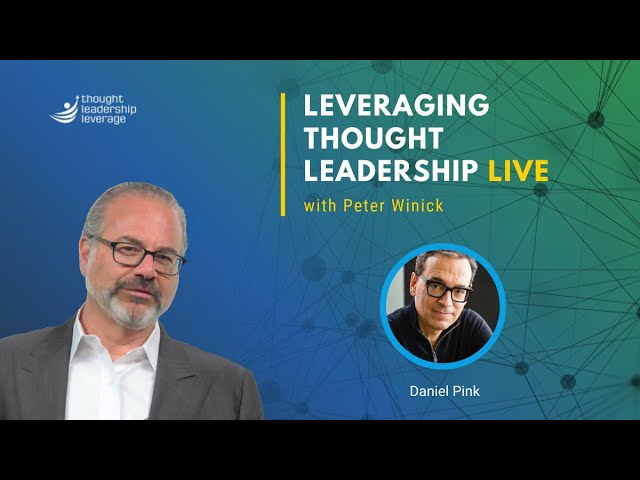
Dan Pink, author of multiple New York Times bestsellers including The Power of Regret, talks with Peter Winick about how publishing has changed over 20 years, whether books still matter for ideas, and how to test concepts across different formats before committing to print.
Chapters
And welcome, welcome, welcome. This is Peter Winick. I'm the founder and CEO of Thought Leadership Leverage, and you're joining us on the LinkedIn Live version of the podcast, which is Leveraging Thought Leadership. And today I'm really, really psyched— not that I'm not typically psyched, but more so than normal— to have Dan Pink on. And even though he doesn't really need an introduction, I'll give him a quick one. So Dan's the author of 5 New York Times bestsellers. including the latest, The Power of Regret: How Looking Back Moves Us Forward. His other books include When, A Whole New Mind, Drive, and To Sell Is Human. And before we go into his esteemed accomplishments, I'd rather just talk to him because that would be more interesting. So, Dan, thank you so much for coming on today. Appreciate it.
Thank you for having me, Peter. Always good to see you.
Yeah. So, so let's just dive in. So you have been at the publishing— well, amongst other things, publishing for what? 18, 20 years? When did your first—
20 years.
20 years.
20 years, yeah.
Wow. So—
Which is kind of amazing given that I myself am only 27. So, you know, I was a publishing prodigy. I began when I was 6 or 7 years old.
So you're like the King Tut of publishing.
You know what? That is basically, Peter, how most people describe me. King Tut of publishing. And what they mean by that is they mean that dead and embalmed.
Right, wrapped in gold is how they prefer you, right? Well, given that, that we'll have to wait for that a little bit, at least another half hour, selfishly he hoped. So give us a high-level sort of how different the world of publishing is today than 20 years ago and what's similar.
Yeah, that's a super interesting question, and I'm not sure that I've actually, you know, it's something that I'm thinking about a lot, Peter, actually, so I don't know if I have a I have sort of a, maybe like sort of some early thoughts on it, but it's something that I really am trying to, something that I'm really trying to work out. So among the differences, the media environment in general was crowded 20 years ago. It's ridiculous now. I mean, it is ridiculous now. There are so many outlets and so many different ways to get ideas out there and so much ferocious competition. for attention. It's just incredible. And I have to say, in the trajectory of all the books that I've written, it just gets harder and harder and harder and harder and harder. And so— So let me plug it in. I think that's a— go ahead, go ahead.
Yeah. So that's the signal-to-noise problem, and it's just on steroids. So even 20 years ago, It wasn't back to the quaint old days when we were kids of 3 stations on television, but like you said, it was, it was a, we didn't have streaming. I mean, there's a long list of things that we didn't have, but I think it's the signal-to-noise piece, right? So that there's so much out there. How do you stand out, right? How do you get attention?
I think that it's even more complicated than that. Okay. I think that's right. I think that's a big component of it, but I think it's even more complicated than that. Because so, so if you have an idea or a concept or a book or anything like that, and you're trying and you're vying for attention, you— there is social media, but it's not just social media. There are like 6 different varieties. Okay. Right. So, you know, so, so, so, so I had people who were horrified that 6 months ago I was not on Instagram because I didn't really care. Um, and it, and it took me—
You're not gonna break out into a TikTok dance, right? We're not Not a dance. Okay.
Not a dance. Perhaps perhaps a mime, a TikTok mime, which I am I I think is going to be the next big thing because it it doesn't make any noise. But just silent, right? So so so you have so so you so you you have that. But the other thing about it is is that it's not only the signal to noise ratio; it's also I think an open question about whether what is the best medium for conveying ideas and stories. stories and thoughts of the sort that you and your clients and your pals deal with. And 20 years ago, it was obvious that the best embodiment of a set of ideas was this thing called a book. It wasn't even a close call. I didn't even give it a second chance. It's like, wow, I have this idea. So my first book was a book called Free Agent Nation. I was like, holy crap, there are all these people who are working independently, doing different things. I think this is a big idea. I think it's a big phenomenon. I'm going to capture it. I think that I'm more right than wrong. I think there's something interesting to say here. So of course, I say the form that that takes is a book. Now, 20 years later, as I think through ideas, I think that you have to be much more medium agnostic and say, wait a second.
So—
Is the book— is a book the best and most appropriate embodiment Of this set of ideas, concepts, notions, etc.
Well, I think it used to be that was true, and it was a sequence. I have to come out with the book, then I'll come out with the keynote, then, then, then, then, then. Everything's a derivative of the book. Now the question is— 2 questions: do I even need a book? And then if so, is that opening night, or does that come later? And I've seen a lot of folks— you're a little bit different in many ways than some, than many. test the ideas first in multiple formats and mediums and blah, blah, blah, and then build on it and build on it and build on it, which is what we did.
I think that's actually a smart way to do it. I mean, I think that inevitably one tests ideas. I think that's— excuse me— that's the only way to— give me one second.
Yep.
Sorry about that. I'm recovering from COVID to make my life even more happy.
Oh, that's so 2021.
I know, I know, I know, I know.
As always, this thing is like, I'm so slow I'm always late to everything.
And so it took me 2 and a half years to get COVID. That shows you how sluggish I am. So, yeah, no, so, but I think there are forms. So again, it's, so I don't, I'm not, when I say that the media environment is crowded, I don't mean that in a boohoo way.
No.
There are lots of opportunities there too. So you can, you know, like I have an email newsletter. I've gotten, you know, And I will test out ideas in there. And I remember one idea that I tested out in there. I wrote maybe 2 paragraphs about it. I heard from an editor at a big magazine saying, hey, this is really interesting. You want to write something for us about this? And I did. And I realized that the idea stopped there. It wasn't worth anything more than that. And so I think that the ability to use these various media to test ideas, to get feedback—
So stay with the idea stops there. There are sort of 2 types of TED Talks that you see, right? Or 2 types of books that you read. One that you're like, well, that could have been a TED Talk and should have. And then there's the rare TED Talk you're like, wow, that could also be a book. So sometimes we're forced based on the medium to say, hey Dan, interesting idea, but you put it out in 2,000 words in an article. You got 70,000 words on that? And like you said, you might go, yeah, maybe not, right? Or, or you know, it's, it's a 10-minute thought, and therefore a book isn't the right format to do that. Jim?
Uh, I, I agree. I mean, I get a lot of, you know, I get a lot of books here at Pink Inc. world headquarters and a lot of nonfiction books, and many of them are baggy, many of them are flabby— choose your, choose your metaphor— many of them, exactly as you say, Peter, is, is an interesting idea, but it would be— it's really a 1,500-word magazine piece. It's a 2,000-word piece. It's not 65,000, 70,000 words. And it actually undermines the idea.
It dilutes it to the point of bland. Yeah.
And I think there's an opportunity there, though. Here's the thing. It's like— so again, to go directly to your question, which I think is a really interesting question, something that I haven't thought that much directly about, which is how have things changed over the last 20 years? And And I really do believe that 20 years ago, the first move, the best move, was almost always writing a book.
Yep.
Now I think one has to actually challenge that. And that's more difficult for somebody like me who's been at this a long time, who is a writer. Like, that's who I am. All right? So if I'm sitting on a bus and someone says, what do you do for a living? I say, I'm a writer. If somebody, even when my kids were little, they say, what does your dad do for a living? They say, he's a writer. And so—
So go to the other side of the question.
That's a little bit about teaching an old dog some new tricks.
Right. And now, if originally you thought of yourself as a thinker, not a writer, but the word was, yeah, you're a writer. That's what— that's your— you don't even think. That's an instinct. Who am I? It's part of my identity. It's part of what I do. I want to go to the other side of the question was, what's remained the same? Because I do think there's a lot of— all the things that you talked about are true, yet there are some evergreen principles that remain the same. So talk about that for a moment.
I think that over time, not always, but often, there are returns to quality.
Yes, that's right.
And that there is something about a book 20 years ago and today that is a very robust test of whether you have a real idea and whether you have something to say. And there is something about the sheer amount of work that it takes to put out a good book that gives the people on the receiving end a sense that this is serious, this is thought through, this is important, this is valuable. So I think that that's—
So stay there for a second. So there are and I'm not doing this to flatter you, maybe 6 to 10 authors, thought leaders that when I see somewhere they're coming out with a book, I go to the buy it now button, you know, pre-release, right? And that might be 6 months from now, 9 months now, because I know that when Dan comes out with something, it's going to be good, right? Because it always has been and it always will be. Now, what's interesting about the way you operate compared to many, many thought leaders, clients of ours, etc., is You move from thing to thing, right? Most thought leaders, it's, I'm the resilience guy, I'm the leadership guy, I'm the whatever, agility guy, whatever. And therefore you sort of know what to expect when tuning, you know, it's like going into your car and tuning into the jazz station. Oh, this will be kind of whatever. I kind of don't know what to expect from you, but I have enough trust in you and the brand that whatever it is, I'm probably gonna like it. It's gonna be really thought out and it's going to be good. There's a quality bar. Um, uh, that's gonna be— talk to that for a bit.
You know, I mean, you're presenting it in some ways as, as if it— as if I have a strategy behind all of that, which I absolutely do not. Um, the, um, you know, what I've found is that I've seen too many— I've seen too many instances where somebody has one idea or one book, and they write that same book 4 times. And having read some of those books and having seen some of those things, I was certain early on that that is not something that I wanted to do. That is not how I wanted to spend my time. The other thing is, is that I, again, I think this goes back in part, this is just about me. It's like, you know, I really define myself as a writer. That's what I do. That is the bulk of where my brain goes. And writing a book, writing a good book, is very, very hard. It takes a long time. It is a lot of work. So I only want to choose topics that I am deeply, deeply, deeply, deeply interested in, because otherwise it's not going to be a very good book. And you can see as a reader when an author has lost interest in her book, or when an author doesn't— well, in everything that she says.
In many careers and professions, it's kind of okay to come in and have a mediocre day at work. Not so much in writing, right?
Like, no way.
And to your point, if someone's written 6 or 8 books on X and they write the 7th, there's a high probability it will be a commercial success, whatever that means, because they have the followers, whatever, whatever. will it be a good book, which I think is actually the only standard that really matters. Um, and, and I think we conflate good book with how many units did you sell and what's your ranking on Amazon or whatever. And, and sometimes, A, it takes a while for a book to catch on, and sometimes it might not be commercially successful, but it's brilliant, you know.
Right. And it, and, and it, and it makes— and it lands with an impact in, in the world. That is, people think about it and They change their actions and behaviors, their actions and behaviors based on that. But for me, I mean, it's a really interesting way to look at it about saying like, you know, most of us can have a bad day at work. I can have a bad day at work, like not a great day writing. But I can't have a bad book. That's not allowed.
Well, but it's like when you're keynoting. You can't, you know, walk into a keynote, you've got to be on. Right. You know, it could be, you know, most people in most jobs could say, hey boss, you know, I had a fight with my wife this morning. You know, I don't know, I had a bad burrito for lunch, kind of not feeling so great, whatever.
Not allowed.
You don't really have that op— not all— just not an option. Yeah.
Not allowed.
Not allowed.
Not allowed. Not allowed. Not allowed. Um, it's, it's, to me, it's just, it's, it is, I mean, not to put too fine a point on it, to me that the whole idea of writing a bad book is morally reprehensible. But I mean that seriously because it's a disservice to other people. You're actually imposing a cost on other people. You are deceiving other people.
Time and money, yeah.
In some way. But the other thing about it is that it's terrible business, you know? And so—
Particularly with so many options out there. So I wanna go in a different direction for a moment, Dan. So we're living in, except you, who's a little bit slow on the uptick here with the COVID thing, right? We're living in the almost post-COVID world. Right. Think about, you know, what's changed for you in terms of your business and how you operate and the things that you're doing and who's paying you to do what and all that. What did it look like before and what does it look like today? And what do you think it'll look like in the near future?
So for me, it hasn't been massively different because again, like I'm talking to you from my home office, which is the garage behind my house. here in Washington, D.C. I've been working at home for over 20 years. So, like, I'm used to that. I've been social distancing for 50 years. So I'm used to that too, you know? So it hasn't been— I guess the only small change— well, I mean, maybe it's not small. For this last book that I wrote, I did over— what did I do? I did 190 interviews with people. Not a single one was in person. All of them were over Zoom. And that's a big change because when I did Free Agent Nation 100 years ago, I did hundreds of even more interviews than that. And I think every single one was in person. So I think that's one change. And in terms of sort of like conferences and engagements and those kinds of things, obviously, there've been a few more virtual—
Yeah.
kinds of engagements and obviously, and for a long time, essentially nothing in person.
Right, right, right, right. So I guess the trick is to social distance for 50 years and then there's not a lot of adjustment.
Right, that's exactly it. That's exactly it. So the other thing is, which to all of you, it's like the other thing about this particular weird business that I'm in, and you're gonna think I'm joking, but I'm really not. And I see people violate this all the time is is low overhead.
Okay.
I mean that very, very strong. Like, I will pay for talented people, to work with talented people, and I'll pay for technology. And otherwise, I'm just a cheap mother scratcher. You know, I will not— I have never had an office outside of my home. Um, I, you know, it's like, this is a, this is a very precarious business, and you have to be a pretty effective risk manager. And one way to be an effective risk manager is to spend money on things that help you produce great stuff and save money on everything else. I see so many people say, I'm gonna go become a writer, doo doo doo, and I'm gonna, you know, I'm gonna rent an office downtown and I'm gonna print this, you know, and I'm like, whoa, whoa, whoa, don't do that. Don't do that. Go find your garage, get some Wi-Fi, start out there, keep your costs low. You don't need— you know, I see people who start out and they have like 3 full-time staff people.
What are you doing with that? Right, right.
And it's like, okay, so already you have this incredible carrying cost. So I'm a very firm believer in this particular business in low overhead.
Well, I think that's a key piece. I also think it's sort of risk management from a portfolio diversification piece. So there are plenty of folks that we've worked with where it's easy or was easy to get sort of fat and lazy on the speaking circuit when that was a thing. And then all of a sudden, literally the brakes hit and nobody's financial plan said, well, what if there was zero of this for 18 months, right? And now many folks had diversification, said, oh, well, I have to do less of this, so I'll do more of this. I'll do coaching, I'll do advising, I'll do remotely, et cetera, et cetera.
Oh, wait, we have a question from Tom. Yeah, so I think that's actually important, but I think that the same thing is true on the, You know, I've seen, you know, I just think that you have to always keep things fresh and relevant to your— fresh and relevant to your audience. And I think that that ends up being a bigger problem than the external circumstances. If you have something fresh and relevant to say, the pandemic won't necessarily halt everything. But if you are—
But the modality, if you're constrained by one modality, it might. So we've got a question here from Todd that says he wants to hear Dan's thoughts on thought leadership. Does he think of himself as a thought leader?
Well, I mean, I don't want to annoy my friend Peter here, but I don't love the phrase thought leadership. So I would never think of my— I don't think of myself as a quote unquote thought leader. I actually would never use the phrase. Going back, Todd, to what we were talking about before, I think about myself first and foremost as a writer. And as a writer, one of the things that I do is that I want to get the— I'll look at it almost like an ecosystem, okay? So that the writing is at the core of the ecosystem.
Yep.
And anything that happens beyond that is an outgrowth of that. But without that core, there's nothing. There's no center. And so anything, whether it's audio and podcasts, whether it is speaking engagements, whether it is consulting, whether it is television, whether it is other kinds of media, it all— I draw it as with the writing at the center of it. That's how I think about it. So at the center is a writer. Now, as Peter and I were talking about earlier, Todd, I'm actually rethinking whether that ecosystem is the right ecosystem for this moment. And I increasingly suspect that it's not. that there might— that actually the idea, the thought, the notion might be at the center of that ecosystem. And also writing might be one sort of outgrowth of that.
Yeah, and I would argue that that is a more accurate representation of the universe today, is the idea is at the center. Yeah, a book, writing is one way to get it out. Video, you know, there's lots of ways to get it out, right? Um, yeah, and, and, but whether you call it writing or ideas at the center, it's got to be good. So one of the things that I loved about your latest book on regrets was this wasn't one dude's thoughts on regrets. There was deep research. You can tell this wasn't, you know, this was a couple years of work.
Yeah.
This was thoughtful. You know, I would have loved to see the cutting room floor, the scraps, or the stuff that didn't get into it. And that, I think, is the real— that's the real litmus test, right? Because if you can produce quality in one modality, It's easy to move it into multiple modalities. If it's crap to start, you can't put lipstick on a pig. And I think there's too many people trying to do that right now. And like, I really don't care if I spend $25 or $30 on a book and it's not great. I'll just put it down. But don't waste 6 hours of my time. That I'm not going to allow.
Amen. I am your hallelujah chorus on that. And I actually think about that as a writer because of my— those kinds of frustrations I have. As a reader, when I think about someone picking up a copy of any of my books, I think about it as, holy smokes, man, this person is— I don't— this person is spending $25 or $12 on the paperback or $14 on the paperback, whatever it is. So that's a meaning. That's like real money. It's like not zero.
Yeah.
And but then, but also like, I'm going to say, and what I'm saying to them is that is the time thing. It's like, you know what? reader, there's nothing better for you to do for the next 8, for 9 hours of your life, 8 hours of your life, than read my book. It's time spent, time spent reading my stuff is more useful and valuable to you than spending time with your family, than going out and exercising, than going to the grocery store, than going, you know, and, and that's a very high bar. And, and I try to, and I, and I think about that all the time, uh, when I, when I'm writing. And that's also one of the reasons why I work mightily to keep my books a reasonable length. Um, yeah, and, and, and actually, you know, because I, I've had the experience as a writer saying, okay, I'm reading 7 pages of this, 8 pages of this because you found it out, because you spent some time doing the research.
Sure.
And now you're going to torture me because you did the work, but it doesn't really help me as a reader to read 7 pages on the history of the fruit fly when there was a fruit fly in this experiment?
You know, it's funny that you say that because occasionally I've got stuck in what I call the Kindle rabbit hole. So I tend to read almost everything on my Kindle. And we're, you know, it's just, and I have like the dumbest version of a Kindle because I don't want, you know, I don't want to get distracted, wind up on the internet, whatever, black and white. And it keeps me in like, it's this equivalent now, it took me a while to be in book mode when I thought, here it is, it's my, my trusty dopey Kindle, right?
Yeah, no, that's smart.
And I know I typically read 2 to 3 books a week, so I kind of know my cadence and, you know, blah blah blah blah blah. But every now and then I'm reading something, it feels like, oh my, I've been reading this forever and I'm at 17%. And then I go— have to go backwards and out and say, how many pages is this damn thing? Like, oh my God, 800. I never would have picked up an 800-page book on the history of Winston Churchill's cognac habit or something. Like, I just would have known. So I think there is something, and, and If you can't say it in less, it probably doesn't need the more.
It depends, you know, different— here's the thing, the material tells you how much it needs. And, and, and the, the thing is, is that the material, the material tells you how much space it needs, but the author, the writer has to say, all right, material, are you sure? Are you sure? Can we do it? Can we do it? Can we do it shorter? I'll give you, I'll give you an example of this from my own. It's a pain in the ass. So I'll give you an example from this, from this last book. So I think it was literally to— what's it? This is 2022.
Change the 29.
No, no, 2022, 2021, 2020. Yeah, I think so. I think it was 2 years ago this summer, right around now. I'm in this very office and I'm reading lots and lots of papers about regret. And I was curious about— there's a lot of research on how regret develops in children, a lot of research in developmental psychology about how regret develops, how children process it, how old they are when they're able to understand it. And I read on it, the folders are right over there. I read, I probably spent a month reading that research.
Okay.
And it's a lot. It's a lot. And it's not easygoing. Then when I, and I took notes and I had a whole file there. And then when I got to the point in the book where I was going to talk about that, I realized that I could essentially explain everything readers needed to know about that in 2 paragraphs. Now, that's a pain in the ass because I put in a lot of work. And so the question that you face is, do I want to torture readers because I spent a month of work?
I spent so much time. Yeah.
Or do I wanna actually punish myself, you know, torture myself and say, you know what, you're gonna have to throw that. That's on the cutting room floor, man. Because your readers don't need to know that. And I think earlier in my life, when I was much younger, I might not have had the maturity to do that. But now I think that it's essential.
But is the right metric volume in, volume out? It could be without being— if you're only using it on word count, you'd say, wow, that was a bad use of my time, 1 month for 500 words or whatever the conversion rate is. But you might say, but that actually laid the foundation for my thinking to now do more research on this or build the foundation here.
I agree with you about that. I think that's a very healthy way to look at it when you're—
After the fact.
When you're after the fact, exactly. When you're at your keyboard and you're saying, wait a second, did I just describe everything in 2 paragraphs?
2 paragraphs, yeah.
And there's really nothing more that anybody needs to know about this? Wow, that's kind of a bummer. Are you sure? You know, so—
Yeah, yeah. Interesting. So you are— now, when did the book come out? Fairly recently. Was it a month, 2 months ago?
February.
February. Okay, a couple of months ago. So you're sort of on the tail end of launch, I would imagine, right? Kind of winding down. What are the things that you've learned this time when launching it around whether it's strategies, tactics, what's working, what's not working? I mean, you mentioned how many appearances you're doing. I love that you're able to do it from your office. That's kind of fantastic, right?
Yeah, yeah. Um, you know, I think what I, what I've learned is that it's, that it's, that it's, that it's really hard out there, you know. So, um, and, and I think about someone coming out with his or her first book. Um, you know, this is my 7th, so I have some mileage on me. I have some experience. I have some contacts and things like that.
Credibility. Yeah.
It's ferociously It's just ferociously, ferociously hard out there to break through now.
Right.
I also think, to one of your earlier points, forgive that cough, is that there are returns to doggedness. I do think that a lot of times publishers are too seduced by the idea that you have this white-hot center to make it big. And if you don't hit during that period, it's over. And I do think that—
That's just not true.
Yeah, I agree. I agree that you really, really have to stick with it, which is the other reason, even more so today. That was true before, even more so today. You have to stick with it. You have to think about it as a long-term proposition, which is why you have to pick topics that you're deeply interested in. And I think that's true for anybody who begins to amass any body of work. I'll give you an example. So I think it was, what is this, like, yeah, yeah, I think it was like about a week ago I was on this call and someone said, oh, are you done promoting this book? Meaning this regret book. And right, exactly. Thank you for that laugh. And I said, no, dude, I'm still promoting a book I wrote 20 years ago. Like, I never stopped promoting these books.
So state that because I think you pointed out the inherent conflict is Books have, books have a long-term amortization schedule, right? And there's a lot of reasons why the cadence of the publishing industry— oh, you're a fall release or a spring release— like it was a piece of fashion. But I mean, I live in a world of books, right? And, um, when I give a book or recommend a book to someone, they don't say, what was the publishing date? You know, it's like a bottle of wine with the, oh, 2018 was a great Napa vintage, but 2019 not so much. It's like good ideas last and live.
Right.
But we're living in a world that just because you can go to Amazon, like, with your OCD and say, ooh, you know, where am I on the list, where am I on the list, that's not necessarily a good thing. And the reality is the data shows us that most nonfiction books do better today, year 2, than year 1, which is the opposite of what sort of the book industrial complex will have you believe and the PR firms and all that sort of stuff.
I think a lot of times it takes readers time to find the book that is right for them. Word of mouth, even with the word of mouth for worthy things, I think remains slow. Word of mouth for deceptive, enraging things is incredibly fast, but word of mouth even today for these kinds of things is slow. And so you see a lot of books out there that sell and sell and sell and sell and sell and sell over time. And even the whole idea of— I mean, again, this is controversial in this world, but even the whole idea of a bestseller list, which is denominated based on sales for one week. I mean, it's silly. It's silly in a sense. It'd be like—
Everybody falls into the trap.
Of course, I do. Let's see who can run the furthest. All right? And our measure of who can run the furthest is who can run the fastest during a few days. And whether that person actually achieves any distance, we don't care, because all we're measuring is who had the fastest velocity over those few days. I mean, it's completely bonkers.
So I've just titled your next book for you, by the way, Rage and Deceive. That's your next book, guaranteed bestseller. Write that down.
But one of the things that you see, as you know, in the UK is that they actually print actual sales figures, which I think would be— which something the American publishing industry does not want. Because what they'll find out is that a lot of these worthy books that the intelligentsia loves don't sell any copies. And what sells copies in enormous numbers are books that the intelligentsia doesn't— barely even knows exists, let alone reads.
So like the Kardashian cookbook or something?
Yeah, but not even that. I mean, if you think about something like If you think about, I'll give you an example. So Atomic Habits, incredibly successful book. I mean, just unbelievable commercial success.
Yeah. Yeah.
My hunch, it's only a hunch, is that the New York Times has never written about that book, that the New York Times has never covered that book and said, this is a phenomenon. What's this guy saying? This is something that people are embracing. My hunch is that the New York Times has never written anything about this. This reminds me a little bit of and I'm showing my age here on 2 dimensions, is that when that book Good to Great came out, it must have been like in the mid-'90s.
20 years ago. Even longer.
Yeah. When Good to Great came out, huge phenomenon. Huge phenomenon. And I remember at some point, one of the big outlets, it was like Newsweek was still a thing or Newsweek Business Times was still a thing. It was like 7 years later, they're like, There's this book called Good to Great that everybody seems to like. And it's like after it had sold millions and millions of copies. So I guess to all the authors out there is really, it's like low overhead returns to doggedness and finding stuff you believe in. And high quality. And high quality, doing your very, very best work, doing work you're proud of, doing work that serves. and being relentless in talking about it and sharing your ideas with people, which again goes back to the fundamental thing. I mean, Peter, you're so right, quality, but also something you care about. I've seen a lot of journalists get seduced.
Mm-hmm.
A lot of journalists who will write a story, especially now, they'll write a magazine story, and for whatever weird set of circumstances, it catches fire.
Right.
And suddenly—
At a moment in time. Yeah.
And they start getting phone calls. That should be a book. That should be a book. And, and they are so seduced by that, they end up writing a book and they realize like, this is not a book. This is not a book I wanna write. And they're trapped and they end up writing a mediocre book, um, that—
On a topic they're not all that interested in.
On a topic they're not interested in. And they just, they just wanna move. They just wanna move past it. It's like, it's like having an ex spouse and you just want to like move their stuff out of the apartment, right?
Exactly.
Not that I've ever had an ex. Not that I— not that I have. I've been happily married for 27 years, so I have no ex-spouses, but that's the analogy.
Good to close that loop because you're about to get a text.
Yeah, really.
Um, any other words of wisdom before we wrap it here? This has been phenomenal. I appreciate and admire, uh, your work. I appreciate your time.
Hey, thank you, Peter. Any other present wisdom? No, I just think that it's— I'd be curious for you to keep thinking, because I'd love to hear what else you have to say about this in the future and even your viewers about— I think it's an important question is, if one is trying to convey ideas, make arguments, make a case, tell stories, What is the best medium for that today? And I think—
Well, I would say not even for that, for you at this moment, based on your world.
True, true.
I don't think it's a— I think it's a bespoke answer, actually. Yeah.
Yeah, yeah, yeah. And for me, again, I mean, I'm talking to myself, is that I am trying to lose the muscle memory of immediately saying, that's a book. That's a book. Every idea I have, I think, that's a book. And I don't think that's the way to think about things now. I think that— I think there are many, many more opportunities out there to do really interesting things that help people understand the world, that help people live their lives better, that are cool and interesting and engaging, that work that you can do, be proud of, and that serves other people. And, you know, as much as I'm a reader and as much as I'm a writer and as much as I love books, I think that we have to think about whether in all cases the book is the best vessel for that. And I don't think that it is.
Yeah, great stuff. We appreciate it. Thank you so much for your time, Dan. Thanks so much.
Peter, what a pleasure. Thanks for having me.










