Leveraging Thought Leadership Live featuring Keith Ferrazzi
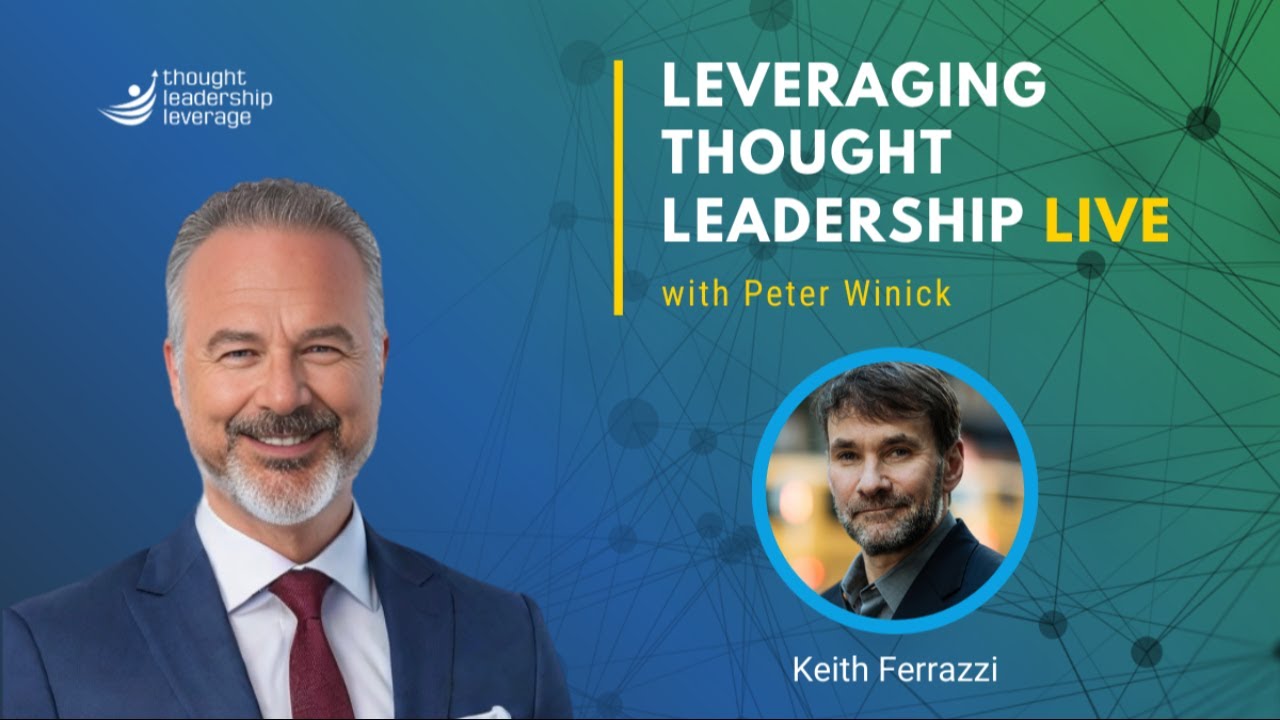
Keith Ferrazzi talks with Peter Winick about building thought leadership through books, research institutes, and brand partnerships. Ferrazzi introduces 'teamship' as an alternative to traditional leadership models and discusses how thought leaders can address C-suite problems and AI.
Chapters
And welcome, welcome, welcome. This is Peter Winick. I'm the founder and CEO at Thought Leadership Leverage, and you're joining us on the LinkedIn Live version of the podcast, which is Leveraging Thought Leadership. Today's gonna be a lot of fun because I've got a dear old friend, Keith Ferrazzi, joining me today. Keith is the author of many, many books going back from Never Eat Alone to now Never Lead Alone. And he and I worked very closely together for Quite some time when we had different hairlines way back when. But thank you for joining us today.
Some of us are holding on to ours a little better, but that's okay. It's a struggling fight.
Yeah, I'd call it a push. But yeah, anyway. Okay. I'm an optimist. So let me start with, you know, we're going to get to the book in a moment, but you've been in the business of thought leadership for coming on 20 years now. Right. And like most thought leaders, this wasn't the plan, right? You didn't decide as an undergrad, I'm gonna be a thought leader. Most people, most kids wanna be an astronaut or a firefighter. Nobody really wants to be a thought leader or gets an MBA in thought leader. And then things happen. So for you, it was Never Eat Alone was sort of the jump into the pool. So maybe tell a little bit of the origin story and then let's get into sort of what's different today in the world of, in the business of thought leadership and what's the same.
Well, first of all, I, I would beg to differ just a little bit. I always wanted to be an academic. I always really thought that someday I would, I would write a book. I just had no idea that that book would be about networking, which was the first one.
Right.
You know, I was a marketer, was groomed at Deloitte and Starwood Hotels as the chief marketing officer over there. And I always assumed that my work would be in that space. When Never Eat Alone came along, it was, you know, sort of thrust upon me because somebody asked me to write a book about how I was able to achieve a lot of success early. And the first thing I would say is I, I do think it's very important to think in methodology. My early jobs were in the industrial engineering space, in manufacturing, down, you know, doing total quality management. at the front line in manufacturing. And so I've always thought as an engineer.
Mm-hmm.
When I put my mind to this book about Keith, why were you successful? I came up with 10 critical tips. And when I'm advising folks today to come up with their own thought leadership, I say it's not a daunting practice. Start with the 10 sentences that define the takeaways of the book you want to write. And when I say the takeaways, define the 10 things that people will walk away from your book feeling deeply grateful, and you will have been significantly generous to them. And so that's basically the structure. And then I always—
I think what's beautiful about that structure is there's one bucket of thought leaders or speakers or call them what you will that that are really fascinating and entertaining and have wonderful life stories. And they won Olympic gold medals or survived this or survived that. Not to diminish the stories, but it's not replicatable. There isn't a system or a method or a process or language definitions. Go back to Covey with 7 Habits. We all need a system and process to follow. Now, it doesn't mean that if Joe the actuary reads Never Read Alone, they're going to turn into Keith Ferrazzi overnight. but they can follow a methodology and develop those capabilities. Well, that's the key.
What I'm basically saying is everybody has to be able to codify their insights in methodology. So I'm working with a CEO right now that's a $200 billion company and they're looking to double the market cap. So $200 to $400 billion. Obviously there's a lot of solution engineering that goes into that and our particular focus on all of this is how do they marshal high-performing teams to achieve that transformation. So that's, that's what I do for a living. I coach teams. And but in the point of this particular person, I keep saying to him, you think in different ways than other business executives. The audacity of doubling your market cap at a $200 billion base is extraordinary. So I keep trying to tease out of him. And by the way, this isn't just for the world of a book someday to make him the next Jack Welch.
Right.
I'm not in the business that you're in. I'm trying to get him to codify his methodology for the company so that people can follow.
Exactly.
As you begin to think about re-engineering the corporation and changing it from a $200 billion to a $400 billion value, what are the— what's the methodology? What's the levers you're pulling? What's the critical steps? So I do think that any business leader needs to think in methodology from a communication perspective so that people can follow the strategy. Because strategy is one thing, vision is one thing, but the steps to get there are really about practices. And that's really methodology.
Cool. So I want to go to Never Alone comes out. It's almost 20 years ago, right? And you had a business, but now sort of it changes everything, right? And the business of thought leadership in those days was primarily perceived to be, go out and do a keynote and then do another keynote and do another keynote, and people are gonna love you and buy more books, publish a book every 2 years. That's kind of not the way it works today. So talk about sort of the evolution of your business. And then underneath that, the importance, the increased importance of research. 'Cause I would argue that a lot of business books 15, 20, 20-some-odd years ago, it could be the Jack Welch way. Like, who wouldn't wanna hear how Jack Welch got to be Jack Welch? But the underlying research wasn't necessarily the prereq that it is today in some levels. Yes.
So the first thing I'd say is I was a chief marketing officer of big companies, Deloitte, Starwood, head of sales. And then I moved over to be an entrepreneur working for one of Michael Milken's companies as a CEO. That's when I was asked to write the book, Never Eat Alone. The book didn't come out, though, until after I had already decided that after we had exited that business, I had already decided to start my own firm. And my firm was not about networking. It wasn't about Never Lead Alone. It was about how sales and marketing needed to work more effectively together to, to build bridges in go-to-market strategies. So in the back of my head, I really already had the model of Never Lead Alone as my focus. And then all of a sudden, this thing comes out of the blue. Never Eat Alone. And I have to admit, I don't think I've, I don't think I ever really, back in the day, lynched onto this asset that I had, this massive successful book, and make it congruent with my core business, which is coaching teams.
Yeah.
So there were these 2 platforms I had. There was the consumer version of me, Never Eat Alone, Who's Got Your Back, etc. And then I started to realize that I needed to make sure that my thought leadership was congruent and supported my core business, which is high-performing teams. That's when I started researching Leading Without Authority, which was the application of networks from a leadership perspective.
Right.
And along the way, you're right. I mean, I realized that as an academic mind, as an engineering mind, I didn't want to just riff the most the most horrific things we do in publishing is when somebody has a successful book that they took a lifetime to think about and write, then all of a sudden they want you to write your next book in a year.
Yeah.
And I say, what the hell else do I have to say? That was the problem with, you know, leading Never Eat Alone and Who's Got Your Back. Um, I started a research institute, and that's been very important for me for a couple of things. Number one, the, the recognition that I'm not just a one-trick pony. I don't just have a life story, but I have a codified body of knowledge that I'm moving forward. And now what I've done, which I think is different than a lot of people, is my research institute ended up being not only a break-even but a funding arm for me because I did it in partnerships with brands. So when I was writing books like even Who's Got Your Back, I partnered with the University of Phoenix.
Right.
To not only bring the book to market to their students, but to do a massive tour. And at the same time, the research underpinning how do small groups of people commit to not letting each other fail, that was something that they funded because they wanted to bring that to their student body. They wanted to bring that to their alumni network. So along the way, I started building brand relationships in the research, which ultimately helped me even take the books to market because of those relationships. So Merrill Lynch was a great story and research that was told in Leading Without Authority. And then it was also a channel strategy for getting the book to market once the book came out. And that's certainly what I've done with Never Lead Alone.
Just stay here for a minute because I very much love that thinking. And a lot of times when I'm working with clients, people tend to think in a linear way. So I'm going to write a book, so here's the process. I have a—
Then I'm going to do the marketing.
Well, yeah, there's that. No, but I have an idea, I have a hypothesis, then I'm going to research it, then I'm going to write it, you know, then it's going to get published, and then there's the rainbows and unicorns, right? Like, oh, and then magic will happen. Well, magic doesn't always happen, and I believe that you can conflate During the research phase, who else can you interface with? During the writing phase—
That's what I'm saying. Marketing doesn't come at the end. You have to engineer the buyers of the book. Look, you and I both know— and by the way, I've stopped worrying about the bestseller lists.
Yeah.
Um, one benefit is I've got a number 1 New York Times bestselling title. And nobody credits me for it. Like literally, I will be constantly introduced on main stages and it's like, Keith Frazee, bestselling author. A bestselling author is something that anybody can have because people will claim that they were a cultural team, blah, blah, blah, on Amazon bestseller for a day. Now they call themselves a bestselling author. The reality is—
Well, and I would add, you also did that organically because there's plenty of people that buy their way onto all these lists. I don't want to even go down that rabbit hole. But the reality is the goal should not be to be a bestselling author. It's an outcome of—
Well, all I have to say is having been a number one New York Times bestselling author, it's not made a difference. I don't think it's ever brought me a dollar's worth of revenue in my entire life. And I don't know that, you know, maybe in credibility's sake, but nobody ever remembers to say it. They always just say bestselling author. All right.
So if the New York Times is listening, update the Ferrazzi obituary. Let's put that in there.
Yes, please.
Number one New York Times bestselling author. We want— we want—
You can often— you can tell it's a bit of a soft spot because, you know, I, I worked my ass off to be— to be successful with these books. And, and because of the success of Never Eat Alone, the velocity of interest in Who's Got Your Back was so high that it, you know, it hit hard when it hit. But look, I mean, the, the thing that I would say is a couple of things to, to those out there. Number one, no question, a research basis is important. Number 2, you can actually get other people to fund your research if you co-create with those individuals and give them a brand lift along the way of what you're doing. The other thing is, yes, you need to think about your sales of the book at the earlier stage of writing it.
Yeah.
And you and I both know that if a book doesn't hit 10,000 to 15,000 in book sales, In the first couple of months. If you want to be on the list, it's got to be in the first week. But if it's not there in the first couple of months, your book's going to have a very short life.
Yeah. And it's going to be difficult. But let's go to the business side because there's a couple of interesting things going on here, right? So the way you make a living per se is working with high-impact teams, right?
That's right.
They're going to pay you whatever you want to charge them because the outcome at that level of leverage is measurable and impactful, right? If you can lift a $200 billion company and be even a small part of getting them to $400 billion, whatever your fees are, rounding error in the grand— rounding error, right? That's high touch, right? And that requires you to be in the room or in the Zoom. Talk a little bit about the more leverageable, scalable derivatives of your thought leadership that you get out there. Because part of the focus that I have is, well, how do you democratize thought leadership? Because the more people that touch it, the better it is for everybody. And there's a wave that happens from that.
Well, first of all, one of the things that I'm thinking about all the time. So the research co-creation is a funding stream.
Yes.
And I, you know, for many people, that funding stream might be quite significant. I plow those earnings back into research all the time. So I just want to be out ahead. And, you know, you and I've talked about this— calling yourself a thought leader is, you know, it's like— and, and, and by the way, the problem is everybody is caught up, is thinking themselves as thought leaders today. One thing that's different between when you and I worked together back in the day, 20 years ago, is the proliferation of people selling IP.
Yeah.
It's massive today.
Huge.
And so this 20 years, it's what you built your business on.
Yes.
20 years of everybody wanting to be a thought leader and viably so. I mean, one of the chapters in Never Eat Alone talks about being an expert, being an expert at something, and you can constantly pivot and be an expert at different things in your life in order to stay relevant to what's going on today. I'm spending most of my time not just talking about teamship, and why teamship is more important than leadership, which is, I think, a really big idea. But it's also about how do you apply that in having the C-suite partner differently to get more out of AI. So I just had 120 CIOs and CHROs in New York talking about how to apply this book, Teamship, to the codification of their AI strategies. Because if you're— if you continue, if you do AI in silos, you're going to inch forward. But if you do it in a collaborative, truly breakthrough way where you bring the best of the engineers, of the IT and CIOs, you bring the people people, you bring the business people, and you work differently together, you can 10x it. So I'm always one step ahead of what the zeitgeist needs. In terms of—
stay there a minute, because when I, when I look at somebody's body of work, I sort of chunk it into 2 categories. Here's what's evergreen, right? Here's, here's what will always be true regardless of the stock market went up, it's a recession, who's in the White House. So again, I'll use Never Read Alone as an example. I still give those books out to people all the time because there's some evergreen principles, even though that's written in the days before social media. There's some good, really good stuff.
We rewrote it, by the way. I don't know if you knew that.
Yes.
We rewrote it for the digital era. So Paul and I dusted that off and redid it.
Yep. But so where I was going is, so there's the principles that are sort of evergreen, and then there's what can you do to connect it to what's going on in the world today?
Exactly.
Right. So in your case, what is the C-suite staying up late at night thinking about? What is AI? Is it going to attack my business? How do I use it to grow? Where does it You know, exactly.
And so what I'm doing is I'm bringing a methodology to approach that question, right? So the methodology— and people, it's, you know, I, I, I, I'm saddened for people who are one-note Johnnies.
Yeah.
And, you know, and by the way, let me say this, um, some of those one-note Johnnies do quite well.
Yeah.
Because it is an evergreen topic and they just stay focused and that is all they are. And it actually kind of works well for some of them.
Yeah. Well, and it's also, they don't have to have the things that you do in terms of the research, right? Because if you didn't have the research arm, you probably wouldn't have much more to say about AI than most other people, right? The research gives you the cutting-edge stuff. So you're taking the theoretical And closing the gap to the applied in a way that's of high value, right? And maybe in 2 years it'll be a different thing and you'll have new research coming up, but it also makes you really relevant to the C-suite because they're, again, when you think about the worst place to be as a thought leader is selling training and development into the HR channel. Yawn, yawn, right? Because that's a commodity. Somebody's going to do it for a penny less or LinkedIn Learning is going to eat your lunch, whatever the case may be. But having cutting-edge content out there, you can charge a premium for that.
Yeah, I've been very surprised and deeply appreciate where anybody can carve out some market at some level. Yeah, you know, not everybody is looking to build a global impact brand that changes society and makes tens of millions of dollars, right? I mean, that's, that's a certain level of aspiration.
Sure.
Um, any little bit of what I'm doing could make somebody a very good living. Tomorrow morning, I'm, I'm, I'm addressing an audience at coaching.com, and what I'm going to be giving them is a way for any coach— and now there are millions of them, as we know, you know, anybody who is in between jobs as a coach Used to be that anybody in between jobs was a consultant. Now anybody in between jobs is a coach.
Right.
And so I'm going to be giving them a simple methodology in, in Never Lead Alone on how they can begin to step a team through transformation in a, in a set of high-return practices. And I basically give away the coaching manual. I think that's, You know, for me at this stage of my life, you know, it really is about trying to make the, the biggest footprint on the planet. I think Never Eat Alone did that. I, I don't think— I think the way we talk about networks and networking today was forever changed with that book 20 years ago, and I'm blessed for that on a global basis. Now I'm looking to do the same thing around leadership by focusing on teamship and what is the role of the team. I, I think we have radically under-indexed on what's the role of a team in leadership. We focus on leaders and leaders giving good feedback, but we don't focus on teams and how they give each other feedback. We focus on leaders and how they hold a team accountable. We don't focus on how the team holds each other accountable, how the team keeps each other's energy. So this idea that there's a layer that's under-curated, and I think that's important for your listeners who are interested in being thought leaders for themselves. They need to find the white spots. Where are the empty spots? And always be looking for that gap. And I really think in my world, teamship is a major gap in terms of the leadership genre.
No, I think that's interesting because we all develop the skills to be good individual contributors at whatever we do— marketers, accounting, finance, whatever. And then the other thing we want to aspire to be is leaders. But the reality is we're spending most of our time and most of our working life in teams, and we're not really taught what is a good team. How can I create the environment and the feedback and the culture of a good team? Because without a good team, hey, you know, we've all been on great teams and we've all been crappy teams, right?
And that's in most— and what I find with my diagnostics, and the diagnostics are in the book, and so is the data. The average team is pretty mediocre.
Yeah.
And meaning on a scale of 0 to 5, the average team is a 2 in terms of its ability to be courageous and speak openly in the room.
Yes.
Now, if you look at that and you're trying to double the market cap of a company, there's no way you can do it with half your team being conflict avoidant.
Yeah.
The power of the team is overlooked. HR has spent so much time looking at employee engagement, right? And enterprise equity and inclusion. What we miss is the work level. We're just not focused on how teams get shit done. And, and yeah, you can go back 20 years ago and pull off Lenzioni's book, which inspired me greatly and still does. But it's a, it's a, it's a 20-year-old parable that needs to be updated. For, you know, the modern era of hybrid work, the modern era of a global marketplace, of American DE&I that still is scrambling to find its foothold.
Yeah.
And for the volatility that exists and the tools that are available today, teams have changed. And it's— Give me a quick—
give me a quick— Keith, if you and I were sitting and watching television, and the volume was off and a Jenny Craig commercial came on, we would easily deduce, I don't know, I don't remember the brand or whatever, but they're in the business of making large people less large over a period of time. That's the Jenny Craig before and after. What is the before and after, or what do you aspire the before and after to be for folks that are exposed to this work, whether it's through you personally reading the book, et cetera?
The before and after of never lead alone is a team steps up and has a very clear roadmap on how to step up and what is expected of them to meet the leader in leadership. I sit in a room and the, and the room, the conversation has gone down into a rat hole. Yeah. And I will pause as a coach and say, hey, raise your hand if you think this has gone into a rat hole. Everybody raised their hand. And I'll say, whose job was it to stop it? And the answer is everyone's.
Right.
And, you know, how do you get the team to be fully transparent and to meet the leader in the role of leadership? When that happens, the leader gets freed up by 30%. The team steps up and delivers disproportionately more than ever before. And as a result, Outcomes are pretty radically transformed. The General Motors organization, I was very, I was deeply touched by the CFO when we were working with them that said this work was crucial to them getting out of bankruptcy because you can't have a bunch of silos that aren't fully pulling together. And I think there's so much value lost in the interdependencies of business. And that's always been my point. I mean, originally it was sales and marketing.
Right.
And I wanted those to be more effective working together in order to drive revenue. And now I wake up and it's really the whole organization being much more interdependent, squeezing value out of the transformation. With AI, it's necessary.
Yeah.
You can't nibble at one part of the value, you know, once at the sales organization and not get to the R&D commercialization side.
Sure.
It's an end-to-end process that needs to be re-engineered to Teams, first of all, need to be redefined having nothing to do with org charts.
Right.
You know, Workday is having their big meeting this week. We need to be looking at redefining teams and redefining feedback and redefining everything outside of an org chart definition. Teams are about who you need to get KPIs done.
Awesome. So in the last couple of minutes, address the folks out there that are not as far along in the journey as thought leaders as you are, right? So they know what their expertise is. They're trying to figure out what they do with it, whatever. What would you advise?
Not to take them off of your platform because I'm sure you have lots of good library content. Peter Diamandis and I did 2 really good podcasts that I'm very proud of. One of them was a podcast of how to write a bestselling book, and the other one was a podcast of how to become a world-class and have a world-class speaking business. And I think go and find both of those.
Great.
I think they're everything that I know, everything Peter knows about those 2 topics. But at the core, I would just say to all of you, first thing is get real clear on your 5 game-changing messages of how you want to change people's lives. You got to define who those people are. Are they senior leaders, middle managers, careerists, women, whatever they are? You decide who these people are that you want to change their lives. Have 5 statements of the before and the after, similar to your Jenny Craig. You know, it's like, I want to take them from here to here, from here to here, from here to here. Once you have that, right? Then you start researching the stories that give it life. Then you start researching the practices that people use. And once you get good on the IP— and the other thing is, make sure that you're humble enough to let the world stress test it. When I'm coaching a person to write their book, I'll say, give me the 10 sentences that would define each chapter of your book, which is really that X to Y. Each chapter is an X to Y. And that's what this is. This is 10 shifts.
Yeah. Yeah.
To go from leadership to teamship. Each one is a very clear message. And then I would say to them, give those 10 sentences to 5 of your most thoughtful and courageous, candid friends of yours. Let them eat it up. And then when you do that, then sit and think and rewrite those 10 sentences. Now, when you rewrite them, write a paragraph for each. Then give it out to those same people and another 10 people. Let them beat the hell out of it. Then come back and rewrite those 10 paragraphs into 10 pages. And once you've done that, you got a book proposal.
Yeah. I love that because a lot of folks think writing a book is this isolated piece. You can't get there alone because I would rather get the feedback that 3 of my sentences were terrible so I didn't go down a rabbit hole.
Or that somebody doesn't understand point 1 and point 4 sound exactly the same to the world. Your nuance makes it make sense that it's different, but in reality, it's the same thing. Or somebody says, well, what about this thing? You're like, oh shit, that's an entirely different chapter I didn't think of. Look, I've not written a book yet with generative AI as a partner.
Right.
So what I would do is I would also take every one of those points and have generative AI write a book about each one.
Right.
And I would then use that as influence to how you're writing your chapters. So generative AI, of course, is your partner in writing today. I don't think generative AI is going to write your book, but generative AI needs to be your sparring partner as you, you know, and then this idea of here's 10 sentences, just ask generative AI to blow out each one. And to give me what redundancies it sees. And also, can you think of 4 other sentences congruent to these that I would add?
Right?
I mean, there's so much—
Well, let me play with it and say, how would I modify that if I'm talking to an audience of CEOs versus CFO, whatever?
And you could say to it, for each one of my sentences, give me the names of the best thought leaders in that space that I need to go research and read.
Yeah.
So, I mean, it's amazing what generative AI will be as a writing partner, as a thinking partner that I've not had that luxury of to date. And now I'm beginning to do that.
Awesome. Well, I want to be mindful of the time because we had a hard stop about a half hour in. So I thank you for sharing some really great insights as usual today. Appreciate it.
And look, I know that so many people have been touched, moved, and inspired by Never Eat Alone. I promise you, if you're an individual that is trying to get the most out of a group of people, that Never Lead Alone will be equally as important to you in the annals of your thought leadership books. So thanks.
Awesome. Thank you.
Cheers, brother.










