Leveraging Thought Leadership Live featuring Mark Goulston
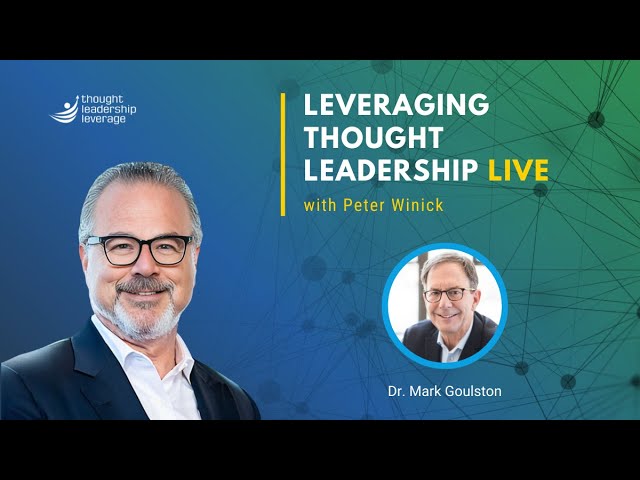
Dr. Mark Goulston, a psychiatrist facing a pre-leukemic condition, shares how confronting mortality clarified his values: kindness, curiosity, execution, and responsibility. He offers practical tools like the 10-10-10 decision filter and the Michelangelo metaphor for suicide prevention, and explains how therapeutic skills translate to managing conflict and accountability in business.
Chapters
And welcome, welcome, welcome. This is Peter Winick. I'm the founder and CEO at Thought Leadership Leverage, and you're joining us on LinkedIn Live, which is an extension of the podcast. So this, this is going to be a different episode, to say the least. So today my guest is a dear, dear friend, Dr. Mark Olsten. Mark has taught me and many, many people that I know how to live, how to love, how to be in a relationship. And now, unfortunately, he's kind of teaching us how to die, which is kind of a strange thing to say. But Mark is the author of— I don't even know how many books at this point, 6 or 8. One's better than the other. And he is a psychiatrist. He's a friend. He's a mentor. And here he is. So, Mark, what's going on?
Well, I'm dying to tell you what's going on. Uh, I'm dealing with mortality. Um, rumors of my demise, though, have been slightly exaggerated by me, so I, I'm not dying imminently, but I, I will be dying sooner than I planned. Um, I have a condition that's, uh, that leads to acute myeloid leukemia. And, you know, which is fairly significant, and the main treatment Uh, the definitive treatment is a bone marrow transplant. Fortunately, my children are all donors, and, uh, I don't have a reaction to that. So if we go down that route, uh, that's what we'll do. But, but what I— why I wanted to meet with you is because I'm the calmest I've ever been in my life. I'm the most serene And part of what I'm doing also, Peter, is, you know, I know you have that kind of interesting sense of humor. One of the things I'm learning is I've always had trouble letting anyone care about me because I'm a caretaker— therapist, doctor, father. And lately I've been letting people care about me. And when I feel they care about me like you do, I get emotional. And the emotion is embarrassment because I don't want to burden anyone, appreciation, and, uh, maybe something I've always wanted underneath. Yeah, I wrote a, a blog that's going to come up on Chip Conley's Modern Elder Academy called love and caring mea culpa, meaning, uh, it may be that all the love and caring I've given the world is something that I wanted.
Yeah, well, you know, stay there for a minute though, because I— you know, one of the things that I think about from a thought leadership perspective is, you know, why do people pick the topics that they do? And it's usually, uh, uh, obviously it's something that interests them, but but it's a problem that they're personally trying to wrestle with, solve, whatever the case may be, right? So I think you might be onto something there. I can speak to, from firsthand experience, as well as dozens of people I know personally, the number of people you've touched and the number of people that care about you. So Marc's got— I'll give you a couple of Marc stories. So the first time I met Marc was, I think, 2005. Right? So almost 20 years ago, um, Sunset Tower Hotel in LA, which is cool and funky and whatever, and Mark and I are neither. So there were the 2 guys that were not in the business sitting there with the script, and Mark proceeds to, within 10 minutes, A, connect with me in a way that like very, very, very few people in my life have, and takes out one of his books or his workbooks and has me circling words that describe feelings. I don't do feelings. It's not the F— it's not my favorite F-word. It's not even my top 5 favorite F-words. And just broke through to me in, in, uh, in a really powerful way. And I've seen him do that dozens of dozens of times. And, and what I always found fascinating about Mark is if you read a transcript of what he says to people and you didn't understand the, the, the way that he delivers it, you would think the next response from the other person would be a right hook, but it's usually a hug. It's always a hug. I don't know if it's ever been a right hook. So anyway. Something I wanted to share with you. So you're now, you know, you've written so many books, you've done so many cool things with so many senior-level folks all around the world, and you are calmer than I've ever seen you before. So, you know, to me, the question is, okay, well, I'd like to be that calm, but I don't want to get the news that you got, right? So what can I— what's the hack? Everybody wants to know the How can I get some level of calmness before hearing something catastrophic, or potentially catastrophic, I should say?
Well, I had sort of an insight this morning, and it's half-baked because I'd never thought about it. So one of the things that mortality is teaching me every day are things that I never thought about in a certain way. Something that's always made me feel like an outsider is I've been curious my entire life. And it's a curiosity, just pure curiosity. And I felt like an outsider because when I was younger, it's a, what are you wasting your time for? You know, what are you so curious about? Why don't we all get drunk? And, uh, and I admit to getting drunk a few times and doing pot at Berkeley in the '60s. So, you know, it's not like I'm a total Pollyanna, but I've always been curious. And what I've been curious about, I realize, is what a good life is. What is a good life? And here's the irony, is I think it's giving me peace. And I'll get a little emotional, is I think I'm having a good death because I realized I lived that good life. I didn't know. So how—
So how are you defining good life? Because you and I have worked together for years and been friends for 2 decades now. And on the one hand, you've always said, oh, but I haven't hit it as big as whoever else is the big thing du jour. And I said, but you've touched more people than you know. I mean, I don't know how many zillions of copies the books have sold, but—
100 million.
People that read your stuff, that get your stuff, whether it's the blogs, the video, whatever, in whatever format, it gets internalized in a way that most stuff doesn't. You know, I spend my life working with people on business books. Most of it's great stuff, but you take it in, you do something with it, you move on. It's not life-altering. So how are you defining or thinking about the good life?
Well, I have a friend named Bill Liao, L-I-A-O. You can look him up at SOSV Ventures, and we kind of mentor each other. And we were talking recently about values, and one of the things he pointed out is he said you should always hire for values. And there are certain values that are compatible. For instance, compassion, um, warmth, kindness— those all cross over, just as ROI, EBITDA, uh, and near-term results are all compatible with each other. But if you hire people who have those different sets of values, there's going to be a real conflict. And one of the things that Bill and I share is my top 4 values, which I think I've lived. The top one is kindness. And to me, kindness is not the same thing as niceness. To me, nice is you're a lightweight. Oh, he's a nice guy. Kind means you have the power to hurt people, but you choose to never do it.
Right.
So kindness is really important to me. Curiosity is somewhat of a distant second because kindness is so important. The third thing is getting stuff done. Just get stuff done. And the final thing is take total personal responsibility for your actions, your responsibility. You know, no whining, no complaining, no blaming. Know what we're seeing in politics. And so I think I've lived according to those, and that has set me up. Also, in these little videos I'm putting out, I don't know if I'll do one of them.
Mm-hmm.
I also define another thing about a good death that I've defined, which has calmed me down, which is enabling me to be calm, is number one, look, I'm not great with intolerable pain and suffering. So for me, you know, I'd like the pain and suffering to be manageable. Second, I do not want to be a burden to anyone. Because I've watched people be a burden to other people. I've experienced some of that going on in the family I grew up in. And I think I internalized, never do that. The third thing is I'm involved with about 5, 6 projects where I— unbeknownst to me, I'm the visionary. I'm the one who created the IP. This is what it looks like. We're getting traction. And I don't want to leave people hanging. So, uh, my focus now is how this lives on without me. And then the fourth thing is, you know, I've listened more to people probably than I've been listened to. And when you listen to people for 50 years, you just learn things. And I want to share that. Like, one of my lessons, which is very ironic— I used to do house calls to dying patients, right?
Right.
And I remember seeing someone who was this iconic, beloved figure. Everybody loved him, and he liked that I could be direct with him. And I remember I visited him and I said, what's the matter? You look like crap. And I don't think it's because you're dying. I've been dying. You've been dying as long as I know you. What's going on? And he looked at me and he said, I don't think I've ever done anything important. I said, what? You're a wacko. You got a hospital named after you. You got beloved fans. You know, the public loves you. Yeah, your private life could have been a little bit different. And he looked at me and he had this wonderfully engaging, wry smile. Now he was getting a little bit skin and bonish, and he said, "Don't con a con man, especially when he's dying. I've got all the love that money can buy." And he said, "But everything I thought was important isn't, and every thought, everything I thought." wasn't important is, and I've run out of time to fix it.
Yeah, I want to go back to a couple of things that you touched on— this not wanting to be a burden and then the caring thing. So not wanting to be a burden doesn't have to be— there are plenty of people that are burdens every day when they're healthy, right? It's not a sick or dying thing. But is that Burden thing connected to your being the caregiver and not being comfortable being on the receiving end of care?
Oh yeah, totally. And, uh, and, and here's a little bit of my, uh, Peter Winick humor. Um, uh, uh, letting people care about you when you've never let people care about you usually stamps you as a non-burden. They like caring about you. They, uh, some people, when I start crying And I apologize. They say, "Just stop it! Stop it!" I say, "Why?" They say, "It's an honor to care about you." And and and this is possibly the most emotionally intimate conversation I've had in months, maybe years. Yeah, you know, yeah, yeah, I got a husband, I got a wife, but it's not this intimate. And so they they say it's really a gift. So here's my my friend Peter Humor. Now, if you're someone. Who's always been a taker and a grabber, uh, who's sucked all the caring out of other people, you've used up all your chips. So this doesn't apply to you if you've lived your life being a burden to other people and having a heck of a time doing it.
Right. Well, there, I mean, there's, I mean, there are people that that's just how they roll, right? They don't, they're not even aware of it. But, you know, one of the— it's funny, when you were talking about your 4 pillars there, I was scribbling down before this call some of the things that I reflect on when I think about you. And it was wise, kind, and grounded. And the grounded is the last one because it's more recent in terms of—
Well, no, Peter, Peter, Peter, I've always been grounded. I've just beaten up on myself. Because I never focused on money, right? You know, I, I would see, you know, I have a pretty good track record. None of my patients died by suicide in 35 years. And if you paid me, that was fine. If, if you didn't pay me, that was fine too.
I mean, I saw some people— Because, you know, there are those out there that are all about the money. There are those that are all about the ego, and there are those all about sort of the The more evangelical in a non-religious sense. They want to get it out there, and it's easier to measure money because it's universal. How many dollars did you make to do the thing, or money in the bank, or whatever? The other things are harder to measure, but I would say, you know, if there was a standard scale for that, your, uh, your stuff's off the charts in those other buckets. Right. And, and, uh, Uh, you're not going to take the bucks with you.
Yeah, absolutely. Here's something that I realized, you know, so I don't practice now, so please don't reach out to me. I'm retired, I'm not licensed, I'm just trying to share what I knew. So one of my— I guess one of my proudest things is that I— one of my focuses was suicide prevention, and none of my patients died by suicide. And people would say, isn't that really depressing? And I'd say no. And I want to give you my simple formula, uh, uh, which to me, you know, would help end suicide, but it's not evidence-based. Whenever I'd be with someone, I had 2 focuses. The first thing is they're hurting so much that death is compassionate. I mean, there are some people who are hurting so much and there's no escape. That, you know, death is reasonable. And so my whole focus was, how do you lessen that hurt so that death isn't the only solution? And then I have something called Michelangelo, uh, uh, uh, a Michelangelo point of view, which is Michelangelo said, I saw the angel in the marble and I carved to set it free. So in suicidal patients, I saw the hope inside the hopelessness. And I just carved away the hopelessness until they could see and feel the hope. And, you know, a little bit of hope, which is a future, a little less hurt, voilà, you know, you know, maybe I can make it through another day. And it's interesting, uh, what my first episode of I'm Dying to Tell You is called Michelangelo Dying, because what I've done is I've identified what's not important in life. And it's stunning, at least in my life. Now granted, I don't have to earn a living. I'm 75. My wife said they're going to be okay. But I've identified what's not important in life and just scraped it away. And what is truly important glows. I mean, it is a Statue of David.
So how do you— how might you have, or how might others that are listening today identify those things earlier, right? Because I would, I would argue with you that wouldn't it have been cool if you, you figured that out 10 years ago, 20 years ago?
Well, one of my favorite books, which is a lesser-known book by Suzie Welch— she was the editor-in-chief of, uh, Harvard Business Review, then she got into a relationship with Jack Welch and yada yada yada— but she, one of her books was 10-10-10.
Yep.
And she said, before I make decisions, and you can, uh, you can change the criteria, she said, I think of what would be the result of that decision 10 minutes, 10 months, 10 years from now. Now you can change the parameters. And she said, so for instance, when I was a divorced mother, I might have to tell my kid, birthday party's off, gotta work, and in 10 minutes I'd be looking at a tantrum.
Yeah.
But in 10 months, I'd be looking at a raise.
Right.
And, uh, and then she said, but the toughest one, which was when she knew she had to get divorced from her first marriage, is when you walk on a beach or take a nice hike in the woods and you think 10 years from now. And that's when she knew, I can't be doing this 10 years from now. I can't be in this marriage 10 years from now. So I think that's a nice way to try to look at your life as a way, as a filter. There's also a transformation.
I'm going to share with you. So 15 years ago when I got divorced, you'd said something to me along the lines of, well, you know, half of marriages end in divorce. And half of the other half don't even have— don't have the courage to go through it and wish they did, which was a depressing Gulstonism that's probably true, right? So, but that speaking to your point of, you know, the person that you're with now, do you look forward 10 years from now and say, geez, oh my God, that would be a nightmare, what am I going to do? And, and then not do anything about that, whatever that relationship might be.
So I'm going to share something with you because it's going to come out in the next few days. So I write all over the place, you know, I blog, I just— and so my latest article for Newsweek Expert Forum, so that's a place where I put up content, and this will be out in the next few days. It's called The 7-Year Itch 2.0, and it's an epidemic. And for your younger listeners, in the '50s, there was a play, there was a movie with Marilyn Monroe. Her dress got all blown up.
Yeah.
Called The 7-Year Itch. And the idea is in seven years, it was thought that a lot of romance goes away, and I'm seeing an epidemic. So I'm just sharing this with you as a preview of that article. What often happens now is that working moms and dads, before they have children, you know, you can live in an impatient world. Yada yada yada. I mean, you know, younger generations speak faster than I can think.
Mm-hmm.
And, and, and, and it's okay to be impatient, but then you get an infant, and that infant— and you don't have the nannies to dump them on— and, uh, that infant is exhausting if you're working. And if you're a working mother, what happens is— and here's where the 7-year itch begins— is most people don't bare their necks. Most working women who are exhausted won't share with their husbands, I think I'm a terrible mother, we shouldn't have had kids, I felt like— I feel like yelling at the kid all day long. But they don't bare their neck. What they do is, uh, they're afraid to admit to themselves how angry they sometimes are, and they're exhausted, so they displace it onto their husband. So the husband comes in, he feels like he can't do anything right. Now add to the frustration in that working woman is she has developed— she has experienced the feeling bonding with that infant who after a couple months starts smiling when the infant's feeding.
Right.
It's a bond beyond what she could have imagined. It's unbelievable. Husbands are distant, even loving dads are a distant second. And what happens is it's Is it's so huge that she can't talk about how great it is to be a mother at work.
Right.
You know, she has to give high fives to the young people who just landed the 7-figure deal, and isn't it great? And she doesn't want to be a Debbie Downer because it looks like she's not there ready for work. So she has to suppress her joy at work at being a mother. And then she has to suppress her anger at home. She displaces it all on her husband, who feels like he can't do anything right. The husband goes off on trips with associates, clients, and what happens is the husband runs into a woman who looks at him in the same way as his wife did when they first met. And he doesn't have all this insight or introspection. All he knows is Oh, I'm going out there and I can't do anything wrong. And when I come home, I can't do anything right. So at about 7 years, you have a couple of kids, you know, maybe 4 and under, and the dad's finally bonding to the kids. Daddy, daddy, daddy. And so the father feels secure in the connection with the kids. But he often looks at the marriage like, you're not happy, I'm not happy. You know, let's not make a mess out of this for the sake of the children. Goodbye. And I think it's epidemic.
Right, right.
So could you track with any of that, Peter?
Yeah, I mean, 7 might not be the number, but I think that's fairly, you know, we— everybody's busy, everybody's suppressing. It depends where you— what stage in life you are, what stage in—
So here's the solution. Here's the solution. And if, and if you're dating a new Peter, Uh, there's another principle I talk about, which is anytime you're reactive or you have a reactive mind, the chances of you making a situation worse are about 100%. But anytime you can be proactive— and this goes to leadership too— the more you can be proactive, the better the chance you can actually prevent what's going on. So if you're in this kind of marriage, Or this could be with your executive team. And what you say is, we're scheduling once a month a dinner. And the focus of the dinner, husband and wife or executive team, is we need to bring up and out anything that gets in the way of our looking forward to seeing each other. Because once upon a time, when we got— when I hired you, when We dated, you and I looked forward to seeing each other, and now we don't put a smile on each other's face.
So stay there for a minute. So you just did a classic Mark thing, and I want to sort of point it out. So you've got all this experience as a therapist, obviously, as a psychiatrist, on working on relationships that are in need of work, right? And some of your magic has happened, and I've been part of it firsthand is then you took a lot of that, you spent a lot of your career moving that over and saying, you know what, I'm not that into the, you know, the husband and wife dealing with their stuff again. I want to move this into the corporate arena, right? Because a team is a team is a team. And most leadership teams, there's levels of dysfunction that could be more functional. And when they are more functional, it's optimizing the business, optimizing people's life, all that. Um, you, you've been able to take from traditional psychiatry and therapy and all that and go right there and, uh, you know, put that in front of folks that didn't necessarily volunteer for it when their companies said, hey, we're going to bring in this crazy outside doc named Goldston to help us sort of optimize our team. Because it all— it was always framed in ROI impact business language, never the F word again, right? But you've done that better than anyone I've ever seen do it firsthand and at senior teams at some of the biggest companies across the globe. So where'd you get that spark to move it from one domain to the other?
Well, I think one of the things that potentially dying has freed me is I've always been able to see the elephant in the room. And, uh, and sometimes you had to pull your punches because you had to pull your punches, uh, because you're dealing with a fair amount of narcissism, uh, and now I'm not pulling my punches any. So, so here's one of my non-pulled punch, um, if you're a parent and you're too busy and you bail out your child from taking responsibility for his or her actions, Keep this in mind. Every time you bail out your child and give them a trophy for finishing last, they're at— at the same moment, there are 10 million children your child's exact age, and they are facing adversity, dealing with adversity, taking responsibility for the consequences of their action. And one day, one of those children are going to grow up. They're going to be your child's boss, and they're going to fire them.
Right.
Just the way, just the way it is. And, uh, uh, and so I'm able to sort of speak that truth to people. I'm thinking of changing— you'll get this, but everyone listening in wouldn't get this— I'm thinking of changing my LinkedIn profile. Uh, I was going to be dying to help you, but, uh, too morbid. But, uh, and I was going to call it, uh, Because people would say to me, you're an empathic, emphatic catalyst.
Right.
Not a coach. So what'll happen is if I can tune into where you're coming from, and part of my leverage is people will say, how did you know that about me? Well, look, don't get paranoid. It's something I've developed. Is it true? It's all true. How did you know that about me? Well, you know, I, I've developed this over 50 years, and— but that gives me the leverage to be emphatic. There's someone I'm coaching in a company that's going to blow up into the billions, and, and I said, uh, and he said, I'm terrible with conflict. And I said, well, you know, if I'm an investor, uh, you're the visionary. You're the IP person, you know, you can get a hitman, right? As long as you got that base covered, you're good to go. I said, but here's the caveat: if you bring in that hitman and you don't delegate, you abdicate. That hitman has you over a barrel, right?
Right.
And you better be really careful when you bring in that COO or whoever it is Because there are people who are sort of unscrupulous, and when you abdicate something like that, you're you're vulnerable to their taking advantage of you and squeezing you. And and he said, "No, no, no, no, no." I I avoid conflict everywhere. It's hurting my marriage. And and I said, "And by the way, you know, a lot of founders with a lot of IP who aren't good at." Conflict, they either get angry and make it worse. You know, we know of a number of people like that who, you know, right, or they avoid it. Uh, I said, by the way, if you learn to master it, um, the respect that people will have for you will surpass the admiration they have for your genius. Right. So that's a great opportunity. Yeah, people can admire, oh my God, you invented blah blah blah, and that's wonderful. But boy, if you can be someone that people respect because you, you deal with what you're supposed to deal with, uh, you hire slowly and fire quickly, you're going to have it all. So I love working. I love working with this guy, and he's already seeing the results, and people want to throw more money at him and yada, yada, yada.
Great stuff. All right. Well, as we start to wrap, I just want to share with you a couple little things. So one is, you know, you touched on this theme of, you know, everything you thought is— you were quoting someone else, you know, was important isn't. And I think when you think about what's important, it's spending more time with the people in your lives like you, if you're lucky enough to have them. So, uh, that's one of my big takeaways.
Okay, so, and here's what I want to, uh, and, and you're hearing this live and you can reject this, you can reject this. I don't think you will. So when I've run into people who care about me and I start to cry and then I apologize and I'm embarrassed, and sometimes, you know, you know that, you know, they're transactional, they have an agenda. Sure. But when I apparently give them the gift of caring about me These are very busy people. It's tough to schedule anything with them. And I think you would fit this. What they say to me is, Mark, uh, 24/7. Yep. You can, you can call me 24/7.
Yep. I think you've got a long list of folks that you can call.
Pretty special. Yeah, you're, you're You're pretty special.
So are you, my friend. All right, I love you, my friend. Thank you, everybody. Thank you, Mark.
Thank you.










