Leveraging Thought Leadership Live featuring Waldo Waldman and Freddie Ravel
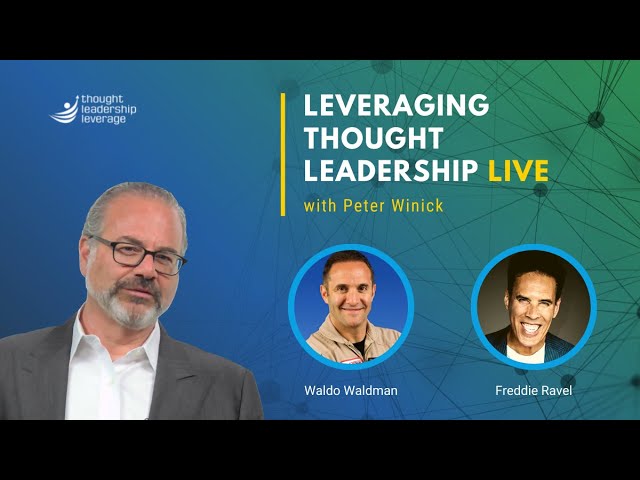
Waldo Waldman, a Hall of Fame speaker and former F-16 pilot, and Grammy-winning musician Freddie Ravel discuss how keynote speakers adapted after COVID. Waldman uses post-event digital products like his ACE Academy to add value, while Ravel teaches trust and collaboration through live piano performance. Both stress that hybrid events and real-time chat interaction are now essential to maintain audience connection.
Chapters
And welcome! Digging, digging the music there. So welcome to Leveraging Thought Leadership, the livestream. So the concept here is we've been doing the podcast for 4 years, which has been myself and one guest typically, and then we decided that it would be more fun if there were 2 smart guests and a mediocre host. So that's what we've been doing, and this is our second one of these. I'm I'm really excited about these— this one today, and I'll introduce my friends here. So first, I will introduce Waldo Waldman. Waldo is a New York Times and a Wall Street Journal bestselling author and a Hall of Fame speaker. He does keynotes live and virtually. He's definitely known as the Wingman, and he has been inducted into the National Speakers Association Hall of Fame. And he's also a former F-16 fighter pilot. I always thank him for his service. So welcome, my friend. Waldo and I go back about 15 years, so we know each other.
I remember our first conversation was on the deck of my townhome talking about my book, and, uh, yeah, laughing. We were instant brothers back then.
Exactly. And then my other brother is Freddie Ravelle. So Freddie is amazing in his own right. He has a, uh, piece that he does called In Tune. But prior to that, and still concurrent to that, Freddie's a Grammy Award-winning artist. He's played with a couple of little bands you may have heard that have done okay called Santana, Earth, Wind Fire, Madonna, Kanye West. What else do we got here? Prince, J.Lo. So, you know, so I think the trick is if Freddie's playing for you, you're gonna do all right. So welcome aboard, my friend. Good to have you both.
Good to see you, Peter.
Yeah, so let's just dive in. So these are 2 of some of the best and most innovative and creative keynoters that I know, and I know lots and lots of them. And what I thought I would do today is just sort of You know, have a conversation of, well, what's working, right? Because 2 years ago, the conversation would have been, yeah, yeah, yeah, I was in Orlando this week and last week, and how many gigs I'm doing. I mean, Walden, my last trip before COVID was down to Atlanta, like literally 10 days before the shutdown, and we were talking about, oh, this is the best year ever. And then lo and behold, life has changed. So what have each of you done the same, and what have each of you— how have each of you pivoted to provide value? to your clients? We'll start with that one, Waldo.
Yeah, sure, and great to be here. And by the way, Freddie and I are really good friends as well. Uh, I've been to one of his Santana concerts. He gave us a little backstage pass. Uh, he grew up or lives like, I guess, 10 or 15 minutes from my wife in Woodland Hills, California. And we— I've been to his house several times, and we've developed a great relationship and got him into the National Speakers Association where he wowed us on the main stage. And, uh, Uh, just another— this is just another example of relationships and how, how things bubble up when you just are kind and connect and show value as people, not just as business people. Um, so look, I'm sitting in my car right now. I had 6 minutes to get in there to go to my hotel room. I had a last-minute engagement in Oklahoma City. There's my hotel up there in the distance, the illustrious Grand Casino, uh, East Oklahoma. And I'm driving down to, uh—
Is that part of the Four Seasons? Because this is the glamorous life of a speaker.
As a matter of fact, I'm going to the Four Seasons tomorrow. In Dallas. So a little bit different, but hey, I don't care where I stay. I'm, uh, as long as business is good and there's running water and a bed, I'll be fine. But, but so I'm sitting here pivoting on this, on in this car, right? I'm using this medium, StreamYard, uh, LinkedIn Live, having great access and tools. I was telling you stuff before about, you know, leveraging some of my, uh, my, my content. From my, uh, uh, uh, from my— some of the assets that I have available to me. How you interact with prospects and clients is, is absolutely different. We can be on a video call, we could be in a parking lot, slave to a cell phone, and have a great conversation and provide value. And hopefully we're going to provide value for the folks here. If you're not adept at the technology, if you're intimidated by it, if you're reluctant to learn it, you will be shot down. Because many great speakers are phenomenal on the platform, but they don't know how to sell. They don't know how to leverage technology, this beautiful MacBook that I'm using, our cell phone, to connect, to be human with a client, and to demonstrate the value that elevates you above your competitors. And if it means making a phone call in a parking lot at a hotel, so be it, because yeah, a lot of these customers, speed is life. You got to get back to them quickly and use whatever medium you can.
So let's stay there a second. So I've seen you both speak and perform multiple times. So Freddie, I would have thought, you and I talked about this at the beginning of the pandemic, well, it might be harder for you because Freddie's whole piece is experiential and music and getting the crowd singing, and it's all sort of this improv piece. And I'm like, wow, that's going to be hard to do remotely. Yet you've won, right? Like, yet you figure out, like, the essence of what you were delivering wasn't necessarily the stage. We're all in the same ballroom on, you know, Tuesday at 2 o'clock. So talk about what you've done, because I've seen some of it. It's really, really creative and innovative and cool. And more importantly, the market's digging it.
Yeah, thank you, Peter, and thank you, Waldo. And I think, you know, and I think we got to boil this down to like the core stuff, you know. Um, in preparation for this interview, I was thinking a lot about the parallels that Waldo and I share, right? And as even though we have— we both have pivoted into the virtual world and we both are using this technology, uh, in my case, I have a technology called Ecamm, which I think is an amazing technology that allows me to pull up videos and, and screens and everything. And it's very powerful. And I also have the ability to play the piano while we're talking, right?
Right.
I, I, I literally had a desk constructed as when COVID kicked in. I said, I'm going to build A desk that I can stand in. So I'm in my studio in Los Angeles, Waldo's in Oklahoma, you're in New York. I'm standing, I'm fully standing. I have a keyboard that I can pull out. Let's see, you don't even see it because, uh, I think StreamYard cuts it off.
Right.
You can hear this. I have a keyboard right here, uh, that, that I'm playing. Let me see if I can Lower the camera so that the people can see it. Can you see this?
Yes. Yeah, there we go.
There's a keyboard here, and I can, I can see you, I can see Waldo, and I can, I can play. And that allows me to talk about Mozart and, and relate it to team building, leadership, time management. And being able to do that all across the world simultaneously. You know, I've done this now where I've had 1,000 people on a call and I'm talking to 16 different time zones and I play the piano and the nanosecond that I hit the keys in Los Angeles, my guy in Cape Town, South Africa is nodding his head. And I'll be honest, I have no idea how that actually works. I really don't.
But let me ask you this. So I, again, I've seen you both live and you're both performers in the good sense of the word. Like there's something about, like everything about Waldo's event is, I don't wanna say scripted, but there's a music, right? There's a theme, there's a brand, there's the visuals of, you know, like, and then you come out in the jumpsuit and we're already emotionally sort of there and you feed off the audience, right? So that you can see who's leaning in and you lean towards those people, whatever. I think a lot of speakers that have had a tough time Putting it out there in an environment that this is an awkward environment. This is sort of like we're all the, you know, green screen face on CNN, and you don't get that instant real-time feedback of, uh-oh, I'm losing them, let me go pull another story. Or, you know, oh, I see all the blue screens because they've got their phones out, what can I do? So how do you, how do you overcome that? Or how have you guys each developed new capabilities, new muscles to win in this, in this market?
Well, they're Yeah, so, and that's a great point. I use the Ecamm as well. I would be linking it in if I was in my studio. I'd be pressing buttons. You'd see some stuff on the screen, just like Freddie. Press a button, videos play, a video shows, an image shows, right? And I'm going to share a little bit more on the sales side why that's important, but you've got to be able to look at that screen, Love that screen, that camera, and be as present as possible. It's extremely difficult because you don't have that human interaction. Many cameras are off on these Zoom calls.
Yeah.
You may not see their emotion. They may not be laughing. So discipline and focus and ultimate presence and practice are absolutely critical. It is not easy to create an experiential content-packed program looking at a video screen. So really practicing a lot and making it very emotional. Now, if you're a tactical speaker, a sales process speaker, more of a content speaker, and Freddy and I, for lack of a better word, are more experiential, we're creating a theme, getting emotions involved. That's hard to do on the screen. Process, pretty easy to do when you're talking about sales steps and looking at slides and whiteboards.
Sure.
So you've really got to put yourself back into that state of re-engaging that story, putting yourself in the proverbial cockpit on the stage with your keyboards, experiencing things. And homeostatically, physiologically, mentally, spiritually, you've got to be really, really present, knowing your customer inside and out, rehearsing, practicing, and ultimately making love to that camera and pretending that's a human being in front of you that you're trying to connect with.
Yep.
extremely hard to do, and I guarantee Freddie and I have worked hard at it, and we still have ways to go, but we— it's gotten a lot better over the last year and a half.
What about you? Yeah, Freddie, I was gonna say, you've literally gone from, you know, 70,000-person arenas to now performing live from my home, right? Yeah, yeah, yeah. What's that adjustment been like for you?
Yeah, you know, Like, just like Waldo says, you know what, I— you have to make— you have to look at that camera. And when I say, you know, may you always sing your melody, listen for harmony, dance to your rhythm, and celebrate the great score called you. Like, just that.
Yeah.
I'm making love to that camera. And I feel thousands of people behind that camera. And I see them. I see a woman in a kitchen in Mississippi looking at this. I see a guy sitting at a desk at IBM. with headphones in a cubicle looking at this. I see a Japanese lady, you know, on the other side of the ocean with 2 kids, you know, looking at it on an iPhone. I mean, I'm imagining.
That's very interesting.
Yeah, so I think that has a lot to do with it too, is who, like Waldo says, know your audience, study them, work with them. I just begin, all my live gigs are starting to come back now. There's quite a few live gigs that are coming back. And it's funny, some of the things I've learned in the virtual world, I'm now able to bring back to the live world. It's an interesting phenomenon. You would think, what am I gonna learn in digital that I can bring back live? And one of them is the focus. Remember, when you're speaking in front of thousands of people, you're like this. So it's a great privilege to be here to speak to you. You're looking around the whole room.
But you're not connecting.
My 1,000 people, Yeah, that's great.
Very cool. So I want to, I want to shift to sort of, sort of the value prop. So the old school value prop of live keynote speaking was you both had stellar reputations, right? So the client's going to bring you in, you're going to do your 40 minutes, hour, whatever it's going to be, and you're going to rock them and you're going to customize. And you're both really, really good at the customization of, well, what is this client bringing me in to amplify? It's not about me, right? So is it, we're having a great year, is it overcoming resilience, is it teamwork, is it, you know, working in harmony, whatever it is, right? And then you're gonna do that, and assuming there's not a technical problem or whatever, whatever, whatever, 99.99% chance you're gonna kill it, right? And it's gonna work, and you've done it before, and you've got the chops. Now, in this, forget the non-live event world, how does the client, how are you seeing the clients justify the investment In you, and I'll tell you, I'll plant it with what I'm seeing is it's less about the experiential, the entertainment, and more about the capabilities. What will my people take away that will— they'll be thinking about that might get them to do something differently, to interface with each other, with a client in the market? What are you hearing from your clients about sort of the, you know, the value prop in a non-physical world?
Well, the Content is always king.
Yeah.
I've worked with KPMG, Lockheed Martin, Honeywell, the biggest companies in the last 6 to 12 months. They don't ask me, well, when you do the virtual program, can you share what kind of camera you have and what kind of lighting is it? Tell me about your microphone. I've never had one asked. Now, I will maneuver my camera and I'll show them. And by the way, bringing them into your life, bringing them in, I've had my dog jump into the camera. I got a Great Dane puppy. I'm able to use props a little differently. These are things also that you can use in a virtual setting to build that connection both on screen when you're doing a virtual keynote and connecting with a prospect, humanizing yourself, reducing the barriers of fear and doubt that many prospects have when they're deciding, am I going to invest in you for $1,000 or $30,000 to do a virtual keynote? So content is always king. You've got to understand your value proposition extremely, extremely well. Typical, you know, finding out what their needs are, their challenges are, making sure that there's a right fit. But then what I find also when it comes to value and taking action, because it's always about what happens after that meeting that counts, is how you— what products, what solutions do you have to deliver post-virtual keynote? That will create that red thread of content that will sustain the momentum, that will help create actionable items for those men and women who invested their time on that hour keynote and maybe the 2 or 3 days that they're on that virtual program. So I've developed what's called an ACE Academy, 50+ videos plus worksheets that dig into collaboration and trust and courage and all the content that I discuss. And folks and companies are more palatable to digital solutions as they have remote workforces that need these solutions. So if you can provide that, if you can bolt on to your proverbial F-16 extra weapons systems, they'll be like, hmm, worth the investment. So it can't be just—
So a little bit of that is sort of like in the real-world presentation, everybody always used to say, oh, if we could bottle the energy at the end of that keynote when they're all up on their feet and they're feeling it. In essence, in your— What you've done is come up with the ACE program, which is a little taste of it, you know, once a week for a year thereafter, gets their brain back there, gives them a capability to work on. And you're using language and you're using definitions and you're pushing that out at scale really cost-effectively. So one, for you, it's a good thing. It's an upsell, right? It's a differentiator. And for the client, it's a great thing because it keeps that momentum and that rhythm going. Freddie, what are you doing? In that regard.
Yeah, no, I think, well, my main thing is of course music. Music is the stickiest thing on the planet. There isn't a human being alive that doesn't love good rhythm, a good melody, a good harmony. And when I know exactly who the client is, I use specific music to that culture, right? So I just presented on the floor of a big factory in downtown LA for garment workers for a company called The Reformation. Fantastic company that's making sustainable clothing, and they're very popular. They're a rising star in the clothing industry, and they wanted me to speak bilingual. You know, I'm bilingual. I speak in Spanish and English, right? So I delivered this in Spanish, and I used La Bamba and Bésame Mucho. Now, I've never used those songs before, ever, but I knew that if I talked about rhythm by using da da da da da dum ba da da da da da da dum. I knew that if I used that, it would connect. So I'm using customized music. And by the way, I made the decision 5 minutes before I played it. Sometimes it's very planned and I have video footage with Santana and Earth, Wind Fire playing with me that I jam to talk about collaboration. But many times it's in the moment.
That you're just going there. Very cool.
And I think an important thing to also say is that, you know, Both Waldo and I, you know, Waldo's work is so incredible because it basically is centered on trust, right? Trust your wingman, you know, and find people that you can have courage and make tough decisions with that got your back, right? And I love that Waldo emphasized that level of integrity. This is what so much of his message. And in my case, I'm teaching trust through listening skills. Because if you had to boil down everything that I'm, I'm doing, I'm using music and, and, and the lessons of harmony and lack of harmony, rhythm and lack of rhythm, to establish a high level of listening, trust, and integrity. So, so the flagpole that Waldo and I both share is teaching an evergreen principle of integrity and trust.
I love it. So I want to chat for a little bit because everybody, or at least everybody in my world and probably your world as well, are making predictions, you know, oh, speaking's coming back, it's not coming back, and, you know, then we had Delta and then we had all that sort of stuff. So, you know, we had this great rush for Q4 of this year, Q3 and Q4, that got pulled back largely. Talk about what you're seeing, and if you wanna be bold enough to make a prediction on where things might be in a year or 2, in a world that has been unsteady for a year or 2, then have the courage to do that as well. But what are you seeing and where do you think it's gonna go? What will be the same and what will be different?
So yeah, great question, because you've got to prepare for the future but still remain ultimately relevant in the present, right? I mean, here I am on the road and then I'm going back, I'm gonna do some virtual programs as well. Bridgestone Tire just hired me. They've got 3,000 of their general managers, their store managers that normally get together. They're gonna do it virtually. However, we're gonna be on-site at a studio in Nashville, Tennessee, where we're having a professional setup. They're bringing in high-end equipment, etc., and we're gonna create this environment so that when people are looking at that screen, it's gonna be much more experiential. It's gonna be much more—
Will there be people in that studio, live people?
Some people. There'll be some people, maybe several dozen, but most of them will be listening outside of it. Same thing with Husqvarna. We had a gig in Vegas a couple weeks ago. They changed it. with the Delta variant. Now I'm meeting in North Carolina, in Charlotte, in December. Same thing. We're going to be doing these hybrid events, either hybrid where it's totally hybrid, where we're totally, you know, maybe several dozen in one room.
Sure.
And most of them are going to be listening virtually. But then the other, for example, I did one in Dallas last month, actually in the beginning of— end of August, where We had 400 people in a, in a nice venue and 2,000 were watching. So I think that's going to stay, stay, uh, uh, present because there may be some folks who just are reluctant to travel. There may be some issue out there. But that being said—
Or they can invite others that they wouldn't have invited before, right? So if you have 400 folks in Vegas and say, you know what, let's open it up to the field office because what the heck, like, it doesn't really cost us anything. Yeah, so it's more democratizing the work.
The content can connect and impact a lot more people. So there's more value with that. But I do think people still want to get together. I've never seen the level of excitement and connection with these live events that I'm doing. People need to get together. They want to get together. Hotels are doing a fantastic job, venues, on maintaining the social distancing. that hygiene, and, and it's really impressive. And, you know, they have different codes on how much you want to be approached or not. I do think hybrid will be around, but live events are not going away. They will stay present, but maybe they're going to do more that hybrid event, or more going to be able to do live and then, and then stream it out to a lot more folks. And I assume, Freddie, you're seeing the same thing.
I'm seeing this exactly. I'm going to parrot Waldo exactly, but I'm also going to say Something that people don't talk about a lot, and that is the chat. A Zoom call with the chat.
Ah, yeah, yeah, yeah.
And what a revolutionary tool that most of us sort of take for granted. You know, it's like, what is this thing? But when I'm doing virtual— remember the old days before Zoom, right? Before, when people would go to a live event, most people tend to sit in the back. A lot of people don't want to sit in the front. You know, human nature. People are shy. They kind of sit towards the back. And, you know, public speaking is one of the greatest fears in the world for many people, right? It's one of the top fears. So people, a lot of introverted people, and many people are introverted, will sit in the back and not really participate. Well, Zoom and the chat—
Yeah.
—opened up an entirely new dialogue to the folks that would not normally communicate with the speaker. And so I'm getting the intimacy of someone's thought in the moment that I never had, or Waldo never had, when we spoke purely live. And so I think that is a huge game changer.
That interaction piece.
And engaging and touching the heart. Yeah. And then everything Waldo said of hybrid. I'm doing events now. I just did an event a month ago where the emcee of the event was in Buenos Aires, Argentina. The CEO was on a big screen behind him, like a 20-foot-tall screen, with the CEO from Colombia, and I'm on the other opposite screen, right, Los Angeles, and there's 450 people from all of Latin America listening in.
Yep. So I want to go back to something Waldo said about, you know, this excitement when you're seeing people. It's the first time colleagues have gotten together in 2 years or whatever. There's a human need Right? So content, we know we can get anywhere we want. I can go on YouTube, I can go whatever. But that connection and that community, I think the smart speakers like you all have figured out when we take advantage of the physicality of being together to use that connection. But I wanna go just a little bit further. Do you think we're getting back to, let's say, another 2019 or 2018 where the default is, you know, company X does X number of events a year in wherever, Orlando, Chicago, or We're going to do less in-person and say, you know, sort of the bar's raised, or what do you— what do you— just general sense of the market? Waldo?
Yeah, I think, I think, uh, they're gonna be more— they're gonna do more due diligence and, uh, a, uh, a needs requirement on whether or not it's gonna be best to bring these folks together. Uh, I, you know, I'm talking with, uh, the major motorcycle manufacturer— I won't say specifically— and a lot of that— they used to have a lot of their dealer meetings, but they don't have their dealer meetings anymore because They weren't able to get them together, but now they're going to more regional events, smaller regional events.
And that's a cost factor too, right? Because now we've done the math on travel.
Yes. And I think a lot of quote-unquote sales meetings where— not necessarily sales meeting where you bring in an outside speaker, but maybe 10 people getting together or 5 people getting together— it could be done virtually. We can impact the same thing. I'll have a cup of coffee here and you'll be across the way. We're looking We're getting the same stuff done. There's nothing better than, than, you know, live interaction in person. But the virtual medium isn't bad as well. I do think that there's going to be a greater emphasis, in my opinion, on making sure that people have an option to get together because they are disconnected.
Yeah.
I talk about collaboration and trust, you know, like Freddie. And so part of it is That human interaction, that the solution that can be found through a conversation at a breakout session or over dinner at a live event, that connection with your prospects, your vendor partners, your channel partners, getting their input live and in person and getting that feedback where the shield is down. You may not be able to get that through a virtual call, but you sure can get it over a steak or, you know—
Sure.
Or having a glass of wine. So there will be an increased emphasis on getting them together and making sure that that is an option. Because if we stick with this virtual medium, if that's all we're doing, I think we're going to lose the heart and soul of business. People are going to become disgruntled. They're going to lose that connectivity. And, and this is a problem. I think you're seeing it all over the internet. I mean, look at what's going on with Facebook and Meta.
Yeah.
They're creating this virtual world that, that, that can work for some, but for others, we need to get together. And I think it will never go away. Yeah, we're gonna have to connect live.
Freddie, what are you, what are you thinking?
Well, um, at the end of the day, us human beings are— we love tribes. We let— we're part of tribes. We, we are wired to be together. We are wired to, to share. And at the end of the day, a live experience is the ultimate expression of a tribe, you know. And every company and every organization I speak to is their own collective tribe of people with a certain culture and philosophy. And if they can be together physically, it's almost always better. At the same time, digital opens up, you know, I'm doing events now where I'll speak, but maybe 10 minutes before I enter the room, They're having a coffee break, they're having a chat, they're having a cocktail hour, if you know what I mean. Mm-hmm. Before I even come up on stage, they're having a social time. And, um, we, you know, humans are very innovative. We find ways to, to stay connected. Um, but I do think that, uh, the answer to your very first question is hybrid will continue. Um, it works, and I think a lot of people are not as free to travel As we are, you know. Sure, to jump on a plane, they're not able to do it, and they've changed their life and they've modified their life where they're not going to travel as much as they used to. At the same time, people are so chomping at the bit that they cannot— they're going to go stir crazy if they don't get out of the house.
Exactly. So the last, last, uh, last thing I'll throw out there before we run out of time here is just any general thoughts on sort of the business side here, meaning, you know, the bureaus more important, less important, pricing, right? So initially, I think when this happened, you had a bunch of speakers at $50,000 going, uh-oh, I guess I'll do it for 2 grand, right? So then, whoop, there goes your brand out the window. So where does pricing fit in? How do you maintain pricing integrity? Are the bureaus more important, less important, or the same? Any, any reactions to that?
I had an interesting discussion with a bureau, uh, 2 interesting discussions with 2 different bureaus the last couple of days. One who had a client cancel and then another that was canceled in the beginning of COVID and they've been kicking the can down the road. And then the company was acquired and blah, blah, blah. And then now the meeting's canceled. The bureaus are having a hard time. I think they're realizing that relationships are more critical than ever. You've got to really dig in and add value. It's not just the talking head.
Mm-hmm.
They have to ask the questions. What are the challenges? What are the issues that you're facing? And come up with a customized solution via 2 or 3 speakers, not throwing 10 speakers at them and saying, choose whichever one of these, uh, and whatever sticks, they're gonna— the bureau is gonna get a commission. And there are some wonderful bureaus out there who understand that relationship, others that are more, you know, order takers. And so the relationship is really, really important, and they need to understand, and, and speakers need to understand once again, what are the value adds? What are the extra things you could bolt on to create the sustainable chain and justify the pricing? and justify the prices. I may get my standard keynote fee, but in addition to the 1-hour speech, they're getting all these extra add-ons at maybe a small premium, a small margin, or—
But it's more of a package than just—
Bundling it in. They're like, okay, your fee was kind of pricey for just the hour, but with all these other things, I could see the value. And you as a speaker must understand how to deliver that value proposition and create a solution for them. And then you as a If you're a channel leader or a sales manager or executive maybe watching this, you need to be commanding in some way through your questions and having that speaker demonstrate beyond that 1 hour or 30 minutes or whatever what value they can bring. And do your due diligence and choose the one who's going to create the better solution, not just fill the slot. Impact change because change for the better is so important now and people need need solutions because there's so much, uh, it's a very precarious business world out there and companies need to be more value-driven.
Anything to add to that, Freddie?
Yeah, well, first of all, exactly what Waldo said, I totally agree. And at the same time, um, when people are having fun, they learn 5 times faster, right? So remember, there's an, you know, it is very precarious. We live in a very precarious time. The anxiety is very high, high in the world, right? So when you can come in with a fresh way of looking, fresh perspective that has a little bit of electricity and joy in it, that's gonna, that's gonna put you to the front of the, front of the line in terms of speakers. And that's, that's what I think really works. So I think advice to people out there who are thinking about speaking or presenting, try to have that spark, try to find that distinctive spark that sets you apart.
Yeah, it's so true. That's, that's seasoning, right? You need that seasoning or the ice cream to stick out.
Yeah, yeah.
That's really— Freddie, you're so spot on. People want to have that heart, that heart massage. Sometimes it's not as much about the content, it is about that experience, the feeling, humanity of it, and love. And that is so critical, I think, uh, and Freddie is so good at it, and, and I, I created a lot. They want to have that experience, that heart. Because they're missing that emotional context, uh, and that's a huge value as well. It's not just about the numbers, it's about the heart.
Yeah, so love it. So we're coming up to that end of time spot, so I want to thank you, Freddie, Intune, and Waldo pushing it up. So these are 2 of the best guys in the business that I'm proud to call my friends and have known for a long time, and I appreciate everything you've done. So thanks, guys. Thank you so much, Peter.
Thank you, Waldo.
You got it. So great to see you guys. Stay safe and healthy and enjoy. And they could find us all, Google our names and you'll find us and, and connect with us on LinkedIn if you, uh, if you like this program and if you, uh, have any questions for us as well.
You got it.
Ditto. Thank you.










