Five Years, One Goal: Freedom Through Real Estate with Pete Schnepp
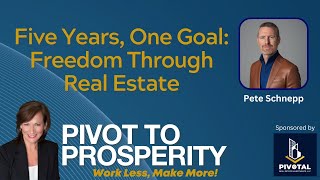
Interview (Pivots of Prosperity podcast) with real estate investor and entrepreneur Pete Schnepp about his journey from running service businesses to building a cash-flowing small multifamily portfolio. Pete describes his ‘five years to freedom’ goal (targeting $20,000/month in rental free cash flow), his focus on small multifamily (≤50 units), deal-sourcing methods (tired landlords, seller financing, broker/wholesaler flow), and preference for joint ventures with high-net-worth partners. He also mentions background in construction/project management and prior business exits.
Questions this video answers
Fall of 2007 (lost it in a short sale during the market crash).
About 100 doors in Phoenix (stated in the episode intro).
10 and 11 years old.
13 years.
$20,000 per month in free cash flow from rents.
Chapters
Are you one of the many busy professionals working in offices day in and day out? Do you wonder how some people grow their wealth fast, retire early and play on work days? Well, you're in luck because Ginny Bolling hosts this show Pivots of Prosperity where she interviews people that can do just that play on work days. Many guests have become financially free. She also interviews people that are on their journey and people that are in support roles like attorneys, contractors, brain brokers and others. Commercial real estate is the common element. She is on a mission to be sure. Busy professionals know they can own substantial commercial properties too like apartments, self storage facilities and others and not have to do the work managing them. Passive investing is the key. Syndications are the typical method. Tax write offs are some of the biggest rewards. Ginny and partners find the deals, build a strong team and business plan, then offer the investment opportunities to passive investors. New episodes are released Every Tuesday at 12 so watch for new releases. If you want to get involved, let us know. You need to get pre qualified to hear about most deals. See the show notes for contact information.
Hello, Hello. Jenny Bolling here with Pivot to Prosperity brought to you by Pivotal Real Estate Investments where we help our investors build wealth and income through commercial real estate that also improves communities. Today we have Pete Schnepf with us. Pete, thank you for coming on.
Hi Jenny, thanks for having me.
So we have in common a membership in Raise Masters and I've, I've talked with a lot of people from Raised Masters and we've, we share through that the fact that there's a lot of people doing a lot of things in the, not only the syndication world but the JV world. Right. The number of things that our members are doing is phenomenal. It's really a lot of different things.
And that it's a vibrant group, lots of deal makers there, that's for sure.
There is, there is that Slack channel is invaluable, isn't it?
There's a lot of info flowing. Yeah.
Yeah. All right, well so I am going to read a little bit about you here and then if you want to add to it, you just let me know. So from interpreter from being an entrepreneur to real estate investor, a journey of financial freedom and infinite returns is one of the things that is the overriding and most impactful statement to say that summarizes you it sounds like and you own and manage profitable multifamily real estate and got about 100 doors in Phoenix, spent 15 years as a self employed entrepreneur building Envision service group and Investing in real estate. You specialize in infinite returns, structuring deals where investors get their capital while keeping cash flow indefinitely. You've been through market cycles firsthand, investing through uncertainty and making strategic moves when others hesitate. Your work has been recognized on the Inc. 5000 and within the entrepreneurs organization EO. Right. What would you add to that?
Sounds good. I don't know what else I'd add. I mean I'm a proud father and husband for sure. I've got amazing 10 and 11 year old kids and I've been married for 13 years now, which I feel is a little bit rare. But yeah, I'm definitely a family guy first. Entrepreneur and investor second.
Well, I'm going to add a little more myself too after looking at some of the other background. You have some good strong training being with Toll Brothers as a project manager. That's awesome. For construction background, project management background. And so you're able to see things a lot of people don't and probably stay on a timeline, I bet.
Yeah, I guess I kind of take that for granted. I've had a lot of construction training and background, project management, Toll Brothers and another firm. I also got my real estate license back then. So I've just had a ton of real estate and construction throughout my entire life almost.
Well, and two other things. You're the co founder of a bug science pest and termite control company.
That's right. Yeah. We actually sold that a couple years ago.
But background is huge in this business. It really is an advantage. And your paint and roofing company has won awards.
We have, yes. Award winning company here in Phoenix, Arizona.
You need to add that to your bio. All right, well, just wanted to add those, but. So Pete, tell us how you ended up deciding to go into real estate.
Well, I've kind of been in real estate for a long time, but I guess once I became self employed after I last left the corporate world, I was really just running my service business, getting that off the ground in vision because that's what I knew best at the time was painting. Now we do painting and roofing. But at the time that's how I felt I could best provide for my family with, you know, maybe an above average income. And so that's what I went into and I loved it. I love the service business. I love being of service. I love talking to clients and transforming their properties and really like making a difference. But it's a grind, right. And you're always tied to your phone, you're tied to your work, you're running around and it's really, you know, comparing it to employment, it's almost when you're a self employed contractor like that, you're just, you have no time. You know, you have the ability to make a little bit more money maybe than most employees doing that. But when you factor in the time equation, a lot of times it's not even worth it because you're doing everything, bookkeeping, sales, production, management. And then as soon as you try to hire somebody, you know, that comes out of the income that you can pay yourself. So I'm building up this business and you know, I also have my real estate license, so I was trying to sell houses as well. Nights and weekends, do that on the side. People would call me for a paint job and I'd try to, you know, try to sell their house also, anything I could do to make a buck. And this was the time when my, my first kid was starting to get born. And you know, we were going through tough times at home, me and my wife with the, with the newborn and I had to make a decision and do I want to like work all the time and become this, this rich guy that, that's divorced and doesn't, you know, have a family or, or do I want to figure out how to make this work? And so I chose to because, to stop messing with selling real estate, you know, nights and weekends and be present for my family, which I think was a good decision. But along the way I knew that, you know, owning income property was really, that's, that was really going to be like the ticket to a life of freedom and wealth because, you know, it all goes back to that little purple book that Robert Kiyosaki wrote. I'm sure you're familiar with that, Jenny, right?
Yeah.
But being in real estate and construction, I knew that, you know, as a contractor, it's really almost impossible to get to the point to where you're earning money while you're sleeping, right. And that's the goal as to how can you earn money while you're sleeping. And so for me, the easiest path was to start owning income property. So my first house that I bought out here was in the fall of 2007, right before the market crashed. And I wound up losing that through a short sale like most people did out here. But that was my first big lesson, that was my first entry into real estate, right. And luckily I bought that house with no money down. So I didn't really lose anything. But I saw everybody around me lose a lot. They lost their businesses, their jobs, their houses and so really made me fearful. But when I was able to start getting into the market and buying again a few years later, that really like shaped how conservative I was. And in hindsight, it's probably why I'm not over leveraged right now. I don't have any loans that are about to default. Like most people who are buying in 2021 and 2022. There's a lot of distress right now, but I'm not in that position. I did buy a few properties, but I bought them so smartly that there's just no, no distress. And there won't be. So. And I think that goes back to like my entry into real estate was in the last crash. Right. But anyway, as a contractor, you know, I was basically my goal every year was to make enough money, the difference between what I made and what I spent to have enough to buy an income property. And so you asked me about pivotal people in, in my life and there was a married couple or an older couple that we met at a dinner one night. I don't even know who they were, honestly, I don't know their names. But they made us. At the time I had told them that I had one rental and they made a suggestion that we should try to buy one rental a year. And at the time that kind of like blew my mind. Like, who in the world can afford to buy another house every year? Right? That's just insane. But it planted, it planted that seed in my head. And, and you know, you, you meet people that, that have huge portfolios and they're buying 100 unit properties and you're like, whoa, that's just so out there you can't wrap your head around it. But the thought that, okay, well, if I can make an extra 50 to $100,000 a year, keep my expenses low and keep hustling and make that spread and put that into a property that's actually something that might be doable. And so that became my goal. And it was my goal to buy an income property a year. And over the, you know, the next many years I didn't buy a property every year, but some years I bought a few or two or three or whatever. And over the course of 15 years or more, you know, you wind up building a pretty nice portfolio. None of those properties individually make you rich. None of them look like a home run on paper, you know, but you learn as you go and you hold and you let inflation do its thing. And so over time, I'm still owning the service business. My real estate company is Growing on its own, just a self funded portfolio. And over time that became my main business. Right. But part of that was realizing that okay, I've got something good going here. I created a goal for myself. I called it five years to freedom. And this was back in 2017 or 2018. And so my goal was to be financially free through rents so that I wouldn't necessarily need the income from my other business so that I could either sell it or step out of the day to day. And, and I set a bhag. Big hairy audacious goal to do this in five years. And to me, I defined financial freedom as if I could have 20,000 bucks a month in free cash flow from rents, that would be financial freedom. It's more than enough to pay my bills, a little bit extra to cover some travel and stuff. And so after four years of, you know, like 100% focus, like literally every day I woke up really just dialed in on, on getting to this goal. I did it, I accomplished it in four years. Right. And so it was pretty cool. And I didn't sell the business, I kept it. And I empowered my team and, and they run it now and they're doing a great job. And I spend all my time, 95% of my time on the, on the real estate business continuing to buy cash flowing assets with potential for capital appreciation.
Terrific. That's terrific. And so doable. Really. Lots of people are actually on that same or similar path. I think that you're a good, you're a good person for them to hear as a success story really. So tell us what you do now as far as when you're structuring your deals, what are you looking for and where are you. Actually, we didn't then say where you're, you're buying anyway and, and go into that. Would you?
Yeah. So now I do mostly joint ventures and some, some syndications. I like joint ventures better, but I do both depending on the property and, and the potential partners. And so I've got a couple of joint ventures with some friends and family that, you know, we all go in together. I've got some where I, where I partner with high net worth people and I build them a portfolio. And so I'm in Phoenix. This is my market. This is where I have the most value. I know the areas that work, I know the areas that don't work. I've got all my resources, you know, my vendors, the guys that do work for me, the property management. And so this is where I focus. I've got an incredible Deal flow. I've got probably at any given time I might see a dozen or more deals that come across my desk from brokers, wholesalers, and I even have somebody on my staff that cold calls property owners. So we've got it dialed in and we just stick to the market. This is a rare market where you can, where you can get cash flow and appreciation. I'm also, I am buying another deal in Indiana right now. We close tomorrow. But I've got a partner out there. I've got boots on the ground that I trust and that was a, a really nice deal that I couldn't pass up. And I wanted some diversity as well. So that's the only one that I have right now outside of Phoenix. But the JV thing is cool. I mean, I really like just working with amazing people. And so generally they're high net worth individuals. They either have their own business or they're, you know, an executive somewhere. They're earning really good income on their own, but they don't have the time to go do this. They just know that they want a good asset allocation in real estate. And so we partner up and they provide the capital. I do all the work, I provide my team and everything and we share profit and we just need to make sure that we're aligned with the same strategy, vision, so on and so forth. But I basically take what I've done for the last 15 or 20 years on my own and now I share it with, with people that I like working with.
So what size deal are you buying usually? How much? Dollar wise?
Yeah, good question. I focus in small multifamily properties, which usually means 50 units or less or potentially 4 or 5 units or more generally. Like for example, the one I'm buying right now this week is a 24 unit. We have a 44 unit under contract. And so those small multifamily, I've just come to really excel in them and we get amazing deals from, from them because we can buy from tired landlords. And so that's really what we go after. People that have owned the property for 20 years or so, they've got a ton of equity, they haven't kept up with raising the rents or the maintenance. And so these people usually just want a convenient exit. They want to sell to somebody that isn't going to screw them around. They don't want to mess with listing it on the MLS or you know, showing all the units and bothering the tenants because then they're going to get repair requests, you know, so on and so forth. They just want somebody that can do a quick walkthrough and make a fair deal and, and they'll trust that they'll close. And I've, I've built that reputation and I get really good deals that way. We structure them. Win, win. I do a lot of seller finance with these people because hey, they're landlords, they're just like you and me, they love cash flow and if they get a big paycheck they have nowhere to put it. And so they would almost rather sell or finance to me so they can keep the mailbox coming in, which means we're not messing with banks. A lot of times we get more favorable rates and terms in the banks, but there's not all the regulation and stuff. So I think actually five of the last six deals we've done, we've had really good seller financing. But yeah, that's, that's my niche, the small multifamily stuff.
I'm convinced the smartest sellers will finance it. You know, of course they, it has to be if they're not needing the money somewhere. But truly that's the best way to, to handle it for them and still keep that income stream of a property they already know and love. Right?
Yeah, exactly.
Yeah. So today, these days, if you're getting ready to close and all and you're underwriting, if you know it's a good area, growth area, economics are right and all that. What kind of, what kind of cap rates are you using generally compared especially like to the interest rate? Are you in the 6.5 area for the interest rate or where you at there? Six maybe not today on the, on.
The interest rates we're getting at for the purchase, for the financing. Yeah, it depends. So the one that we're closing on tomorrow, we, we get a really good deal. We've got, it's a six year interest only note from the seller. And the first year, first two years it's at 3.25%. Then it steps up to 375 and then to 4.5. So it's blended at 3.88 interest only. The other one, let's see, I've done, yeah, I've done a couple at four and a half percent. I've got one at 5%. I've got the one under contract right now at 7%. So it really depends on the purchase price, how the numbers shake out.
I should have said more institutional. Yeah, it's different when it's the seller finance for sure.
Yeah. So banks right now I just quoted on A bank for a purchase, a credit union, and 7% is what I can get on that.
So what cap rate would you use on your offer? Typically, roughly.
So, you know, the entry cap rate doesn't really mean much to me because I'm not buying retail. I'm buying stuff that I can add value to. So it's more about, you know, the cash on cash return and what's the cap rate after stabilized and the potential of it. And so, you know, cash on cash return, we're usually looking at 5 to 10%. The one that we penciled out right now, yeah, it's about 10% per year annually. Cap rates after stabilized could be 8, 9, 10%. We'll look at that. We'll look at the IRR. We'll look at a variable, you know, a bunch of variables and piece it together. Generally, I'm not just sitting around waiting for home runs, you know what I mean? Not swinging bat. That doesn't happen. I'm. I'm a singles guy, you know, and so really a lot of the deals that I've bought along the way, I buy it and it's a solid single. It doesn't look amazing on paper, but it cash flows. And then what's going to happen in the future, you don't really know. You can project it out at a 3% appreciation or whatever and be conservative, and it really doesn't look super attractive on paper. But deep down, you know that you just analyze 20 deals and 18 of them lose money on day one, and this one breaks even and there's a component to add value. Right. So it's like, what properties can I buy that are solid single, that I can get undervalue? Right now I can force a little bit of appreciation by doing hard work or raising rents or where's the quick ad? And then, you know, let inflation do its thing over time. And what happens is if you buy enough singles, if you buy enough singles, those singles will turn into doubles and triples and homers, just with inflation doing its thing. But also when you're in the game and you're looking for singles, occasionally you find one that's just a knockout deal and you recognize it and you jump on it from day one. And that's happened, that's happened to me many times along the way. But I realized that you don't come across. You don't. You don't get the opportunity for those knockout deals if you're not in the game playing. I've had people, I've had brokers call me and deliver those to me because they know that I'm a buyer in the area. They saw that I've just bought one recently, and then I'm a trusted closer. And I've seen them on the MLS where I just see one pop up on the mls. I recognize that it's priced way under market and I jump on it and I tie it under contract. Those things don't happen when you're not in the game hitting singles, right? Yeah.
Yeah. One of my better tricks to it is also to whenever I'm looking at these, I believe in looking at comps as well, even if it's an income property. And lots of times I'm looking at listings and it's like, wait a minute, I need to be looking at that one. Yeah, that's. That's definitely one of the things that, that I feel is important for us to be doing.
You got to recognize the opportunity when it's there. There's opportunity all around us, any market. And if you, you know, if you turn over enough stones, you're bound, you're bound to find a gem. Right. And that's what I do. That's what I love doing. I just love looking at deals and then just making offers, you know, and if you work hard enough, you'll find them.
Well, I totally agree. And I think it's fantastic what you're doing because there's a definite need for high net worth people to be able to do things outside of syndications. And so that makes it probably not only simpler for you, but for them. And it's a win win that way, especially when you're, you know, looking at treating the seller right and whatnot too. So it goes three ways.
Yeah, I found that that's a need for sure. Like, you know, with the syndication space, it serves a purpose, you know, and being an LP is great, but most people that, you know, have a significant net worth or, or income, they want some control and they want to be able to say, hey, I want to sell this property this year, or I have a capital event coming up, I need to do something, or hey, let's refinance this and redeploy this into another deal. But they want the decision to be theirs, not. Not mine. Right. And so I'm okay with that because I love partnering with amazing people. I'm just, I'm just the deal guy. I'm like the workhorse. And it kind of goes back to, you know, what I loved about running Envision Service Group is the service side of it. And really, like Helping people. And then I got into real estate and I was really just doing it all for myself. And it was great because it was, it was my wealth engine. But what I'm doing right now brings me back to the whole service component and really helping other people. Does that make sense?
The more rewarding. Yeah. Right?
Yeah.
Back to your roots.
Yeah.
All right, well, so, and as I told you towards the end here, I'm going to ask you if, and I know you already brought up there, if there's a pivotal person or event that brought you to where you are today or is pushing you towards some certain place. And so is there something you'd like to name in particular? There's.
Yeah, it was that one older couple and honestly, I don't even know who they were. It was just that conversation that really planted the seed in my head. One property a year. And what that did is it got me thinking, well, well, shoot. I mean, in 10 years, what would that look like if I had 10 properties? You know, like, it'd be a totally different future than, than I, than I could picture. And so that was truly pivotal. There was another pivotal moment. And again, it was somebody that I don't know personally, but when I was working at Toll Brothers building these beautiful, beautiful homes for the affluent people, there was an Indian family that moved in and the lady was telling me that they just got back from a overseas trip with their kids. They had young kids and at the time I was, you know, a young, young guy employee, not making very much. And she's like, oh yeah, when you have a family, you should take your family on, on one international trip per year. The kids really get so much out of it. And at the time it blew my mind. Like, how in the world can anybody afford a trip like that every year? I mean, I could barely afford to take care of myself at the time. Fresh out of college and really just trying to get started. But now travel has become. It's my newbie hag, right. I want to travel the world with my kids before they move out and start their own lives. And, you know, so I've got. Travel is a huge component of my goal. And we're doing, you know, the last couple of years, we're doing two or three international trips each year. So it's two, two stories where people planted a seed for me at the time. And at the time I really thought it was super far fetched. But now I'm, you know, exceeding that way, way above. You know what I mean?
That's terrific. That is, that's very good. All right, well, thank you so much. Why don't you tell people how they can reach you?
Yeah, sure.
We'll put it in the show notes, of course, too. But go ahead.
Yeah, you can look me up on LinkedIn, Pete Schnep. Schnepp. Or visit our website. You can contact me there assetstreamproperties.com and we're happy to chat.
Great. All right, well, thank you so much. And we will have this airing here. Not won't be too long probably. But thank you again.
Awesome. Well, thanks a lot, Jenny.
More from Pete



How I Turned $3K Into $300K Tax-Free: Real Estate Wealth Hacks You Need to Know!