Polly Barnfield OBE, CEO at Maybe* on the Renovata AI Panel
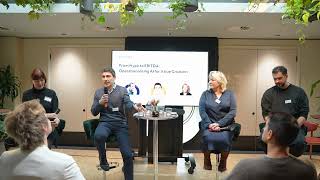
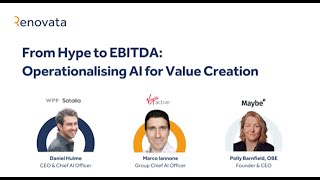
Polly Barnfield and fellow panelists discuss why only 5% of businesses get real ROI from AI. They identify four red flags: premature data readiness, unrealistic talent expectations, chasing quick wins, and underestimating software-scale challenges. Polly highlights a confidence gap in 95% of agencies, arguing that cultural adoption and AI literacy matter more than technology alone.
Chapters
Good morning. Thank you so much for giving up the time. I know diaries are under pressure at this time of year. If we've not already met, My name's Julia. I run the events program at Igvarta. We look to tackle topics that are keeping our clients, for example, investors and divested backed businesses awake at 3 o' clock in the morning. And I think it's fair to say there's only one topic that sits with that class right now. I'm going to do a quick chef house. Who in the room feels that they are working with or in or advising a business that is realizing meaningful value from AI at the moment? Just kidding. I'm sure you're all familiar with the statistic that came out of MIT earlier this year as well, which was around only 5% of businesses are actually realizing meaningful value. That's what we're here to talk about today, how AI is creating actual meaningful value, ROI and returns. We're not going to talk about hype or headlines, but rather believers of growth, efficiency, margin in the companies that you all either own, invest, operate in or advise. Thank you all for submitting your questions. It would be a race to try and cover all of that ground in one session, but we'll do our best. You collect. So we're going to start. I'm going to head to the biggest question that I think came out of your responses to, to our, to our, to our open question of what we had to ask the panel. So how do we know, how do we know that AI is creating value and what does that look like? And I think from a big picture perspective, I'm going to go all the way to the left and start with you, Dan, if that's the right.
I've been working building AI solutions for the past 25 years. I don't think I need business. If it wasn't creating value, it would have died a long time ago. I sold my AI to WPP four years ago. And so WPP have dual strategies with respect to AI. One is empowering people to use these technologies, however they want to improve their job. And we have Now, I think 60,000 people across the organization that are actively using these technologies, doing stuff. I actually don't know what they're doing, but they're doing something clearly that must be valuable to them. And then the second strategy is how do you apply AI solving problems, frictions across our supply chain to be able to create ads or promotional materials much more effectively. And again, I think we'd be investing 300 million per year in solving those frictions and give you some numbers later on. But ultimately these technologies are completely transformational, at least for our industry and driving value, not just in terms of making them more efficient. There's a lot of emphasis at the moment on improving productivity, how we get more out of people. But the reality is that productivity is really not going to differentiate your business. You might solve some sort of back office problem, but the reality is there's some third party that probably provides solutions going to solve that problem more effectively than you. I encourage organizations to identify problems across the supply chain that are going to really differentiate their business. And I'm guilty of this going after quick wins and low hanging fruit. The reality is that quick wins and low hanging fruit are a distraction. Really what you need to be going after are those differentiated solutions. And those are typically not big and they're not easy. And so that's really where I think organizations need to be focusing. But the problem is that people apply these technologies to solving the wrong problems or problems that are not valuable. So we have to think that they're valuable. But if you identify the right frictions, if you apply the right technologies, they provide a massive amount of value.
And I think, Dan, you wrote an article recently about how AI is a mountain and not a bubble. What do you see at the top of the mountain?
Essentially?
So I guess there's two bubbles. One is the financial bubble, which is, is there all the speculation around technology. Arguably, actually 50 years ago, the bubble was you were told to build data lakes, put tableau on top, hire machine learning experts, data scientists, and hope that by extracting insights from data and giving those insights to humans, it will lead to better decisions. The reality is that giving human beings better insights won't lead to better decisions. That was a misinvestment, it was a misunderstanding and arguably also Metaverse was a bubble. There was no real clear trajectory to value. So whilst there is often speculation about technologies, and sometimes technologies are ephemeral hot air surrounded by a thin, shiny, veneer, generative AI, these technologies are not technology bubbles. I argued through a mountain full of gold, which is what you need to do is you need to understand the right equipment, tools, energy, resources. You need to figure out where to find gold, you need to have experience and certainly how to extract gold for that mountain. And that is not easy. And so AI is not a technology bubble. It might be a financial bubble. It's not because there are proven track record organizations extracting gold from that outing.
Great coming down. Thank you. I wanted to go straight to Marco on this question of ROI and value, actually. So from an in the trenches perspective, I think we've talked about there being quite a clear mental map that it's useful for people to follow when they're looking at implementation and adoption.
Absolutely. And. So I think one of the key challenges we're thinking about AI, particularly if I put myself in the shoes of people in this room, is what's so special about it and the difficult aspect that we're looking at it is in many ways, obviously, AI is completely transformative, but at the same time, there's a number of ways in which you want to think about AI that are very similar to many other projects, particularly when looking at roi. There's no particular. Sometimes people look at AI in sort of a magical sense that we need to do it, and then, you know, value would just appear out of thin air. That's not necessarily the case. Particularly when looking at building a business case, particularly when looking at trying to measure roi. There isn't anything necessarily different about AI. The element of difficulty with regards to the AI is the fact that there's a lot of uncertainty around a lot of the use cases. But when you actually want to be the solid business case, when you want to build roi, when you want to justify why that initiative needs to be in place, ultimately boils down to the good or simple ways in which you would have calculated ROI for many other initiatives. At the same time, you need to take into account, obviously that there's a set of risks, for instance, that are quite different from other initiatives. There's a set of skills that you need that may be different from other initiatives you may need, as Dan was alluding to, you may need partner with a different set of third parties. So I'm not suggesting that AI is necessarily run of the mill, exactly the same as other types of transformation that you've seen in your company. But at the same time, when justifying roi, when justifying an initiative, you know you need to be able to better the fact that your customers will benefit in a particular way. There will be some sort of productivity improvement, which I agree very much with Dan, until those are kind of the. The smaller stuff in the grass scheme of things. But I think that's what I would urge to focus, is to go through the fog that surrounds AI and try to see exactly how value impacts you at your company, specifically in very, very measurable ways. And within that, the map that Julia was alluding to can help you to kind of figure out what are the types of forms of AI that would be beneficial to you, the types of impact in your company. And so the way normally I frame it is, and this is the way I'm looking at it also in my current job is that on one hand that you do want to enable every single person in your company or in the companies in your portfolio to feel that confidence in AI and an expression that I quite like because hopefully it's not too ambitious, seems reasonable. You want people to ultimately be able to default to AI in the same way in which now it would be embarrassing for you to send around an email to a lot of people saying, hey, can you help me to figure out what is the capital of Jean? You know, you can Google that in exactly the same way. You want people to realize that there's a number of tools that you can use from their point of view that will enable you to do your job in a more effective way. And soon it will become embarrassing to not have gone through that process before actually asking questions, talking to your colleagues. For instance, if you're looking for a third party, you will need to do your research before even engaging with other people, etc. So a lot of people are, a lot of employees in companies are going through this learning process. And I think I very much urge everybody, including the senior people, to go through this process as well and to be able to become default into AI as a kind of a matter of fact. Then briefly, the other components, on one hand, obviously there's the productivity story, which can be impactful depending on what you're looking at. It's not the big box necessarily, but what can help is to build the muscle within the company of identifying the right type of projects, building the ROI in a way that is kind of slightly safer, as it were. Then there's third component, which is what Daniel's alluding to, which is very much the transformation of the customer experience, the way they deliver value to your customers, and that's where generally there is value for your company. And then the fourth component, which is much more future looking, is how do I need to prepare for the way my industry is going to be disrupted fundamentally by AI. And some sectors are going to be quite resilient. I'm lucky to work in a sector wellness that is quite physical. So ultimately people would still need to do their exercise, whether in a gym or elsewhere. But there are other sectors, such as E commerce, for instance, there will be profoundly impacted by AI. And so you do want to start thinking about the next two, three, four, five years and how you need to prepare for the adventure thanks Marco.
And Polly, we're having Mike trauma this morning. Polly, just go for it with that. So Polly, you've spoken to many, many different businesses over the years and you recently produced the research that talked a little bit about the confidence gap. And Marco, that's something you just alluded to as well. So can you talk a little bit to that in terms of how that makes a difference from a value creation perspective?
Yeah, absolutely. So we've recently surveyed a thousand agencies about their use of AI and we've called it the big AI secret. And the reason for that is because actually you, you only need to open papers of like this or open up LinkedIn and you could have the most amazing FOMO. You think I'm high? Hands up. Hands up and sleep there. Maybe not. No, nobody didn't mean to look, you were like this. That's the big AI secret, right? Is that, you know, let's be true. So AI has been around for a long time, but only 3 years ago ChatGPT arrived and it became thing, you know, they made it real, maybe something you can use. It's the biggest amplifier, it's the biggest enabler. But actually there are no rules yet and that makes it scary. So we discovered having intuitive agencies for everything, big guys like these guys, two to small guys was actually that 95% of businesses, they haven't got skills, we haven't got the tools internally to do this. And actually there aren't enough people that know because it's all happened so fast. So 75% of those agencies said they haven't really started. They're making that phase of just using a little bit of AI. There's no central governance to it. Governance is a big reason for not moving forward. It's a good excuse for not doing it. 25% have started of those, 17% are implementing and only 7% have really embedded AI in SS. Alice seen great results, but I think to the ROI point, I think a lot of this, it's easy to talk tech but the bit that really matters is determining what does ROI mean for you. Because AI is an amplifier of people. It can be an amplifier systems, it can be an amplified process. So trying to determine internally before you start what is it you're wanting to improve because you won't know that you're never going to make your own way. So I think there's a lot of you can't measure the roi. Did you know clearly what you're trying to make in the first place?
That means we do so emphasis, so emphasis on Measurement absolutely key. And we'll come back to the sort of people element and capability and confidence, I think, towards the end. But one of the things you said, Polly, there are no rules, right. So governance is unclear. But I think the other thing that's stopping people in their tracks is this idea that things have to be at a certain point in your organization in terms of data infrastructure, the readiness, the question of readiness. Yeah, please do.
Nobody's ready. You've just got to start. This thing is not stopping. We've all got access to it and you have to come up and plan because don't you?
Yeah, I agree. There's absolutely no, no way in which you can weigh that everything is aligning, that everything's perfect and then you do AI on top of that. That's absolutely never going to happen. And particularly so if you look at it from the point of view of the data and systems, by the time you sort out all your data and everything is tidied up, two years have gone by and with the pace in which AI is moving at the moment, there's no way you can wait for those to list until they get things right. So you need to get started in a way that is potentially messy and that's where the fun is.
Actually, Dan, I can see you're going.
To jump in the mountain article I wrote, I talked about the signals that I look for in terms of will that AI project be successful. But what's really interesting is signals that will indicate apparently, and I think really there are four red flags. One is, here's the data ready. And 50 years later, having been told to build endflakes, our data still isn't ready. Your data will never be ready. And I know it's blinding obvious, but you always start out with a problem and work backwards. Don't start with data, don't start with technology, start with problems, start with friction, figure out, use every detailed roi. Please start, figure out, is it going to be valuable for your organization, can you solve the copy of the skills, et cetera, and then work backwards, but make sure you're building these solutions and then building AI capability over time. So not just out of the data lake, the second is hiring talent. So we all want to hire DeepMind talent, but the reality is that 1% of us will be able to do that. I think it's really important to admit to ourselves that we can't hire really differentiated talent. If you want to build differentiated solutions, you need to have differentiated talent. And I know there are lots of people that rebranded themselves as AI experts the past three years. But the reality is that differentiated solutions require differentiated talent. And the reality is that most organizations can only reengage their talent as a partner company. So there are partners out there you can engage with that can bring that talent, that can augment that talent with your domain, your expertise. The third red flag is quick wins and buying fruit. Again, they are probably not what you want to be going after. And then the fourth one, my brain's failing me right now. It was probably some profound failure. If you've never ever picked software, then you're probably, if you've never built and scaled software in your organization, you're probably not going to be able to build and scale AI. AI is just software, actually more complicated than software. AI projects fail not for AI reasons. They fail because they don't have the right budget, they have the right expertise. They always think about how it can be maintained, supported, all of the stuff you need in place to make software work. So agents are now a thing. Agents have been around for 40 years, but people are going to now deploy agents across our organizations. And AI at the moment is actually intoxicated graduates. So you're going to deploy all the intoxicated graduates across your organization and you're going to be surprised by fails. Forgive me, it's going to be a shit show. That's the technical term for this. And there's going to be then much more emphasis on regulation and governance and all that kind of stuff. So that's why I expect will happen over the next few years.
Absolutely agree. And I guess one of the risks when thinking about this, and actually we were having a conversation about this five minutes ago with and is that a lot of senior executives, they feel like they need to do AI and they need to have a kind of AI project they can talk about and boast about. And so as a consequence, there's pressure in a number of ways throughout organizations to do some AI. And obviously that's the completely lopsided way of looking at it. So you don't want to, you know, like to feed the egos of potentially some senior executives in the company, try to boast about the 15 million as we were talking about that they somehow magically made a PR somewhere in the pnm. You want to start from the problems, you want to start from what are specific ways in which I'm going to add value. And then to some extent it's quite likely that that AI will be able to enable at least some of it. But it's definitely not going to Be the cure call. It's going to be an ingredient that you need to be able to apply to build ultimately what are for instance, new digital experiences for customers or new ways of making sense of the data that you may have. But starting from AI is definitely not going to get you anywhere. Well, good.
You in the room has been in a board meeting or an leadership team meeting when AI has suddenly been table on the agenda with very little preamble.
For sure.
Go on, Marco. I think I wanted to talk about typing next as well, because the point at which AI appears as a commercial driver and there is that impetus to create value, to generate RO buys.
So I would just like to take that point alongside Daniel Shisha, which is that I think cognitively understanding what AI can do is very hard. These, the technology, it's software, but actually you've also to work out how it works with your people. And from the ROI perspective and from the boarding perspective, sort of from a, from a. How you manage this new technology is about thinking, well, how are we going to amplify our people? How are we going to enable our people? And Daniel, to your point about agents, they are going to be everywhere. But unless you write a good brief for a new employee, unless you write a good job description, unless you give them the right structure to work in, you're human to your player and AI will be exactly the same, is you've got to be able to know what you wanted to do, explain to it what you want it to do, because it is like it's not human, but it does follow, it does follow rules really, really well. So all of those broader conversations about, well, what do we want it to do and is that going to deliver benefit? And when you get to that point.
Just to build on that, one of the uncomfortable truths that I find myself mentioning quite often is back to what probably was mentioning, is that because AI not only is somewhat confusing and very, very different, but it's also changing all the time. The expectations with regards to AI are changing constantly and quite radically. So what that means is that if you are in boardroom conversation, you will not be able to meaningfully contribute to the conversation if you are not using it yourself in a way that you can build those intuitions. So you generally generate this be part of your daily life and if it's not already, if you don't have whichever LLM on your phone as an app, you should install it as soon as possible because you yourself need to be the intuition that enables you to then build an idea of what AI can do for you, for your company. So it's absolutely essential that at the most senior levels of the organization this happens. And there's a very strong correlation. There was a survey that came out a couple of days ago. There's very strong correlation between the level of AI literacy of the leadership of a company and whether or not AI actually is, is delivering positive returns back home. So that is very much something I recommend at all levels. And that's. I joined this company literally a month ago. That was literally the first thing I said to the whole executive committee. Everybody needs to get on with this and everybody needs to be enabled with this. Lo and behold, half of the people were perfectly happy to go with this. The other half were not. And so there is a transformation that needs to happen.
Yeah, I think there are three things that differentiate the company. First is data. If you have data that contains insights, it's more useful. You have competitors and you have an advantage. It's data that makes AI smart. And if you don't have data, then you have to come up with interesting revenue models, ways to capture, model open source, all that kind of stuff. The second is AI talent. Again, you need AI talent to leverage those insights to be able to drive value. And then the final place is leadership. And leadership understand about transformation, how these technologies, if they place the right bets, then you have an advantage. And it's a huge amount of nonsense out there. It's really distracting for me as well to try to understand all of these things that are going on. But maybe one thing that's quite helpful is to understand also the trajectory in terms of how these technologies are developed, because they are developing very quickly by now. I do argue they're like intoxicated graduates. You have to ask yourself, would I employ an intoxicated graduate to do this job? And if you did, then like carpet horses and stuff around it. But they are now graduating to a master's level where they can do rudimentary reasoning, they can start to check their own nonsense. Maybe in the next year we'll have PhD levels so they can apply solve complex problems. I think in the next three years we'll have a postdoc level so they can actually apply the scientific method. They're pushing the boundaries of knowledge. And then by the end of this decade, it's predictably professor in our pockets or something that can actually not only solve very complex problems, but can ask questions that humans haven't asked. And so when I think about building technology, I'm thinking about building touch, because you might be able to build something now, in a year's time, it's going to be diluted. So it's important to maybe think about how it's newly.
Yeah, just a bit on that. I think that is back to the point about ROI and back to the point that in many ways a business case for AI is similar to any other business case that you've done. That is probably one of the main things which is not the same, which is the fact that right now you may want bin solutions, very clever, uses the top of the range AI. And in six months from now you need to throw it in the bin because all of a sudden that particular solution has been made obsolete because there's a better solution. So in many ways there's a bet. You cannot necessarily know exactly where the hyperscalers are going to be six months from now. But there are strong. There are ways in which you can mitigate that risk by, for instance, leveraging primarily your own internal data or by talking to people who work in these companies that kind of have an idea of where the direction of travel is, or building an assumption about that. But certainly I've seen this again and again. There's a lot of effort to build a solution that seems very clever, but all of a sudden, three months later, it's like, wow, that is a waste of time.
I think the question of targeting is key. I'm going to come to you next, actually. What advice do you tend to put to leaders like best thing with this prioritization framework, you know what to do first and how do you prevent them from ending up in paralysis?
I think even just listening twice, it's quite confusing. So accept this is going to change. It's going to change faster than anything else. But the absolute reality is that within every business there's a whole bunch of stuff right now that our humans are doing which they shouldn't need to have to do. Repetitive stuff, filling in CRMs, reporting stuff that could be done really, really well by AI. So find the repetitive, boring stuff that frees your humans to do better stuff. And when the best technology comes along, that will get better. But unless you start to think AI first, you'll never get to that perfect place. So, you know, we're all moving in different ways. There are ways to start and I believe that it's not such a shit. So pick the things that your people aren't doing really well right now. Because it's also very important that your team understand that AI is not about taking their jobs, it's about empowering them to do their jobs better, have your existing team do a better job, serve more clients, whatever it is. But you've got to build that confidence because otherwise you have a cultural issue they own as well. So for me it's start with boring stuff, fix that, and then you'll discover your path forward.
And just. I want to lead straight from that actually to a question for Dan about the buy, build or partner framework, which you already alluded to. Actually, how do you navigate that? Typically.
It'S very simple. Again, I go to an organization and I sit down with them for a day and say, what are your questions? What are the pain points? You have a problem organization. From expenses all the way through to supply chain optimization. Let's sit down and let's prioritize those frictions according to some criteria. And actually, I don't believe in complex return on investment models. We use a very simple one where the question is, is the data available? What's the expected return? Is it big value? What's the timing in terms of we'll get our return? Is the stakeholder buying not just the senior stakeholders, but the whole income people in the grand tribes, it's going to be affected. Is it hyperbole? We're going to celebrate. Do you have the time to maintain how much it's going to cost? There's like certain criteria that we use to score those frictions, prioritize those frictions. We ask ourselves, okay, let's solve this friction. Is this something we need to buy, we buy off the shelf, or is this something we need to build? If you're building stuff, it's really, you only need to be building stuff that really then differentiate your business. And what's exciting to me about building stuff, trying to build back things from suppliers, is that if you get it right and this is hard, you can not just turn it into a cost center, you can turn into a revenue center. So one of the things that we've been doing with the APS at the solar company for the past 12 years is that we've been solving problems gradually across the supply chain from last mile delivery, middle mile delivery, warehouse management. We predict football in their stores, we do workforce optimization in their stores, we predict whether suppliers are going to default on the suppliers. We can solve these problems across the supply chain using different types of AI. What's interesting is that we've now platformized that they've actually created a company called Sofa Delivery Company that they're now delivering sofas for their competitors. So there is an opportunity. You do build these innovations that Differentiate you. You can then turn them into coffee sectors. But just something frictions and we each want to decide is this an off the shelf solution? Is this who we need to wait for a startup to solve? Is this who we need to build ourselves to differentiate us? There is a lot of excitement around these technologies and we do like to build stuff and we like to build careers around it. You know, we saw this 10 years ago with machine learning. People build models, they build technologies that in three years time the talents left, they don't have technology that they are because disappointed. And we don't have three years to get the wrong answer. Now we got three years to get it wrong. And actually going back to the first question you asked, which is where are you on your journey if you haven't started yet, that's not a bad thing. There's a lot of organizations that are misinvesting, they're creating tech that, that they're going to have to undo. So if you haven't started yet, that's not a problem, but just make sure you start the right way.
Yeah, I completely agree. The whole idea of build versus buy, first of all, it depends very much on the company and your level of maturity. If you're reasonably comfortable building digital solutions, then obviously adding AI on top of that may become more sensible. But even in that context, as Dan was alluding to, building something means actually making sure that that remains future proof for the long term, you need to maintain, etc. So it's a major commitment. You only want to do it when it's something that is generally strategically meaningful to you and is differentiated. Otherwise, the vast majority of the cases you may want to either just buy, which hopefully is. Obviously you're never going to find something that is exactly what you're looking for. But by and large, for the vast majority of the needs of a company of normal company, there's a plethora of software as a service solutions out there that will enable you to do things or more and more it's becoming possible to actually build automation workflows with solutions that are already existing. So it's not necessarily, it's something of something in between build and buy. When you use a solution that enables you to. Back in the day it was called robotic process automation. Now obviously it's kind of workflow automation using AI. But you can connect different pieces of your organization, digital pieces of your organization in such a way that you build meaningful workflows. And obviously occasionally agents are the right solution for that if you use them carefully, very carefully, so there's a number of solutions, the fourth solution if you like. So there's kind of if you build by some sort of integrate, shall we call it? And then the fourth solution is obviously to partner with another company that will buy, will build something for you and obviously they will also be able to maintain it for you too. You wouldn't to worry less about that. So again, how strategic is it? What are the skills in the company and what is available in the market? Those are all the factors you want to take into account. The vast majority of the times you will not want to build it yourself unless it's generally transformative for what you're trying to do.
Paul, you can't give specific questions on this for you actually one was around where do you see businesses getting it wrong? The other one was around for SMBs or businesses with less large budgets. What does that dialogue look like in terms of how would you advise that as.
Great question. So I think that, I mean SMBs, even to a very high level, you want to think about partnering. Definitely don't try and build because you've got to consider am I going? Marty, LM question number one. That's already a massively complex question and there's not enough talent out there. So find a partner that understands you, relates to you. There's a human fit because despite all the technology, AoA is an extension of your human team and and you've got to have that deep understanding of what the organization wants to achieve. It's not a one size fits all and AI is like Lego. You want to be able to piece it together, but fundamentally it wants to feed off your single source of knowledge. So is my knowledge safe, is it connected to my systems and is it culturally a good fit? And then you've got tools to build out what's coming next because do we art smart but not everybody knows. And so you've got to create a framework that will scale, but you probably need some help with that. What I find is that we often see somebody goes all right, we're 17, I'll drink you at this. This is not like social media. It can't be given to the engine person. It needs a plan and it's pragmatic because it's been a change and that's the same whether you are large or small. We see a lot of blocks as well. There's a lot of reason not to do it. Date of the brain, when already. But culturally that creates the environment which is we're shelving it and that doesn't work. Either. So it's about saying to Daniel's point, don't get me unsalpted but you need a plan and that's about being open minded, fun. Right people. But it's these. It's not just about technology, it's about cultural physics.
On yeah. So I mean there's a really good definition of AI that comes from the definition of intelligence. I know that this very popular definition of AI which is I think the Wheaties definition which is data computers to do those achieve humans can do and that's called corresponding natural language of web basic objects. But there's a really nice definition of AI from the 1980s which is which comes with definition intelligence which is goal directed adaptive behavior. The key word in that definition is adaptive. What you want to do is build systems that can make decisions learn about those systems that could adapt themselves. Now at the micro level, when you're building AI systems ideally you would make it adaptable. But most systems are adaptable. Arguably nobody's doing AI but of course that's ridiculous for all the AI. But most systems in production are adapting themselves. What you want to ultimately do is create an organization that's adaptable. That's when I look to invest in companies. I'm assuming that technology is going to be be a clarity and when you ask the question what's coming down the line? The reality is that like your large language models we all know about horrendous they need to be efficient. They require loads of data to learn. They learn very slowly. They're crude representations of your brain. Your brain operates for how the light bulb. You don't need a new capacitation to run it. Your brain doesn't light up entirely. You only need to know that's a microphone once and you know what microphones are. You don't need to see. The reality is there are many innovations that are being developed stacking the EU right now. That model how our brain is working. Those innovations will completely change how AI is going to work over the next five years. It's so hard to predict the future. I would assume that technology is not going to be differentiated for you. I'd assume that actually maybe the daytime not really a differentiator. What's a differentiator is your ability to adapt to a rapidly changing world. That means being able to innovate rapidly. And that's a cultural problem, it's not a technological problem.
Absolutely. And that is something you can literally start right now to the point where we make regardless of where you are from systems or data Point of view, what you can start is to try to build the master that enables you to learn quickly and build solutions, find solutions quickly, solve problems quickly, deliver value quickly. And you get it wrong. Or the companies in your portfolio. We get it wrong a number of times, but ultimately that's how you build the muscle that would enable you to kind of stay adaptive over the course of the next universities.
So questions around culture, actually people came up frequently in terms of. Terms of what you wanted to ask the panel. And Polly, I know that this is something that you've written about extensively. The tech is there, right. How do we create organizations and cultures where the technology and the behaviors actually align?
So the. To mark his point, you can say everybody should start using AI. But organizationally you've got to also have that thought of how do you manage this safely? So you do need a company policy because you want your data to be circuitous and have restricted cases to where global companies are. Had the focus groups put into ChatGPT. And you can't do that. Let's be clear. Do that. You'll give them. We're putting on secrets and we win. So culturally, you've got to have a policy that says, this is how we're going to do it and enable your team. I don't remember your question.
It was about how do we get behaviors and technology to align.
Yeah. So you've got to have a yes. Policy. You've got to have a public. That we're doing is policy and you have a public. This is how the company is doing this. We're working very hard right now making sure that I'm assigned by agents. Can I say that we're working really hard at lending agents to work with the team inside slack or inside teams. So they just become another colleague. I believe that we are on a journey. Is it going to be right all the time? No. But can it make an independent, an individual's life better? Yes. Now if we can get to that point, that's where you start to get cultural change with an organization. That's where you'll get everybody in an organization thinking, gosh, could an agent do that fully and better? Why am I. Why do I keep doing this for better cons. So I'm about legal wins because that's what changes culture. But you get Everybody to be 20% more efficient across an organization and that's massive change.
And.
And that's what matters.
Yeah, I check maybe just a bit. We know that AI can solve problems across supply chains. I think we've all done that and we can solve problems in a way to differentiate. One of the real opportunities of AI is to create what's called a digital twin documentation so you can actually now project questions across your supply chain. Something happens here. What impact will it have on my supply chain? Supply chains exploratory, disconnected. And the goal really is to try to create a simulation so you can adapt your organization to a changing world. But there are three footprints I think companies need to build. One is a supply chain we're all going on really trying to apply it to make things more efficient, more effective. The second is back office processes we've already talked about. I don't think we should be solving back office process problems. I think leave that to your third parties like and AI is not only making back office choices more efficient. I think we all know backup stresses are boring, bureaucratic, they are a hindrance to innovation in one company. I know I won't say to you but the expense policies. You ask your manager for some money to go to an event like this, it goes up an email chain to some accountant in some corner of the world and says yes or no. They don't know what they're saying yes or no, do you? It's a bad way of making decisions. So Gore Tech, the clothing company, they let people expense whenever they want. All of their expenses are publicly available so people self decreasing which is much more effective when living expenses. So the whole opportunity to make back of exposures more effective. And then there's the method of workforce. And I think most organizations are structured as a hierarchy. I think we all know that hierarchies are a crude way of decision making across an organization and that's at the top. Of course you can go make those decisions. Actually what AI is enabling is the ability to what's called liquid organizations. And this is something I've been thinking about a few decades and we try to implement some of these ideas in Satalia. One thing that I used to do before I realized it was illegal is that we used to get everybody in the company to make public recommendations for their salary. So every public declare what they want to be paid and then people would then vote on whether those salary should reduce or increase and we would use AI to determine how many votes one person has for another. So if I've worked very closely with you over the past year, got very knowledgeable about your domain, I can look at your digital footprint, determine how expert you answering this question, how good are you making this decision about csl? Turns out people rubbish at setting salaries but the point is, what you're trying to do is you're trying to create essentially liquid hierarchies. You're trying to figure out how do I get the best diverse group of experts to make a decision that unfortunately typically gets made in rigid hierarchies. What AI is enabling is the ability to create these liquid organizations where you're not only getting the best group of people, but the best group of AI to come together to solve the problem. And it might feel like your organizations are a million miles away from that. The reality is if you start using this concept for feedback, like identifying people's feedback needs, and you can very quickly go on to career development, salary setting, performance reviews, very, very quickly, you can start to operate in these ways. And so in terms of married culture and technology, I think we need to actually change how organizations operate. I don't know if most of you probably are therapists, but 60% of the population are dysfunctional at forming and maintaining relationships. We all have attachment disorders from our childhoods. And of course hierarchies and organisations are not set up to create safe environments. So we need to change the way organisations we cooperate.
Marco, you've just stepped into a new role in a well established, well known brand. What would your take be on that in terms of how leadership is going to optimize in that environment?
It would be incredibly dependent on different contexts and the extent to which you will want to actually kind of move fast or not. I think a good example of this is Moderna, the pharma company that they always have been describing themselves as a tech company that operates in pharma. And I think recently they ended up merging the IT department and the people department, the HR department, because they turn into the department of getting things done. And whether that's going to be done by agents or by people is going to be decided by that department. I'm not suggesting that's the right way of looking at things, but it's a way of embracing what's happening and trying to modify the structure of your organization to adapt to this kind of change. Again, the circumstances will be very different in the context of the role that I have at the moment. We are doing a lot of what Dan just described as the liquid organization that we are looking very much at.
Building.
Teams across the hierarchy of the organization and that can be very important to get things done. Very often this applies to a variety of different projects, not just AI, but in AI, very, very often a project to deliver value is not siloed in one particular team. One particular department you want to speak to anybody from marketing to IT to operations, et cetera. And so what that means and within those teams you want to find the right people with the right kind of mindset to actually explore and innovate. So one thing that I don't know in some companies you call those target teams or whatever you may want to call them but effectively building this kind of cross functional teams that can get things done in space of AI with exactly the right skills and not only that, with the right attitude not only to AI but more generally to change transformation that can be incredibly effective in to get things done.
I think Mark is determined at describing internal influences.
Yeah if you call them that way.
I think I'm going to pause there actually. I'm really wondering at time because I wanted to be decent channel time for questions from the law. And so I will step out here with a mic and if one of my boys come grab another mic it feels like we've just done the fastest dance through a whole load of confidence conversational real estate. So let's get to some specifics that you all want to to ask who.
Would like to donate their mic.
Hi there.
Thanks very much. It's all been very quite processed corporate structurally driven the conversation but obviously people.
Are what make companies tick.
AI is quite scary for some, are very exciting others. And I've seen a few spaces where companies are using AI to actually help their staff just improve their lives.
For example, I think I tend to pretty much send people dyslexic.
Reading emails reports is a nightmare for them. Writing things is disaster. So just helping them use tools to turn text into audio thing or be.
Able to write their emails better.
Do you think it's something companies should spend more time understanding and investing in because if people can understand how I can help personally might help them be happier at work and do more.
I'll take that as a dyslexic with a daughter who's dyslexic. I think it's transformative. So I think it's a massive enabler and yes it's a very simple life. It's. You know that whole point of cultural adoption is key because it's, it comes back the cognitive load that we all have to manage. We're dancing dance with so many different systems, so much information we've got to manage. So whether you're dyslexic or not actually it can reduce cognitive load as well. And I think that's we are all pushed by this. AI can take on jobs but actually enable AI enables you to do as a closed path, you know, that's the lowest list possible. Start with. Then begins the organizational change piece.
Yeah, actually, so I mentioned the BP strategy which is looking at a central organization scaling 300 BP experts try to solve specific problems across our supply chain. But then the policy is let's give everybody access to these technologies, let them innovate at the edge. Now the challenge with that is if you don't give people access to ChatGPT natively, then they could be uploading, they could be engaging man putting data there that they should be putting. So, so we had to control that very, very quickly. We had to get control over how people can access these technologies. So we built the company between Open, which is our end to end sort of AI platform that allows people to engage with these models. But people are probably using models to help them pay parking fines. Right, but we've got no idea. But the point is let people use it. People are using it and then benefit. What's also interesting is that what it's highlighting is those people that have a breadth of knowledge, those people have done art history or advertising technology or learn about photography, lighting, aperture, camera angles, they're able to actually much engage with AI better than I can. They're able to refer to some, you know, some tribal, a team to the corner of humanity that I've never heard of and they're able to surface those things from AI that I can't. So encouraging people to develop breadth of knowledge so they can ask better questions has also been very exciting because people are now valuing the humanities in search of the technology.
I think that's, I think really interesting quote which is actually all going to learn how to manage AI. You've got each one of us got a whole team of people and it's how do you ask the right questions? How do you add value to who you are by using AI?
Yeah, and building on that, one of the. Oh yes, building on that. One of the experiences that people go through when using AI is that there's a big difference. And this is also reflected in the way the workforce will evolve in terms of impact of AI. The way you relate to AI when you talk to AI about something you're very familiar with or something you're not familiar with, it's a massive difference in that as going back to the metaphor of the intellectual security graduates, you don't want to entrust them with something that you're not familiar with at all because obviously you just take the answer face value. And believe it. So I would very much recommend in very practical terms to start using AI or to focus on AI use cases where actually you can tell the extent to which the answer is correct and the extent to which is complete. Very often that's part of the challenge because AI will be particularly beneficial to the people who are already familiar with a particular topic. And so that's a very strong place to start as opposed to starting with something completely unfamiliar. And then back to the point that both Dan Olig were making. It's absolutely essential to empower people to identify the ways in which AI is helpful to them. So you came up with an excellent example there. But there's a plethora of examples that I would never even be able to imagine. And so that's why helping with AI literacy and helping people to build the confidence to use these kind of tools is advertising with use cases that, you know, people in the, in the boardroom or people in the leadership will never even imagine.
Other questions.
Thank you, Dan. You spoke about not prioritizing quick wins, but really focusing on bigger problems to solve fully. Resonates. But I think one of the challenges, and I think our investors are not here. One of the challenges a bit. Every time I go to the board meeting, my CEO ask asked me explicitly to talk about how can we do things quickly with AI and what are the liquids and how can we show that we've done it faster than we have for 12 companies. So how do you practically approach these conversations? Because I think the ROI question is still there, right? Like how quickly can you get something to market, how much money you can save or take? What's the best way that we've seen companies do?
So I'm guilty of it. I'm going after quick start building freeze as well. And actually if you want, I can share some slides with everybody, which is a very, very simple framework that we use. Again, identify frictions. What type of have you got a friction that is turning data into information or extracting insights from data or meaning decisions from insights? So I've got this very nice framework to help understand what frictions you have. And then again this very nice, very lightweight model to, to prioritize those frictions. And then you can then start doing a conversation with them saying, okay, we got this friction, let's say expenses, the expenses or checking expenses of friction. Job data probably is easy to build.
Yes.
It takes weeks to build. It's not basically expensive. What's the return on investment? So you can actually have started a conversation around whether it's something that you should build yourself, which is going to take three months worth of build or you can advise them from Microsoft for a fraction of the price. And so I think just say let's not talk about quickly lying through. Let's just focus on what are the frictions that we have and prioritize them according to what's going to organization try to remain this rhetoric.
I think from the research we also realized that this whole return investment question calculated quite literally and said what do our teams spend time doing? How could we if we fix that, what's the return on investment for it? And then you just have a framework you start to prioritize because it's how do you create a process that says we understand why we're doing what we did when. And then you can look at technical risks or big technical risks. Does it help by development with the.
Answers you can I guess I was practically in relationship with those CEOs. If you settle them, what you're saying is just like the answer. You're saying quick wins because you don't know what you're talking about. It depends on what your relationship is. But I think it's really important to.
Be honest with people.
Don't go take or being told by tech consultants.
Can I study just to add to that, I completely agree. However, we do sometimes find ourselves in a position where you need to get the leadership on a journey. And I think that's what you describing. And sometimes if they're not particularly familiar with AI, they know that you know we have to do it, but they would also want to see the roi. And so sometimes you need to accept the fact that you need to start building momentum in ways that can be expedient, not necessarily optimal, so that then you build trust and so that the senior people will then see okay, these people know what they're doing, we can see returns. And then you can make an argument for building much bigger, more ambitious use cases. So sometimes there's an experience in terms of doing those kind of simpler projects because just so that you can demonstrate that things can be done because the reality is a lot of projects stay in pilot phase. And so it's perfectly legitimate for boardroom to be skeptical about enormous benefits like from one day to the other, or being skeptical about investing millions in something that doesn't have a clear return. So sometimes for building momentum within an organization, for assisting in that process of kind of cultural shift, you need to accept the fact that some projects may need to be slightly less ambitious and then people buy to that kind of momentum that you need.
Thank you. We've got one for Stephanie at the back and then Mike and we'll try and take female T recommends staying on.
Top of those Know what students are out there like it seems every day like I've got like three emails on.
AI and one gives you five new.
Products every single day that's supposed to make my life more efficient. I still have to read the email for me. Yeah.
So I mean I've been off that question. Is there one CEO of a very large organization? I introduced myself into two areas so there'd be and he said isn't that just a noddy job title I shares of that company but so I think there are some organizations, there are some industries that are actually quite immune to the consequential power of generative so if you're growing things here, distributing goods, they're stocking warehouses the reality is that generative AI is probably not going to make a difference in terms of optimizing that supply chain. These things like so I make albums, machine link albums that do that. But there are some industries that would be completely transformed by in marketing. Media for example is one of them. I think some industries, the CIO, the CTO can read LinkedIn often enough to say oh cop out what's going on out there. But if your industry is being complementary I think that having a chief AI officer I think is important. Someone who's dedicated to understanding what these technologies are, what trajectory. So you do place place wide bets. So a lot of organizations find it hard to hire goods chief AI officers There are now companies that are providing fractal I think it's a good solution by the way I think you don't need to necessarily have a dedicated chief houser you just need something to make sure that you're being sober about how.
You'Re applying these technologies Polyam the alternative is building a train specific for only.
At ragin dates but then to give you a third view on that maybe you don't do what you just suggested. So you don't actually need to be necessarily on top of every single tool is out there. In a previous company we kind of we were mapping tools for variety of reasons. We got to kind of thousands and obviously we used AI to do that. But the reality is for day to day you don't need to know that there's yet another kind of video generation tool that enables you to put me inside of it or whatever. It doesn't necessarily matter what matters to you. If you start from a problem then it will be very easy to identify the right solutions. Occasionally it may happen that there's a new solution that is actually immediately relevant to you for a particular problem. You don't need to know about that on the day in which it is released. And ultimately, if it's big enough, you will probably come to your objection. So I think there's an enormous amount of concern about, okay, there's a million tools. Do I know. Did you hear that that new tool came out? You know, people are busy and I don't know if you necessarily need to know about everything that comes up.
Thank you so much.
Who's actually given a brief down a ton goals finding strategy, when you use it, to know that's the intellectual property required to use AI to find.
Yeah, you can do that.
And coming to Mike now.
Okay, thank you.
If I may, I'll ask two quick questions. So I'll start and get one Priestess. The first is there is a strong sense of urgency from this expert panel which is reciprocated in just about every boardroom in the land and particularly in private equity land. You know, people are thumping the table to the management team. What are you doing about AI? I have a hunch that is giving rise to a lot of artificial AI projects, which might be behind that 95% failing figure from MIT. So my first question is, how do you balance that sense of religion, which I think is appropriate, with making sure you're doing constructive, meaningful and AI work? The second is more to you, Polly, where you've talked about, you know, automate the repetitive and the grunge work. I have no statistics, but I just.
Have a personal feel that, you know.
Young professionals coming into a business, that.
Is where they learn their skills, you.
Know, on that grunge work, sorry to use that expression, the repetitive work. And if that's no longer there, I.
Sort of feel, what rung of a ladder do they get on in order to start their careers? I'll take the repetitive clubs question first because I think what's very interesting is those people are now the AI first generation. So they've come through education in my daughter's 18 and what should I do where they're beginning to use AI for all of their own repetitive tasks. So they're learning how to manage AI, not in a corporate sense, but at a personal level. So I would argue that I've heard this many times, which is that repetitive piece where people learn the trade. Why don't you see pain differently? That we used to do things, auction that, then we go currently it's about saying how does that next generation do things differently because they've got different tools.
Tools.
So I would argue that learning how to use AI to improve the repetitive task gives us better opportunity to use hard humans in a better way. So it's changing the way that that work gets done doesn't mean it goes away. It's getting that next generation to manage it.
I guess as you first want the backing of the table, you deal with the backing of the table, you know, list them and succumb to them. So I, I do huge amounts of ball talks and I try to educate them. Why put wings and lingeries? And I think so I think you need to educate people. At least if you go somebody banging the table, asking about AI without knowing about what atomic environment, you've got a problem. So I'd educate them and I volunteer me and have to go tell them that they don't want to talk about. And then, and I think it's really important to make good decisions, right? I talk to boards because it's ultimate. They are decision, decision makers. And if we make the wrong decisions then our economy is going to suffer over the next five years. It's really important to educate leadership then. On the skills thing, what's interesting is that there is this concern that we might not be learning these low level skills to appreciate the higher level ones. But I think the reality is that AI is going to solve that problem. AI will help put people in educational scenarios. Not just testing their knowledge, but testing their ability to adapt to complex situation, to be creative, resilient. So I think we're going to see over the coming years more AI being used in learning development, actually accelerate the first part. Not to remove it, not to ignore it, but actually accelerate it so people can in a few years be really ready to do higher order stuff.
Just coming from both. So from the first question about the boardroom point, ultimately what you want to do is to have people who earn the trust of those people buying the what are you doing in AI? Because what are you doing in AI is the wrong question. Nobody should ask that question, however it is being asked. And so what you want is to make sure that the people in the boardroom, they feel like they are in safe hands. So literally on Thursday I have my first meeting with the boardroom and that is the only objective that I have is to tell them, don't worry, we know what we're doing, so leave it, you are in safe hands. Because I think that's really what they want to know. And you know, this is the first month. In three months they will probably want to see some actual impact and they will see it, but I think that's the key objective. So back to the education. You need to build that trust and perhaps that trust comes with some smaller projects where you deliver exactly what you said. So people believe that actually, you know, what you're doing. On the second point, while I totally agree and I'm very much an AI optimist, there are contexts where actually an organization is built as a pyramid. So this is true in consulting a few service business, in legal and software development, for instance. And we need to acknowledge that it is possible that people at the entry level in those pyramid type of organizations may struggle. And there may be arguably some signs that this is already happening in the workforce. But I, again, I'm very much an AI optimist, but there is a narrative disruption there because there are some jobs that, you know, I used to be a manager, consultant, and the kind of jobs I used to do as a junior there now very often can be done by AI. So there is a challenge there. And again, I'm very much an AI optimist and I believe things will find a different shape, as Paul and Dan was saying. But at the same time that would cause the disruption for sure.
We've got time for a couple more.
Thank you, that's been very good.
I'd like to build on Mike's first question.
If you go back to traditional business, traditional commerce, it's always been driven by customer pull rather than public push. The problem with what I'm hearing today.
Is there's lots and lots and lots of product push. You know, we've got all the latest.
Whiz bang AI enabled to do this, this and this.
How are you going to ground it? By making sure the customer, the consumer.
The client actually wants what you are producing.
I think some projects you're working on right now, which is really exciting to consider, the exhaust of the world, the comments on social media, the what's being said today. Well, AI gives you the most beautiful way to listen to them, to react to that, to define the product roadmap, the like, what the company's doing. I think that whole listening at scale, responding, being able to feed that information back in real time into organization changes that dynamic really well. And I think one thing we haven't touched on here is that what AI can do, thought about sort of holistically across the organization, it changes workflow, it changes process, changes process. The other day turned off. I said no one day. So yeah, it changes clothes. It means that suddenly what we're assigning operations, you go hang on a minute, we've got that data there. That means that thing there's no need. And so I would argue it's very customer first. If you take a line data in and that's beautiful unstructured messy data. But he can understand it and that's an AI first approach which I think for me is very exciting.
So your pilot one mic which means that we must draw to edge soon. But I think we've just got more one, maybe two more.
Thanks. So over the next few years what sort of technology businesses would you invest in and which would you must avoid?
I think, I think one by one. So I think there are, you could argue the next year we are in financial bubble is potentially true. I'm not professional investor. Do not take this it's what you're saying for investment advice. It's definitely not it but I would focus on peaks and shorts to begin with. So companies that are very much underlying the data. So you know, from cooling systems to real estate for better sanctions, those are the companies that are much less in public eyes. Nvidia he said that please think he wouldn't have large. I wouldn't necessarily focus on how to scale it.
I like that.
So disclosure I, I, I'd like class myself as one of those companies. So we're in Pixels Shovels business. We're in the enablement business. We're in the business of enabling. Let's go to the knowledge gap there. We're not going to fill the knowledge gap with how people deploy this. So you need a blend of very easy to use tools that blend together all of the the leading LLMs with the core tools to develop and integrate with existing business systems so that AI becomes a seamless layer and you can connect to all employees regardless of the size of the app or the organization. And it's that kind of enablement because the revenue from this comes from the AI attorney. So if you can find businesses that are enabling the AI to turn faster regularly, then you're plugging in for a revenue stream.
Great. I'm very conscious of time. We're going to wrap it up there. Thank you so much to the panel. I did actually want to just finish on a quick fire round. There might have to be some shuffling of bites. So AI overhyped or underutilized? One in one sentence.
Underutilized.
Underutilized massively.
Both.
Actually both.
And synthesize.
If you had a million pounds today, what would you invest in first data partnerships or something else I just have.
To complete sole mission consciousness to the first offering is age verification so testing to make sure that agents are going to behave themselves very important thing.
So when can we climb and I'd invest a million pounds in training skill and.
Well back to I would invest in companies serving the infrastructure that is in it for AI so not Nvidia but companies selling to Nvidia as an example number one and second being what Dan was saying anything that is enabling the age of economy so for instance payments that secure payments that simply knows great.
And then to finish what's the biggest lie that you think people are telling each other themselves about AI value creation at the moment?
Well, based on the the 500 hours of interviews we did most people say please don't tell the client, the boss or my colleagues because we're all doing it very differently and we're not doing as much as you say.
There's this phrase that people used back in the day with Dave which is like teenage sex everybody say that the number is.
It.
More from Polly
SHE BUILT AI THAT WRITES, PLANS & WORKS LIKE A HUMAN| With Polly Barnfield | The Business Spotlight
Why Most Founders Are Doing AI Wrong — And What It Really Takes to Scale It Across Your Team



Transform Your Business with a Complimentary Digital Growth Bundle for High Street Businesses
What should I post this month? Bira webinar 28th February 2024, featuring York

Understanding Place Sentiment - February webinar for The High Street Task Force