87. Poonacha Machaiah CEO, Chopra Foundation – A Spiritual Warrior’s Guide to Resilience

In this interview, Poonacha Machaiah, CEO of the Chopra Foundation and managing partner of Chopra X, shares his personal philosophy, professional journey, and vision for a more peaceful, healthy, and joyful world. He discusses the concept of flow and impermanence, describing life as a co‑creation with the universe and emphasizing a "no resistance to existence" mindset. Machaiah explains the creation of immersive meditation experiences such as the House of Enlightenment, aiming to build modern, transformative spaces that blend light, sound, and brain‑entrainment. He outlines his "ABC" resilience framework—Attitude of gratitude, Belief in impermanence, and conscious Choice to love—drawing on Viktor Frankl and personal practice. The conversation details the Chopra Foundation’s three focus areas (mental health & suicide prevention, health‑span wellness, and conscious leadership) and how Chopra X accelerates innovative well‑being solutions worldwide. He reflects on his transition from corporate tech roles at Motorola and Nortel to social entrepreneurship, integrating his Indian tribal heritage with cutting‑edge AI, digital twins, and the concept of a "Cyber Human" that serves as a personal digital assistant. Machaiah addresses fears around AI, arguing that technology reflects human intention and can augment empathy rather than diminish it. He highlights mental‑health statistics (global suicide every 40 seconds) and his commitment to youth well‑being, as well as his interest in psychedelic medicine and its potential to be recreated via VR/AR. Finally, he shares personal practices—daily Gayatri mantra, motorcycling in the Himalayas, and learning bonsai—illustrating his "spiritual warrior" ethos of balancing ruthlessness with kindness, and the importance of intention and inner peace for global change.
Chapters
Foreign. This is punacha Makaya Machaya Machia, global humanitarian, entrepreneur and artificial intelligence trailblazer. We're going to get into that. He is the CEO, okay guys. Of the Chopra foundation. And we're going to talk about a whole lot of stuff. Ed tech, mental health, nutritional longevity, integrative therapies, why he's here. So let's start with that. Punacha, you do have a few places to be. Why did you choose to join us here?
I think, you know, we all. It's universe conspires, I believe. You know, I would be very arrogant to say that I chose to be here. I believe nothing in life is a coincidence. When you're not awake to the magic of the universe, it just becomes an accident. But when you actually are co creating, co creating, I think life happens and we are supposed to be here. Otherwise, you know, that's just the way I look at life today. I don't, I don't plan anything. I think there's a much bigger plan. And so I believe the only permanent thing is impermanence. So if I, if I live in the moment and the world conspires, then it's flow. And I think the very interesting story, Deepak talks about that when he met his guru, Maharishi Mahesh Yogi, the Beatles guru. And apparently he was in a big event and you know, and after the event was over, Maharishi asked Deepak, you know, what is this word stress? And Deepak, being a physician, gave him all the, the biological what happens when people are stressed? And Maharishi said, that's a resistance to existence. When you have no resistance to existence, you have flow. And I learned in my Life at level 53 that, you know, no resistance to existence.
Yeah, flow, let it flow. Well, you know, it is so funny. You and I met I don't know how many months ago. It was with the amazing Veronica Schweibe Smith at the celebration in Los Angeles of the unveiling of the Chopra House of Enlightenment. I don't know, that space is like where the Van Gogh exhibit where the art is all over the walls and floor and whatever, and you took it over. Do you remember what that night was about?
Yeah, it was called Journey to Self. The whole thing was that I, you know, when we started meditation, the world's largest meditation experience is Oprah and Chopra 21 day meditation. And that really started a whole movement because you have now inside time of calm headspace. We think about meditation. People think like, sit cross legged, close your eyes, chant as one aspect.
Right.
But there's an entire generation growing up who wants to experience and we want to have this communion. So our goal is like, what's the next meditative experience? And we believe that's creating immersive spaces. Right. When you can kind of really, when you go to a. Like yesterday at Sexy Fish, the music is playing, right? There's brain entrainment, right. There's light and sound. And when you look at this, both these things actually train the brain. So we want to create these spaces which will transform experience. Like going to a temple or a mosque or, you know, or a church. And how do we create the modern day version of it that you and me can both be in a space and be transformed. So that's really the goal of why what we're looking at, getting immersive experiences where young adults can go there. And that would be the new, the new religious experience.
I mean, it was moving. But you know what struck me? Deepak Chopra, I looked it up as 77 years old. He's still going so strong. There's so many much going on in his world, which we'll talk about. But as I stood there, I mean, I put on those, I don't know, the virtual glasses to go into the Metaverse, the House of the Enlightenment. And then we went in when the meditation was going with all these images, and he stood there and I thought, what does it feel like? Because he sounds like God, but he is a man and he's just among the crowd. I just kept wondering, how does he feel right now? And his wife was there to bring him down to Earth.
You know, Rita always does that, grounds everybody.
Yeah, but it was so unique. The House of Enlightenment was in the Metaverse then. Can you tell us where it's going to be now? We just met the gentleman this morning in Utah. Yeah.
So I think the reason we started the House of Enlightenment, the House of Awakening was to. Is this real? What we are right now, is this, this real?
That's Tony Nader talking.
I don't know. Because what is real is this is an experience. Sensations, images, feelings and thoughts. And I'll say, this is a microphone, this is my phone. But if my dog was here, he would say, I don't know, this is. I don't know what this is. There's a butterfly here. I don't know, the butterfly called something else. So reality is different. Right. So I think our goal was to give people an experience where they can change, people can connect with each other. So for us, the House of Enlightened house. Awakening is a way for us to kind of people have a very personal experience and then use meditation as a way to get into it. So what we are creating right now is physical spaces, for example, the one in Amiyali, but also virtual spaces. And so virtually the Metaverse experience. So if I can look at your sensations, images, feelings and thoughts, I can upgrade the illusion, right? Somebody's really stressed and having anxiety. I can now use light, right? Strobing of the light to entrain you. I can give you a visual experience like what Louis does. What Louis is doing is actually medicine for the eyes. Louis Schwarzberg and he changes your biology. Same thing's happening in the Metaverse. So we believe we can create these unique experiences in the future. If somebody has high blood pressure or stressed, instead of putting you on medication, we'll kind of go to this metaverse, spend 20 minutes every day and using this experience of sound, light, tone, intention. Everything we talk about is intention. So that's what we want to capture these experiences, the intention. Why do you do what you do? And can we transfer this intention of well being?
Well, you know, my first awareness of Deepaktober, believe it or not, 1991, was I've been in the wellness and spa industry. It was the very first spa association meeting and it was in Florida. And he spoke because Marla Maples was there and they were friends. And I was like, what are you saying? And then 1995, I don't know if you remember or heard of this, he was on the COVID of Esquire magazine and the headline was Deepak Chopra has a cold. Because they're like, you're so healing and light. You should never have a cold. You know how they cut that angle, right? But then just lately, when this, you know, distressing situation in the Middle east happened again, rose its ugly head. I was so proud of him. He took to Instagram with these stunning videos about peace and revenge and calm. It was a gift.
Peace is the way. And so I think the foundation we started, we launched that week two online initiatives. One is to talk about peace, non violent communication, but inner peace, because, you know, there's peace, peace. But then if you are not peaceful, you know, we all say, we all God dressed in drag, right? And but we're all spiritual and how do we kind of connect with your most intimate self? And that really became what we kind of. So what can we do? Because I'm not, I can't make any statement because I'm not there. You know, we are not There, Yeah. You know, so the best we can do is maintain our peace and maybe that'll help everybody else. So I'm a big believer that this uniform, this vessel, you have to do the work first, you know, before you can tell me anybody else to do anybody anything else. Right. You got to be peaceful. If you're not peaceful, all these peace activists, I'm like, we are still an activist. You just have to be joyful.
So it's almost like the world bombards us with images and things that we wish we could stop and help. But you have to ground before you can figure out how to help. Right?
Yeah. No resistance to existence. I mean, I think things come in. Impermanence is the only permanent thing. I practice this thing called resilience. I teach my boys this, I try to teach my boys this. I'll be arrogant to say if I can teach them anything. But what I talk about is ABC principle A is always having attitude of gratitude. Glass is half empty or half full. It's a perspective. I complained I had no shoes until I saw a man who had no feet.
Right?
What is my attitude? And that's why I talk about gratitude a lot. B is believe in impermanence. Right? Even you're going through the deepest, darkest winter of your life. There is spring and summer, there's going to be sunrise, sunset, sunrise, doesn't matter. The world is going to go on. You're not that important. So believe in impermanence. And C, make a conscious choice. You can always choose love. Viktor Frankl's Man's search for meaning. Right? You always have a choice. Choose love. So that's really what I look at today, the ABC principal that, you know, you can always ground yourself irrespective of what's going on, you know, in and be more resilient.
Now your background certainly, you know, secularly, what do I read here? You've worked for Motorola, you've worked, you know, for real three dimensional, earthy companies. How did you make the transition from Nortel?
Yeah, yeah, the Fortune Hundred companies. You know, when I first came to the U.S. i came as an immigrant. So everybody wants to work in a big car, big, big bike, big house, smoke a cigar, do all of the, you know, go to the fancy clubs. And it happened at a very young age. I got there right then I realized I climbed the wrong mountain. That's not really what I wanted. And I think that really started my shift and I said, you know, is this what I really want? And is net worth the most important thing or is it Self worth. And that transition of asking, who am I? What do I want? What is my purpose? What am I grateful for? So this kind of. This exploration of inner space versus outer space. And that I think was my. When I first joined Nortel, I was a vice president of Nortel very young. And then I. There was a lot of transition. Y2K.
Oh, right, right.
And then there's a big, big shift. That's when I really said, you know what, there's more to it. I don't know if I really want. If corporate America is my thing. And so I became what I call a social entrepreneur. I won't use tech for good. And so that really started my. Then I met Deepak and our relationship has been a long one. And I think really when he first spoke to me and said, I really want to create a more peaceful, just sustainable, healthy and joyful world, I said, sign me up. And I think for us it's been a great journey because we are the most opposite.
You are.
We are. I mean, we have. Because he has a perspective of life, I have a perspective of life, you know, but we are both united when it comes to using tech. You know, I'm very much. I'm like, let's find a better tech solution.
You are so funny because when I saw you with him, he really acts like, these are my people. They need to be here, they need to be in this picture, they need to stand by me. And it really felt good. And I know it feels good for you.
Yeah, absolutely. And he's like my best friend. I know. It's like, I think we have a great relationship and deep respect, I think, because what we are trying to do is not easy because when you talk about disease being optional, we really believe it. Because only 5% of diseases are fully penetrant gene mutations. Right. If you have the Baraka1 gene, sure, you need a double mastectomy, but 95% is lifestyle. And if you can change lifestyle and it can be joyful. My dad always said something, he said, eat lightly, drink moderately, exercise regularly, and love excessively. Because love is the best anti inflammatory, best anti inflammatory. But I joke about it, but there's a lot of truth to it. Today it's love in multiple, not just personal, one on one, but just love. And I think that's why it's kind of a big flagship for everything we do.
So speaking of what you do, would you mind, please? Let's lay the groundwork. Describe to us what Chopra X is and what the Chopra Foundation.
So Chopra foundation is a 513C nonprofit really focused around personal transformation, societal transformation. Right. So that's every day my existence as a CEO, that's what I focus on. Focus on three areas, never alone, which is mental health and suicide prevention. Focused on peak living, lifestyle, wellness, I would say health span versus lifespan. The third area is the soul of leadership, creating conscious leaders globally. So those are the three areas I'm focused on the foundation side, on the Chopra X side, which I'm the managing partner of, is really focused on bringing innovative solutions globally. And I realized over the years there were so many amazing solutions in the market and they all wanted how do I create and talk to this audience? Like well being. We have access to, to a well being community. I bet as a young entrepreneur who was maybe building a new meditation app or somebody, a woman who I saw yesterday from Africa who's got a yoga community and she's trying to do something, we said, why don't we help them out every day we have so many people reaching out to us. So let's kind of find a way to provide that exponential growth for these companies. And that's really what we're looking at. Once again, this is evolving. Like everything in my life, I kind of let it evolve, you know, but these are the two initiatives I'm focused on now.
The real dichotomy in your life, I think Punacha, is that you come from a very strong tradition. You talked to us about your heritage, your even tribal, indigenous heritage in the south, southern part of India. And yet here you are at the forefront of tech. I mean, I looked on YouTube, you were one of the first to yak about AI. You really were. How do you blend the two? How do you do low touch, high touch? How do you do?
Yeah, I think 1991, I came to this country to be an AI programmer. I used to program robots, right? And in fact, in 1993, I had a national competition on programming robots and I programmed called Willy the Robot. And I really believe that robots could help in hazardous environments and things humans would not want to do. And that was how my first, you know, I just found the picture the other day, My mom sent it to me and then I'm like. And from that point onwards, I've been fascinated with really helping humans. AI for me is augmenting intelligence. How do I use do that? How can I be more creative so I can do other things right, if I can use it? But I also believe that technology can be good or bad. It's how we use it.
So true.
So for me it's all about being conscious about technology. And you know, it's very interesting. At 53 and 91, 92, I was part of the Internet revolution. High speed Internet, optical Internet. And then I was Motorola. Right. And there was the motor Razr phone and that revolution. So one in one revolution created pornography, high speed video. Yep. Number one content on the Internet.
Isn't that encouraging?
It's crazy, right? And the second one, addiction on mobile phones. So I looked at my life and I said, you know what, punash? It's time to redeem yourselves. Like these two technologies have really not helped the world. And so when I look at technology today and now when you get into this intersection of AI and everything's happening and blockchain. So I was talking to Deepak, I said, let's kind of do our best. I have no idea where it's going to go, but at least let's use it very consciously. And at least let's try to be the voice or try to be the voice. Do our best to create conscious AI. And that's really my goal.
Describe what we saw in the, in the conference room today. What was it called? Your human.
Cyber human.
Cyber human. Oh my God, what are you talking about?
So for me, I believe like everybody has an assistant. I believe everybody needs to have their own digital twin. As I sit down here right now, my twin should be telling me, punacha, it's X, Y, Z time. If I was a vegan, it's going to tell me these are my vegan options here at the Hilton or the Hyatt, sorry, Hyatt Regency. You know what, the food, the buffet right now does not have vegan food. But in the cafeteria there's this on the menu. Human beings are very predictable at times, irrational. We do the same things pretty much, yeah. Only we get kind of get out of it. If I live together and you would say, you know what, punaja, do this right? But today we are not. We don't hang out with each other. It's kind of anomaly. You're super connected but very lonely. And if you can use technology. So my goal is to create a digital twin which helps you be your best self. And at home, at work, at play, on the road, it's constantly giving you suggestions, tips for you to be your best self. That's really the goal.
What do you do about the fears it'll supply? AI will be the bane of our existence. With misinformation, cybersecurity, catastrophes maybe take over things like power Plants it, hospitals. But what touches me is when people say it will take the empathy out of experiences. How do you answer those?
I think it's all fear. Fear is false evidence appearing real. F E A R False evidence appearing real. I'm sure the same conversations happened when the automobile came. I'm sure the same conversation happened when the printing press came. Same thing happened in mobile phones came. I think every leapfrog evolution, there's going to be things which people will say. But then I don't think these technologies have the power to take away the human conversation and connection. But all comes down to human intention. And for me, I go back. That's why I keep saying, if you connect with who you are, don't confuse yourself and your selfie. And if you just connect with who you are, these things won't happen. Right. But when you're so disconnected, why do we give something else the power of agency? Right. This all just coming from fear. Yes. They'll always be diabolical. Right. Whether it's good, there's bad, there's dark, there's light, there's always going to be the yin yang. Right. But I think it's just perspective and I think it'll do far more good right now. My father passed in April. I talk to my mom every day or every other day using the mobile phone. I can do a WhatsApp call. That's an amazing use of technology. Thank God that technology is there. I really, I still remember coming to this country in 91, I had to call collect to India, right. And I would run out of money to call, you know, the coins. Because calling India collect, like, it's like a lot of quad quarters required. And now you have WhatsApp free calling. That's amazing. Am I like anybody in the world? Amazing. And so I go back and I say, no. Technology's brought us together, but we also distance looking at each other, sitting next to each other and texting. That's a terrible use of technology. But technology didn't do that. We became unconscious. Right. That's the way I look at it.
So you have some specific solutions? I heard you talk about, talk a second about mental health and why you're passionate about it. What are some of the statistics on.
Suicide that grab you every 40 seconds you do someone's suicide globally, 40 seconds in this 30 minute podcast, more than 35 people would have died. Just think about that. That's tragic. In this country, every 12 minutes. This is before the pandemic, the second leading cause of death among young adults. Death by suicide. So while we talk about global wellness, we're doing all of these things. Our young adults are saying, take me out of here. Yeah, I want nothing to do with this.
Yeah.
So there is something going wrong and I'm really trying to explore. I'm like, as a father, I'm always trying to figure out the mental health of my kids. Not easy. And I'm trying to understand how are they communicating, what are they doing, how old are they? 22 and 19.
Yeah, yep. It's still.
Yeah. And I'm gonna go back and I say, huh, we're talking about global wellness today. How many young adults are there? How do we understand what they're thinking? So I'm really, I want to understand youth, you know, because they are not the future, they're the present. Right?
Really are.
People always say they're the future. I'm like, no, they're the present. What is happening right now? So I'm really fascinated mental health, that's the reason why.
And also many of the problems that this generation, my generation brought on are worrying them. I mean, climate change, they call it climate anxiety. I don't blame them, you know, I mean, you think, well, I wonder how long Miami will stand before hurricane level five takes it down. So it says here that you're investing in transformative, like the theme of this summit. Tech. Is there any other tech you're really encouraged about that you're exploring, you know.
For me, anything which transformed human value, well being. So I'm fascinated with psychedelic medicine because I believe it's helping people a lot. So I work with a company we advise, like Cybin, which does work with psilocybin. Right. They're able to take it, isolated the molecule. One looks at mental health, which is very important. The second aspect of the molecule looks at neural inflammation in the brain, you know, Alzheimer's, Parkinson's, dementia. So I'm really excited about the role of psychedelic medicine in psychotherapy and things like that. So that's another area which I'm really focused on. But more importantly over there, can I recreate those experiences with technology? So, yes, a young adult, you can't go through a psychedelic experience. But what is happening there, which is giving you the shift and which is bending your relationship with time and space. And can I recreate those experiences through VR or through AR experiences? That gives me a lot of experience. I feel like end of the day I have absolutely no idea what I'm doing. All I'm doing is playing.
Well. It's a good thing that you're approaching play with such informed background. So another thing that we talk about a lot on this podcast is we heard this week from Fountain Life and just phenomenal real life experiences of people doing prevention and saving their lives. Finding things in their bodies they didn't know they had, whether it's cancer or heart disease, and stopping it before it got them. But of course there is a barrier to entry. It's the same with the beautiful housing community in Park City. What's the name of it again? Samiyali Amiyali. Around the hot springs. Oh my gosh. But you know, cost of entry, the minimum is 300,000, right? So what are we doing to take these tools to the masses?
I basically talk about free medicine, right? That's what we talk about. The seven pillars of well being. Nourish, move, manage emotions, healthy emotions, have a mind, body, practice sleep, connect with community, connect with nature. If you can do these seven things, you return the body to homeostasis, you start healing. That's free medicine. You don't need to go anywhere, do it wherever you are, right? Just eat, nourish your body, right? That simple. You know, just don't even, don't even Sign up for CrossFit or go to a gym. Just move, right? That's free. Manage emotions, have a mind, body, practice prayer, singing, dancing, anything which helps you feel selfless, timeless, effortless and richness of experience. Then, you know, sleep well, try to at least connect with nature. Our body is water. The circadian rhythms kind of affect us. Connect with nature. Forest bathing, walk, bare feet, you know, do all the things you know and connect with community. Very important. None of these require membership. So it's free, you know, so as.
A meditator and as someone who believes in the spiritual realm having an effect, if we sit and think about, well, I didn't live in a kibbutz, I didn't go through that. I'm not sitting in Gaza with bombs going off every few minutes. What can we do for those people? What do you think our minds can do for them?
You know, there's no they, there is no us. We all are connected, right? Aham Brahmasmi, you are the universe, right? And I think we are all intrinsically connected. So I believe in the power of intention. Like if I am peaceful, there will be peace, right? If there's no inner peace, there's no outer peace. So the best we can do is hold space and believe with kindness. That's something which, in spite of everything going on in the world, I think we can Set that intention. And so that's the only thing I can do, right? I'm sitting down here. Be the change you want to see in the world. You want peace there. Be peaceful here, right? That's the way I. That's maybe that's also part of my Eastern wisdom tradition, and that's kind of what I try to practice.
Those are words to live by.
I call myself the spiritual warrior. I. And as people ask me, like Punachalis, they say, you see, you say you're the warrior monk. Why is that such a contradiction? Right? But I say the warrior always helps the helpless, and the monk provides hope to the hopeless. And the world where no one is helpless or hopeless is a world I imagine. And people ask, how does that work in the real world? Like, you know, you're a leader. What do you do? I always say a spiritual warrior is yin and yang. It's always the polarities, right? Be ruthless in achieving your goals, but always be kind. Be cunning in achieving your goals, but never be cruel. Be patient in achieving your goals, but never be negligent. Sweet, but never foolish. If you can practice this philosophy, you can be in this world, but not off this world. And that way you kind of, you know, no resistance to existence.
All right, well, we've got to. We want to really give our listeners a treat, and that's hearing a chant from you before we close. But can you please share with us two or three things about you that they'd be surprised to know, like, are you an equestrian? Do you skydive on Saturdays? What are some of the things we'd be surprised to find?
I love to ride my motorcycle, so every year I try to ride the Himalayas. So I'm a very classic. I've ridden on the most. And the world's highest roads in India, 18,900ft, called the Kardungala. So an avid biker motorcycle. That's something which I love to do. Recently I took up bonsai.
What?
Yeah. But I killed three of them. I do have one. So what I really want to understand this bonsai. And I'm, like, taking all the online classes, but I'm like, I think I'm really not that good at it, but I'm really working on it.
Why do you like it?
You know, it's somebody like me, if I was born in this country, would have been diagnosed with adhd. I think that's my superpower. I just wanted to work on something and just see how beautiful it is. You never see the change, but the changes you. And that's what I find beautiful over bonsai. This thing is just there. It's like this whole tree in my living room. It's so beautiful. And I'm like, I know. I want to see it grow leaves every day, but it's only one leaf on it, and I can count the 10 leaves on it. Like, I'm like, okay, I need something happening here. And I'm. I'm being happened. Like, you know, it's actually teaching me something, but that's why. So it's teaching me patience, you know, and this kind of discipline to be, like, really patient.
All right, and what. Tell us what your kids think of you.
I have absolutely no idea. But they do know that I'm a little bit of a renegade. Dad's a crazy guy, and he does some crazy stuff.
That's awesome.
But I do. I think. I believe I said, infinite flexibility is the key to immortality. And you have to be flexible in the body mind, not stuck in your ways. And I think that's why children are so youthful. I think Krishnamurti said it beautifully in his book Truth is a Pathless Land. He says, comparison and conformity lead to conflict. A mind without conflict is a spiritual mind. And if you think about every day, I reflect on that quite a bit. Comparison and conformity lead to conflict. And a mind without conflict is a spiritual mind. Children never compare. They don't say, my bank balance is so and so, my stock is so and so. They don't compare, nor do they conform. They're running around naked, doing whatever they want to do. Then you say, you're a boy, you're from India, you're a Coorg, Your name is Punacha. Then you're screwed for the rest of your life. You're really defending this fictional identity called Punacha Machaya. And you're caught in all the drama of what it means to be you. I think that's really why I find to live without conflict something I try. I try. It's hard.
I agree. All right, well, let's end, as we should, with a wonderful chant from you, if we could.
I'll try, but. So this is something called the Gayatri Mantra. And I practice it every day for 108 times every morning. It's kind of my mantra. And it gives me. It kind of gives. Grounds me, right? So it goes something like this. It grew three times.
Thank you so much.
Thank you for having me. And let's create a more peaceful, just sustainable, healthier, and joyful world.
We should. Let's do it.
Nothing else is worth it.
More from Poonacha


Your senses are a homecoming no machine can download | The Being Practice — Day 5 #Shorts


Attention is love — what you attend to, you become | The Being Practice — Day 3 #Shorts


Mindfulness, Meditation, and Technology—Poonacha Machaiah—Next Mission Summit 2025
AI in Healthcare with Poonacha Machaiah | A Consciousness-based Approach to Wellbeing
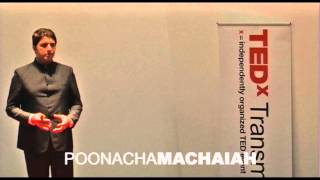
Purposeful Technology for Positive Change: Poonacha Machaiah at TEDxTransmedia