Mindfulness, Meditation, and Technology—Poonacha Machaiah—Next Mission Summit 2025
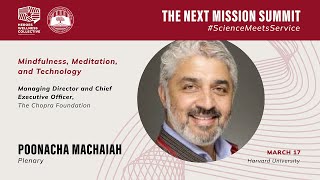
A live talk/transcript by Poonacha Machaiah focusing on mindfulness, meditation, love-in-action, and technology’s role in supporting mental health—especially veterans. The speaker leads a short guided inner-awareness exercise, poses four reflective 'soul questions', outlines the 'four A's' of love (attention, appreciation, affection, acceptance), reviews the IS PATH WARM suicide-risk mnemonic, and presents '11 principles/pillars of well-being' aimed at returning the body to homeostasis.
Chapters
First of all, it's an honor to be here. I want to thank Dr. Wortham for generously inviting me to be here. I think in September last year, Jennifer, we were here, sitting here with General Stan McChrystal killing Captain Matt Provencher and we were talking about leadership. So I had a bunch of things to talk about today. So I actually decided to rewrite everything. I was really inspired by Colonel Fred Dumar who really spoke about love. So I think what I wanted to do is I came to this country in 1992 as a student. Everything I am today is because of this great country. I grew up in India in a family of the Indian armed forces. They called us the Cordova warriors we were actually supposed to be. Every single person in my family has joined the Indian armed forces except me. So I've decided to spend the next chapter of my life in service of the armed forces and the veterans. And over the last 10 years, as CEO of the Chopra Foundation, Dr. Chopra and myself have really looked at mental health and well being. So before I really dive into the conversation, what I wanted to do is maybe spend about five minutes going through an experience, right? I think Maya Angelou said people don't remember what you say, people don't remember what you do. People never forget the way you make them feel. So if you might humor me, for the next five minutes, let's kind of go from outer space to inner space. So let's generally vari. You just close your eyes, take a few deep breaths, your palms on your laps and just observe your breath. Take a few deep breaths at your own pace and just observe what I call your sensations, images, feelings and thoughts. A deep breath in, a breath out. Once again, just observe sensations, images, feelings and thoughts over the next five minutes. There's nothing to do, nothing to accomplish. Just connecting deep within yourself. I can always Google and find out everybody's LinkedIn profile. But what we're going to do now is understand our soul profile. So as you're in this space, let's ask the four soul questions. And once again, when you ask these questions, just ask the questions and just observe like a movie in the field of your consciousness. The first question, who am I? Who am I? When you ask these questions, don't try to answer it. Just observe what comes up. Any sensation, any image, any feeling, any thought. Who am I? Who am I? The second question, what do I want? What do I want? We're all spiritual beings having a human existence. What do I want in this journey of ours? What do I want? Once Again, not trying to force an answer or trying to change something. Just ask the question and see what comes out. What do I want? The third soul question. What is my purpose? What is my purpose? Why I'm here on this journey? What is my purpose? Once again, observing any sensations, images, feelings and thoughts. What is my purpose? And the final question. What am I grateful for? Gratitude returns you to healing wholeness. What am I grateful for? And as you just go into this state, I want us to go a little bit deeper. Now I want to ask. You can say silently to yourself, I am first name, last name. I am Jennifer Wortham. Or I am John Sharon. I am Fred Dumar. Once again, I am first name, last name, silently to yourself. And when you say, I am first name, last name, bring into your awareness right now everything that's happening in your life. The good, the bad, the ugly. Whatever it is, whatever is going through today, just bring it into your awareness. I am first name, last name. Now let go of the last name and just say, I am first name. I am Jennifer. I am John. And now bring into your awareness your earliest memories of childhood. It could be running around the cornfields in Kansas or in Central park, playing with your parents, your grandparents, whatever was your earliest memories of childhood. I am first name. And just bring those memories into your awareness right now. Now let go of the first name and just repeat silently to yourself, I am, I am. I am. Or in Eastern wisdom tradition, there is a vibration called soham, which is your breath. I am. Now let go of the I am and just be in silence. And I will mind the time. Now, from this space of stillness, let us set an intention. The intention is joyful, energetic body. Joyful, energetic body. Loving, compassionate heart. Loving, compassionate heart. Reflective and alert mind. Reflective, an alert mind. And finally, lightness or being. Lightness or being. And from this space here at Sanders Theatre, let's set an intention for a more peaceful, just sustainable, healthier and joyful world. And gently open your eyes. So this is once again, thank you, Colonel Fred. I think you kind of set the tone, I think, and Jonathan talked about it too, Dr. Sharon, that love. I wasn't planning to talk about love, but I've maybe decided that I should talk about love and maybe something action item. Today is a long day, so I want to maybe give you all a program. They say love without action is irrelevant, and action without love, it really doesn't matter. But love in action can change the world. And there are four attributes to love. The first, they call the four A's. The first A is attention. Deep listening. And I think when you are running with your partner and comrade in arms and you're working together as a team, the first A comes into place, your attention, you're attentive. And today what's happening in the world, we're all on our phones, there's no attention. You know, every person, at least statistically speaking, every person who has died by suicide at least spoken to four people. We have not been attentive. We have no community, we have absolutely no intimacy. In my village in India, if I wasn't looked like shit, they'll say, punacha, what's wrong with you, man? Come, let's go have a drink. Today days can go by and nobody ever knows what's happened to you. Hey, what's up? How are you? Great. But really are you? Great. So let's look at attention, Deep listening. Listening with every cell in your body. I think this is something which we have to cultivate. The first A attention. Today people are in relationship. I was speaking to somebody at the National Guard over lunch today and they said, you know what? There you go, sir. He was saying, you know what? We work, you know, we basically have work two days a month and then we go back home. And actually when I'm at work, it's great, but when I go back home, nobody knows what happens to me. Attention. When you go to a therapist, what happens is they talk about your marriage. You take a deep breath, they look at your breath, they look at your pupil dilation, they look at your, are you sweating? They look at your gait, they look at your movement. They do an analysis today, actually, you can use all of these in your mobile. Your mobile phone today knows you better than anybody else. Scary, right? But it does. So maybe there's a way to use technology for good. We'll get into that. Another conversation. I don't want to get into that. So attention. Deep listening. The second A is appreciation. You know, I feel being a dude who is beyond just even lesser because I'm not a veteran or served in the armed forces or do I have any rank? I'm just a civilian who's trying to use his passion to democratize. Well, being that I don't think we appreciate people and the sacrifices they have done today. You press a button. You have a veteran in Syria. You press a button, the person's back in San Diego. And then people asking questions, why did you do what you do? And when your proportional of service is not in proportion to the recognition, there is burnout. Right? So we have to understand that that is great to have comments and go on Facebook and or Instagram and say this, that or whatever. But you never put your life on the line. So what gives you the right to say anything? So I think we need to understand appreciation and we do not appreciate enough. So attention, appreciation. The third A is affection, love, kindness, tenderness, compassion. I think these are words which are. We say grown men don't cry or grown women don't cry, but I think we have to kind of understand affection. And the fourth A is acceptance. Radical acceptance. And I think when we practice the four A's, it becomes an operating system. I think we will create intimacy. I think if I look back and I say, what is the one thing I want? A message I would like to leave over here. What meditation does. And if I look at the four soul questions, who am I? What do I want? What is my purpose? What am I grateful for? I could have been. I went, I started my schooling in Kansas State University. And you know somebody in Kansas, you, you know, we are born with love. Every child born is proof that God has not given up on humanity. What happened to that child? Colonel Fred talked about the combat mind. He wasn't born with it. He was crafted, chiseled and became it. That is fine. Radical acceptance. I think we are very quick to add labels. I don't understand diagnosis. We need to understand people versus attaching a code which is there on the make it easy to do a psych evaluation. Right. So I really think we have to get back to what meditation and mindfulness and these practices does is get to connect with the deep as who you really are before you become socially conditioned. Once you say, I'm Punacha Machaya, I'm an Indian born in India, you're a male, you're screwed for the rest of your life because you're defending a very fictional identity. Who you are is much more than the labels you're worn. Who you are is more than who you served. You can general all that is just labels. But you are much more than all of that. I think for us getting into who am I? What do I want? What is my purpose? What am I grateful for? Are the four soul questions I use as reflection. And so that's something which I wanted to maybe leave you all with. I work in technology and AI and I was fascinated saying that especially working with young adults. If suicide is the second leading cause of death in this great country, what are we doing about it? And I learned a mnemonic which was used in the American association of Suicidology. How many people know about this acronym called Is path warm? My accent is different. Is path warm? Anybody heard of this? It's a fantastic acronym. And now I'm actually looking at how do we create technology to connect people together? I'll kind of break it down. Is path warm? I is ideation. S is substance abuse. P is lack of purpose. A is anxiety. T is feeling trapped. H is lack of hope. Warm. Sorry. W is withdrawn. Anger, resentment, and mood change. Is path warm. Imagine this is what you would do if you were all hanging out leathers every day. Ideation. John, what are you talking about? I heard you talk about this five times in the last week. What are you talking about? Substance abuse. You know what? Hmm? I smell alcohol at 6 o' clock in the morning, buddy. I think we should just catch up. It's okay. So is purpose. Have we talked about purpose today? It is so evident. But we are designing urban spaces. All the design. There's a design problem. We're not designed to be together. Seniors should be together with children. Veterans should be in the community. We should all be connecting and learning from each other. You know, the biggest buzzword today is longevity. People want to live longer. What's the point of living@125 if you are really, first of all, not happy? Healthspan versus lifespan, right? So when I look at longevity and wisdom, I talk about the wisdom of age and the vitality of youth. We need stories people are doing. Everybody's motivated to lose weight. Everybody's motivated to be happy. Everybody's who is not motivated to make money. Everybody's motivated, right? Only reason people change is because of inspiration. We need inspiring stories. We need people to look up to. And that's part of the narrative. People don't really care, you know, unless you're not inspired. Nobody changes today. How many people say cigarette smoking is injurious to health? You put all the, all the graphics you want on it. You can put anything you want. People say, you know what, by the time I am 75, there's going to be CRISPR, take care of my lung cancer. No big deal. There's cancer vaccine coming out soon. So we look at inspiration. So the last message I have for you all is well being is what I work on. So I think the doctor this morning spoke about inflammation is the number one cause of disease. So we look at veterans and I look at just in general, when you're stressed and all of that, we say inflamed gut, inflamed brain, inflamed society. Right? Your food system of schools. Children are having bad food. You know what inflamed gut? Guess what? They're not able to sleep. They're not able to focus. Serotonin and dopamine productions in the gut. The gut brain acts as the vagus nerve. The tenth cranial nerve. The gut and the brain are connected. Inflamed gut, inflamed brain, inflamed society. So Here are the 11 principles to return the body to homeostasis. The body heals itself. The first one. The body is a process. Everything is changing. There's neuroplasticity, everything. The body is not a noun, it's a verb. Everything changes every day. The second principle of well being. Depressed. Third principle of well being. Nourishment. The fourth principle of well being. Nutritional supplements. Adaptogens. How do you kind of augment the body? The fourth principle of well being. Movement. The fifth principle of well being. Eliminating toxicity. People, substance and place. The seventh well being is looking at love and relationships. You know when we talked about love. So I'm going to use Colonel Fred again. What happens when people are in love? When people are dancing together? There's something called flow, right? You feel selfless, timeless, effortless richness of experience. It's called the stir principle. We're in the hypnotic state. People just lose concept of time. Time is just, you know, there's no concept of time. But there's something that happens biologically. There's limbic resilience, first phase, second one. There's limbic regulation with the dog. Once again, Arcana and companions. Limbic resonance, limbic regulation. Then limbic revision. We learn to tango with each other. We move with each other. We anticipate each other. I lost the pillars of well being. I think I was ninth. Pillar of well being or ninth, it doesn't matter. It is creativity and flexibility. In Eastern wisdom philosophy, there's a saying which says infinite flexibility is the key to immortality. Flexibility of the body and the mind. The tenth principle of well being is aesthetics. Feeling young. There's chronological age. There's biological age, the psychological age and the spiritual age. You can set your biostat. What do you want it to be? I'm chronologically, I'm 55. I could be biologically 65 or 45 is how I abuse my body. Then there's spiritual age. Right? So there's depends, what's your biostat? And the last pillar of well being is connecting with the rhythms of nature. We are 80% water. There's lunar rhythms, solar rhythms, the things you hear about. If you're in San Diego, you walk on the beach, you feel grounded, so connecting with rhythms of the universe. When you practice these 11 pillars of well being, the body returns to homeostasis and healing. And that is free medicine. Everybody can do it. And I think on that note, I want to thank you all for the opportunity I'm going to be around this evening. I'm always got time. I was joking, Jennifer. Never say you're running out of time. Because if you say you're running out of time, your body thinks you're running out of time, your heart rate goes up, your platelet gets sticky, and eventually you do run out of time. So infinite time. So thank you again, grateful.
More from Poonacha


Your senses are a homecoming no machine can download | The Being Practice — Day 5 #Shorts


Attention is love — what you attend to, you become | The Being Practice — Day 3 #Shorts


AI in Healthcare with Poonacha Machaiah | A Consciousness-based Approach to Wellbeing

87. Poonacha Machaiah CEO, Chopra Foundation – A Spiritual Warrior’s Guide to Resilience
Purposeful Technology for Positive Change: Poonacha Machaiah at TEDxTransmedia