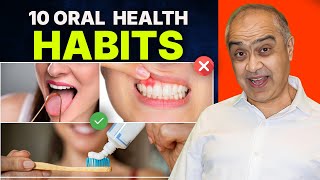
YouTube video by Puneet Nanda titled "10 Oral Habits Ranked Best to Worst for Your Teeth" (uploaded Feb 28, 2025). The speaker lists and explains ten oral-care habits, ranking them from most harmful to most beneficial. Major points: avoid toothpaste ingredients like sodium lauryl sulfate if you get canker sores; fluoride reduces cavities but may not be suitable for everyone (used in water since 1945 and in use ~70 years); wait at least 30 minutes after eating before brushing to avoid enamel weakening; clean the tongue with a stainless-steel scraper to remove odor-causing bacteria; oil pulling can loosen biofilms and freshen/whiten teeth; herbal tooth powders may avoid preservatives; rinsing after meals (lukewarm water, optional salt) helps raise pH and reduce cavity risk; poor oral hygiene links to systemic disease; some toothpaste preservatives/artificial sweeteners (methylparaben, ethylparaben, sodium saccharin) are flagged as potential risks; use a soft-bristle brush with gentle circular motions and brush for at least two minutes; diet (vitamins C/D, calcium, probiotics) and reduced sugar/acid intake support oral health.
Chapters
So today I'm going to discuss 10 oral care habits ranked from worst to best. Stay with me till the last one. Number one, how harmful are the toxic toothpaste ingredients? Many commercial toothpaste in the market have sodium lauryl sulfate. So if you are getting canker sores all the time, number one thing you do is check your toothpaste place, look at the ingredients and if it says sodium lauryl sulfate, stop, change your toothpaste and you'll see those go away. Most probably this is something that has been a huge problem for many people and people don't understand. Fluoride is not for everybody. There are other alternatives available like hydroxyapatite, whether it is nano or micro. I personally talk about micro hydroxyapatite. Now I'm not against fluoride and I've made several videos about it. Fluoride actually helps form fluoro apatite which ensures that you don't get the acid erosion which is the number one cause of cavities. And fluoride has been used for 70 years. So it is the one that is recommended by ADA. But what has happened is in 1945 the fluoride started to be added in water, which is a point of contention. And right now the new health administration is looking to remove it in America and I am with them. Whether I'm off fluoride into toothpaste. Yes, I think that's not a bad idea. Now switching to herbal alternatives is always something that is more safer option. Although you need to consult with your dentist because some people do need fluoride and I'm not going to tell you not to use it. Number two, should you brush your teeth immediately after eating? A big no. Because right after you eat that food is also become food for the bad bacteria, for the streptococcus mutants that eat that food and poop acid. That acid is going to cause micro pores into your teeth and that acid is maximum right after you eat. So brushing right after meals can weaken enamel due to acid exposure. It is best to wait at least 30 minutes before brushing your teeth to protect your enamel. Because once enamel is gone, it is gone. Remember that. Number three, why is cleaning your tongue essential for oral health? Why do you people use tongue scrapers? The tongue harbors harmful bacteria that causes bad breath. You could be very pretty outside, but if you have bad breath, nobody likes you. And it is very important to ensure that the plaque buildup on your tongue is removed. It is the first thing you can do for lymphatic drainage. It's the first thing you can do to detox yourself using a stainless steel tongue scraper is something that I like because it's copper, is not copper anymore. I like stainless steel. It is the same material with which you make surgery equipment. So that is the product of choice for me. That is the metal of choice for me. Number four, what are the benefits of oil pulling? You know, Guru Nanda has number one oil pulling brand in United States. It is an ancient Ayurvedic practice that loosens the biofilms. And when it loses the biofilm and you brush after that it's a pre brush rinse. All those bad bacteria don't have any place to live so they can't form the kind of damage they would do otherwise. It detoxifies your mouth in a way. Also does whiten your teeth. We have lots of studies to prove that. But FDA does not allow you to make claims. So we can't make claims anymore on our package. Although I personally have a strong belief it whitens your teeth and the clinical studies approve of that. Now it also freshens your breath. We have clinical studies that tell you that 12 hours of fresh breath can be attained. We've also got a clinical study where it is actually done against cpc, Acetyl Freedom chloride, which is a strong antibacterial agent. And oil pulling which is a natural regimen, works as good as cpc. We have detailed clinical study on that. In the study, links have been put on gurunanda.com Number five, how does herbal tooth powder compare to regular toothpaste? Now some of these herbal tooth powders are made without all the added preservatives. Why? Because whenever you have to keep it in a toothpaste form format, you do have to add certain preservatives to ensure that the gel stays like a gel. So if you can find a brand that actually is adding clean ingredients, herbal tooth powder is not a bad idea. And especially if it has herbs like neem powder. Neem is being used for thousands of years in India, which is one of the largest population in the world for centuries. So we use neem in our toothpaste because toothpaste is a product of choice in America and I swear by it. It's a little bitter. But trust me, your toothpaste doesn't have to taste like a candy. Bitter is better. Number six, why is rinsing after meals a very powerful habit? Because whenever you rinse your mouth, you're bringing the PH level of your mouth at 7. Acid erosion starts. Whenever your pH level is below 5.5. That is when your micro cavities start forming. Simply rinsing your mouth with simple water, or if you have a pinch of salt that adds a lot to it after eating, helps remove food debris. Remember lukewarm water? Even better, because when you clean your utensils, what you do, you clean your utensils with lukewarm water. Because water, whenever it's warmed up, its electrons move faster so it has more energy. So at the end of the day it reduces plaque formation and your cavity risk is decreased. If you have that one simple habit. Anytime you snack, anytime you eat, rinse your mouth. It's really amazing, very powerful. Number seven, how does oral health impact overall health? There have been studies where poor oral hygiene is linked to systemic diseases like cardiovascular issues. So the same bacteria that has been causing the plaque in your teeth has also been causing the plaque in your heart. There is enough evidence that their poor oral hygiene also can actually cause diabetes, infections, even sepsis, making dental care essential for whole body health. Number eight, what are the dangers of harmful toothpaste ingredients beyond sodium lauryl sulfate and for some people, fluoride? Because there's a study which shows that fluoride could cause Alzheimer's. And I think that study is more dedicated to fluoride in water. But apart from that, certain artificial sweeteners, things like sodium saccharine and certain preservative like methylparaben and ethylparaben in toothpaste may contribute to long term health risks. Certain herbal and fluoride free alternatives are what I personally use and I recommend. Now you have to ask your dentist before you make that decision. I personally make Guru Nanda toothpaste that is fluoride free. It has micro hydroxyapatite neem. It also has seven essential oils, vitamins and a whole lot of other reasons. So it's more of a holistic toothpaste, not focused on one particular item, it is focused on several items. So we have literally taken the fluoride and actually created a web of other things so that you get a holistic benefit. Number nine, what is the correct brushing technique for healthy gums? Using a soft bristle toothbrush is number one most important. Butter on gums toothbrush is actually one of the best toothbrush, according to me. And in case you have sensitive gums, butter on gums is like heaven. So gentle circular motions and brushing for at least two minutes prevents gum recession and protects enamel. Because if you're brushing hard, you can actually cause gum recession, enamel erosion, and once enamel is lost again, I'll Repeat it's gone number 10. Last but not the least, how does diet influence oral care? A nutrient rich diet with vitamin C, vitamin D, calcium, probiotics. They strengthen teeth and gums. Avoiding excess sugar intake prevents cavities and gum disease. Remember snacks are a no no and always try to eat greens and fruits, fruits like strawberries. And don't try to eat too too much sweet stuff or too much acidic stuff. So for example if you're eating lot of oranges and not washing your mouth right after, you could actually get cavities just because that acidity is going to erode your teeth enamel and you could get micro pores. So remember these 10 techniques. Let me know how did you like my video? If you want more videos regarding any of the dental issues and me to go into more details on any one of these dental issues, please put it in the comment section and if you like it share it and your each share your each like means a lot to me. Thank you so much.