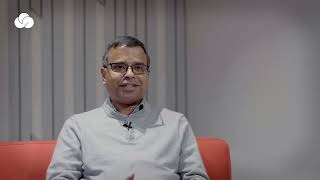
How to Innovate and Lead Wisely in Today’s World with Navi Radjou - An Initiative by MentorCloud

Recording of the Amrit Kaal Mentors launch (chosen on Jan 12, Swami Vivekananda's birth anniversary) featuring Navi Radjou in conversation with Dr. Ravi Gundlapalli. Radjou presents a two-part talk: (1) frugal innovation — defined as creating greater economic and social value with minimal resources, illustrated via concrete examples (Mangalyan/Mars $70M mission, Arvind Eye Care, Embrace incubator, low-cost cardiac surgery, reuse/upcycling/data reuse, decentralized 'scale-out' manufacturing); (2) wise leadership — a framework from the Bhagavad Gita focusing on perception, action, and motivation that complements technical intelligence. The talk emphasizes empowering youth, decentralization, inclusivity and combining resourcefulness with social and ecological purpose.
Questions this video answers
January 12 (chosen as Swami Vivekananda's birth anniversary / National Youth Day).
Thinkers50 Innovation Award (2013).
TED Global talk in 2014; reported over 2 million views.
Over a quarter million copies sold.
Mangalyaan cost reported as $70 million versus NASA's $700 million.
Chapters
Foreign.
Welcome to the Amrit Kaal Mentors launch day event. We have chosen January 12th to start this movement. We're not calling it an initiative. It's a movement. It'll. It'll go on starting today. And we chose a very important day, you know, which is the birth anniversary of Swami Vivekananda, who is considered a national mentor for the country, who is the one who really put India on the right mind and right minds and the right framework for all the Westerners. If people like me and Navi can go around us and have the respect, it's because of what Swami did back in 1893. So we chose today, which also is celebrated as the National Youth Day, to do this movement, whose intent is to empower youth, because youth is our demographic dividend. And it will become a dividend versus a liability.
If only if. And only if the youth are skilled, are really dharmic in their approach, become good leaders, skilled professional, make a lot of money, become super successful, but yet be grounded in what India is all about. So that is why we have carefully selected speakers who really care about you and your success. So right now we have my dear friend Navi Raju, who wrote about me many, many years ago in sbr. And so Navi, whatever you wrote is now, is now true, you know. So Navi Raju is a French American scholar. I think your heart is Indian. I know that for a fact.
My soul as well.
And your soul as Indian, it beats for India. So he's a scholar of innovation and leadership. Born and raised in, should I say Puducherry or Pondicherry?
Puducherry. Let's make it Indian.
Indian.
Yeah.
So, born and raised in Puducherry, India. He holds a dual Franco American nationality. He studied at Ecole Central Paris and the Yale School of Management. He called in the center for India and Global Business at the University of Cambridge Judge Business School, which is where I think you wrote your first book. Served as a vice president at Forrester Research, which is when I met you, a technology research and consulting firm in Boston. He's ranked by Thinkers50 as one of the 50 most influential management thinkers. Guys, you're in for a treat. He's one of the 50 people on the planet right now, so really, really privileged to have you. He won many prestigious awards. The Thinkers50 Innovation Award in 2013, which recognizes management thinkers who are redefining the way we approach and practice innovation. His TED Global talk in 2014 has gotten over 2 million views. And he's all about frugality, which velumani talked about earlier. But in innovation, Frugal innovation. Not spend a billion dollars to just mow your lawn, spend $100 to do some great things. So frugal innovation is his thing. He's the co author of the global bestseller Jugaad Innovation. Over quarter million copies sold and I just love the book. I've given away gifts to so many people because being an entrepreneur and being an Indian is being jugaad like nothing is given to you on a nice platter. And he's also the author of from smart to Wise. I can claim that I actually connected you and Prasad and you wrote a book. I'll connect with more people and more books. Let them come out is the latest book the Frugal Economy, which I hope you'll talk about. A guide to building a better world with less. Demonstrates how businesses and nations can maximize human potential and social well being within planetary boundaries. A very sought after speaker and advisor and I'm so glad that you are part of our big movement that will go on for rest of our lives. Navi, I think you and I are pretty much the similar age now. So till the last breath this movement will go on to continue to empower young people. So over to you Navi.
Thank you so much Ravi. So I also want to make this session very interactive. So what I was thinking is I will divide my presentation actually in two parts. In the first part I will talk about the concept and practice of frugal innovation, which is India's gift to the world as a new paradigm. And then the second part will be on wise leadership. So, so that's why the title of this session is how can you innovate frugally and lead wisely. And maybe at the end of the first part I can pause and maybe we can address some of your questions with Ravi and then I can move on to the second part. So let's begin with the first part which is about frugal innovation. So I grew up in India in the 70s and 80s when we faced water shortage. Electricity was rationed. So the idea of scarcity of resources is something I grew up with. We had only, you know, a couple of buckets of water every day to cook and clean ourselves. So I kind of was very accustomed to doing more with less. That means, you know, finding a way to, you know, have fun. And I was playing in the streets. We didn't have branded toys, you know, back then. And no video games, no Internet, you know, I didn't have even a TV at home. But we were happy because we were able to use our creativity to make our own toys. You know, makeshift toys with pieces of wood. We would play cricket in the streets, you know, by protecting our knees with makeshift, you know, gear made from cardboard. So we were actually very resilient and very creative. But then I went to the west, and then I spent, you know, 10 years, first in the U.S. working for a company called Forrester Research, which is a technology research firm. And we were actually trying to convince big companies that they need to invest billions of dollars to come up with great products. So the logic and assumption was that, you know, if you want to be innovative, whether you're a company or a country like India, you need to have a lot of money and invest massively in research and development. But then about. Exactly, and it's interesting, exactly 20 years ago, Western consulting firms like PwC begin to challenge this whole idea that you need to invest more money to become more innovative. As a matter of fact, they found no correlation between how much money you invest and how innovative and, you know, how value you create. Actually, for instance, 85% of consumer products launched in America fail. Okay, so can you imagine, right, you're spending billions of dollars as Procter and Gamble or any of these brands to develop new products, and yet 85% of them fail because they don't really address actual customer problems. And meanwhile, living in America, which is supposed to be the richest country, I was very surprised 15 years ago to discover that one third of Americans don't go see the doctor when they have a health problem because they can't afford it because healthcare is very expensive. You can see that innovation as practiced in America, particularly in Silicon Valley, where I lived 13 years, is not inclusive. That means that the innovation you're developing is not benefiting the society at large. Then about 15 years ago, I began to come back to India, and I discovered that in India, we're innovating differently. So I'm going to give you a couple of examples. For instance, we discovered this potter, Mansuk Prachapati in Gujarat, who has developed a fridge made entirely of clay. It's called mithikul. It doesn't require any electricity, and it can keep fruits and vegetables fresh for many days. That's one example. When we discover that this is the person who didn't even finish high school, but he was able to go within himself and look for his inner resources, his training as a potter, and then apply that to create a product that creates value for the local communities. He also employs women in his workshop to make these Clay fridges. So he's also creating employment and opportunities for local community. Another example is, you know very well is Arvind eye care which can make cataract surgery for just $50, whereas in the US it costs $3,000. As a matter of fact, myself two years ago when I had a cataract, I went to Chennai to have cataract surgery at Arvind. It turns out that Arvind can make these cataract surgeries in high volume, with high quality service and yet keep the price low. The same way in Bangalore, Dr. David Shetty is able to perform cardiac surgery for only $1,500, whereas in the US it can cost up to $150,000. So it can actually deliver a high quality cardiac surgery for almost 1% of what it may cost in the US. Then finally, you all are familiar with how India is now pushing the boundaries of space exploration. In 2015, we launched an exploration spacecraft to Mars. The project Mangalian cost only $70 million, whereas the NASA, the US space agency, spent $700 million to send a spacecraft to Mars. Now why is it possible, right, is because if you look at what the NASA spends a single month, that is the annual budget for isro, the Indian Space agency. So that means that, you know, in India we have, you know, great aspirations and, you know, low resources. So that combination of high ambitions and resource limitations makes that even the sky is no limit. You can actually use, you know, this jugaad mindset to find creative ways to achieve your ambitious goals using fewer resources. And this is the nutshell, what is frugal innovation? It's the art of creating more economic and social value using minimum resources. So for you, I thought that I'm going to share with you three principles of frugal innovation that you can begin to reflect on and maybe practice, whether you're an entrepreneur or even if you're a student and later you join a company or you can apply these three principles to do more and better with less. The first principle is keep it simple. One of the big issue with the Western companies is that they tend to make innovation very complex, right? We love developing very complex products because we think that the more complex the product is, the more sophisticated and more innovative it is. But Einstein famously said, any fool can make things more complex, but it takes a touch of genius to make things simpler. So indeed, it takes a lot of creativity to make products and services simpler so they are easier to use and maintain for your customers. And let me give you one example of how to practice this Principle. Today there are millions of babies that are born prematurely around the world. And in the Western world we keep these babies in incubators. And an incubator cost $20,000 and requires electricity. So it's very expensive. And in India or Africa, where we also don't have electricity, which is reliable. So five students from Stanford came to India and launched a startup called Embrace, which actually has developed incubator, except that the incubator doesn't look like an incubator in plexiglass as you see in photos in the West. Instead it looks more like a small sleeping bag, except that it delivers the same performance and the same function, which is to keep the baby at constant temperature. That's what an incubator does. It turns out that this simple incubator cost only $200, which is 1% of the incubator that you find in the West. And it doesn't require electricity, but more importantly, it allows the mother to hold the baby close to her body. And this is called the kangaroo care, which is important for the mental well being of premature babies when they grow up to become adults. And this simple solution embrace has already saved the lives of half a million babies worldwide. And today it's being produced in India and shipped to Ukraine, which is waging war with Russia, because in Ukraine, since the war began, the number of premature babies have tripled. So that's the one example, right, about how you design product by, you know, minimizing waste and features and maximizing ease of use and impact for the customer. And to do that you need to actually have empathy for the end user, right? And Scott Cook, who is the founder of software company called Intuit, which makes accounting software, famously said, don't fall in love with your solution. Fall in love with the customer's problem. And what they do at Intuit, which is based in Silicon Valley, is that they spend 10, 10,000 hours a year going into customers offices or homes to see how they actually use their software. So by observing customers in the natural setting, they find out, for example, that some product features that engineers were proud of actually customers don't give a damn, right? They don't use them. But in the contrary, there may be some features that customers desperately need and you can observe them, you know, really getting upset because they don't find those features in the software. So that informs the developers to prioritize those features that are the most valuable and impactful for the user customers and then avoid any other features that are non essential. So this is the essence of frugal Right. Frugal means that it's. Frugal doesn't mean cheap. It's about minimizing waste and minimizing the features and then prioritizing those features that actually really address customers problems. That's the first principle about keep things simple. Keep your products and service that you develop and offer to the market as simple as possible, accessible, easy to use and maintain. The second principle is going to be particularly important for India where we are going to be running off, you know, running out of a lot of natural resources. It's about. So the second principle, I call it reusing existing resources. And these resources could be physical resources, natural resources.
Equipment.
Space, physical buildings. But it could also be intangible resources like knowledge, intellectual property that could be widely available. And you can actually figure out a clever way, a jugad way to reuse, repurpose, recombine these existing resources to create a frugal solution. So I'm going to give you first two examples to show what you do when you face the resource scarcity. Let's say you don't have resource X. Then instead of complaining about that, can you find another resource, resource Y or Z, that can be used to address your need? For example, let's say that you're running out of water. Okay, so, well, it turns out that there is a lot of humidity in the air and you can convert air humidity into water. And this is what startup in Israel called Watergen does. They create a technology that actually absorbs the humidity in the air and then purifies it, distills it and generates hundreds of liters of drinkable water every day. And this technology can be deployed in places that face natural disasters. Think about the fire in Los Angeles or there is a hurricane, or there is an earthquake. They can quickly deploy the solution and generate water from that particular location. And similarly, let's say that today you are saying, oh my God, we need electricity to power our devices. We talk about the Internet of devices and there will be 50 billion devices that will be connected to Internet in the next decade. So can you imagine the environmental disaster if you want to use 50, 50 billion batteries, you know, to power these devices? So we need to think differently. We need to think about a jugad way. And a French startup has found a solution. It's called Dracula Technologies. What they have developed is they, they found a technology which is not a new technology. It's the inkjet printing technology. Right? The printers, you know them, right? So they're using the inkjet printer technology to print tiny solar cells that can be attached, embedded into devices like, you know, smoke detector, your thermostat, or your remote control so that you don't need a battery anymore. Because the solar cells can harvest generate electricity from the ambient light. And you need to know that even in dark places, there are always photons, the particles. Light particles are everywhere, even in dark places. That's why they call the startup Dracula Technologies, because it can operate even in dark places. So these are the two examples where rather than complain, oh my God, we don't have water, we don't have electricity, you make the most of what is already there. Humidity in the air or photons, ambient light. And then transform that, like an alchemist into a useful resource. The second type of application of this principle, right, about reusing existing resources is how do we transform waste? Because we are generating a lot of waste, right? And this waste material can be upcycled. That means transformed back into something useful. So two great examples. One is a company called Paka P, A double K, A based in Ayodhya, which actually transforms sugar cane waste, agricultural waste, into biodegradable packaging products for food items. And their factory is 100% powered by biomass. So they're using waste material to both use as energy to power their factory and the factory itself produces packaging solutions that are made from waste. So this is called the circular economy. And it simply means it's a new economy where rather than extracting virgin materials from earth, make some products and then throw them away. You find clever ways to reuse existing resources like waste to make new products. Similarly, you can think about Today there are 50100 billion.
Tons of clothes, used clothes, right? We buy clothes and then we throw them away. So there is 100 billion tons of waste clothes that goes into landfill. And only 20% of the clothes that you throw away is actually recycled. So this is why there are two women entrepreneurs from Israel started a company called Refresh Global that actually.
Extracts from used clothes high value fibers. And then these fibers can be used for making car interiors or used as construction materials. So this is an example also, right? Where everywhere in the world we are throwing away clothes. And rather than sending them to the landfills, maybe there is a way to repurpose them, reuse them to make something useful for other industries like the automotive or construction sector. And then I want to continue with two more examples to show actually this idea of reusing resources, right? So far we talked about physical resources, but what about reusing data, right? Because we are talking about, right, a lot of data being generated. So how do you cleverly repurpose existing data to create value? So let me give you two great examples. Three, actually. One is a startup called Algo Surge, which is based in Mumbai. What they do is that they allow hospitals to automatically using AI algorithms to convert 2D images from X ray devices automatically into 3D models. That means that hospitals don't have to invest in expensive CT scanners or MRI devices. They just use what they already have, the X ray devices, and then the algorithms automatically convert the X ray data into 3D models. So that's a way about, you know, upcycling, you know, creating more value from your existing data, medical data. Another interesting example is from South Africa, where 90% of the loan applications by small businesses are rejected by big banks because these small businesses don't have good credit score. You know, the credit number that shows if you are a risk or not for the bank. They don't have the data. So one startup called Lulaland came up with this idea that they said, okay, so you don't have the credit score, which is one type of data. But there could be other data that, you know, a loan applicant has that can be used to assess if this person is a big risk or not to, you know, to give a loan. So what they do is that they use AI to look at your social media behaviors and, you know, and how people, you know, view you on social media. And so they can analyze that to assess, you know, your, you know, your profile, your personality and your credibility. And then they also analyze your E commerce transactions, online transactions you make, you know, on Flipkart or Amazon kind of thing, and how credibly you pay back. They also can scan your paper statements from your bank and then analyze the data. And then based on that, they can assess your credit worthiness. And then if you are approved for a loan, they give you the loan in two hours, you know, using mobile technology. Whereas it takes, you know, as, you know, many days with the typical bank. So that's a great example, right, where, you know, you don't have the typical data that banks require. But there are other kinds of data that already exist right on the Internet related to you, that can be analyzed by AI to give a loan to small businesses. And then finally, in the same spirit of reusing data, rather than creating new data, new information, there is a great startup called Digital Green that enables Indian farmers to share their agricultural best practices and replicate proven farming techniques from one region to another. So, for example, today a farmer in Rajasthan may find that the crops, maybe the wheat or whatever is not growing well, so they can take a photo of the crops and then send it to the cloud. And then the AI system will recognize that, oh, someone else, another farmer in Punjab or in West Bengal, faced a similar problem, and then look for the solution that that farmer has implemented. And then it will communicate to the farmer, Rajasthan, what is the right step to take to deal with his own local problem. And the information is delivered in the local language. Local, regional language as well. So this is a great idea because what it shows is that you don't need to look for new best practices. You can look for best practices that has been tried elsewhere, and then you can reapply them to have an impact locally. Then the third principle. And then I will pause and address your questions for this particular first part. The third principle is particularly important for India. I call it scaling out your solutions. You know, when you hear about the. The term scale, right, we keep hearing right now in India, you know, India is growing. We need to scale, scale, scale. But what we mean by scale is scaling up, right? And the idea of scaling up comes from the west, and particularly it comes from the industrial revolution that emerged in the, you know, Europe and then later in America, where essentially, you know, famously, right, Henry Ford basically was a pioneer of this concept of scaling up, where he produced the same car in big factories in large volume, right? But the car was the same color, same shape, right? And that means you keep making the same car in increasingly large volume, but you don't try to personalize the cars. You cannot do that, right? Because it's called standardization. So you create a standard product and then you scale it up. And that is where the notion of scaling up comes in. But in India, we have something important we shouldn't forget is the diversity, right? We have diversity of languages, diversity of geographic landscapes, diversity in terms of supply, the resources we can find right across India. So for a diverse market like India, I think the notion of scaling up is a bad idea. Rather than standardizing our products, rather than building products in big factories like Foxconn, right? Is building a big factory in. Has built a big factory in China, right? To make, you know, large quantity of products, we still need that. I'm not criticizing it. But in addition to that, we need to think a different way of scaling out. That means distributing, decentralizing your production so that you can actually produce and deliver goods as close as where the customers live. So let me give you some amazing examples of entrepreneurs doing that. There is a French startup called Avatar, Avatar, which makes their built Electric cars. And these electric cars are five times lighter than typical EVs electric vehicles, and they consume three times less energy. But the real innovation in their electric car is not in their energy efficiency, but the way they are built. Unlike Tesla's Gigafactory, this Avada car will be built in a network of micro factories that will be located in multiple regions across Europe. And each micro factory can be owned and operated by local entrepreneurs who can assemble these cars. Sometimes they can be personalized for the local market, for the local customers. Okay? And the idea here is to actually, right, scale out the production so that you can create more economic and social impact in multiple regions across the, across Europe. And we are seeing, we have seen the same thing in India with the social business called Selco which has implemented off grid solar systems for 1 million rural households in some of the most remote villages across south India. So this is the example, right? This is called decentralized distributed energy production. That means that instead of producing all energy in a one central nuclear plant or one big grid, you distribute the production of energy so that the last mile becomes the first mile of energy produce, energy creation. Okay? And what is interesting with SELCO is that now that they have enabled 1 million households in India to produce their own electricity, now they are thinking, why don't we use the electricity to also, you know, empower economically these people. So they have built solar powered equipment that helps small farmers to process the crops. Wheat, millet, millet, whatever you want.
Locally, okay. In the, in, in the home. In the home or in the village, which helps them create more income. So this is also a great example because they're also scaling out the impact, right, the social impact of the solution by not only giving a fish to the rural communities, which is clean energy, but they're teaching them how to fish. That means using the clean energy to find new additional value revenue generating opportunities like in the case of small farmers. And the last example I will close on, which is more a high tech example. So Selco is more traditional, kind of low tech we can call it. But now you can also use high tech like robotics and AI to also scale out your solution. And the example is a startup called Lumas L E U M A S which is based in Bangalore and they are building a network of nano factories. So these nano factories will be located, you know, in a decentralized way in closer to, you know, regional markets or even city markets. And each nano factory can produce a variety of personalized products like healthy foods, cosmetics, etc. And these nano Factories use less water, less energy and are more flexible than big factories. And they also reduce transportation cost and carbon emissions. Right, because they are located close to where the customers live. So this is what I mean by scaling out your production is to figure out how you can find a distributed, decentralized value chain where you leverage as much as possible locally available talent and resources to sense and respond quickly enough to local needs and offer personalized solutions to your customers across India, which again as I said, is a country which is characterized by great diversity. And I think that, you know, moving forward we need to figure out, right. How to look at diversity as an asset for India and not a liability. So I'm going to pause here and you know, maybe address some of your questions and then we will move on to the second part which is around wise leadership.
Oh great.
First of all, I could listen to you all day long with all the examples. I was taking notes about the Avatar, about the Loimas and so on. So wonderful. I think to the students listening, I think we have a few alumni as well. I think the way is how can they think frugal innovation in their own job search, in their own intern search? Because every example has certain learnings. In fact, Dr. Velmani talked about his idea of franchise for Thyrocare came from observing another industry in Coimbatore, not healthcare. So you always have to learn and your emphasis on diversity is very, very important. In fact, I just heard a talk this morning about how in ancient India the manufacturing happened at the village level and the towns were the towns where the places of trade where they came and exchanged and the so called big cities where the relationships were built and some financial institutions were done. Now the western system was exactly the opposite. So I think to all the young people in the session, I think we had to go back to this in a decentralized way which is more sustainable, more frugal and it also creates employment. So one question, Navi, which is frugal innovation or frugal thinking? Same as lean management and Kaizen principle.
Yeah. There are many similarities in terms of the practice of frugal innovation, which is like Lean startup, right? Which is about developing a minimum viable product. It's about Kaizen, which is about continuous improvement. The way I would always say is that Jugaad and frugal innovation is less a method and more a mindset. And I think the question was about frugal thinking, right? So that's where the difference is, right? It's about more a thinking and it's about thinking and it's about feeling and then doing as well. So if you're only focusing on the doing part, which is the practice of frugal innovation, there are many similarities. But where it gets different is the example I gave about the mythical and all the examples I gave these are people who have, I call it a jugad mindset, a social heart and an ecological soul. So this is a combination that defines a frugal innovator is that they have all three. Right. They have this kind of very clever, resilient, creative mindset, resourceful mindset, but they have a social heart. So that's where the empathy comes from. Right. So you know, yes, they may apply, you know, methods like Lean Startup or Kaizen, but the trigger, the starting point is always this compassion for, you know, fellow beings. So in other words, they don't think as customers. Right. They don't reason in terms of markets and customers. Like for example, Selco, his motivation was, you know, to help people in rural areas to have access to clean energy. Right. And then he didn't think about, you know, I'm going to apply Lean Startup or Kaizen is that. But he started with this awareness that, you know, there's a pressing need in to electrify rural areas and rural areas can leapfrog straight from candlelight to solar light. Right. And then he has to do a lot of iterations, right. To get there. And so many of the frugal innovators, they will never tell you that oh, I'm applying this principle or that method, right, because, and we'll talk about that in the next second part is because they are driven by a larger purpose. Right? So, so you can, what I'm getting at is that think about, you know, frugal plus wisdom. And we'll talk about that because I'm actually in, in Mumbai and here we have a business school called SPGIMR which has actually launched the Wise Innovation center where they're trying to train a new generation entrepreneurs who actually have, what I said, the jugaad mindset, social heart and ecological soul. So that essentially we will create a new breed of Indian innovators who unlike Silicon Valley entrepreneurs are not only thinking about efficiency because the Lean Startup and Kaizen, they're all focused on efficiency becoming more efficient. But in addition to efficiency, you also need agility. We need to be more flexible. Right? So frugal, frugal innovation actually has three major components. It's about being afford, making things affordable, your product and services. It's also about developing an agile, you know, Kind of flexible mindset. And third is about being inclusive. Right. Because you can apply Lean Startup and Kaizen to make very expensive products, then that misses the point. Right, so yes, there are some overlaps between Frugal Innovation and Lean Startup and Kaizen. But rather than focusing on the what and the how of innovation, what India is going to bring to the world in terms of thought leadership is focusing on the why question and that people talk about. But I will challenge the, the notion of why in my next, next part. You will see because even the why keep changing. Right, so, so that's interesting. So India focuses on the why question, the purpose, the dharma. Right. What is the dharmic purpose kind of thing. But more importantly, the biggest contribution of India to the world is the who question. Who is the innovator? What is the level of consciousness and how do we raise the level of consciousness? Right. So I'm from Pondicherry, which is the home of a famous philosopher, Sri Aurobindo. Right. So Sri Aurobindo is all about the evolution of consciousness. Right. So are you an unconscious innovator or are you a highly conscious innovator? Right, so if you are a highly conscious innovator using these, you know, Lean Startup or, or MVP and Kaizen, fantastic. But the problem is that most, most of the applications of Lean Startup Kaizen tend to be for essentially developing products that are good for the market but may not necessarily be ecologically sound or socially impactful.
Beautiful. Beautiful. I think the distinction is very important. Now you mentioned you have a second version of the talk. How much time do you need?
I will need about 10 minutes.
Let's get into that part then quickly because we allocate half an hour. So I just want to make sure that. So everybody who has joined this second part is. I was part of his book, which he wrote with another friend of mine, Dr. Prasad Ka. Smart and wise. So I'm looking forward to learning about wise leadership. Because your session is how to innovate, which is frugal innovation, but lead wisely. So go.
Sure. All right. So essentially the idea of wise leadership.
Because as I explained the first part, I think it's important to tell you why I decided to write about it. And I'll also show you how my own, you know, consciousness evolved. Right. So in the 90s, you know, I was, you know, more I was admiring people who are very smart. Okay. So I thought that people who graduated top of the class and people who have, you know, very high iq, I used to see them as gods. So two such People that impressed me. One is someone named Rajat Gupta who was a former CEO of consulting firm called McKinsey. He graduated Baker Scholar, that means top of the class from Harvard Business School. And in the 90s, I wanted to become like him. You know, like Rajat Gupta and you know, become a senior partner in a big consulting firm and one day become the CEO of a consulting firm. But then I was shattered when in 2012 he was convicted of insider trading and spent two years in prison. And then another person admired is CEO of a French car company, Renault Nissan. His name is Carlos Ghosn. And he also went to the most prestigious French engineering college, Ecole Polytechnique. And he also was the guy who really admired frugal engineering. He coined the term frugal engineering to describe the frugal innovation capabilities of Indian engineers. He was a big fan of India and he actually helped India contribute to his company in terms of talent. And yet in 2018, he was convicted for misusing his company assets. So these two kind of events really shook me to the core and made me realize that maybe what I should look for in leadership is not just intelligence. Yes, there are many smart people that become CEOs, but they end up doing dumb things right and even end up going to jail. So I begin to ask myself, beyond intelligence, is there a human quality that we need to cultivate? And particularly for your generation who wants to become entrepreneurs or managers, what is beyond intelligence? This question I asked myself with my co author 15 years ago. But today it becomes even more important. As you know, with artificial intelligence, again the word intelligence is there. I asked myself, okay, one can be very smart, but what else will make that person not only successful professionally, but also more impactful in terms of societal impact? And that's where we looked at Bhagavad Gita as a sacred text and inspiration to identify leadership principles that can be applied in the corporate context. And what we found is that based on the Bhagavad Gita, is that actually what we call wise leadership, which is the application of wisdom, is something that anyone can do. In other words, wise leaders are not Superman. They just think and feel act differently than smart leaders. So what is different about wise leaders and how can you cultivate wise leadership? There are three things that you can do and they are related to your perception, your action and your motivation. Again, perception, how you see the world, action, how you act, and motivation what drives you. So let's look at them briefly and quickly. So the first one is perception. Perception is about what is Your view, what is your worldview? A great story here, and I will just take maybe 30 seconds to narrate that parable is there is a reporter that goes to a construction site and he finds three bricklayers. And he asked the first bricklayer, what are you doing? And he's saying, well, I'm laying bricks because I need to earn money to feed my family. He asked the same question to the second bricklayer who answers, oh, you know what, I want to become the best bricklayer in the world. So I want to show off, you know, that I'm damn good in laying bricks. And then the third bricklayer, when he's asked the same question, answers, I am building the most beautiful mandir temple in the world that will last for decades and millions will come worship here and my great grandchildren will be proud about. So you see the difference is that the perception was different, right? The three bricklayers are doing the same job. The first person looked at it as just a job. The second person looked at it as a way to, you know, look good, right? And show off his skills. But then the third person looked at it as his calling, right? As a divine calling, as his Dharma in a way. So the perception means that, you know, how can you connect what you do to a noble purpose and then stay connected to it? Because when you find the North Star, right? And you align your activities, North Star, and even if you are doing could be perceived as something very mundane, will become sacred and divine and it will give you greater sense of meaning and purpose. So for instance, my noble purpose is to connect the east and the West. Rudyard Kipling wrote the book, right?
It's a British guy and he actually famously said that, you know, the east is east and the west is west and both will never meet. And I want to actually challenge him and show that actually, you know, the east and west needs to connect. And so my noble purpose is to bring the Indian wisdom to the Western world, okay? So that is my perception of, you know, how I see the world as being more united rather than being divided. And I want to contribute to that unity of the world. The second area where you can cultivate wisdom is in your action, the way you act. And again, in the Bhagavad Gita, we talk about the three gunas, we talk about Tamas, Rajas and sattva, right? The Tamasic people tend to be risk averse, right? They obey orders blindly. They don't ask questions. They like to stay below the radar. The Rajastic people like Rajat Gupta and Carlos Ghosn that I talked about earlier, they actually are bold, they are willing to take, you know, they're a bit reckless, they can take big risk. But the same.
Unfortunately what happens is that because they are very reckless, they, they could actually make ethical mistakes, right? And therefore Rajasik is important because Rajas is the fire, right? That gives you the willpower and the capacity to move forward. But with that, what happens sometimes you have blinkers and essentially you become very self centered and you can make some ethical lapses and then the Sattvic person, right? And it's important because in the India, unfortunately when we talk about Sadva is positioned as superior to Tamas and Rajasic. That's not true. Actually Sattva is the capacity to use discernment to balance Tamas and Rajas when you act, okay? So that means that if you have enough self awareness and you have enough, you know, discernment, you can judge when is it time to be more tamasic. That means, you know, and the Bhagavad Gita sometimes talks, right? Is sometimes inaction is the best action, okay? And, and then there are times when you have to act resolutely and quickly. For instance, right? We are facing climate change. This is not a time to be tamasic, right? You actually have to use more Rajas to quickly find some solutions to deal with pressing climate issues. So the way that you can act, right, is by balancing the Tamas and Rajas. And a key expression from the Bhagavad Gita is yogista kuru karmani. That means rooted in self act. That means that when you act you need to find that you need to be centered, right? You need to find that place often it's in the heart, right? The under Atman, the deep Atman is actually residing in a cave in your heart. So you need to find a place where you can root yourself within yourself, right? That's yogishta kuru karmani. So that essentially when you go in the outside world, right, everything is so volatile, right? You don't drift, you like a bamboo, right? You stay rooted and yet flexible at the same time. That is the posture of a noble warrior who is able to act and then finally about action is important is that you need to be able to lead not only from the front, but also from the back. As a matter of fact, Ravi Gant, the former CEO of Tata Motors, yesterday I met him and he has written a book called Leading from the Back. And this is important. You need to have humility to allow others to shine rather than always stealing the limelight. And a great example of that is in 1979 when India tried to send a satellite to space. It failed, and the head of the space agency, Professor Sadish Dhawan, took the blame. He did a press release, press conference, and he said, I am the one to blame. The bug stops with me. In doing so, he protected a scientist named Dr. Abdul Kalam, who was actually the mission director. And the year after, in 1980, when the satellite launch actually succeeded, Dr. Dhawan did not attend the press conference and rather allowed his protege, Dr. Abul Kalam, to be seen as the victorious.
Mission director who created history for India. So that is also how you should act. You should act with humility and let others shine rather than trying to steal the limelight all the time. And then finally, the third area is motivation. And in Sanskrit we call it Sankalpa, your intention, right? And Buddhism talks a lot about purifying intention. That means when you're acting, make sure that the I, the ahamkara, the ego, is not in play, so that you act with detachment. And that means that whatever you do is motivated by higher purpose. Now, this is important because when I say this, it looks like, oh, you know, navi is telling us to be altruistic. No, that's not the point. There is a middle ground between being totally altruistic and totally selfish. And then middle ground is what we call enlightened self interest. That means that if you are acting, let's say you are doing something good for the society or for the planet, and if you are running a company, it turns out that that is also good for your business because increasingly your generation of customers want to buy from companies, right, that are socially conscious and ecologically.
Doing good things. And the same way as employees, you want to also join companies that are acting nobly for society and the planet. So this is the third kind of principle, if you like, of wise leadership is being conscious of your motivation and make sure that the ego is not driving.
Your motivation, but there is a noble purpose. And this noble purpose doesn't have to be all about being altruistic and giving everything to the world. It could also be about thinking in a way that you create a solution or a business model that can create value both for society and the planet and for yourself and for your shareholders. And so this is essentially what becoming a wise leader is. It's about changing and broadening your perspective. It's about acting in a more balanced way and then being driven and motivated by something that is transcendental that means something larger than your small ego. So that is the wise leadership part.
Fantastic. Oh, I didn't realize that you had this section which is very, very powerful.
All the examples.
In fact, Dr. Abdul Kalam has a video on YouTube where he talks about that particular story, talks about what does it mean to be a good leader. A good leader.
They own the failure but they pass on the success to their teams. So let me be that leader and pass on the success of this movement. That this has happened because of our wonderful team members from pod, AI, from become, from Algoshack, from Urban Communications, all of them did a fantastic job to make this happen. All I had to do was just have this idea with a much larger purpose of connecting people like you to and make your wisdom available. Like I, I wanted to, you know, tell all the young people I have all his books. This is Jugaad Innovation. Okay. This is Frugal Innovation. I have that too. And Mark twice. So when I say I read books and when he, when, when I, when we tell you people you should read books, I'm just saying it by doing so. Ravi, what is your next book that you're working on?
Actually I just published a book called the Frugal Economy that actually looks at how India can achieve Vixit Bharat and Atmanir Bharat. But then I'm really dying to. Since I'm going to be living in India, I'm thinking that I'm going to do a field trip and go to Bihar and Uttarakhand and these states that people don't associate with innovation. But my hypothesis is that the next frontier of innovation, the wise innovation, is happening below the radar right in these places, whether it's in the backwaters of Kerala or.
I can give you a scoop. Check out Dharmastala, which is a Shiva temple 300 miles from Bangalore. They are doing some amazing thing around circular economy but nobody talks about it. Right. So I'm thinking that will be interesting to write a book on not only Vixit Bharat developed India, Atmanirbh Bharat which is about becoming self sufficient and resilient. But I like the notion of Turiya Bharat. Right. Turiya means conscious, enlightened. So I want to show that, you know, and showcase some entrepreneurs across India who are building all three at the same time which is Vixit Atma Nirbhar and Turiya Bharat.
Fantastic.
So I can't wait to read your new book that you just published. So I'll have it to my List frugal economy when we meet. So I'm also spending a lot of time in India and I look forward to more interactions. And yes, there is a lot going on. A country like India is so strong over tens of thousands of years because there is innovation happening at those grassroots levels that may not be, you know, sexy in the, in from a Western glamorous. Yeah, they're not glamorous, but it solves problems, right? It solves problems and it creates employment. So thank you so much, Navi, for your.
Thank you.
Invaluable wisdom and, and thank you to.
You for doing this. This is very important. I'm very proud of what you're doing. And I also wanted to briefly tell the young people listening, like, you know, you know what, I'm a bit envious right now because, you know, I left India exactly 35 years ago in 1989 and this was before 1991, right? The economic liberalization which interestingly was launched by, you know, Mr. Manmogan Singh, was sadly passed away. And I feel that we are just the starting block, right? India is just about to take off. And I'm envious because your generation, those of you listening, the young people, you are the ones who are going to be the architects, you know, of the new India. And I would just repeat what Sam Petrora said, right? Nation building takes time. So while I understand I'm a very impatient person, so I think you also probably in the listening to us are very impatient. But remember that this is a nation building process, right? It takes time. It takes 20 years, you know, some time to get there. But the exciting thing is that you are the generation which actually is willing to unlearn, relearn continuously. So join mentor, cloud and programs like that to continuously update your knowledge base and keep learning constantly and share that wisdom with others so that collectively we can build this Vixit Bharat and Atman, Nirbhar Bharat and Turiya Bharat.
Fantastic. Thank you so much. And I want to reflect on my quote that Sanjeev Sanyal said, which is something that I found very profound, that India is not just building an economy, it's also rebuilding a civilization. This is the nice combo combination that we build a great economy, but at the same time don't lose touch with who we were. So we have to do both. And so all the examples you brought are so, so, so part and parcel of who we are as a heritage. Navi, thank you very much. Namaskar.
Thank you. Namaste.
More from Dr.

Essentials of an Entrepreneur by Dr. Velumani Arokiaswamy, Founder of Thyrocare

Skills & Traits for Better Employability | Amritkaal Mentors – An Initiative by MentorCloud

What Leaders Look for First-Time Job Candidates | Amritkaal Mentors – An Initiative by MentorCloud

Crafting Your Academic Journey with Dr. Manish Kothari - – An Initiative by MentorCloud



Advaitha Jagruti: Awakening The Spirit Of Adi Shankara In Indian Youth | Dr. Ravishankar Gundlapalli

Testimonial | Sanjeev Sharan | Catalyzing Growth From Within | MentorCloud Mastermind

How to Make a Mentee Feel Comfortable #mentorcloud #mentoring #coaching #wisdom #experience

Testimonial | Kellie Teal-Guess | Catalyzing Growth From Within | MentorCloud Mastermind