Be Careful With Each Other's Hearts with Rebecca Silence
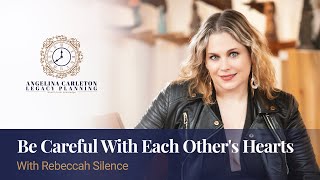
In this episode of the Design Your Legacy podcast, host Angelina Carlson interviews behavior specialist and generational‑trauma‑healing expert Rebeccah Silence. Rebeccah shares her personal story of growing up in domestic violence, earning a master’s in counseling, and later experiencing an abusive marriage, which led her to dedicate her life to understanding and healing trauma. She introduces the concept of “high‑functioning unhappiness,” describing how successful, Type‑A individuals often neglect self‑care, resulting in hidden distress that undermines their ability to serve others. The conversation explores how early childhood decisions (ages 4‑7) shape whether a person becomes a victim, perpetrator, or chooses a fourth, healed path. Rebeccah reframes trauma as a reversible pattern, emphasizing that the people who harm us were also victims, and that recognizing this can reduce fear and empower change. She discusses intergenerational transmission of trauma, citing her own family’s patterns of addiction, abuse, and financial loss, and stresses the importance of modeling new, healed behavior for future generations. A practical four‑step framework is presented: assess thoughts, align feelings, listen to the body, and connect to spirit, followed by journaling exercises to identify what one does not want and its opposite. Rebeccah also highlights the need for healers to first do the work themselves before guiding others, critiques traditional therapy’s focus on symptom management, and promotes getting to the root of pain. The episode concludes with a call to action—visiting rebeccahsilence.com, accessing her free leadership‑training gift, and reading her book Coming Back to Life: A Roadmap to Heal from Pain to Create the Life You Want—as listeners are encouraged to design legacies rooted in emotional literacy and compassionate self‑governance.
Chapters
What if legacy meant we learned how to be careful with each other's hearts? I'd like to welcome Rebeccah Silence to the Design Your Legacy podcast this lovely day. Welcome, Rebeccah.
Well, hello. I am ready for a life-changing conversation about legacy. Let's do it, Angelina.
I am so happy that you're here, and I shared with you I did so much research regarding your prior podcast, and you bring a depth of emotional intelligence as a thought leader. So I'm very happy to have you here today. So to break the ice just a little bit, would you like to share anything about your background, or should I just jump into the first question?
I mean, what I'll say about my background is that there, there's no trauma that can't heal. And what I think is important to share, I made my life's mission about becoming a behavior specialist and a generational trauma healing expert. Had a master's degree in counseling with the 4.0 GPA, And let me tell you what, I grew up in domestic violence, and understanding trauma and all of my education wasn't enough to prevent me from ending up in my own domestic violence marriage, because we attract what we haven't healed yet, period. So my story is a story of truly having to become someone who learned what it meant to heal trauma so the past could be the past, so I could create whatever future marriage business legacy my soul was destined for. And thank God for the practice of emotional healing and what I've learned, so that I've been able to support hundreds of thousands in healing through their trauma for real— not managing it, understanding it, doing their best in spite of it, but healing it. I'm here to have a liberating, empowering conversation about what it means to let go of who we're not and what we've been through so we can be who we are and create whatever we want.
Oh, that's awesome. So let me go back, uh, to the problem again because I think a lot of times people get stuck, and then I'm going to agitate the problem a little bit. So you've said that self-care, or the lack of it, leads to problems in relationships. And yet many people, especially successful people, Type A personalities and so forth, they do not allow themselves the needed self-care as their gateway to happiness. So there's so many individuals that I know that are affluent, you're from family businesses, multi-generational families of wealth, and they won't allow themselves to be happy. So tell me about self-care.
Yeah, well, first let me tell you about high-functioning unhappiness, because that's the term I use to coin, like, the problem that is so optional. But I think we're trained— if you're here on this podcast in this gorgeous audience, you are somebody that cares about impact. You are somebody of service, right? We don't talk about legacy without talking about service, and we don't talk about service to people who don't care about being of service and as healed as possible, right? Like, that's the other special thing about this show and why I wanted to be a part of it, because you're here to help people have a healed impact. A lot of people are of service, but they're not healed, so it's even more taxing on them and on the people they're serving. So we talk about high-functioning depression, high-functioning anxiety, high-functioning addiction, but we don't talk about high-functioning unhappiness. So if you're someone who's high functioning and successful on paper, but not quite happy and just telling yourself you should be more grateful. Here's what I want you to know. We must threaten your unhappiness if you actually wanna be high functioning in a sustainable way. And taking on happiness isn't some myth. It doesn't make you selfish, and it's not an illusion that happiness is a real thing. When I'm talking about happiness, I'm talking about you're free, your life fits in with you, and we can threaten every part of your life that isn't fitting in with you on your terms and liberating you to the point where you can serve even more.
That's awesome. That is very awesome. So you grew up with abuse, as you mentioned, both in the preamble as well as your icebreaker. So you decided over the years of your life to where you are today, not only to break the pattern regarding not allowing others to abuse you, but also that you wouldn't abuse others. Because I've seen so many people that have been victims, but then they turn around and they become the predator. So my question to you is, how did you break pattern to go from there to here? Because a lot of people give up, right?
So I think I decided really young, you know. And if we think about fight, flight, freeze— fight, flight, freeze is how we're managing and coping with unhealed trauma. And maybe we're we're innocently not even aware of it, right? So my work is a lot about bringing to the light what's hidden in plain sight, but not in our awareness yet, right? So none of what I'm about to say gets to be used as ammunition against yourself. You've been doing the best you could, and now I'm gonna wake up, you know, some ideas and some paradigms and some possibilities that you just didn't have before. So that doesn't mean you were doing anything wrong, but really the anatomy of an abuse cycle looks like A trauma happens and I decide I'm either going to be the one who's never the victim again or who's never the perpetrator, predator, you know, persecutor again. That's not a conscious choice. And this is like between ages 4 and 7, typically make that decision because—
and let me just interrupt for a moment and then I want you to keep going. You've said we can choose to not relieve our— relive our past with different characters and costumes. Going forward. So speak more about that decision between age 4 and 6, because some people, I feel like— I hate to use this term, but it's almost like they get infected with evil and then they become that predator.
Well, right, because it's so painful to think that I'm going to be the victim again, that I'm now the one that does harm, so I'm not the victim, right? But it's innocent. This is the anatomy of an abuse cycle, and it is so unconscious. Nobody does this on purpose. But between ages 4 and 7, we're determining right and wrong. For ourselves on an identity level. But that has nothing to do with our conscience. It has everything to do with the reactions we got from our primary caregivers, right? So if I tell the truth and Mom has a negative reaction, I learn real quick lying is better. But that's another form of persecution, right? Me lying, it's, it's a negative impact that I don't want to have, but I don't want to experience being misunderstood or the victim. So fight, flight, freeze. You picked on an unconscious level between 4 and 7, which one you thought was the best option. But there's a 4th option called you're healed that nobody teaches you about the way I do. And here I am today gonna tell you what nobody else is gonna tell you, that the person doing harm was victimized too. And that's just a way of powerlessly taking your power back. The person who's harmed that decided, like me, I was this person, I'm never going to be the one to do harm. Well, now I'm going to be a magnet for people to do harm with me because I'm not going to do harm unless I break the cycle and become healed, which means free. When I'm talking about trauma, I'm talking about heartbreak. When I'm talking about healing, I'm talking about freedom. And fight, flight, freeze are not the only options. And if you don't want to be that one that's fighting everyone and everything. A, don't think for a second that you're not the perpetrator persecutor if you're negatively talking to yourself in a way you wouldn't want anybody else talking to you, or in a way that you would never want to speak to someone, right? Because a lot of times you're attracting people mentally, verbally talking down to you. Maybe it's even abusive, Well, you're a vibrational match for that because you do it with you and it was done to you and you haven't healed that yet.
Yeah, yeah. I wanna ask you a conversation regarding what you, you're sharing because I know you made a choice regarding your daughter. You said, okay, I could let it happen to me, but I'm not gonna let it happen to the next generation, which is awesome and courageous. 'Cause there are some parents that just throw their children underneath the bus, whether it's money or a variety of reasons. So yes, you've shared that no one is immune, Heartbreak, also known as trauma, and that it's a choice no matter our triggers, as well as our choice to shut down, and that it's who we are when we get reactivated and upset. So my question for you is, how do you leverage trauma to your advantage? And how can trauma conversations be empowering compared to dark and gloomy and all of that? Yes.
Well, and it really is true that I teach, if you can't do it for you yet, Who are you living for to keep you going at your best in the moments you don't have it in you to do it for you? Right. And how do you break the cycle? It's a choice. So this is controversial. And thank you for doing your homework on me and understanding my work so well already. But it really is about— as adults, we can't be victims.
Yeah, we have to grow up.
It's a choice. If I am a vibrational match experiencing myself as so disempowered and I have no agency and life just keeps happening to me as an adult, it's a choice to stay in that world. And I'm not saying you've done anything wrong. It's not your fault, but it is your work if you're dissatisfied and high functioning and unhappy to break through, meaning moving through the emotions you haven't faced, moved through, and conquered yet, moving through where you're stuck at that stuck age too, right? So think about it like this, and I work daily with gorgeous VIP clients in my private practice for almost 20 years. We've had over 1,000 people go through my private practice, which is wild to me. But all I'm doing, rinse, wash, repeat, is what is the experience you're having that you don't wanna have anymore? So maybe it's disappointment, maybe it's betrayal, maybe it's you're cheated on, maybe it's you're not valued and you're not getting the right salary and you're doing all this work and other people keep getting the promotions and not you? What's the experience that you're sick and tired of reliving day in and day out? And again, back to what you were talking about earlier, I do talk about you fight with the ghosts of your past until you heal your past, right? So you cannot talk to your father for 30 years but be dealing with him every day at work in, in the person's head, right? Like, you're gonna turn people into the characters that harmed you that you haven't healed with until you take your power back decide, here's the experience I want to have. Who I'm committed to be is this me, the highest me, right? So it's identifying the experience you don't want to have and then identifying who you would need to be to no longer have it.
Yeah, I think, I think what you're saying is brilliant because even let's say somebody that goes back and they say, okay, I'm going to look at the emotion around the trauma, instead of becoming frozen like a deer in the headlights, they have the choice say, okay, well, maybe it's not evil. Like you had said, maybe that individual is just victimized, whether it is that parent, the school teacher, boss, whoever. And then once somebody realizes, okay, that other party got victimized, they're a whole lot less scary, and the whole situation is a lot less scary, and we can just bring it down.
100%. And just because you're empathetic and compassionate and can see, oh my God, you are innocent, and you're just playing out what you haven't healed yet too. And you're here to help me play out what I haven't healed yet in a way where I actually heal. Now, All that's beautiful, but you do not have to be the person that, because you have compassion, puts up with the BS. They can play their nonsense out elsewhere once you've gotten the lesson and healed the pattern for you, right? Because I used to think, well, who else are they going to be able to heal with? Like, I'm equipped. I'm equipped to hold space for their healing personally, professionally. Well, that doesn't mean it gets to be in my world, in my environment, in my space, energetically coming at me if it's not healthy for me, right? So my whole thing— how do you, how do you use trauma to your advantage? And how do you have an empowered conversation about trauma? You get, I'm an adult, I have free will and agency, and nothing gets to dishonor me, disrespect me, or not take care of me that I can help, right? The goal is Just because we're used to disrespect doesn't mean we should put up with it. The goal is that you have a life that fits in with you and that you have a life that honors and respects and takes care of you. And people are gonna do what they do, and that's never personal. I've said this to so many clients. I was just working with a woman yesterday who was taking it very personally that her business partner is attacking her, manipulating her. Gaslighting her. And I said, do you think you're the only person he does this with? And she goes, well, yeah. And I said, no way. You're just who's there, right? It's never personal and it isn't your fault ever. But it is your work to learn how to honor and respect and take care of yourself. How to learn— you get to plug into your spiritual GPS the experience of life you wanna have. Maybe it's peace. Maybe it's joy, maybe it's adventure, maybe it's fulfillment. But in any moment where something feels off, I go, what's the experience I wanna have? Even if the situation doesn't change, I plug that into my spiritual GPS and then I go, okay, who do I need to be? The highest me. Because it, it really is this simple. We have a choice, Angelina. We can choose to be empowered or disempowered. We can choose to let our survival self— and let's just look at the movie Wicked, for example. Okay. I look at it like this. Glinda is someone who created who she is, right? Being good in a very fear-based way because that's how she survived. Elphaba is like, I don't change who I am for anyone for any reason. Thank you.
I will have to check out that movie. I haven't seen it. Keep going.
Oh my God, it's so good. So Glinda the Good Witch in theory, looks wonderful, right? I'm kind, I'm compassionate, people love me.
It's a show. Yeah.
Who I really am, who the hell knows, right? Because I've created this me so that you love me. And how many of us do it? I did it too. I created Rebeccah Silence so I'd be loved, so I wouldn't be abandoned, so I wouldn't be abused. That survival self isn't the truth of who I am. And again, What most people aren't going to tell you is that your survival self isn't who you are and that you're not going to wake up one day and know who you are. You wake up one day and know you're surviving, and then you get to design who you are.
Yeah, absolutely. And you get to design that legacy. What I think is so interesting is that point that you just made, that we aren't our emotions that moment. We aren't that experience that moment. It's going back and saying, in my highest spiritual self, let me make a distinction between survival and my spirit and who I need to step in to be? Because I think a lot of times we forget to ask that question because we cave in underneath the pressure of like a house of cards. We just cave in and we go, oh, I'm not strong enough.
Right? Or we think falsely, if I stand up and tell the truth about what honors and respects and takes care of me, if I say no to what doesn't honor and respect and take care of me, I could threaten what I've built. And I'm here to tell you—
Keep going.
Well, right, but the status quo. Oh my God. So if you're here, you deserve a life where you're free and fulfilled and fully expressed, and joy and excitement are the rule you live by. But you don't necessarily know what you want yet, who you are yet. I mean, I see it all the time. People— I just had a, another client earlier today saying to me when she hired me, she didn't know what her opinion was. She didn't know her favorite food. She didn't know her favorite color. She had no idea. And I said to her, that is so much more common than, than we ever talk about. But then we think, right? And so you can start by making a list. And I do this with my clients all the time. What don't you want?
What's the starting point, right?
Like, you know what you don't want, I guarantee it. So write it down and then guess at what the opposite would be. And here's the other hack. If you want to reclaim your life and yourself and figure out who the hell you are? What do you want for everybody else? Because I guarantee that's what you want for you.
Yeah, I think that those are such profound questions, and you're absolutely right. Private school and public school didn't ask those questions. And if somebody doesn't do the work here and now, then they are— they can fall through the cracks. So I have you for a limited amount of time, so let me ask you about inherited trauma patterns and the intergenerational transmission of violence? Because I thought this is where it goes deep, because it's the pink elephant in the room. A lot of people don't want to talk about it. And yet even— I can bring up the holidays. Half of people spend the holidays alone because their families are dysfunctional and they don't want to open up that can of worms and they don't know where to begin. So how is this a self-inflicted gas ceiling if we just leave it alone and we don't heal it?
Well, right, because then the other half are experiencing holidays the way they did growing up, even if they're not hanging out with their family of origin. Right? If we didn't break the cycle and knock the pattern in a new direction. So inherited trauma, what I mean by that is like, what are the biggest pain points in your family system, right? In some— in my family system, there's addiction, there are affairs, there's making a bunch of money and losing all the money. There's a ton of sexual abuse and sexual trauma in my family system and in my lineage, right? So there's also a ton of women not making their own money, not having a voice, and being extremely submissive to a man that they're dependent on for everything. So I'm just rattling off some examples in my personal experience, but pick your poison, right? And in my book that I wrote, Coming Back to Life: A Roadmap to Heal from Pain to Create the Life You Want, if you want more on the steps, because you're like, okay, Rebeccah and Angelina, this is amazing. I get it in theory, but what Do I do? Buy my book, get it on audio, buy it anywhere books are sold. Coming Back to Life: A Roadmap to Heal from Pain to Create the Life You Want is available. But it, it start with like the root issue. So often regular therapy and most coaches, they're, they're looking at two different extremes. They're looking at what's the mindset and strategy that you need and how do we manage and cope with the pain. And just like that, Fight on one end of the pendulum, freeze on the other end of the pendulum, victim on one end, you know, the persecutor on the other, otherwise known as passive on one end, aggressive on the other. The extremes don't work. We have to find the middle ground and what's true for you and what's right for you. And most traditional work is trying to help you heal your emotions through the mind, and it's treating symptoms. It's not treating the root. Yeah. So in my work, we got to get to the root.
Yeah. I think what you're saying is really valuable. But a lot of the coaches, if they haven't done the work, they can't lead someone else through what I call the forest to the canoe by the lake because they haven't processed it enough where they even have the language to talk about it, to even give a voice to the client. Like when you're asking your clients, what is it that you like? What is it that you don't like? That is a starting point because you started there one time with your own self from the ground floor on up. And I think a lot of times coaches mean well and consultants and advisors and so forth. But again, if they haven't done the work, They, they can't.
But in the training, yeah, the training isn't as helpful as, as we need it to be for therapists to really be able to work the magic that they're capable of, right? So yes, you have to go there first. You can't take people farther than you've gone. But also, the training is faulty if you're trying to have a new experience of life and feel differently the mind work isn't gonna cut it, right? So it's about getting to the root. What is hurting you the most? And what's the new experience that you want to have? And the inherited pain, it does just take one person in the family that raises their hand and says yes to reinventing themselves and their life and their leadership. Generational healing, it's just simply about modeling new possibility. It's not about— it's your job to heal everyone in your lineage. Good luck with that. You know, I have a huge family. I have one aunt that reads every book, buys every course, goes to every event. The rest of the family, they watch. But I am modeling next level living, next level leadership, next level freedom. And that makes the difference. You know, I had a family member whose son was very, very sick. And she said to me, if I didn't watch you, following your intuition, then I wouldn't even know I had any to lead this situation with my child. And that meant a lot. I didn't know this family member was watching and paying attention, but I think generational trauma healing, it feels like pressure because, A, we're taught certain things just can't heal and you have to live with it. And B, we think, well, if I accept the role of being the generational healer in my family, now I have all this responsibility on my shoulders.
Well, yeah. And then you're Yeah. And you might not wanna carry that weight or have a role reversal if someone's young and, you know, or the parent—
Well, and we don't wanna be irresponsible, right? Because people were so irresponsible with us. Your only responsibility is to yourself. The only thing you have to lose is you. Don't you dare let that happen. And my God, if you can survive survival, you can survive alignment. Cuz that's what we're talking about. Connecting to the highest you, to your spirit, and to divine guidance, right? So a quick, quick, quick, 4-step process for this beautiful audience to live your legacy like never before and to lock in in a way where you can be careful with other people's hearts because you've learned the art of being careful with yours, right? You can't be more careful with other people's hearts than you are with yours. You just can't. So it starts with, what am I thinking? Is it worth following or not? Nothing else to do there. Just turn the volume on the thoughts that aren't worth following. Turn the volume up on the ones that are. Then drop into your heart and pay attention to what am I feeling, and is it how I want to feel? Then drop into your body that has the information about what you need. Then you get to drop into your spirit that has the information about what you want. And once you know what you want and you're committed to being the person that gets what you want— I get what I want, I get what I want. I get what I want. You get to get what you want. And I would invite you to do a journal exercise today. If I was honest with myself about what I really want, here's what I really want. Let yourself go there. Nobody's gonna die because you're getting your needs met and you're getting what you want. You will serve more.
Yeah. Well, I think what you're pointing to is countercultural, especially for women. And I think it's lovely. And I think there are individuals, if they were not allowed to get their needs met, even their basic emotional needs, this is an act of courage for them. So you'll have to come back on one day and speak about the Karpman Drama Triangle. But since I've got a few minutes left right now, yeah, since this is a Design Your Legacy podcast, is one of your guiding, quote, legacy principles, I am the space where all healing is possible. What say you?
Yes, I am the space where all healing is possible, and so are you. And all the Drama Triangle is, is victim, persecutor, rescuer. Consciousness, right? Where I go, it is 100% of the time only available to me to fight, flight, or freeze. And I can come back and take it deeper. But being the space where all healing is possible, all it means is I could choose to be the healed me in this moment. I could choose to be my highest and best in this moment and make the best of this moment. And that isn't positivity. That's possible.
Yeah, I think sometimes people don't realize if they step into that rescuer role or the different roles. So you'll have to speak on that further in the future. So what does the word legacy mean to you?
Legacy to me means holding myself and everyone capable, right? I don't need to be anybody's savior, but I am the hero I've been waiting for. And that rescuer energy is just about thinking it's up to me to play God, and that never Works and people get resentful cuz no one wants to be disrespected, even if they gave you permission to be treated like a victim who needs saving. Nobody wants that. But where your energy can go and flow is to being the parent you needed that you didn't have, to being the hero in your story that you needed, that it's you, you've been waiting for, and it's you that has the keys to the kingdom. That has access to the stairway to heaven on earth that you deserve. So, go play yourself some Led Zeppelin. Play yourself some Stairway to Heaven. Look in the mirror. Get honest with yourself about what a badass you are, how capable you are, and do some journaling about what you really want.
I think— thank you very much. I think what you're speaking to is emotional literacy and especially emotional governance. And this might be very new for some people because, again, they could be so focused in— they did well in school. They've got their career going well, their family business, their investments, and now they're at a point in their life where if they are going to design a legacy, they might need to look at that heart space. So, my lovely guest, any closing thoughts before I read out my paragraph?
Well, I want your kids to have healed parents, and I want your love story and your life to be magically delicious. And I just want you to know it's not nearly as out of reach as you think. You can visit me at rebeccahsilence.com. I have a free gift there. It's leadership training, but it's also Training to Have a Healed Home Life: The 3 Must-Know Secrets to Heal and Save Your Family. Visit me at rebeccahsilence.com. Get the 3 Must-Know Secrets. Get Coming Back to Life and let yourself know that 2025 can be the year where you're more liberated and more you than you've ever been. And that doesn't hurt anyone. It makes your life honest. And what a gift to give every life you'll touch.
Wonderful. I just want to take a moment before I read my closing paragraph to thank you for being a guest. We started today's conversation with the intention and the question of what if legacy meant that we learned how to be careful with each other's hearts? And I think we have fulfilled that today. So thank you for being a guest so much. And, um, and again, rebeccahsilence.com.
Yes. And thank you so much for having me, and I will happily come back anytime.
My pleasure. My pleasure. In closing, I'm Angelina Carlson, hostess of the Design Your Legacy podcast, as well as the founder of Legacy Planning, a boutique advisory firm based out of Beverly Hills, California, USA, but international in those I coach and consult. I hope to dive deep deep into subjects that can help a person to find, develop, and execute their legacy, and continue to scour the landscape for those who can be great resources to every dimension of your legacy. For many listeners, there can never be enough education and preparation in the moat around your castle. Whether you find yourself with new wealth or generational wealth, may the content on this channel be an anchor in any storms ahead. We do our best to provide original content for intellectual and emotional curiosity. If you're checking us out on Spotify or Apple Podcasts or SoundCloud, please remember to rate and review, share with your family and friends, send an email to either Rebeccah or myself and let us know your thoughts about today's episode. Thank you so much for joining us this week. And thank you to Rebeccah for speaking into your legacy.
More from Rebeccah





Free 5-Day Live Online Bootcamp for Mothers, August 24–28 4 PM EST. Replays available #shorts



