Be the GOOD CHANGE!
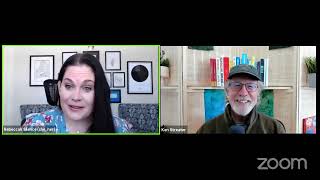
Ken Streeter survived childhood trauma, a crippling back injury, and losing everything in 2008. He rebuilt through therapy and community support, wrote two books, and started the Good Change Podcast. He talks about why integrity and vulnerability matter when your life falls apart.
You are about to meet a special guest in the Healing is possible hot seat with me, Rebecca Silence. That is literally inspiring good change in the world. And he is here today to share his story of healing through depression, financial devastation, hopelessness into designing his life exactly the way he wants to while he leads and inspires others to be the good change together. So, Ken Streeter, dear friend, welcome to the hot seat.
Good morning. I'm happy to be here, I think. You know, I dressed in camouflage colors today, hoping to not be noticed, but I don't think that's going to help me.
Let's let the world meet you, Ken. Who are you?
Who am I? So that's a great question. I'm River Guide, entrepreneur, social good, community member. First and foremost, a father and a husband. A guy who tries to keep his word and sometimes falls flat on that, but in general believes that the world is good. And I'm here to help with that.
Yeah, tell us. I mean, in this man, everyone is endorsed by Meryl Streep. He's making a difference on the planet. So. So don't let the camouflage and humble demeanor fool you, Ken. You are a big deal. And tell us what you've learned about healing. Let's just dive right in. What have you learned about healing?
It's hard work. You know, it's funny, I'm sitting in this chair today because yesterday my wife and I were in our therapist's office and peeled back another layer to get to why I am the way I am. And I was crying. But as I had a chance to reflect on that meeting, that counseling meeting yesterday, I wouldn't have changed it for the world. It's tough to find out your flaws. It's tough to do the work, to move past them. But healing is a practice. It's a day to day interaction with yourself and others. And sometimes it hurts like hell. Yeah.
And why is it worth it to you?
Relationships, pure and simple. The best thing you can do is to figure out what makes you tick in order to be there 100%. I'm not a big fan of the word authentically. I think it's overused. But to be there 100% real so you can be a better father. That's a big goal of mine. To be a better father, to be a better husband. So it's worth it just because it allows you to build better relationships and to build more pure relationships.
Yeah. And will you share your story of healing? How life was, what happened, where you are now?
I mean, it started with my childhood, with an alcoholic father, and then a. An abusive stepfather. And layers and layers of anger and distrust and sadness that manifest itself into a teenage life that was less than ideal. I still was accomplished, but I was making mistakes, doing some stupid teenage things along the way. And then in my 20s, I discovered rafting and became a river guide. And that was a salvation. Here was an opportunity to spend time outdoors, which I love, and to spend time with people that love the outdoors and that literally and figuratively have your back. It's rare to work in an occupation where your outfit is a life jacket. And that means that every day that you're. You're to some degree or another, putting your and other people's lives on the line. And that was as. That's about as honest an existence as you can find when you're in the company of people that love what they're doing, providing others with adventure, and then wearing a life jacket in order to make sure that people survive. So that was a huge transition for me. And I discovered really what mattered to me at that point in my life, which was camaraderie and adventure. And then I hurt my back and had to get out of the rafting gig. Did that in my late 20s. Hurt it to the point where I was laying on my back 20 or more hours a day for eight straight months. I had pain running down my leg that felt like a freight train driving over it or somebody hitting it with an electric cattle prod, just depending on what the nerve sensation was choosing to do with me in those days or on each day and each moment. I had ruptured discs. I didn't want to have back surgery because I thought I could heal myself. And it led to a psychological devastation. I was in my late 20s. I'd been adventurous at that point, and I thought I was now relegated to a life where I couldn't even walk to go to the bathroom without it feeling like somebody was pounding on my leg with a sledgehammer. And so that took months to get over. You really get introspective, and you also get compassionate when you spend your days looking at the ceiling and a white acoustic ceiling with one of those 70 styles light fixtures. That's pretty much all you're doing. My then girlfriend, for some reason, she became my friend and I don't know why. To this day, I look like a character out of Starsky and Hutch, except I was not at all fit. I was 6 to 150 pounds. I was just a mess. It was a mess psychologically and physically. But she helped me out and we later got married. So I came through that after having back surgery and through her love. But that was an eye opening experience for me. To recognize what really matters is to just be able to walk and to somehow or another produce and to somehow or another have relationships with people where you could connect to them on something deeper than the kind of the levels that I had been connecting with people as a teenager. So I went back into rafting and started running my own company and was lucky enough to do trips all over the world with. We had 50 people on payroll. And we were doing trips in a number of different countries and in a number of different states. And that was a completely rewarding, exhausting, but rewarding period in my life. And then I started having kids. My wife and I had kids. And I realized that that lifestyle was probably not best to be a good father because I was away a lot. I would have to go to Alaska or Norway or Idaho and help set up trips and run trips. And so I decided I needed to get out of the outfitting business. And I got into real estate. That's a whole other story. That's a bizarre, bizarre turn of events. And that was in 2006. And then we all know what happened in 2008. The market crashed, the housing industry went under, and so did my family and I, as the result of some stupid investments that we made. We were underwater on real estate that was not paying its bills. We were 150, $160,000 in credit card debt. And I was an emotional wreck. I felt completely guilty for putting our family in this position where we were at risk of losing it all. And I would wake up every morning for months at about 2 or 3 in the morning. And sometimes I would cry quietly to myself. Other times I would just lay there with my head spinning. I didn't want to wake my wife because I didn't want to worry her. And it took a long time to get out of that. And the healing process for that was very slow, but it was deeply, deeply meaningful. And in the end, I'm here today a much better person, better father, better husband, better community member as a result of having gone through that financial peril. The introspections that I gained in that time were invaluable.
From that. You decided who you wanted to be. Speak to that. I mean, where are you today? And if you could tell our audience the possibility of really what it means to live how they want to live and how you've done that, I think that would be profound.
Yeah. So I had experienced my deepest connection to myself when I was doing outdoor adventure stuff as a guide. And I got lost. I was an oxymoron. I wasn't myself in the real estate world, but I still needed to pay the bills or try to pay the bills. And so I had three choices to make. I formulated this idea that I had three choices to make as a real estate broker. And I transitioned into commercial real estate at that point, not residential real estate. And I had three choices. One was I could hate what I did. I woke up every morning feeling like a phony. I literally hated myself, hated what I did so I could wake up, go to work and hate it. I could get out of the industry, but I, you know, I would go back to being a river guide or an outfitter and not be with your kids and not have any money to speak of because it's not a lucrative business. Or I could change the way that I approached my work and my life by changing the circumstances that I was in control of. And I realized then that I could make a difference in the real estate industry by being more river guide, like if I chose to apply those characteristics to my work. And so we created a business, we started a company, my ex partner and I, we've since sold the business, but I started that business and I applied the principles of river guiding, which is have each other's back. Put your community before commodity, meaning put people before profit. Make sure that you're being in integrity, you know, that you're not just doing something to make a buck off of somebody. And of equal, if not greater importance, our motto was community before commodity, which means just that, put your community first. And then our second motto was family is our first fortune, which is just that, put your family first. And so I realized I could run a business in an industry that didn't have a whole lot of those kinds of operators. It's gotten better since then. And so I reinvented the real estate industry and reinvented my real estate company. And then I recognized that I could do even more with my life and reengage kind of my purpose, my sense of purpose. And that was I decided to write a book. After going for walk after walk after walk in the morning, I changed that routine in my life. My kids were asleep. I would just get up early, 5:30, go for a walk. If it was dark, put a headlamp on, go for a walk and just ponder, ponder, ponder, ponder what mattered to me. And I realized that it was community and it was being able to help people up. And a friend of mine was a river guide, and she had suffered a debilitating injury where she became paralyzed from the waist down. And I thought about myself in comparison. I thought about all those years where I was in just extreme pain and recognized that I was not in anywhere near as bad shape as a lot of people. And I still had a lot to give and I could work through my financial issues. And so I decided to tell her story. Her name is Kelly Kalafadich. I decided to tell her story by writing a book about her. And then in that project, I recognized that I really wanted to tell stories about a lot of people who have done great things for their family and their community. And so the walks would shrink in length and the time would grow. Me sitting in front of my computer from essentially 5:30 to 7. My wife was working till 1 in the morning at the local airport trying to help us make ends meet. And so I was the one that would get up and get the kids off to school. Although, man, there was. She would wake up with five or six hours of sleep every day and help with that. But I needed to be ready to get them to school and give them care in the morning. And so I would write from 5:30 to 7 until we woke them up and got them ready for school. And out of that came a book called the Gift of Courage that is about seven everyday heroes who, in one form or another, lifted up their community by facing their fears. And it was really, you know, what it was, was as much as I was writing about other people, it was cathartic for me because I was touching deeply the fears that I had and doing what I needed to do to get through that. And so that was a very important healing step for me.
Will you share your definition of integrity? You're saying so much that's incredib beautiful. But this word integrity, I think, gets thrown around as much as, if not more than the word authenticity. And I'd love to hear what integrity means to you.
So it's interesting. I've been. My son is 17 and he's getting ready to go off. He's graduating a year early, which is phenomenal. He's an amazing, amazing young man. And he's, you know, like, we all at teenage. In our teenage years have had some challenges, and he's come through those. And he's graduating a year early and going to a technical institute for auto repair so he can get his certification in auto repair. And I've been trying to think of the ultimate fatherly advice as you send as you watch your child get in their car and drive away. And one is. So I guess there's three parts to integrity. One is do not have a casual relationship with the truth. That's the first.
Oh, Ken. Yes.
The second one is.
Wait, you got to say more about that. Tell them what that means. Oh, my goodness. So good.
So there. There have always been times in everybody's life where you need to fudge the truth a little bit. You know, whether it's to. I don't know what it's about. Everybody knows that they're the little white lies, and they're not good, but they're little white lies. But if you don't have a piercing awareness of truth, that matters. The importance of truth, the importance of keeping your word. And that's another item. But just the importance of understanding what real is, because that's really what truth is. Truth is reality, and it can be our definition of reality. But if our definition of reality is so skewed from others, then it's not truth. It's not truth. And also, truth is founded in right and doing right. And if you're struggling like I have over my 61 years, 62 years, if you're struggling to figure out what's right, odds are you're not landing on what really is right. Because right does not need defining. You either know it's right.
Oh, good. Yes.
So that's not having a casual. Not having a casual relationship with the truth is understanding. Right. It's understanding accountability. It's just making sure that your version of reality is really jiving with everybody else's. That's. That's. Number one. Number two is the most valuable asset you have is your work. There's nothing, nothing more valuable in your life than your word. And if you lose track of that, you will lose one opportunity after another to help others, to help yourself, to be a good partner, to be a good father, to be a good community member. Your word is the most valuable asset you have. And then the third One is be 100% accountable for the percent that you are responsible. So if you're in a marriage and trust me, I've screwed this up thousands of times, I don't know. But if you're in a marriage and you're responsible for an argument because of something you did that was completely stupid, if you try to deflect that and aren't fully accountable for the percent that you are responsible, then you should never expect anybody else to come to you in that same way. So that's the third One is be 100% accountable. Be 100% accountable for the percent that you are responsible in any transaction, any relationship, any engagement.
So good. And then I would suggest to all of you watching, is there ever a time where we need to deflect from the truth or our responsibility? I want you to speak next, Ken, if you would, to why people should risk it. If they're in their own personal hell, if they're in their own version of survival mode, if they're, you know, emotionally suffering in any way, why should they risk getting out of their comfort zone and taking on their healing?
I'm going to use a rafting metaphor for that. So I've run a lot of great rapids around the world, and some of them have just literally scared the crap out of me. And then I've run some fun ones, some easier ones, with people in my boat who felt like their life was at risk going through the easier rapid. But nevertheless, it was completely uncomfortable. The celebration of life beneath at the end of a rapid, in the calm, where all these colors are unfolding in front of you in a way that you didn't even know existed. It's so vibrant because you've just come through this turmoil. That moment, that moment of celebration, that moment of reflection, that moment of togetherness, that moment of peace is worth every millisecond of the turmoil that you went through to get there. And, of course, that's a metaphor, and it certainly, I think, applies for why you take the risk, why you peel the layers back, why I decided to go to therapy in order to try to fix things in my life, and why I spent morning after morning going for a walk, trying to figure out what the hell I was doing with my life. The other side is. Maybe Shangri La is too big of a word, but there are moments of Shangri La where it's all worth it.
Ken, you've been with me in the trenches in moments of turmoil, and you supported one of the biggest breakthroughs of my life. And I don't know if you even know about this or would remember the story, but I was in my driveway. We had done seminar work together, and I was in my driveway, and you were facilitating a Byron, Katie Judge, your neighbor worksheet with me. And I was leveled by a fight I had had with my husband. I don't know if. Do you remember this?
I do. I don't remember the outcome, but I remember the conversation.
Here's the outcome. Basically, in the moment where I got willing to be in the fight with Mark as Many times as I needed to be in the fight with Mark, until I didn't feel the way I was feeling anymore. I was free. I remember saying to you, oh, my gosh, I need to be willing to have this fight as many times as I need to have this fight until I don't feel like this anymore. And that moment gave me an opportunity to get responsible for my work. And then the support of you being there with me was so incredibly healing. Will you speak to the importance of relationship and community in our healing and not doing it alone? Because I think you might be one of the best I've ever met at leaning into support and building community while you are vulnerably healing in front of everybody.
Well, thank you. And I remember that conversation and, and I'm watching now your life with your family and your husband, and I just marvel at where you're at. And you know, Rebecca, we've spent hours just broken together. And it's. I mean, it's. The glory, the glory of the other side is worth every. Every micro ounce of effort that you put into it. It's remarkable. And, and, you know, we've talked about you helping me. You know, when I was in the middle of the. Of the pity party, really, I mean, that was a big part of my life was, you know, feeling sorry for myself, feeling angry at myself, feeling sorry for myself, just on a roller coaster of shame. And I was coming out of that, and, you know, I think I'd started to write my first book or written it or something, and we were on another worksheet or conversation, and you said to me in paraphrasing this, you need to play bigger. You need to go for it more, you need to step up. And that was years and years ago that you said that. And, you know, for a while, the trajectory was like this, you know, barely going up, barely going up. And I swear to God, Rebecca, that conversation has replayed in my mind 150,000 times or so it seems, because I would level off and I wouldn't engage and I wouldn't peel back a layer and I wouldn't do what I had to do to heal and get through this plateau. And. And then it just feels like in the last couple of years that maybe in the last year actually that it started to go like this. And it still rings in my head. It's like the. The ball in an arcade machine, a pinball machine, where that's bouncing around, bouncing around, bouncing around. Play bigger, do more, play bigger. You're capable of making a difference in the world. Get past your own crap and go, you know, fix yourself, fix yourself. Play bigger, play bigger. And then every once in a while, the ball tries to sneak out. And then there' Rebecca's voice. That one of those flippers that puts it back up into play. It's brilliant. I love that you did that.
I'm hearing Eminem in my brain. Snap back to reality, but speak to, if you would, about community and support and not doing healing alone.
Oh, my gosh. So I call them Godsense. And, you know, we've had challenges. I've made mistakes, and my wife and I have had challenges, and my kids, we've had challenges with our kids. And every once in a while, this little sparkling person from out of nowhere, I'm going to back up here a little bit. I was talking to somebody the other day, and this idea just came into my head, and that is that persistence breeds serendipity. And so if you're working at making yourself better, if you're working at healing, if you're willing to sit in a hot seat, metaphorically or literally a reward in that process are these moments of serendipity. And for me, they've been godsends. There have been these people that have just appeared, either because we took steps to make that energy possible, or because there's glorious energy in the universe, and it just happens. But without these godsends, whether it's a therapist or whether it's a friend or whether it's a complete stranger that just says something to you about life without these connections, without these godsends, it would be so much more hard to negotiate the road. It would be more like driving on a mountain pass and your car slamming into the guardrails every time you missed the turn, every time you didn't handle something correctly. But with godsends, they're like these little warning signals in the cars these days that say you're drifting out of your lane, and they just help you stay tuned in to what matters. And so that's a big part of community. Your friends and therapists and coaches, family members who are just. They're that little signal that says, hey, hey, hey. Don't hit the guardrail. You're doing great, but you're starting to wander. Don't hit the guardrail.
What would you say to the people that are afraid to be in their emotion, in their vulnerability, in front of the people that they love and care about?
Oh, man, that's tough because it's so hard. It's so hard. You talked about you and Mark's relationship and my relationship with my wife. There's been times where I've just clammed up. I think it goes back to what we were talking about earlier, which is you. It's okay to ball up on the floor. You know, I can remember times where I was just balled up on the floor crying my eyes out and wishing that it was different. And sometimes you just. You can't do it on your own. And if you spend too much time in your head without having these guideposts in your life, these people that care about you, it can unravel even more deeply. And so the importance, I think, in that is to recognize that. And there's a distinction here. There are people that may want to help you, and there are people that want to help you. And the key differentiator in that is you kind of know who is holding your heart in your hand. You kind of know, you know, whether or not somebody's talking to you because they've got an agenda and they think you need to do it their way because their way is the only way. And then there's people that love you that. I mean, I had a great. I had so many great conversations with a friend of mine during a lot of this where I just knew he had my heart in his hand and that he cared. And without that kind of guidance, without that willingness to listen and take to heart what others are saying to you, who care about you, it's a much longer and lonelier road. And for that reason alone, it might be worth it to just engage with people. Allow yourself to engage with people who have your heart because you're not alone. And sometimes the. The caressing, the tenderness that they provide, can provide, can make it shorter and easier to get through.
Yeah. And you know, to me, we're not broken. We deserve to allow our hearts to be open. And that requires breaking through the guardedness, you know? And to me, Ken, you know, the moments you and I have shared together, the moments that I've shared in community, doing the healing work, they become a permanent change. Life before is no longer an option. When you've broken through and done that vulnerable work in community, it's very different. If you're alone, hiding in your emotions, and then that's a start. But risk it. That's what Ken and I are here to tell you today. Risk it. Healing is possible. And Ken, I would love, before you go, for you to tell everybody what you're doing now. This movement you've created, you've got a brand new book. You've sold your company, You've got a podcast. You are literally leading a movement called the Good Change Movement. I want everyone to hear about that.
Can I talk first about my breakdancing?
Yes.
No, I'm not. If I break dance, I'll break something. That's my breakdance. There's no breakdancing. But. So after writing the Gift of Courage, which is about the everyday heroes and people who face things far greater, far greater in terms of challenges than I ever will. One story was about a firefighter who fell through a roof and suffered second and third degree burns on 51% of his body and lived to tell us about it and changed his community as a result of that. After writing that, I really became aware of the fact that people found meaning in the stories that I tell. And so I decided to write another book called Be the Good, which has 20 stories, actual stories, that in those stories have advice for people to become a part of the transformation of the world. The subtitle is Becoming a Force for a Better World. And you know, Rebecca, you and I have learned about the difference between power versus force. And I considered the word power there as opposed to force, but I think in generic sense, people. People understand what. That you can be a good force too.
Yeah, I love it.
And so that book, it's an international bestseller and it's gotten rave reviews from readers. It's just so humbling. And then from that, I realized that I had more. I should capitalize on playing bigger. I should play bigger. And so I started a podcast called the Good Change Podcast. And the subtitle for that is Conversations about Making a World of Difference. And you were a guest on one of the early shows and we've had some amazing movement leaders and everyday heroes on that show. People who have reshaped the education industry, people have reshaped work cultures by making sure that they're compassionate and heart driven. We talked with the first woman to retrace First Norwegian Explorers Path to the South Pole. And her story is off the charts. Off the charts touching, where she talks about how, you know, you want to talk about the power that you have when. When you're vulnerable and when you're struggling. You may not realize it, but the power that you have when you're vulnerable and struggling and the meaning that even that can bring to others, even though you think you're a basket case. And there's, how could I possibly be helping others? So the reason that she went to the south pole by ski, 800 miles, 50, 60 days in minus 40 degree weather was because she was an oncology nurse a decade before that, and one of her patients who was dying said, you have to live while you're alive. So here's a guy who was at the end of his life and probably was in complete despair, and yet he managed to impart to her something so important that it changed the trajectory of her life. And that's an example of somebody who is part of the good change movement as somebody who a, offered those pieces of advice and B, somebody who acted on them. And then she lifted an entire country with her pursuit. And people then were able to say to themselves, if I take the risk, getting back to that whole part of this conversation, if I take the risk, I can live my dreams. And so the podcast has people like that on it that are inspiring. And my goal is to share conversations about how to make a world of difference.
I love it. I love life. I believe everyone watching your life is precious and risk it, risk living it fully while you are still here. Ken, what a gift you are to my life, to the planet. Thank you so much for being here. Any final thoughts on healing?
You know, for people that have rafted or for people that have gone through something risky, Recognize just the euphoria and the tranquility and the bliss that you feel as you reflect on that. Whether it's a trip through a rapid or whether it's having the guts to go to a therapist and then feeling how, upon reflection, how good it feels to have been able to purge yourself or clean that layer up. That's my final thought, is take the risk. It ain't going to be easy, but my God, the rewards on the other side are angelic.
Ken Streeter how do they get a hold of you?
KenStreeter.com is my website. K e N S T R E a t e r.com or just feel free to email me ken streetermail and I have 127,000 unopened emails, but they're junk emails. I'll get to yours.
Bye, Ken. Bye, everyone. Thanks for tuning in. See you every week in the hot seat. And if you want to join me in the hot seat, message me. Let's get you in here. Doing your work, sharing your story and impacting.
More from Rebeccah





Free 5-Day Live Online Bootcamp for Mothers, August 24–28 4 PM EST. Replays available #shorts



