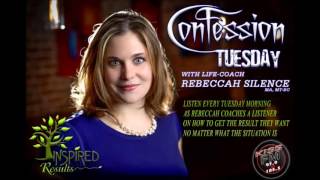
Radio interview segment (Confession Tuesday, 10/25/16) on KISS FM where life coach Rebecca Silence and host Liz discuss domestic violence during National Domestic Violence Awareness Month. Rebecca discloses her own experience of emotional and physical abuse, explains intergenerational patterns, and encourages victims to seek support. Practical resources are offered, including the Utica YWCA and its contact information.
It is a confession Tuesday with life coach Rebecca Silence in studio, of course, inspired results. Coach.com it's how we roll here on a Tuesday. All the backlogs are@cnykiss.com youm can listen to past segments. You can also submit either a question or topic that you would like Rebecca to talk about. And with October being domestic violence month, I wanted to make sure that we had a chance to talk about it. Because if a guy or a girl, a lot of people think that domestic violence only happens to women. That's not the case. There are guys that are suffering through domestic. So if you're in a situation like that, it's very hard to get the courage to stand up for yourself to. To get out of that situation. So I wanted to talk to you about it and get your, you know, feelings, opinions, thoughts, something that, if you're listening and you're in that situation, something that may be able to help, you know, turn the corner and get out of that situation.
Yeah. So October is national domestic violence awareness month. And, you know, domestic violence is something that goes on every single day to so many people and we don't talk about it very much. So I'm grateful for the opportunity to talk about it. And I'm not sitting here as this life coach, you know, idealistically not knowing what it's like to be in a domestic violence situation because I was. I got out of it. Domestic violence, marriage, my first marriage, there was emotional and physical abuse. And what I knew for myself was that I needed a lot of support to get out, but I had to because I didn't want my daughter growing up witnessing this type of dynamic and thinking that that was normal or acceptable.
Right.
And I do believe that pain is inherited where experiencing in abusive situations, not just our own pain, but pain that our families and our ancestors went through too. I believe that patterns repeat until somebody is brave enough to heal them. So what I know for sure is that if you're in a domestic violence situation, we can pretty much guarantee you're not the first person in your family to be in that type of a situation.
Okay.
But you can be the last.
So how do. What. What is a good way to. To. To. To do it? Yeah. Like you've made up your mind. Okay, I can. I just. I can't anymore. But then all of a sudden, fear comes in and then all of a sudden, you know, realistics come in because they're living together or they May not be able to, you know, there may be a money dependence on the other one, you know, So a lot of these factors, they feel like they're trapped because of those things.
Well, and I think before the thought that maybe I shouldn't be living like this can happen. You've got to get real about what's happening. I think more often than not, people are just so used to the abusive dynamic that it doesn't even occur to them that something's wrong or that it could be different.
And so it's one of those, well, I can, you know, if I'm. I can take care of it. It'll be fine. It'll get better, It'll be all right.
So here's what I know. My first ment used to say that people are either loving or they're crying out for love. And it doesn't make the abuser's behavior okay or acceptable. But what I know for sure is that most people who are abusive were also probably abused. And again, it's this pattern that has just continued generation after generation. And what you can know is that you deserve to be safe and you deserve to be respected, and that if you're in an abusive situation, there is no nothing that you could have done to warrant abusive behavior.
Say that again.
If you are in an abusive situation, what is really important to know is that there is nothing, nothing at all that you could have done to warrant abusive behavior. Nothing. The person that you're with is looking for a reason to explode because they've got anger issues and probably past abuse that they haven't dealt with. And it just bleeds out onto the people closest to them. If they haven't gotten help, somebody who's abusive, you can get help. You can get anger management. If you're somebody being abused, don't think that you caused it. Don't think that there's something you did to ignite this flame in the other person to cause the abuse.
I think that that's something that a lot of people needed to hear this morning. If you're in that kind of relationship or in that kind of situation, what is the first step?
So the first step is to be willing to outgrow the dynamic. Whatever the cost, whatever it take, you can't do it alone. In my experience, support is critical. You're gonna need support, you're gonna need friends, you're gonna need family. And the local YWCA is our best resource here locally in central New York that has counselors and has places where they can put you up for a short period of time and resources available for you and your children if you're in this type of a situation. So asking for help is critical. Pretending like you should do this alone just doesn't make any sense. Why? You've been suffering long enough and being brave enough to make the choice to not suffer anymore, you know, means reaching out and getting support. And I won't lie, it might get worse before it gets better. It might not be easy to get out. It probably honestly won't be. But I want you thinking about the long game of your life and what you want for yourself. And if you have children, your children, and be willing to do what it takes to do the hard work up front to get freedom and to get your life back. And that's what you deserve. Everyone on the planet, regardless of whether or not you're in a domestic violence situation or not, you deserve to be free.
And the phone number for the utica YWCA is 732-2159, 732-2159. They also have a Facebook page that you can contact as well. And if anything, let that be the first step. Let that be the first step and they can help you. If you're talking about advocates to help you, whether it be through the legal system, they'll help you every step of the way. And they are absolutely fantastic at what they do. 732-215-973-2159 for the YWCA, you can be.
Part of the solution and you are not the problem. That's what I would say to anybody that knows someone in a domestic violence situation or you are in a domestic violence situation. You are not the problem, but you are the has to step up to be the solution.
It is Confession Tuesday with life coach Rebecca Silence Inspired resultscoach. Com. Rebecca of inspired results on Facebook as well. Thank you so much.
Thank you.
And we'll talk to you next week. It is a Confession Tuesday on KISS fm.