Emotional barriers that block happiness from flowing freely with Rebeccah Silence.
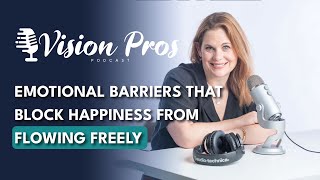
In this Vision Pros Live interview, host Jackson Callum talks with therapist‑coach Rebeccah Silence about the emotional blocks that prevent happiness from flowing freely. Rebeccah outlines a framework of five core emotions—anger, fear, grief, joy, and excitement—arguing that these are the natural, biologically‑based feelings we are born with, while most other feelings are learned reactions. She connects these emotions to the classic fight‑flight‑freeze responses, describing the stuck emotion and unmet need behind each: anger under fight, fear under flight, and anger (as a suppressed feeling) under freeze. Rebeccah differentiates emotions from feelings, teaches practical techniques for healthy expression (air‑screaming, recognizing three types of tears, and moving through victim, grieving, and joy tears), and explains how to move from a “survival self” to a “healed self.” She shares her personal story of surviving cancer, enduring childhood trauma, and building a coaching practice since 2002, emphasizing the importance of investing in personal growth through coaches, masterminds, and books (e.g., Wayne Dyer, Brendon Burchard, Jamie Kern Lima). The conversation also touches on leadership concepts of power versus force, the impact of healed parents on children, and the broader societal ripple effect. The episode ends with a call to action for listeners to access Rebeccah’s upcoming “Ultimate Guide to Breaking the Silence” and to engage with Vision Pros Live resources.
Chapters
you put on there.
Thank you.
So good stuff. All right, so, um, and today we're going to talk about emotional barriers that block happiness from flowing freely. Sound good?
I love it.
I bet you— good, I'm glad you did. Sometimes I write those and my guest is like, nope, that's not quite it, and they'll give me a nuanced word, and I'll be like, oh my gosh, you're right, I shifted the whole meaning, um, of what this is.
No, that's great. I mean, I feel like you get me, Jackson. Let's make it happen.
Absolutely. And, and we know we, we've gotten to meet a couple times before this and get to know each other. And we dove into a very deep vetting process. Um, you know, experience that with me. And we talked about, um, different entities that exist out there that, um, I haven't been too happy with for certain, um, certain misalignments that lead— that people call just marketing in the world. And I said, no, that's unethical and you're lying. Uh, not you, them, these entities. And so we, we had to meet under kind of abrasive circumstances, and yet we still had a great call and we still had a great relationship.
Here for the hard conversations, Jackson. I wouldn't even describe it as abrasive, I would just describe it as honest. And that, I think, is the thing that will change the world most, is when we are willing to break the silence, have hard conversations really care about understanding where the other person is coming from more than us being understood and find a path forward that works for both people. I was just on another show earlier today and he was basically saying to me, but you have to acquiesce if you love somebody, right? And I'm like, no, no.
What does that word mean? Help me out. I want to understand that.
Well, what we were talking about, he was saying, isn't love compromising for the other person? And acquiescing for the other person's benefit and changing for them. And I said, oh, hell no. It is about being unwilling to betray yourself in the name of love. I'm a relationship expert not because all of my relationships have always been perfect, but because I know how to stay me through it all. And anyways, when we met, I really respected and appreciated that you're you through it all. I'm me through it.
And that's why I don't know that word, right? That word has never come across my radar in a way where I'm like, I—
yeah, you're like It doesn't compute.
No, let's just eliminate that from the dictionary. Um, so, okay, obviously being a little facetious, but yes, your leadership skills came through, and I was like, awesome. And that's why you're here today, um, because I got to see that, and I was like, wow, okay, Rebeccah shows up super well. This is going to be a lot of fun. Um, and as we get ready to dive in and talk about how to not have happiness blocked and how to, how to heal ourselves or our families What are 3 resources, Rebeccah, that have helped you get to where you are as a leader and as a visionary?
Yeah, well, I think, number 1, just being a coach with a coach is so important. I think people that are in leadership positions, power positions, you know, authority positions that aren't in their own consistent work is dangerous. And I think having coaches is so important. I spend over 6 figures a year just on my own growth, more than we spend on anything for my entire family, so that I can be at the top of my game and supported so I can be of the utmost support. So I've had my own coach since I started helping people heal in 2002, and I can't recommend that enough. So resource number 1, Find yourself a great coach that can leap you and challenge you and help you serve at the highest levels. I think the second thing is masterminds and community. I'm also in masterminds with other people growing and in the trenches, but I'm not in masterminds to learn the right way. And this is something you and I went deep on in our vetting experience with each other, you know, finding the the mastermind not so they can spoon-feed you what they think is the right way, but so that they can help you be as integrous and foundationally sound building your company and being of service your way. So I think coaches and masterminds. And then, you know, obviously books. I'm a published author. I love books. Some of my favorites are right behind me. Wayne Dyer's The Power of Intention, Brendon Burchard's High Performance Habits, the two books by Jamie Kern Lima, Believe It and Worthy. I'm devouring books like it's my job, you know, on a regular basis, and just immersing myself in possibility through other people's life's work. And I, I think that has been a difference maker in my life.
That's awesome. You named so many resources right there at the last second. I was trying to write and I'm like, whatever, um, I didn't, I didn't get them all. Um, but I, you know, it's— that's one of the other truths about this, my friends, as you're listening in. It's not about capturing it all. It's about capturing what you need, um, you know, and really listening to what you're here— you'll hear what you need. If you want to go back, you're obviously welcome to go back and learn that. And diving in with these, these leaders, these authors, these opportunities is huge. In fact, I would say you named 4 resources. One that you snuck in there that really spoke out to me was you talked about spending 6 figures on your own personal growth. Which I would put actually separate from the reality of coaching, even if the majority of that is going to the coaching itself. Um, there's, you know, the ability to have a coach for business purposes, for life purposes. This guy behind me, LeBron James, has dozens of coaches in his life, if not more than 100. And so I find it very interesting when, um, you know, people limit it to, uh, like that statement of 'I already have.' a whatever it is, you know. I already have a coach, I already have a house, I already have a dog, I already have oxygen, right? It's, it's like, wait, why are you putting lids on all of those aspects of your life, um, and blocking abundance from entering in? That, that you teach their own, but I'd rather, I'd rather leave that open in abundance. So, uh, we just did write a supporting article regarding how to find a great coach and recognize the, the good flags, uh, and the red flags of of trying to find one. We will probably put something together after this episode for the same thing related to masterminds, uh, because I'm also a big fan of masterminds. So what we do with that is we use ChatGPT to help us, and I prompt ChatGPT with a series of questions to create the article, um, and then that produces the resource. That'll be fun. Um, so thank you for prompting that today. Yeah, and, uh, we're gonna come right back We're going to dive in and talk about emotional barriers that block happiness, how to, uh, how to make sure that happiness is flowing freely in our lives. And we'll try to talk about that from as many angles as possible. And we'll see you guys on the other side. All right, welcome in to Vision Pros Live with Jackson Callum. I'm your show host. We will be doing interviews for visionary entrepreneurs and guest leaders who are building fantastic visions out there. Hey there, welcome into another episode of Vision Pros Live. I'm your show host Jackson Callum, founder and CEO of First Class Business, and I'm excited to have Rebeccah Silence, um, on today. Rebeccah Silence, um, brings happiness to the world. She's been out there crushing it, getting her, her PR and media going and pushing her brand forward. And as I saw what she was up to, I was like, man, This lady's got a lot of tenacity. She's got the, the depth and ability to, uh, to really get on the map in ways that I've seen. I've seen a lot of major stage presence out there that under the surface, they're, they're not all that bag— they're not all that and a bag of Doritos. Um, they, they're not nearly as confident or as centered or as willing to be authentic, um, as they seem. And so when we met, I was a little bit worried about that. I was, you know, am I meeting with somebody who's actually that phenomenal, or am I meeting with somebody who's a shadow behind the scenes of who they present themselves on stage? And I can gratefully say that I'm really impressed with who Rebeccah is and what she's able to bring to the table. So, um, know that we're, we're going to continue to probably bring her back on the show if she's willing to, because there's a depth that I really want us to explore, um, for the sake of all of you who are listening. And so enjoy today, it's going to be awesome. I'm going to go pretty fast through the sponsors. Because I want to get to more of the depth of what she does. But, I am going to say that Dave Morrow with hardtokill.org, phenomenal program. Go and join us in there. He's helping 100,000 veterans lose weight. And, he's also opened the Hard to Kill community to civilians like myself. I've been on a very good track ever since joining this community as well. I had done my workouts religiously for the last, I don't know, almost 3 months. Yesterday, I could use the excuse of my birthday as a reason why I did not do my exercise for the first time. But it led me to think through how the heck do celebrities and really, really famous people balance their lives so that when they get hit with all the birthday barrage, they still keep their disciplines into place. So, level up opportunity. I got to learn how to do it. I will be back on track today. Then there's oportunidades de trabajo para latinos. That's opportunities for work for Latinos. That's our own homegrown program. It's our way of helping Latinos that live in Central South America and of course the rest of the world to figure out virtual assistant, uh, positions and digital ambassadors as we call them. And we do a free job training program. The reason why I'm bringing this up here, um, is because if you are a Latino listening in, you're a leader, come and be on our show, our Spanish show, and show the world what you're up to. Because, uh, part of, part of helping people make moves into new sectors is hearing the stories of other leaders and inspire them to say, hey, you know what, uh, that person, uh, used to be like me. Maybe I have the potential to become like them as well. So Latino leaders, come and join us. Come and be on the program. Cynthia and Louisa do an excellent job of hosting that show. In fact, they're better hosts than I am on this show. And, uh, it's fun to see them take off. I have a feeling Telemundo will come along and try to recruit them sooner than later. Uh, then there's The Water Project. The Water Project is not our program. The Water Project is one that we do, uh, love and support though. When I saw that kids don't have access to clean drinking water, I chose to really like dive in and think about this. It's not something I've ever faced or dealt with. I've never really been thirsty in my life, not truly thirsty. And so I found out millions of people don't have access to even our most basic essential for living. I chose, you know what, we got to do more about this. We got to do something on our end and contribute. We also need to talk about this more. My hope is that this inspires you to at least go and talk about this with your friends and family. You never know the type of impact you can have. Even if you don't give back financially to this, you might share it with somebody who makes a difference for all sorts of communities throughout the world. So in addition to, um, this, uh, the ability to share it, if you do give back, I love that you get to pick the community that you want to give back to. And in that process they show you the results. They actually show you the well that they create with that community, and that transparency is something I'm a big fan of. Now, if you have something else you'd rather see us talk about and support, another project, it could even be something, uh, close to home, a small Kickstarter project, do us a favor and drop that in the chat because, um, there's no telling what we might do. We might contribute to ourselves, we might bring it on the show and talk about it. We got 8 billion people to help, and my hope is that you'll join me in those efforts to help others. So without further ado, Rebeccah Silence, welcome back to Vision Pro's Live.
Hello and happy birthday. Thank you.
Oh, thank you. I would take that and the unbirthday every day of my life. You're welcome to unbirthday me.
Um, and thanks for the beautiful introduction, truly.
Well, thank you. Happy unbirthday to you, by the way.
Oh, awesome, awesome.
When is the birthday? When is it?
November 12th. I am a Scorpio.
You are? They say we fight.
Yeah. Oh, what, what So you're—
I don't know that stuff.
You're Libra.
Libra.
Yeah, I've had really good friends that are Libras, but this next birthday for me is actually really significant. I'll be 44, and it will be my favorite number. I was diagnosed with cancer right before my birthday exactly 10 years ago this birthday, so I'm at a decade of beating cancer with a 5% chance.
That's amazing. That is awesome. I am so happy for you and for the fact that we get the knowledge, um, you know, from you now. Like, we get to explore the wisdom of what you've discovered, you know, with those, uh, with those— I'm gonna call them bonus years, um, because I— and I know some people might not like that, but like, for me, every day is a bonus day. Um, you know, it's like just something that I'm grateful for having and knowing, like, okay, I get to have this and utilize this. So, yeah, um, you know, I'd love to know, like, in your words— I tried to define it, but Rebeccah What is your vision for those that you serve?
My number one vision and mission is for kids to have healed parents, period. And to me, I define healing as freedom. And most people are going through the days in fight, flight, freeze, otherwise known as survival. And the healed you is relaxed. The healed you doesn't need anything outside of you to be different. Or anyone to change for you to be okay. And I don't want you to need a breakdown or a crisis to heal yourself so that your life is yours again. I look at it like my life is frosting. You're calling it bonus years. I just feel like I'm here on divine assignment. So my whole life is frosting now, and all I want to do is serve with everything I've got so that kids have healed parents, so that families heal, and so that adults can have the dream of life they've imagined for themselves.
Wow. Okay, I, I really like the way that you put several things in that. The first one I'm going to key in on is it would be, um, it's prudent and important to heal kids. And at the same time, if you, if you heal the child but they're in an environment that is not healed, um, that is a challenge, uh, they're going to have a very hard time with that environment. So you're talking about going directly to the source. And the irony of, right, doing that, right, is when you— I should say the irony— the byproduct of if you're working with parents and you're helping parents address the things they might— may not even be able to see for themselves, then again, the byproduct becomes now they can be a permanent solution for the child. Yeah, we might be the frosting for the child as well. But, uh, yeah, the, the impact of helping parents is massive. My international politics teacher— I'll end on this— said, Jackson, if you want to, if you want to change a nation, educate a mom, which goes hand in hand with what you're talking about. So can you elaborate on that from your perspective?
Absolutely. I think being a healed parent means you're emotionally sound and regulated And from there, your kids' emotions aren't going to threaten you. And you'll be able to hold space for your children as they process their emotions. And I don't think kids need healing. I think kids are healed. And my work is about helping people get back to the truth of who they are, breaking through what I call their survival selves. In a way, we're all bipolar, Jackson. We all have a survival self and we all have a highest healed self. Almost no one has their healed self in charge of the mission called their lives. And once you identify survival, you can break through. And we don't wake up one day and know who we are. I think this is really important. We wake up one day and we know there has to be something more. And that's the day where you're recognizing, without necessarily having the words for it, your survival self has been running the show. And I can tell you when it came to cancer for me, I realized this isn't my trauma needing more healing. It's the healed me, because I've done all the trauma work, gets to be in charge of the mission called my life as I take on the fight of my life. And that was profound to recognize.
Those are, those are definitely profound and big thoughts. Now, the skeptic in me came out, and some of them—
bring it.
Absolutely. So As a, as a kid who had to overcome a lot of trauma myself, um, one of the triggers within me said, uh, no, um, there was definitely healing that needed to occur, um, in my life, uh, as a kid. I wasn't able to fully self-heal on things and, and needed that help. But you're saying that kids are healed. Um, where's the— how do these two paradigms and perspectives, um, belong in the same conversation?
Brilliant and beautiful question no one's asked me before, and thank you. So what I'm talking about is when we're born, we're healed, we're pure, right? I teach— when we're talking about emotional barriers, let me just interject here the 5 emotions I teach. Brené Brown's Atlas of the Heart has 80 emotions in it. That's really complicated, and I love Brené, but I'm teaching 5 emotions. We only are born knowing anger, fear, grief, joy, and excitement. Anger, fear, grief, joy, and excitement. And you've, I'm sure, seen a 1-year-old, a 2-year-old, a 3-year-old moving through these 5 emotions in 15 seconds. Anger, fear, grief, joy, excitement. There's no resistance, right? Obviously, my severe abuse in my upbringing started at age 4. I'm not saying that kids don't go through heartbreaks, disappointments, questioning themselves in the face of their parents having a negative reaction to either their own emotions or to the child's emotions, right? But I'm saying we're born pure, and my work is about helping you get back to the original you so you can make passion permanent again, so you can reclaim your voice and your peace and your power and be the best of you no matter what. That's where we're going. It's not an easy journey, but it's a doable journey. And then as your children are growing up in your house, the paradigm I'm empowering parents with is the paradigm of your kids get to be who they are, not who you expect them to be when you're healed. When you're not, you need them to be who who you need them to be because they're a reflection of you and you need them to model back to you that you're a good parent. And that's a lot of pressure on the kids.
Right. It's a really good gauge too. Like it's an easy way to self-regulate or think through. And so it's practical as well. It's something that's attainable. So I really like that gauge. I do want to go back to another interesting concept related to the 5 emotions. And I think I'm coming from the perspective of it's not an either/or. You know, it's like, I mean, I can read your materials, I can read Brené Brown's.
Oh, sure.
You know, I can read somebody else's and see that all of those give me different opportunities and perspectives. The ones that do scare me though are the ones that seem limited in scope unless I can see the full truth. Clearly outlined on it are the ones where they, they, they gravitate around absolutism, um, like absolute word choices, like there's only 5. I'm a huge fan of the book, um, Feelings Buried Alive Never Die, um, and that particular book, I think she's got more than 80, uh, emotions that she keys in on in that book. I think it's close to like 200. I don't, I don't remember. I just remember being very overwhelmed with that part of the book process. And also being really grateful that she talks about how our, our DNA and our DNA actually, um, gets affected when we as kids, we experience trauma in the womb. So not from birth, but even before the birth experience, if we grow up in a home where there's violence in the home, or there's alcohol or, or drug abuse, or there's yelling, that, you know, that, that baby inside the womb is already being affected by that. And we can actually restructure our DNAs and our RNAs. It's a really fascinating read. It helped me connect, um, principles of happiness and sadness together that I, I hadn't learned anywhere else. It brought some, some scope of comfort. So, uh, again, I'm not saying— I'm not a doctor. I want— I'm not God. Um, second, I'm not a doctor. And so when you say these are the only 5 emotions that infants are born with, I guess, where is the study or the proof behind that reality?
Well, I will tell you, part of my goal in the next 5 years is to have a research project that can really back more of what I'm teaching. But, you know, this is important to me to also say, I'm not here to be the coach that says I have the way or I know the right thing for anybody. I'm here as the coach that says, I will help you find your right way. And all I know for sure, I am a therapist as well as a coach that's been helping people heal since 2002. So my work is based on what I've learned in grad school, what I've learned in the coaching certifications I've been through, and my clinical experience, and what I've directly downloaded from what I believe.
What I hear you saying is there may be more than 5, but these are the 5 that you found.
Well, let me explain it like this, Jackson, because I believe Anger, fear, grief, joy, and excitement are naturally occurring emotions. And that's very different than our feelings about what's happening that lots of personal growth experts and healing experts in the mental health world have taught as emotions, but they're not. Anxiety isn't an emotion. You learned it. It was modeled to you. Pressure, overwhelm, stress, exhaustion, abandonment, rejection, jealousy. A lot of people would claim these are emotions. I'm going to say these are your feelings about what's happening, not the emotions that you would need to feel if you want to be happy. My definition of happiness is a healthy relationship with anger, fear, grief, joy, and excitement. And you can actually produce dopamine processing deep grief, deep anger, deep fear, the darker emotions when you have no resistance to it. So I'm just trying to make the very complex world of emotional intelligence and mental health very tangible and simple. And I do know for sure, anger, fear, grief, joy, and excitement are naturally occurring. And there are so many feelings we have about what's going on that we learned to cope. So we didn't have to be with the emotion underneath it all. And so there's a difference in my work between feelings and the emotions we need to feel. And so So hopefully that's a useful way for everyone to just consider my work is about the practice of emotional healing. Get to the emotion underneath it all, and that's how you set yourself free. Not needing external factors or other people to change, but getting to the emotion underneath the feelings is magic and medicine.
Absolutely. I think there's, there's such a challenge on that because we live in a society that's getting more into feelings and emotional discoveries. And at the same time, there are spectrums, right? There, there are lessons and realities like this that I think other therapists and psychologists and psychotherapists and coaches need to understand at a very, very deep level. I think— I don't think most people know there's a whole lot of disconnect going on behind the scenes with that. I think most people need to be met at a at a far simpler level, um, than all of us probably like to dive into, um, when we're, when we're kind of like masterminding about the subject of healings. Uh, anxiety is interesting too. I'm going to add another link because there's a phenomenal TED Talk that I recently listened to about, uh, anxiety and how at its core it's a resource within us. And I had never heard about it talked about like that. Um, and it's one of those, uh, one of those talks that's going to stay with me forever. I'm like, wow, that really shifted my paradigm on how, how this emotion or this feeling associates. So again, I, I hear the, the overall spectrum. One of the things you talked about was something about how if an adult has an emotional blockage, or a parent does, that that's going to naturally affect the children, and on the adult's relationship with the child will be affected by that. So Um, it's one of those areas where I'd love to see us explore, but I want to tie that to one of the things you said. Most people talk about fight and flight, fight versus flight. I do it all the time. I often forget to consider the freeze, right? The fight, flight, and freeze. So how, how does that show up in our life as adults? What are some signs we can catch that we're, um, falling into fight, flight, and freeze? And How do we say?
Oh, thank you for asking me that, because under each one is a stuck emotion. So I'll explain that as well, and an unmet need. I don't usually get to talk about this, so I'm very excited to. Um, and you know, I've got over 1,000 people have gone through my private practice and their lives have changed because of the understanding about exactly what I'm teaching here. And, and you applying what works for you is the most important thing I want, right? I'm not trying to say I know, but I do, I do want people to take and run with what is helpful for them. As I'm, I'm sharing, underneath it all, there are 5 emotions to heal that can really open up your ability to connect to your own spirit. In the mental health world, and traditional therapy is trying to help you heal emotions through the mind, and most people aren't trained to help you actually heal and release and move all the way through the emotion. In grad school, they taught us you can't help people heal. You can just help them manage and cope. And I had a problem with that. And I can tell you, my methodology actually can help you heal, meaning it's done. There's no sting in it anymore. You have your power back again in the situation. It doesn't have power over you. So with that being said, fight is that persecutor energy where you're in the lashing out place. You're avoiding what you're feeling, and you're making what you're feeling about other people, and you're aggressively, powerlessly trying to take your power back. With the flight, you want to run as far as you can, as fast as you can. So that can look like you're rescuing other people, putting all your focus in trying to save everybody else so you don't have to deal with yourself. Or it can look like vices and ways you're escaping— affairs. It can look like alcohol or substance use. It could work like— look like workaholism. It could look like sleeping too much, not sleeping enough, eating too much, not eating enough. The list goes on and on and on. Flight is what keeps dysfunctional, toxic pain patterns alive as well and well. Flight is what keeps abuse cycles and trauma cycles alive and well, more than anything else. So however we run, we reinforce the pattern. The freeze, we don't talk about enough. And if you've ever felt like, I've lost my voice, I don't have words, I don't know what to do, you're in a freeze response. And for me, this is where I would default because I never wanted to be the bad guy. I never wanted to be the abuser. And what people do in an abuse cycle is they decide, I'm never going to be a victim again, or I am never going to be the persecutor, that fight, that bad guy energy. And then they stay in the cycle. So with freeze, the stuck emotion underneath it is actually anger. And here's the deal, Jackson, people associate anger with persecution. Anger with violence. And let me just debunk that, because no healthy emotion has anything to do with anybody else. And it is never a healthy expression or emotional release when you're lashing out at someone or blaming them and a victim to them. Okay, the emotion has nothing to do with the other people. And I write very specifically in Chapter 2 of Coming Back to Life about how to have a healthy relationship with the 5 emotions, how to process each emotion in a healthy way where you actually release it. You don't take it out on anybody. And we do. We take it out on people without even meaning to. So freeze, you know, because you're shutting down, you don't have the words. Fight, you know, because you're boiling and you're wanting to lash out and bulldoze people. And then the flight, you're just wanting to get as far away as fast as possible, and you're escaping. So those are just some ways that you can identify it. And the other thing is, not only do we not talk about freeze, we don't talk about healed as the fourth option, thank you very much.
Right?
So many people are just going through the motions of fight, flight, freeze.
Right. Like if you're— it's like, it's like taking weeds out of a garden, garden, but not planting new seeds.
That's a great metaphor, man. Yes.
I love that.
Exactly. How about healed?
Yeah. Well, I got to— let's stick with freeze for a minute because you said something that I wanted to grasp onto and I couldn't quite grasp it. And I don't know if it was just the speed or it's because I don't have a lot of experience with it. But you said something about anger and debunking a specific myth. Can you go back to that and walk me through that? This is for myself, the audience listening in. I'm an audience member too.
Yeah.
I'm learning as we go.
If you need more clarification, I'm so happy to give it for everyone because I'm sure everyone else does too. So when we're freezing, it's how we're coping.
Okay.
So that we don't have to feel the emotion underneath it, anger, that needs to release. Now what's interesting about freeze is often this person is crying what I call victim tears, these poor me tears. And do not hear me as judging. I was the ultimate victim, damsel in distress. I grew up in domestic violence. My first marriage was domestic violence. I was the ultimate victim in consciousness, never in reality. I don't think adults are victims. I think that we are playing out powerlessly trying to take our power back until we heal. So you're not a victim. But the freeze, it looks like we're grieving because often there's victim tears. But we're just reinforcing how much we don't believe we're capable or worthy of handling the situation. Of getting beyond it. So underneath freeze is stuck anger, which is not violence. But so many of us default to freeze so we don't become the person that's in fight hurting people because we associate anger with the fight that's hurting people. And it's not the same. Anger isn't violence. Anger is healthy. Anger is passion. Anger is standing for something right. And this is something in our first exchange, Jackson, I felt very— I would say it like this. I had a lot of respect for you because you're not afraid to stand for what you think is right in a way that's responsible with people. A lot of people stand for what they think is right in a way that's irresponsible with people and actually harmful. So violence is an anger and you standing in your anger, expressing it in a healthy way. And here's one great way to do it. Air scream. You can let it out. Air scream. When my 9-year-old is starting to get all pissed, I go, 1, 2, 3, and she knows what's coming next. We air scream too. Like, let's just get it out of our body so that we have a clear channel, a clear path to accessing our spirit and source. That's what we want, right? Underneath fight, it looks like this person is angry, doesn't it? No, they're just more comfortable with anger than they are with the stuck grief underneath it all.
Yes, interesting, right?
So you say under the flight is stuck fear. Go ahead.
You talked about air screaming. Um, you know, do you condone, or, um, I don't know, suggest is the right word, um, as well, actual An actual scream, or is it—
the problem with that can just be you gotta scream from your gut, you gotta scream from your diaphragm so you don't hurt your voice.
Yep.
Right. So I, I like to facilitate the scream, you know, because often people are screaming and then they lose their voice later. And, and I don't think just screaming alone— if I don't recognize I'm not screaming because of this person or this thing that happened Right. And a lot of people cry about the situation, and a lot of people scream about the situation, and that's not going to have you feel better at the end. And what we want— so when I do my work with my clients day in and day out on all of what we're talking about today, when I'm working with people, I want them to almost feel like they've had an emotional orgasm. When I have women's retreats, these women leave literally looking 10 years younger. You know, I mean, and I am processing my emotions in real time. And sometimes people wouldn't even know, but I don't want to harbor this stuck toxic energy. I want to release it in a healthy way. And let me just say this about tears. There are 3 different types of tears. Victim tears. When I cry victim tears, my body doesn't let me get away with it. I end up all puffy. And then I'm human, so I'm not trying to spiritually bypass my humanity or make it wrong when that happens. But I'm just saying, I know that disempowered crying. When I'm crying healthy grieving tears, I'm glowing after because it's empowered, right? So there are victim tears, there are grieving tears, and then there are tears of joy. Yeah. And if you don't know how to navigate and move through the victim tears so that you can navigate and move through the grieving tears so that you can ultimately get to joy as the rule you live by and cry joyful tears, you've got barriers to your happiness.
Absolutely. And I will admit, I'm certain I have barriers to my happiness as well. I'm not immune to— I don't have a perfect life. Um, so those of you listening, as I get what to say, what I'm going to say, I just want you to be aware that it's always a journey. Um, my kids, as— and we watch a lot of movies together, um, they know that Dad's gonna cry. Oh, I'm gonna go there. And as soon as my chest starts to like waver or quiver, my littlest, um, from my first marriage, she'll— she looks at me and I'm like, come on, babe. I was like, can you not do that? It's like, I was like, I'm enjoying this, um, you know. And, um, and it's, it's just a— it's a funny topic because I don't get to like fully embrace the moment anymore because I've also got somebody else whose curiosity is piqued. Um, and so it kind of conflicts with the moment that I want to have. But, um, it is, it is amazing. I've got another friend who, uh, another podcast, uh, podcaster. I don't think he's ever cried in his life.
And let me at him.
I felt that's how I was like, man, I was like, man, that's tough. And it, you know, he, he appreciates that I can be— he, you know, he calls it whatever he calls it, and I'm just like, I'm just me, man. Oh, it's like, I, I just, I do a lot of different studies and a lot of different things, but it's not like one specific thing, um, you know, has been the, the opportunity as much as what you're talking about. We're going to go into now that fourth level, right? The flight, fight, freeze. And I shouldn't say levels, they're, they're probably all different levels, but I think of it as this little triangle with possibility all around it. Nice.
That can expand and expand and expand the more you're emotionally clear.
So let's hit healed. What are we looking at there?
What we're looking at when we're focused on healed, okay, and let me just disclaimer this as well. I don't think healing is sexy. I think it's messy. I think it's scary. I like to say we get raw, we get real, we get messy, and we grow. We get raw, we get real, we get messy, and we grow. But I will say healed is sexy. It's magnetic. It makes you so attractive in business, not just at home. We want you to have a magically delicious life at home beyond what you've ever even imagined. My greatest testimony that healing is possible is the life I have now, not all the crazy I've overcome that I wrote about in Coming Back to Life. You know, I think all that just prepared me so there's no case I'm ever going to be afraid of. Or threatened by. But healed is sexy. So let me just make it worth it for you.
And I wish more— as a, as a single man, I'm gonna say something so bad, but I wish more women my age were healed because, because it is so sad.
And we wish more men were healed too.
I know, right? I don't need that on my side as much. I don't need that. Oh, it is so important to to embrace the reality that we can heal. And that's what I hope people hear out of what I just said. I know it's such an ego thing to say, but like, please, people, like, we have the opportunity to heal. We have the opportunity to move into so much more. And if you don't know how to do that, then turn to somebody who can help, you know? Like, like, whether it's Rebeccah Silence or somebody else. Like, there— I love that you said it— healing is sexy. Like, it is so awesome to see Healthy. Yes, healed. Like, yes, you're exactly right, that process of getting there. But, but the point is, there's a reason why James Bond is attractive. Um, there's a reason why people who can show up just authentically and in themselves— and I know it's a movie, so it's not that authentic, but that they're portraying a specific type of individual in life. And I, and I've never thought of it that way, that you're right, it is a healed person.
Oh, it's, it's just Gorgeous. And you feel it.
Yes.
You can feel it when someone is emotionally foundationally sound. And so what does it take to be healed? Okay. It takes a healthy relationship with all 5 of these naturally occurring emotions, healthy relationship with grief, healthy relationship with anger, healthy relationship with fear, healthy relationship with joy, healthy relationship with excitement to start. Some of you are actually more comfortable in the darker emotions than you are with joy and excitement. Joy and excitement can threaten people. They don't trust it. They think the others—
I hated it as a middle school kid. I, I hated the joy, jubilant. I wouldn't even say the words. It was awesome. Yeah, yeah, I didn't have it. I wasn't even close to it.
Well, and for me as a trauma survivor, excitement used to scare the shit out of me because I associated excitement with sexual abuse.
Jeez.
So I wasn't gonna get excited about shit for a lot of years, right? And again, you don't need a breakdown to break through. You don't need to wait for things to get worse or a crisis to decide to fully live and commit to your life, right? So healed means I trust myself with all of my emotions. I don't need anything outside of me to change for me to be okay. I recognize there's nothing outside of me more powerful than me and my ability to be. These are the 3 big pieces. Being who you want to be is something you always have control over. Being your best, being someone you're proud of, you always have control over. Feeling how you want to feel, you always have control over. And experiencing life the way you want to you actually always have control over. So being healed is about healthy emotional relationships to all 5 emotions, you knowing, loving, and trusting yourself enough to be true to yourself no matter what, you owning your power. And here's just a quick way to look at your power. I think a lot of people think power is force, right? David Hawkins wrote a book, Power Versus Force. And power is so soft and gentle and relaxed. The most powerful person in the room is the most relaxed person in the room. That's right. Owning your power is just resting in your unshakable wholeness and the truth of who you are. And for me, it's really about self-validation more than anything else, and self-responsibility. The mission is healing, the cure is self-responsibility, and that requires you to self-validate. You know, I've taken a lot of risks in my life that people told me were never going to work. Starting a company in a little tiny town that didn't have coaches yet, and, you know, the beginning of the coaching industry, going on a top 40 radio station and saying, I'm going to have a private pay, private practice. I want a radio show one day a week where I take your listeners' questions, and I don't want to buy commercials from you. I want the airtime to be a show. I'm still on the radio today, 14+ years later. And it was a risk, and nobody told me it was a good idea. But I knew it. I knew this was correct. Right? And I helped 150 women start businesses in that community, my hometown community, where I was so severely abused and traumatized, you know, and then later with cancer, quitting chemo was not a choice anybody that loved me supported. And I knew it was the right choice. And I would never say to anybody out there going through cancer, quit chemo. What I would say is you have your right answers, and you can trust it. And if you're waiting for the world to validate that this healed, aligned, next right choice for you is correct, you won't move forward, right? They can't see it. It's your job to carry the torch and hold the vision. And to me, it's about focusing on being as healed as possible. And from there, just What's the next right step? I always encourage people, don't get too far ahead of yourself. One next step at a time is enough. Let your best be enough.
Yes, I would venture to say that 99% of those who are listening in right now, um, the leaders, the entrepreneurs of the world, most of you are leaning heavily into force. Versus power. And the difference between the two is, uh, portrayed really well in The Lion King. There's a lion which has power, and there's a hyena which basically relies on force. Force can be powerful, but it's usually not. Um, versus, you know, again, a lion doesn't have to roar at another animal for the animal— I don't want to know— it is boss. It just is boss, um, because it exists, because it is already powerful. Entrepreneurs, leaders, we don't have to exercise— I don't have to tell you I'm certified in something in order to tell you that I'm valuable. If I do it, I actually demean my value. I'm forcing the issue. I don't have to tell you, um, you know, I don't tell you anything about me. I don't have to go out and portray something if I'm actually strong and I actually have power on my side. That power is going to exude itself. I don't have to try to take control over a circumstance. And so whether you're doing that with those— your interview— whether you're doing that— I'm talking about job interviews— or you're doing that with those nasty messages you get on LinkedIn that are supposedly somebody trying to attract you to work with them, um, if you're falling into feeling like you have to respond back to those individuals— and a lot of you are, um you're not leveraging the art of power. You're trying to control everything with force. So, Rebeccah, I really appreciate you bringing that up because it's one of those things that we, we can all fall victim of. We can all end up trying to accidentally control the external variables in our life.
Yeah.
And abandoning our true sense of power. So it was beautiful. Yeah, we do have to wrap up a little bit, but as we do, I will ask the, the favorite question. That comes up in my mind on these opportunities. If this was your last chance to share something with the world, what powerful lesson can other visionaries learn from your experience?
Well, I think power is about who you're being. And the most important gift you can give yourself in every life you touch is your you, the same you, the healed you in all areas of life. You don't have to be one you at work, one you at home, one you with friends, one you with family of origin. You can be the healed you. And healing is about who you're being, not about doing, not about achieving. It's about connection to your spirit. My company is Inspired Results because I want people connected to their own spirit in the pursuit of their most inspired results, but also regardless of results. And you, the best of you, focusing on who you're being, focusing on your ripple. Because yes, people taking their power back powerlessly and aggressive, that is impacting. And that's an energy you're blessing the world with. I don't think it's powerful, but it's an impact. And I want you making your healed impact, not impacted in fight, flight, freeze, blessing the world with energy that isn't healthy. And we're human, so we can start from wherever we are. We don't need to have good days or bad days. We can reassess, reinvent ourselves, and say yes to that any moment. And my only other final thought I would say is the ultimate goal is to be careful with each other's hearts.
I love that. Being careful with each other's hearts, being, um, Understanding the value of impact and the consequences thereof, the intentionality of things like impress, right? What does it mean to impress upon something, um, right? There's, there's responsibilities that we all have as leaders, and I hear Rebeccah Silence starting to really, um, dig into these concepts in ways that a lot of us are skimming past and overlooking. Some of the world calls this frou-frou conversation. Um, I think it's foundational. Conversation. Oh my gosh, super important components. And for those of us as entrepreneurs who— and I've got 2 pages of notes here— um, who are parents as well, um, it's so easy for us to lose sight, um, you know, of all the things that we, we want to be juggling and need to be doing for our kids. And, uh, I think one of the greatest, one of the greatest things that comes to mind right now, and I don't know who it's for or why but is, are we being careful to again focus on that healing of ourselves, or do we get distracted by the ballet, by the piano, by the gymnastics classes that we need to get our kids to, and all these external extracurricular activities that seem good, and how many Disney trips we want to take and beyond. If we're doing all of the doing aspects that the world says are important, but we're forgetting to be the type of adult that we want our children to become, then I worry for where that's gonna— that's gonna leave us as parents and where that's gonna leave our children. So let's take this opportunity seriously. Um, down below this show, um, you'll see the notes where we'll have the action steps that you can take if you want to get in touch with Rebeccah, learn more about her companies, connect with her on all the social media platforms. Down below that, we'll also have that list of resources available so you can dive in deeper And if you're a visionary who wants to come on the show, um, then click in the top right corner where it says Be Our Guest and, uh, apply to be on the show. Come and join us and share your vision with the world for how you're helping people. There's so many beautiful visions that, that we can have. We're always grateful for leaders of different, um, from different perspectives, different industries, um, different sizes of scale as well. That, that doesn't matter to me. What matters to me is that you're showing up. To help others. And before we go, Rebeccah, any final thoughts? I'll let you end today.
You know, if you are interested, I have a brand new Ultimate Guide to Breaking the Silence for anyone listening. It's not even published yet. And healing does start with breaking the silence and having words that express your truth while leaving people better than you found them. So it's just occurring to me that if anyone out there is interested in being first, literally, to get access to this guide, 10 one-liners to have hard conversations when you don't have the words to move people forward. Just DM me on Instagram @Rebeccah Silence, break the silence, and I will send you the ultimate guide to breaking the silence.
That's perfect. There you go, Vision Pros, and we will see you in the next episode. Everybody have a fantastic rest of your day. Thank you for being here today. I'm really happy that you tuned in to Vision Pros Live. I'm looking forward Looking forward to seeing your reactions as these episodes continue to move forward. This is going to get more and more fun. We'll have more and more engagement as well. We'll invite people to participate in the show. And thank you for giving us your time and attention. Have an excellent day.
More from Rebeccah





Free 5-Day Live Online Bootcamp for Mothers, August 24–28 4 PM EST. Replays available #shorts



