Healing IS Possible, even if you grow up in a cult: America's Life Coach: Stephen Lovegrove
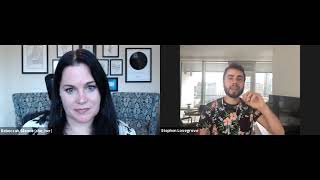
Stefan Lovegrove grew up in a strict fundamentalist Christian cult, terrified of the Rapture and ashamed of his sexuality. He healed through A Course in Miracles and now coaches clients on unlearning fear and reconnecting with love, purpose, and each other.
Welcome to the Healing is Possible hot seat. I am the creator of Healing is Possible, Rebecca. Silence here with a very special guest and dear friend and one of my mentors, Stefan Lovegrove, AKA America's life coach. What we do in the hot seat is we do get hot and sticky and we talk about healing and what is in the way of it. And the goal is to start things up, to get you moving forward. So with that being said, I want to welcome Stefan to the hot seat. Hello, Steffan.
Hello. Always happy to be with you in any space and especially this one.
So excited to have you. And we are going to do a two part series with you, Stefan and I wanted to just introduce you to this gorgeous community, having them hear your story. You coach celebrities, you coach big influencer people in their life purposes, making a big impact. And that didn't just happen overnight.
Yeah, no, it definitely didn't. And I, you know, this keeps getting asked lately, and I even had a friend the other day that was like, stefan, there's a big celebrity that I want to send a proposal to and I just wanted to ask for your input. And maybe I'm really just asking for you to tell me there's no magic bullet. And I said there is not. And it is a journey. And, you know, it is a whole journey that led me to where I am today. And it did, you know, to be on topic here. It did take a lot of healing to get here, but was definitely worth doing the work.
Yeah. So where did you start and what happened? Would you just share some of your healing journey with us?
Sure. So I grew up in a fundamentalist Christian cult in the southeastern United States. I kind of frame it for people as it was a little bit like the town in Footloose. So no dancing, no modern music. You know what rule I remembered the other day, Rebecca, is we couldn't shop at certain stores, like Abercrombie, Paula's store. They're a little too spicy. So it was kind of like Footloose in like, the weird, strict rules sense, but also a little bit like the kind of cults that you watch the HBO documentaries about where there's mind control and you can only trust information from us and you're shamed if you leave. And so it was very scary. And I think, you know, all of us have a past. All of us have wounds, all of us have trauma of our own that's unique. And so I certainly can't compare my starting point or my story to anybody else's. But, you know, I do Want people to know if life was scary or difficult or just too much for you even at a young age. I really relate to that because my upbringing was certainly not easy. And you know, one of the things I just have so much compassion for little me about is, is I think about like 7 year old me already had fully taken on the fear and the terror that I was going to die and go to hell. And I fully, I mean, at seven years old, I constantly was terrified about this. And in the world that we grew up in, they believed in something called the Rapture. And so at any moment I believed my parents might just disappear and so we'd be traveling in a foreign country. I couldn't find my mom for a second and I was like, oh God, it happened. They've gone up to the sky. And it's like a little bit funny to look back on now, but I have so much compassion for the amount of fear that that little version of me had to carry. And that's where things started for me. And so that was kind of the starting point of my story is a lot of fear, but that I ingrained, that I took it, you know, that I completely integrated because it was what I was being presented with as the world and as truth.
Yeah. And what about the part of your story where you were really starting to believe that you. And I don't know if you called them gifts yet at the time, but I've heard you talk about really feeling like if you were really you, you would do harm to people.
Yeah. You know, I have to say I love to talking to you every time we do any kind of interview because you've, you know, you've been with me on this journey for so many years and you really do know so many things that you bring out parts that often don't come out in interviews, which I love. So here's the thing, right? I did always have an inner sense that I had power within me to do big things in the world. I was telling someone this morning, I kind of always had an inner sense that I was going to have a platform, that I was going to have reach and influence of some kind. So if you're out there and like there's been gifts within you always, or like an inner sense that you were supposed to do something big, something great, like, I relate to that because I felt that way. But I also was being told who you are at the core is wrong and really downright evil. Right. And I say that on two levels. One, because just in general, the world I grew up in was, you are sinful, you are sinful. You are rotten to the core, no matter who you were. And that was the core belief system. But also, I was growing up as a gay kid in that world. So as if it wasn't bad enough to be sinful, evil, rotten at the core to begin with, now I'm like, extra bad, extra wrong, extra abomination. And so that had been so ingrained in me that that it really made me afraid of my power because I started putting two and two together, and I was like, okay, so if I have influence at all, if I have a voice at all, if I can have a platform at all, but who I am is so wrong and not to be trusted. I really have to be afraid of myself. And I remember even seeing the musical Wicked and as a kid and watching this, you know, why can't I remember her name, Elphaba, grow up and almost be, like, afraid of who she was and what she was capable of. And that is where I was at at the time, because it was so deeply ingrained in me that who I was was wrong and I had to be afraid of my heart, afraid of my desires, afraid of myself.
And so what shifted? What was the magic moment or series of moments where you started to embrace those gifts and that vision and that power in you?
Yeah, well, as with, I think most of our journeys, I don't know that I can pinpoint it to one, one moment that changed everything. Right? Because it was one change after another after another. But I think one turning point. There's a spiritual text that I love called A Course in Miracles. And one of the big things it talks about is returning to the truth that God is love, not fear. And even before I discovered Course in Miracles on my journey, I think that was a key piece for me. I remember watching Maya Angelou on Oprah talk about how this new thought minister made her repeat three times, God loves me. God loves me. God loves me. And really take it in. And realizing, what if the power and presence that many of us call God, what if that is actually not a big, scary old man in the sky who is angry at you and mad at you and ready to punish you at any moment? What if it actually is, in fact, unconditional love? I think that was the core, core breakthrough of all of it for me, that that really started it all. And again, I don't know that there was one moment where I said, you know, I'm done with all fearful beliefs. It was an unlearning for sure. But I Think that's what so much of healing is. You know, I think my favorite definition of healing is a return to the truth, because that which is true has always been true and continues to be true. And when we return to it within, we can experience it on the outside. And so for me, that is the core of the breakthrough, I think. But it was an unlearning. An unlearning of the fear, a return, as Marianne Williamson so beautifully worded, a return to love. And, you know, that has been the journey ever since.
I love it. Stefan. My definition of healing, I don't know if I've shared this with you, is when it's healed, it doesn't hurt anymore. And I think you're basically saying the same thing, right? Like a Course in Miracles also says nothing real can be threatened, nothing unreal exists. And to me, that truth is. Is the realness. And you're living really as you even coming from a timeline in your childhood with so many fundamental value clashes. How do you. How do you navigate that with your family today? And you really, in my experience of, you have this wide open heart, no matter who's in front of you, no matter the value clashes, how do you do that?
Yeah, Well, I love that we're talking within this framework of the real versus the unreal or versus the illusion. One of the things that was a big healing breakthrough for me over the years was realizing that if love is the core of who we are, then that applies not just to me, that applies not just to you. That applies to every person out there. And so we have to apply that to the people that are maybe hard to love. That's also true for them. And I remember one day, the. I don't know if I've ever shared this story publicly, but my. My grandmother on the fundamentalist side of the family, that's all, you know, still in that world, sent me a letter. And to make it just a short. Without going into details, I'll just say it was a triggering letter. It was not a fun letter to receive. And I remember getting this letter and being so angry about it and so upset and just. I just remember getting all worked up. And then I remember having this moment. And I try to use words lightly like revelation and download and all of these things, but. But it really was this aha moment that came from within, that, you know, the real thing about this relationship, the only thing that is real and the only thing that is eternal here is the love that you share. And whatever this is, the fear, the judgment, the labels, the Drama, the conflicts, whatever this is, this is not real and this is not going to last. But the love that you have for this person and the love that they have for you, that is the part that is real, that is the part that is lasting. And when I got that, I had this realization, why would I want to spend a lot of my time and energy caught up in the illusion that's fading away anyway? And I would like to live as much time as humanly possible in that which is real. And so that, I think has been the thought for me is every moment that I give in to love, I am having an experience of reality rather than caught up in some illusion. And so I'm not always going to do that. Well, I'm not always going to do that. Right. But that's always my goal. And even if someone is in front of me, and there's a lot we disagree on, there's a lot that I don't share the same perspective as them on, et cetera, you know, I. I still have the opportunity to teach love, and I would always rather do that than get caught up in some separation.
So will you elaborate a little more on this? You always have the opportunity to teach love. What if you're in a situation with a person that isn't receptive or giving you permission for that?
So when I use the word teach, and we're really in Course in Miracles today, so, you know, this is principle for everyone, whether or not you're into the text. But we are on theme with Course in Miracles. Course in Miracles says to teach is to demonstrate. And so the way that I use that word is in every moment. And by the way, this is how our brains are wired. Your brain is wired to look for and create evidence of something. So we talked about this the last time you and I did a different interview, that our brains are going to go prove something true and go find evidence for it because we believe it. And so if I choose that what I would like to demonstrate in my life is love, I can set something into motion from the inside out, and love is what is going to be demonstrated. Or, and this is again, a very Course in Miracles framework, Course in Miracles says you can have a grievance or a miracle, but you cannot have both. And so often what stops us from love is instead of demonstrating love, we have a grievance. We have something that we believe they are wrong. They are so wrong. And what they did to me is so wrong. And we're demonstrating and we're committed to proving them wrong. And I just learned that's not productive. That doesn't tend to work well for me. That doesn't tend to go anywhere. And so that is, you know, I would say I'm not using teach in the sense that you're going to sit there in the conversation with that family member and you're going to say, I'm going to show you love. You're going to agree with me. But it's. Sometimes love has boundaries and love draws a line or love walks away. But you're still demonstrating love by choosing what is the most loving choice for.
You in that moment and remembering that that love is eternal. I had just read in A Course in Miracles. I'm vibing so hard with you with this A Course in Miracles conversation, how there are no grievances that don't have to do with a body. And I thought that was amazing to think about. Like, wait a minute, I'm. I'm in a commitment to a grievance, and there's so much more. Well, to see, to heal.
Well, let me use the example with that grandmother that I had. The letter from. The time thing was what snapped me out of it, actually, because I had the realization. So it's deeply in my belief system all problems exist within time. This is why we meditate, by the way, not to. Not to go on a tangent, but why we meditate is to get out of space, to get out of time, to go back to the realm of the eternal, because all things are whole there, and all problems only can exist within time. And so I had this realization. There was a time when I did not feel this separation from my grandmother. There was a time I've hugged her, I've spent a holiday with her, I've sat and shared a meal with her. There was a time I didn't share, I didn't feel this separation. And there will be a time, as sad as this is, to think about where she will not be here in a human body, in this human experience, and I will no longer be even able to maintain a grievance because she will no longer be with us. And remembering that on both ends really put it in perspective to whatever I'm feeling right now that's valid and I can hold space for that. But at the end of the day, the love is the eternal part. And this grievance that exists within time, I can let that go. And so I think that that does provide a lot of perspective, is if it's happening within the realm of time, it's certainly temporary and it's probably an illusion.
I love it. Tell us what happened that had you become America's life coach? Choosing that title, choosing this path?
Yeah. Well, again, a series of choices. I got on the personal growth journey for myself because I had my own healing to do. And so before I could think about using my gifts for others, I was on this journey to, you know, meditating in my dorm room, journaling in my dorm room because I needed it for myself. Along the way, came across coaching, met my first life coach, realized the power that a conversation had to really change somebody's life and move them forward. Had the coach in my life mentioned to me, you know, this is something I think you could really do if you ever considered it. Just wanted to throw that idea out there, he said. Just felt called to say that, and I'm glad he did. Sat with it for a long time. I actually fully kind of accepted that at a live Oprah event in Washington, D.C. at, I want to say, the Verizon center or something like that, and really said, okay, I'm going to say yes to this. And then America's life Coach were some words that rang in my spirit starting in 2015, that I resisted for a long time. In all honesty, for about eight months, I did nothing with them. I said, that's a grandiose thing, and I'm not going to put that out there. And then eight months into it, I realized that that was still living rent free, as they say, inside my consciousness. And I was like, maybe I am supposed to honor this. And so I did embrace it. I did start putting it out there, but I did it not as just something audacious that I was trying to claim. I did it as something as really an identity of who I felt called to be and something that I was committed to embody. And so I've really been on that journey ever since.
And as America's life coach, what are some of the key components to healing that you've seen with your clients in your community?
Yeah, well, I think, you know, my. My core principle always goes back to the fact that we create our lives from the inside out. We experience life from the inside out. And so that means wherever there is a circumstance or a situation or even an emotional reality in which you would like to experience a shift, you would like to experience a healing, it all begins from within. And for me, again, going from this lens, that healing is a return to the truth. I think about the quote in A Course in Miracles that we think we have so many problems, but most of them come back to Our belief that we are separate, our separation. And so I think the most common examples of separation that I see, a lot of my clients have God separation stuff because they were raised in an environment that fundamentally said, you are separate from God. And so it is really the honor of a lifetime for me to help people process the God trauma and return them to a place where they do feel connected to the divine, to their spiritual source to love. So that is a big one. People feeling separate from their purpose or their dreams, like knowing that this thing is meant for them, but they're disconnected from it, they're off track. And so that's a big category of work that I get to do. And then just, I think in the day to day of living a life and maybe even running a business, people feeling separate from what they need and what they want to live out, their destiny and their calling. And so, you know, we can have an area of money feeling separate from the resources and the wealth that we require to create in this world. Um, people feeling separate from the love that they want to receive from a partner. I mean, there's all kinds of ways that separation can manifest. But when we close that gap of separation, when we return to the truth, when we connect back to the reality of love, that is what we are. That is the place that I know healing occurs.
And what do you do if you can just give us a little nugget with people that are having difficulty accessing those dreams, that purpose and what they need and want?
Yeah. So usually there's just a bunch of layers on top that are masking or covering up what's under there. And as frustrating as this may be to hear, if you're in that position and you're like, I just want to get to what is under there. Tell me what it is. You know, we have to figure out. When did you start ignoring, repressing, hiding from your inner voice, your inner guidance? And we have to undo that. And it's actually a lot easier and faster often than people think to, you know, to reverse that. And as soon as you see something differently, you can begin to heal with it. But that, that is what it takes, is that guidance has always been there. If you are disconnected from it, my question is always going to be, what layers have stacked on top to muffle it, to mask it, to cover it up. And it could be childhood stuff, it could be religious stuff. It could be a traumatic experience, a past, just bad experience. Whatever it is, when we peel back those layers, what's been there all along can really come Forward.
Yeah. I love your commitment to people living fully express rest. And to me, that's a level of healing that we all have a right to. And I just want to thank you for being with us today. Our next part of the healing is possible. Hot seat with myself and Stefan Lovegrove will be taking on worthiness. So you don't want to miss that next week. Any final thoughts on healing being possible for us today from you, Stefan? And how do people find you?
Yeah, well, I'll leave people with a Michael Beckwith line. He said, the presence of love heals absolutely anything and everything. And I know that to be true experientially. And so if there's an area where you're desiring to experience some healing, sitting in the presence of love is always going to be a good choice. And however you get there, whatever that looks like for you, there's infinite ways to access it. But get there and let it heal. You would be the thought I would leave people with. And I am on Instagram. Rlovegrove.d r l O V E G R O V E if you're watching this, I assume on Facebook, Stefan Lovegrove on Facebook would love to connect with you.
Either way, your generosity. Stefan, I'm just thinking about another thing I know about you that I don't hear you talk about very much. You give 22% of all of your income to charity. I know a story as well about, you know, in the very beginning of your career, spending $10,000 to take your family on a beach vacation. I want people meeting you today to know that this man has achieved his purpose and success. And I know you're always growing, but I think a big part of your success is giving back and your generosity and that true commitment to love. And I don't know very many people and that actually live a true commitment to love. And you're one of them. And it's such a blessing for me to have you in my life. Thank you for being here with us.
I appreciate you. Thank you.
More from Rebeccah





Free 5-Day Live Online Bootcamp for Mothers, August 24–28 4 PM EST. Replays available #shorts



