Healing the Shame Around Feeling Too Deeply | Rebeccah Silence
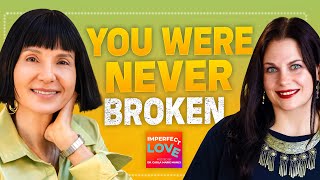
In this episode of the Imperfect Love podcast, clinical psychologist Dr. Carla Marie Manley interviews trauma‑healing practitioner Rebeccah Silence. They explore how childhood and intergenerational trauma can shape adult relationship patterns, explaining concepts such as the intergenerational transmission of violence, the fight‑flight‑freeze‑appease response, and the idea of being a “vibrational match” to familiar (often unhealthy) relational energies. Rebeccah introduces her Aligned Intimacy Method, a five‑step framework (Vision, Values, Vulnerability, Self‑validation, Vibration) that guides individuals toward “alignment” – a state of freedom and unconditional self‑love beyond survival patterns. Throughout the conversation they discuss practical tools (making standards lists, journaling, conscious self‑inquiry), the role of the inner child, neuroplasticity, and the importance of courage, patience, and perseverance in healing. The episode concludes with Rebeccah sharing her website, free masterclass, community group, and her book Coming Back to Life as resources for listeners seeking deeper work.
Chapters
Rebeccah Silence. We often believe that we leave our childhoods behind us as we enter adulthood. Yet, as a clinical psychologist, I found that our childhood experiences, including destructive wounds and the resulting trauma, stay with us until they are healed. Some cope by running away or compartmentalizing their pain and shame, but healing only comes by facing and moving through trauma. Could the mindful creation of a new experience of love and relationship be part of the healing process? Today we'll focus on this listener's real-life question. I finally decided to take a look at my childhood after a series of dead-end relationships. My last partner, like a few before her, told me that if I didn't face my childhood trauma, supposedly from my alcoholic dad's rages and unpredictability, that I'd never be a good partner. It's hard for me to believe that my childhood has anything to do with my adult relationships. What do you think? And with that question as the focus of today's episode, I'm Dr. Carla Marie Manley, and this is Imperfect Love.
Welcome to Imperfect Love with Dr. Carla Marie Manley, psychologist, author, and relationship expert. I'm here to help unravel mysteries and misconceptions about love, relationships, and mental health issues.
Plus everything in between.
Love is complicated, people are not perfect, and relationships surely can be tough. Together, we'll navigate this messy, imperfect space of real life.
Today I'm joined by a very special guest, Rebeccah Silence, who will be sharing her experience on emotional survival and coming back to life after trauma. Welcome to to the podcast. Rebeccah, it's such a joy to have you.
Oh, I'm thrilled to be here, Dr. Carla, and I can't wait for this conversation.
It's going to be a good one. I already can tell that. So before we dive into the listener's question, what is— what could you tell us? What makes you you?
Oh, I love that. What makes me me is I am the space where all healing is possible. I'm a real stand that healing isn't promised, but it is possible. And I really believe that there's no especially emotional wound or pain or heartbreak that can't heal.
I'm with you. And we just might scare off a few listeners with this. It's my perspective that one of the biggest pieces about the healing that makes so many people consciously or unconsciously resist it is that it doesn't happen with a pill. It doesn't happen overnight. Yeah, there is no magic to it. It's that often— and I'm not saying that psychopharmaceuticals aren't necessary sometimes, that's not what I'm saying here. What I am saying though, when we're working with trauma, it's not going to go away unless we work. Unless we have patience, perseverance, and in my mind, a lot of courage.
Amen. And I like to say healing is freedom. You know, you're healed when you feel free. You know, there's healing to do when there's any hurt, right? And I'm a mom, I'm a wife, I'm a woman, community member. I'm all of these things, but I am someone who has set myself free and that doesn't make me unique or special. We all have the capacity to fully heal. It's just most people don't believe there's life beyond survival, even if they get that conceptually. But one of the things I love to say is if you can survive survival, you can also survive alignment.
Beautifully put. Beautifully put. I want to go back just to something you already said that's even in my mind, more profound, that healing is freedom.
Yeah.
Many people don't realize that trauma keeps us locked in our— in the trauma that's held in our bodies, in the trauma that's held in our minds, in the trauma that's held in our souls. And so when we're having a negative reaction or we shut down or we freeze or we're hypervigilant, all of those things that are really often, you know, letting us know that trauma's somewhere lurking, right? That once we begin to heal, we have the freedom where our thoughts, our feelings, our mindsets aren't dictated by something that occurred sometimes before we had words in those pre-verbal years. That in fact, we then come from a place where we're able to be mindful, and reflect and respond to a situation as we would like to, which for most of us, I would think, would be with grace and compassion and love and integrity. But if we are letting trauma rule us, we're in a jail cell created by that trauma, which wasn't our fault.
Right, right. And it gets inherited. Not only is trauma not our fault, but we inherit trauma. We inherit our survival coping mechanisms and strategies and our survival personality. And it really is something that we have control over to say, wait a minute, I'm not going to let my past win. I'm going to win in this lifetime, even if I don't know how, right? You don't just know how. I think it starts with that decision, and we can each decide to decide that we're we're no longer going to be a prisoner to our past or to our ancestors' pasts. We can just decide we will learn in this lifetime how to use trauma to our advantage, how to beat it, and how to come out the other side in control of our lives, ourselves, and our destinies as healed adults. Because what happens when we're trapped in that trauma is we're at a stuck age with stuck emotions. Then the adult in us is not the one driving or leading our experience of life or our decisions anymore. It's our wounds and our unhealed inner child. And we really can free that child up, throw the stuck age, release the stuck emotion, and have a new experience even when the external hasn't changed yet.
Okay, so let's pause. Let's give our listeners a little bit of a break here. This is some big material.
Yes, it is.
With the first thing you break up, bring up, and people, this might be a foreign concept for many people. Yeah. Um, but the idea of, you said inherited trauma, what I as a clinician would know as the intergenerational transmission of violence. And when we look at that, people think, well, no, I inherit my DNA. I inherit my dad's green eyes and, and my mom's, you know, brown hair. That's what I inherit. Maybe I inherit a propensity to high cholesterol, but I'm not gonna inherit trauma. So let's lay the foundation of what we mean when we're talking inherited patterns or intergenerational transmission of violence. And we can use possibly, if it's okay with you, the listener's question. We have an alcoholic dad. We don't know how old our listener is. Let's imagine he's had some people in and out of his life. So let's make him, for the sake of argument, 38. Okay, so we have this 38-year-old who's realizing, oh, maybe all of these people are leaving me and I can't have a quality relationship. And they're all saying the same thing. Like, buddy, there's some stuff going on with your alcoholic dad. And it's making you a miserable part, you know, miserable to be with, or unhealthy to be with. How? So explain to our listeners how his alcoholic dad's patterns— he's not the alcoholic, we're not hearing that— how are they affecting his current life?
So, so much of this is unconscious, right? And part of what's really important to me, Dr. Carla, is that the trauma conversation becomes an empowering one. And I'm not smiling and light as we're having this very serious conversation because I'm trying to make light of how significant trauma is to not not just each of us, but to the world, right? The point is we can be in an empowering conversation that helps us understand so that we don't repeat. So this isn't anyone's fault, and we're innocent, and it's almost always unconscious. The work that I do with my clients and this work to heal through inherited trauma, right? We're not waking up in the morning going, poor me, I have to play out the patterns of my past again today. My alcoholic father is still running my life today. We don't think about it consciously, right? So let's just address that first and foremost. But let's look at it like this. So let's just take fight, flight, freeze, for example, right? Our nervous systems go into fight, flight, freeze when we're dysregulated and when there's a perceived threat. And when we're growing up, we learn which way is the better way to cope. We learn there's someone or something to fight. We learn there's someone or something affected, and we learn that there's someone or something that's going to be the saving grace. But what we don't learn is that this isn't all there is. Fight, flight, freeze, otherwise known as Karpman's Drama Triangle, right? Victim, persecutor, rescuer. So none of this is who we are, but we learn to survive and we learn to cope, and we learn the ingredients that go in the recipe called family that are the only ingredients we know go into the experience of family until and unless we get some support and breakthrough. So for the listener, I grew up in an alcoholic home, and I decided I was never going to be the abuser, I was never going to be the alcoholic or the addict. And what that meant was I would just keep falling in love with them, and I would be the victim like my parent who wasn't the addict. It just becomes this limited self-inflicted glass ceiling that we don't even know is there. And we learn on some level that what we're tolerating and growing up with that's dysfunctional is just how it is, especially when it comes to family. And what we need to understand is this isn't a conversation to throw our parents under the bus, at least from my perspective. It's again about understanding it so that we can be the one in the family that raises our hands and says, the cycle stops with me because I'm aware, and it can.
I am with you 100%. I say repeatedly on this podcast, with clients, with groups, that there's no reason looking at your past to shame or blame. Simply, let's look at the past as objectively as possible, often difficult, so that we can learn what happened here. What here did I learn in my childhood, if anything, that is wonderful and that I want to carry on into my future? What here happened in my childhood that wasn't productive or was actually traumatic? Why did that occur? And how can I change my patterns? And this is where the— all of this is where work and the courage come in. How can I change my pattern in order to make my life, my relationships, and then if I choose to have family or already have family, to make those patterns different, to make those patterns healthier than what I grew up with? And in that way, we're not reacting to the past, in which case we'll repeat it or maybe create a worse version of it. We are actually looking and saying, wait a second, I want to do this differently. And I think about it much like when we are out learning to ride a bicycle or a motorcycle, and we fall, or we put the gas on too much, and we topple over a hillside. We don't go, oh, oh, let me just get back on and keep going. We, if we're wise, we look and say, why did I fall off the bicycle? Or why did I go over the cliff on my motorcycle? What can I shift? What do I need to do? Maybe I need training wheels on my bicycle for a while, or maybe there was a pebble in the way, or if it's a motorcycle, maybe I need a smaller motorcycle, or maybe I need some motorcycle training. So we're good at it in so many areas of our lives. But when it comes to this essential area, our body, mind, spirit, all of which are interconnected, so many people don't see this. It's the same pattern. We simply have to look at where it goes wrong to make corrections so that the future is better so we don't keep doing the same falls over and over again.
Yeah, I love what you're saying. And said another way, we get to look at and be curious about what are the energies that I'm a vibrational match for because I got used to that growing up that now I don't want to be a vibrational match for. So what I like to teach is there's a difference between our feelings about what's going on around us that we learned, right? So abandonment is learned. Guilt is learned. Shame is learned. Rejection, jealousy, competition. I could go on and on. These are experiences that we saw as a possibility, but we weren't born predestined to experience those things. Our emotions are natural. Anger, fear, grief, joy, excitement. A baby has these emotions, isn't confronted by them, and can move through them all in 2 seconds, right? A baby can go from anger to fear to grief to joy to excitement just like that, right? And we all can too when we're clear. But the thing that I learned early on in my graduate work was, oh, I'm a vibrational match for experiencing rejection, for example. What if I wasn't? What if I could experience the same set of circumstances differently? What's the experience I would want to have instead? And I'm saying it this way because I want people to see it from that place of courageous curiosity, let's just call it. And one thing I also wanted to say in response to what you were just saying, Dr. Carla, you know, don't be afraid when you start to address survival in a way where you don't want it anymore for yourself. If you start to feel threatened letting go of your survival skills, your survival cell, that's okay. Breathe through it. I really do believe that when we let go of survival, it can feel like we're dying. But we're not. It's our ego. It's our survival self not wanting us to die that's hanging on, that doesn't know we can survive without bracing ourselves for our next heartbreak or attack or rejection or whatever it might be. But I want people to understand, you don't have to be a vibrational match for anything that isn't serving you anymore. And how do you know it's not serving you? It doesn't feel good.
Okay. Let's pause again. You have so much information. Let's get some working definitions for our listeners. Yeah. So definition, we've, we've had one definition already, intergenerational transmission of violence. We have that pretty well, or intergenerational transmission of patterns for that matter. So we have that one done. Let's go with a lovely definition of what you mean by a vibrational match. My guess is you're going to say something like, hey, you grew up with an angry alcoholic dad, that feels normal to you. That's your normal, you didn't know anything else. So you're going to be seeking unconsciously, no one's going to wake up when it's time to have a partnership and say, I'd really like to go and have a partner who's my, just like my angry alcoholic dad, we don't do it consciously. But instead, as you said earlier, there's this sort of victim that then falls in love unconsciously with the person who has the energy of the alcoholic dad, that unpredictability, the mercurial ways, the walking on eggshells, the fear, the kind guy that turns into the mean guy at the flip of a switch. So if I'm hearing you right, vibrational match, vibrational energy would be that you're unconsciously looking for someone who vibrates at that level. Did I get that right?
Yeah, or said another way, you're in alignment with this experience, with this pattern. You're comfortable there, you're used to it. And back to what I said earlier, healing is freedom. And you can heal and free yourself of that availability to have the experience that hurts, that causes suffering and distress on you and your body and your nervous system. You don't have to continue that. But what gets scary is, especially if you're someone who's highly sensitive, and empathic. I think what gets really real and scary for so many of us is, well, if I'm not a vibrational match for this, does that mean I have to lose the relationship? And what I wanna say is there's no threat, there's no danger to being vulnerable and authentically communicating, this isn't working for me anymore. Here's what I need instead. So it starts with that honesty with yourself, right? This experience, this low-level vibration. So say you keep experiencing rejection in your relationships. Wait a minute. I am no longer available to experience it as rejection. What I want instead are relationships that are real and are reciprocal. Just an example. So if my standard is I want real reciprocal relationships, now if someone isn't meeting me at the level that I show up at and I've communicated and I've said, I'm ready for a next level of relationship with you. Do you want that too? And they say no. Well, now I'm not rejected. This just isn't the right fit. So again, I, I want to lessen the charge and the fear and the threat when we're talking about what are you and what are you not a vibrational match for. I like to say the only thing you have to lose is you. Don't you dare let that happen, especially not letting your past win. In a season of your life where you recognize it can be so much better for you, because it can. And the right people will stay, I promise you that. And the ones that don't, they're not wrong or bad. They're just in a different vibration. And I think about it like a bunch of circles, rings. If I'm able to have this higher standard and higher availability for more in my life, but somebody else is in a different vibration and I'm going, let me be less so that you're comfortable and you want a relationship with, with me. Now I betrayed me instead of being respectful of the vibration and the version of myself that I am now. And what I like to do is hold on to my vibration and my expansion and give people the opportunity to meet me there. And none of us are wrong. I'm not wrong, you're not wrong, but this is the vibration I'm unwilling to abandon because I'm unwilling to betray myself. That's a paradigm that we can all take on. And one more big thought here, Dr. Carla, We don't need a breakdown to break through, and we don't need a crisis to light a fire under our butts so that we'll finally make our life ours, so that we'll finally step into healing and freedom. We can just decide, I'm bored. I was just doing a Peloton ride with one of my friends this morning, and we were talking about a place where she's really bored in her life, and she literally asked me, is it okay? I want more. Any of you that are wondering that, yes, it is okay that you want want more. Yes, listener, with your question, I know you didn't word it this way, but it's okay. You want more than a life where your past has to keep being part of the conversation, but you have to deal with it so it really isn't part of the conversation anymore.
I agree with you so much, and thank you for taking it back to the listener's question.
Yeah.
So I'll take what you are giving to us and then feed it back toward his question, which sounds as if with his former partners, they were at one vibrational level, may have been attracted to him at the beginning, and then they found, wait a second, this isn't working for me. You're not willing to show up. I'm talking to you about it, but you're not willing to do your work. I'm out of here. So yes, they lost the relationship. They weren't rejected. He wasn't necessarily rejected. They just said, not a good fit. I'm moving on. Do some buddy. And then all of these relationships later, how many, however many there have been, this last one, maybe he finally got some of the message of, of all of these people saying somewhat the same thing, it sounds like. And he's saying, wait a second, I am choosing, I'm at least going to dip my toe in the water to see if there's some truth here. All of these people are saying this. My supposedly bad childhood, or maybe his dad— it sounds almost as if the dad is still perpetrating some of this negativity and emotional abuse, whatever's happening. And so he too, it almost sounds as if he's on the verge of saying— I— not only is he curious because he asked a question, which is brilliant of him to come forward and reach out and ask a question, that's huge. Means he's open, means he's looking. And that takes courage to actually read out, reach out, and write a question. Yeah, that's courage. And then the next step would be for this individual to say, okay, I want to do the work so that my, my vibration's already changing. I want to match with someone who is going to give me a different experience on the planet, an experience that feels loving, an experience that I feel safe, and I want to give that to them rather than repeating the terror. I'm imagining it would have been a pretty scary childhood, always unpredictable, which dad is going to show up, the nice guy, the mean— the mean guy, the ambivalent guy, and then to create that change in himself that will allow him the freedom to have healthy, fulfilling, truly loving relationships.
How does—
did that sound?
Oh, I love what you're saying. And let me just take it slightly different, all of what you said. But also, what if, listener, you no longer have to be a vibrational match for women telling you you're not okay as you are? What if, yes, there's work to do because you choose, you don't want to repeat patterns, but you can be in a partnership where we're not telling each other what's wrong with each other. We're honoring ourselves, taking responsibility for ourselves, and being our best for ourselves, which then creates a healthier relationship. I just wanna take it back to the vibrational match piece, right? Because sometimes we're just attracting what we're used to. And in an alcoholic home, there's typically a lot of criticism. There's typically, especially alcoholic You know, children of alcoholics, I should say, are experiencing low self-worth, low self-esteem, not feeling worthy of healthy love. Again, it's so unconscious most of the time, but I just want to empower the listener to go, why don't I take a beat to journal my standards of what I'm looking for in a partner? Not just who do I need to be to be loved, which is actually more of the pattern of growing up in the alcoholic house. You don't need to be any more or different for you to be worthy of healthy love. But you can make a list of the standards you're looking for in this season, then become all of that, and then see what happens in your next relationship.
And I love that you're talking about making a list of standards, because in, in all of my books, I talk about that as an essential piece. Because some people say they want to be abusive and unkind and horrible and lying and betraying. Then they say, take me as I am. But they're expecting their partner to be faithful and kind and all of those things, right? And so I start off with saying, wait a second, look at what you expect from yourself. Look at what your standards are. Look at your moral compass. And then when you're working— and we can all do this, we can all keep working to refine and evolve and be better humans— and that alone, as you're saying, starts changing whether you call it vibrational energy or, you know, emotional palette, whatever it is, your, you know, your magnetism, whatever way you want to look at it, it becomes part and parcel of who you are. And so if somebody's coming to you and they're trying to be, you know, gaslighting you or being emotionally abusive, it's like, no, no, this is not going to work for me, just as you said. And so I think it's so lovely. I like how you use the word because so many people hear words like vibrational energy, and they're like, oh, too woo-woo for me. Yeah, yeah, really all we're talking about is your character, your essence. And we're all responsible for how we cultivate our character, how we cultivate our essence. We may have inherited some of it, some of it may have been more hardwired in that, but we can all change to become the person we really want to be.
Well, and we can all get 100% of the love we want, Dr. Carla, right? And we just unconsciously think love means things that were, were experienced growing up, but it can be whatever you want it to be now. I laugh because I made a list 11 pages long, front and back, before my husband and I got together. I— my first marriage was domestic violence. My track record was a shit show. Even with all of my education, I still couldn't attract next level, right? And vibrational match just means what is the level you're attracting right now. So I sat down and I made an 11-page list front and back, and I made sure I was fully embodying every single thing I wanted and exceeding my own expectations. Then I—
pause, let's pause here, such an important piece. Many people, when they're making lists for a partner, about the partner they want to manifest in their lives, meet, you know, bring into their lives, they focus on, oh, I want him or her to have, you know, dark hair, dark eyes, slim figure, vegetarian, carnivore. I want them to make six figures. I want them to want two kids, no kids, whatever it is. So really focused on what we want, want, want, want, want from the other person. And I with you. The key to starting that— it's so interesting. This is one of the first elements of my book, Date Smart: Transform Your Relationships and Love Fearlessly. Why do I start with that? We can't— well, we can, but it's not necessarily the most healthy thing to do— is to say, this is the list I want from another person, but I'm not going to worry about what I'm bringing into the mix. Well, that's the primary piece. We want to know what we have to offer. Offer. Yeah, what we have to offer ourselves, what we have to offer other people. No shame, no blame, no judgment, but know what it is and be able, in my mind, to not ask for anything from somebody else that you're not willing to cultivate. So if you're a person saying, I want a respectful partner and a hard-working partner and a loving partner, and I'll just sit back and let myself be loved and taken care of, well, ideally we want reciprocity where we're willing to be hard working and loving and all of those things. What do you think of that?
Well, I couldn't, I couldn't agree with you more. And when I'm working with couples, my favorite part of the couple's work is the moment they each become the healed adult and they get to meet each other for the first time as two healed adults. So many of us are making our list still reacting to our childhoods. Here's what I don't want any more of, which is essentially doubling down on, see, I'm still a vibrational match for it because I have to put down I don't want this. Put down what you want in the specific direction you're looking for, not here's what I don't want, and then just believe it's out there. This is the other piece. I just have to dot our I's and cross our T's here, Dr. Carla, because it's easy almost to fantasize and make the list. But do you believe that it's going to come to fruition? Do you believe this is a person that you're calling in? Do you believe you are worthy of this level of standards of relationship? And, you know, the funniest part about my really 22-page list, because it was 11 pages front and back, third date with my husband, I brought out the list thinking for sure I'm gonna scare him. He's gonna be running for the hills in about 2.5 seconds. Seconds. I finished the list. He pulled out his own. His was a half page, but he had his own list that was in his wallet. We'd been looking for each other.
This is all amazing, Rebeccah Silence. I have a question that was on my list for you from earlier that comes right back in now. For many people, I really believe in the inner child experience. I believe about how much control that inner child exerts. For the positive, like our creativity often comes from that great inner child, but also an unhealed inner child can run the show. And we often see this, you're in an airport or supermarket and there's an adult, you know, 30, 40, 50, and they're throwing a temper tantrum.
Yes. What?
And, you know, inner child is really big and really active, or behind closed doors. We hear about it in partnerships where one or both partners, they're really great at their jobs, great in the world, and sometimes, especially if there's, you know, one that's the abuser, that inner child comes out and, you know, it just takes hold and it's yelling and screaming and being emotionally abusive, sometimes physically abusive, and And so I believe, as you believe, that, that we get stuck, people get stuck. And this may be even the case for the listener. We don't know what's going on behind closed doors. We can tell by these people leaving him that there are some patterns, whether it's emotional abuse, physical abuse, whatever it is, where people are saying, no, we're not. No, thank you. So let's give our listeners a working definition when you're talking about I just kind of gave a description of it, but if you would give a working definition of this inner child who has unhealed trauma and how that makes that child stuck, maybe at a 5-year-old place, a 7-year-old place, 3-year-old place. Sometimes we see it as a 12-year-old place. So please, please explain. Yeah.
So our inner child was born trusting. Who we are, was born knowing that emotions are healthy, not conceptually, but, but free, right?
Liberated.
So back to the example of fight, flight, freeze. If you wanna fight the moment you're in, if you wanna run from the moment you're in, or if you find yourself frozen in a moment you're in, what do you know? The inner child is wanting to, or has already taken over that moment. So here's what I mean. We can catch it quickly and we can understand. Newsweek quoted my book Coming Back to Life by using this quote, we don't lose our voices, we stop talking, right? Because we think the world can't handle our truth, or we think that if we don't talk, we somehow resolve conflict quicker. But the healed, aligned you is a) already unshakably whole and knows, loves, and trusts themselves to be able to navigate and lead any moment in front of you. Now here's what I mean by that. Your inner child is often riddled with self-doubt, and heartbreak has had you guard your heart. When you're guarded and in that self-protection constantly, or consciously I should say, or unconsciously universe is just saying, well, you're available vibrational match for protecting yourself. So just play with this the next time. And back to the listener's question, someone is telling you that you've got to do XYZ to be an acceptable partner for them. Notice, do you want to run? Do you want to fight the moment? Not physically, but just defensiveness? Or are you finding yourself frozen? If any of that's going on, just take a deep breath back to the courage conversation. And if you had nothing to fear and nothing to lose, what would you do next? Versus playing out the pattern of protection, and it's just more of the same. What's a different dance step? And again, I think these metrics of fight, flight, freeze are great alarm bells and indicators that the adult is either already taking a backseat or about to be. And there's nothing wrong. You're innocent. There's nothing about this that means you're doing something wrong. It's just a better way is available. And then there's life beyond fight, flight, freeze. And most people don't know that, especially when it comes to intimacy or relationships.
Absolutely. And for our listeners, when we're talking about these patterns, they happen when we are triggered. And it's, it's happening unconsciously. It is less than a split second where the brain decides, okay, this person is frightening me or threatening me. And you, you don't choose one of these responses. You don't choose fight, flight, freeze. And I use the Four Paradigm Model, which has appease in it. So listeners, if you hear that from me or other people, fight, flight, freeze, appease. Appease is the one where we go, I'm sorry, please love me. And we see it in all of these in the animal kingdom where maybe a dog, you'll see a dog kind of roll over and like, oh, I'm sorry. That's the appease pattern. And so many people, and often women, when they are, men tend to go to fight or flee, women often, and I'm overgeneralizing here because no matter what your gender is, you know, you can have, you have 4 choices that your brain's choosing one of those very quickly, very unconsciously, that many women go into the appease position immediately or the freeze. And then they'll say, oh, I'm conflict avoidant, but it's all hardwired from childhood. And anything that's hardwired in childhood, the beauty of neuroplasticity is that we can rewire it with conscious awareness. So I love that you're really breaking it down, Rebeccah, into these beautiful principles that help us understand that trauma happens. It's not our fault, but we can make conscious choices to change the patterns that take hold of us, and it takes mindfulness. Wellness. It just takes be— and I'm saying just, but I'm not minimizing the amount of work. It takes a lot of work to start noticing the patterns, stepping back from them, and choosing healthier patterns. And that takes, as we started off with, so much patience, perseverance, and commitment and courage. But at the end of that, is the freedom, right?
And alignment, right? That's the alternative. So I say, okay, life beyond fight, flight, freeze is alignment, and it's on the table. Life beyond fight, flight, freeze, appease is alignment.
Hey, pause. Please explain for our listeners when you say alignment. Many people think alignment means your body is straight and you're sitting tall. So let's into alignment.
Yeah, yeah. As you're using it, this is so huge because back to what you said earlier on this episode, the patterns will repeat until they heal. So the point is you don't need the person to behave better and then you can be okay. You don't need the diagnosis to change or your partner to have not cheated and then you're okay. Listener, you don't need this woman to want a relationship with you and then you can be okay. What we need, if we want it, is alignment. So here's how I define alignment. I teach what I call the Aligned Intimacy Method. So I've got 5 V's that go with it. When you are living in a commitment to the vision you have for your life, when you are living in your values that you choose, not the values that were those ingredients in your family recipe growing up, but the values that are yours on a soul level, what light you up when you are vulnerable, communicating because you can, self-responsibly, no blame, no threat, no intimidation, just vulnerable, here's me on a platter communication. When you know how to validate yourself— what I mean by that is, I'm a cancer survivor. I had a 5% chance to live, diagnosed while I was pregnant 8 years ago. I made a choice to quit chemo. I had to know how to validate myself that that was the right choice for me at that time because everyone around me is panicked. There were no other treatments. I had a 5% chance to live. I quit chemo because I had a vision. I owned and lived in my values. I vulnerably communicated, and I was able to self-validate. And from there, my fifth V is vibration. So that is the 5 steps that I teach and embody when I think of alignment. But really, alignment is just this ability to rest in unconditional self-love in your unshakable wholeness regardless of circumstances.
Wow, deep breath in, deep breath out. That was quite a lot. So first, what courage it took you to do what you knew was the right step for you. So glad you are well and healthy. So glad you made the choice that was right for you. And for our listeners, because that was so much, I'm just going to repeat those very precious and priceless 5 Vs: your vision, your values, being vulnerable, which is so hard for so many people, self-validation, and then your vibration. That I just— beautiful 5B process, all of which you've done an excellent job of explaining and allowing our listeners to see how that works in your life. And taking it back to our listener's question, it sounds to me as if he would be able to have a vision for what he wants himself to be. What does he want to be? Not what his dad was, right? Right. But a vision of who do I want to be? Do I want to be loving and kind? Do I want to prioritize relationships? Do I— you know, what do I want? And then, which is then goes into the values. What are, what are that his values now? Not his dad's values. What are his values, his chosen values. And being vulnerable, so hard, particularly for people who went through childhood trauma, grew up with alcoholic parents. Yeah, because if love is viewed as a child as love is unsafe, love is walking on eggshells, love is people criticizing me, love is all of these negative things. Who wants to be vulnerable if love is toxic? No, thank you. I'll shut the door on that. And I think that happens to so many people, even when they meet a truly loving partner. Partner. They may be like, mm-mm, your kind of love is too unfamiliar. You're too kind. You're too this. You know, no, no, no, I'll take the toxic kind of love because that's what I'm used to. So it takes that reformatting to be vulnerable, to see, wait, this person is going to stay. They are going to love me. They are going to want the best for me and I for them. So good on that piece of self-validation. I love how you showed us that in your own life, that you followed your steps and you validated yourself. And I can see how that works. Because with this listener validating himself and saying, wait, I am on this path, I'm evolving. I mean, I might choose to go to therapy. I'm making good choices. I am making good choices. I am evolving. And then the last is the vibration, which sounds like the gift. When your vibration starts changing and you're going, wow, I'm safe. I'm loving. I'm whole. I'm evolving. Your whole energy changes because you're coming from a place of freedom rather than fear.
Right. And alignment rather than survival. And no one will know better for you than you do. It's such a cliché term. I would never say, oh, Cancer, you know, patients listening, quit chemo. It just was what was right for me. And you are the authority in your life and you get to vibrate Another way to define vibration is, is living. How are you living? You get to live relaxed and resting in the best of who you are. And there's never a moment that doesn't offer us a choice. And survival would have us choose disempowered without us meaning to. Alignment offers us the option of choosing empowered, understanding there's nothing more powerful than the truth of who we are and the best of who we are. Nothing. There's nothing outside of you more powerful than you. Nothing.
Beautifully said, Rebeccah Silence. And I love your message. I love the concepts. There's such richness here, and I could talk to you for quite a while on many, many of the subsets.
Oh my gosh. So good.
So as we wind down for the day, Could you please tell me where our listeners can find you and your work?
Absolutely. So please visit rebeccahsilence.com. There are plenty of free gifts there for you. I have a trigger trauma release masterclass to help you understand triggers and how to, what I call just very bluntly, make your triggers your bitch instead of your triggers owning you. That's available. I have a spa day for your heart, mind, and soul, all available for free. And then I've got a workbook that will teach you my Aligned Intimacy Method as well. So lots of free resources at rebeccahsilence.com. There's also a free Facebook group called Reclaim and Rediscover You, my community that you can join and be a part of. And you can check out my book Coming Back to Life: A Roadmap to Healing from Pain to Create the Life You Want wherever books are sold. And I was just so honored to be awarded one of the top 10 best self-worth and self-love Books in the World by the Best Ever You Network. This read will change your life, and it is my story of liberating myself. So lots of places to see me and work with me, and I would love to have you in the community.
Thank you. And listeners, I'm going to spell Rebeccah's name. It's R-E-B-E-C-C-A-H. So that's Rebeccah and Silence. Silence, S-I-L-E-N-C-E. So you will be— and she's also, Rebecca, you're also on Instagram and Twitter.
Oh, absolutely. Yep, @RebeccahSilence and Facebook, all the places.
Okay, so remember that unique spelling. I'll give it to you one more time: R-E-B-E-C-C-A-H, Rebecca. Thank you, Rebecca. It has been a true joy and a true pleasure. I'm so grateful for your time and energy.
Well, I am so grateful for the work you do, and thank you Rebeccah Silence, for being a practitioner that empowers and liberates us all. It's such an honor to be here.
And thank you too. And listeners, we thank you. And closing for today, this is Imperfect Love.
Thanks so much for sharing your time with me today. Remember, you have the power to transform your life and love fearlessly, if imperfectly. And it's my privilege to help you along the way. You can find more life-changing content, including my books and other podcast episodes, at drkarlamanley.com.
Feel free to submit your own confidential questions through my website.
I'll do my very best to include your issue on a future episode. If you found this podcast helpful, please subscribe and leave a review. Until we connect again, This is Dr. Carla Marie Manley wishing you oceans of blessings and love. Please note, this podcast is psychoeducational in nature and is not intended to replace formal mental health support. Please contact your healthcare provider or emergency hotline if you need psychiatric care. And as always, please take good care of your amazing, wonderful self.
More from Rebeccah





Free 5-Day Live Online Bootcamp for Mothers, August 24–28 4 PM EST. Replays available #shorts



