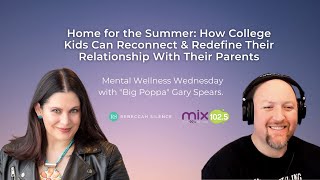
A short radio/video interview (Mental Wellness Wednesday) with life coach Rebeccah Silence about college students returning home for the summer. The conversation centers on shifting parent–child dynamics as students re-enter the family home, emphasizing treating college-aged children as emerging adults, setting a few simple shared ground rules, mutual expectations (parents ask what the student needs; students propose solutions), and keeping solution-focused communication to preserve long-term relationships. Closing includes mention of Silence's book Coming Back to Life and her website rebeccasilence.com.
I think the most important thing I could say to parents is we want to continue to encourage your child to be stepping into adult life as who they are, not as who we as parents think they should be.
Mix 102.5 the best mix from the 90s to now. Big Papa in the afternoon. It is a mental wellness Wednesday. Life coach Rebecca Silence. She is also the the author of Coming Back to Life. You can get it to wherever you get your books and you can Also check out rebeccasilence.com Rebecca, how are you?
Well, I am very well. So grateful to be here.
So it's a funny time of the year right now because it's the end of college for the, for the semester.
Yeah.
And college kids are coming home and a lot of them are coming home to live for the first time in, you know, six, eight months. And the dynamic between the parents and the college kids coming back to live with their parents after living away from their parents for that amount of time and coming back to living under someone's roof, there's a lot of, you know, butting heads and a lot of things that are going on there. Can we talk about that? Like the kids, the students coming back and living with the parents for the summer and you know, that, that kind of dynamic. And I want to take it from not only the parents point of view, but I also know a lot of college students listen and I want to take it from the, you know, the college students point of view as well.
Absolutely. I love this conversation because we've got both sides of the coin and both are really important. So I think for parents, you know, there is either a I can't wait to have you back in the house or a what's your plan? How much longer are you going to be staying here? Right. And I think what's really important is to be listening to your child and helping them get set up to win. I think where things go sideways is when there's no, there's no plan, there's no setup that still respects the students independent life that they've had for four years or two years or however long it's been. They're used to living their life on their terms. Now sure, there might be guardrails, there might have been financial support, you know, they've had school. But there's still a sense of independence and freedom and an ability to sit with themselves and powerfully choose who they want to be and what they want to do. So I think the most important thing I could say to parents is what we want to Continue to encourage your child to be stepping into adult life as who they are, not as who we as parents think they should be. The second you go into judgment, criticism, trying to helicopter parent your child into being who you think they need to be, they're going to just push you away. There's going to be a wall up, there's going to be resentment. So I think for parents, a lot of questions. What do you need for life at home to feel good to you before.
You, before you get, before you get there? And I'm so, I'm sorry to interrupt. I. I think that another angle on it, which is, is kind of rudimentary. I don't even know if that's the right word, but I felt really smart saying it was, you know, especially like, think of his coming home from the, from freshman year of college.
Yeah.
Okay. And parents a lot of times expect it to be just like it was before they left for college. And a lot of times they're like, okay, well they're back now, staying with us, so the same rules apply.
Right.
And you know, and the kids are coming back again. You know, like you said, they have matured and they're starting to live their own life and be their own person. And I think that's where a lot of that comes from.
Well, absolutely. And it's like, this is a brand new stage of parenting and we're not going back to how it was, nor would we want to, because the goal is for our children to become adults that can stand on their own two feet, that know who they are, that know how to create life in a way that they're set up to win because they know how to do that for themselves. Themselves. Right. So we're wanting to empower and encourage these adults now. Right. Because by the time they're in college, they're technically adults. They're not children. So we've got to relate to them and have relationship with them as adults, not as like an authority that's presenting as a hierarchy, a higher up that gets the final say. What we want is long term relationships with our children. So this is the time, this is the season that parents are going to have to parent in a way that nurtures the possibility of a long term relationship while they nurture their children in growing into being an adult that actually likes being an adult. And I think this is a really important point. We do not model being adults in a way that makes it attractive for our kids. I'm sorry to laugh, but it's true. Right. We make it look Terrible. So when I'm working with these college students and teenagers and even younger kids, I'm always saying to them, being an adult is great, it's life on your terms. But they're looking at me like, are you kidding? Like, no, really it is. But we don't model that enough. So this is the time to pay attention to helping your child, your precious child who is now an adult. Recognize that being responsible and being an adult and having freedom, it doesn't have to be scary and they can trust themselves. And then there have to be ground rules. But I just would suggest keeping it simple. Like as long as we're not, you know, into X, Y, Z, as long as you know the house is respected and the basic agreements are kept around what is expected, you still have freedom. I think what's really important is that your student doesn't come home and feel trapped. We want them to continue to explore who they are and to have this experience of expansion into who they decide to be. So what I would recommend is having a conversation about what you expect from them, but also asking them what they expect from you. And then try to find like three ground rules that everybody agrees to to keep it simple. Maybe you're sharing the car, maybe, you know, you've got like these couple of nights a week. Coming home at 2, 3, 4, 5, 6 them isn't actually going to work for me as the parent. But be solution focused and have the conversation about what you expect from them. But also ask, what do you expect of me? What do you need from me to feel good about coming home? What will have you feeling supported? Here's what I need so that you can use my car or whatever else. And what do you need from me? That's a key question. And then for the students, listen, this is your life and it is on your terms. If you decide it is. And this relationship that you have with your parents, you can be a part of leading, in reinventing it. You can be a part of thinking about what you want and what you need from these relationships with these adults that love you so much, even if it doesn't always seem like that they do. So you start thinking about what the best case scenario is for you and propose it to your parents. Try that. Wow. Your parents. I've thought about what I need. I've thought about what hasn't worked before. I've thought about what I think will work now. Offer solutions and let your parents know how much they mean to you. But what you require at this stage in the relationship, don't be afraid to take ownership of. Don't be afraid to lead that conversation. And only good can come from it. Even if it feels scary, even if there's some conflict or some pushback, the story's not over until it's over. So in the middle of the conflict, don't shut down. Keep the conversation going. And for both the parents and the students, focus on solutions, solutions, solutions until you get to one. That's a win win for everyone involved. And I promise you, the win win exists as long as you don't give up.
If you want to learn more about Rebecca and everything that she does, go to rebeccasilence.com and of course, grab the book Coming Back to Life. It's a Mental Wellness Wednesday. Life Coach Rebecca Silence. Great stuff, as always. We'll talk to you next week.