Navigating Emotional Shadows: The Authentic Way to Choose Light Over Darkness
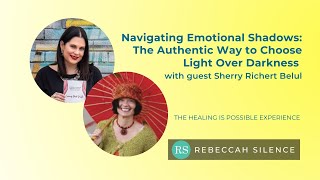
A recorded conversation on the Healing Is Possible Experience where host Rebeccah Silence and guest Sheri Blue explore how to authentically navigate emotional shadows and choose light without toxic positivity. Sheri shares a 30-year personal recovery arc—from being suicidal to finding tiny "pinpricks of light" through meditation—and both speakers discuss the hidden reality of being "high-functioning yet suicidal," the role of identity and generational patterns, practical steps for facing difficult emotions, and the importance of community, service, and choosing who to surround yourself with. The episode closes with resources (books, courses, websites) and invitations to connect.
Well, hello, if you have ever had to deal with navigating emotional shadows, and if you've wanted more on how to choose light over dark without being toxically positive or inauthentic, man does the Healing is Possible experience have a show for you today.
Okay, we're going.
Okay.
Three, two, one. Welcome.
I'm Rebecca Silence, emotional healing and relationship coach, author and media personality. And every week we bring you an episode of the Healing is Possible Experience, which is a show designed to support you in full self expression, full life, joy and fulfillment.
And.
And we're just here to take you on a journey of more hope and more healing, because why not? We can never get enough. Today's episode is about navigating emotional shadows, the authentic way to choose light over darkness. Let me welcome very, very special guest, Sheri Blue, who is no stranger to healing through the dark and living into the light. And this is a friend of mine that is a leader in light and love and possibility. But the I asked her to the show today is because I've watched her extremely authentic about. It's not all sunshine, rainbows, smiles. And if you see and meet Sherry online, you know, this woman, to me anyway, exudes joy that is so authentic and such a high vibration. And I know that she's not faking it or pretending and that it's not always easy. So I wanted her to talk about what is it like to emerge into your own light without faking it until you make it. So, Sheri, welcome to the show. I'm so grateful you're here.
Oh, Rebecca, that was such a beautiful introduction and I already feel. I just think my heart is open. I love who you are and I love what you're bringing in the world. Thank you, thank you, thank you.
Right back at you.
So let's kick off.
Sheri, why is this topic so important to you?
Yeah, and it is, it is. You know, I was so looking forward to talking to you because being in the world in a way that is authentic and also trying to bring light and love, it's a huge topic, right? Because it's not easy. And for me, I'll just tell quickly because it's really important that 30 years ago I was suicidal. And so everything in my life, every moment of joy comes from that foundation. And I think it's really important to say that because I feel like a lot of people are afraid of our mental health. And I'm one of those people. Right. It's like I've been there. And so my story actually has to do with light because it felt to me like an iron wall closing in. Rebecca is like the, the amount of like self talk and self hate. And I just felt like I couldn't live up to who I was supposed to be in the world, you know, and just like I just had all this talk all the time about what was wrong with me. And it just felt like it was closing in, closing in. And then I had a miracle happen. I went to a meditation group and on one of. You know how they practice the in. Focus on your breath in and out. And on one of the in breaths, I heard, I don't want to kill myself. And it was, it was like there, there was a tiny pinprick in that iron wall where light could come in. And this is why light is so important, because it's like I really. I felt like one tiny bit of light changed everything. Like it wasn't solid. And I, I thought, oh, if I had a moment where I didn't have that immense desire to be off the planet, well, maybe I could have another one or maybe I could have another after that. You know, it became a quest for me of these tiny moments of, well being, these tiny, tiny moments of light. You know, I behold my cat. Or you know, maybe I would see the way the light was coming in through the leaves. And so everything in my world for these past 30 years is still based on that, you know, on that one tiny moment of light can get us to a new place. So that, that's, that's why it's so important to me. It really literally saved my life.
Sherry, thank you for being so open and vulnerable. And I know you are speaking to so many people. Would you describe yourself 30 years ago as suicidal yet high functioning?
Absolutely.
I really want you to talk about that because I. So many high functioning, high performing. Our world is about high performance, right? And I don't think we talk about it, that high functioning high performers can also be suicidal. And I know when I was diagnosed with cancer eight years ago, pregnant with my second daughter, I thought, you know, I've been suicidal so much that maybe I caused this. I have died so much that maybe I now have this terminal diagnosis. Because it was terminal. I had a 5% chance to live because I had so many years that I didn't want to. But I had a very similar experience. And at the time I wasn't suicidal anymore, but I had been. And it would come in for me. There were three major suicidal episodes, you know, decades apart, that kind of all of a sudden crept up on me and it didn't feel circumstantial, it just felt so dark and the pain was so much. Right. But what I realized is I didn't cause the cancer and I certainly didn't create it because I was suicidal. I get to. I get to decide who I'm going to be in this moment. And that was the moment for me of this tidal wave of a commitment to life like none other. So let's spe speak to the high functioning yet suicidal reality that I don't think is talked about nearly enough.
I love you even for just putting those words together. You know, I'm. I knew there was a reason I really wanted to talk to you today. It is so important because I can almost cry just talking about it, like, because part of, part of at least my experience of being high functioning and suicidal and is that it meant that I couldn't ask for help. And it's still to this day really hard for me to ask for help when I'm going through a hard time. Because when we identify as someone who is high performing or, you know, I'm not, I can't say successful because I never identified as successful. I identified as someone who could go under the radar, right. Like I performed well because I didn't, I didn't want to be. To be seen as someone who did it, I guess is the weird way to say it. But I think that the biggest piece of it is that idea that it's like I'll just go, right? Like, for me at least that that's always how. And I still have, you know, to be completely honest, you know, I still have thoughts of suicide. It's like a part of my DNA. I think there's something, some way that I'm wired. Of course, now I know so much more. Right. But, but I think, to answer your question, it's like we have to learn to ask for help. I just think that that keeps coming up for me right now as we're talking that it's like, how do we get past that idea that, you know, at least again for me, that the world would be better off. That that was sort of my recurring thought.
Wow.
Because if you're so used to doing well and performing and doing, you know, doing, doing, doing for other people perhaps is a piece of it. Then it just becomes this sort of pressure. Do you. What? Yeah.
What do you think? Oh my goodness. Well, first of all, I love that you're talking about identity for me. You know, I identified as so strong and yet I always would breathe into one breath At a time, there's so much power in our breath, you know, let me just breathe again. But I didn't know how much longer I could take the pressure. I was so strong, but the pressure felt so great. And I don't know about your lineage, but I'll speak to mine. Lots of suicide in my family history. And one of the big things that I teach in the practice of emotional healing. And for those of you watching, go to rebeccasilence.com get the free trigger trauma release method if you're ready. And called take my Emotional Survival Kit course. Because in less than three hours, you can change your whole life, but in an authentic way, meaning you've taken your life back. Right? So for me, I think about, you know, a lot of. When it feels so intense, I will just make up. I don't think this is just my work. I think it's generational. So me being brave enough to take this on isn't just for me. It's for everyone that came before me that didn't have the words or the skills or the capacity or the understanding or the vision for what was possible and for everyone after. And, you know, I teach in the Emotional Survival Kit, the first tool, it's a blanket that represents a commitment to our life. And I think we're looking for a reason to break through and break free and feel our own light again. Or we're looking for a reason to surrender down into the dark. So, you know, I think you bring up this excellent, excellent, excellent point that also isn't talked enough about. How are we identifying and what would it be like to break up with our survival? Not just personality, but identity, because we have one. We have this version of ourselves that we created to survive and perform and produce. Especially if you're in my world, in the healing as possible family and community, you care about making your biggest difference. And it can feel like so much pressure. And how do you make your biggest difference without the pressure? That's what Sheri and I are here to talk about today, right? And it is this coming to Jesus that only you can do with you, where you decide the pressure isn't worth it anymore. And the. The achievement results, driven external, validation, driven identity pieces, we've got to drop them like it's hot.
We've got to.
Or you're holding yourself hostage in your own lifetime. And it's learned. Pressure is learned. And the good news about this, Sherry, is it can be unlearned and we can literally let it go. And one of the things that I teach is as survival selves, identity, personality, coping mechanisms, as all of the survival pieces start to die, it can feel like you're going to die, but you're not. And I think Sherry brings up such a gorgeous, profound point. I've never met someone suicidal that wanted to die. They just wanted the pain and the pressure gone and they didn't know how, that they could live and perform and produce without the pressure and the pain. It's almost like an experience of peanut butter and jelly. Like, I can produce and I can perform and I can be my best. But what has to go along with that, the gas in the tank, the rocket fuel in the tank, is pressure and pain. And I'm here to say no, it doesn't have to be that way.
Rebecca, you're reminding me of a really profound moment for me in this journey that's related to. What you're just talking about is I was at the Santa Cruz boardwalk, and I love boardwalks. I love the sights and smells and the colors, and I was bawling. I just was feeling again, it's back to the pressure. I couldn't maintain it. I couldn't maintain that external everything's fine and internal struggles that were going on. And again, it was like a bit of grace that dropped in where the thought dropped in. I could move to the Santa Cruz boardwalk and live in a little shack and work at the, you know, Apple Fritter lady stand. And my life could be about just reading books and laughing with people and talking to me. Like, I somehow managed to drop all of those expectations, and I have held on to that. It's called her, my alter ego, you know, the Apple Fritter Lady. Because it's like there's something about what you said about the external validation, like if. If. Because some of it's internal, but some of it's also like, that's how I felt love, right? It started in. In grade school. I realized if I got straight A's, then people would like me, the teachers would like me. You know, it. It's that kind of, you know, getting love through performing. And so I think what you're talking about and this conversation is so important because it's like you said, we can feel as if we're going to die because if we stop performing for external reasons, then it might feel as if we're not going to have any love. And I think that image that dropped in for me of laughing with people and smiling and serving, you know, fritters on the. The boardwalk, it gave me this idea that it's like, oh, you know, just being here with other people present, that's enough, right? That's enough.
But also letting yourself be the you that you were comfortable with, that you wanted to be. Apple fritters brought you joy, like, and you know, that is so monumental to connect to. Well, what brings me joy? What brings me more alive? What brings me to a place where my soul is singing and nothing needs to be different? You know, I write in my book Coming Back to Life that a miracle is just the moment. Nothing needs to be different than it was or is. It's all miracle is right. And we can get to that place. But only I think, and I'd love to hear your thoughts on this, Sherry. When we recognize our life is ours. And I never don't have choice, and I never don't have access to my light or to my truth. And when it gets to this point of recognizing, you know, not just we don't get love from external sources, but we don't get more evidence that we have value. For me, it wasn't about love. It was about value. I didn't know I was valuable without doing and achieving and in essence being superhuman. I mean, before I got sick, Sheri, my practice, I was on the radio and that just fed a pipeline. I had a six month wait list for years to get in with me for private practice work. And I was working seven days a week, 10 hours straight back to back with no breaks. And that was just what I did because it was never. I could never do enough. I could never be enough. I could never help enough. Right. And you talked about, you know, the power of connection. And I was so worried about connecting to more external proof that I was valuable, that I had disconnected from me and what actually honored, respected and took care of me. And that's not a life.
Oh, wow. Oh my gosh. I feel like this is so much. I love talking to you because I feel like you see me, you know, even though it's. It's a little bit different what we've experienced, but in some ways the similarities are. They're striking to me of. Yeah, that. That place of really coming back to who we are. And I mean, for me, I was lucky because that. That first meditation class that I went to, that really felt like grace to me. That led me to a 30 year. I mean, I'm still practicing Zen, which, you know, is truly about everything. Just like you just said, everything is right here in this moment and right. Like, so just being able to come back to this, this is enough. Just Being here, right. Being here talking to someone I want to talk to or. Or being drawn to whatever is calling to me specifically, right. When I come back to that, which I think is the. The apple fritter lady, right? She's just like, I love to talk to people. I love to just hear their stories, right. It doesn't have to be calm. This was the other thing, Right. That I still grapple with a lot. Doesn't have to become a book. It doesn't have to become a YouTube this or a that or.
I'm so glad you're saying this especially to our high performers. Yes, please keep going.
Because that's a big part of it. My joy would get snatched away instantly because ego would take it and tell me it's not worth anything unless you turn it into something, you know, it's not worth anything. I'm not worth anything unless I'm, you know, have something to show, like here, look. Right? And it's a really razor, razor thin line, as I'm sure you know, and I'd like to hear you talk about this, but it's like there's a great joy in creating. There's a great joy in taking our experiences and turning them into books or programs or courses, or there's. It's so. Oh, it's so subtle when it gets taken over from, oh, I really want to do this to. I have to do this because if I don't do this, I'm not earning my way on this planet, or I'm not showing people that I'm valuable or I'm not earning love. It's.
Absolutely.
Well.
And for me, you know, in my book Coming Back to Life, for example, there's a lot of my story, but the purpose is to connect people to their story. And I couldn't have created the book or the emotional survival course or the YouTube channel or these shows that I've done when I still needed that external validation to help me prove my enoughness. I waited until. And I had a coach, Sherry, say this to me early. Early on. I already had a master's in counseling and I was a nationally board certified music therapist. And I was still a goddamn shit show. And I knew it. Like, something is off. I get it, but I don't get it. And I had this coach say to me, there's going to be a day where you talk about your childhood sexual abuse and it's just past the butter. And I said to her, carol, are you kidding me right now? Like, there was still a power in my victim. There Was still power in me, surviving and living in spite of. And then there was a day where it was past the butter. And then there was a day where I got a publishing deal. And my book isn't about my story being validated. My book is about navigating emotional shadows, the authentic way to choose light over dark. And then, you know, my next question for you is, for me, I actually, when I think of light, I think about connecting to my light, you know, and in the emotional survival kit, I talk about just let your light shine your next. Right, correct, most aligned next step, and let that be enough. Like, let's not get too far ahead of ourselves. Did you experience the light in the wall that you were talking about earlier? As external or as you.
Oh, what a great question. Yes. So initially, I'll just tell you the journey because it felt like it made a lot of sense now in retrospect, looking back. So initially, it was totally outside of me, right? So all I was doing was looking like, when is something going to drop in? That can be a tiny moment of light. I started calling them pinpricks of light early on, like, beautiful. Where. Where is the pinprick of light going to come from next? And it, you know, that's scary, right? Because it's like I'm sort of relying on something to come in. And then there was a big moment where I realized, oh, I could create those moments, but they were still outside of me, which is. I think you're really putting into something important. They still helped me survive all of this, you know, and then I started creating those moments. But the real, real transformation came from exactly what you're talking about right now. And this was years later, right? So it's like I spent. I spent a long time just hoping they would fall on me and I could survive. Then I spent a long time creating moments of light. But then I. I think what happened is I healed enough to understand exactly what you're saying. Like, oh, it's just here. It's here in me. And the other part that was so important for me was realizing, like, finally getting out of my own suffering enough to see, like, oh, my gosh, so many people are in the dark. We're all here, you know, so many of us, whether it's, you know, grief over a death or it's illness or divorce or empty nest. I mean, we could go on with all of the, you know, 10,000 joys and 10,000 sorrows. But when I realized that it was in me and that other people were also in the Dark. It became this mission to just be that light. Yes. And it. It's not even. It's not even me or outside of me. It's kind of just how I keep looking outside because I have this beautiful tree out here, and it's like that tree. It's not like the tree would say, like, oh, it's my light. It's not, you know, but the tree is light. The tree is love. I feel like that's what we are.
Yeah. Yeah. I mean, what I'm hearing as you're talking is there is our ability to not chase the light from outside of ourselves, but to connect to the light in us. That is the universal light.
Yes.
Right. And we don't need crisis. I say this all the time. I see people, and I'll literally. I'll have people. This happened about a month ago. I had a woman on a discovery call with me, very interested in opening up Pandora's box, looking at what's there so it's not running or potentially even ruining her life anymore. And then she says, you know what? It's just not bad enough yet. And we do this. We think, okay, I can take it. I can take it. I can take it. I can take it. I can take it. I don't want. Especially if you're high functioning and a high performer. I don't want to risk the. The loss of what I do have that I want. If I get more authentic. But, you know, I love to say, the only thing you have to lose is you. Don't you dare let that happen. And for me, it was such a breakthrough moment to recognize that I had light in me that I was denying. Why is that ever a choice that we think will lead to something good? Denying our light means denying our life. And I've never met someone who didn't have some sort of trauma, some sort of survival, some sort of armor around themselves in their heart. And I just want to invite everybody watching today. You can connect to the light that's you. To let all that melt away. And that doesn't make you exposed and at risk. It actually gives you the opportunity to be so much more grounded. Sherry is one of the most grounded vibrations I have been around. You feel Sherry's energy before you even, like, see her. Yet if you're in her physical vicinity. That's my experience of sharing. I'm not even kidding. I know when Sherry's right around the corner because I can feel that level of groundedness, but I don't know how to be that grounded without getting way More comfortable with the dark and the light and our ability to choose.
Ah, thank you. Oh, my gosh, Rebecca, first of all, thank you. What a probably the best compliment I could receive. Right? Because that's, you know, it's so important to me. And that just the word grounded, I think my practice, which until talking to you right now, I don't. I don't think I've ever phrased it this way, but it's like it is really being aligned with the universal light. And that sounds kind of woo. Woo. It sounds kind of like, what? But it's. I don't know how else to say it, but, like, that's what I recognize in you. Right? There's an allowing. I think this is.
This is it. Right?
Because it feels to me, and I'm wondering. People listening feel this too, right? Like we cover, cover, cover, cover, cover, cover. Because we don't want to be vulnerable. We don't want to be exposed. And yet it's almost as if, like, you've, like, you've pointed out then we're covering up everything. It's just this, like, again, I keep coming back because to me, that's the image. It's an iron wall. It's just an iron wall. That's what it is for me.
Yeah. Yeah. And even if it's just a curtain, like a little layer of fabric, us being disconnected from our right to be fully alive and fully expressed and out of fear, it doesn't matter what it is. We are meant to live our lives our way. And we always have choice and we always. I love to say there's not a right way or wrong way to live. There's just what works for us. And I really think this conversation, Sheri, is about helping people connect to what works for them. And how do you know something isn't working? It feels like the walls are closing in, and we don't have to let it get to the point where we're literally suffocating. It can be so stupid, subtle. We can catch it so fast, and we don't have to wait for a crisis or a pandemic or a breakdown. I do not believe we need breakdown to breakthrough. I think it's all about choice. And we are not meant to be in reaction to our past or our trauma or modeling life only based on what we saw as possible. Because this is how our family of origin did it.
Yes. Oh, my gosh. Yes, yes, yes, yes. A thousand times. And I. This is. Reminded me of something I really wanted to thank you for and to appreciate that you said a little while ago, which was that we are doing this. I do think so too. Just like you said, it's not just for ourselves. It's healing generations behind us and generations forward. And even the person across the street or across town or across the world, I really think that there's something so much bigger. And for some people, maybe that helps. For me, it helps because it gave a bigger purpose. Also that it's to the urgency of not waiting until the worst possible crisis. It's like it's important. Again, I keep coming back to. For me, it's as simple as a lot of people are in the dark, you know, And I feel like we're here to help each other and I'm. I'm one of those others. Right? So it's like I'm. I'm part of that.
And you can hold space for darkness that other people are going without fear because you're no longer afraid. Right. And let's talk about this. How do we help our audience today? Sheri, what are your top tips on getting to the point where you're no longer afraid of the dark?
Yes. What a wonderful question. I think, and this is like kind of classic, right? Like if you. I had a young. My son is 22 now. He's no longer little. But, you know, when they're little and they're scared, we take their hand and we sit with them in the dark. Right. I mean, that's one of the ways we can do it. I'm here with you. It's okay, we can do this. We don't say, let's run away, let's never be in the dark. Which is what I think I did with myself is I was so freaking scared of it. But it just built up then the fears. Whereas I think that a big piece of it is to understand, like. And it's not always easy. In fact, it's very rarely see. But to go to the sadness, to go to the grief, to talk about it, you know, I mean, I've been. The last couple weeks, I have just had this like crazy grief. It was just like free floating grief. What it takes to pick up the phone and call a friend and say, can we just talk? I'm just, you know, this is scaring me. And, but, but not to, you know, not to try to hide from it. I feel like that that's maybe, at least for me, that's the number. The first thing to do is to turn toward it. Even though everything in us says, don't.
Go there, face it. What do you think you're speaking my language. I mean, I teach the practice of emotional healing because I think what is required in the dark moments is the release of a stuck emotion. And what I teach Sheri is there's only five emotions. I think Brene Brown talks about 80 in Atlas of the Heart. I just stick with five. And those five are anger, fear, grief, joy, and excitement. Because I believe anything and everything else is learned and therefore it can be unlearned. But these five emotions, I don't know how to unlearn, they're human. It's like the frickin weather, right? Anger, grief, joy, excitement. So I love that you're speaking to connecting to the emotion and not only facing it, but connecting to someone else so that you're not alone in it. And the more you're not afraid of the dark, the more you'll attract people that aren't afraid of the dark. And I really believe in reciprocity. You know, I don't think that we have to over function and be so strong. Let's only go halfway so that in our moments of needing support, someone else can meet us halfway. And if you got someone that just isn't capable or interested in meeting you halfway, don't call them when you're in the middle of yes, I've got to just be real with myself and acknowledge there's some dark, that underneath it I've got some emotion. And if I can just be seen and loved in this vulnerable place as I express this emotion, what more is there? That is such medicine. And if, if no one's around, get out a journal, get it out of your body, get it onto a page, look in the mirror and lock eyes with the gorgeousness and greatness that is you. And know, you know, we don't need the other people. But I do believe it's so healing to be with other people and to connect. And that emotional release work. And it's so funny, the work that Sheri and I do together is with Brendan Burchard. And I don't know what you would say, but this is certainly not like the most emotional community, right? And I'm walking around there and if I need to cry, I cry. Like I'm just not afraid of it, right? And Brendan's mom at the last event in Austin, she's like, rebecca, honey, what's wrong?
What.
What do you need? You know, And I'm like, I'm so good, I worthy, you know, like, why not just let ourselves let it out and give other people permission? As Marianne Williamson says to do the same in the process. Right, but what you're saying about connecting to your emotions and connecting to those that are not going to try to fix it, right? Like, we're not helpless. So when we're talking about asking for help, we don't need to be fixed or rescued or saved. That's not what we're asking for. It's just about, you know, being fully where we are honest with ourselves and the person in front of us that I think is so liberating.
And again, like, I want to thank you because you pointed to something that is also true. Like, hopefully we know somebody in our lives we can turn to who's not going to try to fix us or worry about us or just. But the. Listen, I have a practice that I learned from my spiritual teacher. We use a recorder. So sometimes the person I call is myself, right? And I call by turning on the recorder, and I just speak true. You know, I'm feeling so sad. I don't know what's going on. I feel all this grief. I can't find my joy. I can't find the light. And then we put the recorder in the other hand just to kind of listen from a different place. And then listen. You just listen to the recording. And always, always, Rebecca, this, like, kindness, compassion, love comes through, usually starts with something like, oh, honey. Oh, honey, of course, you know, you're a human being. Of course, you feel, you know, if you were happy all the time, that just wouldn't be normal. Right? Like, and. And so we can use. Right? We can. We can turn to our friends, but we can also turn to ourselves. I also was thinking when you said that I'm reading a book called Bittersweet by Susan Kane. Do you know, I don't know if you know that book.
I haven't heard of it yet.
It doesn't matter. But. But the reason I say that is because sometimes there's a book on our shelf that almost speaks to us, right? Like, I'm reading this book, and she. She talks about the word melancholy in a way that our culture has taken over melancholy and made it into depression or, you know, something wrong. But she talks about melancholy as, like, a part of, you know, being alive. You know, it's the poignancy of, like, me, I have a mother who's 85 that I love dearly, and she's 85, and she's, you know, she's not going.
To be here forever.
And it's the poignancy of feeling that. Not, you know, not trying to Pretend like, oh, well, everything, you know, I shouldn't feel this way, blah, blah. But just, like, letting it all be there, letting the joy be there, the bittersweet. Letting the joy be there.
Right? I'm hearing, like, meeting yourself where you are and meeting life where it is. I had another cancer scare last fall. I had malignant cancer on my body and had two more surgeries. I think this was 18 surgeries. The cancer I had was melanoma. And if I go, okay, I don't want to deal with this. I don't want to face this. What happens, it spreads, right? And so does darkness. And I think one of the other things I want to talk to you about on this episode, Sheri, is why are we so comfortable in the dark? Right? Because everything looks different with the lights on. And we always have the ability to turn on our own light, to. To look at, to face, to meet ourselves where we are, life where it is. But I do think there's a comfort in the dark and a resistance to trusting the light. So can we speak to that?
That, Yes, I think we need to speak to that. That's really good, because when you were talking about identity earlier, we didn't go there, but it's one of the places I went in my mind briefly, which is I. I find myself. Sometimes I identify as a happy person. Sometimes I identify as a person. I'll say, oh, I'm comfortable in the dark, you know, or I. I know the dark, or I'm, you know. But I think identity is such an interesting thing, right? When we're identified with being. And you tell me if this speaks to you at all. But for me, I have to be really closely paying attention to not being identified in either of those places because I spent so much of my life being in the dark that sometimes it feels like any childhood thing feels familiar and comfortable and, dare I say, safe. Even though it's not safe, there's a weird.
Well, there's power and control. I think that's a big part of it. And I love that you're bringing up identity because, I mean, and I. I don't think it's cookie cutter again. There's not a right or wrong way to live. There's not a right or a wrong way to heal. We have to find what works, works for us. So you're finding that for you, it works to not identify as dark or light, just as you alive. And here's the moment I'm in and what's next. And that is such a beautiful, amazing process. And Somebody else might actually feel more alive identifying as light, not as dark, if they've been identifying as the dark. So whatever it is for you, find that and take it and run with it. But, you know, I want to share here my definition of happiness. I don't talk about this a lot, so my definition of happiness is just having a healthy, comfortable relationship with all of these five core emotions. Anger, fear, grief, joy, excitement. I can be in fear and be happy because I don't need anything to be different. I can be with anger. I can also be with the light. For me, you know, I had a first, you know, seminar experience where there was a lot of, like, receiving love. And, man, didn't it feel safe because I had associated love with such severe trauma and abuse. And, you know, I think again, meeting yourself where you are is so critical, but also recognizing that the other shoe isn't going to drop. Yes, we've survived enough, and life's going to be life. So, like, I didn't cause my cancer. Sherry didn't cause suicidal ideation. I didn't either, you know, and I think suicidal ideation can be inherited. Being comfortable in the dark can be inherited. Being afraid of your life, being better than those you loved, that can be real. I was blessed at a seminar to have my mom say to me in front of 100 people, go, be better than me. Go have it all. We're not all blessed with that, but you can know that and tell me if you disagree, Sherry. But I think all parents want better from. For their kids. And when they're in a protective way, potentially seemingly trying to keep their children smaller, it is out of love, even though it's a little wonky and goofy, right? You can tell yourself it is okay to be better, to be more, to have more, to love more, to live more than what I've seen. And you doing that, it does model that possibility for every life you'll ever touch. You may not have a parent saying to you, go ahead, go be better than me, but you can give yourself that permission, and there's no benefit to you not giving yourself that permission. That's what I want to say.
Oh, and what I love, I'm going to take it out even further because what you're talking about, like, I'm talking to you, and every time I've talked to you, you know, it's like there's an unspoken now, there's a spoken. But it used to be an unspoken permission to be as much as I could be. You know, you can do that, right? And I think this is really important. So whether we have children or parents or, you know, whatever, I think just taking it out to this bigger place of what if everyone, right? Like, what if we all walked around and we were that permission to everyone else, you know, be bigger than me, be brighter. Because it's like I'm influenced so much when I'm around people. Like, I'm like, I'm in front of you right now. Even though we're on zoom, I feel like I'm in front of you, so I'm taking on your energy, right? So I'm going to go away with an expanded feeling. And maybe my expandedness attracts something totally different than yours will, but that it's that. Who said that? Didn't somebody say that? It's like humans are we not even humans? I think every living thing just grows, right? It's a part of our DNA that we want to expand, we want to grow, we want to feel more, be more. And I. So beautiful to think about instead of like. I think a lot of my childhood experience was a lot of really scared people. Really scared. And so everything's small. Everybody's small. Everybody's just like you said, even parents, you know, they're afraid. And so things come from that small place. And it just feels so much better. Even just the express, like, even the physical expression is better. I mean, it feels better to me to be absolutely big than tense and small.
Right?
Right.
There's that Fat Joe song. Turn it all the way up, right? All the way up. You're not gonna hurt anybody and anybody that wouldn't want you turned all the way up as you. They're not aligned. That doesn't make them wrong or bad. And, you know, I think the darkness isn't wrong or bad. The light isn't wrong or bad. It's just you get to choose. Once you decide to take your life on and to take it back and to come fully alive as you. What is the baseline experience you want to be having? And I, for me, look at darkness as an alignment opportunity, you know, And I think it's. It's easy to be great and your best and to do your best and to make the best of the moments that are your preference of the. The seasons that are going your way. But it's the dark. It's the moments when this is an ideal that you can recognize this isn't your fault and it is your work. And we don't have to be afraid because our ability to access and connect to light is always there and always More powerful than surrendering into the dark and letting it to take us over.
Yes. And I know we've said this, but I feel like I want to say it again, because to me, this seems like the most important piece is that one does not exclude the other. Like, to me, that very initial experience is still what informs me every day, which is I can feel like I'm in the dark and have light. Right. And they're not there. And I think, to me, this is. I was just talking to my own community about celebration. You know, I feel like we just have. We have to expand the whole. The whole way. We see celebration in the same way like we celebrate when we're in grief. We can celebrate when we're depressed. It's like we. We have to understand that we're. We're really capable of so much more. And the moment that we say, and I think this is what you and I keep circling around, the moment that we say, oh, honey, that's okay, that you feel sad, we're in the light. There's actually happiness. At least I think. I agree. I love the way you define happy. It's like there's. There's a great joy in being so kind to ourselves, so accepting of life, so human, that it's like it's no longer depressed.
Yeah. Well. And I define depression as just shutting down your truth, and I define anxiety as rejecting your truth. Right. And I've worked in psych hospitals, and I have a master's degree in counseling. And like you said earlier, this isn't easy, but it is this simple. And we always have the ability to lighten up, and we lighten up faster when we face reality faster. And. And what if nothing needs to be different? And it's just occurring to me, Sherry, you know, there is a possibility available to all of us that we experience our light, and the light, no matter what. And we are always creating. We're not sometimes in creation mode. We're always creating. And we always have the ability to ask ourselves, what choice am I going to make about what I'm creating now? Not once things change or as long as things change, but as life is, as I am, what do I choose to create next?
Ah, Rebecca, I'm feeling. I just have to say this. I'm feeling such an overwhelming sense of gratitude to you right now because it could have been that we saw each other and we're like, oh, you know, that person's so joyful. I love that. I love that joy. I love that energy. And we could be talking about you know, from a different place. That to me is not authentic. And I feel like what's making me feel this overwhelming joy right now is that I'm not having to in my head be thinking, am I saying the right thing? Is she, you know, like, do you.
Know what I mean?
But. But when I was. And it wasn't just that I was high performing, when I was suicidal, I was, I was. People would describe me as like, bubbly and enthusiastic and because I had this. I call her Cardboard Sherry, right? She was always like, I knew what people liked. You know, I was a smart kid. Like, people like people who are cheerful and. But it's a totally different thing than how I am with you right now. Because it. In my head, I was constantly, you know, having to recalibrate and how am I presenting? How am I presenting? How am I present? And that is so freaking exhausting.
Amen. And I love that you're saying it this way. You've got cardboard cherry and you've got apple fritter shake, you know, and I've got depressed, suicidal, like pressure cooker Rebecca and what I call powerfully relaxed Rebecca, you know, and powerfully relaxed Rebecca is always available to me and a way better choice. And when I'm not finding myself powerfully relaxed again, it's just an opportunity for alignment. But I want people to hear us saying, you get it wrong. And your job is not to be who everybody you know needs you to be or who you think you need to be for everybody else. You're modeling, relaxing into you. Just powerfully choosing breath after breath, moment after moment. That I think is the best medicine any of us can be, to be a part of healing the collective. And the pressure gets to be off and people are going to have their opinions, you know, and when I quit chemo and my family was. Was freaking out, I just said thank you for loving me so much. Because I think it is coming from intention. And when I was starting my business and people are saying, you're not going to get a gig on the radio or be a private pay life coach in this little town, I'm like, thank you for loving me so much. Like their vote, you don't have to accept or their opinion. And it doesn't mean that they're bad or wrong. But I think where we should end this today, Sheri is talking about the importance of picking who vibrationally you surround yourself with. And you can love everyone and you can see and speak to the light and everyone and be available for the dark and everyone and pick who's close to you. Because to me, that's been the most important gift I've given myself the last two years, is making the decision that I'm unwilling not to be ruthlessly selective about who gets access to me.
Hallelujah, baby. Hallelujah. That is so important. And I, I love, I'm so grateful for the way that you, you always phrase things like this too, right. It's like we can love everyone, but we don't need to let them in to the place where they're going to be, you know, And I just had this like, like sucking our energy or, you know, taking, taking, taking, taking from us in the way that, you know, some people can. And I think I, I am so selective. I mean, I'm, I'm like in Brendan's community, I'm in my spiritual community. Almost everyone that I come into contact with, there are people who, again, it's not like they're toxic, toxically positive, but they're people who are paying attention. They're people who are really invested in mindfulness and awareness and kindness. And that's. That's it for me.
Right.
Like this conversation, I think is exactly that. Like where you've said over and over, it's not like there's a cookie cutter.
Right.
Only want to be with this, this type of person. But it's the spirit of being around people who are loving and kind and have your best interest at heart. Yeah.
Yeah. And Leah Valencia. Leah Valencia, key and I just did an episode about, you know, who are you choosing? Do you choose people that enhance your light and how do you know the difference? So that's a great episode on the YouTube channel if anybody wants to go back and watch it. But, you know, Sheri, I think this is such an important conversation and, you know, being the only word I feel like I want to add to your list is service.
Yeah.
You know, because I know people you hang out with and people I hang out with are up to service.
Right.
And, and we care about our ripple. I mean, I honestly, I, I have myself on a process of, you know, I don't think we can choose our thoughts. I, I don't think, you know, we create the external circumstance, but we can certainly decide who we're going to be in the face of wherever we find ourselves. And for me, I think about is this choice I'm about to make. What I would bless for the world, what I would want for humanity. I can't be beating myself up and in self loathing, you know, and not recognizing that that contributes to this epidemic of the darkness taking us over and drowning out our own light. I think about. And I think about. Brendan teaches that as the role model, you know, mindset and mentality and, you know, archetype. I think about it as an archetype. Right. But is who I'm going to be in this moment or who I want to be more of a blessing to the world or more of these, you know, dis. Ease paradigms that we've all gotten so comfortable with?
Rebecca, I'm so glad you added that. Right. Because it is. That is important. And again, to make the distinction, I'm saying this to my own little. That little part of myself that says, oh, I'm not of service to the world if I'm not happy. Right. Like that I have to make sure I say to her, it's not that. It's choosing the light and being out in the world as the light, even when it's hard or I'm in grief or I'm sad or I'm anxious. But it's. It's like this conversation to me, like we're. I. I hope. I mean, I feel like we're having an authentic conversation.
Yeah.
We're not talking like, oh, my God, Rebecca, it's just like it's so hard and the world is so awful. Right. We're not. We're not coming from that place. Just like. I love your expression. It's powerful.
Right.
There's a. There's a empowering. Yeah. Sense to it that it's like we're making choices and we're making choices about how we are with all these other dear human beings. Like everybody. It's like, you know, absolutely everybody's trying so hard to be here and to love and to. To be free and to be of service.
Yes. And it is such a simple concept. Right. This concept of, like, getting real. But I ultimately think that's what we're talking about, about today is getting real. And if you don't know what that is, you can at least start with what it isn't. And if you're suffering or stressed or feeling pressure, that's not really you. Yeah. Real. It just feels effortless. In this conversation with you, Sherry, I think, is a beautiful example of just effortless. Like, you can stop efforting, you can let it get effortless, and you can be real with yourself. And as Lizzo would say, it's about damn time. And if you need help, you know, I'm here. I have private practice services, the emotional survival Kit, the book coming Back to life. The website rebeccasilens.com Sheri, how do people get in touch with you?
Yes. So I just want to say. I just want to. I have a book called say it now, which is also like my path to growth. And I would love people to start there because one of my strange, unusual paths to healing has been through loving and creative gifts that I make for people. And it's a really beautiful thing because it's like that creativity, it feeds me. But then I can gift, you know, gifts of love and appreciation to people. And so my book say it now is probably a great introduction to who I am in my work and how.
Do people get it? Amazon.
Amazon. Yeah. Yeah.
Beautiful.
And I'm simply celebrate on. On social media. So perfect.
Thank you for the gift of just you and my life and for the gift of this really powerful and beautiful, I think, really important conversation. The darkness is real, but so is the light.
And Rebecca, thank you. I, you know, you talked about the ripples, and it's like I've experienced so many of your beautiful ripples of light, and I know countless, countless people also do. So I just want to thank you for everything you've done to be you, you know, to really, like, let you shine.
I received that and so appreciate it and so appreciate you. And to all of you watching, subscribe to the Rebecca Silence YouTube channel, share this episode with someone that you believe would be supported by this conversation. And just know the world needs you healed so you can make your difference. And healing is possible. Not just for some of us, for me, for you, for all of us. I love you so much. I'll see you soon. Sheri, thank you for a magical, magical, magical conversation. I truly mean it when I say I love you.
Oh, I love you back.
Thank you.
Thank you.
And we'll see all of you so soon. Sam.
More from Rebeccah





Free 5-Day Live Online Bootcamp for Mothers, August 24–28 4 PM EST. Replays available #shorts



