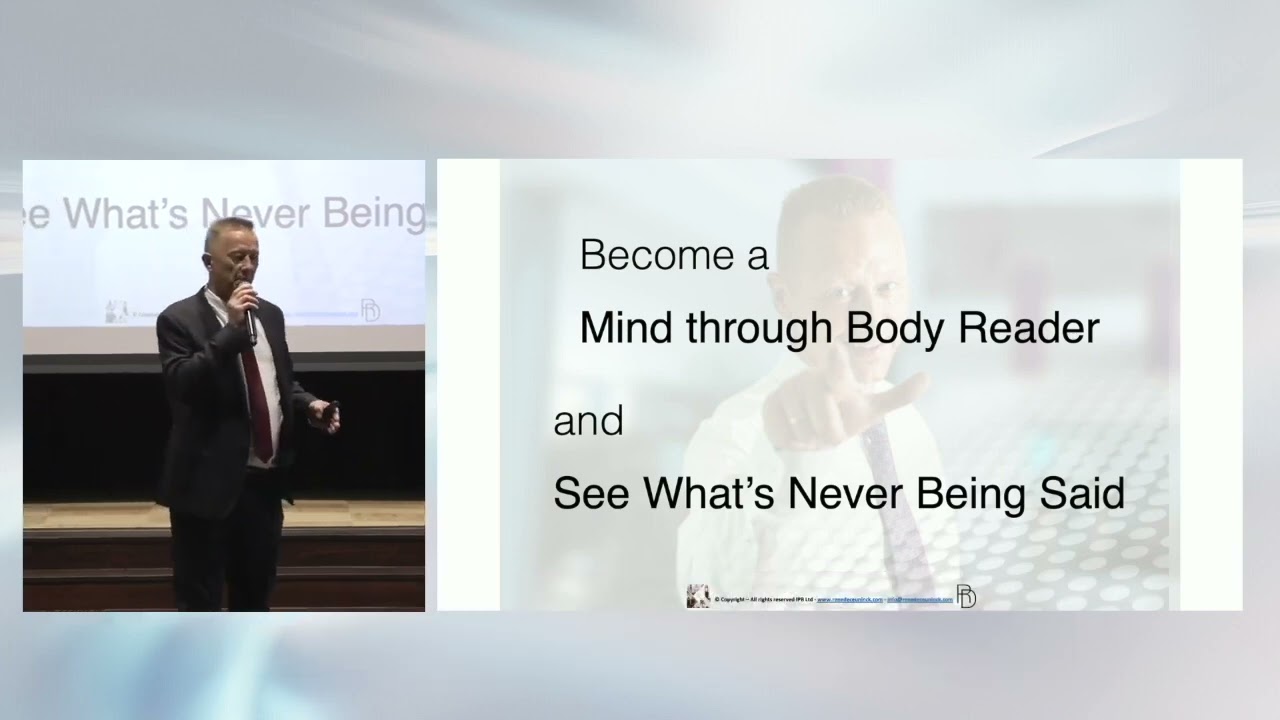
Body Language renedeceuninck.com

Stress expert Aida and body-language trainer René Deceuninck discuss how thoughts fuel stress and how breathing, nature walks, and meditation can quiet mental chatter. René breaks down communication: 55% is body language, 38% tone, 7% words. Your feet point toward what you actually want to do.
Chapters
Mental stress. So that mental stress maybe is when, when you are getting worried about something, when you are, um, thinking so much, when you have so much fears, insecurities, and they are blocking you. So it's more in you, in the mental, no? And then physical stress is when all of those things from before affects to your body. And that's the most important or the most complicated part, no? When you let all the stress already affect your body, but can affect in many ways. Maybe you can lose your hair, maybe you can have headaches, maybe you have pain in your back. So even sometimes you can have some sickness and you don't even know that that sickness, it comes from your stress. Many, many, you will be surprised. So of course there are many, there are many techniques, but depends on which grade are you as well. But for example, go for a walk is the best thing that you could do. Maybe when you're stressed, but if you do it every day, you are going to save— you are going to, you know, when you are walking in, in the nature, uh, just, just because you are walking, you are making exercises. So you are your body is segregating endorphins. So because you are walking, you are breathing deeper, so you are going to get more oxygen. And if you are walking in the nature, it's double, the oxygen is more high. At the same time, when you are walking, not thinking, so you are helping to yourself to realign and don't think that much. Because, you know, just when you are close to the nature, the vibration of the nature, the noises from the birds, from the water, they are— it helps to your, um, nervous system to relax. So it's a natural way, very healthy, to just go for a walk, 20 minutes. If you have 1 hour, even better. But it's going to help you to equilibrate your organism. That simple thing like a walk, or even you have many techniques for breathing and they are working very, very well as well. Yeah, when you have a stress situation and you cannot go for a walk or you cannot have a, a bath, for example, Cold water is very good as well. Just some breathing, deep breathing. There is one technique that is very powerful for anxiety as well, so it's called, um, the double breathe. So it's like double time, two time and deep exhale. Do it a few times because it helps as well to your, um, your system to relax.
Yeah, I mean, and stress— I mean, in stress situations, and I remember Jay Shetty. Do you know Jay Shetty? I think you know Jay Shetty, right? Jay Shetty, he went for skydiving in Dubai. And I've been jumping out of airplanes in those days in the armed forces. I mean, I loved it. Parachute jumping was one of my favorites. And but he went for the very first time with Rady, with his wife. And Rady and Jay Shetty went for parachute jumping. And he separated himself in an empty room to do some breathing exercises. And because a lot of people say, parachute jumping, are you out of them, out of your mind? I can't do that. Everybody, everybody can jump out of an airplane. It's the stress factor that holds them back of doing it, right? And like, or bungee jumping anyway. And he went in a separate room and then he came back and he says, the reason I do exercises with my breathing is that when you are angry, you have a certain way of breathing. When you're happy, you have a certain way of breathing. When you are excited, you have a certain way of breathing. When you are sad, we— no matter the situation, there's always a way of breathing attached to that, right? And he says, when you can control your breathing, you can actually control your state, if that makes sense. And I'm like, wow, that makes sense. That makes an awful lot of sense. So So stress in fact is controllable. Um, but what could be like the sources of stress? Because a lot of people say, you know, how to handle it, that's amazing. Where does it come from? What are the roots of stress? How can I define my roots of stress? Is there like— are you— do you have any like information or any things like that could be the root, or Anything? Like you have financial stress, like your kids, you have your job, and yeah, there is one important thing that we have to understand.
Uh, we feel how we've been thinking. So if you've been thinking that, um, it's very dangerous, I don't know what I have to do this, what I have to jump, and blah blah blah, I, I am very scared, I'm going to broke my leg. Of course you are going to have so much fear because you've been thinking in that way. So the, the feelings are all the thoughts that you've been thinking before. So that's why if you want to change your state, the first thing that you have to do is change your thoughts. Yeah, so you need something to broke up break up that pattern. So for example, breathing, as Tibetan monks, as my master, he was always saying, breathe, kill your thoughts. The breathe is silence. Your mind, because your mind, you just can't do one thing at once. So you just can't think once, you cannot think in two things different at the same time. So if you are concentrating, uh, breathing, and you are concentrating exhaling, your mind is going to be just thinking how you are breathing, just thinking how you are exhaling. So it's not going to be thinking in another thing. Okay, so it's one way to help you to just disconnect your mind, because it's your mind who is going to create your state.
Yeah.
So when you get to control your mind, you are gonna get how to— how you are going to feel. So that's the clue, that's the key actually. Control your mind and you will control your emotions.
Yeah.
Instead to be thinking, uh, it's pretty dangerous, I'm gonna kill myself, you breathe out all those negative thoughts and reprogram yourself. Everything's gonna be fine, I'm going to really enjoy, it's gonna be the, um, expecting from my life, and then you will start feeling better.
Yeah.
So everything starts with a thought.
Yeah. Do you have like a, an example of a, a client of yours? You don't have to mention their name, please don't. But do you have like an ex— an experience you had with a client where you could apply your knowledge, your whatever you know about this, and then make them, um, have a change in their life about their stress? Do you have like an example of a client?
All my clients, no one, all of them. So everyone that does the program, they realize how important it is. I have many clients with anxiety, and after they realize and they release the anxiety, and so every time it's getting less and less. It's not like one pill and stop. No, you have to, you have to teach your mind. So it's a learning process because maybe you've been like 40 years or 30 years don't controlling your mind. So now you have to start, you know, reprogram yourself. You have to start, you know, saying to your mind, stop thinking that. And you might have to, have to stop. So maybe at the beginning it take a while. But after that, after learn how to control your mind, you're gonna be like, okay, that thought is not— it's not going well in myself because it's hitting me with stress, it's getting me with anxiety, is— I'm not feeling well in that way. Yeah, I'm going to change it easily. But you need practice, you need practice.
I mean, I remember, I remember a, um, um, a quote, or not a quote, is like a way of thinking. Uh, Socrates is a philosopher. You know Socrates, the philosopher, right? So there's a, there's a— he had in the whole of his philosophy, there's one thing I remember from, from Socrates is that he was approached by a friend of his, and that friend says, hey, Socrates, I got something for you.
Do you—
did you hear about such and such and such and such and such? And Socrates said, stop. What you're telling me, is this true? And the guy said, well, I really don't know. He says, okay, what you're telling me, he says, is this good? He says, well, not really. And so, okay, okay, third question, final question. What you're telling me 'Can I use this?' And the guy says, 'Well, not really.' And Socrates said, 'Let's change the subject.' And I think for a lot of people watching now or listening to us, I think it's very important if you will lower your stress level, is to be filtering out the conversations or filtering out the, the people who are adding stress to your life and say, hey, listen, wait a minute, is this good? Is it true? Can I use it? No, change. I think there's a lot of people that— I mean, myself, I don't have a television. I never watch the news. I never— I mean, I'm not interested at all because it's so manipulated. Um, I went to a certain country in the Middle East, and, um, all government says, Rene, you shouldn't be going because it's a very dangerous country. And I went anyway and had the most beautiful time of my life. So it is so manipulated. Where does stress come from? But I think, I mean, I don't know, can you agree with this, that you can filter out stress yourself in the very beginning of a conversation? Could you do that? And is there a way how to do that?
Stress, you mean with someone else, with another person?
Another person that is communicating with you and then I mean, it's easy for me to say and easy for you because we know how to handle these things, but for somebody watching or listening to this for the very first time, it might be a complete new thing. So what would be the beginning steps of like filtering out, uh, like stress? How, how would that be possible?
Toxic people in your life, for example. Yeah, you have to learn how to take care about yourself. And if someone is talking to you in a negative way, in a, in a very stressed situations, you know, and it's transmitting to you that feeling, sometimes it's like, hey, just one step back. It's like, it is not mine, it's yours. So you don't have to let I mean, of course, sometimes if it's family, if our friends, you have to stay there, but you have to teach them as well that that kind of behavior is not going to help you, it's going to get them worse, you know. Because when these negative people is again, again, again talking the same way, in a negative way, in a stressed way, they are making their own hole. And it's going deeper and deeper and deeper, and then they get even depressions because about the negative, negative— because, you know, as we said before, negative thoughts are creating negative emotions, positive thoughts are creating positive emotion. So if you will saying, saying the same kind of speech, negative, negative, negative— so it's not just for them, if it's It's as well for you that you are listening because you are absorbing as well that emotion all the time, all the time. So even if you love them, you have to tell them, stop saying the same all the time. So this is going to hurt, it's going to, it's going to hurt you, it's going to take you to a bad way for sure. So just you have, you know, like Tony Robbins say, change your history. Stop being the victim. Stop being this. Like, what can I do to resolve the situation? What can I do to get over? What can I do to, uh, to be more happy in whatever? But you have to switch. If not, you are gonna get into the hole.
Yeah.
And you are gonna be with them. So or they change, or you get step away at the end. Yeah, it's a choice.
It's also, I mean, would you agree that it's also the law of attraction, that what you send out come back to you?
As well, as well, because I mean, at the end, what you, what you give is what you're going to receive.
Yeah, I mean, like, like in what I teach in my body language courses is that um, we have non-verbal communication and we have verbal communication. So the verbal communication is, is conscious. We are— we, we can hear it, right? So I'm talking to you, you can hear me, okay? Um, that's conscious. This is in the moment. It's the same thing as when you taste something, when you touch something, when you hear something, when you say something. It's conscious, it's in the moment. However, scientifically proven, they say that verbal communication is only 7%. Well, I go, wait a minute, what about the rest? And the rest is non-verbal, which goes subconsciously, which is 38% tonality and 55% body language. But the thing is, what, what I want— what's my whole point is that verbally it's only 7%. We transfer 40 bits of data per second. 40 bits of data per second. So I'm speaking to you, we are transferring now 40 bits of data per second. When I add my body language and my tonality to it, which is subconsciously, we transfer 40 million bits of data per second, which is like a million times more. It's like, wait a minute. And this is not me inventing anything or saying something just for the sake of— no, this is scientifically proven. And I was like, what? So subconsciously, you now you're going to pay attention to my hands because I say pay attention to my hands and you're going to pay attention to it, right? If I say, hey, can you pay attention to my tonality, you're going to pay attention to it. But a lot of the times I ask people, when you are in a conversation with somebody, do you pay attention to their body language? And they said, well, Heck no, no, not really, no. What, what, in fact, what is body language? I said, wow, do you pay attention to their tonality when people are speaking to you? Because nah, not really. I mean, and 90— there's nothing wrong with that, it's a normal thing. I mean, 90% of society doesn't pay attention at all to tonality and body language. But you know, this is, I shall say, So, so if you know that it's 40 bits of data for the verbal and 40 million bits of data for the non-verbal, so I say something to you, I add my body language to it, I am— I add my tonality to it, it will arrive in your brain in a certain way. Your brain will process the whole thing and come back to me with an answer, a statement, or a question based on what I send out for you, if that makes sense, right? But if that body language attached to it is in such a positive way, you're going to have a big smile on your face. And I think in terms of— to come back to the stress factor— if you know how to read body language, because that's a, that's a third phase. The second— the first state is recognize your body language. Pay attention to how do you handle your hands, your tonality. How do you do that on a daily basis? The second stage is to recognize body language with somebody else. So I can read your body language, I can read your microexpressions, I can read, you know, your gestures, your postures when you say something. And I can easily define a lie in less than 3 seconds today. I mean, after 3 decades, right? But the third stage is— so the first stage, you know your body language, you know the body language of somebody else because you can read it. And then the third stage is how can you use that to create a decent conversation that really makes sense? And that's why— that's where, you know, when the stress factor comes in, when people— yeah, But this, but it's okay, calm down. What's going on? Tell me. And I think, would you agree that if you can control your state of being, your body language, that your stress factor would go down tremendously? Okay, it's a very profound question.
It's a very deep-going question, but But I think, but as I feel it doesn't mean that I have to be the complete truth. It's what I feel. You know, when you speaking, your unconscious, your non-verbal language is unconsciously, so it express what you already feeling. So you can cover up, but you're still gonna be with that feeling. You can try to control your movements to doesn't seem that I'm stressed, but if you feel stressed, you feel stressed. And in which way it's going to— so I think if you wanna— if you really want to, you need to change the state.
Yeah.
If you— because if not, it's going to be like covered. So sometimes, because it's unconsciously, so in some, some gestures, of course, you are going to— they are going to be well because you are controlling. But unconsciously, many of them are going to be the truth because it's how you feel. So deeply, you need to change the state.
Yeah, yeah, yeah. One, one question I have for you now, I'm very curious: how can you control your stress?
Controlling your thoughts.
Okay.
But first, so to pass through one state to another state, you need a process. Or if you want something quick, so have to be like something strong.
Okay.
Or get into the cold water Cold water works very well, or like a deep breathing to change your state and then start with a positive thoughts, like a reprogram. Okay, so you need a change.
Okay, yeah, no, no, but I was looking for a recipe. Let's say I'm very stressed out, how can I change my stress situation in, in a formal calming situation?
Breathing deep, so fast and deep. Okay, one breathing technique. I can show you few, uh, one breathing technique, or do something that it really helps you to release.
Yeah, so, so let's say I have a— this, this is just an example, right?
Let's say you, you can break one something as well, like a glass of water, you know, to release that stress out. With the breathing, you can release that stress out. With the cold water, you can release that stress out. And start change, change your program, change your thought. Everything is going to be well. I'm okay, I'm perfect, I'm power, I'm going to get whatever I want, you know, change it.
Okay. Because I mean, imagine that you got a lot of financial stress. You got like, you're working in the company and the manager is like pushing you and pushing you and pushing you and you build up stress and stress and stress. I know a lot of people in London, for example, who are in the corporate industry. They get so much pressure. What would be like an ideal thing for them to do, for example, besides the breathing exercises? Uh, let's say like, uh, I, I'm working for, let's say in, in the financial sector, I'm working in Canary Wharf. I know that area very well. In Canary Wharf, we've got all these banks and all these, you know, KPMG and HSBC and Barclays, and these people are under such a stress, it is crazy. They're under such a pressure. Like, those people, what would you recommend to do besides the breathing exercise?
Sizes. You know, the thing is, many, many of them, they can start shouting, you know, when they are stressed. It's a way to release. They are releasing the stress by shouting someone else. Okay, you know, but that's not a good way. Of course, they help them to release, you know, because they are releasing shouting, but it's not the way. Or maybe some, maybe they are— they can't even just cry because of the stress. So, but a good way to release is doing something like this. Uh, for example, they were taking— there is one exercise is with the pillow, and they take the pillow and they scream in the pillow. So it's a way to release the stress out. So you have to find your So which one it can help you the most? That could be just take the pillow, could be just punch something to release the stress, could be broken glass, could be just breathing. Breathing is amazing, so you can do it everywhere.
So I know, I know a lot of people in this area, and, and, um, a lot of those people, they, they release the stress in a completely different way. What they do For example, on a Friday night, they go to the pub and they start drinking.
Drinking and they start having drugs because it's a way to get away. No.
Okay. But what is it? It's like, so let's say you're in the banking area and you make a lot of money, but you're under such a pressure. You have a lot of stress. And on Friday night, okay, you know, I don't care. I'm going to the pub. I'm going to have a glass of wine and another glass of wine and another glass of wine. But they do that on a regular basis. Is— I do know what you're going to say, right? It's not good. But why is it not good?
Because alcohol is toxic for your body and it's sugar at the end. So you are destroying your neuron— neuronas from your So you're going to have many problems with your health, circulation problems. And normally when people is drinking so much, it's because they have lack of love in some way. So it's because they feel empty in some way. So the best way to, to release is, yeah, you need to start thinking of your taking care about yourself more.
Yeah.
And find the love of yourself more.
Yeah, because I know in, in, in especially, I mean, there's Amsterdam, there's Paris, there's Brussels, all kinds of big cities, but I know particularly in London because I live, I live in London. Um, in London there's a lot of alcohol abuse and, and all kinds of drugs abuse, even by the higher levels. I mean, people who are really financially pretty, doing pretty well. But then that was my question to you, is like, but I know, I know myself as well, is that it's not a solution. This is just a plaster on the wound, isn't it? If you, you want to get stress out of your life, you have to pull out the roots.
And then, and yeah, you're covering up. It's like, because it's still there. It's not— when you, when you drink, it's you are getting even worse because you just, just you have the stress plus the problem with the alcohol. All right. And it's not good for your health because, you know, you know that everything, you know, alcohol is, uh, is sugar, no? Destilada. You know what is the killer number one in the world? Sugar.
Sugar, yeah, yeah.
So everything comes from the sugar. We think that this, you know, it's sweet, it's nothing. No, no, no. It's after sugar comes diabetes, ictus, problems with, with your brain. Many, many sickness come from circulation, heart attacks, ictus. Everything come from the sugar.
Yeah.
So we don't realize how important and how, how dangerous and how potion is it in our body system.
Yeah. Wow. So as a stress— I mean, do I say that right? You're like a stress coach? People can connect with you?
Stress expert, I like to say. Yeah, the same. Yeah.
Besides stress, is there anything else you, you do in, in, in your profession?
Many things. So it's not just stress, but any kind of fears, conscious, unconscious. And even I help to release negative patterns. For example, you have any kind of block or But as well, if you postergar, how do you say in English, when you don't do the things and you let them for, uh, procrastinate.
Procrastination.
Procrastination, yeah. So this kind of little things that maybe they are not letting you to get your goals. So have more discipline. This kind of things we can work unconsciously, of course, because unconsciously we can— we have the power to recondition our minds to, to come become whatever you are. So you are the owner of your mind. So if you want to change it, you need, you need to make little steps to can do it, but you can. Because it's yours.
Yeah, your own body, right?
Yeah, yeah. But you, you need to, you need to know the steps and you have to do it.
Yeah. So, of course, the Hidden Signs of Nonverbal Cues and Their Power Over Stress is the title of our conversation. And I mean, I can say a lot about body language, but it starts with your subject, right? If you can't control your stress, you can't control your body language. I mean, this— the stress will be expressed in a certain way and a certain level, on a certain— with a certain vibration and a certain energy, on a certain frequency. So you'll attract that person or push that person away, uh, just by the way you feel. Now, we've been in this for 40 minutes now. My question would be like, Is there, is there something you would share here that might help people out to lower their stress on a daily basis? Some practical tips and tricks, like one or two. Do you have anything like that?
Yeah, we've been saying many, but I think, you know, the most important thing that we should to everyone is meditation. Yeah, because we, we should learn how to control our minds. You know, a little exercise is like, uh, any kind of meditation. For example, there is one exercise, uh, is very cool, it's called Rose is from one book, and it's a very good book, Change Life: The Man Who Sold His Ferrari. It's the rose meditation. So you have to pick up one rose, and every day for 2 minutes, 5 minutes, 10 minutes, whatever you feel like at the beginning. So, but during that period of time, you you just have to look at the rose. I don't think— just, you know, observe the beauty of the rose, how it's made, how the shape it is, how is the petals, how it's done. Because, you know, the nature is beauty at the end. So at the same time, you are admiring the beauty, but at the same time, you are not letting to mind thinking another thing, just the ropes. So it's a very good exercise because you are saying to your mind, don't think in another thing, just in the ropes. So like this, you are learning how to control your mind, because you remember, you have to learn, because many of us didn't control their minds for years. That's why you have anxiety, how you have stress, how you have a lot of worryness, a lot of fears, unconscious, because you don't know how to control your mind. So it's that important, because when you control— you learn how to control your mind, it will control your life.
It's, it's like, it's like where focus goes, energy flows, right?
Yeah, yeah, yeah, of course. So when you, when you learn how to control your mind, you will focus in whatever you really want to. So you are going to be more efficient.
Yeah, our focus goes closer. I had a— I saw an interview with Tom Cruise and, and about anxiety, about being worried, about all of these things. And he says, write down what you want, just write it down. And I have an exercise myself as well, and the mind map of life. I'm not going into that right now, but what I remember from Tom Cruise, he says, write down what you want. And then write down a scenario. How are you going to get there? Don't put it in the computer, don't put it on your phone, put it on a piece of paper. Because when you write things down, your brain is far more active than when you put it on the computer. And I was like, wait a minute. And I've been doing that for many, many years, but it makes so much sense to me. If you have an issue or a subject or something that is not really going the way you would like to to go with, to go, you know, write it down, write it down and think in solutions and think and make a mind map. I was with Tony Buzan. Tony Buzan, sadly enough, he died in, I think, 2019 or '18 or '19. Tony Buzan was one of the person, one of the people who was a creator of mind mapping. I don't know if you know the mind mapping thing. And then his last book was with Professor Hawaya from Oxford. And in his last book, I helped him out with a lot of things, and I was surprised when my name was in his book. But Tony Buzan is one of the guys that I admire tremendously. We met in Devonshire Club near Liverpool Street in London, and he says when you put things in a mind map, You have a visual. And once you have that visual, you can then start creating things and have results. And matter of fact is that people who are dyslexic, who have dyslexia, can cure or enhance their life by mind mapping. I said, what? So for those, for those people who are listening right now and watching this, go to Google and Google, hey, Dyslexia mind mapping or mind mapping, you'll see mind mapping is an amazing tool to cure that or to enhance your life. But I do it myself. I mind map on a daily basis about my business, about what I do. And you know, when you start mind mapping, you start lowering your stress level, if that makes sense, because you have it on a piece of paper. You don't have to think about it anymore. And that piece of paper, you can take it out of your— of whatever you are and out of your book or whatever you did put it. And then you have a look at it. In fact, I have one myself here.
I don't know where.
I think it's here somewhere. And mind mapping is something so powerful that can lower— let me put like this. Oh, this is the later— oh, you can't see it. I should wait a minute. I should— the background, right?
Yeah, I think I will move a little bit.
So this is the mind map I have, right? And this is, this, that mind map is a thing that I, oh, my background is not too bad. That's okay. But the mind map, when you make a mind map, it's such an amazing tool for yourself to, hey, where is this going? Where is this going? Where is my business going? But by doing that, your stress level goes like from, well, lower, right? Because you have it on a piece of paper. Because when you put it in the computer, it is somewhere, and most of the times you don't find it anymore because you can't remember the name you put on it. And then you go through all these searching things on your computer, and then you find it, and they go like, oh yeah, oh yeah. And then you, you know, your, your focus goes somewhere else, and then you forget about— but But when you have it on a piece of paper, you have it on a piece of paper and you can watch it and then start like structuring it or restructuring it. I know by doing mind mapping, my stress level went completely like towards zero because I know now how to do. And most of the things are on a piece of paper. I got a notebook where I write everything, everything. What happens during the day, I write it down, write it down. I can go back so many years, like 2018, November 20th. What did I do at that very specific day? I'll take my notebook. Oh, damn. Oh wow, interesting. You know, is it necessary to do that? I don't know. Each person, each individual has to make that decision. But I do it this way and it helped my life tremendously. Instead of putting in a computer, I have it in a notebook. Um, and for me, it helped me tremendously in a sense that it lowered my stress level.
By lowering your stress, it's perfect. I mean, depends on the person, always is going to choose one tool or one of the tools. Normally, for example, to my clients, I give few tools, so then it's up to you which one you want to use. Some, some people, they prefer to breathe, and other people maybe they prefer to learn how to control. But a mind map, mind mapping, for example, is a wonderful tool as well. Yeah, there is another exercise, for example, that when you have stress, write down everything that is causing that stress and then say, okay, what can I do to resolve this?
Yeah, yeah.
Say, well, what you can do to resolve this— I cannot do anything about that, so you cannot do anything about that. So How can— what can I— what can I do to feel better about this? And say it. So because when you wrote down, you are releasing as well that emotion.
So true.
So that's why it's perfect when you write down. It's like psychomagic.
That's why I write down.
It's perfect.
So yeah, hey, but is there like a one final thought you would like to give away to people who are listening or watching?
Um, I think they should teach in the school how to control their emotions and how to control your mind, because as much you learn, as much more happy you are gonna be. So I will suggest people to start training their minds because, I mean, your mind is the most beautiful and amazing and powerful tool that you will have. But if we don't know how to use it well, can get us from the heaven to the hell.
So yes, so, and, and, and so, I mean, we have been speaking a couple of times now besides this Zoom meeting. I am very impressed in what you do. I am very impressed in the sense that I can only say, hey, for people watching this or listening to this, where can people find you?
Of course, you have my Instagram. I write down is Aida hypnosis. Okay, I can, I can write it down here if it's necessary.
Yeah, I will share it. So this is recorded, so it's going to be on YouTube, it's going to be on social media. I'm going to share your details anyway, but please, please put it in the, in the, in the chat for sure, your website or where people can find you.
Aida.pw. That's my, my website.
Okay.
And I will write mine. And I would like to know as well about you, some things. Yeah, well, you know, body language, I— it's, um, it's something that I really love it because I was reading a few, few books.
But you know, I'm, I'm not that you are an expert, and I would like to know more as well about, um, the reason, the reason I started, like, the reason for body language, where does it come from, is when I was a kid. I was 5 or 6 years old. I was born at the beach in, in Belgium. And I spent hours on the beach, and I was in love with the beach, the water, the ocean, the North Sea. And, uh, but I was also watching people. And what surprised me a lot in, in, in, in that area is that people would say something and their body language would say differently. And I had no idea about body language at that time. I mean, I was 5, 6 years old. I didn't know anything about this, but I was always surprised. Why do people say certain things and their body is saying differently? I, I couldn't, I couldn't get things together. And then, um, I, uh, life goes on, you go to school, et cetera, et cetera. And then I turned 18. I said, I'm gonna join the forces. I joined the Navy. And, um, when joining the Navy was an amazing time, but I, I was like, hey, wait a minute, I see people with stars and stripes, so if they can, I can too. And I only had a diploma, hotel school, right? So I went to hotel school, I had a diploma as a— I'm a certified chef and a certified sommelier and maître d'hôtel. But I, I was watching these people, said if they can, I can. So I applied to become, um, an engineer in, in building bridges and roads and stuff, and And I got in. And people— and that's another thing that in my life, people bullied me like crazy in school and later on as well. And who do you think you are? How are you going to join the Navy? You aren't. This is not going to happen for you. You're not smart enough for that. And then I was— I mean, I'm, I'm an extrovert, right? So when I have something on my mind, I share it with the world. And, um, I was going to join, like, becoming an engineer, and said, Rene, you have to study for that. This is not for you. And, and half a year later, I was an engineer and building bridges and roads and whatever. And then I saw people jumping out of airplanes and said, wow, this is me. This is, you know, you're in your early 20s, what do you want? And especially guys, you know, guys, the adventure and, and forces. And you see these special forces and then you go like, okay, So before I knew it, I was jumping out of an airplane. And then all of a sudden I saw the pilot and I said, if he can, I can. And I went home and told everybody, ah, this one is going to become a pilot. And they go like, what? Rene Deceuninck, you are out of your mind. You're crazy. This is not for you. Forget it. And funny enough, a year later I was flying my own aircraft anyway. And then, uh, I left the forces after 7 years of serving and then 4 years. So in between leaving and becoming, starting my own business, which there's just 4 years in between, I was a truck driver. I had to put things on the table, you know, you have to put food on the table. So you know what, I'm going to become a truck driver instead of, wait a minute, pilot, truck driver, that doesn't make sense. But I loved it. I mean, I was watching Europe from behind the windscreen of a truck. I went through all countries in Europe, uh, driving a truck, and it was an amazing time. However, you're gonna say something? Okay, so however, in 1995 I started my business, and, uh, somewhere along the line I got my first book from Tony Robbins. It was Notes from a Friend.. And it was in 1995 or '96, 1995. And that book was written in 1994, 1994 by Tony. And I wrote the book, I, I read the book and I was like, man, you can read the book in less than 2 hours. It's such a tiny book, Nuts of a Friend. And, um, I said, one day I'm gonna, I'm gonna, I'm gonna work with that dude. That were my exact words. I'm gonna work with that dude. And, uh, you know, and I think things are moving on and you do this and you do that, and all of a sudden somebody says, hey Rene, we have an amazing thing coming up, you have to join us, it's about body language and it's for free, you know, come with us, we're gonna have a great time. And I said, body language, man, this is for hippies, this is not for me, this is— this doesn't make sense. Anyway, long story short, they convinced me and I went anyway. And that was the most beautiful thing that could happen in my life, is joining that free seminar about body language. Afterwards, I went for my trainer course and then master trainer course and trainer trainer. So I'm a full trainer in body language and expertise in body language. And thank God they convinced me. And then actually, in early 2010 or 2011, I joined Tony Robbins. I collaborated with him for a full decade. It's also a long story attached to it. But the thing about body language is that I am obviously very excited about it because I know why I'm excited about it. But if only people would start being excited about it, that 93% of all communication is nonverbal. And especially for people who are in business, who are— when you have kids or when you have a partner. I mean, I had a, I had a couple of ladies in my seminar one day, I'm talking about like a long time ago, and they said, hey Rene, listen, that body language thing of yours, can, can I use that for everything? I said, absolutely, but do know one thing, karma will get back to you. And go like, What do you mean? I said, if you use it for the wrong reasons, don't. And you can use body language for all kinds of reasons, but in relationships, for example, if you learn about body language, why don't you take your partner and teach your partner as well about it? Your relationship will go through the next level. That makes sense. So I mean, in relationships especially, because I mean, you can be good in business, you can have kids, your kids will leave your house anyway. I got a daughter, she's 36, another one 34, another one 32. So they left the house already many years ago. The thing is, you will be left behind with your partner, and if you can't communicate with your partner, I guarantee you within a year you're going to get divorced. So that's why I encourage people when they follow certain people or certain, you know, courses or training, make sure your partner is there too so you can together enjoy that information about stress, about body language, about, you know, all these things. And I guarantee you, if, if 93% of all communication is nonverbal, what the heck are you waiting for to learn it? But make sure you drag your partner in it as well so So you can grow together. Does that make sense?
Of course. And I would like to— why don't you give us an example about non-verbal communication? Because I would love to. For example, hey, how is exactly— or for example, to know when someone is lying to you, what we should know?
Well, there's, there's, you know, the, the brain, you can control the brain, you can control your brain to a certain level. But initially, the, the body will never lie. That is one thing to understand, your body will never lie. So when I ask you a question, How did your trip to, uh, Portugal go last year? And then I will zip it. I will say— I won't say anything anymore. How did your trip to Portugal go last year? And then you go like this, or you go like this, right? So what happens, even if you don't move your head, your eyes will go somewhere. And when they go to the right which is for me, this, this is my right. That means you are making a construction of something. Now when you— they— your eyes go to the left, you make a memory of something that really happened. So if I ask you about your trip to— so like you're doing this like now, like you did this, right? So I'm paying attention. But anyway, the thing is when I ask you a question, you will look in a certain way, right? This is connected to the brain. So your right brain is your emotional brain, your left brain is your rational brain, connected diagonally. That means like your right eye is connected to your left brain and your left eye is connected to your right brain. So your left eye is your emotional eye, your right eye is your rational eye. So when you say to me, oh, we had an amazing trip to Portugal, I will doubt that because you are making a construction of something you should remember. This is very basic information. It's far more complicated than that. Let me give you an example. I was in London. I was a lady. She said, hey Rene, can I meet you because I have some issues with my relationships and I want to talk about it with you and just to have your opinion and bloody, bloody blah. I said, okay, no worries. So we went to London, had a conversation with the lady, and after 10 seconds I said, stop. She says, stop what? I said, you are lying to me. And she says, what? I said, listen, I've been doing this for XYZ decades. You can't lie to me. Please tell me the truth. And she started crying. I said, why are you crying? Well, she says, you're right, I, I, I didn't tell you the full truth. I said, I know, so let's recap and now give me the real version of what's going on, because otherwise you're wasting your time, you're wasting my time, and you're wasting especially your money. And she says, Fair enough. So she started sharing her story and her issues, and I was like— and all of a sudden there was a change in that state of that body, of that person, that she even relaxed. You could— you could— shoulders went down, like, ah, because finally somebody was listening, and somebody was listening and wanted to hear the truth, right? But that's where body language comes in, or nonverbal communication. Because you analyze the tonality and we also analyze the postures and the gestures. So yeah, I don't know if that answers your question.
Yeah, but more, more examples. For example, if I— little details.
So yeah, for example, I was, I was speaking the other day to somebody about a certain subject and I felt in my stomach— did you ever have that feeling in your stomach something is not really right? Right, you have that feeling, like your gut feeling as they call it. And I had a gut feeling like, yeah, something is— and all of a sudden I go with my eyes towards the feet and one foot was pointing away. That means that that person in that very moment wanted to leave the conversation. And most of the time where the foot is pointing is the way they want to leave. Why is that? Because the body parts the further away from the brain are the less controllable. So you can show— you can control your face, you can control your hands, but you can't control your feet, right? And especially if you don't know nothing about body language, you won't control anything. And that's where I pay attention to. For example, if I have that gut feeling, I will never read— people say to me, ask me, do you read body language all the time? I said no, I would go crazy. But when I get that gut feeling, like something is like, I don't know what it is, but something is not correct here, then I'll start reading body language. Microexpressions, facial expressions. And most of the time I go directly, immediately to the feet, because the feet will tell me far more than all the rest.
But the feet, when they are stand up, no, because you know, if you don't see the feet normally, the feet normally, if they, if it's in front of you, is because it's, it's okay. If it's in another way, it's because they wanna leave, they wanna—
Yeah, and if you are notifying this, that the feet are pointing away, you can moderate the conversation and say, hey, listen, thank you so much for your time. I really don't want to interrupt anything, but hey, do you have your agenda with you? Maybe we can plan a different, another meeting, and because time is very precious. And I have to move on myself as well. So when would be a good time for you and I to, to meet again? Next week or this week? Or how do you see things? And in the mind of that person, it will go like, oh wow, that person understands me. You know what I mean? Subconsciously, they're not aware of it, but the body will like, let's have a— the body will have a relief of like, oh wow, I can leave the conversation. And the only thing you did was watch the body language. A super interesting thing to do as well in a conversation, to read body language, is to ask questions. And which questions? Open questions. When you ask open questions, people have to come up with a story, right? If I ask you, why are we here? You can't say yes or no. If I say, uh, 'Who are you?' You can't say yes or no. So, 'When are you going on that trip?' You can't say yes or no. So each time when you ask an open question starting with what, why, where, when, which, how, whom, whatever, people have to come up with a story. And when people come up with a story, there's a certain amount of things that are very important to know that you give them significance because they can do the talking. So if you let anybody— if you let someone else do the talking, they get so significant. They get like, oh my God, I can talk! Oh my God, I can— and people love talking, right? Give it to him by asking open questions. When you have an open question, people will come up with a story. Based on the answer, you can start creating your next question. Based on the answer, you can see if there's a lie or not involved in it. Because people will tell you all kinds of things, but their body language will maybe say differently. So are they lying or not? And there's so many things that you can do and explore when asking questions. I would— myself, I was applying for a job many, many years ago. I'm talking about more than 3 decades ago, and it was a very impressive job, believe it or not. We're talking about making deals for millions of dollars. And, and one of the, the company leaders said to me, hey Rene, you are not talking too much. I said no. He says, why? I said, the best leaders and the best speakers are the best listeners. And he said to me, you can leave. And I thought like, oh shit, I screwed— oh I shouldn't say that. I said like, I screwed it, right? I messed up. And 3 days later, they called me, when can you start in the company? I said, based on what? And they said, you gave us the exact answer we wanted to hear, but we were checkmate. We couldn't say anything to that. The best The best speakers are the best listeners. That's what we wanted to hear, but we were like not in the possibility to say anything to you. So we said you can leave, right? And I thought I lost it because it was 135 candidates, right? So, and, and 3 days later they tell you, yeah, because you said exactly what we wanted to hear. I said, wow, that's amazing. And this is a fact when you think about it, the best speakers are the best listeners. If you, if you watch television, um, in, in like interviews on television, the one interviewing is asking questions and the other person will give all the answers and they will talk and talk. And then in the interview will interrupt and say, listen, can I interrupt you for a minute? What about— does that sound familiar? They do that all the time, right? And that's, that's, that's how interviews are going. But when you start reading body language on top of it, you'll be surprised what people say, how they say it, why they're lying.
Give us some tips to understand people. The most important tips that you can give now.
The most important tip is that— so I travel a lot, and last time I drove from London to Dover to take the ferry. The boat, the ship to Calais in France and then move on to into France, Belgium, Holland with my car. And as we all know, UK is no longer— United Kingdom is no longer a part of Europe. So you have to go through customs. And at customs in Dover in the UK, they stopped me and they said, hey, sir, can I ask you a question? I said, you can ask me anything. Where are you from? I said London. Alright, okay, okay. So where are you heading? I said I'm heading for Holland. Okay, so you go through France, Belgium, Holland. I said yeah, sure. He says, what do you do for a living? I said, well, I teach body language in businesses. And he said, oh wow, how does that work? I said, well, you got a couple of hours? I said no. I said, okay. I said, And he said, but sure, what is my body language telling you? And I said, sir, honestly? He says, yes, please. You don't want to know. So there was two police officers behind him. They started laughing like crazy. And he looks at me like, what the heck are you— why do you say you don't want to know? What is the reason? I said, listen, sir, with all due my respect, The best body language, right, is what I teach, is body language. The best body language is just be you. Don't fake it. It doesn't work. It works in the short term and it don't work in the long term. So just be you and, and make sure whatever people think about you is none of your business. So my tip here is don't worry about your body language.
Just, yeah, I know, I know, but you know, yeah, but of course I think that you cannot be fake because your body of course is gonna say the truth. But some tips that we can see, for example, little things that I, for example, in, uh, for me, it helps me when I'm talking with a client and, uh, I know that when they are closed and they don't want to talk, so they are closed like this, so to see if we can be open, in which way I can— so I have to talk to help him to be open. You know, little things that you could say to help us to understand the body language.
Yeah. So what I would do when I'm speaking, I always have open hands. That means, you know, open hands. I will never do it like this. I will always have open hands. Open hands is inviting people. You are saying, hey, I'm inviting you, I'm friendly, I'm open, I'm honest. You, you have your open hands. Look at, for example, President Obama. He always had open hands. If you look in Italy, you had in those days Berlusconi. He always had his hands like this, down, down, down, which is very dominating, very arrogant, and not inviting at all. So have open hands. That's the first thing I would, uh, would, uh, suggest. Um, I talk— I, I shared that your right brain is your emotional brain, your left brain is your rational brain. So if I ask you an emotional question, so I want to sell something to you, I will turn my body a little bit like this. I'm exaggerating right now, right, just to make my point. I would turn my body like this. I would look with my left eye into your left eye. So I'm connecting my emotional brain with your emotional brain. And I will ask you an emotional question and I would say, hey, Aida, what's holding you back of doing business with me? Is there anything else that holding you back besides this and this and this? Is there anything holding you back of doing business with me? Tell me. I will look left, left. And then you might say, like, why? Listen, I was looking at this thing there, and if you could repair that, That would be a great thing to do. I say, listen, besides everything else, and besides that, we're gonna repair this. Is there anything else that's holding you back of doing business with me? And we look left, left constantly because it's an emotional decision. And then you might say after 2, 3 things, yeah, not really. I said I would stick out my hand and say, hey, Aida, it's great to do business with you. Let's do the paperwork first and then let's have a glass of champagne. What do you think?
This is to go to find the truth.
No, it's, you know, you can use that in all kinds of situations, but make sure when you use it, you use it for the right thing. Right. If I know I am selling you something that really will enhance your life, use it. Because I know afterwards you're going to come back to me. Hey, thank you, Rene Deceuninck, for selling this to me because it really enhanced my life crazy. It was like, wow, awesome. But if you sell something to somebody just for the fact of selling stuff and you don't know if it's going to enhance their lifestyle, it will get back to you in a negative way. Right? That's why it's so important to know that you can use body language in all kinds of ways for the positive and the negative. But use it only for the positive. And I would say, hey, listen, I have something very special for you. I don't— I, I'm sure that— and I will look left, left again. I will turn my body a little bit. I would say, I'm, I'm so convinced if you use this, your life will— did you, did you watch my hands? Your life will go— you know, this is— so I am using my tonality I'm using my hands, which is a nonverbal. Remember, 93% of our communication, 40 million bits of data.
Yeah, yeah.
And I look left, left, or I look right, right. Okay. And these are things to— but people can find all of that information online as well. And if people have questions or whatever, they can connect directly, immediately as well with me as well if they want to. Um, yeah. And does that— is that a good tip, or do you learn something from that?
Amazing. I love it. I love it. Yeah, of course.
Yeah, yeah.
Say, when, where can they find you? Or if you have any information about your courses, or if it's something new coming.
Everything is on reneedeceuninck.com, and they will be redirected to my Linktree, uh, where there's a couple of things on there. Um, we have a retreat coming up in Jamaica. We have in Jamaica, in the middle, in this— what is it? Is that like in between North and South America? In between is Caribbean, right? In the Caribbean. Um, it's— I, I never been to Jamaica, but I'm so looking forward to go there. It's an all— it's our own organization with a lady from Jamaica. She's an amazing, uh, individual. Uh, and then I got a couple of courses coming up. I gotta— but I would say just go on that Linktree link, uh, and, and if you want to find it, rene-deceuninck.com. Uh, we are creating right now a new website. The old website is, is pulled out, but we're creating a new website, so it's going to be phenomenal. But for now, I would say just go to my Linktree, and, and you know, it's— you can find it on Facebook and on Instagram and Linktree and on, on LinkedIn, on Twitter. I'm very active on LinkedIn, uh, which is more like business-minded. But yeah, it's, uh, yeah, that's where people can find me. I don't know. Yeah, but I would love to— I mean, and, and I would love to, for, for example, because the, the stress, what you are talking about, to be frankly honest with you, Aida, is, is more and more and more people I communicate with in terms of body language courses and body language training and workshops that a lot of people suffer from stress.
It is crazy, and they don't even know sometimes. Yeah, because they— I mean, they call it stress, but every sickness, they have a physical part, mental part, and emotional part. So that emotional part is the stress. Yeah, because it's something that is not in equilibrium in your body.
Yeah.
So you, you will get surprised. So how many stress and how many origin of the sickness you could find. Yeah. So it's more deep that we really see.
I just saw Sonia writing, I learned a lot with this webinar, thank you. That's amazing. And Sonia, all right, thank you, Sonia. This has been recorded, put it on YouTube as well, if, uh, and then people can watch it all over again as much as they want. Um, is there a final thought you would like to share, Aida?
Uh, no, thank you very much. Thank you, Rene Deceuninck. It was amazing. I really like this, this space with you. Yeah, and I hope to, to do it again, to do more things together, of course.
Absolutely. So for who's watching this, and Sonia included, when you're watching or listening, make sure to visit, uh, Aida's website, which is aida.hypnosison on Instagram, and www.aida.p.com. @ReneDeceuninck. Myself, you can find me on ReneDeceuninck.com and on social media in general. So if you need any information, we'll be happy to help you out.
More from Rene


What are ... The Silent Language of Connection and the Hidden Power of Non-Verbal Cues?