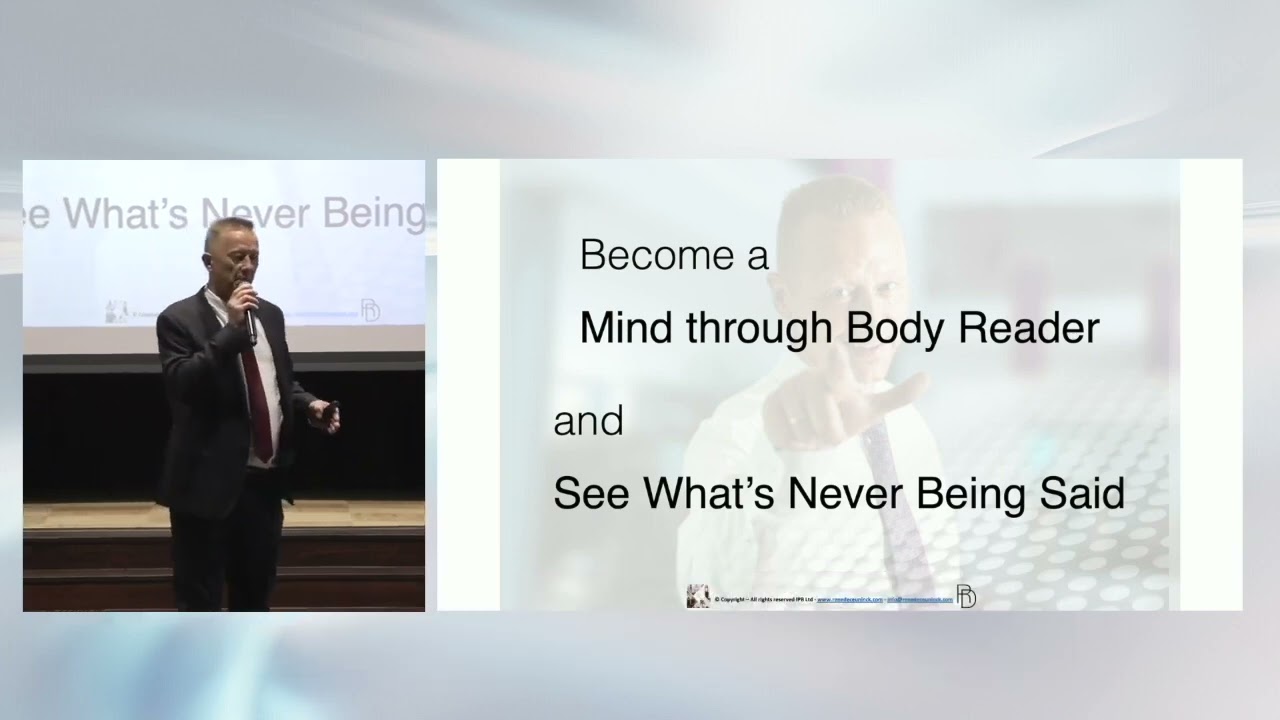
What are ... The Silent Language of Connection and the Hidden Power of Non-Verbal Cues?

In this live Zoom workshop, co‑creators Rene Deceuninck (body‑language expert) and Roxane (micro‑expression trainer) guide participants through the hidden power of non‑verbal communication. They contrast AI‑generated advice with the personalized, dynamic feedback of live coaching, emphasizing that AI lacks emotional nuance and real‑time adaptation. The core teaching is a three‑stage framework: (1) recognize your own body language, (2) recognize others’ cues, and (3) deliberately use body language to influence positively. They explain eye‑direction theory—left eye links to the emotional right brain, right eye to the rational left brain—and give sales and interview examples. Blink rate is presented as a reliable, hard‑to‑fake cue, illustrated with a traffic‑light metaphor (yellow = baseline, green = focused, red = stress/deception). Practical techniques include asking open‑ended questions, observing baseline changes, responding with curiosity and politeness, and using breathing exercises to manage nervousness. Roxane adds a micro‑expression overview (FACS, seven universal emotions) and ties it to eye‑zone work. The session includes interactive Q&A, participant anecdotes, and promotion of an upcoming Eventbrite event on mastering non‑verbal communication. The overall message is that mastering silent cues builds trust, influence, and confidence in sales, interviews, relationships, and leadership.
Chapters
I'm so happy that we are all here today for the silent language, for the universal language of connection and hidden power for influence and, uh, result. Uh, we have creating this event today for you to discover how to make or how to break relationships, leadership, uh, sales. And at the end, it's all about human connection. Isn't it? So I'm not alone today with my co-creator, Mr. Rene Deceuninck, expert in body language since 1995. He's giving and providing educational courses for body language around the globe. So from sales policies and education through negotiation strategies, we are so proud and lucky to have him with us today. So without further ado, Rene Deceuninck, the stage is yours, the Zoom is yours, and we are all ears.
Oh wow. All right. Thank you for the introduction, Roxane. Really appreciate that. Today I am not really going to speak about body language in detail. I'm going to share some tips and tricks for sure. But lately I was looking into why is it that people are For example, they have to go to a job application and they go on ChatGPT and they said, hey, I saw that dude, you know, on Facebook, Rene Deceuninck, he's a body language expert and he says it's very important to pay attention to your body language during a job, how you call that, a job application, a job interview. And then they go to ChatGPT and what they get is a whole list of things to pay attention to. So why would people pay so much money for a seminar to travel for a hotel, you know, to stay a couple of days in that seminar, spend lots of money if they can get it through ChatGPT and or another source that is AI related. The thing is though that the difference between those two platforms, well, it's not two platforms. One is a platform. The other one is life is that AI information is very interesting. It's amazing how interesting it is. In a sense that it is on-demand knowledge. That means that you type in a question and AI will provide instant access to the information that you are looking for. It is structured and is based on data. Now also AI is generalized advice. It's general. It's not like it doesn't know any emotions. So it offers broad research-backed strategies but may lack personalization. Whereas in a live, you have a personal contact with the people or with the, with the coach or the trainer who's sharing. And it's also passive learning. You consume content at your own pace without real-time interaction. And AI cannot fully understand emotions, as I mentioned, nuances, or provide dynamic feedback like a human coach. And in live sessions of personal development, you have real-time interaction. You got live sessions, you got coaching, workshops, therapy, all They allow for dynamic dialogue, immediate Q&A, and tailored feedback. It's a coach or a facilitator can adapt to your emotions, body language, and unique challenges. I can, I will share an example later on. Now, accountability and motivation. The human connection fosters commitment, encouragement, accountability, experiential learning, activities like role-playing, group discussions and real time. The list is endless. The difference between AI and live sessions. One example, for example, I had a coaching session with a person. And so that person started like bringing their story. I said, why do you come to me? Why do you want to see me? And they said, well, I want some advice, some advice in life and relationships. And I said, okay, well, what's up? Tell me, give me, give me some content to work with, right? And hi, Sally, welcome. And what happened is that that person started sharing a story, and in less than 20 seconds, I said, could you please stop lying to me? And that person says, what are you talking about? I said, well, you know, who's the coach in here? I mean, I read body language, and I mean, I read also micro expressions, but that Roxani specialty as well. And I said, either you're wasting your time, your money, and my time, or we start all over again from the beginning and tell me the truth, please. And this is what you have when you are interacting live. When you ask a certain question on AI, you got structured-based information from a database and not from a human being who is specialized in what they do. For example, if you ask me a question and you look at your eyes in a certain direction, that means that, for example, if you look up left, you have something you recall, a memory, right? And if you look up right, right, you're making a construction of something. So if I ask you, how was your holiday in whatever, Costa Rica, for example? And you go upright, you're in fact making a construction of something you should remember. All right, so these are things either to pay attention to for your own sake, but also when you have an interview with somebody, when you ask questions or you say something and you see people looking in different ways, pay attention to that. Okay, but what else can I say is that, for example, I was going to give you an example. I can't remember now what— it's never happened to me. Um, and in between, if people have questions, please put it in the chat. I've got a question about this. Uh, more than welcome to answer your questions for sure. Um, but there's the 3 stages I would love to explain in terms of the body language. Microexpressions will— Roxani will explain that later on. But in pure body language, there's 3, uh, stages that you have to think about. The first stage is that Recognize your own body language. And a lot of people forget to analyze themselves. They love to analyze somebody else. They love to see the signs, but they don't pay attention to their own body language. For example, I use my hands like this, open hands. I'm inviting you. I'm honest. I'm, you know, this is how you communicate, right? And I pay attention to my own body language. When I look at somebody, I will look with my right eye in the right eye or with my left eye in the left eye. Depends on emotional or rational conversations. These are things to pay attention to. What is your body language? And then the second stage— so the first stage is recognize yourself. The second stage is recognize somebody else's body language. And then when you start analyzing somebody else's body language, when you start to learn this and to really to practice it and to really make it a second skin or nature, what happens is the third stage is when you start using certain body language to influence the other person's body language. That's the third stage. So you recognize your first one is you recognize yourself. Second stage, you recognize the other person. Third stage, you start using all kinds of body language to influence the other person. Now, there is something very super important to mention here is that I've got people asking me, Rene Deceuninck, can I use that for everything? Absolutely. However, if you use it for the wrong reason, do know karma will catch up with you. Okay, so body language, you can use it for all kinds of reasons. You can influence people for the negative, for the positive, for all kinds of reasons. But do be aware that karma will catch up with you and make sure that what you give will come back to you. So first stage, recognize yourself. Second stage, recognize body language from somebody else. And third stage, start influencing that person with your body language to just— okay, for what reason? There's two things that— two different things that you have to know is that there's motivation and there's manipulation. And manipulation is trying to let somebody else do what you want them to do, and motivation is motivating somebody else to do what they want to do. And you can do that with body language. By using a certain body language, you can motivate somebody to do what they want to do, and in return, they will love you like crazy. They will say, hey, that's the person to be, that's the person to connect with, that's the person who helped me out, that is a person that I can— I mean, amazing, right? So pay attention to that, the difference between motivation and manipulation. And by the way, manipulation, it will come back to you as well. What you put out there will come back. Right. And are there any questions so far or like insights or something you want to share in the chat? Please do so. Have you ever done— is there anybody ever has used body language? Please let me know. So, and there's another thing. And Roxane, please say, hey Rene, we have to like continue a little bit different way because when I'm start speaking, I can't stop speaking.
Right. I have a question, but I don't know if we can leave it to the Q&A if you are open right now for me.
Absolutely, absolutely.
First of all, I love these 3 stages of body language, that first we recognize ourselves, then the other person, and then how we influence, we motivate and not manipulate. I love it. The question, it is because you share about I check the right eye and then with the right eye, and then I go to the left eye with the left eye when it is rational and emotionally. Maybe if you could Give me an example just to understand it more in depth.
Yeah.
So for example, in sales, selling something and buying something is an emotional thing. People buy based on emotions 99% of the time. So if you know that people buy based on emotions, what you do is you look with your left eye into the left eye. And why is that? The left eye is connected to the right brain. The left eye is connected to the right brain. The right brain is the emotional brain. And we call that leveling. So if I look with my left eye into your left eye, I level my right brain with your right brain. So the outcome of my question or statement or what I want to share with you the outcome will be far more higher, the quality will be far more higher, right? If I look with my left eye into your right eye and I connect my right brain with your left brain, that means that we're not, we're not really connecting. Okay, so your left eye is connected to your right brain. Your right brain is your emotional brain. So remember one thing: your left eye is your emotional eye. And the other way around, your right eye is your rational eye. Connected to your left brain. Okay, so if I would ask you, hey, for example, there's an employee and you have a meeting on Friday, and you look to your employee or the colleague or whatever, and you look at your right— in the right eye and go like, hey, what's the agenda for next week's Friday? So I will connect my left brain, my rational brain, with their rational brain. The outcome of the question or the statement or whatever I want to have as an outcome, the quality will be far more higher. Because I'm connecting the correct brain with the correct brain. Does that make sense?
Yes.
Just one thing to remember: right rational. Right rational. RR stands also for Rolls-Royce. If you remember the word Rolls-Royce, RR, the logo stands for right rational. And if your right eye is your rational eye, obviously your left one is your emotional eye, right? So you don't have to remember that one. Just remember Rolls-Royce.
Okay, Rolls-Royce. I like it. I like also the car. Yeah, let's see on the chat. Let's see, there is, um, on the chat, uh, thank you Rene Deceuninck for great insights as always. Thank you, Sally, for committing. Uh, it's very encouraging for us. Thank you so much for doing this. Uh, it's very helpful. And one more question before you, uh, continue, so we make the, the cup right to right. So Because you say that sales is emotional game. So if, let's say, let's pretend that I am a salesperson and I'm selling insurance, whatever, I'm selling something to you. And so when I want to talk to you about your family, how this will support the family, that it is emotional, your kids, for your insurance, for it will save you, whatever. So I look on your, from my left eye, and with your left eye Not rational here, just emotion. Just let's do it.
Yeah, yeah. That's what selling insurance is, selling a car, selling a house, selling whatever you are into selling. It's an emotional thing. Now don't generalize that everything is emotional. I mean, you have to feel that in the moment. If you say, hey, people say buying is an emotional thing, but all of a sudden that person is asking for numbers. Like safety and security of a car. I've got a person, a friend of mine, he is very rational. He's so rational. And when he goes to buy a car, he's interested in, uh, in, in numbers. So how fast does the car go? Uh, is it very safe? How safe is it? And it's so very rational, rational, rational, rational. But if you then start doing an emotional thing, you're probably not going to sell. You have to feel it in the moment, right? Or you can redirect the conversation versus an emotional situation, right? Um, but it's very important to, uh, to remember one thing in, in communication: 80% of people, 80% of society is not aware of the fact that 93% of our communication is non-verbal. I'll say that again: 80% of society is not aware of the fact that Communication is 93% nonverbal, which is 55% body language and 38% tonality.
Right.
But if you know this, why would you do the talking? The best way in terms of body language is to ask questions and you ask open questions. So I will ask you an open question. How was your holiday? Like I asked earlier to Costa Rica. And then I will shut my mouth and I will let you do talking. You will do the talking. And why do— will you do the talking? Because I asked you an open question. How was your trip to— what did you do on that trip? Why did you go on that trip? These are open questions and you'll come up with a story to me. And then during you are— during the time you are sharing your story, I've got time to read your body language. I am giving you significance because you can do the talking. I can discover a lie versus a true, yes or no, right? I get— there's so many things you can do during that time you are sharing your story. And then you ask another open question, another open question. And then at the end, when the conversation is wrapped up, you leave the conversation. That person will say to other people, This is the first person that understands me, and the only thing you did was asking questions. This is a technique a lot of, you know, people who are in the business of interviewing, they know this. And the more questions you ask, the more significance I give you, the more chances I can read your body language and say, hey, this was not true, she's lying, she's not lying, she's right, she's telling me the truth. Because things like that, the way your eyes are going, how you look, how you use your hands. And then your department, the microexpression, but that's your— I leave that up to you. The thing is, it's so important to ask questions and do less talking. There's a— God gave us one mouth and two ears.
Exactly.
We should use them in perspective, right?
Yes, indeed. Yes, I agree totally with asking people questions. To see how they feel and to recognize their baseline. Because what we really need is to see the change from baseline, what is happening, if there is any change, maybe there is. So this question, opening questions, help us also to realize this. If we go to your second stage, how to recognize other people, but let me see Ah, what Sophia is sharing on the chat. Uh, ah, Janet, Janet, then I go to Sophia. What if I'm just nervous and you interpret it as a lying? Oh, whoa, whoa, whoa, Janet, beautiful. And then we talk about Sophia's technique. Okay, let's, um, uh, go to Janet.
So Janet is asking, what if I'm just nervous and you interpret it interpret it as lying. First of all, we— I, as a body language— I'm trainer, coach, and, and I'm expert, you can say, right? I would not interpret it as lying. I would ask you multiple questions because if you can read proper body language, I would see that you're nervous, right? Because of your body language, I'll recognize it. And my first question would be, are you okay? Are you at ease? Are you nervous about something? I would really ask the question, right? So it will never be interpreted as a lie. I mean, people who are in HR might use it, but generally spoken, when people know about body language and they are in HR and you go for a job, The first thing you're going to say, hey, are you at ease? Do you want a glass of water? Can I help you with any? Are you nervous? Because I see you're like trembling or you're like sweating or you're like washing your hands on your thighs, right? We know that we call that hand washing. So when you go with your hands on your thighs, why do you do that? Because they're wet. Why are they wet? Because you're nervous. Why are you nervous? Right. So as a person, you might say, well, maybe they will think I'm lying. No, not really. Not really. And you can say it out loud if they don't ask you the question. You might say, hey, sir or ma'am, so sorry, but I'm a little bit nervous. So if I have, like, a different body language, apologize for that, but I'm pretty nervous for this. There's nothing wrong with saying that. On the contrary, people will appreciate you're honest. I don't know if that makes sense, Janet.
It's perfect. We name it, always we name it. I totally agree with you. Let's see, Sophia said, is the technique that Socrates used? Yeah, as Annette replies, yes, it does. Thank you, thank you, Rene Deceuninck.
Yes, it was.
Thank you so much.
And is that Socrates used obstetric method? Honestly, never heard about that.
Sophia, can you open your microphone and explain to us what is the question?
Exactly.
Sophia, are you there? Sophia?
Sophia, are you—
I'm here.
Yes, I'm here. I don't know if the— this, um, in English, it's methodos, you know. Yes, because it's not the same. It's the same thing that he tried to, to relax his students, take all these questions and the interest, and then the students from their own, they said what they feel, what they want, and everything. It's the same that they are in assets about the questions that they make to them or the clients that we have, or what else. Yeah, how is the semester Method key. Um, I know what you mean. I don't remember right now by heart. It is when we do it, it's like when you are giving a label to the baby. This is the method that Socrates used, that while you're giving the birth, slowly, slowly you are guiding with your question to take the answer. It's like taking the baby. The baby is the gift, the truth answer. Through this is the method that Socrates used, and this is what Sophia said. But it is exactly what you have said, the way that you have said. Thank you, Sophia, for, uh, thank you what you have said to us. It's so precious. And, uh, maybe now, Rene Deceuninck, since we are having all this beautiful, um, sharing about the stages, the body language, the questions, the open-ended questions, and about— let me see my notes— Uh, that while you are making the open-ended questions, you are taking the data and you are seeing the recognition of how you will make the person to feel more comfortable. Yeah, to have the conversation as an HR, to see is this employee, uh, the right person for the position. So we are doing this all Socrates method, as Sophia said. We do all these methodologies to have a pure human connection and communication. So it's the most important of all.
Just to add to Janice's question is that what you could do before you go in any interview or any situation you think you're nervous is do breathing exercises, doing a lot of breathing exercises. For example, one example, before I go on a stage, on a live stage, and I know there's like 6,000, 7,000 people in the room. I had that once in Thailand and I did. I was backstage doing breathing exercises. And during the breathing exercises, I asked the universe for guidance. I asked the universe to push me to share as much as I could. I asked the universe, hey, give me all the information I need so these people get the information they need to enhance their life in terms of body language. And I'm just a delivery boy, right? Universe used me as a delivery boy. And during my you know, my method, my breathing exercises. And what happens is that I said things on that stage I never heard before.
Wow.
And it came fluently out of my mouth. I didn't have to force anything. I said, wow, this is interesting. But, you know, ask and you shall receive, right? So I asked the universe for guidance, and the universe was listening to me, and they used me as a delivery boy to share information I never heard before myself. And people were like, where do you get all of that information? I said, well, you know, years of experience, bloody, bloody, bloody blah.
Yes.
But yeah, it's how it works. And especially for an interview, if you are nervous to go to an interview, breathing exercises. And if you want to know more about the breathing exercise, because it's a completely different topic and it will take some time to explain that, but please connect with, with either Roxane or myself to get more information about breathing exercises. Absolutely.
Yes, great. I like because this shows the ethos and the intention that it was, show me what exactly this audience need right now. So this is a good human intention to help and support and to deliver. Doesn't mean that we are somebody that is on stage and it's superior. No, it is less because it tries to help and to support other people that they need the information that it comes straight downloading through your experience or what you have heard, obviously. And it's great, I like that you share this story with us for Thailand.
And all right, maybe a little bit by you, Roxani, because okay, yeah, right, with two people here.
For me now, it is— I'm so excited that Rene Deceuninck shared so valuable content, and I know that it will spark also more questions later. So we are going to be open for the Q&A, so write down and share it. We are all here for this. And the three— let's take the three stages of Rene So first, our self-awareness, self-recognition. The other step, it is other people to recognize. So I stop over there. We put an asterisk here. We have— when we want to recognize other people, we want to see the change, the shift. So we watch the baseline when they are calm and in a relaxation mode within each conversation. What is the baseline? Then we see the change or the cluster. How many changes? It is facial expressions plus tonality. It is body posture plus hesitations. It is hesitation plus, I don't know, increase of speed, the talk. Many things, many clusters, many things that we can combine. And then it is the context. So, oh, this man, he's crossing his arms. Oh, he never does this. Yes, well, is it cold over there? What is happening? We are always checking the conditions, the situation, the role that we are playing in society, and what others are expecting from us if we want to communicate best. Now, now about my part. Today we're talking about Blinkrate. Let me share the PowerPoint with you.
Should I introduce you first, Roxane, so people know who you are?
Ah, okay. I am Roxane. I am a microexpressions trainer. I have obtained the Facial Action Coding System. That means I can read 10,000 facial expressions. So there is an algorithm behind the face with combinations of our mimic muscles that they are connected directly to our limbic system. So limbic system, it's the emotional brain. So whatever emotion comes, it goes on our face. So it's a— there's a combination of mimic muscles that they have. Particular muscles, they are creating the sad face. Particular mimic muscles, they are creating the joyful face. Particular mimic muscles, they are creating the disgust face. And so on. We are talking about 7 basic emotions that they are global, universal. And first talk about them, Charles Darwin in 1872, and then 100 years later, Paul Ekman and Wallace Friesen. I can send you all science and information if you send me an email. I can forward everything. Of course, everything is backed up with science. So this is the micro expressions, the small tiny muscle movements that they reveal the true emotion and what hidden subconscious, on a belief or subconscious level. And when we want to suppress an emotion, when we want to cover an emotion, unconscious or conscious, doesn't matter, it comes out in less than half a second. This is the micro expression, what I love. And I keep on training myself because you can miss it. You always can miss it. You cannot be always real time to recognize everything You can understand it's hard. So today I thought to talk about the eyes zone, and I like that Rene also discuss about eyes, right and left. So now we're going to continue with the eyes to have a holistic view today from Rene and me. So I'm going to discuss about blink rate. Let me share my PowerPoint with you. One moment. Give me some seconds to make the slide from— okay, I think now should be clear to you.
Perfect.
It's perfect. Okay, thank you so much. Okay, great. So, Blinkrate, the IQ that speaks louder than words, because eyes are connected so many— all these nervous and muscles, they are connected with direct with our brain. So from trust to tension, we can see things and we can learn how to spot a deception or how to spot a nervous person, how to spot and how to sift. Because today we're going to ask Rene Deceuninck to show us methods how to respond. This is the same what I'm going to do with this conversation with you. Let's watch this small video.
Have you ever noticed how often someone blinks while they're talking to you? This seemingly subtle action is actually a window into their emotional state. Imagine a colleague presenting during a meeting. If they blink more than average, it might indicate stress or nervousness. Contrast this with someone who maintains a steady gaze and balanced blink rate, often signaling confidence and composure. What's more intriguing is how some individuals can consciously control their blink rate to mask true feelings, adding a mysterious layer to interpersonal interactions. Next time you're in a conversation, pay attention to these these silent clues. They just might reveal more than words ever could.
Exactly. Blinking is normal, is healthy. It is what our automatic nervous system is doing in order to keep our eyes healthy from dust, from smoke, from things like that. So this is normal. What is the normal speed? It is per minute, 14 to 17 blinks per minute. So something that is coming slower than that, we say it is a slow blink rate. And when it goes higher, we are talking about higher blink rate. This is a reliable cue for body language, for facial expressions, because it comes unconscious. It's hard to fake, but we can blink. You can see right now my eyes. I can blink it, I can do it, but you cannot do it, it's hard, because the other person can understand that you are doing it on purpose and voluntarily. It reflects the high blink rate, it reflects why we're interesting about this, because it is reliable and because it shows, it reflects stress and discomfort. So during a sales, during a job interview, during an argument, it is this discomfort and reflects stress. And we say before, in the beginning, we want to make people feel comfortable. So we make open questions, we help them, and we speak direct. I see some anxiety. Do you want some water? As Rene Deceuninck said before. So I'm going to use a metaphor like the traffic lights in order to help you with facial expressions and exactly with blink rate, how recognize and how to help you to guide yourself. So it is the behavioral speed. Let's say that it is the traffic lights, and we will say that the yellow light is our baseline. When we're at ease, in relaxation, what is our normal behavior? This is the yellow light. You have to start recognizing yourself. What is your baseline? Understand stress, and what is your baseline when you are happy. So this, you have to take a piece of paper and start writing out stress. My baseline is shouting, and when I'm with friends and happy and dancing, it is I speak loud, I use my hand gestures. So all this information about you, the first stage of Rene Deceuninck, you write it down clearly. Then we are having the green light. The green light is slower than the normal. It is when we are very focused. Imagine that you are studying, you are using to pass an examination, and you are focused and study there. This is the green light. But for green light, there is the dark side. When somebody is, let's say, more sociopath or somebody that is— wants to blame you, there is this laser focus eyes that we put it on the green perspective, but it is the dark side of the moon, let's put it like that. And then we are having the red light. The red light, it's fast, it's speedy, it is deception. Some people, they highly blinkrate, they combine it as a deception. But as we said before, we are talking about a cluster of behavior, so that means many other things. And all over, overload, overwhelming thinking, a lot of cognitive overwhelming thinking, we feel very stressed and overthinking, all these are going to the red light. Also, the fast can be fast behavior like speaking fast, like moving gestures fast, everything is fast. So you start recognizing and putting and starting recognizing yourself. I am a red or I am regular 'Or I am slow.' What is your behavior? What is your body language? And then you go to the second level, the second stage of other people. Let's take a scenario: relationships. Everybody wants to talk about their relationships, the movies, the films. 'Oh, I have this— they treat me bad, they treat me lovely.' What about the relationship scenario? Let's think that we're having Sophia and we're having John, and Sophia is asking John, "Oh, hi John, how was last night?" "Oh, I was to George's house and we are playing some games." And then fast blinking rate, John was blinking rate go high, skyrocket. What Sophia should do, it is a Knight's methodology, to pause, to stay calm in her center and not to get involved emotionally and not to start finger-pointing. So the good response should be observe and use the emotion. I sense some nervousness, sir. Can you explain me? Is everything okay? So just direct question but without finger-pointing. So the trick here, it is if John Maybe you give him open, you give him a bridge to say the truth. You give him a bridge, you give him a way out, let's put it like that, without confrontational or without pushing him to say more and to share more lies. So calm, curious, without being confrontational. This is a methodology that we can use here. Let's hear now a sales scenario. We're having the salesman in front of us. You say, oh, this software will solve all your problems, and all big companies, they are using this software. Take it, blah, blah, blah, all these things, and blink rate skyrockets to the salesman's face. And you are the client, and you know that he might a little bit exaggerate. You are not sure, but you have to discover if there is this small innocent deception let's put it like that. And then you want to help, you want to have a communication, you want to understand if it is exaggeration, if it is truth. So you— we always approach people with a polite, gentle way. We don't accusing anybody. We pause. And this— the 3 steps that we are going to, to use right now, it is clarify gently, like, can you give me some examples? Just, you, could you name some companies that they are using that, that they have bought this software? So gently, just to show the exaggeration. If there is any exaggeration, we need examples. We are asking gently and polite, and then we reflect totally diplomatically about this. For example, we can say, at this stage, we can ask some analysis. Because always, if we need to ask for more data, more analysis, then we automatically— we eliminate, let's say, we eliminate the deception percentage. So we minimize any deception percentage if we ask for more data and more information. So clarify gently if we want to to see if there is an exaggeration and what asking for analysis for data if we want to eliminate deception. This is advice for you as clients to salespeople. And if we are the salespeople and if we are suddenly feeling nervous, what to do? Rene Deceuninck said that we do the breathing exercises. I will say, exhale slowly, Make some pause. Use also data because you will feel more confident if you have examples. To use testimonials, as Rene Deceuninck said, in Thailand I did this, this is a real example, something that he had, he got experience, you can find it out. So by doing, giving examples, case studies, analysis, testimonials, as a salesperson you build the confidence, you have more confidence. And of course, be honest. Be honest. I'm excited, I'm a little bit nervous, I'm a little bit whatever to share this, but I will walk you through the process, through the product. We are all humans. Nobody wants to make somebody to feel bad, and we can understand the nervousness. It's human, it's nice, it's beautiful. Share it. It's nothing to feel uncomfortable about this. So, two tips from me today for you, what you can start doing it, use it from today. It is notice only if there is any change. So what is the baseline? Because maybe a patient's baseline, maybe he got some unhealthy, something is happening in his eyes and he's blinking fast all the time. This is baseline. It's nothing of stress. This is what is happening in his normal life. So you acknowledge the baseline. And you see if there is any change, if it is lower or if it is higher. And then the second thing, of course, it is to respond always with curiosity, with love, with politeness, and not with conclusions. We have Create with Rene Deceuninck a Feeling Great cheat sheet. If you want, I can send it to you. Just send me an email and I can do like that, or I can put it on— let me see, I have it here on the chat box to put it on our chat. This is what better to do.
Yeah.
And then let's share about our upcoming session, Rene Deceuninck, on July 6th, Sunday, same time. Uh, there is already on the Eventbrite page. It's budget-friendly for all of us, and we're going to boost your influence and confidence for sure. Join us over there. Let me share. We open to the public.
Just share the link in the chat.
We will share the— yes, to the people. Just give me some second only, please.
And can I share something on the screen?
Of course, yes, please. Yes.
So this is what it's all about. Can you see this properly or—
One moment. I want to—
So this is the Eventbrite link for July 6th is already in the chat box. And what I just shared here is the— what you see in Eventbrite. So, How to Master Nonverbal Communication to Boost Your Influence and Confidence. How can you influence for the positive, that is, and how can you create far more confidence in conversations with your nonverbal communication, which is body language and tonality.
So that's great.
One moment, let me So in the chat box, I create— I sent the Eventbrite. It's also on Facebook Events already. So for people who want to sign up, please, um, feel free. But it's going to be very interesting stuff that I took away also from my years with Tony Robbins. I mean, for those who don't know, I was Tony Robbins' bodyguard for 2 years, and then I joined him for 10 years as a trainer. Traveling the planet, and it was an amazing experience. I learned so much from, from Tony, but also from other speakers as well during my 30 almost years in the personal development area. So what we're gonna share with you is to get far more confident in whatever you do and influence people in a positive way so people can look back and say, hey, wow, that is an amazing person. I want to do business with them. I want to talk to them, you know. So the silent clues hidden in your blink rate. Okay. MP4. Yeah. Perfect.
Oh no, this is, this is the MP3. I want to, I can't, I'm trying right now. One moment. I will try one more time.
In the meantime, if there's anybody that has a question, please feel free to unmute you and ask a question or make a statement or have a comment or whatever. Is there anybody?
Exactly.
Specific question that you have out of your own personal life you want to ask?
Hi, this is Stephanie, and I came in on the tail end of the presentation, but I love it. Definitely. I have a little bit of a favor, Renee. I tuned in through my phone because I was giving the dog a bath, so I can't download the links. If you would if you can, after this, tell me how to get it through WhatsApp, that would be excellent. And it seems very interesting, this looking at the idea of blinking and in conversations and also normalizing the conversation. So definitely, although I jumped in late, I can tell you both I really enjoyed what I heard and I'm looking forward to signing up for the program that you're presenting.
Thank you, Stephanie. Really appreciate that. I will share you all the information through WhatsApp. We are personally connected, so I'll make sure you get that in your WhatsApp inbox. Absolutely, for sure. And thank you for being here tonight. Really appreciate that because you're, you're calling in from Jamaica, right?
Yes.
Yeah, so you see, people are calling in from London, from Greece, from Jamaica, from Amsterdam. It's amazing. So thank you so much for being here.
Appreciate My pleasure.
And Dr. Stephanie Audrey has her own, uh, also, um, uh, health— I mean, maybe you can introduce yourself, Stephanie. I mean, shortly.
Sure. Can you hear me?
Yeah, absolutely.
Okay. Yeah, I'm Dr. Stephanie Audrey. I'm in the— well, now I say I'm in the wellness and wealth, uh, sustainability business, uh, helping families, uh, live mind, body, and soul. Through a portfolio of wellness resorts that I'm launching beginning in Jamaica and will be coming around the world. And so I have different assets in my portfolio that address different market segments specifically. So yeah, I'll share links and, you know, you could check me out on LinkedIn and just follow so that you can gain the updates as I make additional announcements And then on the wealth side, I assist high net worth individuals that have family assets that they want to increase the value of by offering a subscription model of a 100-year family life plan. And so that's the wealth creation side. So thank you, Rene Deceuninck.
Hey, pleasure, Stephanie. The thing is, what we're going to do here now, what you heard is that Dr. Stephanie introduced herself, what she does and where she does it. What we're going to do with this group as well. We're creating a complete new group, a complete new community based on micro expressions, on body language. But also you guys will be able to exchange information among each other. I know Sally has her own way of her own specialty. Janet is in a certain business. Sophia is in a certain business. Mastaneh is in a certain Kate, you know, Talita, we all have our own businesses or specific, specific thing we do on a daily basis. And that would be great as well to interact with each other in that community. If you have questions about, you know, website building, you can call Talita. If you have something about emotional intelligence, you can call on Mastaneh. And Dr. Stephanie into the wellness industry. Roxane is into the micro expressions and blink rates. And I'm into— I mean, I think you get the picture, right? So the, the purpose, the purpose of the, of that community is to have a newsletter, is to communicate with each other, coming together on a daily— on a not daily, but on a regular basis. And then, um, I will share the information if you can't really, um, um, if we— if there's an issue with connecting, we can share information through WhatsApp, etc. But there's more news to follow. I'm gonna spare you the details for now.. But if you want to sign up already, the Eventbrite link is there. The Silent Clues, etc., MP4 is there as well, and then the PDF is there as well. And Stephanie, you can count on me, I'll share it on your WhatsApp inbox. Is there anybody that has any questions? Please share in the box, in the chat box. So far everybody is okay. Roxane, is there anything you would like to add to this session that like one specific tip that people can take away in their daily life, very easy to apply with direct results, what would that be?
Yes, I always see the change and then I ask questions about the change. This is one tip that you can take from this session. I see the change and I ask about the change. For example, I see the bleeding rate, I see the Narrower body language, I see whatever I see, or the words. And then I ask, is it something that I can help you? I never figure point, always it is diplomatically I approach the, the case. That is me. And then when they feel comfort, they will tell you, they will tell you.
All right, awesome. And you, Rene Deceuninck, maybe you have one last tip for everyone before we One tip for everybody here is that if you are in the conversation, do less talking and ask more questions. And then act like those three monkeys, you know, the three monkeys: see no evil, hear no evil, speak no evil. Well, watch people, listen to what they say, and zip your mouth. Ask questions. The three monkeys, you know. But, uh, yeah, that's my tip for today, for this session. Um, if any— if there's anybody that has Final question. This is your moment. Otherwise, we're going to wrap it up, I guess, Roxani.
Yes. Yeah.
So Roxani just got back from a FedEx in England.
In Wales, in Swansea. Yes, I came back.
Wales.
Yeah.
So Roxani is—
A great experience. Yes, I love it. I love it so much.
Yeah. So if there's nobody has any more questions, we're going to communicate far more information afterwards through email, through Facebook. Roxane, is you wanted to say something?
Yes, only that if somebody, if, if you need our emails with Rene, let's write down our emails. Rene, maybe they want to reach us, just to write down on the chat our emails. Just a moment to write, because maybe, or you can exchange right now your LinkedIn in order to connect over there, everybody to connect.
Yeah, for those who are on the call right now, if you, if you want to share your LinkedIn or your email so everybody has it, if, if, if you want to do that.
Yes, if you want, only if you want to do that.
Yes, I'm going to just share my email here, info@rene-deceuninck.com. If you have questions, please, and if you have questions for, for Roxani, uh, Roxani's email is there as well.
All right. Yeah.
Nice though. That's it. That's, that's it for today then.
Yeah. So thank you everybody for being here. Really appreciate your, you made the time to be here to stay on the call. Super important. And Mastaneh is sharing her information from LinkedIn.
That's lovely.
Janet says thanks for having me. And Dr. Audrey is sharing her email address if you have any questions. Wow, that's awesome. And Marstonic coaching. Wow, awesome. All right, for people who say, hey, listen, can I copy paste this information from the chat box? Yes, you can go in the upper right corner that says save the chat, and then you can save the chat into your download, downloads on your computer or on your phone. So on the right upper corner, there's safe chat, and then you have all the information from the chat. Okay, thank you so much everybody for being here. Thank you, Roxane, for making—
thank you, thank you, thank you so much, Rene Deceuninck. Thank you everybody.