Contingency Planning for Alternative Investment Finds by OPG, Arootah, & ASC Advisors June 2024
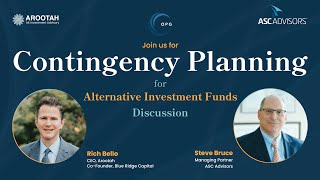
Panel webinar (June 2024) led by Joe Signorelli with Rich Bello (Arootah/Blue Ridge background) and Steve Bruce (ASC Advisors). The session explains contingency planning for alternative investment funds using a 10-principle framework: identify contingencies, map stakeholders (LPs, employees, vendors, banks/prime brokers, counsel, PR, insurers), run and rehearse tabletop exercises (recommendation: ~twice yearly), assign a crisis team and single spokesperson, clarify legal-privilege boundaries, prepare rapid investor and media communications, and prioritize LP interests when responding. Speakers emphasize timeliness, role clarity, rehearsals to find gaps, and maintaining pre-established PR/legal relationships.
Chapters
Hi everyone. Hi everyone. This is Joe Signorelli with opg. Thank you for taking time to come and spend a few minutes with us today. We've got a great session that's featuring Baruta's Rich Bello and ASC advisor Steve Bruce or heavyweights in the industry. And on this topic of contingency planning for alternative investment funds, very appreciative of their time. Joining us to talk to you guys for the next hour about their experiences and expertise. A few really small house cleaning things. We're going to record the session. It will be available for everyone to access. If you need to re access anything after the fact, we'll distribute any slides and contact information after as well. So you have that for those who are not OPG members. OPG is a COO and CFO think tank where we support the day to day operations for investment advisor professionals and that function. Feel free to check us out @our peer group.com and that's the house cleaning. So a little bit we've got Rich. Rich I've known for many years as well. He worked alongside Julian Robertson and future Tiger Cub, founder of Tiger Management and co founded what's now the industry with the industry leading Blue Ridge Capital at John Griffin and now he's the CEO and founder at Aruta which is a firm dedicated to servicing the alternative investment industry by providing advisory consulting services, talent acquisition and professional development solutions like executive coaching. So we're really, really excited that he's with us today and alongside him Steve, Steve Bruce I've known for a very long time and we're very appreciative. He co founded ASC Advisors in 2010 and he's been providing strategic counsel to financial services firms for over 40 years. During the last 20 years he's focused almost exclusively on advising hedge funds and private equity firms in every facet of their business from brand building to investor media relations, speech and media training, position level support, IPOs and crisis management. So as you can see we've got two people at a very high level here that are going to give us some great insight. So I'm going to be quiet because I don't have anything useful to say they do. I'm going to throw it over to you guys and again the only other item is if you have questions or you want to ask the guys questions during the course, there's a question feature on your bar for the Gotowebinar. Submit it through there, we'll monitor it and we might jump in and ask the questions during the course or we'll save some time at the end. So, Rich, Steve, the floor is yours.
Terrific. Well, Joe, thanks so much for hosting this today. We're proud to be supporting you with our peer group. And for those of you that are not members members, we'd encourage you to talk to Joe as the type of discussions that we're going to have today, as well as the other information that our peer group provides, I think is really valuable. And with that, we're going to. I'm really pleased that Rich is joining me in doing this discussion today about contingency planning for alternative investment funds. And before we kick off, we'd like to share a video which I would like to describe as art imitating reality. So with that, we're going to show a short video to kick things off.
You get up?
Yeah.
You all right?
Lawyer. Lawyer.
Lawyer. We have a warrant for your arrest. You can get a lawyer in your holding cell. William Stern, you are under arrest for insider trading and security fraud. You have the right to remain silent. You might want to exercise that.
So not exactly the happiest looking crowd. But I will tell you, back in 2010, I was representing a client who had been raided by the FBI at that time, not Blue Ridge. This was well documented. And on the back end of it. Later that night, I got a phone call from one of the most senior folks in that organization. And what he said was, I think he probably had a nice class of whatever lubricant he might have needed after having been raided by the FBI. He said to me, you know, Steve, I went through the chief operating officer manual this afternoon and was looking for the pages about what happens when the FBI rates you and they don't exist. Well, I bet in about a couple of weeks, every law firm will have them out there. So with that, I'm going to hand this off to Rich to start our discussion today.
Well, thanks, Steve, and thank you, Joe. It's a real honor to be on the same panel with you. Steve, I've known you for many years, won't say how long we don't age ourselves. And Joe as well, and thanks to opg, fabulous organization. So, you know, we're talking about contingencies, and these are. These are things that you don't need to do. You know, we've got executive coaching and advisor hedge funds. When we're coaching, we talk about time management and deadlines and procrastination. And this falls directly in that area because there's no real deadline for what we're going to be talking about today until it Happens, right? So you can. It's easier to procrastinate on things if they don't have a deadline. So the deadline is when they come in. It's like, oh, shoot, we didn't prepare for this. So. So what is a contingency? A contingency, as you can see on the screen, is an event or situation can be an internal event, can be an external event, and it poses a risk to the firm, risk to your operations of your firm, of your. Of your fund. So they come in all different flavors and sizes there we have them down here. You guys know what they are. There's all kinds of business issues, firm closures, regulatory, criminal investigations. We just saw a fun one there. External events, there's all different types of contingencies that you can deal with. And the first step when you're talking about them is when you're thinking about them is to identify what they are. What they are. And this principle one comes, by the way, Steve and I worked on a book on this topic, and we'll share that with you, Share that with you at the end. So we've come up with 10 principles as a framework for dealing with contingencies. So let's. Why don't we move to the next slide? Unless, Steve, you had anything to add to that?
No, I think what we really want to. When talking with Joe and when Rich and I proposed this to him, part of the reason was because of recent events. And so, for example, I don't know whether everybody's been following this, but the FCA has proposed a set of rules where they will announce investigations upon inception, and they're not backing off from this. I was with the Financial Times last week, and a reporter who met with FCA said, oh, we're going to be careful about the types of things we do, but we think that we're going to be going forward, that this is an important proposal and rule that will cause folks to change their behavior. We view it under a quite different lens. But the point is that from a contingency planning and from a crisis communications perspective, there's a chance if this rule passes, that firms will get up to a day's notice or no notice before the FCA is putting out a press release announcing that your firm is under investigation. So that is a potential new reality that requires the type of planning that we're going to talk about today. And then moving onshore in terms of things like notification. The SEC just fined ICE $10 million for failing to notify the SEC within 24 hours of a cyber breach. It's one of the first times that they've actually hit a firm for a, with a fine for the 24 hour rule. And then moving into another area on top of that, the SEC has been decrying defense lawyers for being supportive of their clients and defending them. So you've got a bunch of different things. And then also the last headline we wanted to share was the crash of Berkshire Hathaway stock last week. So there's any number of things that can happen that you need to start preparing for. We just wanted to bring these up as very recent headlines and also on the regulatory front, how FCA is now thinking about looking at investigations going forward and they're not backing away from this. So this is not only current, but it's imperative that people start to factor this into planning as they go forward. I'm going to hand this back to Rich now for a few critical pieces.
Yeah, just to, you know, just again, on these are things that don't really have deadlines. That's why people don't often don't focus on these things. There's Stephen Covey, Principle 2 in his, in his great book on the seven habits of highly effective people. And that top habit, my favorite habit there is habit three. And that's First Things First. And he goes through a time matrix and in that time matrix he talks about things that are urgent and important. Now these may not seem like they're urgent, but they're important. Usually you get to things that are urgent and important, you're doing them, this is important, may not be urgent now, but you never know when it might hit. So get to get ahead of these things. Usually these are the types of things that don't make it to the top of the list. And if they don't, you'll be sorry. So if something happens. So for our principle two, we want to identify the stakeholders who is important in dealing with these issues. So know your stakeholders, be thinking about these people in advance so you've got them. So obviously your LPs, your fiduciary obligation, your LPs are the board of directors, your employees. And Steve likes to talk about this all the time. Make sure you got your employees top of the mind. People may neglect that they go out to LP is like you got to make sure employees are there, you got to have their back. Contractors, similar to employees, vendors, banks, prime brokers, depending on the type of situation also may be important. Law firms. We're going to dig really, really dig into that one. Lawyer, lawyer, lawyer for the People who just joined. There was a, we did a, we did a video just to start up from billions. PR firms, something that Steve knows a little bit about. Insurance companies. You got to make sure, you know, you got to notify them right away or you may not be able to, may not be able to collect on a claim. So. And there are others. So we're talking about communication protocols. What are the best practices that we're talking about here? Usually, timeliness and clarity are crucial. You want to make sure you're really clear, have things in advance, have these communications prepared in advance wherever you can understand the needs of these stakeholders. Each of the stakeholders has different types of needs, and we'll talk a little bit about that in the slides ahead. So here's some examples of how to deal with certain stakeholders. Employees. You want to make sure they're really clear in their roles. You want to define their roles up front. So when there is an emergency, a situation, this crisis situation, they know exactly what they've got to do. You want to make sure that they understand they're safe. If there's a disaster situation, you got to make sure employees know that they're safe. You've got to take care of them and they're not going to take care of you. Make sure they're provided with the resources to do their jobs. Investors, obviously, LPs, a lot of times when there are these events, what are they concerned with, what are their needs, what are they worried about? Obviously performance. And if there's some risk going on with the fund, they want to know regulatory bodies, what are they concerned with? They want to make sure that you're transparent, what's going on, or they're coming in, take it over. Want to make sure that you have a sense of accountability. Legal counsel, ensure that your actions comply with the law. Right. You might want to make sure that you're in there and complying with the law and you're really dealing with them in the right way.
Steve MEDIA Absolutely. Look, it's important that you, either you or the firms that you work with have this, have the established relationships. In that way, you can take down the temperature in a crisis situation, and that can really help with the outcomes and be prepared to understand the ground rules around those communications. And we'll get that into a little bit more detail. But that can be critical to how impressions and also how the markets will react to what's going on at your firm. This is a slide that we really like to talk about because it's really the ecosystem around investment management and so the way that you think about it is not only do you end up talking to these folks, but they end up talking among themselves. And so we like to look at this as the group that you need to understand who the people are in all of these corners of the ecosystem, because they can influence the different outcomes, whether it's with regulators or the media. So understanding what that ecosystem is and who are the people you need to be in contact with and who your team has to be in contact with as a crisis unfolds can be the difference between how the firm goes forward or where it's left.
Right. Like you say, Steve, they. They're going to be talking to. They're going to be talking to each other. You may want to get to them first. They hear the story first from you. All right, So conducting principle three, be prepared, conduct these exercise. Don't just have it. We've got a plan. The plan is good, right? You want to have the plan, then you need to practice executing the plan. So I guess it's more than a decade ago, my partner, John Griffin, co founder of Blue Ridge, came to me. Now, he really stayed out of the operational aspects of the firm. For the most part, he just left that to me. But he came to me one day and said, rich, I want you to be prepared. I was talking to a professor of mine and, and this is really important. I want you to make sure that we are prepared. Conduct mock tabletop exercises for any contingency that we think could occur now by any. Obviously those contingencies that have a decent probability of occurrence and a high impact when they occur. So I called in Steve to help me with this. Like, all right, Steve, big part of this is pr. So conducting what we're going to get into that. So why are they important? Well, you'll have a plan. You got a plan. That's the first part of it. And you're really not going to know what the gaps are in that plan until you play out this exercise. So you also want to make sure that before you have this exercise, everybody knows, before any contingency happens, everybody knows what their role is. You got to make sure. Just like it's just like a game, right? A game plan. Make sure you know what your role is. So you assemble the team. You have a team leader. Somebody has to be in charge of this. Now you do. And Steve and I have talked about. Steve likes to point this out is you do want to make sure you free up the founder, the portfolio manager, worry about the portfolio. He or she has to worry about that. Somebody else has to be operating the crisis. Right. Managing the crisis. So who's the team leader of that can be the COO president. You have to keep the founder and the PM informed, obviously. Then you have senior management. Usually these are the team leaders of all of the different departments that you have. And then there's external groups you want to involve right away in these early tabletop exercises, mock exercises. And that's a PR firm, law firms, your board, advisors, you have to decide maybe different for every firm. So then you facilitate it. And this is where Steve came, and he was our facilitator. He ran the whole process for us at Tabletop Exercise. Make sure you're very clear on the objectives for the tabletop exercise. What are the rules of engagement for everybody? What's the actual situation or situations? Ideally, you'll go through a few different situations and then, well, Steve, why don't you take it from here? You were the one that was the facilitator, so why don't you take it from here?
And I want to talk about the external groups for a minute. Because sometimes when these events happen, people don't think about their offshore board or their offshore council. That becomes kind of an afterthought. You're thinking, sort of, this is the event. I've got my US firms or international firms, whatever they may be. And then the board is kind of the last group to know. So we've always said, make sure that your offshore board and your offshore law firm that's working with that board and represents the funds are clearly in the loop. The other thing, in doing the tabletop exercise, you very quickly ascertain who is comfortable and who's uncomfortable as these different scenarios are played out. And that allows you then to work with those individuals to make sure that you're shoring up their ability to handle the crisis and they understand what the roles are. And in many cases, legal. Your internal law team is working with multiple groups. You've got the IR team that's working to understand and meet investors. And if you've got a large number of investors, that group can get inundated. So having call lists, working through all the elements, identifying who you need to get to first, what disclosure has to be done, understanding that you may have to write an investor letter, but writing it in a way that is almost as though it's going to end up on the front page of the Wall Street Journal or on Bloomberg within minutes. And in many cases, that's exactly what happens. So really taking your team through the paces and doing even simple things like making sure that each group leader has a call list and knows what their priorities are as these exercises are underway. And that's where you really get to see how people interact. How do you stage your priorities? And what does someone like Rich Bello need to know as the coordinator? What's important? What are his priorities as he's managing all of these different teams?
Right. And yeah, and you really never know what could happen. There's, you know, there's only a certain amount of training you can do. At Blue Ridge, we would do insider trading training. And, you know, I would always say that we have a. We have a robust and awesome compliance department, you know, headed up by Mike Cairo and Terry o', Malley, who was our general counsel. And I would always say, look, it's the analysts that are on the front lines. They've got to be trained. They can't be saved by legal or the compliance department if they go out there and do something, you know, inadvertent. So you never know what could possibly happen. You have to be planning. You have to be planning for that. And Steve was amazing on the. I still remember it. And when I get together with Patty Stevens, our cfo, we talk about that tabletop excellence. Steve was like, terry here, this is what happened. This guy's like, patty, what are you going to do? Then you go, oh, cybersecurity breach. So you're just going through and making sure and like Steve said, see who's comfortable and who's not. And then you remedy that. So that's the next piece of it. When you're doing these tabletop exercises, the idea is to identify gaps, identify gaps in your plan, identify gaps on the team, identify gaps and who's able to handle themselves under pressure. Because that's really what this is all about. Handling yourself under pressure and handling the team under pressure. That's why you have to have these pre plans. You've got to make sure you've got it done when you have pressure situations. Great to have a checklist. Boom, boom, boom, boom, boom. Here's what we need to do. You've already planned for it. So you debrief, identify these gaps, and then you close the gaps, and then you update your plan. And then you do this, you know, do these tabletop exercises, ideally twice a year, is, is something if you. There's going to be different. You don't have to do the same ones, but there's a lot of different potential contingencies you want to prepare for.
Okay.
Sort of an overview of what we've been discussing. This is actually designing the plan itself that you're going to have the mock exercise on. Here's the, here's an overview of it. Identifying that leadership team that we talked about that's going to be dealing with the crisis. Making sure that everybody's role is crystal clear. Want to make sure they're really clear on what they're going to be doing. You want to anticipate the different, the different risks that could affect your firm. Know the primary stakeholders as we talked about. Make sure you identify each of their needs in advance. What would they need? How are you going to prepare for what the LPs would need? Right. They want to know. They're going to want to know, hey, how's this impacting performance and how is this impacting my risk in the fund? Can I get out? What's the deal going? What's going on there? The prime brokers, obviously they have a, you know, they have a different. If you're, if there's a performance issue, you know what they're going to be looking for. And you want to rank these risks. A high probability, high impact risk. You should probably do that one first. You want to have a mock tabletop act. You want to make sure you have a plan for a high probability, high impact risk. But don't forget about the tail risks also. Those can be the ones that buy you. You probably want to do the high probability high impact risks first and then you want to establish some type of outreach and monitoring protocols as we sort of talked a little bit about before. Steve, do you want to elaborate on some of that?
Sure. And in terms of the investor communication, as I mentioned earlier, everything you write to investors, write it as if it's going to get out. And then working with your PR firm, establish some smart protocols, things like putting media at your firm address as the central point for all media to inquiries to come with a crisis that takes some of the pressure off of the front desk because they will get the inbounds if they can simply move it over. They don't get into a conversation with reporters or with others and it helps speed the impact of the response. So it's really critical to use things like that and also to watch out what's happening on social media. And we'll get into that in a little bit more detail shortly.
All right.
Okay.
Now this is always an important topic. You know, many times when you're dealing with crises, the lawyers are going to be involved. Right. So you want to understand this is A topic that's a little bit gray sometimes. Privileged versus non privileged communication. Now, not all. You might be. A lot of people think when they talk to their attorney, it's all privilege, no problem. That's just not the case when you're directly seeking legal advice. That's when it's privileged. Right. Even there are some gray areas there and there's some exceptions there, as Steve likes to point out. Go ahead, Steven, go ahead. You like talking about this.
We've always said as we enter into these situations that we've got to be contracted through external counsel. And everything that your PR team does has to be run through counsel, has to be properly marked attorney client privilege or attorney client work product. And it has to have. You have to make sure that you really follow those rules and stick to them because there are weak links if you don't do it. And that can end up causing you significant issues down the road with regulators or in litigation. So that's one of the critical pieces is make sure your advisors are contracted through counsel and make sure that all the communications relating to that matter are properly marked.
That's right. And so why is this important? You're protecting the sensitive information of the firm. And critically important is you want to get the best guidance that you can from your law firm. So that means you need to be open with them, honest with them, and let them know what's going on. Then they'll be able to give you the best advice. And there are some exceptions with this as well. So crimes and fraud, you know, this is not a legal discussion. So we're going to leave that to lawyers. Now handling documents, obviously depending, again depending on the situation, making sure that you are really clear on the backups that you have, making sure that documents aren't destroyed because you can get caught up in those types of things as well. Again, that's more of a legal issue. But make sure that the team is trained in that beforehand. You have some people panicking on things. Make sure they train before and they understand this stuff beforehand. That's why it's so important to have these, these plans in place and have your, have your teams understand their roles and have them, have them trained on these before the situation happens.
And just to put an exclamation point on it, at my former firm, there was a criminal matter involving a client in with some major trading losses. And we got a visit from the FBI asking for documents. Everything had been properly marked. We had been retained by counsel. But don't think that the FBI won't show up at your doorstep one day, right.
As we saw in the opening. All right, Steve.
In terms of media interactions and how to think about crisis situations, understand that one central point as a spokesperson is always the best rule of thumb, understanding the ground rules. What can you say on the record? What do you want to say either on background or off the record? And this can actually be a huge help where we've worked with clients, collaborating with them to background reporters to influence the outcome in their reporting and educate them at the same time. It's hugely important because reporters want to understand what's going on. You've got to be careful, make sure you're staying within the legal guidelines, but there's information you can impart in a crisis situation that can help change the outcome. In the actual reporting, of course, what's newer is social media. You've got to monitor it, you've got to watch what's going on. You feel like at times you're playing whack a mole because you're constantly seeing misinformation gets reposted. So there's many, many times that we have to end up chasing down these loose ends as this information gets out that's incorrect to try to get it corrected. You know, there was a point which I will, there was a story I'll share which was one of our clients had huge energy losses and a news service misreported what a reporter at CNBC had been talking about on air. We had to reach out to the CNBC reporter. That reporter not only went back on air to, to make sure that this reporting was clarified, but they reached out to that news outlet and they retracted the story. So having rapid responses, really good monitoring and correcting misinformation can make a huge again, difference in the outcome. We talked about that ecosystem. So understanding who are the points of contact in that ecosystem, who do you have to maintain the relationships with, as those folks can be sometimes your best friends in these matters and, and support you through that. That clearly happened in that insider trading case where they enlisted the help of one of their largest investors to say that he was still supporting them because he felt like they had done nothing wrong and they were approaching us the right way. That sort of third party endorsement really can help a firm continue. And then if you don't have a senior advisory firm, a PR firm that has experience, it's not trying this out for the first time. Really reconsider that. Think about why this matters now with these FCA rules, with what the SEC has done on ice, with how they're approaching these things. If the first time that you're working with a firm is when the crisis is underway, it's going to take them a while to catch up and then they can be effective. But we think it makes sense. And we've got a number of folks that we are in relationships with just to be there for as a safety. And so that's an important feature. But think about having a PR firm on a retainer in case there's an event. It's part of what you have your law firms there for. It's part of what you talk to your offshore fund administrators. It's part of what you have to talk with your board. It's part of that planning and part of being prepared for events that you don't anticipate. Okay, let's continue.
Well, yeah, I'd like to add a little bit to some of that. We can go back for a second. So, you know Steve Bing, humble person that he is. I actually wanted to put this, this engaging the PR firm as the first bullet because I feel it's so important, you know, for all of this. But she's like, no, let's put it. But I know when we started we founded Blue Ridge, it was one of the first things that John, John Griffin, being the president of Tiger Management said it was so important because John had to be so involved with this at Tiger Manager. We need to get Steve on board immediately. Get him on board. These are the people that are going to be in the trenches with you. And yeah, you want to have that relationship. Early on, Steve said, you don't want to be developing race. Hey, we're in trouble. Help us. Right? And you know that these firms, you know, firm like Stevens at ASC will have the relationships already pre existing relationships with the reporters. So it's really, it's really crucial. And these things are tricky. You know, the. Off the, on the record. Off the record on background, you can really get yourself in a big hole. Like, I didn't think I was talking to reporter. I didn't think that was going to be out there. I thought I was just talking to you. It's like, no, you didn't say it was off the record. Really big time. We've had many discussions about that, you know, through the years. And then the person like Steve would talk to the meetings like, hey, this is off the record. I'm going to be there. Just making it clear it's off the record. And now a whole new ball game with social media. You get something going viral out there. You don't stop it. Like you're saying Steve, whack a mole if you don't stop it and if you're not first out there to stop it, it can get a life of its own. So rapid response is so important. And like I said, and like Steve said, having those relationships in this ecosystem, early on you want to get the first story out there, if you ideally can, is that usually that's the story that other stories are based on. So if you can control that speed, I think that that's important.
Yeah.
Steve and Rich, this is Joe. We got a question in from Gary. I just thought it was a good time to ask it. Do you need to confirm with a reporter when you're talking to them that they're not taping the conversation or does that go sort of standard within the industry? What's your advice?
There's, you know, and that's interesting because as we saw in a recent trial about taping, sometimes it only can be one party that can legally do that without alerting the other party. You know, that that's where getting good legal counsel is helpful. There are many times reporters ask to tape interviews for, to be. For the reliability and to make sure that they don't mistake quotes or things like that. That can be helpful at times when a reporter offers to do that. But you need to understand the reporters will normally say, may I tape this conversation? We like that. As long as everybody understands what the ground rules are. If it's on background or off the record. We tend not to want to tape conversations when they're off the record. But, but on background where there may be quote, attribution later, it allows you to go back and fill that in. I hope that answers the question.
Well, yeah, that is a, that is a complicated. Different states have different laws also.
Right.
You know, whether it's or not legal and it's one sided or not, that one's always confused me and it always depends on who I ask. But that's good advice. Right.
And Rich, in the uk, you know, they've got very different libel laws than there are here.
Right, right. All right.
Okay. Let's continue. Thanks, Joe.
So this is a good one, you know, avoiding some common mistakes. And Steve and I can both, can both talk about this one. I just wanted to add, in these crisis situations, they are, they're different. Your leadership style may differ. In these crisis, somebody has to take charge and there may not be a lot of time. So when we're talking about things in a crisis situation, it's a Different leadership style. So one of the ones we've obviously been talking about, the common mistake is a lack of preparation. People aren't prepared. They may be thinking this will never happen. There's no deadline. I was talking about before. There's no deadline. So you don't prepare or you keep putting it off, you procrastinate on it because there's no deadline. So that's a huge mistake. No tabletop exercise. You can have the plan, but then don't execute on the plan. You don't practice. It's like having a game plan, but you're not practicing and then having a lack of command and control. Steve and I were just talking about this where you. It's really dangerous. A little bit about that, Steve.
Yeah. And we've always said that one of the investors most important concerns as a crisis is what's the CIO doing, what are the portfolio managers doing and what's the other team doing? So having that clarity and what the roles are, investors get comfort if they know that the CIO is running about the portfolio. And yes, he's being updated by Rich Bellow or whoever that person is in the command chair. But it's very clear that what they're focused on is the portfolio. Because in a crisis, portfolios can get hit. You sometimes find that pricing changes, you will see things like positions that are declining as people look at 13 Fs on the fly and they see you've got large positions here. So having the portfolio manager focused on assuring that the portfolio is working the way they are or taking the measures they need to take is absolutely critical for investor competence.
And communication also really important. If it's unclear, you gotta be really clear with communication, especially if you're dealing with your employees and giving them instructions on what they need to do and do it now. Really important. If you give unclear messaging to your limited partners, then you lose the trust factor. Or even with a regulation, you're losing the trust factor, which is really dangerous. Getting it out there fast, making sure you have the proper communication channels established and that everybody knows what they are. When you're talking about communication in an emergency situation, disaster situation, there are internally we talk about as depends on how quickly a decision needs to be made, how important that communication is. So if it's for instance, something that's really important and timely, you don't want to send an email. People are busy these days, a lot of junk email. Even they don't check their emails, right? Text is okay. But if it's really important and Urgent, you pick up the phone and you call now, right? You get it done. You make sure you speak to somebody and make sure it gets a. I was like, oh, yeah, I texted him, no, no, no, you got to make sure this is done. Now, there's all kinds of slack stuff out there, but the point is, make sure you're understanding these communication protocols. Make sure that they're safe, especially if you're dealing with attorneys. And I think we've talked a little bit about that on the attorney client privilege stuff. Stakeholder concerns, really make sure you understand what their needs are, understand who they are, and make sure you're not ignoring their needs. When you're ignoring a stakeholder's needs, that's when trouble can happen.
And if I can chime in just with a couple of examples. And again, this is where the preparation comes in. There are times when there are investigations, criminal or otherwise, where, for example, the FBI has alerted reporters to a perp block. And in one instance, during the height of the insider trading cases in 2010, 2011, they invited a Wall Street Journal reporter to a perp walk. And the person they were going to arrest wasn't there. So the headline was person not there on the loose when FBI went to go get them. And, you know, the government and fca, let's look at what they're proposing. Do you think that if they're going to talk about publicizing enforcement actions, that they won't be issuing, that they're planning to issue press releases and they may be calling reporters to let them know about these press releases and what can be going on. So that would put a firm at a huge disadvantage because the first time that you may be hearing about it is an FCA press release and your first call from Bloomberg, the Financial Times, the Times of London, or you name it, that may be the very first time that you hear about the new investigation to your firm. And by the way, they may or may not name individuals, which we view as, as, as, you know, distinction without a difference, but be prepared and these things will happen in real time.
Okay.
Okay.
Now going into some deeper stuff. So I kind of dig in deeper to some of the. Some of the types of contingencies you might have to prepare for keyman team departures. There's a lot of different impacts when these things happen. There's operational impacts because they have a lot of knowledge with them. So if they leave and they take the knowledge with them, you can have a huge operational impact. There can be a financial impact. Obviously, if you've got A very successful investment team member, huge financial impact. You no longer have that reputational impact. Somebody leaves. Why aren't you able to keep them? You didn't tell us in advance. So there can be all kinds of reputational issues. Steve will talk about this, and he's got some great examples. Firm closings, which I've had the privilege of experiencing. We were one of the few firms that closed on our own terms. John and I weirdly met at the same time. I wanted to let him know that I wanted to go do my thing, and he wanted to let me know he wanted to go do his thing. We had no idea what we both wanted to meet about. We met and John told me, said, rich, he's like, you know, I think I'm going to close down the firm. I've got some other interests that I want to, you know, that I want to pursue. And I started laughing and John's like, why are you laughing? I thought you'd be crying. He's like, this is our baby. We found it together 20 years. I was like, I was going to tell you the same thing. So we closed it down on, you know, one of the few, you know, examples that I can recall. You know, we're both really ready to move on now. It takes a long time to close a firm down. Blue Ridge is still. Is still a firm. We went from 10 billion to I think we're 12 million now. There's always little things. It's really hard. Five years. It's hard to close down a firm completely and just know that I think we have some time here.
Just let me just make rich. Let me make two quick points on this, on departures and or arrivals. A number of great publications that we all read are data mining, LinkedIn. They've been taught how to do that. And that is a lot of calls that we get on a regular basis. Oh, courtesy called to let you know we're about to write a story. That person A has joined firm A and that person B has left firm B. Happens all of the time. You know, one of the things that is new on these partner disputes, and we saw this over the last year play out where not a client have a lot of respect for the firm to Sigma. They put an update into their form adv about a partnership dispute that made its way to the Wall Street Journal and led to a cascading series of stories. So knowing that those types of regulatory filings, informative brochures and things like that, we watch that pretty closely. We talk to our clients about material Changes that can turn into a UPR story and cascade across an organization. So be aware that your legal filings are things that lead to stories and reporters are data mining that. Let's keep going.
So performance issues, these are, you know, these, these are obviously what LPs are very concerned with. You want to make sure that you get them out there. Speed is very important. If people think that you're trying to hide something, then where there's smoke, as John used to say, where there's smoke, there's almost nobody's fire. So speed of the essence, take responsibility. You like to see a letter come out quickly taking responsibility, accountability, then they want to know. The LPs especially want to know, all right, what's the cause of this? Have you really, do you really understand where this lack of performance is coming from? And then describe a remediation plan. What are you going to do about it? New hires, double down, stop investing in whatever it might be. What's the remediation process going to be? What's your plan going to be? And of course, if you're having performance issues, you want to make sure that those that are lending you money to invest, that they are very clear. You let them know right away, they will know already. But it's really the same as, same as the, the bullets above. And you're always, you always want, as John would always say, whenever we were make, this is our north star always our LPs always come first, right? We, when we make, have to make a decision. That's our mission. We are in business for our LPs. Whatever's in their best interest is what we're going to do. And that really is always helpful when you're thinking about what you're going to do is think about your LPs. What is the right thing to do by your LPs?
And Rich, a very quick story on this. So many of you may recall we represented Amaranth. They had a huge drawdown. One of the things was that the GC and the Chief Operating Officer, we.
More from Rich



Goal Setting Workshop: Set Your Top 2023 Goals & Create a Master Plan to Achieve them! NYC

Goal Setting Workshop 2025: Design Your Master Plan for Success! AROOTAH Advisory & Coaching | NYC

Redefining Success: Arootah President Talks with Christyl Murray on Culture, AI, and Much More!

Rich Bello Best Practices Keynote to Family Office Leaders | Parrish Museum The Hamptons | Aug 2025


