Redefining Success: Arootah President Talks with Christyl Murray on Culture, AI, and Much More!

Interview with Christyl (Crystal) Murray covering her career path from UC Berkeley and Wharton through consulting (Gemini, Accenture) into HR roles at JPMorgan Chase and Morgan Stanley, where she led culture and talent initiatives (e.g., VP Academy, Knowledge at Work). Murray explains her change-management philosophy (Kotter, Lewin, ADKAR), discusses major financial-services trends — digital transformation, cybersecurity, client personalization, financial wellness — and argues for treating AI as a ‘co‑pilot’ while proactively redesigning roles, upskilling employees, and governing AI use. She also describes why she moved into advisory/fractional work and mentions recent professional licensing (Series 7 in June 2025; Series 63 in July 2025).
Questions this video answers
September 25, 2025
Rich Bello
June 2025
July 2025
Chapters
All right, Crystal, so thank you first of all for taking the time.
Pleasure.
Hey, it's always good to see you. So why don't we start by just getting a little bit of background on Crystal Murray, so maybe talk a little bit about yourself and how you got started in your career. Let's, let's, let's start there.
Okay, so perfect. I am originally from California. Crystal Lucille is my first name, last name Murray. And being very close to California in the Bay Area area, I was benefited to have the opportunity to go to UC Berkeley where I studied finance. And I feel like I grew up in the management consulting industry, starting my early career right after undergrad with Gemini Consulting and then going on to the Wharton MBA to. Excuse me, to the Wharton Business School to earn my mba. When I think the very interesting and I think important factors for me from that experience was not only the financial background, but also having the opportunity to pursue a master's in International Relations with the Lauder Institute. And I think that began to open my awareness around culture and strategy even and differences within the home or the workplaces. And so when I graduated from business school, I went on back to consulting, ergo, growing up in the management consulting industry. But I worked for Accenture in their organization and change change strategy practice. I really am focused on change as both a science and a discipline. And I think it's very much, you know, a differentiator in terms of being a critical success factor for organizations. How are you managing your culture and how are you not only designing, but how are you executing on your strategies? And I think a lot of that is driven, right, and facilitated by change management. After that time, I, funny enough, after spending so much time in the consulting industry and getting a finance degree, I never honestly really thought I would find myself in a financial services firm. But fast forward board, I had the opportunity to leverage those consulting experiences, diagnosing problems, building strategies, helping to implement. And I began my formal career in HR in financial services. So I was a vice president at JPMorgan Chase for about five years and then I moved on to Morgan Stanley and was an executive director in their wealth management business. The types of activations that I worked on, let's say both at JPMorgan Chase and Morgan Stanley, I helped to build and expand on an activation called the VP Academy at JPMorgan Chase. And the VP Academy was centered on identifying high top potential individuals and working with them on professional development and skills and career planning to help them advance through the organization. Was very proud about that particular initiative because it is still alive today, but it moved from just being an activation in the corporate and investment bank to moving across, you know, all of the businesses and even launched internationally. When I was leaving in Mexico. Fast forward those five years now to Morgan Stanley, and I had the opportunity to really help to execute on their culture strategy. Working everywhere from designing an initiative called Knowledge at Work, a little bit of play on, I would say a thought leadership piece by Wharton, which is called Knowledge at Wharton. But it was very much an opportunity. Listening to the feedback from employees and listening to our senior leaders in terms of their corporate strategy, of wanting to have the firm come together as one and deliver a holistic offering to a variety of our different wealth management clients. It was going to be super important for individuals to know what other businesses did and to facilitate conversations across teams, across businesses. And that's one of the activations that I delivered on at Morgan Stanley as well.
Wow. Thank you for that, Crystal. You have had an impressive career thus far for someone relatively young. So let me unpack a little bit of what you said. You mentioned how when you started at Accenture and then eventually you moved into financial services, your work in change strategy, and you talked about the importance of kind of overseeing change strategy and ensuring that it goes well, for lack of a better way of putting it. What is it about that in particular that either appeals to you or that you feel is just of critical importance?
Well, I will say I'm probably a little bit of a change nerd. And I love the line by Peter Drucker where he states that, you know, culture, culture is awesome. Strategy is awesome. However, culture beats strategy for breakfast. Right? And so what I interpret that to mean is as a strategist, as a business leader, you can work diligently to come up with the best blueprint or the best strategy, the best plan to win against your competitors, let's say. But if you cannot mobilize your organization and your people to execute on that strategy, then it's the worst. Right? You know, I will tell my kids, if there's a deadline to deliver a paper, and it's the best paper, it's the most awesome paper, and you submit it after the deadline, it's not the most awesome paper. And so really what I interpret that to mean is people are our most important assets. And in order to execute and operationalize the strategies that we have, we do need change management. And so when I think about it, it's both both a discipline and a science. And having had the, the, the honor and luxury to grow up in consulting and leverage different, you know, types of models in terms of change management. Things like the Cotter's eight step model and Lewin's model, and even Adkar, which is awareness, desire, knowledge, ability and reinforcement. It really helps us to understand that if an organization has an initiative or a strategy that they're trying to move forward, it's important for senior leaders to explicitly define what it is, help us understand the potential value. Add built this burning platform so people can mobilize around it. You know, look to get your change champions and your individuals to actually buy into the process and then you can move to adoption and then trying to institutionalize it to make it stick. But there are very structured steps that I think are so important to build to success in those areas. And that's, you know, kind of why I, I resonate there because I feel like I, I love engaging and helping organizations drive revenue and growth by working, working with their people.
So, so this is fascinating. There's so many nuggets in what you're saying. So let's, yeah, let's tease that out a little bit. So you are arguably an expert in change management and change strategy.
Yes.
Now, not to engage in a double entrance entendre, but there has also been over, let's say the last 10 years. Right. Significant changes within the financial services industry.
Yes.
Now you mentioned already that the one, the one thing that won't change is people.
Right.
So I guess the question I have is what are, what are some of the industry, industry changes that have taken place over, say the last 10 years that have made it either easier or more difficult for people to advance through their own careers. Right. What are the, either their, the headwinds or, or just non sequiturs, things that just come up that maybe are new or that it just has made it. Right. More challenging for folks.
Yeah. So funny enough, when you say, oh, you know, I look young, I'll go back and say when I started into, in consulting, I started with Arthur Anderson and then Accenture. Right. So Accenture, I think many years since, maybe Even more than 10, 10 years, Josh has always centered their strategies on some type of technological advance. Right. Accenture means accent on the future. And so I think that that has been happening historically. And yes, over these last 10 years I will say digital transformation is everything. Right. So I, I don't, I don't know if I would necessarily say it's a, it headwind. It probably is also a tailwind. It's going to be a force multiply in terms of how we operate so technological innovations, AI is not like tomorrow we are working with, you know, agentic workforces with humans and robots working together. I mean that's so fantastic. And if we can get to a point from continuing to look further from operational efficiency to really driving interaction, engagement and growth, I think digital transformation is always for me going to be number one. I will say that particularly in the financial services industry, it sounds also a little bit, you know, geeky. But cyber security is a big, big deal and we're always banks that are trying to be infiltrated by bad guys in this field. And I'm going to say even with somebody who I feel has grown up with our corporate training and our conversations around not, you know, paying a lot of attention to fishing and things of that nature, I my at home found myself potentially going into a little hole with someone, you know, reaching out, looking, asking for information. And then I said, wait a minute, why do I have to provide this information to you if you're helping me? And I'm going to do a shout out to Rachel Wilson, who's our, the cyber security lead, let's say at Morgan Stanley. And I heard her voice and I was like this is not right. But I mean here I am an educated person in the space and cyber security is a huge, is a huge issue of consideration for, for financial services and fintechs. I think I would consider that to be a number two driver. I would also say particularly in, in the people space, just the continued implications of client expectations and they're looking for more transparency and personalization, which is awesome, right? Technology helps to facilitate that. But transparency. I talked earlier about, you know, the integrated firm strategy but looking for integrated sol this I think too being a woman and a girl mom, hearing the forecasting around the transfer of wealth and how women, the women's segment is going to be very big in the future. So really being able to understand and anticipate and solve and delight our clients is going to continue to be a huge trend. So client expectations and I also think growth, right? Continued growth. How are we going to continue to identify organic growth within, let's say the asset and wealth management industry? Right. We talk a lot about, you know, this asset acquisition funnel, but how are we going to continue to grow and not only growth by acquisition M and A but really growth by looking and delighting new and different customers. So the client segmentation I think is key, key there as well.
Go ahead, go ahead.
I was going to say one of the things that just from my background of growing up in Accenture and actually receiving stock from my company when they did the ipo, and at that time, honestly not really knowing what that meant. Right. And so I think organizations spend so much thoughtfulness and strategy and time and money around creating benefit opportunities and equity opportunities for their employees. And it could be such that all employees do not know are, know and value the benefit because they don't understand necessarily what they're receiving. So this whole notion of financial wellness as part of our benefits offerings and communication on those strategies, that's something that is close to my heart and that's something that I'm seeing too, from my purview. You know, all firms. I, I do believe that Morgan Stanley was a first mover there. But we have, I don't know, JP Morgan Chase and their workplace solutions. You have bank of America work, you have ubs. So this notion of also being able to service not only the B2B. Right. So let's say Morgan Stanley or JP Morgan working with an Accenture, but then also how do we have an opportunity for the B2C to work with the clients or the employees better of those organizations? I think that's a, that's a huge growth opportunity as well in terms of these trends.
So that, that makes sense. Again, you've mentioned a lot and I'm taking it all in, and there's a lot of interconnectedness in what you're saying. There's two themes you mentioned that I want to tease out because I think they're an issue of concern to a lot of people and you're the right person to ask. So because you are obviously, let's call it a human change management expert and talent expert. But also you're an admitted, as you called yourself, kind of an AI or tech nerd. You, you, you're someone who's open to technology.
I'm open to technology.
Right, right. But some people are not.
Some people are not. And I'm gonna give you a term that I learned. I'm co founding this organization, Women upon AI. I'm AI curious and I'm.
There you go.
And I'm learning and I'm exploring and I'm not, I'm not afraid. Right, right, afraid.
So let's have an opportunity. That's exactly where I want to go with this. So the financial services industry is obviously not immune to the advance of agentic AI as someone who's a human talent expert. So on the one hand, you've had a successful career and you have a vested interest in nurturing human talent and making sure that organizations have the right cultures and approaches to getting the best out of their people. So that's, that's a worthwhile endeavor, and it always has been. I imagine it. Hopefully it always will continue to be. But on the other hand, you have people who are actually afraid of AI because they feel that it could make them redundant or it could displace them. So how do you strike a balance between, on the one hand, nurturing talent, getting, optimizing your people, but on the other hand, making the most out of and embracing AI such that they work together and work together harmoniously and that they're not a threat to each other in a way. Does that make sense?
No, that absolutely makes sense. And I'm gonna say as an executive or as a mom, I do believe in transparency and let's say tough love, right? Because there are absolutely going to be certain types of roles, human roles, that are going to become obsolete because technology can do it quicker, faster, more efficient, and cheaper for an organization. But what that means, I think, for us as individuals, is you must continue to learn, adapt, and to position yourself to be capable for the opportunities of new roles that technology is going to facilitate. So we can't say we're not going to lose certain jobs. You are going to lose certain jobs. And I think the newness is both on an individual but also on an organization to say, this is our strategy. These are the types of skills that are tasks. Let's look at it from tasks. Because I'm also part of the, the Work Design collective, which says, let's focus on skills per se and task. Here are the tasks that I need to execute in my organization. Now, of those tasks, does it need to be a human being or does it need to be a technology that's going to better. Better facilitated? So I might take one job, eliminate that. I might look at the tags and tasks and recreate an entire new job. I have this workforce strategy that I am planning. And as an organization, I would also say if these are the human tasks, right, then I need to make sure that my, my people are upskilled in those areas. So you allow opportunities for learning and development and training, and you position your workforce to balance. And I think it's, it's, it's very similar to kind of a competency assessment that we, we would have done, you know, shortly in the past to say, here are the competencies that we need in our senior executives. Let's take a look at where everyone is. Okay, so are we going to build our buy? There might be some that we can't have. And we don't have enough time to build. So we're just going to buy it, we're going to hire out, or we're going to use a AI to do it. But what are the, the, the skills that we can build and who are the people that we can develop into these new areas? And I think that is. Is humanistic in terms of strategy perspective. And I think for individuals, it's always, it's important to continue to move forward. Leaders are learners. You always need to reinvent yourself. I graduated from business school. People do not date me, Josh. But in like 1997. Hello. And I've had a zillion different opportunities to grow and evolve and pivot and change. But it's all been facilitated by continuing to upskill and continue to learn. In fact, just yesterday, I will say in June, I obtained my Series 7, and then I studied in July of 2025 and obtained my Series 63. Wow.
Congratulations.
Thank you. But a mentor in financial services said to me some years prior, but he's like, if you want to move further and be more adjacent to the business and financial services, you need to have your licensing. And I was like, are you sure? I. Here's Jeremy Siegel's book right here. I have this lovely MBA from Wharton. He's like, yes, I'm sure. I'm like, really? Okay, thing. I'm on it. Don't reject it. I think human nature. And they will say and change. People's first reaction is to, yeah, resistant, right. But then you learn and you understand this is what's needed. This is why here's the value. Get on the train or you might be left. Right. It's.
It's important.
It's important.
So, again, fascinating. I'm loving this. So you're talking a lot about change, you're talking a lot about development, you're talking a lot about growth and adoption, etc. Now, let's, if you don't mind, let's personalize it a little bit. Right? You're someone, as you mentioned, you. You kind of were born into the consulting world through Accenture. And then you, you pivoted. Well, I wouldn't say pivoted, but you moved on into, like the, the world of the bulge bracket firms. Right? The big financial services firms.
Yes.
And more recently, you've. You've struck it on your own. So I guess one question I have is, what is it about, say, advisory work? You're now an advisor to companies that really interests you. What is it about being a free Agent, so to speak, that, that interests you.
Yeah. So I love this opportunity to go back to a consulting type of project orientation work. Right. I'm still having the opportunity to work with the best companies, best clients on their most important problems. Right. Help to strategize, maybe stay on after the strategy for delivery. But this fractional component of the work gives me the flexibility to do many things and to still deliver. Right. So I'm having the opportunity to work with Aruta, which is fantastic. But I still have the opportunity to co found women applying AI and help foster different opportunities there. I have time and interest to spend a little bit more time on my board role, which is fantastic. I think as we continue to think through, it's not, it's not a huge leap. Leap for me, Josh, in terms of the fractional nature because even when you're working for a broader consulting firm, it is very much project based. I think in this position I have more authority to choose the type of work and the projects and the timing that I'd love to help make a positive contribution for as opposed to being in a firm where, you know, many times an opportunity is handed to you. And so I really do love the ability to still be engaged to help facilitate strategy development, problem solving, execution and to do it in a way that's more flexible and allowing me as an individual, as an expert to work in a variety of different components of my sweet spot. Want to call it that?
Yeah. No, definitely makes sense to me. And we're glad to have you by the way, as part of the advisory network.
I have to say I was like, I love this project. I love getting together on a team, putting together our plan, going after business. It's awesome. There's a certain high, right?
Yeah.
To go and sell and deliver. And it's very much, you know, I love, I love the notion of starting thinking like going crazy. How are we going to solve this? How are we going to answer, doing the methodology of our problem solving, defining the strategy, delivering. I love that, I love that in it.
Yeah.
I think I do have a personality like I need to be energized and I love the project by project by project dynamic of it.
I do, I hear you and I, I validate that. By the way. You definitely bring the energy and the expertise which is most appreciated. So. So, absolutely. So with that said, I guess really my final question is, look, you are both a participant in and a keen observer of the financial services industry.
Yes.
This is a world that is quite familiar to you given all the things we discuss whether it's AI or change management, all these different trends that are happening within the industry. What excites you the most for the, say, the next, what is it that you most are looking forward to? Let me put it that way. Over the next, let's say the near term, 12 months or even the next five years, what do you see happening? Because there's so much that, and it seems to be happening, the pace is quickening. Right. Changes that in the past might have taken a couple of years to adopt. See, it seems like they now take weeks to adopt.
Yes.
Right. And then everybody feels like they're behind. Right. They gotta catch up. So that's scary to some, it's exciting for others. Right. What is it about what's happening, the changes that are happening in the industry that, as I say, whether in the near term, the longer term excite you the most?
Okay, so it's going to sound a little cliche, but keep in mind, starting with Accenture, Accent on the Future, all the strategies facilitated by technology. I love tech. And so this intersection of AI and human capital, so fantastic, right? Companies are really finally moving from theory, as you said, to practice redesigning roles, experimenting with new roles, co piloting with tech. Like, I love that. So I think that is an opportunity for growth and reimagination. Love that so much. I think also in terms of this post pandemic, there, there really is a cultural reset, which I think is also energizing. As we think about hybrid models at work, how are we going to work together, bringing different individuals and parts of the firm together, Thinking about cultural dynamics, I think culture is still paramount. Like how do we mobilize individuals to work and excite them and to benefit and to har. Right, to harness the real value that comes from having different perspectives. I think that is going to be super exciting in terms of the cultural reset. Again, having, having, I don't know. I, I, I will honestly say that I, I was not talking about stocks and investing in financial wellness at my dinner table growing up. And so to see firms going with a huge push and focus on financial wellness, right, as a benefit and as a benefit, that is not really altruistic. It's not altruistic for an organization to understand that when your people are thriving, that your organization thrives as well. So I love that focus. And then there's, you know, just this need to continue to be open and to embrace change. I do think that that is something that is, it's not brand new, but it is really a differentiator in terms how, in terms of how organizations will really be able to show up in this dynamic of change. So change management is still, I think, paramount and key.
Yeah. I mean I will tell you Crystal, that everything you're saying is certainly resonating with me and with us at aruta because as you may know, we're big proponents of using AI in our decision making matrices and relying on it.
It.
The term you use, which I really appreciate is as a co pilot. Right. Why not avail ourselves of this powerful tool that can help us sharpen our own decision making skills? Right. And it's therefore not something to be afraid of, rather something to be embraced.
Yes, I think too Josh, from the organizational perspective also understand that people are human beings and so they're using AI in their lives. Like hey bff, what should I do today? How can I plan this? How can I be more effective? And so we as organizations also need to inform, instruct, prescribe how we can leverage AI under the auspices of our own organizational efficiency. Right. Many organizations have closed systems. Right. We're going to have our closed systems are partnering with open AI to do proprietary systems. Yes, that's important. But also ensuring that let people know we want you to use it and this is how you use it. And let's go back and iterate so we can have, you know, collaborative peer learning on best practices and share. We don't want people necessarily trying it on their own and experimenting. It's something that organizations need to thoughtfully monitor and guide because it's necessary. And it's, it's, it's, it's kind of an age old notion in reference to culture. Right. Culture is happening every day. It's happening every day in an organization, whether or not an organization is intentionally focused on it or not. Culture is not your beautiful values on the wall. It's how people show up. It's the behaviors that are benefited. It's how people interact and engage. And so if an organization, as they should, has a culture that they want to push forward, are values that they actually want to push forward. It starts top down. You must communicate what they are. Right. You must train on them. You must have executives role model them. You must see, put forth a strategy and a methodology to operationalize that culture and those values within your organization. Because if you do nothing, it's being created in the organization. Same analogy. I think with AI, it's going to be important for orgs to protect ourselves, protect our assets and our business and instruct, guide, influence individuals to use it in the way that's going to be beneficial for the firm.
Wow. Very well said, Crystal. And actually very much in line, as I say, with how we think here at Aruta.
Absolutely.
Yeah.
I'm excited to partner with Aruta. I know.
Thrilled to have you. And with that, you know, our time is up. So if there's. If there's anything else you'd like to say, by all means, go ahead. Otherwise, I will have you know that. That it's been a pleasure hosting you.
Thank you.
And listening to you. And I'm quite confident that what you have said will be beneficial to many. And that is that that is the reason why we met today. Right. To kind of pick your brains and to share them with the world. So thank you. Thank you for agreeing to do this.
Excited and behind a rotar all the way. Thank you. Thank you, Josh.
Right back at you, Crystal. Thank you so much.
Much. Okay. Enjoy your day.
We will be in touch. Take care. You too.
Bye. Bye.
More from Rich



Goal Setting Workshop: Set Your Top 2023 Goals & Create a Master Plan to Achieve them! NYC

Goal Setting Workshop 2025: Design Your Master Plan for Success! AROOTAH Advisory & Coaching | NYC

Rich Bello Best Practices Keynote to Family Office Leaders | Parrish Museum The Hamptons | Aug 2025



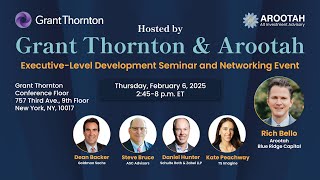
Rich Bello Keynote for Executive-Level Development Seminar with Grant Thornton | Feb 2025 | NYC