Rich Bello Keynote for Executive-Level Development Seminar with Grant Thornton | Feb 2025 | NYC
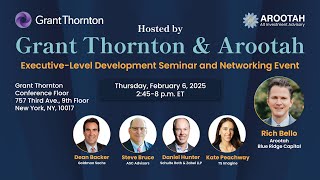
Rich Bello, co-founder of Blue Ridge Capital and CEO of Aruta, presents a leadership framework built on four pillars: mindset (growth, grit, curiosity), mission and goals, measurement, and accountability. He walks through how to align mission across an organization, set SMARTER goals, and track progress with accountability in four directions: upward, peer, subordinate, and self.
Chapters
It's great to see so many friendly faces. It's also great to see those who have recovered from eye connections. There's quite a few here. Thank you. To those that powered through the weather. I know there's more coming if you are late. We try to go as late as we can, but we've got the schedule I've written down here. Don't go off tangent, don't name anyone or don't mention anything that happened in Miami that could potentially embarrass anyone. Especially don't mention Ronan Guilfoyle's tight white golf shorts issues. Mike, leave a video. Maybe later. Maybe later. Don't worry, we'll share it. It's great to have so many people fly in this week. Thank you. For everyone that's come a special mention to the AMA Cayman chairperson, Tim Rossiter, who's slow name Tim. Give everyone a wave. Well done. Thank you, Tim. I think it's safe to assume everyone is here for this event, the GT event of the week. A special mention to the Schulte team for arranging their event the same week and also moving it to Tuesday, wherever they are. Thank you guys. Giving us the prime spot on Thursday. Great bunch wherever Dan and John and the team are. Thank you. We have two fantastic sessions organized for everyone today for followed by food, drinks, networking. There'll be more people coming, obviously with the weather, but we should have a big crowd. Before we start, I have a quick apology. With GT's strong relationship in golf growing the game, we had organized some golf swag including 200 and something Titanus GT hats. But unfortunately my good pals in the Lexington have either misplaced them or stolen them or borrowed them, I don't know. I said do not go on more here. But I will. As a guy who worked in a hotel 20 years ago for a solid 6 weeks, I don't know how you lose 200 hats. Like I mean, but it's okay. We looked at actually trying to make a change and we were going to get hats that said let's make audit great again but sorry, it's a poor audit joke. A special apologies to our friends that have come in from Denmark. I know it's a bit of a sore subject for you guys at the moment, the good guys. But on a serious note, look, if anyone does see Lexington hotel staff wearing tight list purple, white, brown Torton hats, obviously let us know. But don't worry, we do have some swag. So there'll be swag given out outside. I know their room tag guys have some and in between, we're going to give away two Titleist drivers. So everyone's name is in the hat, you'll be picked out and you get to go away with these 800 odd dollar drivers. Yes. Actually off script, the Titleist great bunch of guys have named their driver gt. So their TV ads say it's the best driver in the world. The GT driver. Just think about that quality driver gt. Really good. Thank you Titleist. A very few quick thank yous. First one to Jay Seeley, Mike Pattenel and the team for all the logistics. Thank you guys. It's not easy to run this big. Thank you to Brian Tassell. Where is Brian? Is he here? He was here. So thank you again for your network and all the help. And of course thank you to the team Aruta for the content today. I have a feeling it's going to be fantastic, especially with the likes of Dan Hunter and the other speakers. So obviously no pressure, Rich. We're expecting a lot as a group, so please sit back, enjoy, relax. I'm going to start by just giving a quick intro to Rich. I've shortened his CV substantially because it's rather long. He is the CO founder and COO of Blue Ridge Capital for over 25 years managed 10 billion AUM, held senior positions with Tiger Management, Morgan Stanley, Andy White. We won't hold that against you, but it's okay. He's a consultant and donor for Help for Children, over 58 million grants raised, serves on the board of Imentor 42,000 mentee pairs and is the author of 15 books and counting. Please give a warm welcome to the founder and CEO of Aruta as Sir Richfellow.
Well, thanks everybody for taking the time out of your busy day. I love time management, so I'm going to make sure that you guys get a nice investment in your time here. I know we have about an hour or so. We had a little bit of a late start, so thanks Greg. Thanks for the Grant Thornton team for inviting us for hosting. Also we'd like to welcome Brian Tsai's Pure Exchange. Some of the folks are here today. So now keep in mind this is just a framework for some top leadership principles. This is not something we're going to go into depth into the skills. As Greg said, written 15 books, you want to go into depth. That's where it is. So we're going to touch on some things, we'll discuss some points, some pointers, some top tips in the leadership principles. And you know, as any leader knows, they're leaders A mindset of leaders. They're really curious. If you're curious about something, write it down and then you can dig deeper into it. So let's talk a little bit about Aruta. So some of you know me from my years in the industry, my 30 years in the industry. Maybe some of you know me as the co founder of Blue Ridge Capital with John Griffin, who's the consummate leader. But many of you probably don't know about Routea and why I've been invited here to speak on the topic of leadership. So RUTA is the organization that I wish had existed when I was at Blue Ridge in my perch as the chief operating officer and John's perch as the portfolio manager. At the end of the day we're really a talent organization. We rely heavily on technology to leverage our clients experiences. The bottom line is at Aruto we transform potential into peak performance. We do this both at the individual level and at the business level. So this is primarily for the alternative investment industry. So if you have talent challenge, RUTA is the answer. We'll know where to find it. We have three main business lines. Talent development, do all kinds of executive function leadership training. We do talent outsourcing. Talent outsourcing is basically a network of over 500 advisors that can come in and do any type of work that you need them to do. They can do a best practice review, they can sub in for somebody might be on leave, they can do ad hoc work. We have these advisors in every single area of a function, every single function of an alternative investment firm. CCOs, chief financial officers, CISOs, portfolio managers, analysts, you name it. We also do talent acquisition. Now if we're going to work with you on talent acquisition, we're going to be working with you as a partnership. We don't just source something, you don't just give us a job description. We partner with firms, otherwise we don't think it makes sense to work with you because it's such an important thing. So to root tie, we have a winning formula. This is really for anybody. The winning formula that we believe works is accumulating knowledge. That's why I've written so many books, Knowledge plus process. Now we like to talk about that. Knowledge does not apply itself. You have to make the application. You can sit here and learn a lot of stuff today, but if you don't apply it, what good is it? So process to apply the knowledge. Knowledge plus process plus technology. We leverage technology to make the application of the process more efficient and effective. And then you add Experts, coaches, advisors. Ed experts. These coaches and advisors get you really clear on your goals, have a strategy to help you to implement these goals or a plan. And most importantly, there's an accountability strategy to make sure you actually execute. Everybody knows execution is the hardest part. So for us, the knowledge are the books that we have. The books. We have some publications, we do some newsletters, then we have the experts, right? With technology, then we have the experts. We've developed a bunch of SAS tools. We have the experts. These are the 500 advisors. And we also have 500 coaches on our staff. Executive coaches. These are coaches that are life coaches, health coaches, career coaches, and most importantly for you guys, executive coaches. Now, since this is supposed to be a workshop, we have these engagement sheets. Does everybody see the engagement sheets? Show of hands, people. See the engagement sheets. So it's a workshop. You have a sheet on your table. Please fill it out. These will be handed in and graded at the end. I think Greg is the teaching assistant. He'll be grading them. So obviously I'm kidding, but this is really for you. If you find a tip, something interesting, write it down. Like I said, knowledge does not apply itself. You want to dig in deeper on that, you're going to forget. You'll come out of here. Especially since we're going to be drinking our faces off right after this. You're going to forget. Write the important things down. Knowledge doesn't apply itself. You've got to make the application, have something like, you know what? I really should be doing that. It's like, you know what, write it down. I've had the great privilege of working with Julian Robertson at Tiger Managers. Sat directly across from Julian on the Tiger Trading desk. Very interesting experience. Now, some of the senior analysts there were people like Andreas Halvorson, Steve Mandel, Lindsley, you know, all went on to run these gigantic organizations. John Griffin was the president there. I learned a lot from these leaders. So I believe that success leaves clues. And I've been studying these top leadership skills for as long as I can remember. And I've always felt that the real key to leadership is influence, the ability to influence others. Now, I recall the day that it was the day before that John and I launched Blue Ridge Capital. We were walking across the street and he wanted this to be a teaching moment for me. And he said, hey, you want to know my secret? Well, my secret of success is now. John is by far the most successful person that I had ever known. He was the president of Tiger Management, I believe, at 28 years old Tiger at the time was the top firm on Wall Street. He's on the board of uva, board of trustees, founded Imentor. Perfect, you know, perfect family. It's a long. It's a very long list. So when John asked me, do I want to know his secret to success? I said, not really. I don't really care what it is. And I said, of course I want to know. Your secretary said, you're the most successful person that I know. And he said, it's the Dale Carnegie course. So I took the Dale Carnegie course, How to Win Friends and Influence people. I see a couple of Blue Ridge people. They know how passionate John was about it. And he asked me, do you want. I'll send you. Do you want to go? And I said, no, not really. Of course I want to go. He said, I'll pay for you to go. So I went, now if you ask Warren Buffet, he'll tell you the same exact thing. The smartest thing he's ever done. Dale Carney, of course he keeps that. That certificate. That's the only thing he keeps in his office behind him. The Dale Carnegie course certificate is that important to him. So the key here isn't the Dale Carnegie course. The key here is influence. Influence is such an important part of leadership. Learn how to influence. In fact, I wrote a book on influence myself. I was so interested in it. I was curious about it. We wrote our own book on that. So let's talk a little bit about the first principle, and that's mindset. So mindset really is programming your subconscious mind with ways of thinking. We have to master our minds. We don't master our minds. Our minds will master us. So mindset is a way of thinking. You're training your mind, training your subconscious in how to think. And we'll talk about some of these mindsets in a second. But on the global side, there are kind of global mindsets. Leaders follow one of these two. There are limiting mindsets. They're called limiting beliefs. These limiting beliefs are obstacles. If you have a limiting belief on something, say you want to work out, just don't have enough time, right? You're working too hard. Whatever it is, you don't have enough time to where it's like, you know what, I can't do that, or anything you want to do. You can't do X because I don't have enough time. You know, it's a super high priority for you. It's a limiting belief. You probably do. So if you're talking to a coach, our coaches are always looking for limiting beliefs. We can't get that done. You can't get that goal done. It's usually a limiting belief. So they'll then train. They're trained to look for an empowering belief. So if your limiting belief is, you know what? I don't have enough time to get that done. Think of an empowering belief. You know what? Time is the one thing that we all have the same exact amount of. It's the one thing everybody's got the same exact amount. The President of the United States, same amount of time. As a little kindergartner, right? We all have the same amount of time. So the issue is not that you don't have enough time. You're not prioritizing your time. That's an empowering belief. So I need to prioritize my time to make sure that I can work out or whatever to spend more time with my kids or spend more time at work. Usually that's not the case. So that's limiting versus empowering beliefs. Another one might be I'm not a natural leader. I'm not a natural born leader, so that's just the way it is. I'll be a follower instead. An empowering belief is leadership is a skill I can develop through experience and learning. One of the reasons why you guys are here, or networking, you know, networking feels forced, inauthentic. That's a limiting belief. Building relationships really creates valuable opportunities for growth and impact. That's an empowering belief. So really strive to have. You're a leader, you're going to look for empowering beliefs and you're not going to look for excuses not to get things done. So as a challenge, this might be an area where the CTAs let me think about the limiting beliefs. Here's a goal that I have. I'm just not able to get it done. Is it because of a limiting belief? Let's talk about some leadership mindsets now. So a leadership mindset that I like, and it's kind of another global belief, is a locus of control. There are two types of people in this world. People have locus of control. That is an external locus of control. And people have internal locuses of control. An external locus of control are people that think things happen to me. They have a reactive behavior, right? They blame other things. They blame the market or other people. Internal locus of control is I create my own outcomes. This is proactive behavior. External locus of control is reactive behavior. This happened to me, so I do this. This happened. No, external internal locus control. People Believe that they have control of the outcomes in their lives. And they're not just governed by luck. Rule by luck. Top leaders don't blame the markets. They refine their investment strategies. They improve their risk management. They find new opportunities. So now the best leaders follow these four minds. There's others, but these are four that I really like. A growth mindset. Leaders never stop learning, right? Your ability is not fixed. This is the growth versus fixed mindset. Fixed mindset is I'm either good at something or I'm not. Growth mindset is I can prove anything that I set my sight on. Warren Buffett hated public speaking. He took that Dale Carnegie course and he turned it into one of his biggest strengths. Growth mindset. If you're not growing, you're just falling behind. Grit. When people hire other people, they're looking at grit as one of the top traits. Grit is perseverance. It's passion. Most successful people aren't always the smartest, but they're the most relentless. Steve Jobs fired from Apple. Instead of quitting. What did he do? He built Next, Pixar. Then he went back, took over, took over Apple. He had grit. Crisitunity. This is one that I got from John Griffin. We were writing a partner letter. He taught me this. Crisitunity means every crisis contains an opportunity. There's an opportunity in every crisis. Look for the opportunity. If you just say, oh, there's a crisis. Bummer. Can't get this done. Defeatist attitude. Look for the opportunity. Usually that's where the best opportunities are. So there was an example of Netflix, right? DVDs came out. It was like, oh, DVDs come out. We're done. No, they didn't say, we're done. What'd they do? They pivoted to streaming, right? So did Blockbuster, Right? That's what Blockbuster did too, right? Oh, no, Blockbuster didn't do that. They didn't do it. Goodbye, Blockbuster. Curiosity. Leaders are always super curious, right? Make sure you're curious about anything that will lead to maximizing your potential. Okay? So that's mindset Principle one. Principle two. We talk about mission goals and plans. This is the blueprint for success, hopefully. Does anybody know Grant Thornton's mission? Just happen to have it here. Grant Thornton's mission? To be the leading business advisor to dynamic organizations by helping them unlock their potential for growth. Love it. They have a mission. I love the quote from Yogi Berra, if you don't know where you're going, I think it's up there. If you don't know where you're going, you might end up someplace else. Know where you're going, you don't want to end up someplace. You want to know where you're going. You want to end up there. Every great leader, team and company operates with a clear mission, well defined goals and plans to achieve those goals. Great leaders are proactive, they're not reactive. So your mission is what defines your purpose. Why do you exist? It's the why. The goal sets a direction for getting to where you exist and the plans tell you how to get there. That's the how. How do I get there? Of course, you still have to execute on them. So the mission's your foundation. Now, I believe the mission should not just be at the overall level of an organization. Mission should be at the team level, individual level, division level, partner level. There should be missions for everybody. Shouldn't just be a mission at the organization level. That's usually too lofty. But all of these missions need to follow each other. They must be in alignment. So what's Amazon's mission? It's to be the earth's most customer centric company. It drives every decision that they make, from faster shipping to AI recommendations. Now, values are the DNA of a mission. They define what you stand for. Values should be non negotiable. All decisions should be based on a company's values, core values. And to make sure they're clearly communicated and lived, not just written down, they need to be lived. Bridgewater has a value of radical transparency. Everybody knows that, right? It shapes its culture, decision making and its feedback system. So, so you want to live by principles. And you know, Ray does. Ray has his book Principles. I love that. That translates the values into the actionable rules, puts it on paper. That's where the ball field is. You're playing by actionable rules, that's where your code of conduct comes from. One of his principles at Bridgewater is never let loyalty stand in the way of truth and excellence. This shapes hiring, performance, review, strategic planning, everything. One of Aruta's values is accountability. Whenever we talk, whenever we have a meeting and somebody's assigned to do something, we have one of our admin assistants says, okay, who, what, when, who's assigned to do it, who's responsible for it, what exactly is it that they're responsible for it and when will it be done by it? It's written down, it's put into our technology. So you want to make sure your values aren't just words. You have principles and codes of conduct to make them real. So goals, everybody Knows, you know, the goals are the subsets of a mission. But everybody knows smart goals, right? Specific, measurable, achievable, relevant, time bound people know what those are. So we wanted to dig deeper. So smarter goals, right? So you can see what some of the smarter goals are. Goals must be written down. If they're not written down, they're not happening. Right. Most people have New Year's, they have their New Year's resolutions. And then when's the next time that they talk about the their resolutions or their goals? Next time is usually next New Year's. How are you doing with that? Right? Oh yeah, I forgot about that. You didn't write them down. Goals must be purpose driven. They have to have rewards and consequences. If you achieve your goal, you want to make sure you have your reward. If you don't achieve the goal, consequence, pain. What happens if you fail and you want to feel it? Should be pain. Really should be real emotion. When we're setting goals at Arutar with our clients, we make sure that there are rewards and consequences. That's what drives them to achieve their goals. Now in the smart goals, it's make sure goals are achievable. I don't like that so much. Barely achievable. Maybe not even achievable. Maybe you're not sure you want them to be really challenging. You want to be excellent. Especially in this industry, you've got to set some really tough, tough goals. And we talk about time bound. That usually means that there are deadlines. Time, time bound. In the smart goals, I think start lines are more important than deadline. Deadlines are important, don't get me wrong. But start lines, you got to get started. Procrastination. If you don't have a start line, you can procrastinate on something. Get started. Think about when you're going to work out. That's the hardest part of starting. Have a start line. Make sure they're reviewed periodically. Your goal should be reviewed periodically, not just by you, but by your teams. Make sure they're out there and then have some type of accountability strategy. We're going to talk a little bit more about that later. So plans, right? So mission, goals, plans. You need a plan. You don't have a plan. Your goal is just a dream. Your mission is just going to be a dream. You need a plan. There are 16 components to a plan. We're not going to go through this. We're going to go through one of my favorites now, one that I think is the most important. If you want to look at the other 16, you take a look at our goals book, goal principles book. The one that I think is interesting and important is brainstorming. A lot of people just dive into a plan. They don't brainstorm, they just start writing stuff down. Brainstorming is what's referred to as divergent thinking. Divergent thinking. You want to get out there, you want to brainstorm, you want to get into a good brainstorming mood, a creative mood, right? Want to brainstorm. This is not linear thinking. Come up with as many ideas as possible. We're not looking for. When we're brainstorming, we're not looking for quality, we're looking for quantity. Just get all the ideas out of your head, right? From you, from your team. There's mind mapping is a way to do this. Then you move into convergent thinking. That's linear thinking. That's when you take a look, you filter. This isn't a good idea. That was stupid. Good idea, better idea. When Steve Jobs developed the iPhone, brainstorming, that's what led him to it. Divergent thinking led to so many ideas. And then the final execution plan required a disciplined focus, no physical keyboard, sleek design, intuitive ui. Right? So are your plans actionable? Right? You guys have plans out there, first of all, have you written down, written down your goals? Have you written down plans for your goals? Right? Have you started out on your goals? You started brainstorming, you just start writing action items down. Think about these things. Think about these things in your CTAs as we go. So now we're going to move on to measurement. You know, as the immortal Peter Drucker said, you can't manage, but you don't measure. It's true. It's very true. I know John Griffin, we talked about. I love that. He's like, yeah, I really love that. So you can't develop a culture of accountability without measuring things. The only way to understand whether a firm, a team, or an individual is making progress on its goals. I've broken this down into three types of measurements, progress measurements, classification of measurements, and resource measurements. So progress measurements. People make mistakes. Leaders even make mistakes in thinking about that progress on a particular plan and executing the plan that's good enough, that'll get us there. That's a winning plan, but that's not it. You do need to measure if we're making progress on your plans, and more importantly, need to measure if you're making progress on the goal itself. So you can take this back to basketball game, right, Coach, we're executing the plan. They executed the plan. We're executing the plan. We're working. Game's over. Team lost. Coach happy that they executed the plan. Guys, we executed the plan perfectly. The team's like, but we lost, coach. Right? No, no. It's about winning. It's all about winning. Only winning matters. I know people say you can learn from the. I don't believe that. Right. What did Pat Riley say? There's winning and there's misery. Right. I like that. So there's all kinds of measurements. You want to focus on both plan execution and the goal progress. There's all kinds of measurements. KPIs. I think the wonderful KP Shui is going to speak about some of that on the panel. So I'm not going to dig into that. Put the pressure on her. Now, there's two types of classifications of measurements. There's qualitative and there's quantitative. Qualitative is for babies. You want to have quantitative measurements right now. I'm somewhat kidding. Sometimes you can only measure qualitatively, but you want to have quantitative. This is specific, right? You don't want to wimp out and just have quality, you know, that was pretty good. A one to ten scale. That was good. No, no, no. Measure, measure. Remember in the first letter of goal setting, it's specific. You want to be as specific as possible. You only get there by quantitative measurements. Now, resource management, everybody knows that a leader's job is to manage resources. You've got to manage resources. I believe that the top three resources are time, human resources, and then capital, in that order. Got to manage your time. It's most important. Time is the one resource that we all have the same amount of and it's finite. You've got to manage your time. Once it's gone, it's gone forever. Money you can get back once your time is gone. That's it, it's gone forever. Then human resources. These are the multipliers of time. You can't run a business without human resources. For now, AI is coming. He'll be able to do it soon enough. But for now, we still need humans. So you've got to measure revenue per full time employee. There's all kinds of measurements for both time and for human resources and, and then capital. We all know, you know, measurement of time think capital comes last. Just want to make sure that people understand that time is so important to measure. We have somebody at a route. That's just what they do. That's all they do. They measure time. More important than our financial statements. Right. Measuring time. All right, let's move to accountability. This is the fuel of execution. Really hard accountability. So any seized investor knows that the hardest part of running a business is execution. It's often said that a poor product with a strong management team who can execute is better than an amazing product with poor execution. A management team that can't execute. What's the key to execution? Accountability. So when I think about accountability, I think about four types of accountability. First one is upwards accountability. That's a dangerous one. That's holding your boss accountable. It's tricky. You have to be careful because you could get fired. Never do it in front of others. Don't do it in front of the team. Unless your boss is extremely high IQ like myself. Never do it in front of customers. Never do that. Okay? So you have to work on that. But it's important. You do need to hold the boss accountable. It's not that you don't need to hold the boss accountable. I like to be held accountable. Peer accountability. So it's also difficult holding your teammates accountable. People on the same level. Why is this one difficult? This one's difficult. If you don't really have the leverage, you don't really have the leverage. When you're at the same level, you don't have the leverage, you don't have the compensation leverage. So a good example of this one is Michael Jordan of the Chicago Bulls. I think it was 1990. They had lost their third. This is the Eastern Conference finals, and they lost for the third year in a row. For people who are old enough to remember this, Michael was beside himself on the team bus home. Beside himself. He had done everything. He worked out so hard in the off season. Worked so hard. He'd done everything. He was literally crying on the bus. And coach said, I've done. He told his coach, I've done everything I can. Coach, we can't make it over the hump. Limiting belief. By the way, the coach said, no, you haven't. You've done everything for yourself, but you haven't worked on the accountability for your teammates. You haven't held your teammates accountable. And he did. Right next year, hold his teammates accountable. Six world championships. But that was the big lesson that he got. That was a game changer for him, literally. So the other type of accountability is subordinates holding people that work for you accountable. We all know that's not easy. Think it'd be easy? It's not easy. So I have a process that I've. That I've come up with. Common sense usually Common sense is uncommon, though. We don't. Most people don't do it. So number one is set expectations. Make sure that whatever it is that you want your employees to do, your subordinates to do, they're very clear. Right? Metrics, deadlines. Similar. Similar to setting smarter goals. State these consequences and rewards. What are they? If you don't get this done, this is what happens. The consequences. If you do get it done, this is what your reward is. What happens if they succeed or fail? Get a commitment. Make it official. Make sure they commit to it. Can't just be you. Tell them to do it. They have to say, yes, I'll do it. Right. I'll do it right. So we talk about at Aruta, I'll do it. We want people to commit to it. I won't say that. I don't have them say, I'll do it. Mr. Bellow. They say, I'll do it. We'll make sure we get it done. You hear that? It's like this person's serious. They're going to get it done. So you get a commitment. Put it in writing. Could be an email, but just make sure it's in writing. Otherwise it's confusing. You know what? I don't think I said that. Or did you put it in writing? Measure progress periodically. Don't wait until the end. Course correct early. And then the hardest part. That's enforcing the consequences. The rewards are easy to. He did a good job. Do it. Forcing the consequences. We all know that's really hard. That's really the hardest part when you're dealing with support. Hey, you didn't get it done. We agreed on this. You said you're. And we agreed on the consequence. You got to do it. Otherwise they won't take you seriously next time. Now here's the toughest one. Self accountability. When I'm talking to teams, I ask them. When I talk to leaders of teams, I ask them, who is the hardest person on the team to lead? Most people get it. Who is it? Who's the hardest person on your team to lead? Heard a couple whispers out there. Yeah, it's yourselves. Yeah, it's yourselves. Really hard to lead yourselves. Really. It's the first principle that we talked about. It's hard to lead yourself because it's hard to control your mind. It's really hard to lead yourself. So there's two forces. If you want to be held accountable to doing something. One force is willpower. Good luck with that. Very difficult. I'm not saying you shouldn't do it. And we wrote a book on this. It's very difficult. Willpower is very difficult. And the other force are some outside forces. These can be coaches, somebody to hold you accountable. These can be coaches, peers and competition. Peer accountability is great, healthy pressure. The top organizations have their peers and teammates holding themselves accountable. Right? That's the Chicago Bulls, right? Six championships. Technology. There are apps, reminders. I've been using this app, this habit tracker I've been using for 20 years, and people are like, hey, I tell people about it. Hey, that's interesting. So we put it out there, we built it and it's out there. It's on the app store. Apps can help you public commitment. So I've said, written 15 books in the last two and a half years. They're real books. They're out there. You can see them. These are real. These are great books, right on these topics, if I do say so myself. I'm very humble. Now, these books, the first one took me 20 years to write till my coach told me, I really want to write this book. It's killing me. I can't get this book done. So she said, he said, you know what? Tell everybody you know you're going to write a book and invite them to seminar on the book release. Three months. Three months. Write a book in three months. Three months. Did it. Now. The accountability strategy was public humiliation. I was not going to come in front of all my peers, all my friends. I would be humiliated. Come up with a book. Where's the book? Like, I didn't get it done. I procrastinated and get it done. No, that's my accountability strategy. I got it done. It's like, wow, this really works. Let's write another one. Two months. Let's write a book in tune.
Now.
People on my team thought I was crazy and. And I told them, if you don't believe that we can do it in two months, I don't want you on the book writing team to help me. And there were a few people like, you're out of your mind. Not going to write a good book. I'm obviously going to write a book in two months, blah, blah, blah. But that's a limiting belief. I don't want anybody with limiting beliefs on my team. I want people, yes, we can get it done. And we did. So public humiliation and accountability strategy. The key is to have an accountability strategy. Coaches are my favorite in terms of helping me with accountability. Let's move on to emotional intelligence now. So here, emotional intelligence is really the ability to recognize, manage and leverage Emotions for better decisions and relationships. It's not just your own emotions. People think emotional intelligence. I just gotta manage my own emotions. No, no, no. You need to be able to recognize and manage others emotions and deal with other people's emotions. So the key to mastering EQ is realizing that emotions are signals. They are not directives to act. It's just a signal. This comes from our evolutionary times. They're just signals, evolutionary tools. Now most people just react automatically rather than pausing and responding intentionally. Great leaders are able to separate emotion from action. They ensure that their response aligns with their long term goals. So there's signals. These emotions are signals. When I first heard, it's like, oh, that's really interesting. So fear, what's the signal for fear? There's danger, right? You better prepare for it. There's danger here. That's a signal for fear. Something happens, you better prepare for anger. A boundary or a principle has been violated, right? What's the automatic response for anger? Fight. You fight. Anger, you fight. It doesn't have to be physical fight, verbal fight. But that's the automatic response. Now there are positive emotions too. Excitement. There's an opportunity. Excitement means there's an opportunity. The signal is there's an opportunity. You're excited by the opportunity. What do you do? You go get it. You pursue it. Gratitude. What does that mean? Signal is you have enough. That's enough. You've got enough connect, you sustain. You keep it where it is. So without this awareness, it's really a mindfulness. People talk about mindfulness. I think this is the key to it, being mindful of your emotions. The key is to pause before you react. I've written this in a few different books. So why is pausing so important? It interrupts this autopilot. This emotional autopilot keeps you from impulsive reactions. Creates space for better decision making. It strengthens your leadership presence. Leader who can control their emotions really earns greater respect from their team. So I came up with a 10 step process. I keep tweaking and changing this as I go. I've had this for years and years and years. So first, if you feel an emotion, first is to recognize like, oh, I have an emotion. Don't react. Pause, don't react. Stop right there. Take a breath. This is my first one in the last few minutes. Take a breath. Right. Name the emotion. What's the emotion? Is it anger? Is it fear? Is it frustration? Is it excitement? Identify the signal. What's this emotion trying to tell me? Then ask, is it real? Many times, in fact, probably most times, fear is not real. Fear F E A R. False evidence appearing real. In the Hindu religions, they talk about the story where there's a snake in the road. It's like, oh my God, a snake, A snake, a snake. And people are freaking out. And then they walk up to. It's like it's just a piece of rope. It's not really, you know, it's not really a snake. It's a piece of rope. False evidence appearing real. So if it's not real, you just let it go right there. You can stop right at step five. This is stupid. I shouldn't have gotten mad. I shouldn't have been afraid. Let it go right there. Now if it is real or some semblance of reality. Define your objective. Don't just react. What's the outcome that I really want? The subordinate challenges you in a meeting, right? Your objective may be to appear calm and composed, not to react emotionally. Make sure that's your objective. Some type of objective, like whatever it is, consider your options. How do I get that done? Here's my objective. I want to react calmly, not emotionally. What are my options? Maybe say, hey, let's talk about this later. Let's talk about this one on one. Some other options. Consider your options. Decide on an option. What's the best option to take? Act on it. Execute your response with control and confidence and then reflect on it. How did that work out? It's like, you know what, that worked out really well. As opposed to having an outburst or having a poor team meeting, right? Think about that. So recognize emotions as signals, not commands, not directives. Master the pause. I love this quote by Viktor Frankl. It's actually Stephen Covey, but it gets attributed to Victor Frankl. Between stimulus and response, there's a space. In that space is our power to choose our response. Utilize that. It is so powerful. And then you can apply the ten step process. There's other processes, but apply that process. Apply some process. You know, just auto react. Communication. It's the foundation of leadership. Great leaders don't just talk, they exchange information effectively. They resolve conflicts carefully. They build trust, they inspire action. So communicating concisely. And again, there's a book on communication principles you want to read. Go into depth in any of this stuff. These are just some of the best stuff for me. I think one of the keys to being successful in my career is being able to take complex ideas and make them simple. Especially for your boss, right? I would at Blue Ridge, I would sometimes spend hours and hours, sometimes days, bringing out A complex issue so that I can explain it to John Griffin easily so he can make a decision quickly. They'd be like, oh, got it, Rich. Yeah, yeah, do that. I spend hours sometimes in my team. I was like, why are you spending so much time? Why don't you just give it to John? He's so smart. He's like, no, no, no. We want John. Right, Kate? We want John. The golden goose will be spending his time making money for the firm. Flying, right? Yeah, Right. That's where we want him to be. We don't want him spending time on decisions that the rest of the team could do. That's not a good use of his time. Active listening. Listening to understand, not just to respond. And people. This is a great mistake that most people make in communication is that when they're talking to somebody, they're thinking about when they're listening on the other side, they're thinking about what they're going to say next as opposed to just really deeply listening. If you deeply listen, you'll have something better to say right now. Coaches are really good at this. They're trained to really listen. They're looking for the obstacles. Why can't this person achieve this goal? They're looking for the obstacles and they're really looking for limiting beliefs, mostly. So when an example is Warren Buffett, he credits listening more than talking as one of his greatest leadership tools. Conflict resolution, transforming disagreements into productive discussion. For me, this is all about win, win. We're not going to talk about this here because the great Steve Bruce is going to talk about this on the panel. And same with crisis communication. Leading with clarity. We'll talk about that some more on the panel. Feedback. Mastery. Some communication. Feedback. Not giving feedback. Receiving feedback. That's the tough one. Feedback. The reason why people have a difficulty receiving feedback is because they think they're being attacked. Physically attacked. Right. Fear. Again, false evidence. But they're not being physically attacked. Like, oh, my gosh, defense mechanisms go up, it's not coming in. Feedback isn't an attack. It could be. It's not being delivered properly. But usually it's an opportunity for growth. And even if it isn't attacking, just let it go. Don't put up a wall. That's why people react defensively. At Blue Ridge, what we do for my team is I'd have somebody else come in and train people on this. Maria knows this, right? They would train them before we did reviews, before reviews were delivered, we'd have somebody come in and train people on this. They don't Want to hear from me of the boss, like, ah, it's like talking to dad, like, but when they hear from somebody else, like, oh, that's really interesting. I've been telling you guys this for all. No, it comes from this person's next, blah, blah, blah. The best CEOs actively seek critical feedback. By the way, they want feedback. You know, I love it. We have some people on our team like, thank you for the feedback and they're sincere about it. Most people, like, don't say thank you for the feedback. They say something else to you for the feedback. Great leaders don't fear feedback. They use it to improve and grow. Think about these things when you're receiving feedback next time, like, you know what, let me just stay open to it. Maybe there's something I can learn here. When you're in a conversation, next, listen, actively say, oh, yep, I'm thinking about what I'm going to say next. Put that aside and just see, just test it out. See, maybe when I'm about, maybe if I listen more, I'll say something a lot more intelligent. Decision making. So for me, the key for decision making, obviously this is a leadership skill, making the best decisions. That's what leaders do. So for me it's should I use logic or intuition? The great dilemma. Now, the answer is it depends. Depends on the situation. So Dan Kahneman, for those of you who probably have heard it big in the industry, thinking fast and slow, explains, we have two systems for decision making. One is fast thinking. That's intuition. Now this is good for automatic instinctive responses when you have a lot of experience in the area. If you're a cardiologist and you see somebody coming in, it's like, you know you've done a thousand surgeries. Like, I see it, I got it. They can use intuition, they don't need to study it. Tell me your symptoms, go deeply and start researching it so you have their symptoms. They can make a decision. You need to go into a knife right away, you're fine, you just cry baby. Quick decisions. In familiar high pressure situations, a seasoned trader recognizes a market inefficiency, capitalizes it immediately. System 2. This is slow thinking. This is logic, analytical, methodical. This requires effort and data, data. So these are best for complex, high stakes decisions requiring deep analysis where you may not have a ton of experience. So for example, a hedge fund manager carefully evaluates new investments using financial models right before committing the capital of his or her LPs. Malcolm Gladwell talks about this as well. In blink, people mistakenly think they think that he's just all about intuition. I happen to be privileged to have met with him and chatted with him about this. And he said, you know, people got it. He said, you're right. People get it wrong. That's not what my book is about. They didn't read the goddamn book. That's not what it's about. It's not just about, hey, follow your intuition. No, no, no. It's wracked with bias narratives. Only if you have a lot of experience in this area should you use your blink. An art expert spots a fake instantly, an inexperienced collector might get duped. Now, one of the things that I learned when we. Again, we wrote a book on decisions, there is decision principles, is comparative scoring. Stumbled upon this and started asking some decision experts, like, oh, yeah, that's a thing. So comparative scoring, the best way I can describe it is when you're looking at candidates. If you have a lot of options, it could be housing, houses or candidates, a lot of options. You score them, you score them individually and you come up with a score for them. So we do this. We have this great process at a root. Tougher talent acquisition. We have a lot of scoring, score them on interviews. We do all kinds of scoring. And there are soft skills, hard technical skills. Then we weed them out. We weed them out. We come up with the top of the top. So maybe we'll take the top three. We've interviewed maybe 50 people. Top three. From those top three, it's like, I don't know, how do we figure that out? Do we use intuition? No, we don't use intuition. What we do is we take those top three, and I think they're.
More from Rich



Goal Setting Workshop: Set Your Top 2023 Goals & Create a Master Plan to Achieve them! NYC

Goal Setting Workshop 2025: Design Your Master Plan for Success! AROOTAH Advisory & Coaching | NYC

Redefining Success: Arootah President Talks with Christyl Murray on Culture, AI, and Much More!

Rich Bello Best Practices Keynote to Family Office Leaders | Parrish Museum The Hamptons | Aug 2025


