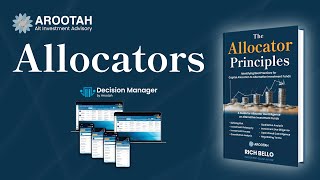
This interview excerpt presents Rich Bello explaining a structured allocator decision process for selecting funds. He argues for a multi-criteria decision model (separate investment and operational criteria), with explicit weighting, a 1–10 scoring rubric, and a comparative-ranking step (not just raw scores) to allocate capital. Bello also describes a decision-support tool that organizes evidence and mentions a book on "allocator principles" (10 principles) and a masterclass built from it.
So allocation is a tough business. I mean, how do you help your clients navigate which funds to invest in when there's an overwhelming amount of options to choose from?
Yeah, it's a really tough business. You're right, it's very difficult. I've been doing it for a long time myself. I've been started to fund a fund, ran, funded internally after doing it externally for number of years. So yeah, there are thousands of funds out there. How do you decide which, which ones to invest in? So it's about criteria. How are you going to measure these funds? And that criteria is not only which criteria, but how do you weight that criteria? So, you know, like I said, I've been doing this for many years. It's hard to make decisions just in general. This is called a multi criteria decision model. That's a type of decision they made. Now a lot of people make mistakes in this. Mistakes that they make. They do it in their head, right? You can't make a decision, a multi criteria decision in their head. So that's, you know, that's a really cardinal rule for me. Making decisions in your head using your gut instinct. Right. I'm not a believer in that stuff. If you're super experienced, that can come into play. But you've got to have a real process to do that. So people make decisions really based on emotions. A lot of people based on emotions. I think that's also wrong. You've got to be really careful about making decisions based on emotions. It's got to be logic based. The other issue with making decisions not in a process based environment but with some type of framework is that they're impacted by cognitive biases. There's all kinds of cognitive biases. A recency bias was the fund that I looked at last. That's silly. He spent a lot of time. I spent so much time researching this fund, right. I just kind of invested. I spent so much time. That means nothing how much time you spent on it, right? What is that, what is that one called? You know, the cognitive biases. We've sunk a lot of time. Very good. So this process really helps you to avoid that. You really need an organized process. So that process looks something like this. You come up with criteria. What's the criteria? How am I going to measure these funds? And you do that on both an operational and investment side. We do it separately. Investment and operation. You got to separate those two categories and you come up with criteria for each one of those. So an example of a criteria is one that I really like. I want to know, is the manager investing in his or her own fund and how much of their network, not how much money, it's what percentage of their net worth is going in there. That's really important. I think that gets you so far, just even for risk management or eating their own cooking. So I really like to look at that one. And then they'll weigh. I'll weigh it. Which criteria? I'll have a number of criteria. We've got hundreds to choose from in our model. So then you'll weigh it. That one I'll put very close to the top as an example. Then you have a rubric to score the criteria. So how am I going to decide to score that criteria? The manager as a percentage of their net worth, is it 50%? I'll do it on a 1 to 10 scale and then it's just simple math. Multiply the weighting by that 1 to 10 scale and you get a number for that particular criteria. Now, you apply that rubric to all the different funds, right? When you're going through this, you apply that rubric to the different funds, to the different criteria, and then you come up with a score for each of the funds. But you don't end there. That's the first part of the decision. Now, a lot of people miss this next part. They score them all and they miss this next part. You narrow it down based on that. So say you've got a certain amount of money to allocate the funds and you narrow it down to the 10 funds and you want to allocate it to the 3. You've given them all a score from 1 to 10. Do you allocate now to those. To those funds in that 1 to 10 ratio? No, you've got to go through comparative scoring. From there, you rank each fund based on the criteria against each other based on that particular criteria. Then you can really see which fund is best in a given criteria. Now, in order to do this, we come up with a tool to do that. As we do it with everything that we have expertise in that we sell, we come up with a tool to make it efficient and effective to follow the process. Each fund gets scored. When you're doing that, you really are able to show the decision maker, whoever that might be, that might be an investment committee, it might be fund of funds. Whoever the decision maker is, you want to be able to show them you've got this score, this tool that's backed up by evidence, evidence of a really thoughtful process if you wanted to make a decision. I was like, hey, Christina, you should invest in these three funds. Right? Here's why do it. I just want to see something. And you can see this in a nice organized fashion. Wouldn't that be a great thing? That's what we have with this tool. So look, the benefits of this decision manager, this allocation tool we're talking about, there are many, there are a lot of benefits. But the most important benefit for me is you get to present to your investment committee or whoever's making the actual decision a neatly organized package, a fund scored in priority order with the supporting documentation for your decision. Wouldn't that be amazing to have something like that?
That's what I would. Absolutely amazing, organized information like that. That's exactly what I would want to be saying if I was investing my money.
Right. I think that just makes sense. So now when we have expertise in a particular topic, we want our clients to really understand it well, we teach it, we do a masterclass on this stuff in and we write a book on it first. The masterclass is based on the book. So the book is on these 10 principles, the allocator principles of what the book is called, and it talks about strategic insights into the due diligence process. Because at the end of the day that's really all it is, is a due diligence process. So these are 10 principles. We focus both on the investment side and on the operational side. These are both the top aspects of due diligence. And we're really, we're really excited for, we just wrote this book, we're excited for the feedback on it from our allocation clients.
So I understand you also offer a master class to your clients on this topic.
We do, yeah, we do. And I love this masterclass. What it does is it's a 10 week masterclass going through the 10 principles in the book. So some of those are allocation models, models that allocators use. We talk a lot about risk and risk management and really the bottom line is we'll go really do a deep dive into the investment and operational due diligence. Now the course also comes with the book, obviously comes with the book. And we really teach you how to use the tool. The tool really all three of them really follow along nicely together. So also get a nice certificate of completion when you finish it and go onto your LinkedIn people and see it's like, you know what, this person's completed the course and, and takes this topic really seriously. So really excited about the master class. It's taught by not only myself, but various experts in this genre.