Goals & Leadership: Interview with Yohan Kim, CEO of RFA | with Kim Levin, Arootah | Jan 2025 | NYC
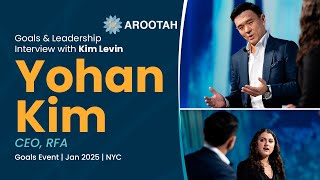
Yohan Kim, CEO of RFA, discusses how his company limits annual goals to three, cascades them through departments with monthly initiatives, and uses weekly sprints with stretch targets set 20% above baseline. He emphasizes emotional intelligence, coaching employees, and learning from failures through post-mortems.
Chapters
My name is Levin. I'm the creative director of Aruta and I'm very excited to have with me Johan Kim, the CEO of rfa. RFA is the leading provider for technology solutions in the alternative investment industry. So if you want to take, take a moment to introduce yourself and your business.
Yes, hello, thanks for having me. My name is Yo Han Kim, CEO of rfa. We're situated in New York, Europe and Asia. I have been with the company around 18 years now and I actually started in the systems engineering space for several hedge funds at the time. And really based on different roles that I've taken, I think I've had actually eight roles at RFA become CEO and since then we expanded into Europe at the time and here I am. Thanks for having me.
Very exciting trajectory. First, let's talk about goal setting as a leadership tool. So how do you as a leader approach goal setting across your organization?
Yeah, so we try to focus on what our mission is for our company. And our mission really has been based on service levels. So what we want to do is provide the best possible end user experience for people in the alternative asset management sector. And based off of that, we have annual goals that we set and we really try to limit it to 3 max. And from there we'll have multiple objectives on for every single department. And then we have initiatives based off of that on a monthly basis.
So let's continue by talking about aligning goals with organizational success. How do you ensure that you align individual goals with the organization's mission?
Absolutely. I think the most important thing for us is when we set goals. I spoke about our mission statement and talking when we talk to our team on what's most important for them and for our clients, we really have to hear it from the bottom up and the top, top down. Right. So we focus on three main goals for the year. And those goals need to be very specific on explaining what they are for. I think, you know, making sure that every single one of our employees have an understanding of why we're setting those goals and they have an understanding of how all of their objectives have a purpose in achieving those goals. So I think those are the things that we have to focus on for ourselves at least. And one of the other things are that it's measurable and it's verifiable because without that it's really just a dream.
Absolutely. Let's talk about balancing ambition with realism. So how do you balance ambitious goals? We all want ambitious goals, of course, but balancing that with your timelines and resources.
Yeah, so usually what happens is when we set goals, we have very specific numbers in place that we want to achieve. So for instance, if we set a goal of 15% client growth per year, then I'll always tack on an additional 20% on top of that. And this usually happens not just for our high level goals, but also for each of the objectives that the department managers have and any of the initiatives that people set up. Because I feel that people try to play it safe and, you know, it's good to be safe, but I think we need to strive to be better. And I think the role of the leadership team is really to help people understand that and extend that going forward.
Absolutely. And let's talk about using sprints for accountability. How do you use sprints or short term milestones to track progress on long term goals?
Yes. So we actually break it down into threes all the way from the goal level. So going from the three goals, each of the department leadership teams have three objectives for the year and then from there we go down to the initiatives per month and then weekly tasks. And then the sprints really support the objectives for each of the departments. And we'll go into these short milestones and short wins because I think that's really important, to be able to cheer more often through accomplishments. And I think that drives momentum and it drives more passion in the subject and, you know, it provides for a lot more success and grit.
Yeah, I can see how that could really drive momentum. How do you think emotional intelligence plays a role in goal setting?
I think that's probably one of those critical things for anybody that's a leader in the company. And I think for a goal setting like a just recently mentioned, we want to push our teams and each individual a bit further than they think they could go. But in order to be able to support that and to help the team members and the individual strive to be better and achieve something better. Our role. And I see my role as plugging myself into all these different departments. Departments when they can't achieve it or when they're close to not achieving it. And we have that through KPI reports and we have that through all these reviews. So I think making sure that allowing somebody to go further than they thought and then understanding the attributes of a person naturally is critical for the role. And I always tell this to all of our management team. The number one most critical thing that they could do in their role is to find the attributes that you're just naturally born with. I think every human being is born with one thing that they're amazing at that they could do best. And I think that's critical. And in order to have that emotional intelligence is going to be very important to identify those attributes. You have to have communication and collaboration with the people and then put them in the right places. I think some people find what they're good at early on and then we've noticed through the years many people actually don't. They think they're good at one thing, but we identify that they're much better at different things. So even for myself, I thought I was great in computer engineering, but then realized I was better at operations and management. And I think the leadership team is trying to find that for each person and putting them in the right positions. And then once you do that, I mean everyone likes to do something well that provides for so much more grit, so much more passion in what they do and a lot more accountability and ownership is shown from there. Where they don't want to hide, they want to be out there and say hey, I'm great at this. And without that understanding and that emotional intelligence and to be able to collaborate with them and to train them and to guide them, you know, that wouldn't be possible. So I think it's critical for any.
Company balancing teams, finding out what their superpowers are on some teams and then finding other people have superpowers that are, that can mitigate with some other team members weaknesses. But I really like when you talk about helping people stretch, kind of like stretch goals. And I find that as well people generally try to play it safe. Like I can achieve this, you can probably achieve a little bit more. And Christina talked a little bit about this even for yourself. In setting your own goals. You want to set them as challenging goals, but not too challenging. They won't be able to cheat them because that's a real killer for morale. But generally people will try to play it a little bit more safe than the leaders of the firm run a stretch a little bit more. So some kind of push and pull. And I think Alita's job is also to provide the. To provide the people that are working for them with the right resources, including development. Never ceases to amazed me how many leaders don't understand the power and the value of investing in their own people.
Right.
They can invest in all kinds of. They'll invest millions, millions. But then they won't invest in their own people. They won't get them a coach, they won't get them the training, they won't get the development that they need. Never cease to amaze me. Until you get the leaders of the firms that are coached themselves, like, oh, I get it. This is so valuable. Going to get everybody. And you usually find that at some of the larger. Some of the larger funds, like you find point 72, Stevie Cohen. Right. Citadel, These firms, Millennium, these firms have coaches for their people. Stevie Cohen was talking about that. He had a. Somebody asked him, how many coaches do you have in your firm for? Your portfolio manager said two or one. I think he said one and a half coaches per portfolio manager. I'm not sure exactly what that meant. Sometimes they had more than one coach. I love that answer.
Yeah, absolutely.
Well, thank you. That's a great segue into actual goal failures. So I don't mean to put you on the spot, but would you be okay sharing about a time where, when a goal wasn't met and what leadership lessons did you learn from that?
Yeah, I mean, in the 18 years I've been with this company, there's been plenty of. Plenty of failures. But I think the most important thing I always say is it's okay to fail because it's better to try and fail than not do anything. Right. Because there's absolutely no progress from there. The critical thing is, what did we learn from it? So we actually ended up creating a form for every single failure that we have. Not just on a goal, because on the goal we could actually break it down. But even on the task level and even on the kind of. If somebody doesn't meet a due date, because we usually have weekly due dates, we try to understand and break it down. What was the purpose of it? Why did we do it? What was it supposed to achieve? How did we achieve it? And then why did it fail? And then the most critical part in the last section is how will we never, ever make the same mistake again? And that's where we constantly really focus on. Because with that, if you fail all the time, but then if you don't make the same mistake twice, I mean, your achievability and probability of success in the future is very high and very quickly. Right. It's like compound investing almost. Right.
Yeah. I love that growth mindset.
Okay. To make a mistake once, that's okay. Learn from it. It's not okay to make the same mistake twice, that's not okay if it's the same mistake and it could have been prevented. So. Right. We always ask that something goes wrong, what happened? How do we make sure this never happens again?
Yeah. That communication brings up a point about how do you ensure the clear communication around goals throughout the organization.
So. Well, even personally. Right. I think it's paramount to write down your goals and I think that's what we were going over prior to this talk. But if it's not written down and it's not easily accessible, and if it's not consistently reviewed with the team, then it's almost not real. Right. And it's, it's forgotten. And I think the way we do it is just like I said, we do it in threes. We have the three top goals and then three objectives from every single department, and then from each department, the three initiatives and then the tasks every week. By breaking it down into a structured format, we are able to create very specific APIs and metrics to review for each of those things. So everyone has access to the ability to see how they're performing because self awareness is very important. And then they also see how the rest of the teams are performing and there is a review period again from that point. The managers reviewing each of their employees and then the directors and then the executives. So we kind of go through this process of reviewing the. Eventually all the KPIs roll up into the top three goals and thus the main mission that we have for the company.
Wonderful. I love that transparency. And my last question is, how do you inspire ownership of these goals at an individual level rather than just blindly following directives?
Yes, I think it's so let's say on the mission statement and on the company goal level. On the top level that's usually set up by the senior leadership team, we'll review and we'll review the past year, see where we need to adjust and make alignments and then create the top three goals. However, we actually ask every single department manager and even want all the collaboration from each employee. Every single employee. What I always like to say is you should be the expert in what you do. Right. You should be the best at what you do and you are, and that's why we hired you. So we want their opinion, we want the nuances that they go to. We want to understand what little thing ticks and why it ticks. If they're the ones that are working with the end users, they're going to be the ones that really understand the emotions of the end user and what really matters to them at any given time. So without that type of information and data, it would be critical to get all of that feedback. So we're constantly trying to a be aware that that critical information, goal setting and objectives really need the input of the entire team. And collectively, we'll be able to set much more specific and effective goals. And from the management side, it's really to make sure and keep that cadence and consistency for the team and set the goals in proper wording and format. At first, many years ago, we used to try to look for just the smartest possible person and the most technical person. And there was this one gentleman. We actually give all of our employees wonderlic tests. If people don't know what it is, we actually hire a company to create cognitive tests and IQ tests for all new hires. Well, new hires and potential hires. And this specific person scored the highest in the history of our entire company. I mean, he was brilliant, spoke very well, but he wasn't really driven in what he was doing, even the way he was kind of approaching his work and subjects. He provided good work, but there was a lack of grit and there was a lack of passion and in what he did. And what we found is that there was no longevity. Eventually the greatness kind of plateaued, and he eventually just fizzled out into kind of nothingness in the sense of he wasn't exactly sure what he was doing or why he wanted to do it. And because he didn't believe in that, and I believe that his attributes were lied elsewhere and not in our field in customer service, we had to part ways. But it's something that now to counter that, we actually hired somebody that scored absolutely terribly on the IQ tests and the cognitive tests. And there was a lot of questions as to whether we should hire him or not. So we actually said, we'll give you a chance. But he was extremely enthusiastic. He wanted to do things, he wanted to learn, and we gave him a chance. And, I mean, if people were going on a progress level like this, I mean, he was like that. I mean, within a couple of years, I mean, he's moved three positions. And, you know, our values are very much based on a meritocracy. We really think that the best idea wins and the best performers win. So we want to have those type of people manage and eventually got up to a management level. But it just kind of shows that it's so much more than their intelligence. Right, right. It's soft skills and that drive and making sure that they're in the right positions so that they want to be accountable for things. Right. Wow.
Thank you for sharing that amazing example. It's not all about the test taking and the interview process. It's definitely about the person and the human you're hiring, right?
Absolutely.
Really appreciate you sharing that.
Can you text me the name of that person, Johan.
No.
And those of you who are out there seeking new jobs, it's definitely about. I mean, obviously that person had a great interview. That's why you even gave them a chance. It wasn't about the task.
Yes. And this happens all the time. I'm not going to name names, but there's this one person that eventually became very senior in our company, and he was brilliant and he was fantastic. All our clients loved him. We loved him. But then we found that his passion was something else that we didn't do. Like, we were on a service side and a customer service side. He was a builder. He just wanted to build very specific types of applications that really don't fall into our company and what we do. So we fired him. And we said, you're amazing, but you need to go and you need to do something amazing. Go build something. And we eventually invested in him and said, okay, we believe in you, but you could do so much more. And I think that's the type of passion that we want to see. And fast forward a few years. His company is worth tens of millions, like 40, $50 million. And that's starting from nothing. And I think that's a testament of how much further you could go. Even if. Even if you've achieved something, you could go so much more. And that's why I like to just tack on that 20% on everything just to get there. Yeah, it's like no pain, no gain, Right. For people that work out. Right? No pain, no gain.
That's right.
I'm sure.
So.
Thank you, everybody. I really appreciate the time that people invested in themselves, really. Thanks, everybody.
Thank you.
More from Rich



Goal Setting Workshop: Set Your Top 2023 Goals & Create a Master Plan to Achieve them! NYC

Goal Setting Workshop 2025: Design Your Master Plan for Success! AROOTAH Advisory & Coaching | NYC

Redefining Success: Arootah President Talks with Christyl Murray on Culture, AI, and Much More!

Rich Bello Best Practices Keynote to Family Office Leaders | Parrish Museum The Hamptons | Aug 2025


