Rich Bello Speaks at SALT iConnections 2024: Insights on Talent Evaluation and Alpha Generation
Panel at SALT iConnections 2024 led by Rich Bello with Mark Anson, Eduardo Ruli, Sam Rosenstock, and Sona Menon. The discussion centers on two goals: identifying talent and developing talent. Key themes: (1) underwriting managers across people, process and portfolio with emphasis on identifying alpha sources and assessing barriers to entry; (2) tools and frameworks—Common Fund's "Flux Capacitor" quartile ranking, Cambridge's research funnel, MAN's structuring and quant analytics; (3) portfolio construction choices (Sharpe-focused preservation mandates vs higher-return strategies) and manager selection (preference for smaller PE firms for alignment/opportunity); and (4) talent development—importance of soft skills, executive coaching, mentoring emerging managers, and talent acquisition/retention strategies.
Chapters
All right, we've got a lot to cover. I'm going to first talk a little bit about, give a little background on myself, then we'll go to the panelists. So I'm a tiger OG Julian Robertson, the original tiger. There's a lot of tigers out there. I worked with Julian Robertson and his analysts. His analysts then became the Tiger Cubs. He was very prolific. Those are people like Lee Ainsley, Steve Mandel, Andreas Halverson, Viking, Lone Pine, et cetera. And then I co founded Blue Ridge Capital with the president of Tiger, John Griffin. We had a nice run for 20 years. And then I founded a firm called Aruta. And Aruta is all about maximizing potential elite performance and such. So let's go to the panel and get a brief background on both you guys and your organization.
We'll start with you.
So I'll start. Good morning everyone. I'm Eduardo Ruli. I'm the cio Hedge Fund Solutions, which is the fund of funds of ubs, sits in asset management but works across the different divisions including wealth management. Our platform today is 45 billion. We invest across 200 hedge funds, 70, 80 portfolios, a full array of institutional investors all the way to high net worth individuals in the private bank.
I'm Mark Anson. I've been fortunate to be part of the common fund team now for about eight years. Those of you who may know us, we were born about 52 years ago with a $2 million grant from the Ford Foundation. We now manage about 36, 37 billion today for endowments and foundations.
I'm Sam Rosenstock. I'm deputy CIO of the external Alpha team within MAN Solutions. We sit within the broader MAN group which is a global asset manager across hedge funds, long only and private markets. The external Alpha team invests in external hedge fund managers, private credit and some specialized private equity managers. And.
Yeah, that's me. Hi everyone, I'm Sona Menon. I'm a partner with Cambridge Associates. Cambridge is a global investment firm and we build investment portfolios for endowments, foundations, pensions and family offices. We have assets under advisement of about 700 billion, of which 75 billion is fully outsourced assets. I serve as an outsourced CIO at Cambridge Associates, building portfolios for pensions and healthcare institutions and endowments. And I also head up our pension business in North America, which is effectively focusing on our growth strategy and talent development.
Great. So the objectives of the panel really are twofold. One is to identify talent and the other is to develop talent. And developing talent is both for the Firms individually, internally as well as externally. So this is a topic that is near and dear to my heart. I'm fascinated. Really what we're talking about here is the decision, the allocation, and written a couple of books on decisions. We have allocation tools, we have training on allocation to funds. So I'm really excited about this topic and we have a wonderful panel here. So let's dig in. Sam. Sam so how has the criteria in evaluating talent changed over the years? And I think there's some particular skills that we talked about that you guys look for that you and your team look for.
Yeah, I think that all of us have universal components in our underwriting, in terms of the people and the process and portfolio management. But when you're in an environment where you expect the the market component of a manager's return to be more uncertain, you have to hone your skills on identifying the alpha component. And that has different nuances, whether you're an active hedge fund or more illiquid private strategies. So really focusing your skills in underwriting, trading orientation and flexibility in your hedge fund strategies. And then on the private side, focusing to ensure that the manager is leveraging more operational skills to create an operational capabilities to demonstrate a track record of growing a company or transforming a company. And in private credit, an example would be just ensuring that the manager has the turnaround capabilities and a track record of leaning into companies to help them turn around if they get into trouble. Another key area would be focusing on sourcing differentiation. Again, it's different depending on what market you're in. In liquid markets, you want to focus into spending time analyzing whether their opportunity is very crowded because competition makes efficiencies in markets. So you want less crowded managers with trades that are less crowded. And also strategies assessing the barriers to entry. So quantitative strategies that, you know, it takes time to catch up to someone who's been doing quantitative investing because, you know, it's just an iterative process. So focusing on if the strategy has a high barrier of entry or if it could easily be new competitors can come into it. And so in aggregate, I think you also need to develop your analytic skills to help identify the alpha component for all of the strategies, no matter where you are in public or private.
Thank you. So, Sona, let's go to you. Perhaps you could briefly describe how Cambridge's outsourced platform works and how find best in class managers.
Yeah, so what we're really trying to do is I serve as an outsourced CIO for my clients. Essentially, I'm trying to replicate an in house investment office inside of Cambridge Associates, but really on behalf of an institution that's outsourced to us. So my team is, you know, composed of subject matter experts, I have specialists on alt assets, I have an actuary, you know, someone who builds private portfolios and operational expertise, etc. So we're sort of what an in house office looks like. We leverage the large Cambridge research platform to identify the best in class managers. Obviously our research platform which has, you know, more than 100 people, they're just working down that huge funnel that you've, you've always seen, right? There's thousands of managers out there and they're doing a significant amount of due diligence, both qualitative and quantitative to work their way down to the sort of the, the less than 5% of that, that that's investable for our clients. And then I as an outsourced CIO get to sort of cherry pick from that bottom of the funnel and I do a second layer of, of re underwriting for my portfolio fit for my, the institutions that I represent, which I'm sure we'll get into the portfolio construction a little bit later. But the bottom line is that we're leveraging a sort of a global research platform of already vetted ideas and then picking the ones that go into our portfolio.
So Mark, you know we discussed super tool that you use at the, at the Common Fund to tease out Alpha. I believe you called it the Flux Capacitor that you developed with Doc. Can you elaborate a little bit on that?
So indeed we have a tool we call the Flux Capacitor at Common Fund. Actually the funny thing about the Flux Capacitor is when I talk about it with our summer interns or our first year associates, they're like flux capacitor back to the future. What? It just doesn't resonate with them the way it used to. So we may have to come up with a new name. But what is it? It's a quartile ranking system for hedge funds. If you live in the private equity world, if you invest in venture capital or private equity growth or buyout funds, everything's ranked by quartiles. Cambridge does quartile rankings pre Quinn Burgess, et cetera. There are a number of agencies out there that will quartile rank private equity and venture capital funds and other private capital funds. No one quartile ranks hedge funds. It's a peer group driven industry just like private equity. But no one's ever come up with a quartile ranking system. So about eight years ago at Common Fund we invented our own. And one of the great things about the Flux Capacitor is it's strategy agnostic. You may often hear this from a hedge fund of funds manager. Well, gosh, we filled up our equity hedge bucket. So we don't want to look at any more equity hedge managers. We now need to fill up our global macro bucket or our relative value bucket or our whatever bucket, our event driven bucket. To us it doesn't matter. It doesn't matter what the next hedge fund is to us, whether it's equity hedge event driven, global macro, because the flux capacitor will take that into account. And so the great thing about it is we can be strategy neutral or agnostic. We really don't care whether the next best hedge fund manager we look at is equity hedge or event driven because that's all accounted for within the flux capacitor. We call this degrees of freedom. The flux capacitor gives us an additional degree of freedom because we're no longer constrained by strategy mix. And we try and build as many degrees of freedom into our portfolio construction process. And when you do that, you can build a more robust portfolio. But again, I may have to come up with a new name because for our summer interns, they just don't know about Back to the future of Flux Capacitor. That just doesn't resonate anymore.
Very good. Well, Edo, let's go to you. So we discussed a distinctive feature of UBS solutions was preservation of wealth. Instead of maybe swinging for the fences as some of my tiger cub lineage does now, this could also lead to outperforming in some of the tough markets, but also underperforming in some of the bull markets. Could you elaborate a little bit on that? Yeah.
So we have been managing hedge fund portfolios for 30 years and the beginning of our history is really managing money for private banking clients. And most of them have already accumulated quite a lot of wealth and is about preserving that wealth. And so our philosophy, our approach has migrated towards high shop ratio portfolios, relatively steady and you know, today in this kind of market environment where it's free being higher, it'd be 70% with a shop of one and a half to two is plenty is all the clients need. And so we sometimes define a bit boring in a way, but it has really served a purpose over the cycle and particularly in most recent times like 2022 where we perform quite well. But obviously in times like this one where everything is going up and there's no differentiation, every asset Class is roaring. It's difficult to keep up. But I want to say something important. Being focused on sharp ratio and low volume doesn't mean that you're only buying funds with low volatility. Because if you do, combination of low volatility and diversification will kind of eat the returns away. They'll kind of flatten out and barely make cash. So you have to mix different things and you have to be brave at some times, go where the opportunities are and potentially do things that are very risky. The outcome, if you do have good portfolio, robust portfolio construction is still I sharp. But in our experience, just buying funds that have low volume and putting together, it really becomes. Becomes very difficult to meet your investment objectives.
Thank you. And that seems that mandate can probably be very favorable for family offices. I would think the preservation. Focusing on preservation is usually more of a focus.
And some institution like pension funds also really like that approach.
So, Sam, let's go back to you. You talked about operational alpha and why structuring is so important in generating alpha. Can you elaborate a little bit on that?
Yeah. So within our group, because we sit within a broader asset management firm that has a very long track record of quantitative investing, we're able to leverage a lot of that technology and quant infrastructure and analytics in our underwriting. And we also have a managed account platform where we spend a lot of time around structuring. And I would say for a long time, the market that many allocators would say, you know, I really focus on the strategy and the team, and I don't focus so much on the structure. But we're at a point in time where you've got a lot of money looking for returns, you have only a limited amount of alpha in public markets, and you have managers that might not be available to you, and you have an interest rate environment that's higher. So to justify having the fees and complexity of a hedge fund allocation, the managers now need to make sofr plus, you know, that hurdle to justify their allocation. In this environment where there's, you know, competition for alpha, structuring becomes more important in the underwriting. So when you can assess the manager's track record and hone in on really what their skill is and get rid of kind of the mediocre fat that they're not that great on and structure to get just that alpha source, then you have a better chance of meeting your benchmark and your objectives as an institution. And so we've been doing more and more of that for our clients and just getting rid of the Mediocre parts of managers portfolios.
Well, great. So Sona, let's move to you. So obviously there's two parts of the business that's identifying the managers and then there's also construction of the portfolios. Can you talk a little bit about the construction of the portfolios and maybe some of the tools that you use for that?
Yeah, absolutely. Obviously the first and foremost is to get the right manager in your portfolio. The best in class, someone who's aligned with your objectives and is going to do what we want them to do in a portfolio. But I think that there's a great deal of success that comes from getting the portfolio construction right. And so that means getting, putting, not only putting the right manager in the portfolio, sizing them in the right way to make the right impact. Not too much, not too little, pairing them with the right existing lineup. Right. There are many, many investments in a portfolio. You want to understand how one is going to behave individually, but also in concert with other. And then also thinking a little bit about timing. Yes. You know, we don't have a crystal ball and we don't know exactly when managers will bottom and top out. But there is some science to trying to get the timing right. So I spend a significant amount of time as an asset allocator to think through portfolio construction once I have the ideas on my plate. We have a, you know, we do, obviously I said I re underwrite the ideas even after research has done them. I re underwrite them to understand portfolio fit and how they might look next to something else. And then I have a lot of tools, a suite of analytical tools that I utilize to sort of understand more quantitatively how certain managers will behave vis a vis their peers in certain environments and what they look like as a complete whole. I use a lot of active risk analysis to understand how I should size an investment to have the right impact on a portfolio. And also our toolkit essentially enables us to check some of the qualitative conversations we've had with managers. When certain funds say, right, well, we do well in this environment and we do poorly in that environment. And most of our returns come from stock selection. The tools that we have enable us to sort of check that. I'm able to sort of say over 10 years, this particular fund generated X amount of alpha. But most of it came from, you know, getting the sector right and not the stock right, et cetera. So there's a lot of checks and balances that happens. And I think that that's the sort of second layer of alpha generation. That, that, that is important for an asset allocator to get right to be successful.
Love that. Obviously very well thought out process. Mark, you mentioned that you tend to stay away from some of the larger private equity firms. And I found your reasons compelling. Could you share?
Yeah. So first off, we definitely stay away from those private equity firms that are publicly traded. No offense to them. It just introduces a third constituent group called public shareholders. And we assume, we just assume invest, not invest with publicly owned private equity firms. The other flip side is we've done our own research on small versus large PE firms using data from Cambridge and Pre Quin Virgins, et cetera. And what we have found in that data is small buyout firms in particular tend to produce very consistent outperformance compared to larger firms. And that outperformance can be 100 basis points or more. So the average size of the PE firms, private equity firms, and when I say private equity, I mean traditionally buyout or growth private capital firms we look to invest in the 700 million to 800 million range is sort of the average size we're looking for. We also like to invest with fund of ones. That is a partner that is spinning off from a large buyout firm no longer wants to get caught up in just endless fundraising and just wants to focus on investing. We like those individuals a lot. We also find smaller firms have better alignment. The management fee is no longer a profit center, which it is for the very large buyout firms. It actually is used. The management fee is used to just pay the operating expenses of the fund. And those smaller funds tend to be focused on getting most of their profit from the incentive or the carry. Again, that's better alignment for us. And then the third reason is smaller firms are investing in smaller companies, SME, small to medium enterprises. And we find that to be a much less efficient part of the market and a much better place where our private equity manager can come in and first buy the company at a cheap EV to EBITDA multiple and then bring a lot more operational experience, basically performance professionalize that company and extract much greater value. We find working with those smaller managers, most of the exits are then to bigger buyout firms. So financial buyers, which is just fine with us. But again, we don't want to be with those bigger buyers buying the second leg of that company. We want to be with the smaller PE firms with that initial company getting that first leg of growth from their expertise. I'll stop there. That's probably more than enough.
Let's go back to you. So you mentioned that as a large multi manager platform, top down approach can be very additive to alpha. And you also noted that you don't follow a dog shy away from a dogmatic mandate and that the. I hope I'm getting this right. The only rule is that there are no rules.
Yeah, well it's a bit extreme but and let me explain it, what I mean is there are no rules per se. There is a analytical framework, there is a process and there's the ability to evaluate opportunities as they come. Right. If I start saying to my team, oh, we're never going to touch reinsurance ever again and you know, reinsurance had a great ride and then at Katrina and then you know, spreads compressed dramatically. A lot of hedge funds came in and so it's easy to say I'm not going to touch it ever again. Is it climate change? Guess what, it became one of the most profitable P and L generator for Citadel a year and a half ago. Right. And so that's why you cannot be too dogmatic. You need to adapt. And if you get the strategies right that the managers right, that's your alpha. You can really make a difference. There are two, when we look at sort of probably the best hedge funds out there in terms of capital, call it return on Capital, P&L $P and L. The two biggest ones and best ones are Millennium and Citadel. And Millennium has a very bottom up approach. It doesn't really move capital around strategies. Citadel is the other opposite. They're very dynamic. The move where the opportunities are, of course they have great talent. But when you combine a great talent and commodities, more recently reinsurance back in the days and can really generate outsized returns and you don't always get it right, we don't always get it right. And when we do, we really provide a service to our clients.
Well, great. Well now we're going to move into a different, you know, different topic. This is on development, so let's shift there. And this is a topic that I've been obsessed with over my career and I worked at Tiger as I mentioned with some of these analysts and these were, these were top of the top. So I've been really wanted to really understand what gave them that edge. And I've been studying this for a couple of decades now. It really comes down to soft skills and technical skills. It's really two sides of it. The soft skills are things like time management, decision making and even health, even getting enough sleep. And then the technical skills are what you would think of. These are the hard skills. Although as one of my coaches said to me, he's like, you know, the older I get, the more important I realize the soft skills are. And he said to me, he's like, rich, I told you this 10 years ago. He's like, the soft skills are the hard skills. So I'm really, really gravitating more to that. And at Aruta, that's kind of what we do. We do executive coaching on the soft skills side and leadership training and the technical skills. We have advisors and, you know, all the functional areas. So, Sam, let me ask you, how do you and your team at Man Group really look at helping your managers supporting these manager partnerships with focus on professional development and things like that?
So I think it's universal for all allocators to want to engage with their managers and the team because that gives you insight on what's going on in that household. So we're always wanting to connect and talk at various different junctures. And many times those conversations are around things they're thinking about doing or ventures or changes. And they, we give our feedback and our thoughts on it. Sometimes it's more formal, sometimes it's more informal. I think that's an advantage. So when you're talking to your advisors or consultants, that's something to look at, but then also just in terms of developing them and helping their development, a lot of outside of those consulting, sort of collaborative advice, we provide a lot of feedback and recommendations in our ODD process. So best standards in hedge fund practices. Hedge funds, because they're liquid, because they are very dynamic, because, you know, they can change their approach, they have a high degree of flexibility. There's complexity in those managers, and so there's the ODD capabilities or the personnel. People who assess hedge fund ODD have a very high bar of standards and they can often give young managers advice on what those best practices practices are. They've also more recently been helping more private managers who are thinking about offering more liquid structures as well, because there's a big learning curve that will have to happen for not only the allocators of private markets in terms of their approach, but the managers in terms of the operational requirements if they start offering more liquid offerings.
So, Sona, let's go back to you. Thank you. Sam, how do you think about talent development both internally for your own team? I believe you had 12 investment professionals on your team. And then I really enjoyed our chat about how you work with and mentor and coach merging managers that are not in your platform. But maybe at some point they're, they're you know, they're kind of on the bench. And I really enjoyed hearing your perspective on that. If you could share it with us.
Yeah, absolutely. I'll talk about the internal talent development first. I mean, I've been at Cambridge for 23 years. I've been a CIO for, you know, 15 plus years. And I think it's important and it's my job to develop the sort of next generation of CIOs. And some of those people are on my investment team right now. And obviously that is a multi faceted role. You have to know how to manage assets across asset classes and understand that sort of hard skill. On the investment side. Risk management people management, process management, oversight of operations, there's a lot that has to happen that they have to learn. So I spend a lot of time trying to coach and mentor the younger people on my team and on other teams to sort of become sort of the next generation of CIOs. And then what's also very interesting is sort of the world outside of us, right? So a large part of our job at Cambridge Associates is to evaluate in diligence and identify the best in class managers. That's where the conversation began. And so a lot of emerging and newer managers are coming to us as well. And sometimes they come to us probably a little too much early. And so what I like to do is I like to spend some time when I can to, to mentor them. And now this is not really a part of my job, but again, I feel like it's my way of giving back to the industry, particularly to, you know, I'm particularly interested in helping develop female investors because let's face it, there aren't enough. But the idea is that when emerging managers come to us and, and it's, we're not ready to give them capital because it's a little too early. What I feel could be even more valuable at that point in time is to give them advice, right? So they have questions that could range from, how do I tell my story? Are my fees and terms correct? How do I fundraise? When do I fundraise? I have this sort of skeleton in my closet. How do I position it so that I can succeed? There are a lot of things that, you know, I've gotten to see over the, over the last few decades that managers do well and they do less well. And so I try to help develop some of that emerging talent. And in doing so, sometimes you may find someone really, really interesting who's not quite ready for primetime yet, but will be in a few years and then, you know, we can get access to them because let's face it, the emerging managers of today, those who will do well, will be the sort of stable, you know, fantastic managers of five years from now. So that's an important part of my job, I think.
Thanks. Thanks, Sona. So Mark, you mentioned that form of collaboration you do with some of your managers and putting together this institutional product and institutional product with a sweet spot, you coach them on how to get to that sweet spot. Can you elaborate a little bit on that and maybe your experience with an executive coach in the uk?
So I shared with Rich a personal experience with an executive coach in the uk. I'll start with that and then we'll move on to a more relevant data point. So I used to manage the pension fund in California called CalPERS. And after CalPERS, I moved to London to take over the chief executive role. So I went from CIO to chief executive. So a new role managing the British Telecom pension scheme, which is the largest pension fund in the uk. But btps as it's called, also owns an asset management company called Hermes, Hermes Pension Speaker Management. So it's a third party asset manager. So I was wearing two hats. So in a new country, wearing two hats, in a new role, chief executive. So I hired a coach for the first time. And back to the soft skills, which sometimes can be the hard skills. So they are hard skills. My first meeting with this coach, we're sitting down and he looks me up and down and the first thing he says to me is, mark, you need to change your shoes. I was like, what? Now, granted, my shoes today are very casual, but I like to wear loafers, penny loafers or slip ons. And he says to me, you need to get a proper pair of British brogues. And I was like, seriously? And he was like, seriously, you will not be taken seriously if you're going to come in to a business meeting wearing shoes like that. So indeed, he took me to one of these arcades they have off of Bond street in central London, David, to get a pair of black and brown handmade British brogues. Now those are the type of things that a good coach will pick up on. Yes, a good coach will help you work through a difficult employee issue, or maybe you're going through a merger and acquisition. But it's the softer skills are really the nuances of where people will either dismiss you or take you seriously. And a good coach will pick up on that and point you in the right direction, which is you were talking about this Rich, asking some of your mentees, are you getting enough sleep? Critical question, most coaches won't do that. So that's on the personal side. Let me give you one quick one on the business side. Current back to helping a a private company get into the, into a sweet spot. We were working with one of the very well known venture firm on Sandhill Road, one of the top five venture capital firms in the world. They came to Common Fund asked what we were were doing on diversity, equity, inclusion and we told them what we were doing and we explained it all out and they asked for a helping hand. And what we said was, you know, maybe you might think about recruiting from different colleges and universities because you only seem to recruit from basically two and you're basically only hiring people that look kind of like you. And so they said great, how do we do that? How do we contact an hbcu, a historically black college or university? So we said well we recruit from them. We're happy to introduce you to them. And so we did. So Morehouse College we set up a meeting with the director of placement for Morehouse College we set up the video meeting. We brought in this VC firm, we brought in the director of placement, we said introduction to this group. Introduction to this group. Here's what they're trying to do. Please help them with what they're trying to accomplish. That's a softer skill. How does that actually translate into basis points of outperformance for this VC firm? I can't really tell you but again it's one of these softer skills that these firms are trying to learn that you can lend a helping hand and you can become then an investor of choice or partner of choice for them. So I'll stop there. Again, software skills really can be critical to a business model or to the development of a human being.
Thank you. I love that. I love the UK story. So Edo, on the talent development front, I know we had a discussion about this and we talked about you're feeling that it's kind of a no brainer. Of course there should be talent development and you know, ideally coaching, executive coaching but yet you often find that there's not the budget for it both you know, internally and for your managers. Why do you think that is?
Well, first of all, obviously we only hire external managers. We don't have portfolio managers in house even though we're part of asset management. My group, the fund of funds is only investing in external managers and we can provide advice. Opted is a great example. Business management, the right structure. But we don't have the experience and the credibility to really develop investment talent per se. And so they would have to find it either from resources inside the bank, which I think would be very smart thing to do, especially for a business of our scale. But like I said, resources sometimes are limited and they tend to be focused on internal employees. But that would be a very smart sort of add on in addition to perhaps open up to the network of the bank in different divisions. So we are a bit limited in that respect. But we do see a lot of value in talent coaching. There are many cases of investments we make where we see for example a lot of turnover and turnover can be very disruptive. You can lose your number two and number three. It can be a distraction for people internally. It's just sometimes a sign that something is not wrong and you lose assets because of it. Consultants are very focused on those data points and just coaching the top one or two PMs, the CIO, the CEOs, in terms of communicating well, managing the team in a constructive way, try to get the best out of the team in a constructive way can provide that stability ultimately leads to better performance. So I think there is a, there's a huge amount of value and I tell you one more point I think about the value of talent development. Even though it's not always easy to measure, you know, outcomes in terms of alpha or risk and return, there are some quantifiable elements. Again there are some multipm platforms that are more focused on internal talent development than others. Others tend to just buy it out, right and pay for it when it's nice, seasoned, kind of safe bet. But obviously it's expensive for us as LPs, as allocators. If you can develop it internally, take a young analyst and make IT grow to a 1 billion allocation in the fund is a fraction of the cost to me as an allocator than going and poach a $1 billion sort of allocation PM from a different shop, from a competitor. So that's very quantifiable. That's actually, if you, if you want is alpha in, in, in. When you look at the net, the gross versus the net return to us.
And sometimes the leadership skills. I was having dinner with that Sarah Samuels last night. I asked her the same question. It's really tough to find the leadership skills and the kind of the, the correlation for leadership skills on communication, on delegation, all the things that you know, that we teach, it's tough to find that correlation. So the one thing I have found that's probably more important than Even talent development. And I can get this across probably better in a story. Is acquiring talent, talent acquisitions even more important? There was a coach that told the story about. He was at a banquet, I forget, at the Hyatt Hotel. And the service was amazing. Like, the service was amazing. He called over Mr. Hyatt. He's like, Mr. Hyatt, Mr. Hyatt, come here, Come over here, come here. And he's like. He's like, yeah, Tony, what? And he's like, I just want to tell you the service here is impeccable. It's the best service that I've ever had. It's like, can you tell me about your training and development program? Mr. Hyatt said. He's like, well, well, Tony, we don't have a training and development program. We just hire the right people. I was like, ooh. Light went off in my head when I did that. I was like, we're starting a talent acquisition business now. Not even for an outside business, which we do have, but I wanted to have it for my own firm. I wanted to be an expert in acquiring talent. So we're writing a book on how to acquire talent. I've had a lot of experience. We were writing a book on it. We're developing software, and then we're going to sell it. If you want to be an expert in something, you teach it, write a book on it. You teach it, and then you sell it. So we've done that. So any thoughts on acquiring talent? Because the worst thing that you can do in anybody's career is having to terminate somebody. There's nothing more painful than that. You really want to get that right. And the problem is, if you have pretty good people, you hire pretty good people, then you're left with a pretty good firm. You don't want to be left with it. It's really hard to terminate pretty good people. Any quick thoughts on that from the panel?
Yeah, I'll pick one. It's great to hire great people, but then you got to keep them. So you have to make certain that. And great people will come to an organization for three reasons. First, they want to be well compensated. I think we all agree with that. But then they want to work on interesting projects, and they want to have an opportunity for advancement. You can offer those three things. Finding great people is the first part, but that's the way you keep them.
Great.
Time for one, did you have, I.
Think, also just talent training? I mean, you can have talent, but you can then help with training around some of these softer managing people. Having difficult conversations, bringing in outsourced outside resources or building internal teams to help with co coaching and talent. Because, you know, it's, it's every day is a school day, right? We're all learning how to navigate either your team, the situation. So having help and training supports that?
Yes.
Yeah.
I mean, maybe I'm stating the obvious, but I would say that we're in the investment business, but we're really in the people business because, you know, alpha comes from skill and skill comes from people. So, you know, I think that we should focus really hard on getting the right talent, keeping the talent, letting them thrive and develop, so that they can sort of give rise to a new talent. And I ultimately think this is the talent game. The alpha game is actually the talent game.
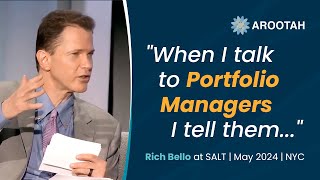
I'll just leave you with this. You know, when I, when I talk to portfolio managers, I let them know you're managing two portfolios, portfolio of investments and your portfolio of people. And as you grow, that portfolio of people becomes a much more important portfolio to manage. Let's thank the panel. Thank you.
More from Rich



Goal Setting Workshop: Set Your Top 2023 Goals & Create a Master Plan to Achieve them! NYC

Goal Setting Workshop 2025: Design Your Master Plan for Success! AROOTAH Advisory & Coaching | NYC

Redefining Success: Arootah President Talks with Christyl Murray on Culture, AI, and Much More!

Rich Bello Best Practices Keynote to Family Office Leaders | Parrish Museum The Hamptons | Aug 2025


