The Emotional Intelligence Panel | Oct 2024 | NYC
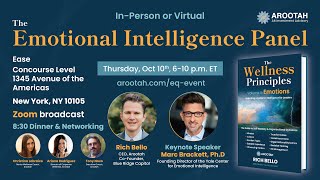
Rich Bello leads a panel with Dr. Marc Brackett and others on emotional intelligence, covering how to read emotions as signals, what happens in your brain during stress, and practical tools like the Mood Meter and RULER framework for leaders navigating conflict and decision-making.
Chapters
This is a great, great topic. The reason why it's so great is because the quality of your emotions is directly correlated to the quality of your life, right? It's just, it's kind of common sense, right? You have great emotions for your whole life. It's like, I had a great life. You have shitty emotions, like, whoa, what a lousy life I had. Right? So we want to have great emotions in our life. So the benefits of, of emotional intelligence, EQ helps you make great decisions, helps you be a better leader. Interpersonal relationships, obviously it's a great, great for relationships, there's unlimited growth, right? There's unlimited growth in emotional. Can you be completely emotionally intelligent? I think there's, you know, you can just keep going and going and going. Helps you to be self aware. So why don't we just jump right into principle one? And so for this principle, you know, all, all of our books start out with the mindset. If you don't have a mindset about what you're talking about or what you're looking to do, you're lost. So even for health, for instance, the mindset for our wellness book on health, the physical body, was that you have the mindset that you're in control in large part of your health. 75%, for instance, 75% of heart attacks are preventable. This is the number one killer, by the way. Preventable based on your life choices, which means you are literally choosing to kill yourselves every, every day by your life choices. And that goes to the top 10 killers and varying. But I think it's an average 75%. So that's the mindset. Just an example for that. You want to have the mindset. It's like, hey, I do have control over my health or at least in large part. So the mindset for this book is that emotions are, well, I call them signals. In your book you call them information. I think it's actually better information and information about what? So for instance, the emotion of fear. Fear is that. What's it telling you? It's like you're in danger somehow you're in danger and you should do something about it, right? What do you do? Fight flight. Freeze Fawn. That's giving that one you probably shouldn't do. So it's giving you some information. So that's the mindset that we want to think about here. It's not that these emotions are there to be suppressed or ignored. No, hey, there's some information here. Thank you for this information. We're going to talk about that. Being grateful for this information. Thank you, great architect, for giving us this tool. So we're going to appreciate it. So, Tony, I'm going to start with you. Why is this mindset important for emotional intelligence?
Yes, emotions are signals. Usually they're a precursor for action. They're kind of telling you to do something. Then you take emotional intelligence, where basically it's an awareness or increasing awareness and a functionality or how to operate successfully in those emotions. But I want to say, too, it's impossible to not feel an emotion at any one time. We're always in an emotion. Our emotions came first. We were emotional beings first. And then we got smart. And for some reason along the way, our smartness said, you know, let's deny emotions and let's check it out the door, you know. And that kind of philosophy had and has consequences. So now we're having to catch up. So I would say that it is an imperative. It's very important to be at least masterful with your own emotions because they are telling you to do something. So imagine this. You're, you know, if they do tell you something and you're trying to ignore them or push them to the side, whatever, and you want to be a leader, it's much better to be aware and be intentional and be deliberate and work with your emotions in that way rather than try to hide them or push them to the side.
So, Dr. Brackett, why don't we go to you? So this question is about the evolution of emotions. People think it might be survival, but they evolve survival. I like to think of survival and then social, and then even Dharma. Is it possible that it's helping you to live your life purpose? I'm just curious if you had that thought or talk about that.
I just want to echo what Tony. I just want to say one thing about that, which is that, you know, regarding the mindset of emotions is that there are people do have mindsets about them, whether you're conscious of them or not. And some of us walk around thinking like, emotions are disruptive, emotions get in the way. You know, when I'm emotional, right? That means I am not capable. And other people have a mindset that emotions are data, emotions are information. Emotions help me achieve my goals. And so a big part of our work is to get people away from that kind of fixed mindset that emotions. You know, I am. This is. My father was like that, like, son, this is the way I deal with my feelings. Great, dad. I guess I'll be a psychologist. And so, you know, that was his mindset, right? That you just does nothing to do with your feelings except, like, act. Other people say, well, wait a minute here. You know, there's. You can be smart about your feelings and use them wisely. And then going to your question around the evolutionary piece, I mean, they're a system for a reason. We have emotions because they help us to do lots of things, like pay attention. So all of you, right now, it's the beginning. So you're with us. I'm a little worried about in an hour from now. And so your emotions are telling you something. If you're bored right now, what are your emotions telling you? What we're providing you is not worthy of your time. It's not that boredom is a bad emotion. It's that we're not engaging in the way we need to be. Not that we're not, by the way, I think we're doing a good job. But you might be very creative with your boredom because you're going to spend time thinking about your business opportunity. But in general, I think the idea that emotions ensure our survival is an interesting point, which is that the emotion system is part of who we are because of a basic principle of approach or avoid. So if you're in a meeting or if I'm up here right now, as you're a presenter and I'm like, like this, Right, what is the signal to you?
You're not happy.
Like, get out of here. Like, who's this jerk? And that's because you're reading a facial expression that is signaling something in your brain that is saying, not safe, avoid. When we display more pleasant emotions, like a genuine smile, which I can't do now because it's going to look so fake. I'm going to. But a genuine smile, what does that say? It's safe to approach. Let me, you know, Mark will listen. Mark is here for me. And that's important to detect because in every environment we're in, people are expressing emotions. And I don't know about you, but I've been in places where I've given speeches and it's like, this is going to be a lot of work. Because the facial expressions are one of a void.
There's this thing called negativity bias that humans have. Why do we have this negativity bias? This is for you, Arianna. Why do humans have this negativity bias? And maybe you can talk a little bit about the role of positive emotions as well.
Mark, you've alluded to it a little bit in terms of that avoid and the safe. Right. And I think at the end of the day we come back to our nervous systems really influence our emotions and how we feel and how we engage with the world around us. So it was really rooted in the evolutionary perspective. We think about ancient times before we had a more developed brain. We had to really keep ourselves safe because humans were in harsh environments, right? There were potential predators at any given moment, perhaps we had to make sure we found food enough to eat. So there were a lot more potentials for threat. And what that means is that we had to really be on the lookout and have an effective and efficient response mechanism to be able to protect us and keep our species alive. Right? So that's where it's rooted in survival. So that's where that negativity bias comes from. And in today's day and age, we're not going to be chased by a potential cyber tooth lion. Rather we're perhaps sitting in traffic or there's something happening. We have to look out for the red light or we have a tight deadline and we have to make sure we meet all of our KPIs. There's different pressures that exist, but we still have a very similar response. It's like, oh my gosh, doing death. We have that response and it serves a really important purpose to keep, keep us motivated, to keep us on top of things. However, on the contrary, we've now evolved to have a brain that has, that can also, the emotional brain also has the more positive side, positive emotions that really contributes to making sure we survive as tribal beings, as community, we can bond, we can feel love, we can feel intimacy. And that also ensures survival of our species by making sure that we procreate and we are safe and as a community, as a tribe, we can actually protect each other more. Right. So that's kind of the evolutionary perspective of why we have negativity bias and why positive emotions exist. Now with a negativity bias they are, you know, we've probably all in the room have felt fear immensely or anxiety or anger, right? It's very, what I know you call, it's like a high energy emotion and we're going to touch on it a bit later. But ultimately there's a lot of energy because that intensity makes us listen. We have to listen. We want to survive. And in coaching, coaching is really helpful, right? At the end of the day we're a coaching business. It's really important and helpful to start thinking about how we can outweigh the negativity and start adapting and reframing that negativity. That kind of knee jerk reaction that we have to survive. Right. So there's actually a really fantastic tool I love to use in my coaching practice which is called the power of three. It comes from the cognitive behavioral therapy approach, which really kind of outlines how intensely we feel negative emotions and negative thoughts, which tells us that we actually, for every single negative thought or emotion, we have to outweigh it with three more neutral or positive thoughts. It takes like three to one. That's a big deal, right?
That's actually a good one, actually when we talk about the positive mental diet to talk a little bit about.
Exactly, exactly. So that's where coaching comes really in hand.
It's really handy. Yeah. Thank you for that explanation. Christina, we're going to move to you. I know you have some extensive experience with Eastern philosophies, so maybe you can tell us a little bit about how the east and the west have cultural differences in how they view emotions and how they manage emotions.
Obviously emotions are universal as we've been talking about. It's part of the human experience, biologically wired into us. But perceptions of how we interpret those emotions definitely change culturally. Not that it's a finite rule, of course there's exceptions and everybody is different. But in the Western culture, I think there's a lot of emphasis on trying to control emotions. There's this idea that negative emotions are something that need to be fixed and we want to maximize positive emotions. And I think that's coming from maybe a lack of understanding or this idea that we're supposed to prioritize one emotion over all the others and that being happy all the time is actually a good thing. On the Eastern side, they think of it more of this transient experience, like a wave on an ocean that naturally comes up and falls. There's a concept in Vedanta which is a part of Eastern philosophy and yoga that's about non duality. And they have a term called maya, which means illusion in Sanskrit. And it really kind of talks about the emotional experience, all of our experiences really being part of this illusion and what it actually offers. It's saying that things that are changing constantly, everything around us, our emotions, all of these states, there's something within us that's still that doesn't move, that can observe something from a place of equanimity. Highlighting this idea that you're observing something like I am not angry, but I'm feeling anger, or I'm experiencing this feeling of anger separates yourself and it allows you more room to make that choice of how you want to Respond, you no longer feel in it. I think sometimes we chase thoughts that way. It's like I'm angry because so and so did this to me. And they did this to me because they don't like me. And they don't like me because in the story, the story keeps going and there's this attachment towards it. And so that separation just allows you to see it objectively.
Yeah. As opposed to more clinical on the Western side. It's fascinating stuff. All right, well, let's move to principle two. And principle two, we're going to talk about exploring the science of emotions. So again, in our books, usually we start with these two principles. What's the mindset about emotions? And then what's the science about whatever topic is in this case, emotions? So this is decoding the biology of emotions. So they're not just these abstract feelings. Right. They have a biological basis in how we respond to the world. So understand the science behind them. First one is Ariane, let's go to you. There's these two systems of the brain, literally two regions of the brain, the focus on emotions, you know, the older brain, the amygdala, and then the prefrontal cortex, which evolve later. So, and I'm fascinated by the system one and system two thinking that Daniel Kahneman talks about and how that might fit into these two regions of the brain.
So system one thinking that Daniel Kahneman really coined is all about that fast paced, kind of knee jerk, very instinctual reaction. Right. So it's when we're under pressure and we kind of just react under, you know, just like go make a decision. That's really informed by what I alluded to earlier, which is that that primitive part of the brain, it's very instinctual, that includes the amygdala and or the limp. The amygdala is part of the limbic system, which is the emotional brain as well as the brainstem. So that is the first part that actually evolves in the womb. In terms of the brain, it's the older part. And fortunately, as humans, as we evolve, we actually have the new part of the brain called the neocortex, or prefrontal cortex, meaning it's just the newer part. And what that really grants us and graces us with is the capacity to actually step outside of that reaction, as Christina alluded to. Right. How can we step outside and be a witness and observe? And it gives us the capacity to problem solve, to be creative. It gives us the, you know, we can be thoughtful and more reflective and choose. Right. We have an element of choice and an intention in how we want to respond onto something. So that's really how the two kind of pieces play. And that thoughtful, more intentional way of reacting is really what we think about. When System two thinking, we're like slow thinking. Right. We're really intentional with it. And that's. As leaders, that's what we want to tap into a lot more. So as we go on today, we're going to talk about some strategies and how to do that so that we can really make sure we have the prefrontal cortex turned on effectively so that we can be show up as our best possible selves.
So, Dr. Bracken, maybe you can talk a little bit about the difference in the neurotransmitters and the hormones as they relate to positive emotions and negative emotions, the biology behind that.
I want to just make one larger comment, which is that emotions are in all areas of our brain. And that's just important to know. Earlier psychology would say that we have these emotions like fear and that universally the scary thing happens and people run away. And more recent research would argue that that's not necessarily the case. Every one of us has a different relationship with fear based on our childhoods. So, for example, I grew up with a very angry father. And so my relationship to anger is going to be different than your anger, than your anger. I saw like, this piercing eyes and those pressed lips early on. And that had a meaning for me. Right. Which was like, run away or get hit. Right. Because my father had some aggression problems. And it's just important to know that that's part of how I've developed in terms of my understanding of anger. Whereas someone else who had a very different childhood. Right. Anger would have a different meaning. Does that resonate with people in terms of. So our emotions in many ways are constructed across our development, and we can change our relationship with emotions. I'll give you another. Just a different example, which is I'm a kid. I had some challenges growing up. That's why I wrote a book called Permission to Feel, because I was in many ways robbed of my emotional life as a child. And so for me now as an adult, I do a lot of public speaking. Lucky that I have success, but I'm not comfortable with it. Like, when people say, great job, I get a little insecure. I get a little like, are you sure you're not going to make fun of me afterwards? There's got to be somebody here that doesn't like what I'm saying. That's where my brain Goes. So my relationship to even joy is unique and all of our relationships to our emotions are unique. I just think it's important to see that because I think a major goal of the work on emotional intelligence is not to think that my way is the way. It's to build relationships with people and understand the reasons that they have their feelings so that I can have empathy, have compassion and relate to them. So going back to the, you know, the biochemical piece, it's more complex than we might think because you can have the same neurochemical reaction for excitement as you do for fear. And so this is where the nervous system is one component of how we feel. But then there's all that interpretation. Has anyone here ever felt, for example, like, late at night you get a little like, I'm a workaholic, so it's like 11 o' clock at night and I'm like on my computer doing emails and all of a sudden I look over at my partner, I'm like, I'm having a nervous breakdown. And am I really having a nervous breakdown? I learned that from my mother, by the way. But that's a whole other story. Am I misinterpreting my body for feeling? And that's what happens. Oftentimes we infer from our physiology what we think we might be feeling, when the truth is I'm not anxious, I'm just tired. And so that's a big piece of the physiology and understanding our neurochemistry is that we do have to like pause, like your thing and check in and say, like, is what I'm doing causing me anxiety or is it just 11 o' clock at night? And I've been up since 6 o' clock this morning and I'm just freaking tired. And so having that kind of ability to pause and reflect and be granular about your experience is just a very important part of the work.
Well, that's interesting. And just these different, the different chemicals and hormones. Like one thing I was fascinated with, and I've read it, and I think I read it in your book, either that it was in the interview they had with Dr. Huberman was that the negative emotions elicit, you know, get you very narrowly thinking.
Right.
One thing I think it was as a cortisol shuts down the prefrontal cortex.
Yeah.
So then you don't reason. And it's good that you don't reason. Like, yeah, let me see if I should run from the saber tooth tiger. Let me think about that now. Now it shuts the reasoning part down. It's just run. You just run, right? It just shuts it down. You're a chemical that actually does that. It's like, sorry, we're shutting you down. We'll bring you back up later. When you ran away from the well.
What'S interesting about this point about negative emotions and neurochemicals is that cortisol in general is good because at moderate levels, there's danger. You want to be energized to get your, to fight your way out of the situation or run. The problem that we have right now in the work that I do, which is in school systems, especially in high poverty areas here in New York City. Our program is in half of New York City's public schools, some of which, you know, there's 20% homelessness, temporary housing, insecure food. You have kids who are in fight or flight mode all day long. And so what happens in particular with strong unpleasant feelings, especially fear, is that your cortisol levels are peaking and they're not decreasing, which causes immune system malfunctions, which causes the inability to focus. And so oftentimes we're looking at kids who are suffering and we're thinking, oh, this kid has a low iq. It's like, no, no, no, no. This kid is plenty smart. They're living in a situation where there's chronic stress and they are biologically not able to learn because their brains are in.
That reminds me in your book where you talked about, we saw the doctor. He said, oh, welcome to Yale. He's like, oh my, is something wrong with me? He's like, no, everybody's welcome to Yale. I think it was welcome to Yale.
Well, that was when I was, I thought I was having a nervous breakdown. Also another time in my life when I was growing up for tenure. And this is like, this is the biological treatment versus the coaching and psychological treatment literally was like heartburn taking my. I'm convinced I'm having a heart attack. I'm a lot better now, but I practice what I write about. But anyhow, went to the doctor because I was nervous. My father had a heart attack at 48. I was around 48. And I'm like, this is not good. He's like, oh, no, here's some Prilosec for your heartburn and here's some Ativan for your anxiety. And it was like literally a five minute meeting. And I'm like, that's it. Why don't you ask me how I'm feeling? And I realized I was in that peak of chronic overwhelm and I Just needed to take stuff off my plate and all of a sudden I had no heartburn. And all of a sudden I was.
Feeling better prior to that. That's good stuff. Well, we're going to talk about vibration. We're a little bit behind time, so just quickly. On vibrational frequency. All emotions have a vibrational frequency, at least according to. There's a great book on this. Do you want to just quickly talk about it?
Yeah. I think the concept of high vibrational versus low vibrational frequencies, not to be confused with high energy or low energy emotions, it's about the ability to make it expansive. Like love would be a high vibrational emotion because it's expansive connection, openness. There's this thing that you're open to things, whereas something like shame is a lower vibrational frequency. It's causing you to close down. There's a feeling of isolation. And these kind of vibrations are felt not only just someone in proximity to you, but through the phone, through the tone of your voice, through a zoom meeting and body language. These things can be communicated like a radio frequency that we're transmitting and other people are picking up on. And so I think it's really a nice thing to think about as a leader, as a human being that the way that you're feeling is directly affecting the things around you. People, plants, everything.
Let's move on to principle three. We're actually taking a look at dissecting the anatomy of emotions. Want to explore the traits? All these emotions have different traits, there's different types. And the purpose really is to label them and understand them. You know, we talk about in the book that there's three core broad categories, emotions, core survival emotions like anger, fear, and there's emotions of connection like love and gratitude. Reflective and transformative emotions like shame, guilt, even pride. Doesn't mean it's a bad emotion. Dr. Brackett, I know you have a great framework, the mood meter that you utilize. I also love your app, by the way. I'm using it myself. I love it. I love to use technology to really help. Like you say. I actually practice this stuff. Like, what good is it? We end the seminar saying knowledge does not apply itself. You guys can sit here and have a great seminar, learn a lot of stuff. You don't apply it, what good is it? That's also why we like coaching. So maybe you can give us a little bit of a feel for the mood meter. And we actually hope you don't mind. We actually have the mood meter here. You talk surprise about the mood meter. You've seen this before. Right.
I'll give you the basics, which are that, you know, you mentioned this in your opening, that from the minute we wake up in the morning till the time we go to bed, we're having emotions and feelings. Now, most of us are not, like, neurotic. And, like, every minute of the day, how am I feeling? How am I feeling? You'd go crazy if you did that. Like, that's not what we want people to do, is check in with their feelings, you know, every minute of the day, because you would go nuts. Checking in at certain points is important, like when you go down for breakfast, if you have children, like when you. Before you open the door to your office, before you make that important phone call as you transition to home. And what we find is that people generally say, well, let's just do it right here. So what's your name? Stephen. Stephen. Sorry to put you on the spot. How are you feeling? Feeling well? Great. We're done. I mean, that's pretty much we're done, right? Am I right, Stephen? Ask me how I'm feeling. How are you feeling? Honestly? Like, I have this weird. I'm on this panel with people staring at me. You know, I had a piece of cheese. I don't normally eat cheese. I've got a little acid. And then I had coffee with the cheese, which was, like, a really bad decision. And then I'm a little dehydrated. I want to drink water, but I don't want the bottle on my face. And I'm a little tired because I just got back from Mexico. I'm excited to be here, but I'm also overwhelmed. And he's like, like, what do I do with that? But how many of you, let's be real. How many of you know what I'm talking about and have experienced what I've experienced, you know, at a point in a day, right? It's like, we're not these simple creatures of, like, I'm happy, I'm sad, I'm angry. We're complex people. I don't. I'm not even. We talked about what's happening society right now. Like, let's not go there, right? Because that's like all those feelings back here that we're living with about what's going to happen over the next few weeks. And so you need tools to help you make sense of all that stuff. And this is a tool that's based on a lot of science. It says that at any given point of the day, our feelings can be honed by Understanding how pleasant or unpleasant we are, meaning do I feel like I want to approach or avoid? Do I feel safe or unsafe? Do I feel comfortable or uncomfortable? And a level of activation, meaning do I feel energized or I do feel depleted? So think about that right now, all of you. On a scale from minus 5, this is the worst experience of your life, which I hope it's not. If it is Rich and I will never be speaking again, or it's plus five, thinking like, oh my gosh, listening to this panel is like nirvana. So where are you? Be honest, you don't have to say it out loud. And then where's your energy at? Do you feel like falling asleep right now or do you feel kind of awake, alert and energized? And then you cross those two things and you've got your mood meter. And so just pick your quadrant. Yellow, red, blue, or green. Where are you primarily right now? Three seconds from now, I'm going to ask you to find the precise feeling word Freeze. Now you've got a cheat sheet in front of you. But for how many of you was a little difficult, like to find the word hands up. Yeah, most of us have a lot of difficulty going from this core experience to precise labeling. And it's because we haven't had an emotion education. So now the questioning comes in like, all right, so why did I put myself in that yellow quadrant? Oh, I'm excited to be here. And when you start asking yourself questions, you can start getting to the more precise words to describe your experience. And so that's what the tool is used for. And it covers all the emotions that Rich was talking about. Your kind of survival emotions, if you want to call it that. The fear and anger emotions it covers, we call learning emotions like optimism and hope and determination, or your self conscious emotions like pride versus shame. And you just think about it, how pleasant is it? How much energy does it have? And it's a great way to kind of just organize your emotional life.
So Tony, maybe you can tell us a little bit in the, in the corporate world. There's a lot of folks from the corporate world here. How can this be helpful in a corporate setting?
We're learning more about emotions, we're driving that idea home, and we're becoming more emotionally intelligent by doing that. So the more we look into that domain, the better. And the more emotions that we learn about and more what they do, what they say to us, the better. Say, if you're going into a meeting or maybe a training class like this, you can Be more intentional with your emotions. Right. So we already know that having an emotion of lightness and curiosity is a good emotion to be in for training, not an emotion of fear or disappointment. Maybe you're pissed off about something in the morning, something happened on the road, getting there, or had an argument with a friend of yours, and you can't let that go. Knowing that you walking into that training class with an emotion of negativity is going to close off access or limit your access to the higher order, thinking of creativity, of innovation, and your empathy. So basically this is a pursuit of being more intentional, detached from being bullied by your emotions and using them and dancing with them rather than hiding them or pushing to the side.
Principle four is about embracing the somatic experience. Ariana, I know you're really interested in this subject, but before you do, Christina, maybe you can talk about, what does somatic mean? How does it relate to emotions being stored in the body or trapped in the body? Okay.
The word somatic comes from a Greek word, soma, meaning body. So anything pertaining to the physical body and in terms of emotions, I guess it's guiding us to understand that emotions are more than a mental or psychological experience, that they're a physical experience too. And it's been said, I think a term that's thrown around there is that emotions are energy in motion. And because of that they're supposed to move through you, not really be stuck or to hold on to things. And the experience of being able to express emotions is really necessary because when they're repressed or they're suppressed, they get stored in the body and create physical ailments, diseases, discomfort, just even the experience of when you're stressed. And you know, okay, there's tension in my shoulders, I feel like there's a lot of weight on my shoulders. I've got a lot of responsibility. Over time, this becomes a chronic pain that you would feel, feel. And so it's important that these emotions are moving through and not necessarily being stuck. There's a lot of talk about that in the Eastern philosophy with Prana and Nadis, and really wanting the energy to be constantly moving through. And so essentially, when we're talking about the somatic experience is understanding that emotions do arise in the body as a physical sensation. And the more that you're in tune with what that sensation is, the more room you have to intentionally decide how you want to proceed. And especially when you have the vocabulary of understanding how to describe and differentiate these different sensations with words, there's more room to explore and to identify what the right course of action is.
I want to move to you, Arianna. There are different modalities for releasing these emotions from your body. Because it's probably not a good thing to have them in your body and cause all kinds of bad things. I think it even cause cancer. Maybe you can talk about some of these modalities for releasing emotions in terms.
Of somatic release, you know, at the end of the day, like you said, it's not really healthy to store and keep these emotions in. And I think Christina alluded to it before as well. In this, in Western culture we have this idea of being stoic and keeping it all in. So it's important to have effective strategies to learn how to somatically regulate. In our culture we often have like a top down, like mind over matter approach. But the important part of emotional release is using your body as a resource. How can we have a bottom up approach to inform how we're feeling and therefore it's related to emotional intelligence? Because then we can actually again turn on the prefrontal cortex as we're linking this all together to better show up for our teams, for our employees and for ourselves and for the people around us. Emotional release work really comes down to, I think of working with a soma, the body. We're thinking about the vagus nerve, which is a cranial nerve. It extends from the back of the brain here and innervates all of your major organs, which is a huge deal. It has a massive impact on so many functions. One of the ways that I really love to teach is breath work. It's the easiest access to the vagus nerve through constricting the back of the throat. It's a form of pranayama in the yogic kind of philosophy. You can constrict the back of the throat. We can even do it now. You inhale deeply through the nose and you almost make like a Darth Vader sound. Okay. So it's like you're exhaling out of the mouth but with the mouth closed. So it sounds like this. So you close the back of the throat. What that does is actually vibrates the vagus nerve to actually turn on the parasympathetic part of the nervous system which is associated with rest and digest. We get to be chilled and get to be more resourceful. We want that same way that we can access the vagus nerve is through sound. So even making humming sound or like an om or a chanting singing are also fantastic ways to access that vagus nerve to kind of stimulate it so that we can turn on the parasympathetic part of the nervous system or activate that part. And then the third part that I absolutely love is more kind of movement based strategies. Right. So we're releasing things. So shaking is really great. If we think of the animal kingdom, dogs, after, they're really excited to see you, what do they typically do? They shake, right? They regulate. We are the only mammals that don't really do that because it's not socially acceptable anymore. But it's actually really helpful. So we can think about shaking, we can think about dancing, ecstatic movement. And then yoga is a more kind of socially appropriate way to move and release emotion. Particularly yin yoga, which accesses really the deep fascia where we store a lot of emotion or doing flows that have a lot of hip openers because we store a lot in the hips, traditionally speaking, and or tension in the necks as Christina mentioned as well. So there's a lot of that we can do with the body. Right. Breath sound and then grounding, centering in the body that way.
Those are some amazing things. A friend of mine did ayahuasca. I think he said he shook for like five hours.
Yeah, back and forth. So a lot to release.
Christina, so what about psychedelics? Have you taken any illicit drugs? Tell us what they are and how does in all seriousness, psilocybin, this is out there now, psilocybin, sound? Maybe you can talk a little bit more about it.
I've been really involved actually in using psilocybin as a form of therapy and combining with my coaching for a few years now. It's a really good tool when done in a proper environment with the right intention. I think a lot of people think that maybe they can take, take this drug and it's going to heal them. You're an active participant. It's a tool, it's a technology. And it's guiding you not only to close down your default mode network that's regulating these habitual responses to things, which is essentially the ego. It creates like breaks down those walls that are hiding those repressed emotions or those things that you're stored in the body. And so those things are removed and you're able to observe them from a different perspective, less fearful way, objectively. And we usually match this. When I'm in my practice, I match this with the use of sound therapy, specifically harmonics. The reason being is that harmonic scale is derived from nature. It's the pure harmony that we recognize in nature different than the western scales that we're using. That has equal temperament, which has been altered for convenience, really. And those sound waves are actually really unstable. If you look at them and isolate them, they're not stable. And so the harmonic series is this ability to retune the body on a cellular level without the mind getting in the way. It just showcases the high intelligence that the body has to respond and react and know what to do when you're out of your own way. When the mind is not at play, the body knows what to do. And these harmonic instruments, like tuning forks, gongs, are amazing. Anything that's going to isolate the ability to hear more than the fundamental frequency, and it's an infinite scale upwards into this harmonic series, which has profound effects. And of course, the most important part is the integration. So after working with a coach, what did you learn? What are we going to do about what you learned? And really, without this, it's just intellectual stimulation. So, of course, the integration is the best part. I could talk about this for a really long time. It's a passion project and something I've been working on for a long time. So if you're interested, just come and talk to me later.
The next principle is about emotional influencers. So it turns out that there are two influences on emotions. I like to think about these things. These are things you may have control over. Internal, for instance, might be something like sleep, and external might be something like music is one of my favorites music. It's kind of, of course, right? Thinking about working out and you're like. And you play some music like, let's go. Tony, maybe you can talk a little bit about, briefly about some of these external influencers.
Well, this might be a simple one, but in the context of leadership, we know that anything input into the body through our eyes, our taste, our hearing, our fingertips, influences us physiologically and emotionally. So as a leader, and if you know that, then you are mindful about what you do put in your body. You know that if you put this in your body, it's not going to be well for this particular meeting. But if you put this into your body, it's going to be. Is going to be something that helps you in this particular meeting or this particular environment. So really it's about being more intentional. And being more intentional requires an awareness and a functionality in these domains, which are our emotions.
There's obviously some internal influencers on emotions. If you can talk a little bit about that. Doctor, I love sleep. I'd be overjoyed if you could talk a little bit about sleep. We all know you don't get enough sleep, you're grouchy. Why is that?
I mean, you can't separate your mind from your body. Right. So that's the simplest thing there is. You know, your brain needs glucose, the only thing that fuels your brain. And so we get glucose from eating carbohydrates primarily. So at the end, at 4 o' clock in the afternoon, you know, you think, oh, let me get that protein bar. It's actually not going to be as helpful as if you had like a little fruit or some kind of, you know, healthy carb, because that's going to give you the energy you need to keep going. And again, like my tiredness at night that I share with earlier, where I confuse that with being anxious. The same thing applies to when you get hangry in the afternoon. It's not that you're angry, it's that you're confusing your physical state of not having enough glucose with a feeling. And so we have to be careful about how we interpret our bodies. Right? Right. Because we can make lots of mistakes. We can over identify unpleasant emotions by just paying attention to our body and so just being aware that, like, it's not an emotion, it's a physical state. Meaning I'm tired or I'm hungry. I would say that the way we define emotions are that they are mostly automatic responses to stimuli. So we have an emotion because something shifts in our environment. Like Rich all of a sudden says, you know, Mark, go blank yourself. Like, I didn't expect that. And so, boom, my brain has interpreted that as a threat. And now I'm gonna go like, beat him up or run away.
He's a black belt.
Yeah. So be careful with that. But emotions come from external. Like you say something, it activates me, but they also come from, you know, I don't know about you, but you wake up in the morning and you start like thinking about your day and you're like, you know, so you have internal representations. And that's part of like, the work that we do is like evaluating. You know, I'm in this weird quadrant, I'm in that blue. I feel low energy, unpleasant. And then you start asking yourself, well, what am I thinking about what happened yesterday? What am I? What do I have to do today? Oh, I have to give that presentation with Rich. Kidding. And so that's where you're kind of interpreting, you know, your cognition as a way to help you understand, you know, what your feeling is. So internal, kind of. I mean, a smell can activate a feeling, right? You know, you smell delicious food. That reminds you of your grandmother's house or something like that activates nostalgia.
So that's interesting. I like this topic because this is something you do something about. You can influence these internal and external. Some of them anyway.
Can I make one more comment?
Sure, absolutely.
I just want to say about the. We didn't get into physical activity. The studies were done where you had someone just sitting sedentary, like we are, versus someone kind of doing a walking machine or a bicycle. And then someone comes in to try to trigger them. And the question was, would the person who was exercising versus sitting, how would they respond? Controlled experiments. So 100 people sit, 100 people do the exercise. And what was found was that people who were exercising right with the release of endorphins and other neurochemicals just did not get as activated as the people who were being more sedentary. So you can see how, like now you should go to the gym before you go home. Right? It'll put you in. It literally will just change your neurochemistry so that you will be less triggered.
So, so let's move on to principle six. And this is about that. Emotions can really literally be habits. Some of them could be habits, some of them just instinctual or just reactions. So they can be habitual, which means if they can be habitual and we talked, we actually wrote a book on habits, they can be transformed. So, Christina, maybe you can talk a little bit about how could habits. How could emotions be habitual? And maybe there's some ways to. Maybe you can talk a little bit about some of the ways that they can be. Be transformed. I know you like talking about the emotional home and triggers. Anchors love to hear all that.
I think emotions can definitely be habits when we're triggered by something, especially repeatedly when we tend to be frustrated in traffic or nervous talking in front of an audience. And then this becomes the regular emotion that happens. Anytime you're even close to a situation like that, your body's trying to find the fastest way to process this emotion. And so going to go the path of least resistance, what's familiar, and it's going to keep repeating that. And we tend to have emotions that we feel more comfortable feeling for whatever reason. You know, the more that you actually repeat an emotion, it doesn't really take as much of a trigger to actually get you there. Even a thought or even thinking that you might find a trigger that's going to bring you there will bring you there. And so it made me feel like, oh, this is just the way I am. And an acceptance. I'm like this because this person was like, my father was like this, my mother was like, this is just the way I am. But the good news is that there is this way to change. But it first comes with awareness, which I think I work a lot with my clients with first being aware of what is that emotion that you keep returning to and what is it that you want to be feeling. So if you're speaking in front of audience, you're feeling anxious, but you want to feel confident. The first thing I think really happens in the physiological body, you decide, I want to feel confident. Well, confidence is a high vibrational emotion. So if I'm hunched over like this, this feels very low vibrational. I'm isolating myself, I'm closed off. So what happens if I just sit up a little bit straighter, My postures change. How does that actually affect my mood? Almost immediately. And then you pair that with something like a very deep intention, like an incantation. So you're speaking something with high emotion, like I am confidence. Confidence exudes out of me. I am, you know, what I have to say is important, whatever that statement is. And you emphasize different words with different tones and excitement and emotion. Because emotion really strengthens our habitual responses. They talk a lot about this. In yoga, anything that's done with an emotion becomes a habit far faster than without. Whether it's positive or negative, we connect these two. So you use that emotion, you use your physical body and then you repeat and practice because nothing becomes a habit unless it is repeated. And this is a very general idea of how you would anchor yourself. The anchor becomes the new trigger for or the experience you wish to have.
So, Arianna, I'm curious about this concept of emotional agility and maybe perhaps since you do a lot of corporate wellness, is this something that can be taught?
Absolutely. So to speak to emotional agility, it really speaks to being able to recognize the emotion, understand it and then better manage it. Right. So this is absolutely crucial when we're thinking in a corporate setting or any team setting, especially as leaders, right? How can we be effective role models for our teams? And equally, how can we make sure that our teams are well and their emotional lives and inner lives are being met the way they need it to be. And then equally, that allows them to show up in a way that is more creative, more innovative, more collaborative. This is really important whenever there's agility. Think about it, it's like parkour for your emotions. We have to be able to adapt at any given moment, right? So if there's a change in management, what do we do if we didn't close that contract?
Oh crap.
Okay, what do we do? Move on to the next. Right. We need to be agile to be able to meet the growing demands, especially if we're thinking about scaling, if we're thinking about just in general meeting business needs. We want to be able to think ahead that way. So how we do this in corporate settings, it really looks like building those skills of emotional intelligence. Can I have that self awareness of where I'm at so I can actually recognize what do I need? How do I then communicate that need to potentially my team, a peer, my manager, higher up, whatever it might be? How can we then collaborate and also build in empathy? How can I then recognize my peers, their needs, what might they need so that we can collaborate and work more cohesively? So it really, really does have an impact on organizational structure. Structure, on just dynamics, workplace wellness, employee turnover, job satisfaction, all the things. Right. So it's very much something that I love to teach and is through workshops we do this and at Aruta we do that, we deliver workshops and we teach just this. It has to be really role based. We do a lot of role playing case studies so that we can actually develop the habits that Christina was referring to. We have to prove, practice and implement these skills to learn to identify the emotion. What do I need? How can I then manage them effectively?
That's fascinating. Tony, anything to add to that?
No, I think that covers most of Usain, but I can cover more about that with this question right here. You're talking about executives who for the need of emotional intelligence. We start out at work generally as good doers, but eventually it is how we are being at work that matters. So what is that going from doing to being, being holding a space, being able to have conversations with high stakes people, being able to read people. They say that, you know, IQ gets you in the door and EQ gets you promoted. Well, this is the reason why we are generally becoming more emotionally intelligent when we are learning how to be more intentional and more understanding of how others are in the same room.
Yeah, that's really good. I had a coach of mine tell me the older I get, the more I realize that the soft skills are so important. Like the technical skill. You focus on the technical skills. Technical skills. I was like, ooh, soft skill's more important. This is a soft skill. So I mentioned it to my coach, said, Rich, I told you this 20 years ago. He's like, the soft skills are the Hard skills. That's good. I'm going to use that one day. So let's move on to principle seven. So now we've been talking mostly about internally, our own emotions. Now we're going to move out to emotions of other people that you're involved. So this is somebody else or that you might be talking to. Strengthening relationships by emotions to Dr. Brackett. Maybe you can talk a little bit about verbal and non verbal cues and somehow sometimes these get mixed up. Not very easy. I was just listening to your book. People have a really hard time with this, and in different cultures it can be different. I'm sure you can talk for a couple hours on this topic, but you.
Give me two minutes.
Let's give you 95 seconds.
Sure.
Yeah. You take as long.
95 seconds. I can do it in 85. So let's imagine I am your significant other. But we're. We're just. Now we're just starting to date, and I come home from work and I'm like, I hate my job. How am I feeling? Frustrated, angry, frustrated, agitated. What do you think? Stressed. So we got angry, frustrated, stressed. Anything else?
I'm relieved to see me look at you.
I have a confident partner. So, angry, frustrated, relieved. What else? Unfulfilled. The question is, do you really know? And I think one of the interesting problems that we face is that we think we know. We tend to attribute emotion to people as opposed to know how they really feel. Because we have been trained by watching terrible TV shows and reading not your books, but other books that are teaching us that emotions are, like, easily detected in the face and in the body. And they're not. As a matter of fact, we are very bad at it. And it's because of a variety of reasons. One is, I'm a man. My true emotion was that I was denigrated at work. I'm making this up right now, and I'm feeling deep shame. But is it culturally allowed for me to be a man who shows up and like, you know, I feel humiliated and I feel shame? No, I'm just going to express it as anger because that's just more appropriate for, you know, society, the way I've been developed. And so now all of a sudden I come into your office, I hate this job. And you're like, who do you think you are talking to me that way? And then all of a sudden we're in this big fight when. Because my emotion activated you, right? Because you're like, oh, this signal, like this guy's, you know, whatever, and think about it as like, parent, child, couple, leader, subordinate. I mean, all these misunderstandings that are happening. And it mostly happens because we get triggered. We think we know what the person is feeling, and because when we're activated, we're not able to be present and say, like, gosh, it sounds like you had a really rough day at work. Tell me what happened. And then you hear what's happening, and then by listening, you realize, oh, my partner is feeling shame, not anger. My partner needs love, you know, not to be yelled at for being, you know, nasty to me.
It's a real crisis with kids, too. I remember in your book, you know, really, if you don't really understand, teachers don't really understand where it comes from or. No, your mom, when, you know, you had that, you know, when you didn't pass that test and.
Exactly. And it's cultural, too, you know, So I remember I grew up in northern New Jersey. You know, it was very white Irish Catholic the neighborhood. I grew up, you know, and I'm not white. I'm white, but not Irish Catholic. And so, like, just, you know, the. Just all I have was exposure to white Irish Catholic people, you know, and then all of a sudden, I went to Korea because I studied martial arts, and I'm like. Like, people are weird here. And it's not that people were weird there. It was because I was a naive Jersey boy, so I had no exposure to other people's cultures. And so I was interpreting things in ways, you know, that were very judgmental based on having no cultural competence. And I think we make a lot of those mistakes, whether it's gender, whether it's race, whether it's, you know, religion. Everything that we do is shaped by our development.
Yeah. And you touched on active listening, and that's a great segue into the question that I wanted to ask you. Arianna, all coaches know how important active listening is. And for this topic of emotional intelligence, maybe you can talk a little bit. Why? Active listening is really crucial.
It's also another thing that most people aren't great at. And actually, I have my hand raised. It was a skill that I realized more recently. I was like, okay, I need to work on this. And we all do. Actually, most people believe they're better active listeners than they actually are. Why is it so important is that we get more. First of all, we get more out of people, right? When we give them the space and create psychological safety and letting them know that they have a place to speak their truth, to be heard and seen, it also is really important in building trust. Right. And when we think about in the corporate wellness space, which is my view of the world is, you know, thinking about that. We're thinking about building trust in teams cohesion. How can we have teamwork so that we can actually build better rapport, actually enjoy what we're doing where we have passion, we can then create with purpose and more, you know, oomph, which we want. And active listening is really gives space for us to also be able to read people better.
Right.
If we're interjecting, we're not actually getting us giving them space to actually say, this is actually what happened at work today, as you mentioned, it's being able to read nonverbal cues, which is a huge part of listening. And most of us always just go with, well, you said. Right. Why, you know, can kind of go on the attack immediately versus reading. What are actually people saying? I could say, like, I'm not stressed. Would you believe me? Not really. Right. And so this is a really important skill to learn for your personal lives and equally in the workplace. So there's a lot of workshops that I love to deliver on this. One of the kind of practices that is great and actually is mentioned in the book and is a huge part of sel social and emotional learning is the use of I statements. So practicing communicating with using I statements and saying, this is how I'm, you know, this is what I'm going through. I feel X when you do Y or this is what's coming up for me. And then the other person just listens. And this is also an opportunity to then practice mirroring. Okay, so what I'm hearing you say is that you're frustrated when I don't, you know, respond to your emails right away, whatever it might be. Right. So. So really being able to give space to communicate and then respond back through mirroring, paraphrasing. And these are really great coaching techniques and we coach people to actually use them in real life too.
The number one reason why people don't actively listen, you're thinking what they're going to say next as opposed to listening. Yeah, that was when somebody told me.
Always on the deep.
That's true. Christina, let's. Let's move to. Not to the next principle, but for. Stay with this principle for a second. People talk about the importance of empathy. They're talking about leadership and emotional intelligence especially. And curious, what are your thoughts on that? And how does empathy differ from sympathy, maybe compassion and pity?
Sympathy is a lot like giving pity or condolences to somebody. It's separating yourself from the experience. Like, I feel so bad for you. It almost puts you on a pedestal. Like, it's so nice and sunny up here. Too bad you're drowning in that ocean down there and it's all cold. It kind of separates. It separates you. And it doesn't really create a lot of room for connection. Empathy, on the other hand, is putting yourself in somebody else's shoes, really understanding how they're feeling. Not to be confused with, oh, I'm going to feel this for them. It's not that it's saying anybody in your situation would feel this. I really understand where you're coming from. It's perfectly normal and natural that you be feeling this way given these circumstances. This allows the person to be validated in their emotion, to be understood. And you're actively going, you know, what would it be like from that side? And this can help in conflict resolution. To just for a moment going, how would that other person feel in the way that I'm communicating with them or given the circumstances, how might they be feeling? Allows you to understand and communicate more responsibility respectfully and effectively. Compassion, on the other hand, is like empathy, I guess, a step further. It's empathy in action, going, okay, now I understand you and I'm motivated to help you move out of the situation into a better situation. Compassion doesn't mean being nice, making other people comfortable. Sometimes true compassion is actually asking the hard questions, doing the hard thing, and really rattling somebody to snap out of a limiting belief or whatever it might be. And coaching is really important as a coach to make sure there's a distinction between what would I do in that situation and what's best for that person to do in the situation. And this is where really questions really come up as the best way to offer compassion. Don't assume that what would make you feel better in a situation is going to make somebody else feel better in a situation. We interpret emotions differently. We all have different needs. And so it's asking those questions, being very vocal and asking the tough questions so that person can find the solutions within themselves. It resonates more with them. It leads to better transformation. And it's really what true compassion is, in my opinion.
You know, one of the top requests I get from coachee clients is strategic thinking. And I say, among other things, that your empathy is part of strategic thinking. To be able to project yourself over there in someone's heart or their mind and feel what they feel is 100% part of thinking strategically. Because if you think about it, there is no conflict. There is no conflict when you fully appreciate and understand with empathy all of the limitations, all of the barriers over there, because then you have it in your calculation. And to be empathetic, we sort of have to be free of a negative emotion because when you're pissed off, you're angry at somebody, there is no empathy.
Well, with that, why don't we move to principle eight? So now we've talked about our emotions for ourselves, understanding our own emotions. We've talked about emotions and interpersonal relationships. Now we're going to talk about emotions from an organizational perspective, from a team perspective. So Dr. Brackett, you know, Dan Goldman talks about self awareness, self regulation. His model, this focuses in, on first yourself and then on interpersonal and then team dynamics. We want to talk about team dynamics here. Maybe you can talk a little bit about ruler here. I think this is not a bad time for you to jump in and talk about your framework.
I think it's important to. We've talked about this briefly, but just to hone in on the fact that all of these skills are intra and interpersonal. So it's. Right now it's, how am I feeling? How are you feeling? What's causing my feelings? What's causing your feelings? Am I expressing? Am I comfortable being my true self on this stage? Or do I feel like I have to, like, mask my true feelings because of the context? And then with all that, like, what am I doing with it? Am I able to, like, be still and present? Or are my emotions kind of running me into a place, you know, that's not great. But also at the same time, I have to be thinking about that as a leader, as a manager, about you. Because emotions are contagious. You know, if I were one of my colleagues, for example, who might, you know, come up here and be like, the know it all and, you know, and just be like, you know, like, rich, I'm gonna tell you what the real thing is here. You know, all of a sudden, like, what happens? Boom. The energy changes. People start wondering, like, what's going on now? And your brains are in a mode of like, do I stay or do I go? It's that fast, though.
It's still good food. Just.
But does that make sense? It's like that, like, all of a sudden, like, all of us have had an emotional shift based on my effect or our relationship here, what's going on? And I think leaders really need to know that a lot because we tend to think of like, my emotions are my emotions and your emotions are your Emotions, but they are co constructed constantly throughout the day, especially in the workplace. And so if you have that mindset that, you know, my facial expressions, my vocal tone, my body language, my posture are sending signals out to the people that I'm leading and they're making inferences about that and that's driving whether or not they want to actually do good work or not. And I'll just, I'll share. I did a study on this, you know, over the pandemic. I do mostly work with school leaders and I did a study with thousands of them across America. And we had them, we looked at their skills of emotional intelligence, their self regulation skills and their interpersonal regulation skills. So the self is like. And they're rated by the employees. So the self one is like my leader can handle stress, you know that people can judge that like. Right. Or the interpersonal is. My leader is helpful at helping us deal with our stress. Like creates an environment where we can be comfortable being stressed out and is supportive. So intra interpersonal. And what we found was as a longitudinal study throughout the pandemic, that teachers who worked in schools with leaders who were higher in the interpersonal intelligence area of emotional intelligence, much more positive emotions, much less burnout, much less likely to want to leave their jobs. And I think one of the most interesting things was they actually had better sleep quality. So think about that in terms of our leadership skill in emotional intelligence is literally affecting the quality of sleep of our employees.
So this topic now is we're in the world of the era of AI, Emotional intelligence becomes even more important. The great differentiator. I know you and I talked about this pre panel. Love to hear you talk about it. Why does it become more important, even more important now in this AI era?
Yeah, I mean I'm not against AI. I think AI is fantastic. But you're not going to make love to your AI. And so yeah, I worry a little bit about that. And the issue is, I think where the AI comes in handy is in the kind of that system two piece, right. The cognitive pieces of it. But we have to. You can learn from AI, but you got to practice in the real world. I think that's what makes emotional intelligence one of the most interesting forms of intelligence, which is that, you know, all of us here pretty sure know that five plus five equals ten. How many of you agree with that? Yes. Okay, great. So we all have that cognitive clarity. But how many of you know some of the things that they were talking about around? How many of you know how to take a Deep breath. Raise your hand if you know how to take a deep breath. Yeah, right? And like we know taking a deep breath works. It helps you deactivate. My mother in law moved in with us during the pandemic for reasons that were not desirable. It was that she got stuck here. She's from Panama and couldn't go back to Panama because of my colleague Robin's wedding. And it was during the pandemic. It was the week before the pandemic hit. So Irene, who I love dearly, got stuck with us. And we were, I mean, it was really rough. And I would take my breath. I'm like, mark. And then I would say, I'm even clear why you need to get the hell out of my house. So I could have gone into AI, like, what do you do with mother in law who's driving you crazy? And we say, take a deep breath and like, think positively. And then I get in the situation where she's looking at me and she's like, you know, are you making me a cup of coffee? I'm like, no, make your own cup of coffee. I don't do coffee with people in the morning. Does anybody know what I'm talking about here? So we have to really understand that the AI will help us learn things. But we've got, this is like a real world intelligence. And so we need to practice. Maybe we can practice with robots. The transference of the robot to the human is still light years away.
So let's move. Arianna, maybe we can move to you on conflict resolution in a corporate environment. Where does AI, where does EI EQ fit into conflict resolution? It's such an important topic.
I think it's the foundation for conflict resolution. When we think conflict, it's a dynamic, there's immediately a dynamic at the base. I mean, we can have internal conflict, but we're really talking about workplace, as you mentioned. And so immediately we're talking about the inter. Relationship that you were referring to. So this is where emotional intelligence is so, so important, right? We have to first become aware of what's coming up for me. What is the story I'm telling myself about that person or about the situation, right? Understanding. Then we have to know how to self regulate, right? Whatever it is that I'm feeling, how can I regulate myself in a way that I can actually turn on that prefrontal cortex, have that online so that I can then engage in a way that is productive, right? So thinking conflict resolution, I think to the work of Peter Coleman, who is actually key in conflict Resolution work. And he speaks a lot about constructive dialogue. And in order to do that, we have to be emotionally aware, we have to be emotionally intelligent. And so not only is it self awareness, emotional regulation, it's also thinking about putting myself, the empathy that we were speaking of before, putting myself in their shoes. So a question I really love to ask or I encourage when we do workshops and when I teach and when I coach, I encourage people to ask, okay, what must be true for them to be showing up in that way? What's happening at home, what just happened in the morning on the way to work, what's going on? So being really curious, inviting curiosity, is really important in conflict resistance. To be curious, I think, Tony, you mentioned it earlier as well, is to be curious, we have to be in that kind of positive emotion. Right? We're not going to be curious when we're like, er, right. That's not going to happen. So we really have to tap into regulation and then being able to show up as our best possible selves so quickly.
Tony, maybe you can talk a little bit about different leadership styles. We're talking about organizational dynamics and how that fits in with eq. And I'm particularly interested in the servant leadership.
Well, servant leadership is when you give more than you take, but more than that, it's actually this proactive empowering of the people that work around you rather than yourself. So I have a story. So I used to work down the street, 1221 Avenue in America's at Morgan Stanley. And I was there for several years. I had a lot of good friends. I was the operations team and I was being promoted. And I worked for the Products Active International who was led by Barton Biggs. And it was a sharp, snappy team. And I thought, oh, I'm going to get promoted. My first time in this business and I wanted to do a good job. So I started looking around me, all the leaders that I thought had the distinctions that I wanted to adopt. It took a while and it was a little bit of an endeavor, but I did finally figure out I can be this kind of leader. Well, it took me two years to build up this credibility and this camaraderie and this love with my team. And in a month, they hated my guts. They saw me as someone who was not myself. You know, I wasn't authentic. I was a Kool Aid drinker. I was just one of the leaders out there. And it was devastating. Long story short, it was after that that my motto became as I led, so I take care of my people first. I work for them. They know who the boss is, but I work for them. And that is kind of like servant leadership. But the idea here is, really, is I advise you to find out what predispositions, what natural precursors and likes that you have, and your leadership style will fit those values. And that would be the best leadership style you can ever adopt with a little bit on the side for adaptability, to have that growth mindset, because you always want to be learning and have that sort of input of opening and curiosity and having that baseline. Any leadership distinction can be put on top of that. That is a necessity for a particular boss or a particular company or a.
Domain, which could involve tough love, which is all you know, which is they.
Know who the boss is.
But I work for this. Painful. Even if you're talking to your kids, it's like, I have to give them this lesson. Like, not. Not like you got tough love, but.
Make sure there's love there.
Love. It has to come from the heart. Yes, it has to come from the heart. Exactly. All right, let's move to principle nine, deciding with clarity. So this is about the impact of emotions on decisions. So when we're making decisions, people think that it's really logic, reason based, maybe a little bit of intuition and depends on who you are. I used to be. No, it's just reason. Logic, logic, logic. We wrote a book on how to make great decisions. We would say all this logic, logic, logic, logic. And at the end, now, what's your intuition? What does your gut say about it? I still do believe that you do have to lead with logic. And then what does your gut say about it? Your gut differs from the logic. It's like, hmm, why would that be? And usually you'll find either the gut instinct might have been some cognitive bias or something, or there is some logical reason why your gut chins. And it's like, oh, that's why I didn't think about that. So then, so what is it? So that there's, you know, making this decision based on logic and then intuition, and it's like, well, what is intuition? So intuition is really kind of experience, right? Experience. Emotions. Emotions fit into intuition. So, Christina, with that preface, why are emotions important and how do they impact making decisions?
I think emotions guide so many of our decisions. Whether we realize it or not. We're highly affected by that. The logic side, of course, is important because you want to make sure that you're not making impulsive decisions, especially when emotions are running really high. If you're angry, you might Say something or do something that you don't really mean and later reflect and maybe regret that. And so I think there's a balance. There's a balance between this intuition, which is that gut feeling, past emotional experiences, what's happened before, and then there's the logic and reasoning, and you're combining the two. And I would say that balance does not always mean that they're equal. There's a. There's a levelness because there's some. There's some instances where decisions need to be made really quickly and you're going to rely on that instinct and you're going to do it quickly. And the emotions are actually also guiding you towards what do I value? What do I. What's important to me? What am I avoiding? I think these are really interesting things to think about, especially when you're faced with a decision where both options are good options. Those are the hardest decisions to make. It's not a pro con list. Both of them have pros. Now, which one do I choose? Well, that's where the values really come into, and that's where emotions come to play. But then on the logic and reasoning side, you know, maybe there's something high at stake. Maybe you have a little bit more time, you want to really think it through, and then you're going to use the logic a little bit more on the heavier side. And then at the end, check in with your intuition and. And got like, how does this feel? Am I okay with this decision? Even that trick where they say, flip a coin and like, if it's the side that you didn't want, it's kind of an indication that it might not be the direction you want. So, I mean, I think that there is just this balance, even though that balance might not always be equal.
Right. And if you do have the fortunate situation where logic is equal to. Is equal to your intuition, it's like, this is the way I thought it would turn out. Yeah, boom. You've got conviction and you move forward boldly.
One thing I want to add is just some interesting research on how emotions affect decision making. And it really pertains to the idea that when we're not aware of our emotions, they have the most profound impact on our decisions. And so it's not that you make a bad decision when you're angry or a bad decision when you're anxious, or a good decision when you're happy. We've made. How many of you ever made a bad choice when you've been happy?
Sometimes the worst ones.
In relationships, it's always like finding when your partner's in a good mood and ask for that thing, right? Or your kids are really great at that. They're like, daddy's in a good mood. Can we go to the mall? And you're like, yes, yes. And then afterwards you're like, what the hell did I just do? And because you were in that positive state, you weren't really thinking about the choices you were making and you just go. So it's important not to think that, like, good decisions are made when we're in positive moods and bad decisions are made when we're in negative moods. You can make a fine decision as long as you're self aware. And so just by naming your feeling and attributing the feeling to its cause, it will kind of delete that bias. Does this. So you can be like, I've had this. I sound like I'm an emotional wreck. I'm not. But like, I tend to be irritable in the morning. I just like, I wake up having an existential crisis and then I'm like, what am I doing with my life? And I'm doing this thing tonight and I'll get in the car and I might ruminate about that, you know, and like think about it and then I'll get to work and someone will say, mark, would you like to look? You know, can you look at this grant proposal or can you read this paper? And if I'm not careful and I have a lingering feeling of irritability, I will project that on my judgment of that piece has nothing to do with the piece. It's based on the emotion. However, if you use tools like you're learning here around emotional awareness and say before you go into your office, I said, remember checking in, Mark, you're irritable. Why are you irritable? Oh, because you had that argument at home. The dog said this, whatever. Okay, so that's why I'm irritable. I can still be a little irritable, but it won't have the same impact. So I think that's important information to know.
I really think this last principle is really where it's. Where it's at. So this is about how to manage your emotions, right? This is really where it's at, your emotions. And also you can think about the, these constructs as these frameworks, as managing other people's emotions, understanding their emotions, and then managing from there. So, Christina, there's a quote attributed to Viktor Frankl, between the stimulus and response, there is a space in that space Is our power to choose our response. In our response lies our growth and our freedom. This is such a powerful, powerful quote. This is what I say is mindfulness. You want to talk about mindfulness? This is our free will. We have free will. You don't have to react without thinking about something. We can use our free will. So, Christina, maybe you can talk a little bit about this, about the quote and how this could impact these constructs that we're going to be talking about and how to manage emotions.
I think between the stimulus and response is not only a pause, it's actually this ability to reclaim our right to choose who we want to be, how we want to show up, how we want to react. It heightens the awareness. You're checking in to say, yes, like, how am I feeling all of these things, but what do I want to do with this feeling? There's a book that I read years ago called the Art of Being and Becoming, and it touches upon this idea that we're an art project, our greatest art project, and we're actively sculpting and creating the person that we want to show up as. And I remind my clients a lot that people remember how you made them feel long after they've forgotten what you've done for them. And so it's really about this legacy, like our emotional energy that we're leaving behind as part of a legacy. And what I love about this pause is that it's just this opportunity to say, like, what is that brushstroke of paint that I want to be putting on my painting? Like, what do I want to chisel out? What do I want to uncover a little bit more of? And it's a constant creation and I think an ongoing process that is never ending. We're always becoming more and more the version of ourselves that we want to be. And I think it's quite beautiful. And this quote really reminds me of that.
Dr. Brackett, you know, I really want to hear more about the ruler. If you can give us a taste of the ruler, I'd appreciate it. You can talk about some of the other constructs if you want. Real quick.
I can link it to this. Well, RULER is just an acronym for five skills that we teach in our work, which is recognizing emotions in self and other, understanding the causes and consequences of our feelings, labeling emotions precisely, knowing how and when to express emotions across context and culture, and having the strategies to regulate them. And that's kind of when you're using that tool that I shared with you earlier, the mood meter, you're starting off with the recognition piece, like, where am I? Why am I there? What's the precise word? Given my experience, can I express it? Is it safe to express it? How do I want to express it? Do I need to regulate it? Do I need to stay or do I need to shift? We have about 5 million children that we have worked with now across the world that are learning this every day and really building this muscle. And it's a muscle that night when my mother was. I love her, she's a wonderful woman, but you know, I wasn't planning to live with her for seven months and so. And neither was she planning to live with me, you know, and I realized I was a complete narcissist because it was like, she's annoying me and I'm like, do you think she wants to be with you? You know, anyhow, we had like a blow up in our family and she looked at me and she goes, are you really the director of the center for Emotional? And I looked at her, I'm like, not tonight. And like it's going down. And it went down, you know, and then, you know, I went to bed that night and talking about that space, you know, with the Frank Cook quote, I was like, mark, your job is to teach people emotional intelligence. It's like, whatever. And so, you know, you have to understand those failures. Like, you know what, you know, what was really going on for me that I had that failure. It's not that it's a bad thing, it's just that I had to deeply understand it. I had to figure out the best version of myself that next morning because she wasn't going anywhere. And you know, did I have the courage to apologize? Did I have the courage to ask for forgiveness? And I did. And you know, I realized that I was really so self focused and I wasn't thinking about this 81 year old woman who had been abandoned from her home and her dogs and her parrot that we were figuring out how to take care of in Panama. And so regulation from Ruler's perspective is at the top of the hierarchy. Maybe that's why it's Principle 10, because at the end of the day we have to know what to do with our feelings. Do I keep this feeling? Do I shift it? Remember, there's no bad emotion. I always joke if any of my team members are here, please do not get angry with me for saying this, but I like to hire people with moderate levels of anxiety. I mean they get stuff done, right? Everybody, all these mindfulness people that want to breathe all day. You know, like, we have to write papers we don't have. You know, you can go to yoga after work. I'm joking. I'm happy with people who do a minute of yoga. But my point here really is that at the end of the day, we have to. It's about, how am I feeling, what's my context? And is this working for me or not working for me? And do I need to shift and how do I shift? And there are many strategies. We've talked a lot about the body ones today. You know, being in touch with your body. You know, stretching is helpful, breathing is helpful. Meditation, mindfulness is helpful, but it's not helpful for everything. You know, you can't just be mindful. You know, if you're in an argument, sometimes you've got to deal with the conflict resolution stuff and you've got to have the difficult conversation. Sometimes you need to take a bite to food. Sometimes you need to just go, go walk around the block. Sometimes you just stare at the molding. Honestly, that's what I do. Sometimes I just walk out of my apartment, look at the molding, like, gosh, that's beautiful. Oh, I feel better now. And so my point here is that emotions vary. Anger, anxiety, disappointment. The same strategy might not work for every emotion. So if you want to down regulate your stress, you might take some breaths. But if you're feeling disappointment, you might need a different strategy versus when you're stressed out.
So, you know, with that, I'm going to talk a little bit about the rooftop pause process. It's a ten step process. And the first step is to recognize the emotion. What is the emotion that you're feeling? So you have this equivalent in the ruler. What is the emotion? Right. First step is wearing that. You're having an emotional experience, a feeling. It's like, oh, feeling something. Usually it's just in your body. Okay. It's an emotion. Okay. Second step is pause before you do anything. Now, if it's an emergency, you're just going to do it, right? Prefrontal cortex shut off, right? You're just going to do it. You don't have to worry, like, what a fuck car is coming. Like a pause. Like, should I jump out of the way or not? Like, no, it's you're going to jump. Don't worry about that. Then appreciate the signal. Like I said, the Great Architect. The Great Architect has given us this architecture, Right? Thank you for this. You're giving us information, as you would put it, this information. What am I going to do? With it. What's the signal? What is that? So fear. What is the signal from this information? Fear. Signal is right. We always talk about this fear. We've talked about this in the past. Fear is. There's danger. I'm going to do something about it. I got to prepare for it. That's the signal of fear. Fight, flight, right? Freeze or fawn. Then identify the meaning. Then a reality check. Is it true? So there's an example in Hinduism where there's a rope in the road. There's a black rope. It looks like a snake. It's like, oh my God, a snake. Snake, snake, snake.
Right?
And you're like all fear. You run. Then you come back like it was just a rope. Many times fear is like that. FEA are false evidence appearing real. So fact check it. Is this real? Is this emotion real? Then define the objective. Now what do I want to do? What do I want to do with the situation that we had here before? What do I want to do? Do I want to piss them off so we can never come back again in this wonderful space? Is that my objective? No, probably not. It probably wasn't the objective. I have some people on my team mad at me. We told you. We told you. Define the object. What do I want to get out of this now? What action do I want to take that's going to serve my objective? And then wait, once you have an objective, then this is like a goal. Talk about objectives and goals. If you want to achieve a goal, you want to think about the pain of not achieving the goal and the rewards of achieving the goal. The pain and the pleasure. You want to work out. I want to get exercise. What's the pain if I don't? Right? I'll be unhealthy. I'll have a heart attack. Right? What's the rewards like? I'll be rock solved. So much energy if I work out. So define the objective. To give you the motivation, consider the alternative actions. Now what action am I going to take to achieve this goal? Right? Am I going to fight? Am I going to run? Am I just stay right here. Maybe the tiger won't notice me. I'm going to fawn. I just give in. Consider the actions. Decide and act affirmatively. We talked all about decisions. Decide and take action with conviction. And then the last step is reflect. Think about what you did. You might get a chance to turn it back like you did. You know what? I'm going to apologize and maybe that deepen your relationship with your mother in law. I don't know, but reflect on it. Maybe there's. Next time this happens, what are we going to do about it? But reflect on it. So now I'm going to leave you with this. There are two types of procrastination. One type of procrastination on things where you do have deadlines, right? These are things that actually will get done, right? Your taxes, right? This deadline, April 15th. Most people will get their taxes done right now.
What's the pain?
What's the problem with procrastinating on something like it? Stress. Right? Stress. You might not do a good job, you might screw up on it, but you get it done, right? So, all right, you get it done. The second type of procrastination, it's deadly. The types of procrastination without deadlines, without apparent deadlines. Maybe you haven't talked to your sister in three years. There's no deadline for that. Maybe there is. What would the deadline for that be? Yeah, maybe she dies. Maybe I die and never, never get it done. Maybe. I'm sorry, I'm a little emotional about that one because that happened to me, right? And it's like. And it's like the coach like, hey, let's just call her did. Boom. We didn't know why we were mad at each other. Maybe you wanted to write a book. Then you're on your deathbed and it's like, oh, shit, didn't get it done. And this is another one that I have experienced with my uncle. My uncle Mario, super healthy, super healthy. And he always wanted to write this book and learn about animal rights and studying this his whole life. Then, boom. Dr. Liver cancer don't have long to go. Luckily, he had a nephew who is a coach and has a great team that can help write. We got the book written with him and tears streaming down his eyes. He's like, my Pulitzer got it done.
Nope.
Most people won't get that chance. Procrastinating on things you want to do. The bucklist. Things you want to do that don't have a deadline, but they really do at some point. It's like, oh, shit. For the business professionals, the SEC mock audit you're going to do. It's like, we're going to do a mock audit. We're going to do a mock audit. It's like, knock, knock, knock. SEC comes in to do the exam. It's like, oops, we didn't do the mock audit. We're screwed. This is why I love coaching. My coaches will not let me get away with these things. They know it's my goal. We'll set a deadline. How many books have we written?
12.
12 books in the last two years. We set a deadline. The deadline is a seminar like this. I'm inviting everybody I know and then people I don't know and say, we're coming with a book. Setting a deadline. So you need to set a deadline. It was my coach's idea. Set a deadline. My favorite form of accountability is public humiliation. I say, I'm coming with a book. I was like, where's your book? Like, loser. Yeah, loser. You said you're writing a book. We always come out. Comes down to the wire every single time out of the presses. Today's the first day I saw the book because we wrote it. And it's comes right down to them because of mindful procrastination. But this is why I love my coaches. They will not let me get away with the things that I want to do. My most important goals for my mission. They will hold me accountable, Figure out how to hold me accountable. This is why I love coaching. This is why I went into this business, and this is why I love coaching.
More from Rich



Goal Setting Workshop: Set Your Top 2023 Goals & Create a Master Plan to Achieve them! NYC

Goal Setting Workshop 2025: Design Your Master Plan for Success! AROOTAH Advisory & Coaching | NYC

Redefining Success: Arootah President Talks with Christyl Murray on Culture, AI, and Much More!

Rich Bello Best Practices Keynote to Family Office Leaders | Parrish Museum The Hamptons | Aug 2025


