The Health Principles Seminar Highlights March 2024
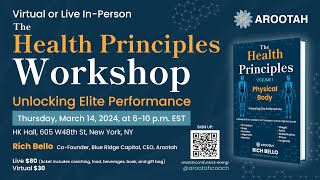
Transcript of a seminar led by Rich Bello (Aruta) with a multidisciplinary panel (medical doctors, nutrition and fitness coaches, yoga and Ayurveda practitioners) discussing core health principles focused on the physical body. The session covers prevention, sleep, nutrition (micronutrients, microbiome, hydration), structure/alignment (posture, yoga, Pilates), exercise recommendations, weight management, detoxification, stress reframing, and longevity/health span, ending with emphasis on applying knowledge via coaching and corporate wellness.
Chapters
Tonight's all about health and energy. And health equals energy. Rich has firmly believed that for many years. He has started health and wellness programs at Blue Ridge Capital and has really noticed the impact that putting emphasis on your health provides for your performance at work. Health goals are really tough. They're very hard to achieve. But we know you can do it and we know you can make your dreams become a reality. And how does that happen? Through goal setting and habit training and health coaching. Because accountability is your secret weapon to succeed in any of your goals. But it's up to you to establish that accountability structure. And every single day when the times are getting tough, you stay focused on your goals and can achieve them. I will give the floor to the speakers now, so I will start by introducing Rich Bello, who is our CEO. He was the co founder and COO of Blue Ridge Capital, a hedge fund for over 25 years with over $10 billion of assets under management.
Thank you all for coming. I'm Rich Bello, the founder and CEO of Aruta. So today our panel is going to be focusing on a topic that is near and dear to my heart and also the most paramount by the way, for peak performance. And that's health health principles. It's volume one, the Physical Body. There will be four, but three other volumes. Let me introduce our panel. First we've got Ryan Maldonado. Nasm is passionate entrepreneur and fitness guru from New York City. He's transformed his love for bodybuilding and nutrition into a distinguished career in personal fitness. Ryan's expertise spans functional strength training, cardio corrective exercise and nutrition. Next we have Andrea DeMarco is a certified functional nutrition and lifestyle practitioner and holistic health coach with over a decade of experience. Her work centers on eating disorders and trauma recovery through energy medicine and mindfulness. Andrew's approach is based on the healing power of food and she meets individuals where they are on their health journey. Next we have Dr. Neil Palvin. He's a multi board certified physician specializing in family medicine, osteopathic manipulation and anti aging and regenerative medicine. Based in Manhattan, he combines traditional and alternative medicine to optimize his patient's health and is a renowned expert in areas like peptide therapy, sports medicine and brain gut connection. Next we have Colleen brinkner who's an Eryt 500 certified yoga teacher with over 24 years of yoga experience. She holds multiple certifications including Thai yoga massage and is a certified ayurvedic health counselor and herbalist. Colleen is known for her ability to offer complex small spiritual teaching in an accessible, engaging manner and is the director of Laila Tendava yoga teacher training. Next we have Alana Rose, an executive director of wellness at Aruta. She's a certified yoga and Pilates instructor and has a background in education and tutoring and is also a wonderful editor of our book. On my left we have Christina Labreco, certified yoga instructor in both Hatha and Ashtanga. She's also an advanced pranayama practitioner, a Thai masseuse, Pasana meditation practitioner, a Sanskrit scholar, she lived in India and immersed herself in the yoga lifestyle. Next we have Dr. Dr. Sean Chalemi, owner and primary practitioner of Ren Healing doctorate in acupuncture and Chinese medicine, Memorial Sloan Kettering, certified in acupuncture and a medical massage and specialized in medical massage for cancer patients. To Dr. Shalomi's left we have Leslie Keough as a board certified health and wellness coach, certified yoga teacher, meditation facilitator and a Reiki practitioner. Following a 15 year experience in special events and content creation, she now focuses on personal wellness development, creating workspace wellness programs and coordinating events for purposeful brands through our company, Mediate Montclair. Next we have Emily Chapman is a certified integrative health coach with a focus on longevity. Through gut and brain health strategies over the past decade, Emily has adopted a holistic approach to health, resulting in a more joyful life. She speaks at conferences, sharing her health journey, has built a steady health coaching practice from clients from all over the country. And finally, we've got, last but not least, we've got Adam Steinhaus, who's recently joined Aruta and oversees our wellness programs, including our health coaching and corporate wellness programs. Prevention, sleep, nutrition alignment, exercise, weight management, the perils that can kill you, Detoxification, stress and longevity. Principle 1. So as you can see, Principle 1 is embracing prevention and prevention. This is a mindset that people need to have and these are avoiding the major mortality causes. So as we can see from this table, it depends on the particular disease, but these are all the top. These are the top 10 killers, basically. And heart disease has been the the top 10 killer for the last hundred years. We're not making much progress there. I'm kind of going backwards in some sense, but heart disease is 85. You see that third, fourth column there, 85. Preventable. If these diseases are preventable and they're preventable by lifestyle choices, we're literally choosing to kill ourselves. It must be incredibly frustrating. As a doctor is like, why aren't people doing these things if they can? Like what, what what's on going, going.
To the doctor and treating something when you have a disease is now doing things at home and developing a program like you're doing to help prevent, developing illnesses that are up there on the board and others. So people, everything starts with kind of what I call the core for it. It starts with exercise. We know exercise for everything from heart disease, diabetes, Alzheimer's disease, all can is one of the best treatments for those illnesses. Sleep is so important in terms of maximizing hormones, decreasing inflammation, helping improve brain health, which again linked things like Alzheimer's and potentially heart disease. Dealing with your diet, I'm sure we're going to discuss diet more fully through some of the other great speakers on the panel here. Simple things that you can do at home without much change, very inexpensive to help prevent and potentially limit chronic disease.
Commercial interests don't seem to be on our side. The tobacco companies, the, the alcohol, the folks that are making food for us, processed foods, they're not on our side. The survival instincts which are focused on short term gratification as opposed to long term fulfillment. So it seems like they're hacking the system. They know exactly what we're programmed for and they're just taking advantage of that. What are some of the preventative measures that people can take to lower the risk of these top 10 causes?
In general, there's those three main concerns. If you're not eating well, sleeping well, or eliminating waste out of your body, well, you're going to have a lot more trouble. In general, we call them the three bigs. But when you start to focus on your emphasis on clean eating, clean breathing, clean exercise, managing your mental capacity and your fortitude for like emotional regulation as well, balancing relationships. So as you begin to unify those three aspects of what make up who we are, fundamentally your true self, which I think is one of the foundational principles behind arutu, may not use the same terminology, but we're all here to really optimize your peak performance and determine who you really were sort of truly meant to be.
We're going to show suggested. I think a lot of these are mine, in fact, suggested goals and habits. This is just an example. Your goals and habits will be different. And at the end of the program we're going to go through a fitness map for yourself. It's a blueprint for your health in all of these different areas. Principle two, and that is sleep. Sleep is really important. I got to get some sleep. It's 2 in the morning. I got to get some sleep. So I realized how Important. You know, lack of sleep is kind of a badge of honor in the business world, right? Sacrificing sleep for work. We even say, well, let me catch some Z's. Can we make it any lower priority by saying, catch some Z's? No. Should we catch some A's? What are the effects of sleep deprivation? And can you actually make up sleep? Can you catch up on sleep like, ah, I'll catch up on the weekend late, or is it a cumulative thing?
Well, sleep deprivation affects us mentally, emotionally and physically, right? So at the different levels of the brain waves, we work on and repair different levels. So when you move from the beta waves during the day to the alpha waves, which is like your transition from the conscious to the subconscious, when you get into the theta waves, your brain has a chance to like, organize the thoughts and the feelings and you're emotionally processing when you get into the deep delta waves. That's when we detox at a cellular level and we prevent the cardiovascular diseases, excuse me, and diabetes. And so if you're not getting the really deep REM sleep in those delta waves, you're not accessing all the options your body has to repair at night. And so if you think you can lose an hour, lose an hour, lose an hour Monday through Friday, and then, you know, make up a few on the weekends, it doesn't work that way because if you're just napping for an hour here or maybe adding an hour there, you don't have the option to get down to the really deep restorative, nourishing levels of brainwaves in the REM sleep.
So now we're going to talk about nourishing your body, right? Principle three and nursing your body is, yeah, it's nutrition. So this is sustaining vitality through nutritional exercise. Building on our understanding importance of sleep, we're going to now explore how important nutrition is, how crucial it is to our health and vitality.
Micronutrients are definitely important. Those are our vitamins and minerals. So it is essential that we do get them in our diet. They should be a supplement to a healthy diet that is mostly based in.
Whole foods, different colors of different phytonutrients. Is that true?
Eat the Rainbow is a very simple way to think about how to get, to make sure that you're getting all of those specific micronutrients that we were talking about.
Should we all be taking probiotics, prebiotics, postbiotics? And can you talk a little bit about the microbiome?
Sure.
Microbiome again, another topic that's kind of growing and growing in terms of just kind of being a buzzword to now we're knowing how to use it and treat it and how to use it appropriately. So in terms of supplementation, I always tell patients right now, if you can get tested, because we can get a lot of data what's missing and we can get. If we find you're missing Akkermansia or lactobacillus, we can actually replace that specific specifically, as opposed to taking too much of one, which is almost as bad as having not enough of it. We need to use prebiotic, which feeds our bacteria in our gut. And we also need to have the postbiotics, things like butyrate, which has come kind of the most common one that people talk about at this point as well as others.
Electrolytes. Ryan, you know people, you generally think about electrolytes in exercise and being our resident trainer, what can you tell us about electrolytes?
So electrolytes is going to be essential when you're working out, because what it's doing is hydrating your muscles, is keeping your body hydrated. When you're dehydrated, that's when you're going to cause. It's going to cause you to have symptoms of feeling faint, feeling lightheaded, feeling very tight, causing a lot of cramping in your body. Himalayan sea salt, Celtic sea salt. Adding that to your water is going to just ensure that your body is just feeling hydrated throughout the day. You're not feeling foggy. It's also going to help to prevent a lot of migraines and headaches throughout the day, especially if you rely on caffeine throughout the day. You're drinking a lot of coffee, so.
That'S good transition into water. I'm not sure if people really think about water. What role does water play in nutrition?
Not all water is made the same tap water. You know, you're fueling the body with chemicals. Who knows what's in that water? Even though it's safe to drink and we're not going to die from it, it's not necessarily the best choice.
And so to make sure the body's.
Getting nutrients, you want to stick with a spring water that's got the naturally occurring electrolytes. You're getting the material minerals. In terms of how much water to drink, I mean, I drink 2 to 3 liters of water a day. You really know by the color of your urine, to be honest.
Yeah.
If it's a light pale yellow, then you're in a good hydration. Zone.
Plastic is a real big thing that you want to be aware of if you are, you know, focusing on quality water. You want to avoid drinking water from plastic water bottles because there's so many harmful chemicals in plastic. Now if you don't, if you're on a go and you're trying to get something in a, you know, in a pinch, then just make sure that there is a label that says BPA free when you are getting your water. But for the most part, you want to prioritize using a stainless steel water bottle.
Principle for how to structure your body. You know, lining for optimal wellness. But even before exercise, you want to think about structure. So as you're delving into this, we're going to turn our focus now to the skeletal and muscular systems and that compose our physical form. So this principle emphasizes the critical role of our body structure and alignment in overall health. A well aligned body ensures the efficiency, safety and maximum benefit of our physical activities. Why is structural alignment crucial for our overall health?
So structures are the way that our body is literally composed with muscles, bones, connective tissue, and it's the way we move, the way we interact with the world around us. So when we're structurally misaligned in other ways, we wind up wearing away the joints, wearing away the cartilage, the ligaments, the connective tissue. We can also wind up predisposing yourself to early cardiac disease. Just posturally, if your ribs are coming close and being pushed over the heart for 10, 15, 20 years with stress, your heart is gonna be working harder to pump because the structures are pushed against it. Your shoulders are lulling forwards. I see this with teenagers that I work on in high school. You notice the kids who are the heavy athletes where they don't use the backpack. They stand up nice and tall and straight. They've got very positive outgoing energy. And then you see the kids with their big backpacks, their shoulders went forward. They feel less good about themselves, they feel more depressed, they feel more reclusive or introspective. But correcting those structures can change the mood, can change the personality, can change the physicality of the body as well, and allow them to be much more prone towards optimization of their health and well being.
Your posture is going to dramatically impact everything that you do. Because if you have poor posture, think about it as a ship sailing in a sea. If that rudder is off by 1cm, eventually that ship is going to be completely derailed and it's going to be pointed in the wrong direction. The same thing with your posture if your head is constantly, you know, rounded forward, you're constantly on your phone, you're on your laptop, on your different tech devices, if you're doing that chronically for days, weeks, months, years, that's just going to lead to a whole slew of dysfunction. It's going to affect your knees, your hips, your lower back, your spine, your neck, your shoulders, everything.
Tell me a little bit about yoga.
So I think of yoga as a branch of Ayurvedic medicine. And in Ayurveda the idea is that your breath and your alignment are the way in which your body optimizes your digestion. And your digestion is your fire that helps you to move through life. So in your head, I'm going to build on what you said. When your head is aligned directly over the base of the spine and you're taking a deep diaphragmatic breath, the diaphragm is then pressing down on your stomach in a rhythmic way and it's churning all the digestive juices. So it's really like the first line of defense in having healthy digestion. So yoga is then looked at as a way in which we align the body so that we can digest well.
Can you talk a little bit about Pilates in terms of structure and core?
Pilates was actually created by Joseph Pilates who was sadly bedridden and he was looking to develop a movement that could keep his body active. In developing your core, you are strengthening like throughout the rest of your body. We want to feel strong and aligned in our center, right. Both physically and in terms of how we're arriving in our lives and arriving in the world.
Principle five, energizing through exercise. Right. Igniting your strength and endurance. So exercise, everybody knows exercise is important to tell me yoga can do both Yoga, aerobic and anaerobic.
Yeah, absolutely. There are so many approaches to the practice chaturang, like when you lower down on the push up or you jump through and jump back. If you do that quickly enough and enough times, that's going to be very aerobic. And you can even add weights. I add weights to my ankles. I add ball of bangles to my ankles to increase it.
The CDC says, I think that there.
Is a recommended recommend.
150 minutes. What does it say about it?
Aerobic or 75 minutes anaerobic, two time resistance training. And if you're over 65, balancing, there is something called non exercise activity thermogenesis. And what that is, that is what you were doing when you're not eating, sleeping or working out. And those Are the things like going to the grocery store, park far away from the door and walk.
So as we delve into principle six, which is managing a healthy weight, we find ourselves at the heart of a conversation that is as complex as it is personal. So weight management is a journey that intersects with our physical health, our emotional well being and societal pressures that help to shape our perceptions of ourselves. It's not merely about the numbers on a scale, but about cultivating a lifestyle.
So definitely building muscle and prioritizing. Building muscle is going to be very important. But at the same time, you can't outwork a bad diet. So you also want to prioritize diet. I always say that diet is going to be 80% of your results. So you want to first start off by prioritizing your eating habits. So perfect example would be prioritizing your first meal within the first hour of you waking up. That's always like my number one fundamental rule to jump starting your metabolism, getting your body in a fat burning mode. And it's just going to lead to better eating habits throughout the day. So if you find yourself, which is often the case with busy professionals, where you're skipping breakfast, going hours without eating, typically eating a really late breakfast or lunch, like early in the afternoon, when you prioritize eating something within an hour of you waking up, it's going to help to accelerate your appetite.
How do we boost our metabolic rate.
Effectively in terms of nutrition protein rich foods as a priority. It's definitely going to help you with that. Also prioritizing your sleep as well.
If you don't get a good night's sleep for some reason, you're starving.
Carbs is going to help to increase your body's insulin sensitivity, which allows your body to utilize carbs for fuel and for energy to be able to supply your muscles with the energy that it needs to continue to repair and rebuild itself. So you want to prioritize complex carbs. So complex carbs are going to be carbs that have a higher fiber content, such as sweet potatoes, quinoa, basmati rice, jasmine rice. You want to try to prioritize carbs in the middle of the day because that's when your metabolism is going to be most active. And also prioritizing your carbs with your post workout meal because after you do strength training or any form of working out, your metabolism is going to be accelerated and it's going to while you're working out, your body is depleting through your glucose stores, which is going to be the energy, the fuel source that your body uses for energy. So it's going through those glucose stores so you want to replenish that so that your body can tap into that.
So food is very much emotional and surrounding family. In Chinese medicine, food and digestion process comes through the stomach and the spleen with the main digestive organs in combination of the liver. But the spleen energy represents family. So oftentimes we develop cravings for food like family food that we grew up eating. When we're in times of sadness, grief or joy, our memories are locked into that food as well. Cravings are often an emotional correlation to something you're lacking emotionally or something you need or something you're trying to satisfy with an emotion. Spicy food stimulates the heart and the cardiovascular gives you like passion. You know, spicy food is often very passionately driven because food is essentially energy. We call it a calorie but it's literally energy listening to the emotions and the cravings. If you're craving salty, you're probably, you're probably a little bit depleted. You're more come act like electrolytes. You, your adrenals are probably being taxed, your kidneys are being tonked, you're not sleeping right. If you're craving sweets, you're probably not getting enough protein. Spleen chi, the spleen organ correlates to the muscles of the body, the physical structures of the body. Sour is the liver. If you're very stressed, you want a little sour to break it up. That's why thirsty Thursdays and things of that sort are really popular because it's near the end of the week, you want to de stress, give me some Lyme, give me something and you unwind that stressful liver chi that's really bound up. And so paying attention to what you're feeling as you're eating and then how you feel after you eat is a great indicator of are you eating properly for your mind, body and your spirit.
One of the things we talk about at Aruta is knowledge does not apply itself, right? You can come to the seminar, hear about all these things, but if you don't do anything with them, you might have had an interesting night, some good food, but if you don't do anything, what good is it? So knowledge does not apply itself. It's really one of the reasons why I love my coaches because they hold me accountable to applying the knowledge. The perils in these high risk behaviors oppose significant threats to our health and well being in modern society are out there. There's substances like alcohol, smoking, drug use, everything we're talking about here is increasing the odds to a long, happy and healthy life, which is health span. What can you say about society and individuals in general? How do we overcome these perils to prioritize our long term health?
Moderation is always key. We've talked a lot about the 8020 principle. So alcohol in small portions, even in ancient China and modern medicine is considered healthy. There's a lot of articles saying, you know, a three to four ounce glass of wine is very beneficial to certain capacities. When you start to have two or three or four, which is equivalent to a bottle, when you look at the end of the night, oh man, sat down to have three bottles between two friends, that's, that's a lot of alcohol. You start doing that two, three, four nights a week. Now you're on the verge of being identified as a functional alcoholic without even knowing that that is really what you are.
Smoking and vaping. You know the myths and then the truths behind smoking, but this one really bothers me because they're targeting kids. Kids younger and younger are starting to vape. These are limiting beliefs. The limiting beliefs, they're myths. So myth number one is that smoking reduces stress, right? Does it really think about it? Is it really. Do people, they smoke, they reduce stress. What's actually happening is you're addicted to nicotine, right? So your nicotine levels are here. And then when you don't smoke for a little while, your nicotine levels go down and your body's like, we need more nicotine. That's why you get stressed. So when you smoke, it brings your nicotine levels back up. Do you think that you're relieving stress? But it's the, it's the nicotine, the smoking that's causing the stress. That's what it is all along the way. So does nicotine really boost confidence? No, nicotine reduces your confidence. If you look at the study, detoxing is a process that transcends fad diets, right? These quick fixes, these are literally killing us with these poisons. We need to detoxify them. How can individuals effectively integrate daily detoxification practice into their busy lives without feeling overwhelmed? So it's not just, I got to have a detoxification diet every once in a while. How do we do that on a daily basis?
Always stay hydrated. We talked about the importance of hydration before. When possible, if it is feasible financially, choose organic over non organic because you will lower your toxic level load and exposure to pesticides as well as incorporating exercise, ideally daily, maybe not daily. But that will help move lymph, stagnant lymph in the body. If we don't have an outlet to move it through the body, we will.
Pool toxins on the ayurvedic side. Can you talk about detoxification strategies?
Some easy ones are hot water with lemon in the morning, tongue scraping, dry, brushing. You can do abhyanga as well with the correct herbs for your constitution. It's a massage with oil going long down the limbs and circular on the joints moving towards your heart. And you can do that in the morning and at night sweating out the.
Toxins in your pores. Especially over the winter when you may not have such a robust cardio exercise routine. That's how the Scandinavians get through the winter. You sleep better, you eat cleaner, you generally feel lighter and more alert. But if you can do the alternating saunas, cold water sauna, steam room, cold water, boom, boom. I mean, everybody's talking about the cold showers and the cold plunges now, right? Dates back to thousands and thousands of years. The Romans were doing this, the Greeks were doing it right, and the skinnies were doing it. But if you can add a hydrotherapy and sauna routine to your weekly or daily routine, not only does your stress, your stress level is reduced, but like you literally just start melting.
It's important that the guts, the intestines working well as a whole so we know that the food's not going to be broken down, your toxins are not going to be removed as a place appropriately, the gut's not going to move as well if the microbiome is not as healthy, if there's inflammation in the gut, there's toxins in the gut, if there's an allergic component. And now a new thing that we're learning is not new, it's kind of merging. Is that stress or overuse that people are going to like work themselves to 11. When you have an over sympathetic nervous system, your vagus nerve, which is your rest and relax, is not working as well. And now we're doing tools and techniques to kind of balance it that will help your body detox, to kind of reset your body, not only what you're.
Eating, but what you're putting on your body, what you're cleaning your house with and just being cautious of what those chemicals are and how close in contact you are with them. So, you know, do your body a favor instead of having to constantly be doing that detox process, just not exposing yourself to the chemicals in the first place.
All right, so let's, let's, let's move into Principle 9. Let's continue our panel discussion on transforming stress into strength. So today we're going to embark on a journey to reframe our understanding of stress, not as an enemy to be battled, but as a powerful ally. What is stress and why is it necessary?
Stress in itself is the fuel behind evolution. Without the need to change, change wouldn't happen. You see it in nature all over. The necessity for roots to grow deeper because water's not available, or leaves to grow broader to keep the soil drier when the sun is out. And there's so many different ways in which nature adapts as it's necessary. And so there is this need for stress to occur, for us to adapt and grow into our fuller potential. It's interesting to call stress good or bad, and I think that's what you're referring to. Eustress and distress. Distress being the negative side and eustress being positive. Essentially, energy and stress is a stimuli that is causing a reaction like a habit. And it is your habit to react a certain way. And I think by calling stress good or bad, you're kind of taking your agency away of using that energy to your benefit. And so I think if stress is limiting you and causing you to feel any sort of physical tension, hair loss or skin reactions or headaches or stomach problems, that you're probably not using it in the right way. But stress can be extremely positive. It can challenge people to step out of their comfort zone. It can make people achieve miraculous things like an elastic band is nothing. And if you stretch it and put tension and stress it, you're able to shoot it across the room. And if you stretch it too far, it'll break. And so there is a balance of understanding. When you need to take a step back and create boundaries or whatever it is that you need to feel safe. And also when you need to actually allow that stress to happen for action to take place.
Stress can affect everything. It can affect your metabolism. It's a direct risk for obesity. It's a big issue today when you're not sleeping, you know, and you have a lot of stress.
I think the key is distinguishing the difference between internalizing stress and channeling stress.
You practice something at. At a route talk called mindful procrastination. We don't start right away. We wait a little while. We want to build up some stress. And what I found, you get a little bit of stress. That's when you become the most creative, right? That's the adrenaline builds up, you become really creative. You compress time. If you give yourself three months to do something, it'll take three months to do it. Give yourself a month to do it. You'll do it in a month now. So there is an ideal time to start. Is an ideal time to start. You don't want to start too soon because your work product won't be great. You'll waste time, you won't have the creative energy. You start too late, you might not have a good work product. Longevity. This is our final topic, Mastering longevity for extended Vitality. So really, this is what it's, this is what it's all about, is what people are looking for, sort of. Dr. Paulvin, longevity versus health span. Larry was talking about Health Span. What are we looking for? Longevity, Health. Spanish. Can you talk a little bit about Health Span?
And well, I'll be on both. But the key one for most people is Health Span. If you're going to live to 100 years old, you want to be a 99, running the 100 yard dash or climbing a mountain, you don't want to be sitting in a nursing home. So our goal is first, foremost, usually work on Health Span, which is starting when, now, when people in their 20s are getting blood biomarkers done and getting hearts tests and dex is done to figure out what their deficiencies are and they're exercising and eating appropriately to maximize their health. But again, the paradigm is flipping where we're not treating disease, we're trying to avoid disease and live a healthier, longer life.
What are the blue zones? And then what are some of the common characteristics that people have that live in these blue zones?
Well, a lot of people who don't know what the blue zones are. You may have heard of the Blue Zone Cookbook. There's a guy named Dan Buettner and he in 2014 went and studied five or six areas of the world, one of which is Loma Linda, California. One is in Japan, one is in Greece, one is in Italy and studied their lifestyle behaviors and came up with what is called the power of nine. And those are the key characteristics of the people that live over 100. These people live a long and healthy life. And so what are they? They move naturally there. Again, we're talking about neat. They're not actually at the gym pumping weights. They're actually moving in their lives. They're not sitting here on a daze. They're going to stand up and they're going to do their work. Many of them garden. And that's a really top area for health and wellness. These Days because you get in the garden and dig deep with your friends. And that's another thing about the blue zones. They're not lonely. Many of them live in multi generational households. And when we talk about diet with them, they're eating what is termed as the Mediterranean diet. They're eating a lot of fatty fish. We didn't talk really much about fats tonight, but make sure it's organic. But Omega 3s are great. If you're eating farm salmon, most of the time you're getting Omega 6s, which is not what you want. Other healthy fats include avocado. These are the things that the blue zones are eating. They relax, they meditate, they practice yoga, they practice the 80% rule. You know, 20% of the time they may be cheating. They eat red meat one time a month, that's it. And maybe not at all. Guess what? They drink at 5 o' clock and they drink red wine and they don't drink more than one glass. They eat mostly plants. They pick the right tribe. They have positive friends and family and think about that. That's really important to have positive people in your life. They put their loved ones first and they belong, they belong to their community. So I think it's a really great study on living longer. One of the biggest epidemics in this country is loneliness. So that was fairly evident during COVID and it seems to be getting worse. So surround yourself with positive people, reach out to other older ones and be supportive and live a long and healthy life. But it's a really great study in longevity.
I'm in this business in service, right? I've had my career in the hedge fund industry. I'm in this business, I'm in service. Wrote this book, really in service to people. And you know, so this is how, you know, this is how I've chosen to give back. And one of the things we do a seminar on procrastination because people have problems with procrastination. Everybody procrastinates and they're like, oh, help me with procrastination. It's part of our time management seminar. And I talk about it, talk about why people procrastinate and then how not to procrastinate. But the really difficult issue with procrastination, the toughest type of procrastination, I talk about mindful procrastination, which I like. Then there's procrastination with deadlines. But usually if there's procrastination on something with deadlines, you got to pay for it's due, you get it done. You file your taxes on April 15. But the real, real painful issue is procrastination when there is no deadline. You know, there's no deadline to come visit Ryan at the. At the gym, right? There's no deadline to hire a nutritionist. There's no deadline for, you know, for running in the morning. There's no deadline for. For quitting. Quitting smoking cigarettes or not drinking alcohol. There's no deadline for that, you know? Or is there? So this procrastination without a deadline, really difficult. That means you need to be proactive, right? So be proactive. Take advantage of what you've learned here. Knowledge does not apply itself. You must make the application. It's not going to happen for you. That's why I love coaching so much. I have a lot of my own coaches, right? That's why I love coaching so much. But they will kick my ass if I don't do it right. They'll, they'll. They'll do whatever it takes. That's what our coaches do. So please think about that. You don't coach with us. Coach with somebody else if you don't set something up. But I highly encourage you to take that test, see what's going on with each of these 10 areas. How are you doing in these 10 areas? Not getting enough sleep. Good chance you're going to get Alzheimer's. Right? Increases the odds anyway. Sleep, by the way, increases the odds of almost everything. Heart disease, everything. You're drinking too much. Going to increase the odds. The idea, I'm a numbers guy. The idea is the. To increase the odds for health span, the longest health span you can have.
Corporate wellness isn't a nice to have. It's a must have for so many organizations. We choose who we want to work with and where we want to spend much of our day is by how we feel we're being treated, who we're working with, finding that work, life, harmony, being able to take care of yourself and having people promote that for you.
And if we don't either solve the problem or make a significant, significant impact, create a significant impact towards solving that problem. You should not sign up for our coaching. What are the goals do you want to set? Have a coach start working with you. You get a free hour of it. The only thing you lose is your time. I'm gonna leave people with that. Thank you very much for, for listening so intently. Thank you, panelists. This is really, really good stuff. Thank you so much, everybody. Stop, stop, stop, stop.
Sa.
More from Rich



Goal Setting Workshop: Set Your Top 2023 Goals & Create a Master Plan to Achieve them! NYC

Goal Setting Workshop 2025: Design Your Master Plan for Success! AROOTAH Advisory & Coaching | NYC

Redefining Success: Arootah President Talks with Christyl Murray on Culture, AI, and Much More!

Rich Bello Best Practices Keynote to Family Office Leaders | Parrish Museum The Hamptons | Aug 2025


