Unlock the Secrets to Building a Dream Team: Arootah's 10 Talent Acquisition Principles
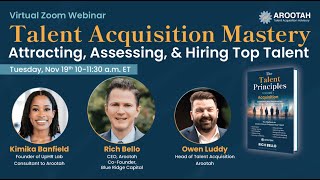
A conversational recap of Aruda's (spelled variously in transcript) webinar on ten talent-acquisition principles led by Rich Bello and Aruda leadership. Speakers review a 10-point hiring framework covering: a people-first mindset; gap analysis (consider tech, vendors, fractional, then hire); applicant-tracking systems and automation with human oversight; strategic, inclusive job descriptions; multifaceted sourcing (active, passive, events, referrals with caution about homogeneity); employer branding grounded in culture; pre-screening (knockout questions, one-way video); structured interviewing assessing hard and soft skills; data-driven metrics (time-to-hire, drop-off rates) with weekly reviews; candidate experience and personalized communication; thorough reference checks including unlisted references with consent; and onboarding that connects new hires across departments. The webinar also promoted Aruda services (free strategy calls, Contingency/Retained/RPO, fractional professionals ~400, compensation experts) and teased a talent-acquisition app in development. The Q&A emphasized balancing structured scoring with intuition and integrated health/wellness coaching for talent performance.
Questions this video answers
November 21, 2024.
Rich Bello — founder & CEO; John Verbertmoes — president; Owen — head of talent acquisition; Kamika — CEO of UPHR Lab.
Contingency, Retained, and RPO models.
About 400 professionals.
A talent-acquisition app based on their 10 principles.
Chapters
Okay, so imagine this. You've got a team, and it's so good, it practically runs itself. No drama, no hand holding, just pure productivity.
That's the dream, right?
It is the dream. And that's exactly what we're diving into today. Cracking the code of ARUDA's ten talent acquisition principles.
Oh, yeah, they pretty much wrote the book on strategic hiring.
They really did. And you sent over this recording of their webinar.
It's a gold mine.
It is a gold mine.
Yeah.
So our mission is to pull out the most valuable tips and tactics, the stuff you can actually use right away. We'll uncover those sneaky little things most.
People miss, and hopefully help our listeners dodge those painful hiring mistakes that can really cost a company.
Right, Those face palm moments. So the webinar features Aruda's leadership team. John Verbertmoes, the president, Rich Bello, the founder and CEO, Owen, their head of talent acquisition, and Kamika, CEO of UPHR Lab.
It's a powerhouse lineup.
It is. So let's jump right in. The first principle they emphasize is mindset. Your people are your business.
Makes sense.
It sounds simple, but Rich Bellow really hammers this home. He's like, building an exceptional company starts with exceptional people. End of story.
No compromises, no settling.
He uses this great analogy. He says, a team of pretty good.
People, you can only create a pretty good company.
Exactly. You hit a ceiling. But if you want to reach excellence, you. You need to surround yourself with top tier talent.
So it's about shifting your thinking from just filling roles to actively investing in your people as your most valuable asset.
Instead of thinking, oh, I need someone.
To do X, you're thinking, who is the absolute best person to help us grow and excel?
And it's not just about finding brilliant individuals. Right.
It's about building a team where talent amplifies talent, where one person's strengths complement another's.
That's a great point. Okay, so before you even start thinking about specific hires, Aruda stresses this thing called a gap analysis.
Right. And Owen explains how they do this for both their own company and their clients.
And what's interesting is they don't automatically jump to hiring as the solution.
They actually consider four different options to close talent gaps.
Really?
First, they look at technology, AI and all that, to see if it can do the job.
Makes sense. Technology can often be the most efficient solution. I'm thinking like chatbots for customer service or project management software to keep everyone on track.
Absolutely.
Ah.
If technology isn't the answer, they then think about using Vendors or consultants. They're big on fractional outsourcing for specialized needs.
That's smart, especially for startups or companies with limited budget.
Right. And only after exploring those options do they finally consider hiring a new employee.
Starting with part time and then moving to full time if absolutely necessary.
Exactly. It's about having a clear understanding of where your talent gaps are, both now and in the future, so you can make strategic decisions about how to address them.
Don't just react. Plan.
Plan ahead.
Okay, speaking of planning, let's talk about applicant tracking systems, or ats.
Oh, yeah, Owen gets super excited about this in the webinar.
He does. He considers the right ATS a secret weapon for efficiency.
He's all about that automation and how it can streamline everything from screening resumes to sending out offer letters.
It frees up his team to focus on the human element of recruiting, building relationships with candidates and really understanding their potential.
Absolutely. So imagine having a super efficient assistant who handles all the tedious administrative tasks, leaving you free to focus on the strategic side of hiring.
Okay, so for someone who's new to ats, what are some must have features?
Well, one of the most valuable is automated resume screening. You set specific criteria like keywords or years of experience, and the ATS filters out candidates who don't meet them. This saves you hours of manually going through applications.
Right.
Another great feature is the ability to schedule interviews and send automated reminders to both the candidates and the interviewers.
That can be a nightmare to coordinate when you're juggling multiple candidates in interview panels.
Exactly. And it helps ensure you're treating all candidates fairly and consistently. But Owen does have one important caveat.
What's that?
He emphasizes that even with all the bells and whistles of automation, you still need a human in the loop to handle those nuances and make sure the system is working as intended.
Don't just set it and forget it.
Right. You don't want a fantastic candidate getting rejected because of a glitch or receiving a generic impersonal email that doesn't reflect your company's culture.
Technology should enhance the hiring process, not completely. Completely replace human judgment and connection 100%.
Okay, moving on to principle number four. Crafting job descriptions that are like magnets for top talent.
I like that. Kameka stresses the importance of strategic alignment here.
She argues that your job description needs to be more than just a list of duties. It has to authentically reflect your company's.
Mission and values, send a clear message about what your company stands for and what kind of people you're looking to attract. And she even cites a McKinsey study showing that companies with strong gender and.
Cultural diversity are significantly more likely to outperform their peers.
It's a strategic advantage. When you have a team with diverse perspectives and experiences, you're more likely to.
Come up with innovative solutions and make better decisions.
So how do you actually make your job descriptions more attractive to a diverse range of candidates?
Kameka has some great advice. She emphasizes inclusivity and clarity. Use language that resonates with a broad audience, and ditch the overused jargon like ninja or Rockstar.
Make sure your job descriptions are accessible and appealing to everyone, regardless of their background or experience.
Exactly. Okay, so you've got your mindset right, You've identified your talent gaps, you've got a shiny new ats, and your job descriptions are polished and ready to go.
Time to talk about actually sourcing candidates, right?
Go in shares Aruda's multifaceted approach, which includes active sourcing on platforms like LinkedIn, attending industry events for passive sourcing, and.
Building those long term relationships with potential candidates.
It's about thinking beyond just posting a job on a board and hoping for the best. You have to proactively seek out talent through a variety of channels.
Now you might be thinking, I'll just ask my employees for referrals. Easy peasy, right? And while employee referrals can be great, Rich throws a bit of a caution flag here.
Oh, how so?
He argues that relying too heavily on referrals can create a sort of echo chamber and lead to a lack of diversity.
He's not saying referrals are bad, but he emphasizes the importance of making sure you're comparing referred candidates against other candidates from diverse sources to ensure a fair and unbiased process.
You want to find the absolute best person for the role, not just the one who happens to know someone in your company.
Right? It's about casting a wide net and being open to talent from unexpected places. You never know where you might find your next superstar.
Absolutely. And that brings us to principle number six, which Kameka refers to as employer branding.
This is where things get really interesting.
It does get interesting. She argues that your employer brand has to be more than just a flashy marketing campaign. It has to be a genuine reflection of your company, culture, warts and all.
She's right. Candidates, especially those top tier folks you're after, they can sniff out a fake from a mile away. If you try to project an image that doesn't match reality, it's going to backfire big time.
So how do you build an employer brand that's authentic and attractive?
Well, Kamika suggests investing in cultural assessments. This could involve conducting interviews with current employees, running focus groups, even using surveys to get a pulse on what truly makes your company tick.
It's about understanding the lived experience of your employees, not just the aspirational values you put on your website.
Exactly. And Kameka shares a great example from her time at Bonchon. They went through a CEO change and experienced significant attrition, which forced them to take a hard look at their employer brand.
Sometimes those moments of disruption can be incredibly valuable opportunities for growth.
Absolutely. In Bonchon's case, they realized they needed to revamp their employer brand to attract a more diverse workforce and create a more inclusive culture. It was a tough but necessary process that ultimately made them a stronger company.
It's a good reminder that your employer brand isn't static. It needs to evolve and adapt as your company changes and as the world around you changes.
Now, once you've got candidates knocking on your door, it's time to get serious about screening. And Rich emphasizes the importance of moving quickly from, you know, billions of people in the world down to that one perfect hire for the role.
That's where pre screening comes in.
Exactly. It's about getting to know faster so you can focus your energy on the most promising candidates.
He's a big fan of using those knockout questions.
Oh yeah, those initial screening questions that can quickly eliminate candidates who are clearly not a good fit.
So this might be something like, do you have experience with X software or are you willing to relocate?
Exactly. You can also use resume reviews to weed out candidates who don't meet those basic requirements. And even one way video interviews where candidates record themselves answering preset questions.
I can see how video interviews would be really helpful to get a sense of a candidate's personality and communication skills early on.
Yeah, and they can be more efficient than scheduling a bunch of phone calls, especially when you're dealing with a large number of applicants. Now, Rich also makes an interesting point about bringing in external experts for senior.
Level hires when your team might not have the specific domain expertise to properly assess a candidate's qualifications.
Right. This is particularly important for those highly specialized roles where the stakes are high. It's better to invest in that expert advice than to risk making a costly hiring mistake.
Definitely. Okay. Speaking of investing and expertise, let's talk about interviewing. Owen Aruda's head of talent acquisition stresses the importance of assessing both hard and soft skills.
And he argues that soft skills are even more critical for long term Success.
This is something I hear all the time. You can teach someone technical skills, but it's much harder to teach things like communication, problem solving, emotional intelligence.
Absolutely. And to make sure you're assessing those soft skills effectively, Owen recommends using structured interviews, which means asking every candidate the same set of questions in the same order and using a standardized scoring system to evaluate their responses.
This eliminates the risk of those personal biases creeping into the evaluation and ensures that you're comparing candidates on a level playing field.
Exactly. It also helps you avoid those gut feeling hires that can sometimes backfire.
Right. Owen actually shared one of his favorite interview questions.
Oh, really?
It's designed to reveal how a candidate approaches problems solving. Do they jump right into action or do they take a step back to analyze the situation before making a move? It's fascinating how much you can learn about someone's thought process from a single well crafted question.
It's like those brain teaser questions they ask in consulting interviews. They're not necessarily looking for the right answer. They're more interested in how you think.
Exactly. Now, once you've conducted your interviews, it's time to crunch some numbers. And this is where Aruta's data driven approach really shines. Rich is a firm believer in data over gut feeling, at least initially. So he's not anti gut feeling.
No. He acknowledges that intuition can be valuable, especially after you've gathered all the data and you've analyzed that objective evidence. But he stresses the importance of starting with that solid foundation of data to inform your decisions.
I think we all have biases, whether we realize it or not. Data can help us challenge those biases and make more objective decisions.
Absolutely. And the kind of data Rish is talking about includes things like time to hire, time to fill candidate drop off rates.
By tracking these metrics, you can identify.
Bottlenecks in your hiring process and find ways to improve efficiency.
It's about taking that scientific approach to hiring. Experiment, measure and iterate.
And Owen revealed that Aruta actually reviews these metrics weekly to ensure their hiring process is constantly being optimized. They're not just setting a strategy and letting it run on autopilot. They're actively monitoring and adjusting it based on the data.
That level of dedication is impressive. It shows a real commitment to finding the best talent and constantly raising the bar.
Now, while you're busy tracking metrics and optimizing your process, don't forget about the human beings on the other side of the equation.
Right. We can't get so caught up in the data that we forget about the candidate experience.
Exactly. Kamika refers to this as the candy. You've got to treat your candidates well and keep them engaged throughout the process.
It's about showing them that you respect their time and appreciate their interest in your company. Even if they're not ultimately the right fit.
Absolutely. And she emphasizes the importance of regular communication. Keep candidates informed about where they stand in the process, even if it's a no.
And while automated emails can be helpful.
Kameka cautions against relying solely on technology for communication. A personalized touch can go a long way in creating a positive candidate experience.
So maybe a quick phone call or a handwritten note to thank them for their time.
Those small gestures can make a big difference. It's about building relationships, even if it doesn't lead to a higher camps. You never know when that candidate might be a perfect fit for a future role or when they might recommend your company to someone in their network.
Speaking of networks, let's talk about reference checks. Rich is, shall we say, skeptical about listed references. Those.
He's got a point. Let's be real. Everyone's going to put their best foot forward when they're providing a list of references.
So how do you get a truly accurate picture of a candidate's past performance?
Rich believes that unlisted references, those that you source through your own network, are far more valuable because they're more likely to be candid.
I can see how that would be the case. People are more likely to be honest with someone they know personally than with a potential employer. But I imagine there are some ethical considerations here, right?
Absolutely. You have to proceed with caution. Always obtain written consent from the candidate before reaching out to any unlisted references.
And be transparent about who you're contacting and what information you're seeking.
Exactly. It's about building trust, not sneaking around behind people's backs. Rich actually mentioned a company called Kroll, the world renowned investigations firm, as an example of an organization that excelsior and conducting thorough reference checks.
So we don't need to hire a private investigator?
Probably not. But it does highlight the importance of thoroughness when it comes to verifying a candidate's background and experience, especially for those senior level roles.
Okay, so we've gone through mindset, gap analysis, technology, job descriptions, sourcing, employer branding, pre screening, interviewing, data analysis, candidate experience and reference checks. I think we're finally ready for the last principal onboarding.
You made it. This is where you really set your new hire up for success. Kamika emphasizes the importance of making them feel welcome and included from day one.
And that goes beyond just handing them a stack of paperwork and pointing them to the coffee machine.
Exactly. Onboarding should be an engaging and interactive experience that helps new hires understand the company culture, connect with their colleagues, and get excited about their role.
Aruta has a really unique approach to onboarding. They require every new hire to meet with representatives from all departments, not just their own team. It's a brilliant way to foster a sense of inclusion and help new hires understand how their role fits into the bigger picture of the organization. It also helps them build relationships with people across the company, which can be so valuable as they navigate their new environment.
It's like building a network of support from day one.
And speaking of support, let's not forget that the webinar itself was packed with offers of support from aruta.
Oh, right. Oh, and yeah. The head of Talent Acquisition invited listeners to schedule a free strategy call with one of their experts to discuss their toughest hiring challenges.
It's a great opportunity to get personalized advice and solutions from people who really know their stuff.
They encourage you to come prepared with your most pressing questions and problems. Whether it's a search that's been dragging on, a low offer acceptance rate, or anything else that's keeping you up at.
Night, it's like having a personal talent acquisition coach in your corner.
And beyond these free strategy calls, Aruda offers a whole suite of services including Contingency Retained and RPO models.
Owen made it clear though, that they're not your typical recruitment firm.
They're looking for partners who are truly committed to finding the best talent and who are willing to actively participate in the process.
They don't just want to throw resumes at you and call it a day. They want to work collaboratively to find the perfect fit for your team.
That's where their deep expertise and data driven process really shine. They take a very hands on approach from crafting that job description to participating in the scoring and interview process.
They're invested in your success and understand that their reputation is on the line with every hire they make.
And they also offer fractional outsourcing, providing access to a network of over 400 professionals for short term projects or longer term support.
This is a lifesaver for businesses that need specialized expertise without the commitment of a full time hire.
Rich even described it as the ultimate interview because you get to see someone's work in action before making a hiring decision.
Talk about a trial run. And they also have a team of compensation experts who can provide those detailed reports and analyses to make sure you're offering competitive and fair salaries crucial for.
Attracting and retaining top talent in today's market.
And finally, the big reveal. They're developing a talent acquisition app based on their 10 principles.
It's still in development, but it's a testament to their commitment to innovation and using technology to improve the hiring process.
This app could be a real game changer for anyone involved in hiring, offering a powerful set of tools and insights based on Aruda's proven methodology.
Absolutely. It's a perfect example of how they're constantly evolving and leveraging technology to stay ahead of the curve.
Before we wrap up this part, there was one more interesting point that came up during the Q and A portion of the webinar. Someone asked about the importance of health coaching in relation to talent development.
Oh, now that's an intriguing connection. Tell me more.
Well, Rich explained that Arruda takes a very holistic approach to coaching. They believe that physical and mental well being are crucial for executives and employees alike.
It makes sense you can't perform at your best if you're burned out or struggling with health issues.
He even shared that his first question for any new executive coaching client is about their sleep habits. It's often a major factor in their overall well being and performance.
It's amazing how often we overlook the fundamentals in our quest for success. We focus on those productivity hacks and time management strategies, but sometimes the most effective thing we can do is simply get a good night's sleep.
Then Kamika added that incorporating those wellness initiatives into your company culture can have a significant impact on employee retention and even attract better talent.
It's about creating a workplace where people feel valued and supported, not just driven to achieve results at all costs.
Absolutely. It's about recognizing that people are more than just their job titles. They have lives and needs outside of work that impact their performance.
And creating a culture that acknowledges and supports those needs is essential for long term success.
It seems like Aruta really does have a lot to offer in the realm of talent acquisition and development.
They're clearly passionate about helping businesses build those exceptional teams and create a positive and thriving work environment.
And based on the wealth of information and insights they shared in this webinar, it's easy to see why they're considered leaders in the field.
Well, I'm definitely intrigued to see what they come up with next, especially that new talent acquisition app.
Me too. But for now I think we need to take a little break. We'll be back soon with Part three to explore the remaining Q and A from the webinar and wrap up our deep dive into Aruda's 10 talent acquisition principles. Welcome back to our deep dive into Aruda's 10 talent acquisition principles. We covered a lot of ground, but we saved some of the best for last. The Q and A.
The Q and A always has some good stuff.
It does. It's where things get real. So one question that really stood out to me was about finding that balance between having a standardized interview process, you know, for fairness and consistency, while still leaving room for intuition and those gut feelings.
It's a tough one. You don't want to be too rigid, but you also don't want to let bias creep in.
Exactly. So how did the Aruta team handle this? Well, Rich, being a data guy, he was all about that structured process. Consistent question scoring keeps things objective. It does. But he also said that intuition absolutely has a place, especially after you've got all the data and you've objectively scored those candidates.
So use your intuition as a final check, not necessarily the starting point.
Right. He even told a story about a time he hired a candidate based on gut feeling, even though another candidate had scored higher in the structured interviews.
Oh, wow. And what happened?
His gut was right. There was something. The scoring system just didn't pick up some intangible quality that made that candidate the perfect fit.
I think that's so interesting. It shows that even the best systems have limitations. Data doesn't always tell the whole story.
It doesn't. And Rich pointed out, the more experience you have, the more you can trust your intuition. It's like a muscle that gets stronger with practice.
Makes sense. Another question that came up was about Aruta's health coaching immersion program.
Yeah, this goes back to their whole holistic approach to talent development. Rich is a big believer in physical and mental well being for everyone, not just executives.
It's true. You can't expect people to perform at their best if they're exhausted or dealing with health issues.
They actually offer these health coaching services as part of their corporate wellness program along with their executive coaching and training.
Interesting. What was his reaction to that? Seems a little unconventional.
It's funny you should say that, because when Rich first brought this up at Morgan Stanley, people were totally skeptical.
I bet they didn't see the connection between health coaching and executive coaching.
Nope. But Rich being Rich, he went ahead and wrote a book about it, the 10 principles of wellness.
Of course he did. So what's the connection? Why is health so important for executives?
Specifically, he says, all about energy. You can't be a high performing leader if you're constantly tired or dealing with health problems.
Makes sense.
He even said his first question for a new executive coaching client is always about their sleep habits because it's a major indicator of overall well being.
You can't pour from an empty cup. You have to take care of yourself before you can effectively lead others.
And Kameka chimed in to say that investing in employee wellness can lead to higher retention rates and even attract better talent.
It's about creating a workplace where people feel supported, not just pressured to hit those targets.
It's about recognizing that people have lives and needs outside of work and those.
Needs absolutely impact their performance.
So after this deep dive into Aruta's world, it's clear they really are a one stop shop for all things talent. Recruiting, onboarding, coaching, development.
You've got it all.
And they're not stopping there. With their new talent acquisition app in.
The works, they're constantly innovating.
It seems like they're always looking for ways to improve the hiring process.
I'm really curious to see what they come up with next.
Me too. But for now, I think we've reached the end of our deep dive into Aruta's 10 talent acquisition principles. We've covered a ton of ground today, but hopefully you found it valuable and most importantly, actionable.
Absolutely.
If you're wrestling with a particularly tough hiring challenge, remember Aruta offers those free strategy calls. It's a great way to get personalized advice from some of the best in the business.
You can find all the details on the website. Just search for Aruta and you'll be well on your way to building your dream team.
Until next time, happy hiring.
More from Rich



Goal Setting Workshop: Set Your Top 2023 Goals & Create a Master Plan to Achieve them! NYC

Goal Setting Workshop 2025: Design Your Master Plan for Success! AROOTAH Advisory & Coaching | NYC

Redefining Success: Arootah President Talks with Christyl Murray on Culture, AI, and Much More!

Rich Bello Best Practices Keynote to Family Office Leaders | Parrish Museum The Hamptons | Aug 2025


