6 Books Everyone Should Read (That You’ve Never Heard Of)
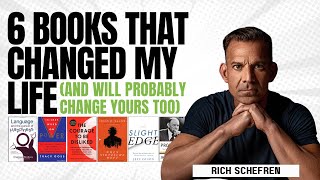
This is a YouTube video titled "6 Books Everyone Should Read (That You’ve Never Heard Of)" created in September 2024. It features Rich Schefren sharing detailed personal insights and reflections on six impactful books he recently reviewed. The content is a monologue where Rich discusses the themes and lessons from each book, explaining how they influenced his thinking and life, and also describes his note-taking and knowledge retention process.
I was recently asked about six books that I could recommend from my friend Garen. And what I did is I went to my Evernote to find the books that I most recently reviewed in my book notes. And so here are the six books that I've touched most recently that I first read First Consumed, then took Highlights, then took notes on those. So these books all mattered in my life. And here are the six that matter. So the very last one, the one I most recently touched, is a book that I think everyone would benefit from right now. And it was written by a French sociologist, philosopher, slash, whatever kind of a polymath. His name is Jacquez Illal. And he wrote a book. It's a dense book, but very insightful. He wrote a book on propaganda. And I'll tell you just something that comes up in the intro that I think is interesting, valuable, and very apropos to the world that we live in right now. He said that the more intellectual someone is, the more likely they are being actually influenced by propaganda. And he had three reasons for it. And I think all three reasons are highly valid. The first reason is, is that the more intellectual you are, the more you learn from secondhand sources, that there's less of you actually doing the thing and learning, that you're learning through, through reading, consuming, you know, those kinds of things. And I think that's true. The second reason is, is that intelligent people feel the need to have opinions about important matters of the day. Right so now. And I believe that to be true. So you learn more secondhand than you do firsthand, and you feel the need to have an opinion on important issues for the day. And then the third is that you feel that you are smarter than the average person, so you're not susceptible to propaganda. So it's interesting. I was reviewing these notes recently because I recognize that I live in an information bubble. I know that I have friends who believe the total opposite of what I believe politically, and that they also live in an information bubble. I'm pretty certain that if I lived in their information bubble long enough, I would believe what they believe and that if they lived in my information bubble long enough, they would believe what I believe. But what shocks me is that I have certain friends that don't believe that. That I have certain friends that live in the information bubble that I live in and just assume that anyone that disagrees with us is stupid, ill informed, et cetera, et cetera, et cetera. And I try to convey to them that's not really true, that's not how the world works, that we all are a victim of the information that we consum. And I feel like one of the reasons that that is so deeply built into the way I look at things and also maybe why I can understand why someone believes the complete opposite of what I believe is from books like that. And so Jacques Law propaganda, phenomenal book. The second book that I've most recently reviewed in my notes is actually something so different from the first book. And it's a self help book. And I generally not the hugest fan of self help books, but this book is the title is the Slight Edge. And really one of my favorite books in that genre because what the book is about is that it's not these big things that really make the difference in life. That it's actually it's the small things done daily. That the things that cause success are easy to do, but they're also easy not to do. And that it's the space between the action, the cause and the result that really cause most problems in life. Like if you were to eat a very unhealthy meal right now and you were to drop dead tomorrow from a heart attack, it would be very easy to avoid that food. But it doesn't work that way. You have to eat that food daily for a long period of time and then you will have a heart attack. And it's that space between cause and effect that really throws people off. And that there's lots of little meaningless things that you either do or don't do. And your life will not change today, tomorrow, the next day, but cumulatively, right, it will change. And so in the Slight Edge, he, what he talks about is that you're always trending in one direction or the other in every important area of your life. It's either improving or it's getting worse. It's not staying the same. And that's my experience. My experience paces with that. So that means your relationships with your friends are either getting better or they're getting worse. Your business is either better today than it was yesterday or it's worse now. These are micro changes, right? But across your health is either getting better or it's getting worse. And it's based on the decisions that you made today. Those decisions you don't see the effect of right away, right? But everything is either trending up, trending down, and recognizing that, then you can look at the actions that you're taking on a daily basis to kind of really get clear the direction that you're heading in. And so for that reason, I Love the book the Slight Edge. And even though it's a self help book, it does make the list of one of the books that I reviewed recently because I feel that that way of looking at life is actually a way to look at life in a way that actually sets you up for success. So the third book that I reviewed most recently in my book, Notes, is actually a total change in another direction. And it was called the Last Word on Power by Tracy Goss. And Tracy Goss was a protege of, of Warner Earhart. And I am a huge, huge, huge, huge. I can't even express how big of a fan I am intellectually of Warner Earhart and the materials he created and the distinctions he created, et cetera. And there's a lot in that book that I could talk about. But the one thing that if I never looked at the book again, would always stick with me was, was her definition of leadership. And I just thought it was so unique, something I never come across, but yet so accurate. And so she said a true definition of a leader is to make a future happen that wasn't going to happen anyway. Right. So everything is trending towards some direction. And what a real leader does is shift the direction and actually make things happen that wouldn't have happened so that you arrive at a different destination than where you were headed. And, you know, it's kind of like when I think of that definition of leadership, it's kind of what is an intervention like, you know, my girlfriend used to watch that TV show Intervention and where, you know, someone is doing a bunch of drugs and the whole family comes around to try and convince that person to take another path. And it's the same thing. That drug addict at that moment in time is heading towards a future that is not a good future. And the purpose of the intervention is to change the future of that addict. And so leadership is doing that on a bigger level with more people who are not necessarily addicts, but a company. And to make something happen that wasn't going to happen anyway. So everything is, you know, kind of following a path to a specific outcome. And if you get far enough back, you can kind of see where it's trending. And a leader changes that trajectory, changes the outcome, and therefore makes a future happen that wasn't going to happen anyway. And I love that distinction from the book the Last Word on Power, the fourth book that I most recently reviewed in my book Notes is, is actually the only book of the list that was a fiction book. Yeah, a fiction book. It's a story. And I don't read that many of those either, unfortunately. I probably should read more of those. This was written by Irvin Yalom and it's, the title is When Nietzsche Wept. And it's an amazing story. So Irvin Yalom is like the creator of Group Therapy. So he's not a, he's not only a great writer but he's also like a famed psychologist, maybe psychiatrist, I don't know. But this book was all about what if Freud was Nietzsche's therapist? And what I loved about it. And I've read a few books like this, that it was written by a scholar. So everything shared in that book as far as details of their life work were accurate. The story's completely not true. Freud was not Nietzsche's therapist. But I got the chance to learn so much of what Freud thought, of what Nietzsche thought in a page turning story that made it really easy to consume, so easy to consume that if I had not highlighted it and taken notes, I probably would have forgotten most of the bigger lessons that I got from reading the book. But yeah, the only fiction book that made the list of my most recent reviewed book notes. So the fifth book that I most recently reviewed in my book notes is the Courage to Be Disliked. And it's funny, I first came across that book when I was taking the train. I used to take the train when I lived in Manhattan. You know, we have a place in Manhattan as well as a place here in Delray Beach. But when I was staying up there, when my daughter, my older daughter went to high school because she didn't repeat the year that I was taking the train to Baltimore at 5am in the morning on Mondays. And I generally took the train back on either Wednesday or Thursdays back to Manhattan. And on the train back I was sitting across from someone and they were reading this book, the Courage to Be Disliked. And it said bestseller in Japan, 4 million copies sold. And I was like, wow. So I downloaded it on my iPad and I started reading it on the train. And it's the psychology, it's, it's a fable. So it's kind of similar, I guess to what I was saying earlier, but it's, it's much more a fable than it is a story. So it's much more about learning the lessons than it is maybe a page turning story. But it's all about the psychology of Alfred Adler. And most people don't know this but Adler was a peer of Freud's. He was actually the first like president of the Psychoanalytic Institute. Then came young but whereas Freud was believed in etiology, I think that's etiology. I'm horrible at pronouncing words that I wasn't taught. But self read where you know, your past really causes your present. And Alder psychology was. Is teleology, right? Which is your, your goals, your future defines your present. And so it's a very sharp contrast. And then there's also like a pulling in of Nietzsche, and I'm a huge fan of Nietzsche about God being dead. And therefore we have to kind of ascribe our own meaning to life and to make it work. And there's a lot in that book. But you know, there are certain things that it reaffirmed in my life that I guess I really enjoy because everyone likes to be reaffirmed, but also a way of looking at life that had me stop and really reflect. You know, I'm not. I had these bad experiences with my dad and I don't think, well, my dad's passed away. He's been dead for over a decade. But when I think of my dad, I generally think of bad things. And that's not to say that my dad didn't do a bunch of nice things for me when I was younger too. And the, what Adler would say is that there's a reason why I hold onto the bad things right now. Freud would say that the bad things were so traumatic, that kind of seared in my brain, caused trauma, which is true, at least I think so. And so my viewpoint about him will always be skewed by that. And there might be truth to that, but there also could be truth to what Adler would say, which is that I, so my dad was successful and I so don't want to be compared to him. So it's very convenient for me to label him this bad person. Think of all the bad things he did to kind of free me from ever having to even consider what he accomplished in his life versus what I accomplished in my life. Because I see him as a bad person, right? So I just think that I'm always interested in being exposed to different perspectives of the world. You know, it's like the first time I went to Japan all the way back when I was in college. Like, what I was most curious about is like, here's this other part of the world that was so separate from my part of the world and they evolved so differently. And what does that look like? What is that? You know, how does that get manifested in all these different ways? And so it's kind of the same thing. Maybe in A more micro level. You know, Freud thought the past determined your present. Adler thought your future and your goals informed your present. And when you change that one thing, how many other things change. And as someone who tries to expose my audiences, especially when I'm trying to create a campaign or something like that, to new and exciting ideas, taking these different lenses of other ways of looking at reality is always a interesting way to get at new ideas. So that's why I was probably reviewing that book pretty recently. So the last book that I, Number six, that I've reviewed most recently from my book Notes is actually would rank as one of my favorite books of all time. And not because of how well it's written or anything like that, but based on the content and the accessibility of that content. So the book is called Language in the Pursuit of Happiness. It's written by Kalmer Brothers, and it's all about. It's very much derivative of ontological psychology or ontological coaching, which is also derived from a lot of the work of Werner Erhard, Martin, Heidegger, Nietzsche, Wittgenstein, Sartre, and a bunch of other philosophers. And it's how much we live in language and how much language impacts us and the idea that, you know, we create our reality out of the words that we use. And so there are so many elements in that book that I could talk about, of which most of the elements in that book I've been exposed to in many other places. But the way it was explained in there just made it even that much more accessible. So one thing I constantly talk about, something I was very, very fascinated by for a very long time, is distinctions. Like distinctions live in language, but they help parse reality. So I have no distinctions for trees and what you can do with trees. Like, I walk through a forest and all I see is a bunch of trees. That's it, right? But if I were to spend one day with a forester and walk through a forest and they explained to me, this type of tree that you'll often see in this way or this way or this way is great for making fire. And this tree is this. And this is a tree, right? Every walk through a forest from that day forward would be different than every walk through the forest before. And I would see things that I hadn't seen before. And because I could see things that I didn't see before, I can now do things that I couldn't do before. I've always felt that expertise in any category, especially entrepreneurship, also comes down to distinctions that you could take me and you could put me in a lot of my clients businesses and I would be able to grow their business faster than them because I have different distinctions that allow me to see things that they don't see and therefore be able to do things that they can't do. And also, like, if you took my mentor like Mark Ford, if you put him in my business, he would be able potentially to grow it a lot faster than I could because he has different distinctions that he's developed over time that will allow him to see things that I don't see and be able to do things that I don't do. And so language in the Pursuit of Happiness does a really good job at making that content, which like I've read probably about 50 different books that kind of really go into detail about that specific thing. But this does it at a very, I wouldn't say shallow, but very, but not to the level of depth where it all of a sudden has you second guessing everything and then get confused. So for that reason I'm very Props to Calmer brothers for writing the language. Language and the Pursuit of happiness. There is so much knowledge out there that is just out there for the taking. And all it takes is opening a book and reading it. But you know, as someone who reads voraciously, I can tell you that a lot of books written today or even in the past were written really for nothing more than the author's vanity. And whenever I come across a book like that, I hope to figure that out as quickly as possible because I will not finish reading that book, nor will I ever buy another book from that author. But then there's the opposite books that when you read, when you open versus when you close that book, you're a different person because you've been exposed to certain ideas that impact you and the way that you see the world and the way you act in the world. And those are the type of books. When I read one of those, I try and buy every single book that that author has written because I know that there's more to like, gleam onto now. Also, when I read a book, I tend to highlight in a copious manner because I'm never going to look at that book again. And I'm going to take everything that I highlighted from that book and I'm going to put it in a bunch of different formats. I used to just put it in my E Reader. Nowadays I put it also in my Evernote. And I learned this process from Thiago Fort your Second brain, that's what he calls it. And I Learned it from him. So I want to give him credit because it was transforming to me where he talks about progressive summarization. So in my Evernote, I will actually take everything I highlighted, and that's what goes into Evernote for that book. And then the next time I come across it, like, I don't do this for every book, but when something I'm working on is relevant to those notes and I come across it, I will then bold anything that I find that is more important than the rest in that note, right? In the. In everything I highlighted from that book. Now, it might just sit there forever, right? But if I'm then working on something else or I'm interested in something and I come across that note again and I notice that it's already been bolded, I will then highlight parts that are bolded that I feel are even more important than what's not bolded and what's bolded right? So now. And if I come across that note again, I will then actually take everything I highlighted and bring it up to the top as bullet points, and then I will leave it at that. And then if I come across that book again and there are certain books that I have, I will then start interacting with those bullet points. I will give my perspective to those thoughts that kept being isolated as more important than everything else. More important than everything else. More important than everything else. And the reason I do that is one, the value of a note to me becomes more valuable the more times I touch it and leave a trail of how many times I touched it, because I'm not just doing this with every book. So if I keep coming across this book and the notes on this book, it means that it's related to something that's more important to me than other things. In addition, getting in there and touching the book or the notes from that book so frequently helps keep more of it in memory. In addition to that, I would say that in the age of AI which is we're just at the beginning of having that trail of what I thought was most important, that most important of the most important, then most important of the most important, and so on and so forth, helps AI If I ever have AI look at my notes, know something about me and what I find important better than had I just stripped out notes, et cetera, right? And I could actually take the original book and start with that to feed AI and just the different layers. So I think that's valuable. But also I think, and this is more Thiago's wheelhouse that most people will change careers, most people will change areas of their field, et cetera, more times than not. And so you need this intellectual capital that you can bring with you from thing to thing. And so, for me, all that resides in Evernote. And so when I say that these six books are the books that I most recently touched, what I'm also saying is that these six books stand out from others as being one worthy of highlighting in the first place, because I wouldn't have if I didn't think they were two. That for all those books, this was not the first time I touched those books. So they all meant something more significant, just by happenstance, than the average book I read. Because not all the books even make it into Evernote, Certainly not all the books even go through one pass. And most of them, you know, so we're selective here. And that I didn't need to review my notes on any of those to talk about them, because I've taken thoughts from those books, and they've actually made a difference in who I am and the way I think. So if any of what I've shared from the brief moments that I spoke about those different books resonated with you, then all I gave you was the very tip of the iceberg. I suggest you get those books and consume them the way I did. Like, devour them, then devour what you devoured from them, then so on and so forth, and your life will be better off because of it.
More from Rich





Russell Brunson Reveals Why He Brought Rich Schefren to Funnel Hacking Live (AI Edition)





