AI Business Manifesto Live - July 30 2026
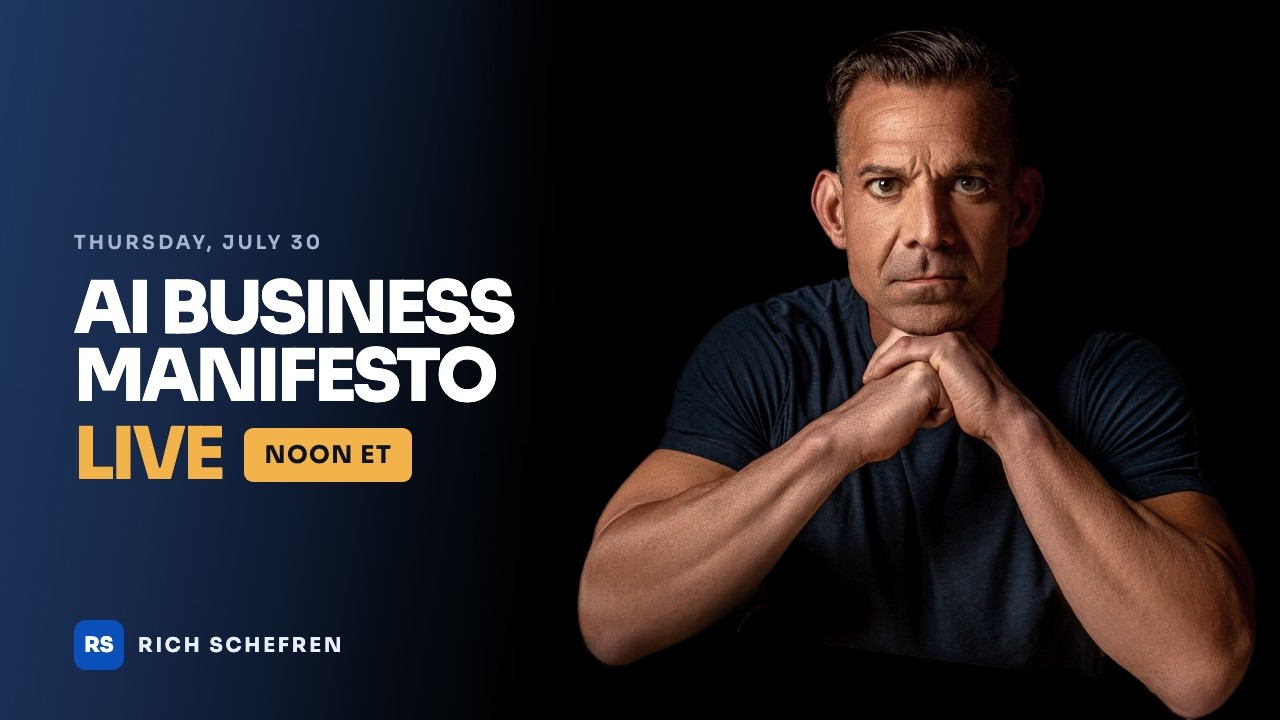
In this multi‑platform live stream Rich Schefren introduces his newly written AI Business Manifesto and explains why it supersedes his 20‑year‑old Internet Business Manifesto. He outlines three "waves" of AI adoption: Wave 1 – three fixes (outcome‑oriented prompting, building a robust AI "harness", and thinking like an architect); Wave 2 – the free Imprint and Atlas memory tools he released on GitHub that let AI capture a user’s real‑time judgment and propagate belief changes; Wave 3 – personal augmentation where AI knows a user’s flaws (ADHD, info‑junkie, procrastination) and helps manage them. Schefren argues that tacit knowledge is no longer a barrier, that AI can now capture a person’s "imprint" and act on it, and that this shift creates a competitive advantage. He shares anecdotes about his own workflow, past reports (Attention Age Doctrine), and past successes (helping clients generate $15 billion). He calls on the audience to read and share the manifesto (hosted at aistrategist.com), promotes the free tools, and invites viewers to submit business problems for him to solve live. He also mentions training executives at Agora, mentoring Mark Ford and Jay Abraham, and his desire to regain the reach he once had. The session ends with a promise to build solutions live tomorrow and a request for more eyeballs on the manifesto.
Chapters
There we go. Welcome everyone. And, uh, just trying to still see if I can get, uh, my— hold on a second here. Oh, I did. I think I'm good, supposedly. All right, so welcome everyone. There we go. Oh, welcome everyone. And, uh, Cool. Uh, so I'm finally on Instagram too, so that's kind of cool. So, uh, welcome. Uh, nice to, uh, see everyone. Uh, if you can, please say hi to me in whatever chat you're watching me on, uh, because right now I'm broadcasting to Facebook, to LinkedIn, to YouTube, to X, and to Twitter— I mean, uh, X— and to Instagram, and What my intention of doing this, and I'm doing this every day, is for people who have read the manifesto. I've written a new manifesto and happy to talk about that, but that's not really the primary reason why I am doing these live streams. What I want to do in these live streams is anyone who's read the manifesto— hey, Mahatma— um, anyone who's read the manifesto and feels like there's something in their way, that like they don't know what they need to do next based on everything that I lay out in the manifesto, I want to help you. And if if I can build a solution for you, then I'll build the solution for you and we'll do it live on right here. And after I build it, I'll give it to everyone that's on. So that is kind of the idea. And the reason I'm doing this is to call attention to, um, the new manifesto that I've written. Um, I'm insanely proud of it. And, you know, it 20 years ago, I wrote a series of reports where I talked about what people needed to do to succeed as the internet changed from the Wild West days to the more business kind of building days and wrote the Attention Age Doctrine series 19 years ago, talking about how attention was gonna become the scarcest commodity online and in marketing and what were all the implications of that, including the rise of social media. And so, Of all the things that I've done in my life, I am— one of the things I'm most proud of are the reports that I've written, and this is no exception. The AI Business Manifesto, I spent about 3 months on, and I believe I broke a lot of new ground. There's a lot of breakthroughs in there, stuff that's new to the AI world in addition to our space, just the entire AI world. And so because of that, that's why I'm here. That's what I want to do. So I'm curious if you guys have read the manifesto. Have you even— did you even know? Um, those of you that are on right now, uh, let me know in the chat because I can see your comments, uh, no matter where you are, uh, I can see them. So hey, Dan Tech and Miguel, hey, good to see you, it's been a while. And Jason, um, so yeah, uh, let me know if you guys even knew that there was a manifesto because I would assume some of you might not have known that. We haven't really geared up yet to make a big deal about it. And so because of that, uh, I'm curious. I'm curious, uh, what you've heard and what you haven't. And, um, let's just see here. I was— while I was, uh, this morning, what I've been working on— let's just see if it's, if it's open still. I don't know if it is open still. Hmm. It is a memory control center, um, and, uh, it integrates all memory systems into one. But, uh, anyway, so I could show lots of things. I could like start to actually just work on work, but, um, my real desire would be to build something for one of you guys. Um, and That only makes sense if I know what the problem is, what's standing in your way, what you feel you need, uh, to succeed. And if that isn't the case, uh, if I don't get any, I can talk about the manifesto a little bit, and I'd be happy to do that, um, you know, considering I just spent the last 3 months on it. Um, but let's see, I gotta move a little bit. I want to use this camera. Yeah. Wow. Okay. You guys are being kind of quiet, so I will talk about— well, let me, you know what, let me pull up, let me pull up the manifesto, I guess. So let's see here. Let me just see draft 53, because that's what it was. And that would be a PDF. So let's just search and find her. Let's see. All right, so, well, I guess I can share my, um, I'll share my Obsidian. That's probably the best thing to do. So let me open Obsidian. Where is Obsidian? There it is. Okie doke. All right, so we got off to a slow start, but now we'll pick things up a little bit. Here we go. And please speak about the manifesto. Okay, you don't have to ask me that twice. All right, so I'm just seeing where do I need to be on this one? All right, like that. Cool. All right, so let's first go to my Obsidian vault. And I guess I'll take code out for now. Yeah, so that I can just have more space to actually show you what's on screen. But I would love to actually, let's see, D53 approved. All right, so let's see. Here's the canonical. Here we go. Let's do this. Share my screen. Uh, share screen and window Obsidian. I'm sorry, I really— I will make it a point to actually have more of this already up, ready, and loaded when I start. Um, but, uh, why didn't that go through? Hold on. All right, share screen. So I spent 3 months on the manifesto. What I'm probably— this can't actually try capturing a difference. That does not make sense. Share screen. Windows. Huh. All right, this is gonna be problematic. All right, well, I have another way to share. Have no fear. But, but that's kind of strange that Ustream is doing that. Let's see. So let me do computer. All right, and then I'm gonna do, uh, Obsidian. Uh, there we go. I'm not seeing it. Son of a bitch. All right. So I'm just gonna talk. All right. So yes, I released a new manifesto. It was called, it's called the AI Business Manifesto. It is to replace the manifesto I wrote 20 years ago that was downloaded 5 million times that really set the way that businesses grow online. And the reason that I wrote this new manifesto is, is that if you follow the advice of the old manifesto, the advice that made a lot of people really rich online, you will go out of business in the age of AI. And that is because the advice in the original manifesto was strip out everything unique, special, et cetera, about the founder, the owner, whatever, because the business has to be simplified in order for it to scale. And so to streamline a business, you always simplified it and you always simplified it by removing anything that was unique and personal of the owner or founder, because that cannot be replicated in every employee. And so therefore, that's the way you would grow. And so that made sense. And that made sense since the beginning of time, really. And, but that has all changed. And that's changed because we're quickly moving into a space with artificial intelligence really being the driving factor. And so right now, you can have a competitive advantage in your business because you know how to prompt correctly. You have the right kind of harness around your AI that gives your AI the ability to do anything and everything. And that you think about it the right way, that you're not thinking about it as someone who's like an assembler who's looking for AI tactics, AI platforms, et cetera, just to kind of bolt onto what they already do, but maybe do parts of it better, faster, cheaper. As opposed to an architect that recognizes speeding up any single part of any single process does not necessarily drop to the bottom line. That unless you've like actually redesigned the whole workflow, odds are you've just sped up one part. And that's why like 2 years ago when they did a big research study at MIT and found that like 93% of Fortune 500 companies got no payoff from any of the AI they have done. It's not that they didn't get a benefit, it's that they didn't get an ROI and they didn't get an ROI because speeding up something here did not make anything drop to the bottom more. And so it's that, that happens in every techno— technological disruption, right? Like, um, I talk about it in the manifesto, like, you know, when we went from factories being powered by steam to be powered by electric, uh, they replaced all the machines, right? They were now all had their own power source, but nobody moved the machines for 40 years. So there was no productivity increases switching from steam to, to electric until someone was like, well, now that these machines don't need to be in this sequence, we can redesign the workflow. The assembly line was invented and then huge productivity gains. Same with the computer revolution. In 1987, Nobel laureate Robert Solow said, you can see the effects of the computer revolution everywhere except in the productivity statistics. And he was right. So by 1987, Productivity hadn't improved because of computers. That's because companies like GEICO replaced typewriters with computers, but they didn't change any of the internal processes. So someone would use a computer, set, print out whatever they just did on the computer, put it in inner office mail, and then send it as opposed to just sending an email right to the other computer because the processes weren't redesigned. So, um, so those are some things that stand in the way. So, What I decided to do was I wrote this manifesto where I really wanted to help people in 3 different places. So the first, so there are 3 waves and the first wave is everything that if you're not making more money in your business right now because of AI, the 3 things that are probably the reason why, the 3 obstacles that are standing in your way, the 3, you know, the 3 things that you have to overcome and what they are is, outcome orientation. Most people prompt or give instruction to AI in a way that overprescribes what you want done and minimizes or sacrifices or leaves out what ultimately you want, the outcome. What is the outcome of the outcome, the ultimate outcome? What is AI trying to accomplish for you? And so that makes a huge difference because when you really get that you need to be outcome prompting and all the platforms out say it, but like we've been teaching this for 2 years. Um, when you're outcome prompting, what you very quickly come to the conclusion on, and this is a big deal, is that you don't need to know how to do anything, that you're not controlled by what your skill level is. You're controlled by your imagination, because if you can ask for it and you can ask for it clearly, you can get it. So we are no longer tied down by what we can do and can't do ourselves. We're no longer tied down to— by what we know and what we don't know anymore, because we have this machine in front of us that can do a lot more. And so by shifting from method prompting to outcome prompting, it makes a world of difference. So that was like fix number 1. Fix number 2 is you must have a harness around your AI. And a harness is everything that surrounds the AI. So like I have a very robust harness that allows no matter what AI tool I'm using, whether it's Manus, whether it's Gemini, whether it's Claude, whether it's Codex, you name it, And my system responds exactly the same way. I can switch from one to the other, to the other. I don't even know which one I'm talking to unless I ask, because my system kind of has each one in alignment for what it is I want. And so my system can pull them in and out, and therefore it's agnostic. Now, the platforms themselves have been making their desktop apps better and better so that they can act like a harness. And right now I would say that I've been a huge Anthropic fan for the last year and a half, and I've felt like Anthropic really had outpaced OpenAI. That's changing a little bit now. And the Codex Desktop is insanely great. And why do I say that the Codex Desktop is insanely great? Well, I say that because my system, no matter what AI I'm using, it can control everything on my computer, right? Like I can ask my AI to Slack this person, take that Slack message, do this with it. Create that with it, whatever. And it doesn't matter. I could be using Gemini. I could be using OpenAI. I could be using Claude. I can be using Manus. It makes no difference. GenSpark. But most people don't have a system like that. My system takes a picture of the 5 monitors that I'm looking at right now, takes a picture of those monitors every second, and then OCRs what is on each of those screens every second so that it knows everything that I'm working on at any given moment in time. In addition to that, right, you know that I wear a necklace that records everything I say all the time, and that goes into AI. All of those things are elements of my harness, right? So anyway, OpenAI though, the Codex Desktop, you flip a button, just a button that says control my computer, and then all of a sudden your Codex or ChatGPT can control your entire computer and any app on your computer. That's no MCPs, no APIs, no nothing, just, uh, working on your computer. And if I'm sweating a little bit today, it's because we're working on The Office. If I switch cameras, you'll see some people behind me, but, uh, it's not that talking about AI gets me sweaty, uh, it's just that it's hot as hell down here in Florida and I'm replacing my air conditioner. So, um, yeah, so Harness. Harness is where the competitive advantage lies today. Right? And the reason for that is, is that no one knows what is the optimum harness. We all have our own harnesses. Well, anyone that's doing AI really significant and seriously. And, but there is no, like, ideal harness. Oh, my dog just came in. She's happy to see us. There is no ideal harness. No one knows what's ideal. And so until someone figures out, oh, this is the optimal harness, there will be a competitive advantage in harnesses. And then when that optimum one is figured out, what'll happen is, is that ultimately everyone will have it, and then there'll no longer be any advantage whatsoever in a harness, right? It'll just be anti to play the game. The third fix, before I get to the second wave, is that you have to begin thinking like an architect. You have to realize that Putting AI on a single task does nothing if you don't figure out the workflow that it's a part of, the processes that it's a part of, and are looking to impact the whole thing. Back in 2008, when I used to teach theory of constraints, theory of constraints talks about, you know, there's always at any given moment in time, there's always one thing that is limiting that any system and working on anything other than that one thing is a false efficiency. You're doing, You're creating more of something that doesn't matter. Right? So the, so you don't want false efficiencies. You wanna work on what is actually a core constraint. And so in the old manifesto back in 2006, I talked about the strategic entrepreneur versus the opportunity seeker. The opportunity seeker of 20 years ago today is the assembler. They're just buying AI stuff and latching it onto their business, bolting it on. The architect, that's the strategic entrepreneur of today, recognizes that there is no simple question when it comes to AI. You know, if you can all of a sudden create a webinar in 30 minutes as opposed to 3 weeks, like what else has to change in the business for that to matter? Oh, thanks. What else has to change for that to matter? Because if nothing else changes, nothing changes, right? You just were able to create a webinar really fast. So those are the 3 things that you must do if you want to make money today in AI. And that will give you an advantage for some period of time, but it will not last. So what will last? And what will last and what will make AI a lot better for you is really the core idea of the manifesto, the really breakthrough idea of the manifesto. The claim that I'm making is rather large. And so let me kind of explain what the claim is. So, for all of human history, there has been a— there's been this knowledge that cannot be articulated. Every expert has what's called tacit knowledge. And tacit knowledge cannot be, like, articulated and given and received to another person. It's the reason that medical students do a residency. It's the whole reason behind apprenticeships that you have to stand around in proximity to the expertise so you can absorb it over time. And it takes a long time. And that's been since the beginning of time. I am saying that that's no longer necessary. That's the claim I'm making. So it's a big claim, right? I'm saying that human history is changing from this point forward. Because for the first time in history, your judgment, your perspective, your point of view can be caught in real time, and it can be attached to what you were reacting to. And so for the very first time in human history, your perspective, your discernment, your judgment, your point of view can be captured in real time, and it can be captured with what sparked the feedback. And so I call that your imprint. And what that allows your AI to do is actually not just sound like you, but to be able to sit in for you, to make decisions for you. Not in areas where you've never decided before, but in any area where you've worked, where you've played, where you've done stuff, It knows how your perspective on it over time and can actually make the call that you would make. And so that's the imprint. And I gave it away for free. It's out on GitHub. Go to Google, type in imprint, Rich Schefren, GitHub, you'll find it. I also created another tool because both of these were missing from every single memory system out there, period. There is no memory system that has what the imprint has. And there is no memory system that has this other element too. And this other element I call Atlas. And you can get that for free too at Atlas, you know, just type into Google Atlas Schefren GitHub and you'll find that. Atlas is the very first memory layer that takes into account that when one belief changes, there is a, there's a radius blast. There is an impact blast that no belief just stands as an island and that when one belief changes, it will impact other beliefs, other thoughts. No system has that, whether you're using Hermes agent, Open Claw agent, nothing, MemZero, doesn't matter. None of them update. So I created Atlas, which identifies all the beliefs that have to change when one belief changes. And it works with OpenClaw. It works with Hermès. It works with GBrain. It works with all of them because no one had anything like that in their memory system. And so how did I know that people needed that? Because I've had memory for longer than most people when it comes to AI. So I've built these two things. I've given them away to the world for free, and I'm going to put big bounties on whoever creates the best version because I don't think I should be the person that creates the best version. And so I'm gonna have hackathons. Because this is my contribution to the world. This is my contribution to you. It'll make it so that your AI, you know, when let's say that you're working on something really important to you, not something like whatever, but something really important to you and you have your AI work on it. Generally, when people have something really important to them being worked on by AI, they get like 80% of the way there with AI, but then they gotta step in for the last 20%. What the Imprint and Atlas do is make that 20% eventually get to zero so that AI can really take it all the way to the final mile. So Wave 2— so Wave 1 was those 3 fixes. Wave 2 were all about Imprint and Atlas. And then Wave 3 is really more the— my more personal side of it. And it's that I, for So, I've been credited with helping my clients grow and make more sales, $15 billion in my lifetime, right? And there are many of my clients that I've been able to give advice to. They ran with my advice and they built huge companies. And all of them were successful than me because of my flaws in the way I work and the way I do things, right? So, I've known the right move but can't take it or take it in a self-destructive way. So in order for me to get the most out of AI, I actually came to AI not for Wave 1 and 2. I came for Wave 3 and then got absorbed in Wave 1 and 2. And I started with AI because I needed personal help. And so I got my AI to know more and more about my life. And the more it knew about my life, the better my life got. I got in better shape. I got better relationships. My business started doing better, more and more, because I finally had something that knew me better than I knew myself and could help me. And so, the Imprint and Atlas are great if what you bring to the table is a winning perspective. If what you bring to the table is not a winning perspective, then just replicating yourself might not be the best option, just like it's not the best option for me because I bring baggage to the table. Right? It's the reason my clients can do better than me. So, because of that, right? You, for people who can get in their own way, having AI know you really well will help steer around your challenges. Right? So, I'm an info junkie, I'm a procrastinator, and I have ADHD. Left unchecked, AI will make all of those worse. It will, at the end of every question, it'll give me 3 new ideas to consider. That's horrible for my ADD. If for my info junkie-ness, it'll recommend stuff for me to read or produce lots of output. That just feeds that. And if it's procrastination, it gives me a bunch of other ideas to consider. All of these things make it worse. But because my AI knows that, it doesn't even allow me to start new things in a thread, let alone recommend other ideas. And when I wanna start another idea, it'll actually offer to do that idea for me so I can stay on task. So your flaws are either magnified by AI or they're managed by AI. But if your AI doesn't know what your flaws are, it can't be managed. And so Wave 3 is all about getting your AI to know you really well and then getting on the same page about the future that you really, really want. And why is that important? Because as someone who's coached a lot of people over the years, even though I don't do that very much anymore, what I can tell you is most people walk around with a shitload of conflicts in their life. They want money, but they want freedom. They wanna be tough, but they also wanna be nice. Like all these different things, right? Those conflicts don't matter that much because the latency or the time delay into execution is long enough that those flaws don't, those conflicts don't show up. But in AI time, an AI that's trying to help you get to where you wanna go, those conflicts now become real and they become friction. What is it that you really want? When forced to choose between more money, more fame, or more time with your family, what will you really choose? Not what would you like to say you would choose, not what you might choose when nobody's looking. Like, what would you really choose? Because your AI can't help you unless it really knows what you would really choose. Now, we can lie to ourselves one day and say we'd choose this and then choose that, and it doesn't matter because we don't operate that fast. But AI operates insanely fast. And if it's gonna help you get to your future, you better have that kind of nailed down and not have as many conflicts in criteria that most people have. So that's the manifesto and it's free. So I'm giving the tools away for free. I'm giving the manifesto away for free. It's the first manifesto that I've ever written that I am not even requiring an opt-in. And the reason I'm not requiring an opt-in is that I'm so damn proud of this. I know that anyone who reads it will make a huge difference in their life, right? The original Internet Business Manifesto was downloaded 5 million times. I don't have any illusions that this one will be downloaded more. I really was at the peak of my notoriety back in 2006, but this is actually a more important document. I believe, like, in 20 years from now, I'll be known for this document more than any other document. And if you go into any search engine right now and you type in my name, it's gonna talk about the Internet Business Manifesto because of what its impact was on the internet for 20 years. But this is far more, and I removed every friction point so that it could be shared because my number one thing is I wanna see this everywhere. And here's why. I'm 55. I've been doing the online game for the last 25 years. For the first 5 years, it was super exciting, and then after that, it wasn't so much. And at 55, or at 50, like, walking up to my desk was not like exciting, like, what the hell great thing am I gonna do today kind of like feeling. That was there when I was 25. That was there when I was 30. Maybe as up until like I had a midlife crisis when I was 40. And what AI has done for me more than anything else has given me this feeling that I can do anything. Now, can I do anything? No, I can't do everything and anything, but what I can do in front of this machine is about 100 times more than what I can do by myself in in real life. So the real Rich Schefren doesn't know how to send an email from GoHighLevel or Keap, even though we've had Keap for 20 years and GoHighLevel, I don't know, for 3 or 4 years. I don't know how to send an email. I don't know how to do anything. All I know how to do is check sales. But in front of this computer, right, I can do anything. I migrated 55,000 of our list to Substack. Yesterday I set up a welcome message and sent out a welcome to those 55,000 through Substack, right? Because I'm going to start writing about the manifesto in Substack. I set up a Substack account. I already, like, did all these things that I'm incapable of doing, but my AI did it for me. My AI published this upcoming episode, like, on the platforms, created the thumbnail. And so because of that, right, my whole demeanor and my whole, like, way of being, my whole way of experiencing myself has changed because I wake up every morning now excited to get in front of this desk, right? So much so that even if it's hot in here and they're working on the air conditioning, I don't care. I don't care because this feeling of invincibility of being able like, what cool thing do I want to build today to move my business forward? I get to make that choice every day. What in my imagination doesn't exist that if it did exist, my life would be better, my business would be better, or my day-to-day experience would be better? Let's build that. So because of that, I feel transformed and it's impacted every area of my life because of that feel, the difference in the way I feel and the way I show up. And so because it's been so impactful for me and I really like as one of the most impactful things that's ever happened to me in my life, And I'm not alone in that. Most of my friends, we're all around the same age. They all have the same thing to say, like they feel more alive today than they've ever felt. And so because that's been my experience, that's been my friends' experiences, the two people that I most wanted to give that to were the two people that mentored me, that made the biggest difference for me when I was first starting out. And the two people that, that, those, those, the two people, blah blah blah, those two people are, uh, Mark Ford, also known as Michael Masterson, and Jay Abraham. So I've already got Mark Ford up to speed with AI. We went, I was down in Nicaragua to train, uh, a bunch of the Agora people in AI. And Mark was down there too, and he was attending. And I stayed at Mark's house, and I brought Donnie and Harry with me. And so we all stayed at Mark's house, and we teamed up on him all weekend, and we got him fully trained. He's written 3 books in the last month, and he's gotten that spark. And he's 75. I'm at 55. I can't imagine how great that spark feels at 75 because it felt fantastic at 55 compared to what I was experiencing. The other person I wanted to give it to is Jay Abraham, and we just announced a Connect the Dots, uh, sometime in August with me and Jay. And Jay's coming down here 3 days earlier so I can get him fully trained. And, um, I think, uh I think we're sold out already. We might have one seat left. Um, but I want to give the two people that made the biggest difference in my professional life, I want to make a big difference in their professional life. And the way that I'm going to, I'm doing that is by getting them this skill. And so I'm here every day doing this live stream so that you can have this skill. And what I am, what I really want these sessions to be about, I'm happy to talk about the manifesto and please go check it out. If you haven't read it, I guarantee you, if you read it, you will be thankful that you did. You will have learned things. You will see AI in a different way than you saw before, and you'll understand why you've had the challenges that you've had with AI, if you've had challenges, and what you need to do to fix it. I promise you that. You've never read anything like this. In fact, you could take the report, you could load it into AI and ask what other thing has written about all this, and it'll tell you nothing. Ask it about, like, what other people write about this in this way, it'll tell you nobody. I know because I've gone into every other AI anonymously and asked. No one is talking about this. And I'm telling you, just like I said in 2007, that attention was going to become the scarcest commodity online, that there was going to be this rise of social media, that was going to give people a voice and that prospects were no longer just going to be targets, they were going to be the single best marketing channel that ever existed in all time. I was right about all those things. I'm right about this. I know I'm right about this. In fact, I'm so certain that I'm right about this, like, I'm, you know, Monday, Tuesday, and Wednesday I am in Baltimore training the, um, the upper executives of Agora with, um, Uh, with AI. And I was just talking to my, uh, Nicole, who runs my company, that since I'm going to be in Baltimore Monday, Tuesday, and Wednesday, maybe Thursday I hop on the Acela Amtrak train and I go to New York. Because, you know, Gary Vaynerchuk and I used to be close friends many years ago, and we became friends because he read one of my reports and he was like, oh my God, there's someone else that is seeing what I see. So it was a report, The Attention Age Doctrine 2, that brought Gary and I together, you know, 20 years ago or however long ago it was. And this report— and this was before Gary Vaynerchuk was the Gary Vaynerchuk— and, um, I want to put this in his hands. And I'd be willing to just go to New York to put it in his hands, um, because I know if he read it, he would agree with it. He would be like, this is the future. And maybe he would even send it out or speak about it, and that would be huge for me. The biggest thing, the biggest challenge, the biggest struggle I have at this moment is just getting more and more eyeballs on the actual manifesto because I don't have the same clout I had 20 years ago because I was absent from the internet for 10 years. And so, you know, there's a lot of people who've joined online marketing that have no idea who Rich Schefren is. They know who the people I coached are, and the people who they coached are, but not necessarily me. So if you've gotten any value from me over the years, I would love it if you would help me promote the manifesto. And the, probably the easiest place, it'll actually take you to a redirect, but the one that I know is if you go to aistrategist.com, Right, so aistrategist.com, and you click on manifesto in the top corner on the upper left. It'll then take you to our— where the manifesto actually lives. But if you do this, I'm just going to do a screenshot here real quick, and just— I'll throw this up. Hopefully I can, and, uh, So based on all that, I'm gonna have to run in a minute or two, but curious if you guys have any questions for me based on what I've shared, because I'd be happy to answer questions. And let's just see, is that right side up or is that the— oh, and it's— yeah, you go there. Is it backwards or forwards? Uh, and maybe I'll change my layout. There it is. Okay, boop, that's there. Uh, I will talk about hooks and injections tomorrow, and I'm happy to do it. Um, don't know if that is— if you're seeing the right thing or not, so I'm just gonna get rid of it. But hopefully you are seeing AI Strategist. If you are, you click on the manifesto and then it will redirect you. Uh, I'd love for you to read it. Oh, it's right. Okay, that's cool. Good to know. Yeah, so go there. I think you'll get tremendous value. You'll see that no one has talked to you about AI this way before, and no one has broken it down this way before. And I don't think you'll come across another document ever that will. So, Rich, I used your hook injection prompt from yesterday and had Claude Lopez 5 turn skills more deterministic and made a lot of mistakes, but I'm testing results now. Thank you. Oh, no problem. It will make a huge difference. Um, you know, in any build, at some point you want to take anything that doesn't need to be AI and make it not AI. So what the way we talk about that is you want to make as much as possible deterministic as opposed to non-deterministic, which would be AI, and you therefore you can't determine, right? Like what is actually being said? Oops. All right. So I'm just gonna get rid of this, but I just wanted to kind of— it'd be wrong if I didn't. I should actually just put the link in the chat. I'll do that tomorrow. Um, yeah. So tomorrow I'm happy to talk about hooks and injections. Uh, it'd be my pleasure. Oh, thanks Oscar for putting the link in. Uh, and, uh, yeah, so read it. I guarantee you that you'll appreciate it. If you don't, let me know. I'd be curious to know if someone doesn't get value from it. And with that said, I'm gonna jet now, but I'll be back here tomorrow. And bring me a business problem because really what I wanna do is I wanna solve your business problems with AI. I wanna build shit. And tomorrow, if someone brings me a challenge, that like excites me and excites you guys, then I'll build that and I'll use hooks and injections in the build. So you'll be able to see that anyway. I'm less concerned about the hooks and the injections and like explaining that to you. Like, that's easy, we can do that. But I'd love to do it in a way where I'm building something and then able to give you guys it. Like, that would be damn cool. And that's what I want to do, and that's why I'm doing these. And I know like this is only day 2 of this, and I've done countless live streams and launched them before, and And it takes me a little while to kind of get my groove and that's what will happen. But, you know, we got a good attendance today on the different platforms. So that's great. So thank you for being here. Thank you to each and every one of you who commented, whether that was on YouTube or Facebook or Instagram and, or LinkedIn. And just thanks for being here. I promise you that if you bring me a business problem, I will solve it and I'll show you how. And I'll do it in front of you, and I will give you the tool that I create for you once I'm done. So I can't, I can't think of how I could make it more appealing, but I'm all ears if you guys have better ideas. And I will see everyone tomorrow. To higher profits and beyond, this is Rich Schefren, over and out.
More from Rich





Russell Brunson Reveals Why He Brought Rich Schefren to Funnel Hacking Live (AI Edition)





