I Solved MRBEAST's Retention Code...
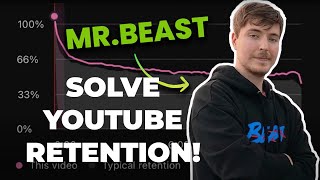
Rich Schefren breaks down how MrBeast keeps viewers watching. The first five seconds must match the title and thumbnail. MrBeast uses visual breakoffs, contrast, open loops, and effort bias to hold attention from start to finish.
Hey, Rich Sheffrin here.
It's game over. I don't care how long this takes, whichever one of you leaves last wins half a million dollars.
Want to solve the YouTube retention puzzle and hit the golden benchmark of 70% retention for your videos? The way Mr. Beast does it with every video he creates? I'm going to show you exactly how right now.
Yeah, 70%. That's what you need.
So how does MrBeast reach this magic number? To figure it out, my team and I spent over two weeks closely studying as many MrBeast interviews, videos and tweets as we could find. And we started to real spread across his content. Mr. Beast has revealed the exact framework he applies to each of his videos to get their attention. So high. And it starts with the first five seconds of the video.
Bro, I roast the hell out of people who like have boring first five seconds.
Here's how Mr. Beast approaches this crucial time frame.
Essentially, your title and thumbnail set expectations. And at the very beginning of the video, to minimize drop off, you want to assure them that those expectations are being met.
Mr. Beast is very clear that in the first five seconds of a video need to meet the expectations of your viewer. To do that, he applies a two step formula to the very beginning of every one of his videos. First, his first sentence matches his title. And second, his first shot matches his thumbnail. Let's take a look at an example. Check out the title and thumbnail for this video. In the thumbnail, there's a close up of Mr. Beast with views of a crowd of players behind him. The primary colors used are red, green and blue. The title of the video is Last to leave circle wins $500,000. Now let's take a look at the first five seconds of the video.
I put 100 people inside of a giant circle.
Did you catch it? The very first shot closely resembles the thumbnail. A huge field, a giant circle, a crowd of players. And the primary colors are red, green and blue. And Mr. Beast's first sentence, I put 100 people.
Inside of a giant circle. And whoever leaves the circle last wins $500,000.
Very closely matches his title. Lets take a look at another example. This video is titled I spent 50 hours in solitary confinement. The thumbnail depicts a close up of Mr. Beast in a prison uniform. The main colors used here are orange, gray and black. Now let's take a look at the first five seconds.
I am going to spend the next 50 hours alone in solitary confinement.
The first shot matches the concept of the thumbnail. Mr. Beast close up in front of a room that looks like a prison cell and his first sentence.
I am going to spend the next 50 hours alone in solitary confinement.
Matches the first part of the title by using the first five seconds to immediate immediately match the title and thumbnail. Mr. Beast minimizes drop off from the very beginning. After applying his two step formula to the first five seconds of the video, Mr. Beast moves on to the first 20 seconds. This is where it gets interesting, because to keep the retention up throughout the entire hook, the first 20 seconds of each of Mr. Beast's videos contain the CSCE formula, starting with three core elements, explaining the context, introducing the stakes or payoff, and and creating a curiosity gap. Let's hop back to the last to leave circle wins $500,000 video to see each of these elements in action. We last left off in this video after the video showed a giant cup full of money inside a giant circle. See if you can follow along.
It's game over. I don't care how long this takes. Whichever one of you leaves last wins half a million dollars. $500,000.
Oh, I cleared my schedule. I am literally good for the next three weeks.
In the first 22nd, Beast has provided context about the video setup, introduced a juicy payoff which, by the way, fulfills meeting the expectations from the title and thumbnail, and created a curiosity gap that entices viewers to stick around and wait to figure out how long it'd take for someone to actually win this. He does all of that in less than 20 seconds. But it doesn't stop there, because in addition to those three core elements, there's actually one more secret element that Mr. Beast applies to every one of his hooks. He alludes to it here.
So at the very beginning, match the expectations, and then you want to exceed them. So you want to assure people that what they clicked on is what they're getting and then blow their mind and be like, but you're also getting even more.
It's not enough to simply match the expectations set by the title and thumbnail to get that retention through the roof, Mr. Beast exceeds those expectations. How does he do that? It's simple. He puts in effort.
A lot of people, though, they underestimate effort in videos. Viewers aren't stupid. They can tell when you, you know, half ass. I don't know if I'm allowed to curse a video or if you, like, really put an effort and like, if they can tell, you're putting in a lot of effort.
When Mr. Beast talks about effort, what he's really doing is Leveraging something called effort bias, which is the idea that the more effort we put into something, whether that be time, energy, or cost, the more we'll value it. As an example of effort bias, if we pay $50 for a bottle of wine, we'll value that more than if we had paid $20 for the same bottle of wine. Leveraging this bias is the special sauce that makes Mr. Beast's hooks so retentive. If we revisit the first 20 seconds of the I Built Willy Wonka's Chocolate Factory video, we can see effort bias being leveraged starting here. This shot is masterful. In one glance, you instantly get the sense that an immense amount of time, effort and money has gone into the making of this video. The next few seconds heighten this effect, showing the full magnitude of all the effort that went into the video. This is how Mr. Beast not only meets the expectation that he did in fact recreate Willy Wonka's Chocolate Factory, but exceeds that expectation by showing how much work was put into this idea. Now, I know what you're probably thinking. How can you leverage effort bias when you don't have a Mr. Beast budget? Well, you don't need a huge warehouse or a flashy set to trigger effort bias. I did it in the beginning of this video. Did you catch it? My team and I spent over two weeks closely studying as many Mr. Beast interviews, videos and tweets as we could find. At the beginning of this video, I specifically mentioned how much time I spent researching for this video. My team's editing shows a high degree of effort as well. As a result, you as a viewer, hopefully started to value my video more because you could tell how much work we put into it. The other elements of mrbeast hooks aren't exclusive to Mr. Beast style videos either. See if you can spot them in the hook to this video. Want to solve the YouTube retention puzzle and hit the golden benchmark of 70% retention for your videos? The way Mr. Beast does it with every video he creates. I'm going to show you exactly how right now.
Yeah, 70%. That's what you need.
So how does Mr. Beast reach this magic number? To figure it out, my team and I spent over two weeks closely studying as many Mr. Beast interviews, videos and tweets as we could find. And we started to realize something spread across his content. Mr. Beast has revealed the exact framework he applies to each of his videos to get their attention so high. And it starts with the first five seconds of the video to keep the rates of retention as high as possible. The sooner the retention curve starts to level off, the better. The question then becomes, how do you keep the retention curve level? The secret lies in three factors. The first one is visual break off. When it comes to visuals, Mr. Beast is quite clear where he stands. He understands that if I just talk.
To a camera for 10 seconds without a cut, like, a lot of people will just like get bored or they'll lose interest.
To avoid this, Mr. Beast maintains visual break off with a cut at least every three to five seconds to break things up. One of the best examples of this is in his I spent 50 hours in solitary confinement. Take a look at the timing of his cuts during this clip.
These are my friends. Enjoy. The most annoying thing in the entire world, Minecraft cats. I will admit it's pretty annoying, but I'm not cracking. Are they going to make me listen to this? I'm trying to annoy Jimmy, so I'm having. Are you going to finish that croissant plate? Are you going to finish that croissant? I think I'm in hell. I don't know how it could get much worse.
To be honest, watching someone being trapped in a room could have easily become quite boring. But by using six different shots within 20 seconds of footage, Mr. Beast is able to hold your attention throughout the entire process. So the key takeaway from this is if you do talking head videos, you could put another camera at an angle and then switch between the two to add variety. Alternatively, if you're like me and you just want to shoot directly to a single camera, you can incorporate different levels of scale, zooming in and out in between clips to keep things visually dynamic like Mr. Beast did. But even the most frequent changes in camera angles still can't make observing a man in a tiny room interesting forever. Attention spans are shorter than they've ever been, a fact that Mr. Beast is quite aware of.
It's very hard with a single storyline if you're doing like a double digit minute video to just have that one thing. Rip their entire attention throughout the whole video and pay off at the end.
And that's where secret number two comes in. Compare and contrast. Now let's go back to the last to leave circle wins $500,000. Instead of an entire 18 minute video of people staying in a circle, Mr. Beast breaks things up using contrast. From the moment 100 people gathered inside the circle, a side story is introduced.
How long are you staying in this circle?
Well, I took off work until January 1st.
You took off work for the next.
Six months, for the duration of the video to break up stretches of the video. Mr. Beast introduces different challenges every day to get more people out of the circle. And the viewers are periodically shown how people leaving the circle also get their prizes. The contrast between people who leave and people who stay prevents the footage from ever getting stale. Before you start thinking side stories don't work for my particular style of video, there are other ways to incorporate contrast. For a talking head video like this one, I try to do this by blending footage of me talking with clips from Mr. Beast's videos or interviews. Hopefully that contrast prevents you from getting too bored of my talking head. Now, is it working? I hope so. And while visual breakoff and consistent contrast are integral components of Mr. Beast's videos, the final secret to the body of his videos is the most retentive of them all. Open loops. This is a concept often stated broadly but rarely seen in detail. So let's get real specific. Most videos look like this. At the beginning of the video, there is high energy from your hook. At the end of the video, there's high energy from your loops payoff. But this middle bit is low energy in comparison, steadily declining in energy until the boost from the payoff at the end. In comparison, Mr. Beast's videos look like this, with frequent loops of high and low energy. What do I mean by high and low energy? It depends on the video. In Mr. Beast's last to leave circle wins $500,000 video to get people out of the circle, he introduces a new challenge and increases the difficulty level each day. The loop opens with a high energy, exciting introduction of the new challenge, followed by the lower energy of people reacting to the challenge and leaving the circle, followed by a new loop with a new exciting challenge. This keeps the pacing up throughout the entire duration of the video, right up until the final high energy payoff of the $500,000 winner at the end. Each of Mr. Beast's loops tends to be between two to four minutes long from start to finish, with the shorter loops towards the front of the video and longer loops towards the back of the video. The slower, more emotional parts of Mr. Beast videos are reserved for the last 20% of his videos, with the beginning allocated for lighter content. And of course, the concept of opening and closing loops for good pacing is not unique to Mr. Beast style videos. For this video, each new retention tactic I mentioned starts a new loop. The loop starts with the high energy introduction of a new tactic, followed by the lower energy of explaining and giving examples, followed by the opening of a new loop with a new tactic the use of Loops keeps Mr. Beast's retention as flat as possible until the very end of his video. And when it comes to those final seconds, they're more important than most people give them credit for. Most people tend to see long drop offs at the end of their videos, which hurts their overall retention. But Mr. Beast keeps his retention upright, and until his final ad read. To do this, he applies the unveil finish technique. First, he unveils a big payoff. And second, he makes sure to finish on a positive note, whether that be dramatic, wholesome, or funny. To see this in action, check out the end of the I Didn't eat food for 30 days video.
A beautiful.
Oh, my gosh.
Breakfast sandwich. Young man, come in, at least take a bite. You'll be the first person in my entire career that I've cooked something from start to finish. Naveta, please, just.
I guess there's. I'll take one bite and I have to spit it out technically because of refeeding syndrome, but I still want to just taste it.
So you're breaking the fat.
I'm going to break the fat.
It's supposed to be sloppy, rich, delicious.
I love it. I love it. It's the best thing I've ever tasted in my life. But you can't just have an influx of carbs after not eating for 14 days.
Happy with that?
I am. I was very happy. Thank you. There you have it. This jerk that's going to make me shave my head. Let's go do it. A deal is a deal, Chris. You can shave my head. Why do we have so many razors? I hate you, Gordon. I love you, Gordon. Thank you. You ready? Go for it. I'm scared I'm going to mess up, but I literally. Lovely. Lovely. That feels oddly good.
You'd think that'd be the end, right? But no. Despite being so intentional about every component of the video from the first five seconds, the first 20 seconds to the body, until the very end, Mr. Beast still has one final secret he applies to hit that 70% retention. After the entire video is made from start to finish, Mr. Beast will go back and cut out every dull moment. How does he identify these dull moments? It's simple. He'll have fans or close friends watch his videos and he'll observe their reactions. He trusts his friends not to hold back when offering criticism. When watching people watch his videos, he looks specifically for when they get bored or reach for their phones. He'll go back to those moments in his videos and either rework them or cut them completely. And that's how Mr. Beast has achieved remarkable retention rates on YouTube. And to get more videos like this with even more detail, featuring the world's top experts in YouTube, AI, Facebook marketing, you name it. Click the link below to get free access to my Steal Our Winners library.
More from Rich





Russell Brunson Reveals Why He Brought Rich Schefren to Funnel Hacking Live (AI Edition)





