RIch Schefren Live 12/17/24
Rich Schefren shares strategies for faster reading and better retention, covering speed reading apps, note-taking methods, and personal knowledge management. He walks through his own techniques and answers audience questions on optimizing how your brain learns and stores information.
Hello. Hello, welcome. It is December 17, 2024 and just getting Instagram live and welcome, everyone. Cool, we're here and everything is copacetic. Hopefully you can hear me. Let me know if you can. I want to say happy Tuesday the 17th and really looking forward to actually sharing what I plan on sharing with you today. And as I say this, I'm just waiting for some people to show up. So let's see here. All right, we got some people showing up there.
Cool.
And so what I'm going to be covering today are some strategies that I've used specifically to read longer, remember more, be better, be smarter, etc. So. Hey, Lorna. Hey, Priya. Good to see you guys. And Jason and Alan. Alan K. Is in the house. Alan, I would love to catch up with you. I'm leaving tomorrow, no, actually Thursday for Nicaragua for two weeks with Ava L. And everyone. But would love to talk to you when I get back or even while I'm in Nicaragua. Hit me up, send me a text or WhatsApp or whatnot. Anyway, so there we go. We're going to be talking about some learning strategies, basically how to overclock your brain. And if this video comes out, well, then I will also probably be turning it into a short YouTube video. And I'm actually turning one of the episodes that we did last week into a short YouTube video that will be posted today. So just welcome to be here. Excited to be here. Sorry. And picked up one of my daughters late last night at the airport. So it is crunch time and what I decided to do. Oh, my daughter's just texting me now. Let me just tell her to come over and say hi. Doing my live stream and what I want to. I actually made slides for you guys today, so we're going to dive in in a second. Come say hi in 15 minutes.
Cool. All right.
So yeah, like I said, I have slides for you guys. It's actually I modified some slides from a presentation that I did at GitHub Geek out, which is one of my favorite. One of my favorite events. All right, so now I just want to get my slides in here and sorry for being a little slow here, but there we go. My computer slides PDFs. We're going to Google PowerPoint.
Cool. Okay.
I don't know. I don't want to do that.
I want to just Share screen. All right.
Present Share screen.
Cool. And window. Let's see. PowerPoint entire screen.
How about this one?
Wait. All right.
Okay, hold on, guys. Sorry about this.
Where is it? No, I don't See it here? All right, there we go.
All right, sure. All right, you guys see this? Three pictures of me trying to turn myself into Albert Einstein. And I spoke about this software before that. I used ArtFlow AI to create these and did a Steal our Winners episode actually on the I'm using ArtFlow AI, which is the tool I use to create these versions of me looking like Albert Einstein to actually increase your click through rate.
So there you go.
What's weird is that I can only see some of the chat texts that come in. And because if you're on Instagram, I actually have to go like this in order to be able to see it. But other than that, I can see your comments if you're on Facebook or on YouTube or on LinkedIn or on Twitter, I can see them right here on my left. All right, so let's dive in, shall we? I want to show you how to overclock your brain. I want to tell you my story a little bit about how I came to actually this information. So let's see, what are we going to cover today? These are my old slides, like I said, have. Okay, so how you can read an entire book word for word in under two hours. How you can become a better copywriter passively. We're not going to talk about that and we might get to that, but we would probably do that tomorrow. All right, so I want you to kind of consider this. That information is now the raw material of our daily reality. How you consume and manage the information flowing through your life is now the most decisive elements in your effectiveness. So how do you deal with the information that's coming at you? How do you capture what's relevant and let what is irrelevant just pass by you? How do you make sure that when you come across something that is valuable, you capture it, but don't get bogged down by capturing lots of irrelevant things.
Right.
So this has been my study on myself of basically how I have improved myself. And one of the things that I want to talk about is that it shouldn't be too shocking when you have someone who can learn fast that they can do well in numerous industries over time. So for example, when I first got into retailing, I read every single book, book that was available for retailing and I mastered the topic insanely fast. When I left the clothing business and I went into the hypnosis business, I read literally probably close to a thousand books on hypnosis and books related to creating a business around it and was probably one of the most well read. And so that has given me an advantage in everything that I've ever done. Good morning Susan, good morning Priya, Good Morning John, etc. All right, so let me kind of tell you that it all. So I've always been a voracious reader and I've always highlighted a lot and taken notes. But something happened and it all started with a missing highlight. So I shot this video back, I think about 20 some odd years ago. It's in YouTube, it's one of my most viewed videos and it's about my entire reading process. And that was the library in my old house. And I was pointing to books that I've read and what I came to find out was that all, not all highlighters are the same quality. And when I, for some reason I don't have the best memory, but I do remember where like I read something on like what side of the page, where, et cetera, like in a book. And so I remember going to one of my books that I highlighted and was shocked to discover that the highlights faded after like a couple years, not necessarily six months, but after a couple years. Which meant that all the reading that I had done in the past, if I didn't remember it after the highlights faded, I no longer had access to what I thought was important. So that kind of freaked me out because it meant that my reading wasn't, I was no longer going to be able to capture it. I wouldn't know what was valuable and what wasn't. So when that occurred, and this is back like 20 years ago, I bought a guillotine for books and a high speed double sided pager scanner and we got a virtual assistant in the Philippines. And every book I read I would highlight. And after I was done highlighting it, it would get chopped, it would then get scanned and then it would get sent to a team member in the Philippines and they would then copy and paste everything I highlighted into a separate document. And then that document would turn into an epub, it would turn into a PDF, a word doc, et cetera, and a bunch of other things that I'll show you. So that was my reading process from basically 2000 to about 2010, right? I would read a book, I would then bring it to the office, would get chopped and scanned at the office. It would then everything that I highlighted would be created into a new PDF and those PDFs would be put in topical binders. This was that video that I was talking about. We're not going to play it now. Well, I'll just see. So you can see. I'm tearing apart the book. This was in our executive offices a long, long time ago. There's the guillotine and I'm just guillotining it. Let's see. And then.
All right.
Then, as you can see, I would guillotine it. I would then get a PDF of it. It would go into different places where I keep my files, but one place it went is in these books that you see with all the white writing on it. Let's see. I'll press play for a second. I don't know what the way. Like old days, before I had my iPad, all my notes went into books like these, which were books of notes on the books that I've read or gone through or courses. And these cabinets go all the way around. So I have these books full of notes. Now. I also have them digitally, but back then I didn't necessarily have them all digitally. So then a friend gave me an iPad, and when they gave me the iPad, everything changed. Because I didn't think I needed an iPad because I had an iPhone and a Mac Air, but changed my life because I would read and highlight the book. The book would get chopped at the office and scanned. I'd get the new PDF, but now that PDF, besides being put in the topic binders, would now get turned into a PDF which would turn into an epub with a software program called Calibre. And then I would load it into my iPad with Quick Reader. That was the app that I used. And then that app would allow me to speed read. So that is one of the things that I did that radically changed my ability to read much faster, to speed.
Read.
How I increased it from 400 words a minute to over 2,000 words a minute. And I use the software called Quick Reader. And Quick Reader allows me to upload any PDF or I think it takes an ePub 2. No, no, it only takes ePub. So you have to turn it into an EPUB through collibre, and then you load it into Quick Reader. And then Quick Reader will pace you no matter what speed you want. And so what I would do is I would start out at my reading speed, that I would go double my reading speed, then I'd do quadruple my reading speed. And I'm really teaching my eyes how to go much faster. And I then go. So let's say I started at 400, then I go to 800, then I go to 1600, then I'd go to 3200, right? And then I'd back it all the way down to like 600 or 800, but that was still faster than my 400, which I was able to read, but I was able to read after going through at higher speeds and then backing it down. Does that make sense that you know and everyone can actually. Let me give you another example, because in audio, it happens a lot faster. If you're listening to something at 200% and it sounds really fast to you, like it's hard for you to comprehend, if you actually boost it up to 250% and listen to it for a couple of minutes, then back it down to 200, it will actually, you'll be able to understand it much better than you could if you actually hadn't done that, right? Sped up first and then go down because. So everything seems slow after you go fast for a few minutes. Whether that's riding on a highway and speeding, whether that's reading, whether that's listening does not matter. The idea here is, is that by going faster than you can at first, then slowing it down, actually you get to be able to comprehend and process at a much higher speed. Now, there's another benefit to it as well. And if you guys have questions as I'm going through this, just type it in, no matter where you're at. I see the questions and I see the comments. So with that said, the other reason why going faster and faster is actually appealing is this because of my add. And what I have recognized is that there is a speed that I can go that will then require me to give all my attention. In other words, that the faster something is going, the more of my attention it will require. So it's very hard for me to pay full attention when. When I'm listening to something going really slow. But it's very easy for me to pay full attention when something's going really fast because I have to. Does that make sense? So in other words, if you have ADD or you struggle with attention, you can often overcome that by just going faster.
Cool.
So as I said, right, with reading, listening, watching everything, and even speeding, it's all relative, right? Speed is relative. It's. And it's based on what has been contextually related to it. So if you're going faster and then you slow down, it will seem like you're going slower. All right, so here's how I got my reading speed up past 2,000 words a minute, I would load epubs of my highlights. So everything I out, everything I highlighted in the book that got chopped, that got sent to the Philippines, that then came back to Me in a PDF got turned into an epub. So I had an epub of everything I highlighted. And then I would review my highlights at 2 times my normal speed, then 4 times my normal speed, then 6 times my normal speed, and then I would review it at 1 1/2 times speed consistently.
Right.
And. And I would just start to read faster and faster and faster. This is what Quick Reader looked like over 10 years ago. It still looks kind of similar, but here's what it looks like. This was me on my elliptical. That's going, I think, at about 2,000 words a minute, maybe a little bit slower. I think I speed it up. Yeah, that's 2000 words. That's 2000 words a minute. That's 3000 words a minute. Two stops per line. There's probably 4000 words a minute.
Yep.
For those of you that don't think you can read as fast, just try and read this really fast in your head. According to research at Cambridge University, it doesn't matter what order the word the letters in a word are. The only important thing is that the first and last letter be at the right place. The rest can be a total mess and you can still read it without a problem. This is because the human mind does not read every letter by itself, but the word as a whole. If you could read it like the way I just read it, then guess what it means. You can read a lot faster.
Right.
You didn't have to figure out what any of those words were, nor did you need to sound them out. Does that make sense to you guys? I'm really enjoying the participation, by the way. So thank you, Susan. Thank you, Priya. Thank you, Lorna. Thank you, John. And I'm gonna go check out Instagram just to see what's going on there, since I haven't been there for a little while. See, a lot of people join, but nobody's saying anything. What a bummer. So anyone on Instagram give me a comment just so I can see it. And while we do that, let's keep it going. All right, so cool. So let's. So the only obstacle is your willingness to practice without comprehension. The. In other words, you have to be willing to go faster than you can comprehend at first so that you can back. You can then slow down and actually be at a higher speed than you were.
But.
But comprehending more, you have to be willing to do it without comprehension. Which is one of the reasons why when I started speed reading and practiced every day, I sped read my notes because I already had read those so because I had already read those, I didn't have to worry about getting it all, and I didn't have to worry about like not following it so that when I came across something later, I wouldn't understand. So here are some speed bumps to faster reading. The first one is sub vocalization. That's saying the words in your mouth, moving, you know, saying the words like kind of silently. You need to break that because you cannot read at a speed fast enough if you're sub vocalizing. So the way to overcome so vocalizing is one of these three ways.
Or.
Or all three. Well, not all three, because you can't chew gum while you have a pencil in your mouth. But you can have a pencil in your mouth, which would be like this because that'll prevent you from moving your tongue or chewing gum or both. You know, chewing gum and listening to music. Right now, regression, that's like starting to read letters, words, and then going back and then reading those words again. That's why a pacer is so valuable and that's why quick reader really helped me by pacing me through. And then lastly, mind wandering. I find that if you go fast enough, you don't give yourself time to wander. That my mind wanders when I am going slower than I can actually go. What makes it work so well for me is daily discipline practice. Because since I work out every day, I'm reviewing my notes every day. The material is already familiar, so I don't have to worry about grasping it all when I'm doing my speed reading drills. Even though my speed reading drills also have me reviewing my notes, there's no pressure to comprehend because I know that it's not like I need to read something here and understand it. In 10 minutes from now, I'm going to be lost. Because it's going fast, it forces you to pay complete attention. And because you're doing it consistently, you're locking in what you've read because of spaced repetition, that process that I explained about going double speed, quadruple six, and then backing it to one and a half. That consistently is pushing you to go faster. And you're consistently reviewing what you've deemed important. And then on certain days, I can take all my notes on copywriting, for example, review them in an hour while I'm working out, and then that on a day when I'm writing copy. So this has been my killer combo for years, although obviously I do a lot of jumping rope these days. And one of the reasons why, you know, my goal this year was to do 2 million jumps and. And I'm now at 2.3 million jumps. But next year, my. I'm going back down to, like a million because I'm not doing enough elliptical and reading. I'm doing too much jumping rope. Anyway, when I'm doing the elliptical, I'm generally using oxygen. I have that oxygen machine right now by my desk. And I do the elliptical and I'm reading, speed reading on my iPad because that way I'm totally occupied as an add person. I'm telling you that combining exercise where I'm not moving, see, that's why I can't jump rope and read. But like on elliptical machine or on a treadmill or on a bicycle, moving my entire body and speed reading or speed listening makes it really like, I am fully. I'm fully occupied. It's not like there's no need for me to get up. There's no need for me to listen to something else. I'm like, I'm totally engaged. All right, so that was the process I did. Then I'd create those new PDFs of the highlights, right? I would save the PDFs in a folder on Dropbox, and I also then put them in those physical binders. I would turn the PDF into an ePub, and that would go into Quick Reader, and that would be what I'd be using to speed up my reading speed as well as reviewing my notes. Then I found this cheap app, sayit, that would allow me to take my notes and convert them also into audios. And then I would take those audios and put them into ibooks, and then I'd be able to listen to them on my phone. So here's sayit. Buy it for, like, five bucks. Cheap, like, product, right? And then, so sayit has been pretty cool, but I found another app that I think is also pretty cool that allows you on your. Right, on your iPad or, you know, on your computer or on your iPhone. And that's Speechify. And Speechify will turn any of my notes that if I don't want to turn it into a P. Into an epub, I could just take the PDF and load it into Speechify, as opposed to Voice Dream, which I haven't explained yet, but I'm going to in a minute. But I can also bypass say it by just creating the audio version of my highlights right in the app itself. So, like, you know, this is just an example of, like, what my ibooks looks like with. These are all books. Those are all just my highlights of those books in audio. Format. If you don't know where to find books, there is a Russian hacker site called Libgen Is. Libgen is. You can see it on the screen. For those of you that buy lots of books, you can thank me. That's where you can find almost any book already converted for the computer, which, you know, I buy, I buy books, but a lot of times I'll buy the book and then also download a digital version so that I can actually get it into my iPad without having to chop the book and scan the entire book. So check out Libgen. I found the app Goodreader and that's where actually in Goodreader is where I do my highlights. So on my iPad. So like there, right? I use my Apple pencil and just highlight just like I would in, you know, in real, in a real life, physical book. I found this site some notes that would take anything I highlighted in a PDF and strip it out automatically and turn it into a document so that I would no longer have to necessarily send my books to the Philippines and get them chopped and all that kind of stuff.
Right?
So no more chopping. And then I found another great app that can read you an entire book in two hours. And that's Voice Dream. And you can set the speed to as high as 700 words a minute. And here's an example of what that would be like. And I don't know if you'll be able to hear it that well, but let's give it a shot. And with headphones it sounds a lot clearer. So that. So that's Voice Dream, right? And you can, you know, adjust the speech rate so that it all is to your liking and easy for you to understand. Then in Speechify, I found something that I'm really kind of excited about and curious if any of you have used this and if you've used it, what you thought of it and if you haven't used it, if it sounds exciting to use. But Speechify, which is similar to Voice Dream, yeah, I can understand that, actually also has a. This is the screen from Speechify on my iPad. And what Speechify allows you to do that I think is so cool is actually it will create a version of your voice by just reading something for 30 seconds. And then you can listen to a book, pacing while you're listening to it. So it's like, you know, showing you the words as well, but you can do it in your own voice. And I don't know, I just have this feeling that being listening to music, I mean, listening to your Books at a high speed in your own voice. I just believe that it's more likely that you'll actually remember it and that it will actually get in because you're actually listening to it in your own voice. So here's what I do with books today, right? I loaded into Voice Dream for the first pass, and I actually, that's what. Where I go through a book first. So before I actually speed read it, before I do anything else, I'll actually get put it into Voice Dream or Speechify. I will get on my elliptical or, you know, some kind of exercise, and I will listen to the whole book while it's, you know, pacing, and I'll determine whether or not it's worth highlighting or not. If it's not worth highlighting, I'm done, right? I will just take some notes on the book in Evernote, but I won't even, like. I won't necessarily highlight, nor will I go any further. But if I do think it's a good book, and I think there's stuff in there that I'm going to want to kind of capture, then I go and I put it into GoodReader and I highlight it. I upload those, the PDF when it's done with the highlights, into some notes, and I strip the highlights out. Now I download the text edit Word file of those highlights. I create an audio version of the highlights, right, that goes into Ibooks on the iPhone. I create a Word doc and a PDF of those that goes into Dropbox. I create Epub and it goes into Quick Reader. I also put it into Speechify, and I also now paste them into Evernote. And. And so determining whether something's worth highlighting or not is really me determining whether I want to have access to that book ever again in Evernote. Now, I started using Evernote because I took this course, Building a Second Brain from Tiago Fort. And Tiago's a friend of mine and someone I learned a tremendous amount from. And so I would take my notes and now I bring them into Evernote, and because I put them into Evernote, right, Like, you can see them here. These are all different book notes that I've read. Is that you, sweetie?
Yeah. Cool.
Oh, where are you going? Okay, cool. I'll see you when you get back. Love you, too. So here you can see these are my notes from a book from Dan Kennedy that was in one of his launches. That was 7 Secrets of Mind Control Copy. You can see that there's some stuff bolded, there's some stuff highlighted, etc. This was something I read. I highlighted. Everything that is in this note was highlighted because in order for it to make its way into Evernote, in other words, everything was a highlight. Now, once it gets into Evernote, I'm going to go through that numerous times. I'm going to explain how and why, but just know that everything in that note is something that was highlighted in the actual book or document. Now, it's sitting in here. This represents all the highlights, but I'm going to process it even more. What I learned from Tiago Fort was that to have this central repository where everything goes, then I just decide whether I'm going to keep it or not. And if I keep it, it is already in Evernote. But if I just. If I don't want to keep it, I just delete it. So I delete it out of Evernote. Now, the reason why that's so valuable, having this one central place that everything kind of goes through, is that is about the way that you really need to think about learning. Because learning is not just about the storage of information. Learning is really about making connections, right? Creating connections from what you already know with what you're learning and what you need to know.
Right?
And that connecting is the actual learning process.
So.
There are four levels of personal knowledge management. The first level is storing information. The second level is managing it. The third level is enabling it. And then the fourth is mastery.
Right?
Knowledge mastery. So now let me show you the process that I go through. Right, so we were looking at these book notes a little bit ago. The Seven Secrets of Mind Control Copy.
Right?
And the first pass through, right. I am going to go through. So, once again, I took everything that I highlighted from this book, and it went into an Evernote note. So everything that you see here is actually a highlight from that previous thing. Now, in Evernote, nothing's highlighted yet. I just put it all into Evernote. And then the first time I read it, this note. Now, just because it's a note in Evernote doesn't mean that I have to go through all these stages. I only go through these stages when I touch a note, which means every time I touch a note, I make it more valuable. And every time I come across a note, I know how many times I've touched it, because I can see how much work has been done on the note. So the first time I go through a note, I will actually bold what I feel is important. This I learned from Tiago Fort. So I just want to let you know, like this called progressive summarization. I learned it from Tiago Fort. And I don't do this with all my notes. I do this as I touch them, right as I like. Just because a note. There's many. There's many book notes that I've brought into Evernote that I never went any further with because I have no need for it right now, but it's still there waiting for me if I ever need it or I ever come across it when I'm working on something. Okay, so anyway, I go through it the first pass and then I bold. Then the second pass I look at. Only now I know that I've actually went through this once, and I bolded what was important. Now I will only look at what I bolded and I will highlight parts of what I bolded because I feel like those are even more important, those pieces that I'm actually highlighting. Whoops, I skipped because I'm getting too many texts from family members. Next, after I have highlighted all of the parts that I felt were valuable from the bold, I, the next time I look at that note, I will actually start taking everything that I highlighted, turn them into bullet points like copy and paste, and then put it at the top of the document. And then I will next start to write my own thoughts as it relates to what I've highlighted and bolded. Now, once again, not every note goes through this. I don't just go through this because I took a note. I do this when I touch a note because every time I touch a note, I want to make it more valuable to my future self. And then lastly, after I've written, after I've consolidated, after I've highlighted and after I bolded, I then actually will create what I call a wisdom note, which is a long term note. That is my knowledge on the subject in that area in my Evernote. So just to kind of show you what that looks like, right here is what it looks like when it is consolidated. So you can see that on the consolidated notes above, right? The first note there, if you can read it, says, trust is one of the most valuable currencies among humans right now, that came from the highlight below. Like where you see it's not always about you. Trust is one of the most valuable currencies among humans. Without it, you can't build better relationships with anyone, right? So that's what made it to the top in the highlighted note. So I just. Hopefully you can see that right now. That's the progressive summarization. Seeing those bolded, seeing those bullet points on top of what I highlighted Below, right, next is now my writing, right? So you can see that I took like in this note, right? You can see that now after I've done the consolidation where I've taken all the highlights and made a bullet points, I went through it again. So I started bolding just of the bullet points. So these are now again another process of going through it, right? And then you can see that bolding, highlighting even of those so numerous times. And then I'm giving my thoughts, right? So what you see in my thoughts are my own writing now, going back and forth with who the author is about the concepts that are being shared, right? So that's my writing, right? And then finally when it's done, it's a wisdom note, right? And the with links out to everything related to the topic that I've taken notes on and I've written about. So that's the process, right? Like I said, not all my notes go through all those stages, but the ones that are most important do, right? And I don't know if you've ever heard of the forgetting curve, but this is how much information we retain. We lose about 50% of it in the first 20 minutes and we lose about 75% in the first 24 hours of what we come across. Which is why you want to do space repetition, right? So that you actually get past that 20% retention. So the first time that I go through a book, I'm using Voice Dream, right? So that would be the initial study if it's a good book, right? I'm already doing the first review when I read it in Goodreader and I start highlighting. I'm doing my second review when I take what I've highlighted and I put it into Evernote and do a bolding and I do another review when it's in Quick Reader or Voice Dream for a second time with just the highlights or Speechify, etc. Right? So I'm getting these reviews in.
Like.
What'S the point of reading a book, taking good notes on it, and then allowing 80% to leave your memory? Because you just don't check in with it a few times over the next 30 days, 60 days, 90 days. The most valuable asset you have is your knowledge capital. And that knowledge capital gets added to based on the projects that you take on, the knowledge that those projects cultivate inside you and the experience it gives you. That's your knowledge capital. Here's my knowledge capital, right? Like my presentation to copywriters on productivity hacks, like I did in Agora. Like, those are my Notes that next time I need to do a presentation on productivity hacks, I already have it. I've done it.
Right?
I can write an article about it. I could do a video on it, I could write a blog post on it. All because I did a presentation on it many a long whiles back, right? Or how I learned, like, notes on how I learned. Or, right. Mental maps. Like, I'm a big fan of understanding mental maps and mental models. And so there, like, this is my knowledge capital, right? I think I've shared my notes with about breakthrough advertising with quite a few people. They actually wanted to publish my notes in the book, and I asked them not to. I really believe that my notes are the best notes on breakthrough advertising that there are.
Right?
But like, I, because I have those notes, I know it at such a deeper level and having been able to review it and be able to revisit it, you know, So I want to end with like this little thing here because I want to kind of have you think about doing things a little bit differently.
Right?
You have two systems. Like, if you've ever read like, thinking fast and slow or Kahneman, you have system one, which is fast thinking, right? And you have system two, which is slow thinking. So quick decisions. System one, slow, you know, thinking, thinking. System two. You want to design your notes for system one by spending time in system two. Let me say that again. By spending time in system two thinking, connecting dots, highlighting, reflecting, and writing on what you're learning, right? That's time in system two to be set up so that the next time that you come across that note, if you're in system one, you can quickly pick up what you left for your future self because you've done all the hard work and you and isolated what's truly important. What do you want to optimize your brain for? The better you. The more that you're clear about what you want to be able to do better, the more likely it is that you'll get there. And the more you realize that your future self is no more, no less lazy than your current self.
Right?
How do you set your future self up for success?
Right.
How do you make it so that the highest likelihood is your success?
Right.
And you can do that by becoming what's known as a choice architect, by. By understanding where you experience friction and where you don't, so that you set up friction to do the wrong thing.
Right.
But you make it really easy to do the right thing. I realize I am going to be just as lazy as I am, right? Now, tomorrow. So how do I make it easier for Richard tomorrow to be successful? The path of least resistance is the path of the loser. Except if you design your life so that the path of least resistance actually is the winning path. Here's a stupid example, but just to give you an understanding of what I'm talking about. Evaldo Albuquerque. One of the top copywriters at Agora for many years. Um, he would, you know, he lived in a duplex. He would leave his cell phone downstairs when it was time to write and he'd go upstairs.
Right?
Because it would be less resistance to not picking up the phone if it's downstairs and he's upstairs.
Right.
So in other words, recognizing that his future self has got the same issues that his current self has, how does he set up his future self to succeed? One way he does that is leave his phone downstairs when he goes upstairs to write. In other words, you can take the path of least resistance and turn that into the winning path by adding friction to the wrong path. I don't do this anymore.
Right?
But for, let's see, how long. For almost 25 years, all I wore were black V neck T shirts with jeans. Made it really easy that I made no decisions about what to wear nowadays because I do so much jumping rope and stuff. I have a. I, I don't have still that many decisions about the clothes I wear, but I wear viori T shirts, Lululemon shorts, specific styles of each every day. And I just have them in every single color.
Right?
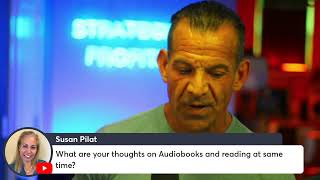
But my, that's my team on the right, like in 2011, all dressed like me with black T shirts and jeans. And it made it really easy because like no decision, right? I made the decision one time 20 years before that that that's what I'm going to wear. And then that's what I did wear for 20 years, right? Just reducing that decision making fatigue. So I could go into. When I did this presentation originally, I then went into a lot of different biohacking, but I also was presenting at an event and I was spending, you know, I was speaking for over an hour. This has already gone longer than I thought it would. But while I'm still here and gone much longer than I thought I would for today, if you have any questions, I'm happy to answer them right now before I take off. And if not, no big, no worries. I'm excited that everybody came and joined me today. We start our sale today, our holiday sale for strategic profits and steal our winners. And but while I'm here, if you have a question, throw it out at me or we will call it a day. All right, so that is how I got my reading speed much faster. That's how I was able to read. Really take over three different industries at three different times. First, the clothing business by having the hottest store in Manhattan. Then the hypnosis business, building the largest hypnosis company that ever existed with a chain of hypnosis centers in New York and Manhattan. And then in the online world, being the coach to so many Internet gurus and stuff like that. All of that was fueled by what I just shared, my reading process, my note taking process. We live in an age where really the understanding that you have your ability to connect dots, your perspective on things is what's most valuable. And if you're not constantly adding to that in a way that is also easily accessible to you, you're doing yourself a disservice. What are your. So Susan asks, what are your thoughts on audiobooks and reading at the same time? I love that. I've never really done it with audiobooks. Well, I can actually show Susan question.
That'S kind of cool.
Forgot about that. It's been a while since I've been really a power user.
Right.
So I do that all the time, Susan. But I don't do it with by buying the audio book and looking at the book. I do that by using apps like Voice Dream, D R E A N Voice Dream or Speechify, which will actually read you the book and also pace at the same time, which is really valuable because it's the pacing that really trains your eyes to move faster. I took speed reading classes when I was in high school and college, but I never got to be a faster reader because I never was disciplined enough to do the practice, which is pacing and really pushing yourself to go faster. What the iPad did for me with those apps like Quick Reader, Voice Dream and Speechify allow me to go much faster as well as be able to pay attention, stay focused, and also improve my reading speed. All right, let's see what great tips for starting.
Cool. Thanks.
Re Watch video. Gotta grab.
Okay.
Any thoughts on Binaural Beats while doing different things throughout the day? Yeah, actually I'm a fan of Binaural Beats. Isomaniac. I'm also a fan of isochronic tones which are have the same effect of Binaural Beats, but you don't need to wear headphones. I'm also a fan of something of an app that supposedly is better than Binaural Beats. I don't know. I Haven't looked at the science, but Brain FM, I bought it for like 30 bucks as for Lifetime when it first came out. And I will use those for focus, but I'm a fan of binaural beats. We use them in my hypnosis centers. I think they're very effective. And obviously you don't want to be in a delta state if you want to be focused, but other than that, yeah, I think they're great. Does AI make connecting dots a more common skill or less common? Great question, Gary. Well, so I read this book a couple years ago called Prediction Machines, and it was talking about that what machine learning and AI really are, Right. And how they really are prediction machines.
Right.
That you've probably heard it like, even with large language models like Chat GPT, it is just predicting what the next letter, next word should be when you're writing as well as when it's writing, it's doing it that way.
Right.
So, and so this book, Prediction Machines, was written by these economists that were talking about what is going to be valuable in the age of AI, when predictions become more accurate and they become more plentiful.
Right.
What as supply of prediction and accuracy of prediction increases, what does demand increase for? Because it doesn't obviously increase for prediction.
Right.
It increases for discernment and judgment. And discernment and judgment are based on your experience and your knowledge and your experience and your knowledge is based on your intellectual capital and what you've captured and how you've codified it and how you remember it. So that's what I would say to that. And so, yes, I say that your ability to be well read and to make connections in whatever place you house your intellectual capital will make you better at everything that you do in AI. I don't have any. I don't have any preferred Binaural Beat app or site. I have a couple of them on my phone that I go from time to time, but Brain FM is what I've used the most. I don't know if it's better than Binaural beach or not. They say they claim that it is. And you can find plenty of binaural beats on YouTube as well. So with that, this has gone much, much longer than I thought it would. Generally, we try to go 15, 20 minutes, but thank you for joining my live today. I hope you got value out of it. I wanted to make up for yesterday because just the technical challenges that popped up tomorrow will be my last day broadcasting here in Florida. Oh, no, actually, because Thursday we leave for Nicaragua on Thursday. So I might be able to do one on Thursday from here as well. But then Friday I plan on broadcasting live from Nicaragua, Mark Ford, Michael Masterson's house at Rancho Santana. So there you go. I hope you have a wonderful day to hire Profits and beyond. This is Rich Sheffin, over and out. And check out our holiday sale at Steal Our Winners at Strategic Profits.
More from Rich





Russell Brunson Reveals Why He Brought Rich Schefren to Funnel Hacking Live (AI Edition)





