Why Alex Hormozi blew up (and you didn't)
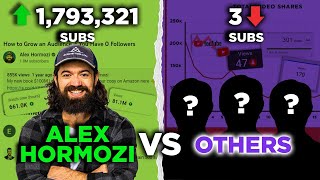
This is a YouTube video titled "Why Alex Hormozi blew up (and you didn't)" created in November 2023. The content is a detailed presentation analyzing how entrepreneur Alex Hormozi achieved rapid social media success by leveraging a strategic content creation and distribution model across multiple platforms. The video includes excerpts of Alex Hormozi speaking, explanations of his methods such as using Twitter for ideation, tailoring content for different platforms, and emphasizing quantity and consistency in posting. The presenter breaks down Hormozi's approach to building his business acquisition.com through social media growth and offers actionable insights for entrepreneurs looking to replicate similar success.
Here's how Alex Hormozi blew up on social media and why you didn't. Alex Hermosi is a social media sensation in the business world. He has 1.8 million subscribers on YouTube, 1.9 million followers on Instagram, and nearly 800,000 followers on TikTok. Thanks to this social media success, he was able to build his company, acquisition.com into a million dollar business. Just because I was curious and figured other people might want to know how he did it, I spent a little over $5,000 on researching and analyzing his activities on various social media platforms. My team and I have spent hours on end watching each and every one of his speeches, presentations, and more. And in one presentation, Alex shared his secret in producing every single piece of content he's made. The secret lies in his content creation model. In this video, I'll talk about how Alex Hormozy mastered the social media virality puzzle. But before we dive in, let's talk about the elephant in the room. Why do you, an entrepreneur, have to grow on social media? I mean, Jeff Bezos certainly didn't get rich from a YouTube channel. Well, you can succeed without social media and there are ways to do so. But that's a topic for another time. Alec's dedication to social media is not just to gain virtual followers or likes. He's a businessman after all. Instead, it's about building a foundation for lasting business success. And his dedication has led to insane results, turning his company, acquisition.cominto a million dollar business. But let's hear the results directly from Alex. So you guys know I'm not making things up.
And so the business result from that is that we get about 400 companies a month that apply for acquisition.com so we can help them scale. And in that time period, we grew from 7 million a month to 13 million a month.
And not only can he do it for free without having to pay the platform, and he's actually paid by the platforms for doing so. So if you have an affinity for social media and you want to get the same results for your business, let's dive in and see how Alex did it. Let's kick things off with the ideation phase. Exceptional content, no matter where you distribute them, starts with great ideas. Instead of the traditional approach in which you base on past data and your own head to determine what will click with your audience, Alex took a different approach and he utilizes Twitter for this. Let's take a look at one example. Now let's take a look at this short form video.
A buddy of Mine has a daughter. She was working at a bowling alley. Minimum wage job. He told her. He's like, you know you can triple your income if you just get a certification. To become a phlebotomist, it takes two days. It's 500 bucks. By taking $500, she invest in the S&P. 500. And at 18 years old, maybe there'd be a ton of compounding. But if she invests $500 in getting the certification and then two days later she triples her income, probably a better investment in buying the certification than forever having a three times higher baseline for what she can make.
See how the tweets and shorts are similar? It's not a coincidence. Now take a look at this tweet. Then take a look at this YouTube short.
The only thing that gave me enough balls to stand up to my dad, to be fair, from a distance, from the car when I was driving halfway across the country, was the idea that, like, I started thinking, like every day I was like, I hope I don't wake up. You know what I mean? That was the thing where I was like, this is a big enough problem that like, if you don't want to wake up, then what have you got to lose? Exactly. I have nothing to lose. If everybody who's like at the bottom and feels like they have nothing going for them, reframe that as I have nothing going for me, which also means that I have nothing to lose by taking action, it makes you a much more dangerous person.
What you see here is that Alex has used Twitter as a tool to gauge his audience's reaction. The engagement and response he receives from his tweets will signal whether the topic resonates with his audience or not. Alex loves Twitter. He tweets around five times a day or so. And this is because Twitter is a flexible and forgiving platform. Tweets can just take the form of streams of consciousness without the need for videos or captions. You can just express ideas as they come to you anytime, anywhere. The ones that garner more reactions will be turned into videos. Threads will be turned into long form videos, while shorter tweets turn into YouTube shorts. This approach is simple, yet remarkably effective for evaluating content and reinforcing positive affirmations within the algorithm. The natural next step after ideation is of course, writing the content itself. And if you think Alex's use of Twitter ends here, you're sorely mistaken. You see, for shorter videos, he applies a four part structure to keep the audience engaged. A hook, hammer, example and explanation. See if you can spot it in this video.
You're not afraid of failing. You're afraid of what other people will think of you if you fail. But if you're afraid of that, imagine what they think of you when you aren't even trying. Oh, yeah, they aren't.
I'm such a dick sometimes. Um, is it.
Is it strange to hear your angry toilet tweets read back to you?
Now you know real talk. The tweets that I have, people don't know this, but the tweets are notes to self. So they're just directed at me so that I can look back on them and, like, be reminders of, like, hey, don't do that. And so, like, I think to myself, man, I'm afraid of doing this. And I'm like, no, I'm not. I'm afraid of what this person's gonna think about me. Because if I were to be able to fail in quiet, in complete isolation, then I wouldn't care. And then I. Well, what if I don't succeed in public? What do they think then? Nothing. They don't think about me at all.
Sounds familiar. Of course it does, because the hook and hammer here is the very tweet that inspired the short. Alex usually positions the tweet immediately after the hook or uses the tweet for the hook itself, since the previous step already lets him know that it converts. Following the tweet, he includes an example and an explanation to provide more context and insight into the tweet's content and purpose. But for the content to work, there's one secret element that he applies to every one of his videos, and that lies in sharing your own story. Like Alex has said, here, hey, here's.
What I did versus here's what you should do. Feel the difference, not what you should do. As soon as you point out people hate you.
Alex is always authentic and relatable in his content. He shares his experiences rather than claiming to possess universal truths. He follows a simple content creation model. Do something noteworthy, talk about what you did, and scale up your actions. He shares what's currently working for him, while emphasizing that it may or may not work for others. This helps him avoid sounding like he's preaching or has an ego. But what if you don't have a major success story like Alex? Let's face it, there will always be someone who's more successful than you. So if you don't have an impressive story, does it mean you should not tell your story at all? Of course not. The good news is you can become an authority in a specific area. Instead of trying to cover things that you have little or no experience in, like teaching people how to live an extraordinary life, which is quite a task, focus on something more specific. For example, you can become really good at helping people set up gym businesses, which Alex did, or growing YouTube channels in a particular community. In these smaller niches, you can shine because you're competing with fewer people, but remember, you have to practice what you preach. You might not know everything about everything, but you definitely know your own life. Sharing your own experiences and what you've learned can be very helpful to others, and as a result, you can truly make a name for yourself in these smaller ponds. Moving on to step three in Alex's multichannel process Contextualization Take a look at this picture. You see how different social media platforms have different vibes and target audience. Alex is a firm believer that contextualization plays a vital role in content strategy, which means that the content must be tailored for each platform for it to work. For example, take a look at Alex's feed on Instagram Reels and YouTube Shorts. For YouTube Shorts, you can see that Alex emphasized creating a compelling and click worthy thumbnail and titles that entice viewers to click on his shorts. He made sure that all parts of the titles were visible and his shorts thumbnail effectively set up the expectations for the viewers. For example, for shorts that talk about gym tips, he made sure to set his thumbnail as him working out or being inside the gym. Meanwhile, for Instagram, he incorporated engaging text and on screen captions that tease the content of the reels. Instagram users often watch videos with the sound off, so he opted to use screenshots to convey his messages and you can see that this has worked out extremely well for him. You can also see that Alex has tailored the editing and branding of the short form content for each platform and keeps it consistent throughout the videos. And as a marketer, I'm sure I don't have to tell you why that's extremely important. Lastly, distribution is the cornerstone of his strategy. The key to efficient distribution, according to Alex, lies in two factors, quantity and consistency. Alex emphasized that you need to do more if you want to be successful.
So many times we're doing the right stuff. We're just doing way, way too little.
Of it to see significant growth in engagement. It's vital to increase your content creation efforts substantially. Alex distributes his content on numerous platforms YouTube, Twitter, TikTok, LinkedIn and podcast, and he focuses on both quantity and consistency in his content delivery. Take a look at Alex's YouTube channel and you will see that he posts not one, not two, but at least five or six shorts a day. Similarly with his TikTok channel. But what if you don't have the time or Energy to create 50 shorts per week? The trick is you don't have to. Instead you can repurpose your content. Alex did this by putting out about three videos on average on YouTube and then repurposing the same three to 80 content pieces a week on different platforms. By applying these strategies, after six months he added 300,000 subscribers on YouTube, 1,350,000 followers on TikTok, 350,000 followers on Instagram, 100,000 on Twitter and 400,000 downloads a month on the podcast. And that's how Alex Hormozi achieved significant social media success within six months. To get more videos like this with even more detail, featuring the world's top experts in YouTube, AI, Facebook marketing, you name it. Click the link below to get free access to my Steal Our Winners library.
More from Rich





Russell Brunson Reveals Why He Brought Rich Schefren to Funnel Hacking Live (AI Edition)





