
Creating Your Vision
Richard Milligan teaches recruiting leaders to build visions that move candidates emotionally, not just offer better compensation. He walks through identifying four core values, writing a vision statement using frameworks like the Pillar Method, and anchoring it with personal stories that make it credible and memorable.
Chapters
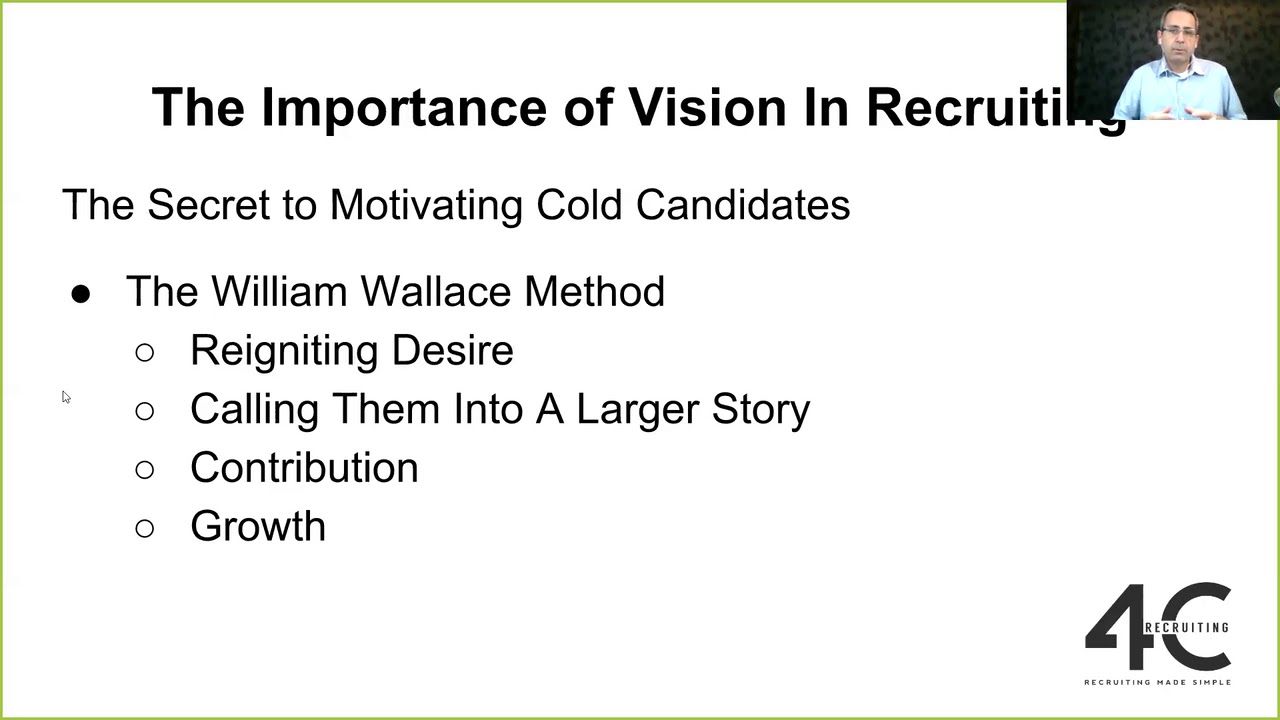
Hey everybody, it's Richard again, and we're on to lesson 2, which is creating your vision. Now I'm going to pause here for a second and give you kind of a warning about vision, because vision can sometimes feel like it's a lot of emotion. It's a lot of heart. Sometimes it feels like it's a bit intangible, like I can't quite grasp it. Talking about things like Core convictions. Okay. One of the best examples that I have seen from an attractive leader who has led with a very clear vision has been from the movie Braveheart. And for all of you men out there, you can applaud because, uh, you probably watched it a dozen times, um, like I have. Uh, and maybe I'm in an exclusive club all myself that really appreciates that movie. But you, um, but there's a scene in that, in that movie that I want you to watch. So when you came onto this page, there was a second video and it was William Wallace, um, a clip from the scene from the movie Braveheart with William Wallace. If you haven't watched that yet, go watch that. It's about 5 minutes and then come back to this. If you've already watched that, then let's just proceed. So William Wallace ultimately represented someone who had a very clear vision. And was able to call people up into that vision. Okay, so we're going to use him as our example in this, but stay with me because I'm going to give you real-life application as we get to the end of this. Give you some examples of great vision statements that are out there, people who are real clear in their purpose statements and their core values. That's really going to help you understand this. I encourage you, slow down here. The tendency is to speed on past vision. Let's go do something else, right? Let's go build the CRM and let's figure out how we present. What's the phone scripting I should be doing? We want to get, you know, we want to go and do the active things. This is at the heart of your success. If you skip over this, you are going to miss out on probably your largest opportunity to go after and attract cold candidates. Your vision, your core values, who you are as the authentic leader is what's going to help move those people to you. Okay, so, um, you know, I love authentic leadership. That means that you are a human being and you are flawed, but you also have some very strong beliefs, and both of those are wins. Okay, being a flawed individual is actually helpful in— and we'll talk about this in storytelling— the flawed leader, someone who's willing to be authentic and real about not just the highlight reel, which are the things that we've done that have made us successful and why, why everything's going well here. But why have there been seasons in your life? There have been seasons in your career, then seasons in your branch or your business where it hasn't always been that way. Okay. So we're gonna talk about storytelling, but, you know, vision, um, is really the authentic you. Let's be real here. Okay. And, uh, let's get a little bit into the heart and the soul and the emotion part. As we move forward with this, okay? So I'm going to do a screen share again, go back to presentation, and see me in the top right-hand corner. Ready, set, go. Creating your vision. Here's the importance of vision in recruiting. It is the secret to motivating cold candidates. Okay, so most people recruit with left-brain thinking. Left-brain thinking does not involve any heart, does not involve any emotion. It is all— it only involves this part of our left brain, which is ultimately all about vetting, analyzing, and trying to figure out what's the best option. Too many people, most people— let me say that again, it's not too many, it's most people in the mortgage industry recruit with left-brain tactics. Let me frame this for you. There's 2 types of opportunities in this business. There's the opportunity improvement Which simply says that where you are now and what I'm offering you as an opportunity is an improvement. Means that you might pay me higher compensation, you might have better marketing, you know, tactics or tools, you might have a better CRM, you might have more products, you might even have better leadership. But those are, those are all things that lend someone to see you as what I call an opportunity switch, which is simply an improvement over their current opportunity. Now, there are other opportunities, and this is why core values and vision and why this is coming up a lot in these first 2 sessions is that when you present through the lens of that, that is now a new opportunity. Nobody's doing this on the micro. There's a very small handful of leaders that are doing this. I haven't ran into any that have not gone through my coaching that are doing this well. Okay, so this is a great place for you to be. Think about it like this, in tangible terms of what we see in life. This is the opportunity improvement, is going from a Chevy to a Ford or going from a Ford to a Chevy. I'm not stuck on Ford or Chevy. Okay, I don't want to get in that conversation here, but that's an opportunity improvement. You've got maybe better gas mileage, you've got maybe more, um, you know, accessories inside the vehicle. Those things are just simply opportunity improvements, but If you're a man, you might get this, and some of you gals will get it as well, that a new opportunity would be the equivalent of somebody pulling a Harley-Davidson into your driveway and you looking at that and then looking at the Ford. That's not an opportunity improvement. That is actually an opportunity. That isn't— that, that isn't a new opportunity. Okay, so when you go towards things like, like your vision, that's a new opportunity. People are not accustomed to hearing people present through that. That moves people away from all of this vetting. And moves people to a place where they're engaging their heart. Okay, now here's, here's why it's important. You can change perspective when you, when you tap into emotion. If you've ever seen an emotional person, you'll recognize most times they're not making rational decisions because they're tapping into the emotional part of whatever the decision is or whatever the situation is that's around them. Okay. So So you can actually change perspective without ever changing a single fact. And the truth is that if you recruit with left-brain thinking, there is always gonna be somebody with a better comp plan. I don't care what your comp plan is, there will always be somebody better with it. There'll be someone who has another product, there'll be someone who has, you know, a better CRM or has more technology than you have, even if you have the best technology. Someone will have better technology than you. Okay. So it's important that you grasp this. This is the secret to moving cold candidates. Okay. If you've watched the video, which I hope you have, let's talk about the William Wallace method to casting vision into recruiting, because you've seen that scene now, right? These men, these men are on this battle scene and in front of them are 2 weak managers. And these managers have a very weak vision. Okay, the men begin to leave the battlefield. Why? Because they're not bought into what the weak managers on the battle scene are, are sharing with them. They're not about possibly dying in order for 2 men who are nobles to actually have more land and more titles and more gold or whatever it would have been. They begin to leave the battle scene. William Wallace rides up on the scene and what does he do? Cast a very clear vision, right? He calls them into a larger story. Okay, this is the William Wallace Method. Great visioneers reignite desire. Now I go back again and again, and I hear stories now from recruiting leaders who are moving people through my system. And here's what's consistent with this. I'm not really sure why that person moved towards me. I'm not really sure why people joined my— why that person or that team joined my group. When someone casts a really clear vision, someone can go from being complacent and stagnant to actually having this desire that's been there laying dormant reignited. That's exactly what William Wallace did. He called these men into a larger calling, which was be part of a larger story, right? Instead of dying on your deathbed, wishing that you had actually been able to come back to this moment and act as free men, act as free men today. Okay? So you can reignite desire in a cold candidate. Who's not going to move towards you because your technology is not going to move towards you because of, you know, your comp plan or your products or any of that. Okay, this is how you get the cold candidates. So calling them into a larger story, it's what William Wallace did. Now we all want to be a part of a larger story. That's just true. You get that, right? It's probably why you're with the organization that you're with today is that somebody called you into a larger story. Okay. We want to call our candidates into a larger story. That's our vision because our vision not just exists— it's not just about core values and convictions. It's about these big, hairy, audacious goals, right? That are in alignment with our vision. Okay. So we're calling these people out into a larger story. That's a part of that. And then look, we all want to be part of contributing. That's just a human value. That we want to contribute to each other. We want to be part of something larger. Contribution is part of that. Okay, so this is part of what we're talking about here. Growth. We all want to be part of growth at some level. Okay, whether that's being a leader in our home, whether it's growing as a leader in business, whether that's growing with a team, whatever that is, we want to, we want to grow. Where we become stagnant, where most people say, I'm good, I'm happy, I'm content. I can almost put my finger on the pulse of someone who's stagnant and complacent. Not always, but many times I can. And so where you call people into this opportunity to grow, you can, you can reignite desire inside someone who's a cold candidate you can't get through your left brain thinking tactics. Okay. Let's talk about creating vision. Okay, there's really important, you know, the important 3 that shape our vision are this: your past experiences. We'll talk about this in storytelling. One of the things that we love to do when we tell stories when we recruit is we tell the highlight reel. We're going to tell the best things about our organization, the best things about our leadership, the best things about our team. But the truth is that it hasn't always been that way, right? And that little statement, it hasn't always been that way, is one of the things we'll talk about in storytelling. But what that means is that there are past experiences that make me who I am today, that make my core values important as they are today, right? I mean, think about that. What are your core values? Like, what are those? Like, give me some of those. I can go back to my original 2010 core values conversation that I have with people. Personal development was one of the things that were— personal growth is part of, even today, part of my core values. My past experiences, and I'll share my story when we get to the storytelling piece of this, but part of my story is that the reason why personal development and personal growth is so important and why it's at the heart of everything that I do, and even why I'm here today sharing this with you, is because I can go all the way back to a pivotal moment at the age of 19 years of age. Okay, that's a past experience. In fact, there's 19 years of experience in front of that that lent to that moment in time. Okay, so your past experience are one of the things that will shape your vision. Your core values are going to shape this as well. And then your dream for the future, right? The big goals. Like, what do you want? Like, like, like, what does your team look like in 5 years? Like, when you dream for the future, you don't dream about doing another 10 units next month or another 30 units in 3 months or whatever that looks like. You don't dream about— just dream about getting from a $5 million branch to a $10 million branch. Like, really dream for the future. Now I'm talking about like these big dreams. Like, what do you want for your people? Like, a cool dream for the future that you could want for your people could be something in alignment with this. All of the people that come to my group, part of my vision is that they will own their dream home. Like, like, say what? Like, like, that's part of your vision? Yeah, it is. Like, how many people inside the mortgage industry actually don't buy homes but rent? And that's okay, right? Nothing wrong with that. In fact, some people actually believe that renting is better than buying. Um, you know, follow, follow Cardone for a little while and listen to the message that he teaches, that he preaches. But, but most people, part of their dream is homeownership. Part of their dream is having a place that they can hang their hat that their family can call home. And at the heart of what we do in this industry, in the mortgage industry, is helping people accomplish that. So what a cool dream, big dream as a leader, is that when everybody— when anyone comes here, I want to know what your dream home looks like. And it's my goal as a leader to make sure that you accomplish that underneath my leadership. That's a big, hairy, audacious goal. Okay, that's, that's called dreaming for the future, right? So let's talk about story. Why is story critical to vision? Story's everything, gang. It ultimately is everything. I began to understand around 2011, 2012, as I began to tell more stories, that this was really at the heart of recruiting. And why I was able to move people quickly is because I was doing things through the lens of story. Okay, think about this. We all have a good friend. That we haven't seen in 6 months or a year or 3 years or however long it's been. But you know for a fact that if you both got together and you had a weekend to catch up, that there would— you would not skip a beat. You would pick up immediately where you left off. And why is that? Because they know your story, because you know their story. You walked with each other through a season and time where maybe there was something difficult that they walked with you through, or maybe they walked with you over a longer window of time. Where they understand everything about you. Okay, story is the context for how we build relationships. Story is the context for how we see the lens of the world. Like if you and I got together over the course of a weekend to do anything, to just hang out, to play golf, to, you know, fish, to spend time in the outdoors, to put our— to hang out together with our families, you know what we would do? We would share stories. That's— I mean, the greatest book ever written was the Bible, and the Bible was written in story format. Okay, there's a reason for that. When your life is over, you will have a funeral and they will play a montage of videos and pictures and people will get up on stage and they'll share stories about you. And the whole thing is, the whole premise of that moment, your legacy, is that they're going to try and recreate a glimpse into your story. Okay, so story is the lens that we all live our lives through. And then why story is critical to vision is this. You've got to attach your vision to stories. I have studied for a number of years now vision, what I call visioneers at the highest level. And one of the things that I've noticed with visioneers is that if you hear them talk for, for any length of time, they are nonstop telling stories. In fact, if you hear a visioneer get on stage, I've counted this, on the low end, a visioneer will share 10 to 12 stories. I've counted a 90-minute presentation. Where someone shared almost 60 stories. Like, some of those are micro stories and they're, they're, they're merging stories together. But there were almost 60 stories shared from one of the best visioneers that I've ever met. Story is ultimately everything when it comes to your vision. And so you need to understand how to share your vision through story. We talked about, tell me about your day, tell me about your best friend, tell me about your family, tell me about your company. Your current company. These are all things that we would tell stories around. Okay. Now we're going to connect stories with vision. Vision plus story equals right-brain thinking. Okay, so I try to create as many formulas around recruiting as possible so that you can get this. Vision plus story equals right-brain thinking. That's how we move cold candidates. Okay. Who are we impacting? Right. That's something that's pretty easy for us to tell a story about. Who are the people we're impacting? Tell me some stories about, you know, the people your branch has influenced over the last year, not just externally, but also internally. You're impacting people internally. There are stories that come from that, right? You know, how, how we will execute on our core values. There's some There's some stories that you can actually share around that. I remember a story underneath my leadership where we had a processor who actually had her home destroyed with a tornado, and we raised $10,000 for her in less than 72 hours and gave that to her. We reached out to the entire company and asked for gift cards to Walmart and Target and to fast food restaurants, and I think we got over 200 gift cards from that. As a team, we raised money to put her up in a rental home and furnish that, not just with groceries immediately, but also with all the linens and towels and everything that she would need to live in that house with her children. Okay, well, that's a story that I can share that exudes the core values of we were a family, we are family. Right, that's a nice core value to have as a leader. Like, one of my core values is that, that I believe in incorporating family into business. A nice core value. Anchor stories are at the heart of what I will teach you in the 4 stages of presenting. Okay? So I want you to start thinking about this now. Your vision has to be anchored. Think about it. It needs to be rooted in story. And these stories, what happens is that when you tell me stories, your stories begin to build trust. Think about the William Wallace era. Like if we go back to that moment, that's, you know, I don't know how long ago that was. 2,000 years ago. We'll take a guess. 2,000 years ago, where there were kings and there were kingdoms, there were 2 basic principles why people resided underneath the kingdom. Think about this. 2 basic principles. That was it. Protection and provision. If you'll protect me and my family, if you'll make sure that me and my family are provided for, even if there's something that comes along like a famine or drought or whatever that is, Then not only will I serve you, but I will lay down my life for you. These men were on the battlefield ready to lay down their life for this. Okay, so, um, when we fast forward to this present day and age, right, and I look at the lens of protection and provision, nothing has really changed in terms of what leadership looks like, because protection and provision means if I trust you, I'm going to trust you that you are trustworthy. Right, and I'll be loyal. Another core value: loyalty, trustworthiness. And we fast forward to today. Leadership and the premise of leadership is rooted in core values. Can I trust you? Can I trust you when I show up? Will you protect me and my book of business? Will you make sure that every— that when I show up, I can trust my comp model and that I'll get my paycheck? And these are the things that people are still leaning on today. So anchor stories at the heart of those core values are what help move candidates through your process quicker because they trust you. Now you're going to get this at the— on this page where my video plays, there's actually a downloadable document. This document is there. It doesn't quite fit the shape of this presentation, but we'll go over this with you. I want you to go through this process. I want you to identify your core values. There's about 75 core values. I think on this, on the sheet. So what I want you to do is just go through here, start with your top values. Okay, put a checkmark by the top 10 that jump out at you. Don't overthink this. Just go through and go, you know, which of the top 10 are true about me? Once you've done that, I want you to go through and underline your favorite 7 out of the 10 because I'm trying to narrow these down. Okay, we're gonna, we're gonna shave a couple of off in that, in that, in that second cut. And then finally, I want you to go through and circle the top 4 of those values you underlined. Now, some of these are going to fall underneath similar headings. You may look at something like encouragement and enthusiasm. Those might be similar to each other. You might look at something like integrity and character and say, well, those are very similar to each other. I want you to struggle with this a little bit. Come to 4 values that you would say are your values. Okay. Now, now that we have— we understand what our core values are, I'm going to move on to vision. Now, there are a number— I'm going to give you some methodology to vision. A lot of people will just generate a couple of statements, a couple of sentences around what their vision is. That's fine. But I want to give you some structure in case you get stuck here. I'm going to give you my method. This is a method that I stole a number of years ago from several successful entrepreneurs that have built multimillion-dollar businesses. I call it the pillar method. I don't know what they called it, but that's what I called it. Um, what I determined was I had 4 top core values. My top core values were, um, personal development, personal growth, leadership development, um, systems. I was a big believer in systems. I always said that, you know, systems equal solutions to problems equal success. Okay. That was one of my core values. And then my last one was growth and not just any kind of growth, but organic growth. And I would make the statement around that, which is that leadership is the— is great leadership. I'm sorry. I got to go back to this. It's been like a number of years since I've shared it. Growth is the natural progression of great leadership. And that was a quote that I coined. Growth is the natural progression of great leadership. And that was ultimately a statement that I had to like make and look in the mirror. And say, are my people growing? Because if they're not, that's on me. And that was an ownership statement that I would make, that I made around that. So I presented my vision through those 4 pillars, and I would share stories around those pillars. Okay. I would share stories from my life that connected with each one of those. And then when we get to the storytelling section, I'll tell more about that. You want to craft stories that reveal why These core values are important to you. What most people do is they tell highlight reel stories. Okay, if you've ever gone and watched a good movie, take Braveheart for example. That is not a highlight reel. There's a lot of struggle and conflict in that movie to get to a place where eventually there is an overcome at the very end, right? So, um, real stories involve struggle and involve conflict. And so we want to share that because that reveals to me that, man, this core value Has been— has ultimately been built with someone whose feet have been in the fire, that have realized, hey, integrity is important to me because there are probably moments where I've gotten burned because there's been a lack of integrity. Hey, character is important to me because there was this moment that I can go back to and say there was conflict and struggle and maybe there was a lack of character. And so this is what ultimately reveals and convinces me that those core values are your core values. And I love creating mantras that help connect the core values with action. So I gave one to you just now. Growth is the natural progression of great leadership. When I was talking about systems, one of the things that I would talk about is a mantra that was at the top of my processor's comp plan. It was a mantra that I had, that I created, and that mantra said that loan officers are the lifeblood of our business. We will provide them with a level of support not seen elsewhere. Okay, so that, that was a mantra. That was that I connected to my core values and the actions that we would take, and I would be able to share stories around those actions connected to that mantra. Think about that. Okay, so here's another method of vision. We've talked about the pillar methodology. Now we're going to talk about the 3 things of importance method. Okay, so this one is maybe a little easier to come to for some people, but here's a statement. What is your purpose? How are you going to help people? Okay, so how I frame this is I say— this is actually how I frame it today— is I'm going to help recruiting leaders grow their business faster than they would in the absence of my help. That's how— that's the first statement I make. I help by— I'm going to help recruiting leaders grow their business faster than they would in the absence of my help. Okay, that's how I will help people. The next one is, how will you accomplish your mission? Like, through, through what values will you accomplish that? So my statement around how I will accomplish my vision is I will achieve this by teaching recruiting skills that enable leaders to vastly exceed their previous accomplishments. Okay, so that's how I frame that. Hopefully that helps. And the last one is, how are you going to measure your success? When will you know that you've achieved your mission? So what I say is I will measure my success by helping more than 100 branch managers each year Live the life only possible through growing their brands, through growing their branches. Okay, so that's how I measure it. This is a great way to come to it if you don't have a vision. And then there's another methodology I've come to, which is, you know, I call it, you know, 3X, which is, you know, the, you know, there's a— there is the, the who, you know, the action thing, right? And it's maybe personal development as an example, plus the who, who am I going to impact? Plus the how, how am I going to impact, that can also equal vision as well. So let me give you, let me give you an example of this. Here are some of the actions that we could take. For example, I'm going to develop people. I'm going to be an encourager and encourage people and inspire. I'm going to use my gifting. I'm going to, I'm going to train. That could be the action. The who would then be, you know, who are we going to influence? Team, referral partners, clients, Clients, community, employees. And then the last one is the how, right? We do that through these different ways, perhaps. So you could take— I'm sorry, you could take any of those and come up with vision simply by coming up with the action plus the who plus the how. Okay, so take one of these if you don't have your vision already and come to vision. So let's go through some examples. I think it's helpful to see this. Here's a cool one that I came across. American Transmission Company, their purpose is to significantly grow our business, provide value to our investors, and to serve our customers well. So they've wrapped this up into a purpose statement, and then they've said, these are our values. We value our employees, our customers, we value teamwork, we value diversity, we value competitive spirit, we value improvement and innovation, and we value fun. And And you've got a copy of this presentation so you can all— you can come back to these again. It's at the bottom of this video, so just simply download that. Here's one, Infusionsoft. I don't have all of their values on this page, but I got most of them. So their purpose, we help small businesses thrive with sales and marketing software built for them. And here are their values. We empower entrepreneurs. We listen, we care, we serve. We do what we say we'll do. We practice open real communication. We face challenges with optimism. I don't have to read all those, but we do the right thing. What a great value. We believe in people and their dreams. Another great value. Here's one with a company called Cintro. Their purpose, improve the lives of people behind the campaigns, and then their values are listed there. Here's one, Hagerty. Purpose, to protect the physical connections To the best moments in your life, and then some great values there. This one I threw in, I thought this one was interesting. It's outside the box. Purpose: helping teams everywhere change the world through the power of software. Check out the values. Don't— you know, open company, you know, no bull. Build with heart and balance. Don't blank with the customer. Play as a team and then be the change you seek. I love that. Be the change you seek. Clif Bar. Again, their purpose and their values. Okay, so, so the 3 critical elements to long-term vision success. So now you've got a really good grasp on how you could come to a vision, how you could come to your values. Now let's talk about 3 critical elements. I'm going to assume now You've got your, you've got your, you know, your, your vision statement, you're clear on your core values. There's really 3 pieces to this that are going to make this legit. They're going to make it real, not just to you, but to your team. Okay, so number one, you have to put this on paper. Okay, some cool ideas, put on mouse pads and hand it out to your team. You know, I've got leaders that have actually painted chalk paint on the wall and And I've written the vision out on the wall. What a great idea. You have to put it on paper. It will not be real until you put it on paper. So I want everyone on the team to get it. I want everyone on the team to accept it. I want everyone on the team to act on it. Okay, this is called culture, right? I think a lot of times in this business, we stick culture around— Neil's quotes, you know, I put quotes around that culture because it means something different to everybody. How do you create culture? And when your team really gets your vision and owns it, okay, difference between stewardship and ownership. When the team owns the vision, that's culture. When they accept the vision, that's culture. When they act on it, that's culture. Like when you're starting your team meetings and everybody's reciting the, the, the vision statement, that's culture. It needs to be seen and easily accessible. I'm okay with you blowing it up and frame it. I'm okay with you painting chalk paint on a wall and writing it out. Again, there's, there's a lot of creative ideas around this. The second part, you got to review it continually. Now, we've talked about the 3 stages of vision: creating it, right, clarity around it, and then casting it. The clarity part is where we find our voice. By reviewing it continually, what we do is we figure out, is this the vision? I've seen people develop a vision over the course of 6 months, change it a few times, or just reshape it and say, well, that wasn't really it. And that's okay. You will come to that by reviewing it continually. By reviewing it continually, you now move it from head to heart. And having coached several hundred leaders through this process, what I can tell you is that even today, the day that I'm recording this, I have a recruiting— I have a recruiting leader. The conversation was there's something they're bumping up against. There's something that is, you know, whether it's tension or whether it's friction, they're bumping up against it. It's an outside influence they don't control. And there's a larger opportunity to make a decision around, you know, whether they move towards something. We went back to the vision and says— and said, is this in alignment with the vision? Right, because in business there's always 2 things: a tension to be managed or a problem to be solved. So is this a tension to be managed or a problem to be solved? And ultimately, because it wasn't in alignment with the vision, it was a problem to be solved. We won't move towards this. Okay, so when you review it continually, you now move it just from head knowledge, but you move it to heart. And that is why the recruiting leader who has a vision, who becomes the visioneer, is unstoppable. They can recruit. Okay? This becomes the tool that you live and breathe by. All right? Ownership. Ownership. Figure out how to pass the ownership DNA for the culture on to your people. And one of the ways you can do that now, if you don't have a vision, is ask the team, what are our core values? What are the core values we want to exemplify? Right? Have an offsite meeting with the group to go, we're going to develop core values and vision. I want everybody's voice in this. Okay? And then repeat it continually because this is going to shape every aspect of your business. And I mean it, repeat it continually. This will, this will become the heartbeat of the team. Start meetings with it. Speak about it around the office. Take moments to recognize when people are in alignment with it. Okay? We're going to get ridiculous with it. Now here's your next steps. I want you to write out core values, your top 4 core values, and then I want you to write out a vision statement. Okay? Don't go on until you've got this one piece complete because it's a critical component to everything we're going to do in the next steps. All right? So with that said, I look forward to seeing you in lesson 3.









