
If You Do Community Events for The Purpose of Branding and Building Relationships with Recruits Then
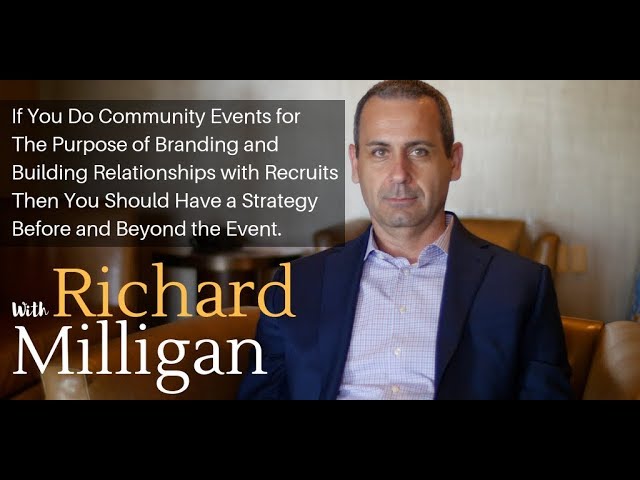
In this solo podcast episode, Richard Milligan of 4C Recruiting shares a practical framework for converting community‑oriented events—illustrated with a golf tournament—into focused recruiting pipelines. He begins by distinguishing mere visibility (banners, signage) from true relevancy, arguing that recruiters must treat events as intentional talent‑gathering opportunities. Milligan outlines a pre‑event research phase to identify target candidates, then details on‑site tactics such as hole‑by‑hole meet‑ups, branded activations (photographer, post‑tournament barbecue, drink tickets), and real‑time engagement. After the event, he proposes a “micro‑sprint” follow‑up lasting 10‑14 days, built around a seven‑touch sequence (personalized photo delivery, handwritten notes, text/video messages, LinkedIn outreach, back‑door voicemail via tools like SlyDial, and scheduled face‑to‑face meetings). He emphasizes building repeatable systems—checklists for before, during, and after the event—and a post‑event review using three questions (what worked, what didn’t, what to improve). The episode is framed as a hands‑on playbook for recruiting leaders seeking to turn community events into measurable talent acquisition momentum.
Chapters
Hey everybody, it is Ricardo Meligano with 4C Recruiting, and I'm going to bring an idea today that is relevant if you're doing events. So those of you that do these charity events, might be a golf event, could Could be a blood drive, could be, you know, happy hour, could be you're sponsoring, you know, an industry large conference or small conference or chamber event. There are a lot of these small events that take place as a recruiting leader because you're more community-minded. And because you're community-minded, these opportunities come up to sponsor these events. So I want to talk about Some specific strategies today. We're about to go live on my podcast. I wanna share some specific strategies with you on how you can take this event, and we'll use an analogy. The event we'll talk about will be a golf event, how you could use a golf event and turn that into momentum on the recruiting side. Okay? So that's where we're going today in this particular podcast. Gonna go live. Hey everybody, it's Richard Milligan here with Four C Recruiting and Recruiting Conversations. We are back. We're back with a really good idea today that I'm going to share. I'm all about sharing ideas, spreading the love, right? That's what it's all about. Thank you to social media for changing the game in some of this space. Where we can go find some great ideas that we can activate on that will propel our business forward. Keyword being activate. So I'm going to give you some context that most of you need around events. If you're a recruiting leader, then you probably do events. You're doing charity events, you're sponsoring golf tournaments, it might be blood drives, could be— a networking event. You know, you could be sponsoring some sort of conference. It could be a small roundtable type conference or some sort of large venue type conference. But few people have a specific strategy of how they're going to actually use that event and move their recruiting efforts forward. So that's what this is about today. I'm going to give you a strategy for this. So, I like to look at these events. Now, for the sake of what we're going to talk about here today, let's just talk about a golf event. I see a lot of these golf events that are industry-specific events that go down. And a lot of times, we sign up to— we register to play at the golf event, or we're part of the sponsors of the golf event. And so, we know we're going to get exposure there. And all of our A lot of this is centered around we want exposure with the industry or specific people in the industry that we would love to have on our team. Okay? So if you've got— we're in spring right now and summer's coming up. There'll be a lot of these things that go off here over the next month, 2 months, 3 months. So if you've got a golf event coming up, start leaning in because this is going to help you. Now, I would tell you, For when, as I did these as a recruiting leader, I never had a specific strategy until the last maybe 25% of my career. Most of these events that I hosted the first 10 or 11 years, they were simply there to get the exposure. I'd see people, say hi, I would shake some hands as I saw some faces, but I was not extremely intentional about how I was going to follow up beyond the event, gain exposure inside the event, and even maximize this opportunity of 4 to 6 hours, 8 hours that I had with the event. Okay? So, here's what I want you to think about. This golf, hypothetical golf event we're talking about, if you're on the golf course, a round of golf takes what? Maybe 4 to 5 and a half hours, depending on the golf course and the speed of play, to actually play, right? A lot of fun things go on at the beginning of the event. If you've ever been to one of these, a lot of fun things go off at the end of the event. Where you're doing drawings and giveaways and best score prizes. And so because of that, this event is not just the 4 to 5 and a half hours that golf takes place, but it ends up being maybe an 8 to 10 hour window of time where we have an opportunity to gain exposure. A lot of us just look at it as a sign on a tee box or a banner outside the clubhouse in this type of situation. And I would say that's great exposure, but it is not what we're looking for. It's not what Again, one of the things that you hear me say over and over again is that there's a difference between visibility and relevancy. The banner is visibility. The sign on the tee box is visibility. What you need is relevancy. Relevancy means that you're engaging in a specific conversation with a specific intent to move someone to a next step. So where you've got this 8 to 10 hours, you really need to look at this as not an opportunity. To become visible, not even opportunity if you're just playing, if you're going to actually play on a team, to play and to wave at people from a distance. You need to look at this as though you're actually grooming a top recruits list. So I want to know everyone that's registered prior. I want to know the starting positions of those people. Like, I'm literally going to treat this, I'm going to treat this like this is an NCAA Amateur golf tournament that I am actually able to recruit at, and I'm a golf coach. Now, you can't do that. I think that's pretty illegal. The NCAA would frown on that because you can't do it. Okay? So, if you happen to be a coach and you're listening to this, you know that that's taboo. But inside an industry play where you're now in business, not sports, You look at it like this, okay? You identify your top recruits, your top talent. I want to know where they're at on the golf course so I can be intentional about meeting up with them at specific holes. What holes are they going to join when? I'm going to plan my day out. The clubhouse prior to the event, the clubhouse after the event, the drink tickets that I might have that I'm going to give away. I might even host my own post-golf tournament barbecue in the parking lot and, and see if I can actually pay and the golf— the, the, uh, the, the, um, the clubhouse allow me to actually pay to have a barbecue, a traveling barbecue truck in the parking lot that I'm going to sponsor with my table set up with my drinks where I can shake hands And hold babies, although there won't be any babies at the golf event, so that I can build relationship more intentionally there. Okay. I want you to think creatively around all of these events because these are micro opportunities for you to actually go further with every single one of these recruits in an environment where great conversation can take place. And I'm simply acting like a farmer where I'm tilling the soil because immediately following this event, I'm going to create a micro sprint of sorts that I, over a 10 to 14 day period of time, I'm going to create 7 touches for every single one of these people. Got it? This means that I might actually pay $300 to have a photographer out on the golf course that's taking great photos so that I can get access to those photos myself and make sure that I have a reason to follow up with people afterwards. It's that statement that everyone ends up somewhere, few people end up somewhere on purpose. We're talking about being extremely intentional. I use the word extremely because you can build a system around every one of these events. And one of the things that you've heard me say, if you listen to my podcast from time to time, is that extreme structure or extreme systems equals extreme success. Think system and structure when it comes to these events. Get a lineup. Where's everyone going to be at specific times? What can I do to maximize the pre-event? What can I do to maximize the post-event? What am I— I'm going to go out of my way to intentionally meet people, get things of value that I can deliver beyond the event to people. Okay. And then afterwards, I'm going to go all out in a short window of time To try and build relationship and create face-to-faces. Got it? So let's just talk about that beyond the event now, because beyond the event, I would call— I call this a micro sprint. So here's what a micro sprint looks like. Typically recruiting comes in seasons. We go, you know, a season's like 3 to 4 months, and we'll try to build relationship over a 3 to 4 month window or sometime over a season of years, right? A longer window of time. What I'm trying to do is to maximize that face time that I have there where now I have relevancy. I got visibility, now I'm relevant to move that into some momentum. So I'm going to lay out 7 very specific steps. Now, is there a perfect 7 steps? I don't know. But I'm just most interested in creating these 7 steps. Now, why 7 steps? Because the average law in sales, in conversions, We're all about conversion here, right? I've got to recruit people to my brand if I'm going to grow and achieve my goals. So if we're going to get the conversion, you've got to— the average law of sales is the number 7. It takes 7 touches to typically make a conversion inside sales. So I'm simply taking this number 7, treating it— if it's an arbitrary number, it's an arbitrary number. But what I do know is that when I focus on a specific number, specific things come from this. And that's what I want. I want to be extremely intentional. Okay, so let's just kind of walk this through. I'm just kind of conjuring up an idea. Had a photographer on the golf course taking great pictures. That person then gives me access to those pictures. I'm going to develop those pictures for these specific individual leaders that I want to get in front of, or these specific recruits that I want to get in front of. Okay. And so then immediately Beyond the event, that evening, I'm going to shoot a text. I'm going to say, hey, I don't know if you noticed, my photographer was out on the golf course, got some really great shots of you taking swings and having a good time. What's the best way to get these photos to you? Right. So there's one step. I'm moving towards a face-to-face. I want a face-to-face. Okay, so as I'm thinking face-to-face, I'm going to stage these specific next steps around that. How do I get someone into a face-to-face meeting? So I'm going to use text. I might use video text. I'm going to use— if I need to use social media, it could be LinkedIn, could be Facebook Messenger, might be Instagram. I'm going to handwrite notes to these individuals as well. And look, there's nothing wrong with mailing the coolest photo that you have inside a cool frame and sending it to them. So I'm going to use handwritten notes, text messages, even backdoor voicemail because some of this has to be passive. I can't be just all in your face 7 times. And so a backdoor voicemail using a tool like SlyDial is a great way to do this. Backdoor voicemail, anything that I can do to get To a place where I'm moving to this ask, which is, hey, let's get together and break bread together. Get together and grab a cup of coffee, grab lunch. And I enjoyed the time that we spent together at the golf course. I've enjoyed our conversations here over the past week and a half, 2 weeks. Would love to do a face-to-face with you. What's your schedule like on Thursday? I'm going to use this event to Create a micro sprint to gain some momentum to put people into face-to-face. Okay? And there's your idea that you can go now insert as a play sheet in your larger recruiting playbook because you have these events that come out, that come up throughout the year. Be intentional. Okay? You could create a checklist around this. The things that you need to do before, the things that you need to do during, and the things that you need to do after. It's that simple. Okay? And then every single time you're done, ask yourself 3 questions. And here are the 3 questions. What worked well? What didn't work well? And what am I going to work to improve on? Okay? Give that to you again. What worked well? What didn't work well? And what am I going to work to improve on? When you ask those 3 questions of yourself, Then you will have every single time that you do these specific takeaways that you can now implement in the next event. And it will get better and it will get better and will get better. And so the intentionality of having a plan around this means that you will put every single one of your competitors at a distinct disadvantage. Got it? Okay, there you have it. There's a great idea. Go activate on the idea and And you now have a better way to get momentum from these events where it's no longer just about visibility and branding. It's about being relevant in a specific conversation. There you have it. So happy to provide this idea to you because it brought me value as a recruiting leader myself. Remember, I'm a practitioner. I'm not about theories. I'm about the practicality of an idea. And inserting that into what you're doing to actually go win at scale. So until next time, I'll be sitting around here trying to figure out what great idea I can share with you to help you grow your business. And if I can help you in any way, you know how to find me. There are no strings attached though to these podcasts. I love— one of the most fulfilling things I get to do is to bring these things of value to you. Because I empathize with your struggle. And that is the truth. I empathize with your struggle, having been in your position for 15 years. Well, longer than 15 years, almost 15 years in one industry. And so I think all said was over 20 years I was a recruiting leader. So my heart goes out to you. Make it an awesome week. Activate on this idea until I see you again or hear you or you hear my voice again on a future Recruiting Conversation Podcast. Have a great week, everyone. I look forward to it. All the best. So there you have it, another idea being shared. I hope it brought some value to you, and, um, look forward to seeing you guys again on another video that— where we are cutting another podcast that will be coming to you soon. Have a great day, everybody. See ya.









