
LinkedIn Pod Strategy
Richard Milligan explains how LinkedIn pods work: small groups of professionals who agree to quickly like, comment on, and share each other's posts to trigger the algorithm. Posts with pod support get 4-5x more views and 10-20x more engagement than posts without it.
Chapters
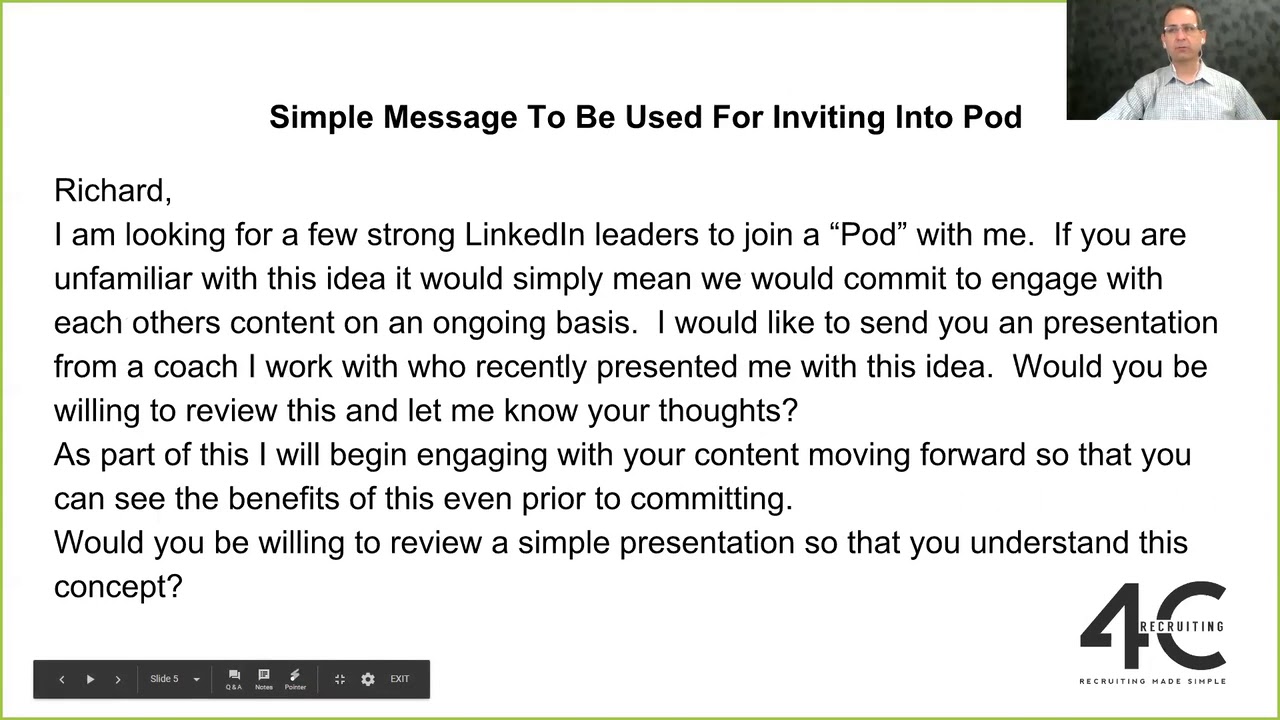
Hey everyone, it's Richard Milligan with 4C Recruiting, and I am coming to you with a really cool strategy today that, um, I would doubt any of you have heard of or familiar with, but it's a really cool way to increase your engagement on LinkedIn, to increase, really pour gasoline on anything that you're doing, you know, the fire of LinkedIn. And so it's what I call a pod concept. Okay. So I'm going to walk you through this. I would encourage you to, to activate on this. I'm going to show you some, some results that are early results that we're getting through doing this. And we'll obviously, as over the course of time, share more around the results that we're getting. So with that said, I'm gonna do a screen share now and we're going to bump over to this presentation. You can see me looking off to the right, which is the presentation. But this is a LinkedIn pod strategy. So what is a LinkedIn pod? LinkedIn Pod is a private group of people who are intentional about influencing the reach of their posts. And they do this through some basic behaviors, which are commenting, liking, sharing content with a specific group of people who have all agreed to engage with it. Now, follow with this because this— there's a reason why this works and why we want to be intentional in doing this. But the general concept, if I had to reframe this for you, is that it's, it's like a networking group, right? A networking group was designed and built to help promote each other's businesses. Okay. And so we're simply creating a networking group creatively on LinkedIn, right? And so in a network group, everyone's responsible for referring the people in the network group to their customers, to their clients, the people that they influence. In this case, we're responsible for commenting, liking, and sharing the content of the people that are in this group. Okay, and so just a slight shift here, but it works. And so let me, let me show you why. Here's why you'd want to create a LinkedIn pod. Now LinkedIn's algorithm determines whether your content is seen As high quality, low quality, um, as something they want the larger audience to see. They control that. Okay. And so where you have initial high engagement on something that you post, it actually tells the LinkedIn algorithm that what you're posting is valuable to the larger audience on LinkedIn. And therefore LinkedIn is most likely to promote that. Okay, so the algorithm is reading, is this content valid? Is it being engaged with? Because they want engagement on the platform. And where it, where it reads that it is, that it has high engagement, that people are interested in it, you're in essence promoting it. Look, the only way to do this on a platform like Facebook is to write a check for it. This is an incredible way to influence your content on LinkedIn. By simply being intentional about creating a pod. Okay? Now with that said, I've had pieces that have had 30,000, 40,000 views on them. Um, um, and I would encourage you to think about the strategy because you haven't— you have, um, the real possibility at some point of going viral where your audience is engaging at a high level with your content. And ultimately that's what we're trying to do is we're trying to create viral content. We're trying to reach a large, large audience, um, that people will engage with our content and then come back to us again and again and again to engage with content they see as interesting, as valid. Okay. So as a minimum, this is going to increase exposure inside our own network. Now, why would we do this? LinkedIn is an influencer platform. When I come to your profile or when I see your post, and there's minimal people engaging with it, you're not seen as an influencer. Where I see lots of engagement, it's very easy for me to interpret this person as being someone of influence on this platform, and now I'm most likely to actually follow you and engage with you. Okay, as a minimum, there's a positive impact in other engagement around other content. There's a positive impact on the, on the growth of your network, the organic growth of your network. And a positive impact on your, on your personal brand. So those are all reasons why you would create a LinkedIn pod. Now, how would you create the pod? What, what I recommend doing is going out and inviting individuals who are also consistently, consistently delivering valuable content on LinkedIn. We don't want to invite people into the pod who aren't engaging on the platform. If it's important for you to engage other people at a high level on the platform, go find other people who are as committed as you are to it. Just like a networking group. If somebody came into the networking group with the understanding that they were supposed to be making referrals and they didn't refer, we would ask them to leave the networking group, right? We're going to, we're going to create our pod with the same expectations around this as that. Now we're going to set expectations with the pod that each person is to engage regularly with other pod members' content. The caveat here being that we're not going to ask them to engage with every piece of content. Because I don't— every piece of content that I deliver is not of equal value, but I am going to ask them to engage with the high-level, high-value content that I put out. Okay. So similar to a networking group, everyone has a responsibility, you know, for specific behaviors. That's liking, commenting, and sharing other content with their followers. Now, one of the things that's helpful in creating your pod Is alignment. Okay? So if you can align in terms of geography, the area that you want to grow, look, if you are in the Southeast, go align with people in the Southeast. For me, it's throughout the entire United States. And so I would, I would align with somebody who's also in a larger geography, not a smaller geography. Okay? We want maximum exposure through creating the pod. So here's a simple message that you can use for inviting someone in the pod. Richard, I'm looking for a few strong LinkedIn leaders to join a pod with me. If you're unfamiliar with this idea, I would simply— it would simply mean you would, you would commit to engage with, with each other's content on an ongoing basis. I would like to send you a presentation from a coach I work with who recently presented me with this idea. Would you be willing to review this and let me know your thoughts? As part of this, I will begin engaging with your content moving forward so that you can see the benefits of this even prior to committing. Would you be willing to review a simple presentation so that you understand this concept? You can send them this presentation as part of that. Okay? So here's ideas for who you can invite. Inside the mortgage industry, mortgage insurance reps have a very similar level of influence as a branch manager, area manager, regional manager. Okay? Large title company reps, very similar. Top real estate agents within the state would be similar. Large insurance company brokers or agents that are in your geography would be similar. And even you could extend out to state or community influencers that you may know that, that are in the same geographical area as you. We want the exposure to be to the right audience, and your right audience, if you're a branch manager, is In the geography that you're at, the loan officers, sales managers, branch managers in that area. But if you're on a larger stage, you want to have a broader influence in a larger area, you're going to have to go out to other people that also have that. Okay, but for the branch manager, area manager, these are ideas for people that you could invite. Okay, so how do we manage the pod? Look, what I recommend is setting up a GroupMe app or a WhatsApp. And, and this would simply be everybody would be in the app and you could take something as simple as the Batman signal and everybody have it on their phone. And when that person drops the Batman signal into the, the app, the GroupMe app, everybody gets alerted and early engagement is what's critical. So we want to have a way to communicate to people to engage with the information quickly because then LinkedIn sees it early. As interesting, high-quality content. So one of the easy ways to do this, because this has to be sustainable, I come back to that again and again. If you have 10 to 12 people, which is a good number inside a pod, if you have 10 to 12 people that have made this commitment, having some rhythm to it is going to be helpful. So you can establish patterns for posting that are conducive to allowing other people to engage. This could include posting at a specific time of day. Um, but in the end, if people aren't able to engage with it immediately, it's not the end of the world, but we do want them to engage with the content. Okay. And then we're just going to model quality engagement over, over, um, low quality engagement. So, you know, making a comment like nice or nice post or love this, um, that's not quality engagement. Okay, we want quality engagement. Our quality engagement is actually going to improve the level that other people are engaging with it. So we want to, we want to make sure that we're playing our part when we engage with something that's more than just a couple of words. Now, this is stuff from, from a month ago that gives you some ideas, some comparisons around this, you know, comparison of with and without a pod. These were done in a similar timeline as each other. during the same week. Okay, you can see one's got 8,200 views, the other has 2,500 views. The content was very similar in terms of quality. Here's another one here, and if you've seen me, I have posted similar things like this from my 7 and my 11-year-old over the course of the last few months. What you'll notice here is that this exposure is about 4 to 5 times the normal exposure that I would get With my audience. And, you know, of course, you know, the likes and the comments that you can see there, those are 10 to 20 times the level of engagement that I would get with my normal audience. So this is exposure with a pod. Okay, so LinkedIn success really comes down to 3 things. We want to post high-quality content consistently. Okay, not spawn, you know, once Every 3 weeks. That doesn't work. We want to do this daily. Okay. Engage with your network consistently. Okay. That means that we're liking, commenting, sharing, or we see other valuable content. And then 3, we want to build valuable relationships consistently. You know, if you know my concept, my idea around jabbing, which is where we're actually being intentional about building value in relationships with relationships. This is such a key component to the wins that you're going to have on LinkedIn. And then we're going to put these 3 principles into play every day for success. Okay. So hopefully you found some value in this. Want to keep this short and brief and to the point. Activate on, activate on this. Be an activator. This is going to take you an hour to activate on it. Simply go through, make a list of the people that you are going to invite into your pod. Go back to the message that I've included as part of this. And you can move that over to them. You can even share this. Um, if you feel like you need to share this with them to get them to understand the concept around it, then do that. You're welcome to do that. And where I can play a role, where I can play a part, um, you have access to me. Okay. Wishing you all the best. If you have any questions, you can hit my calendar up at bookrichardnow.com, bookrichardnow.com. And, uh, all the, uh, cheers and well wishes to you as you continue to pursue LinkedIn as one of your recruiting pillars. Talk to you soon. Thanks so much.









