
Recruiting Made Simple Webinar for Mortgage Leaders
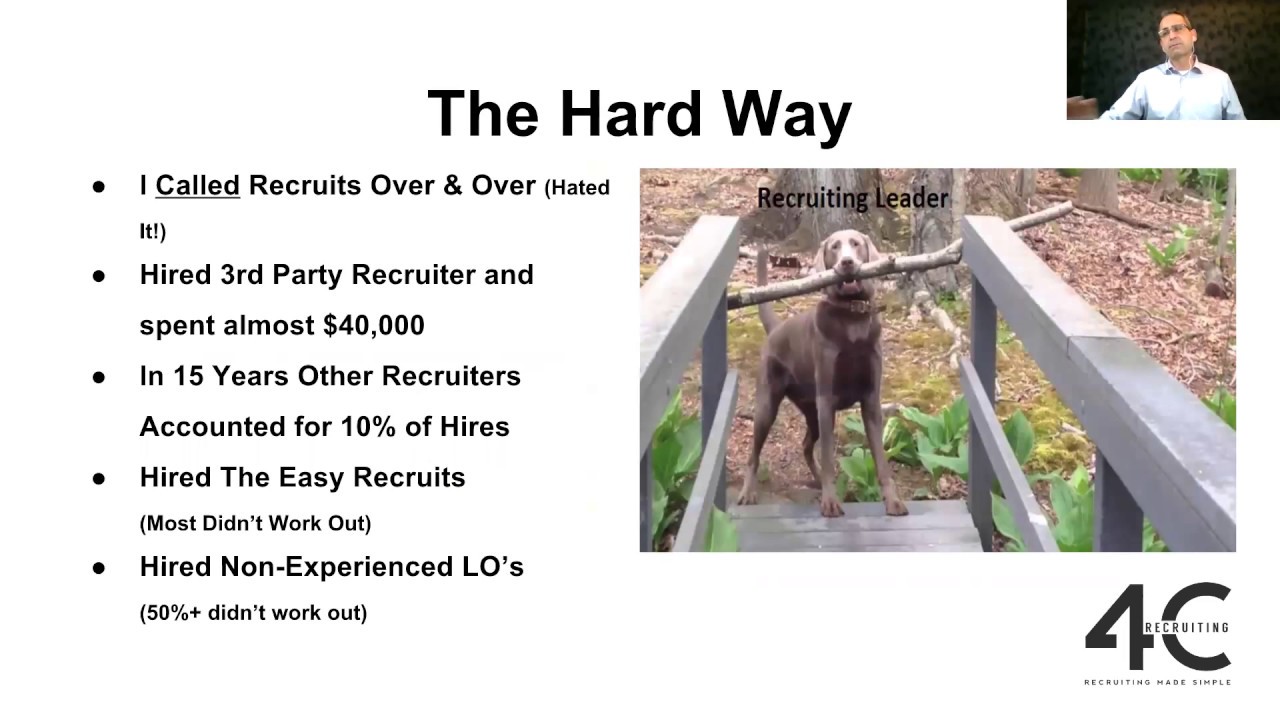
Richard Milligan from 4C Recruiting shares a recruiting system he built for mortgage leaders, treating it as a leadership function rather than sales. He covers three core ideas: become an attractive leader with a clear vision, design a step-by-step process using tools like Pipedrive and daily time-blocking, and use storytelling to move prospects emotionally.
Chapters
Hey everybody, it's Richard Milligan here with 4C Recruiting, and if you all take a moment for me, let me explain to you what we've been through the last hour and a half. We use AT&T as our service provider. They can't figure out what's wrong with our internet coming into our office here. We've been scrambling, using different devices to try and figure out how to hold this webinar for you. So will someone please tell me in the chat box that you can hear me and that you can see me and that, that this seems like a stable connection that you have with me? If you'll just jump in the chat box and say, yes, I can see you. Yes, I can hear you. That'll make me feel a whole lot better. We came across— perfect. Awesome. Well, there's some things that we like to do on this webinar that We typically share different screens and some of those require pulling more bandwidth to actually share them with you. I may limit some of that just from the pure fact that we have scrambled and actually are using completely different technology than we've ever used to host something like this. So there's probably 50 to 60 people on here and out of respect for that, I want to make sure that you guys get a lot of high-end content, a lot of high-end value. And I don't want to ever interrupt the connection that we have, so might change a few things up. But here's my intentions, and we're going to get started here in about a minute. I want to make sure everybody has the time that registered to get on. My intentions are to take you through a presentation. It's going to show you exactly what I did as a— what I call a recruiting leader. That's someone who's a branch manager, area manager, regional manager, VP, possibly more depending on your role. But that means that you recruit, but you also lead a team. I'm going to show you a system that I actually used that was highly successful for me. I'm just going to give it all to you as free content. And then at the end of that, if you want to stay, I'll open up another 30 minutes to Q&A. If you want to ask questions about something specific, you can jump in the chat box. So, in the chat box right now, as we're going through this presentation, if something jumps out at you and you have a question, Just drop it in the chat box and I'll go back at the very end. And for those of you that want to stay, we'll answer all those questions. Okay. So with that said, we're going to get started here. I'm going to go ahead and share my screen with you. Well, I should— you should be seeing my screen now. And if everyone can see the Recruiting Made Simple logo, then, then we've got everything right on this end. So let's get started. Give me just a second here. I feel a little bit like a fish out of water. Okay. So, um, when we're done here today, I want you to understand what you're going to get, because I recognize that carving out 60 to 90 minutes doing what you do is a huge sacrifice. You know, so I want you to have a grasp on what's going to come through this, you know, 60 to 90 minutes. I'm going to show you how to create your own unique recruiting system. Now, I'm not going to show you tactics. There will be some tactics in here. I'm going to show you an actual system from end to end that you can take, you as an individual leader, and wrap all your recruiting around it. I'm not selling a CRM. I'm not selling a system. There's no catch to this. I'm going to show you what I did as someone who was in your position to create my own system. And, and so As part of that, you're going to understand what it takes to actually be an expert recruiter. But then as also part of this, I get the biggest excuse when I deal with recruiting leaders is that they don't have time to recruit. And so I'm going to show you what you can do in 15 to 30 minutes per day to be a successful recruiter, because I've actually taken the time to identify the number of hats that you wear. And depending on your role, it's 12 to 15 different hats. If you're a producing branch manager, you've got your own pipeline and your own production, but then you also have the team's pipeline and the team's production that you're managing. And then you're a liaison to every single department— HR, IT, marketing. I mean, so you take just those hats themselves, you're already up to maybe half a dozen. Then you start adding the weekly, you know, planning that you do for your meetings. You probably help lead some meetings with real estate agents. You are the key deal putter-togetherer, if that is such a word. in your office, so you have a revolving door of, will this work? I can't get this to work. Any suggestions? So I think the key thing I want you to come away with is this is a sustainable system. I'm not going to show you the P90X version of how to recruit. You know, P90X's mantra is something along the lines of 90 days to the body you love. I'm not going to show you 90 days to, you know, the recruiting leader you should become. I'm going to show you really something that's sustainable. Sustainability to me says I've got to wear all these other hats, but then I also know that if I'm going to grow, I'm going to have to wear this single hat, which is recruiting. So I'll pause for a moment and just ask you this question and you answer it, you know, there in your own office. Is there a single talent— name me a single talent— that over-recruiting could help you build a bigger brand, could help you build a bigger branch? Because I don't know of any. And I get to deal with guys like, you know, Tom Nunez. I know of guys like Pat Flood. And these are people that over the course of either 3, 4, 5, 6, 7 years have built billion-dollar groups. I'm not talking about companies, have built billion-dollar groups focusing on the single activity of recruiting. So whether your goal is to go from $3 million to $10 million or $5 million or whatever that number is, or to actually begin to build multiple branches, If there's one thing you got to get good at, it's this skill set. Now I go back to being a parent and I reckon this is very similar to being a parent. I've got 4 kids now. And the first child that I had, who's now 15 years old, thankfully he survived our lack of parenting skills. But those of you that have kids know this. When he was first born, we were not equipped. We were tragic roles as parents and we grew in that role over the course of 15 years. In this business, it's unlike anything else. You, you become a great loan officer, you then are— you become a good producing branch manager, a great producing branch manager, and at some level then you move past that and you become non-producing and you build branches. But it never— at no place in this business has anyone ever said, are you good at recruiting? It's an automatic hat that they hand to you when you get a title and you have to wear that. So I want you to understand how to do this and how to do this well. So this is what we're going to show you. So stay to the end, right? Turn off Facebook, turn off LinkedIn, shut off your email, put your phone on silent. If you will stay to the end, I'm gonna give you one single tactic. It's not a part of the system, it's a single tactic that if you take away from this time with me will make you a better recruiter, and it's something that you can do immediately that will improve your ability to move people to next steps. So a little bit about me. I spent 15 years inside the mortgage industry. I started out as a loan officer, became a producing manager, was a pretty successful producing manager, would do 20 to 25 units in my own production. And then in that grew to 3 branches while managing my own production. And then that was really the first decade. So I was committed to recruiting that first decade. And I would tell you that the amount of effort and energy that I put into recruiting versus what, what was what I got in return. There was no equivalency between the two, but I was committed to it and I saw small successes but nothing major. In 2013, I changed some things. I went off the grid, I went off the matrix, and I went through what I call a sprint. I took 7 days and said, I'm going to actually build a recruiting system. And I built a recruiting system over the course of those 7 days. I came back at the end of that and began implementing that into my business. And what would transpire the 3 years after that would be I would actually build 18 different branches, hire almost 120 loan officers in that, in that period of time. And so that's what we're talking about here. So entire time in the industry, I built 21 branches to be exact, hired over 120 loan officers. And what I do today is I actually coach, but I also help small to medium-sized mortgage companies build mortgage systems that they can use and scale. So with that said, I've done a lot of things right, but I want to take a moment and I want to diminish who I am and what I've done because there's this misnomer that to become a great recruiter, you have to be a great salesperson. And in order to become a great recruiter, you've got to be really high on the woo scale, right? So for those of you that have taken, you know, StrengthsFinder, one of the strengths that you can actually have is woo. But the truth is that neither one of those are connected. What is connected is a couple of key principles, and I'm going to show those to you here. Anybody can do these. So I've done a lot of things right, but again, I want to discredit myself and tell you I've done a lot of things wrong. This picture here exemplifies exactly who I was as each year when I started out with this goal, this idea, I'm going to actually grow my brand. I had that, that stick in my mouth and I knew exactly where it needed to end up at, but I had no clue how to get that thing across the bridge. If you've ever seen the video of this dog trying to get that stick across the bridge, you'll relate to it given, you know, that you're a recruiting leader. But here's some of the ways I did it the hard way. I called recruits over and over again, and I hated it. If there's one thing that I hate, it's cold calling. And so, but I would— I did it, and I would call people again and again until I got them on the phone. And then I realized that the game that I was playing as a recruiting leader versus a corporate recruiter is a completely different game. And that understanding, that really helped me. But I did that, it was the hard way. At one point I had this brilliant idea, and some of you may relate to this. I'll just hire me a recruiter and the recruiter will recruit for me. Right? And so I did that at one point for 9 months. I hired someone who had been highly successful in being an external recruiter, um, and brought them in and we created our own system. And for 9 months they worked alongside me. We made zero hires. And so I spent $40,000 learning that life lesson. And the truth is, I mean, that next bullet point in my research and what I know in my own experience is that 9 out of 10 hires— let's let this sink in— 9 out of 10 hires will come through the recruiting leader. Okay? So if you're dependent upon a corporate recruiter or an external recruiter to build your branch or to build your brand, It's not a, it's not a proposition for success. You really have to learn how to recruit yourself. And so that's 15 years of my own personal experiences. And now when I talk to people today, the truth is that 9 out of 10 hires will come through you. Okay. Now I hired the easy recruits, and today I quantify those in hot, warm, and cold. I was convinced that timing was everything. Like, my timing's just off. Right. I couldn't get my timing on. The reason why is because I only really recruited hot and warm talent. I never recruited cold talent. And there's a secret to recruiting the cold talent. Those are the ones that move every 5 to 7 years, that actually bring a full pipeline when they land in your branch. That— those are the ones that we really want to go after. I hired all the easy recruits, and if you've done that, you know you churn those pretty quickly because you pay them for 90 days and 3 months later, after that 90-day guarantee, they're gone. They're gone. They're someplace else. They might last for a year, but I would tell you most of those didn't work out for me. And then I hired non-experienced loan officers. And I get that we need to hire people that are outside the industry. We need to be bringing younger talent into the business. And so that should be a pillar probably to your business and growing your team. But what I know is hiring those people and putting them through some really awesome training is that more than half of those people did not work out. And so that was the hard way. Now, doing this for 15 years, here's what I know. Recruiting is actually simple. I also know that storytelling makes for great recruiting. So, you know, we're going to talk about storytelling as part of this. I figured out how to motivate recruits even when they were content and happy, where they say things are going great, there's nothing wrong here, and how to move people that were at great organizations that had great brands that were top in market share in the markets that I was recruiting in. And then I also realized that I only needed a few minutes a day to do this. So I discovered this the hard way. I'm gonna give you the easy way. The easy way was in 2014, in 4 consecutive months, I opened a new branch. And over the course of those 14 months, I actually opened 7 branches as part of this system that I'm showing you. So here are the 3 secrets. Secret number 1, and we'll go over these Individually, but secret number 1 is you have to become the attractive leader that everyone wants to work for. Now, that may seem like, and like, yeah, you know, of course I need to be a good leader. But there are things around the attract— what I call the attractive leader— that's really critical that 95% of the mortgage business is missing. We're going to talk about that. Secret number 2, you need to build a system and a process that's unique to you. You have to track your candidates from the moment you identify them all the way through and beyond hire. I'm going to show you a tool that you can do this in. You don't need me to do this. You can do this yourself. The tool is going to cost you $6 a month, and I'll show you how to build step-by-steps in the system as part of this that are your steps. They're not going to be my steps. There are things that you represent that are authentic to you that you do in your branch that allow you to reveal who you are as an attractive leader. You'll build those in this system to reveal that to people, and I'll show you that. And then secret number 3, using your time wisely. This is the big area right here, right? We want something that's sustainable. Can we do it in 15 to 30 minutes a day? And so you can. So number 1, understand and communicate clearly who you are to become an attractive leader. So here's the identity of an attractive leader. Number 1, they have a vision. So I would start there. Now, a lot of you may say, well, my company has a vision, so I've got a vision, check in the, in the box. But is it your vision? I'm not asking you to go create a new vision, but are you owning that vision? So ownership and vision is so key. If you're stewarding somebody else's vision, then move to ownership or get your own vision. Because people that are great recruiters are very clear in their vision. In fact, the second part of, of the attractive leader is not only do they have a vision, but they can clearly articulate it. That means that if I asked you right now and we were on a call or on a Zoom meeting like this, and I said, what's your vision? Immediately you'd be able to tell me what that vision is and tell me what it means to you. 5% of the people in this mortgage industry, in my experience, have a clear vision and are able to articulate it. Now, the last part of that is the attractive leader. The third part of the attractive leader is not only do they have a vision, can they articulate it, but they actually live and act in accordance with that vision. Now, we won't spend much time talking about this today, but what you've got to know is that social media has changed the game for the attractive leader. Because think about it, if I go to LinkedIn and if you follow me on LinkedIn, that's how you've gotten here, then you probably know, like, my— some of my ideas, some of my belief systems. You could go to my summary and look and see who I am. So social media has changed the game in that your business persona and your personal persona are no longer separate. You can't be the guy or the gal that goes to the lake and does crazy weird things and posts it on your personal Facebook and then has these professional awesome posts on LinkedIn and not expect those two to somehow get woven together by people. When you call me, the first thing I do today, if I'm a recruit, is I go check you out. I can see everything that I need to know to see whether you're an attractive leader. And don't think for a moment that just because you're not doing anything, that that doesn't create a filter. That doesn't— that does create a lens. That people are going to look at you through. So, you know, the beauty of it is this, is that we have these places that we can articulate our vision, right, once we've got clarity on it, and that we can live out being the attractive leader simply by documenting the things that we're doing. We go into a sales meeting and you've got an idea, you put it on LinkedIn. You just walked out of a meeting with a group of real estate agents that you were helping your loan officer present to, and you've got something great that came from that. You have these epiphany moments and these moments that go— that you're already engaged and involved in again and again and again throughout the week. You're just not sharing them with anybody. So this isn't about LinkedIn and social media. It's not about idea creation. It's actually about just identifying the stories that you're already engaged in. So if you're thinking to yourself right now, I don't have a vision and I don't really understand how to have a vision, how to get to that. Well, we're going to talk about that in the next bullet point here. But for now, You're the attractive leader. We've talked about that. We've talked about the power of social media. Here's why it's really important in 2018. So I'll give you a takeaway why it's important in this moment. If you go back the last decade, remember I was in this business over that decade. We— that decade had more change in it than would probably ever be in the next 30 to 40 or 50 years. When you go back and review everything that happened with the new GFEs and the changes in RESPA and TRID and all of the people that had to change LOSs because their current LOS wouldn't handle, you know, all of the regulations. And then we add into that these phenomenal spikes in volume where rates would dip, and so people would fill the pipelines. And what would happen is that companies got caught with not enough operational support or operational structure. All of that is gone. It no longer exists. Look at Fannie Mae's projections for 2018. The truth is that This is a very stable environment for most companies. In fact, when I talk to most companies today, they're actually building stuff that's 5 years out now instead of living in that moment. And so I expect companies to get stronger and companies to get better and to get healthier in this place of being able to retain people. And so in an environment where everything's healthy, it gets more difficult to recruit in, which means that only the best recruiters are going to win. And so the attractive leader is that good recruiter. It's someone who's representing these things that we're talking about. And as part of that, the last bullet points there are, as humans, we're one of two things. We either are moving towards something or we're moving away from something. So we're a pain avoider or we're a pleasure seeker. So here's what the attractive leader does. The attractive leader is communicating and acting in accordance with that vision. And as people see that, what happens is The current leadership gets— suddenly is not so great. And even if— and so I would tell you that most people aren't great leaders. They're pretty good managers. They can manage a pipeline well. They can actually make sure that deals close on time. They're there when you need them. But in terms of inspiring people to be more, I'd say as a whole, most people are great managers and not great leaders. Let me give you an example of this. For those of you that have seen Braveheart, There's a great clip in Braveheart. That movie's like almost 30 years old, which is crazy to think. So some of you may not know what I'm talking about. I think it's 27 years old now. There's a great clip in Braveheart where William Wallace arrives on the scene of a battlefield. Now this battlefield has actually already been staged. There's already thousands of these Scottish peasants that are on the scene, and there's 2 lords that are trying to lead these Scottish peasants into something. And when William Wallace arrives on the scene, these Scottish peasants are now beginning to leave the battle scene. Because they're not buying into this vision. They didn't sign up for this. They're not even sure why they're there at this point. And William Wallace articulates a very clear vision and a very clear why. And in this moment where thousands of these men are leaving the battlefield, they turn around and engage with William Wallace, and then he leads them into literally dying because his vision has been so clearly articulated. Now, that may be a dramatic example of the Visioneer and leading people in to draw a sword and die. But the point of this is, if you don't have a vision and you're not articulating that, you don't stand a chance in recruiting. So begin ownership of this. Now, if you're unsure of how to do this, let me give you a couple of simple methodologies, because vision is this messy place. There's a lot of ways to come to vision. If you have a corporate vision and you want to own that vision, then begin answering the questions around that of why is it your vision and why are you passionate about it? Okay, if you don't have a vision that you're not currently owning, then I'll give you the example of how I did it back in 2010. As I was kind of moving towards becoming a better recruiter, I just said I need to be more clear to people in what I represent. And so I said I represented 4 pillars, and I went back to my core values and said, what's true about me and how can I identify my leadership and what people are going to get very tangibly here underneath my leadership? And so one of those things I talked about was personal development. And I'll share with you here in a moment why storytelling is so critical. But I would talk about personal development, why it was important to me. I would talk about leadership development and why it was important to me, why systems were critical. And I would share with people the systems that we had. And I believed in the 3X model around systems, that they then equaled solutions to problems and then created successful teams, successful companies. And I would talk about that. In a very specific way. And then lastly, I would talk about growth, and not any growth, but I would talk about organic growth. And that means that if you came to me in 2017, what could you expect to grow? Because I was measuring it. What could you expect to grow in 2018 as being part of my team? And that was 25 to 30% was a general number that you could expect to grow if you came underneath my brand in one year over the next year. And so I would talk about that. That was True to me, I was operating in accordance with that vision. And so that was my original vision that I actually began to express to people. Here's a moment for me. When I went and I was determining what's working and what's not working in the week that I told you about, I remember something coming up where I had recruited a young man who was a good producer in my market. This guy was producing 10 to 12 units a month. And I met him, from the moment I met him to the moment he was sitting in a chair as an employee, a partner, someone underneath my umbrella, it was 2 and a half weeks. And I was kinda sitting there when that happened, kinda beating my chest going, yeah, that was cool and that was good and you're getting really good at this. And what I realized is that the truth behind it was he had connected with my vision. And I remember that epiphany moment of thinking how deeply he had connected to my vision. So 3 days after he started, he's down the hall, he's got his door open, my door's open, and I remember him regurgitating these exact pillars These were my pillars. These weren't company pillars. Regurgitating my pillars and saying, this is why I'm here, over and over again to the real estate agents that were his partners. And in that moment, I went, wait, there's something to this. I need to lean in. And I began to lean in and began to get even more clear in my vision. And the more clear I got in my vision, the easier it became for people to move towards me. Now, being this attractive leader is polarizing. That means you're not Switzerland. You're not neutral. You don't want to be neutral. The truth is that if you're neutral, then everybody moves towards you, then you will churn a lot of people. You want to build a tribe. You want to build people that are in alignment with your vision. And one of the things that I talk about and teach, we won't do this today, but I talk about how to actually figure out the why of the individual and in your, what I call the visioneer presentation, create alignment with that. It's so critical. At a high level, you've got to understand that. If I figure out their why, I can create alignment with my vision, then they belong here. Not only should I be recruiting them, but they would be happier here than where they are in most cases. And so you don't want to be Switzerland in this. You want to be polarizing to some degree. Be very specific in what you believe. And as you're specific in that vision, it gives people this permission to move towards you quickly. At the same time, it repels. So if you look at my vision, personal development, if you've been in the business for 30 years and you said, I'm not really looking for growth, I'm kind of on cruise control, I'm a good producer, but I'm good where I am. And you met with me and I told you my personal development story, you would actually probably push away from me. And that's okay, because Richard Milligan might annoy you with the, with the personal development piece being underneath his umbrella. But if you were somebody that wanted to grow and you wanted to become more and you wanted to be inspired and motivated, when we talked about personal development, that would resonate with you and you would move towards me. Another way to communicate this is really— I do this today. I do it in 3 different pieces today. So it's changed for me. It's now, what is my mission? Like, what am I doing to help people? Okay. So that first statement for me today is I help recruiting leaders grow their business faster than they would in the absence of my help. That's how I say it to people. So what is your mission? The second part of this, how are you going to achieve it? How are you going to accomplish that? Okay, you can express it in that. So there's 3 statements for me. I gave you the first one. The second one for me is, I achieve this by teaching recruiting skills that enable leaders to vastly exceed their previous accomplishments. The last part of this, an easy way to frame this is, I will know that I've achieved my mission when— this is really where you insert the big goals, right? What is the big goal for you? You know, we've all heard the BHAG goal, the big hairy audacious goals. This is where you insert that. This gives people clarity in moving towards you. Now there's maybe one other way I've come across that's an easy way to do it. It's not in this presentation, but it's, you know, I'll give it to you now if you want to write fast. It's action plus who plus how equals vision. So action plus who plus how equals vision. So give you an example. Take my personal development pillar. My action was personal growth. My who was the people under my sphere of influence, my team, my family, maybe a nonprofit organization that I was in at the time. And then my how was, how am I gonna do this? How am I going to teach them, show them, help them implement? That's another way you can come about this. Now, how do we connect all this? The attractive leader is able to move towards really casting his vision clearly through storytelling. So let me give you a simple methodology around storytelling that you should be using. I call it the 3X structure. So I try to use as much 3X structure as possible. The human brain tends to lean towards, you know, being able to remember things in 3s. If you have to prepare for a meeting, you probably simply create 1, 2, and 3 and you fill in the blanks. You're not sure what your points are going to be, but you fill them in. If you look at fairy tales, most fairy tales are written in 3X structure, and it's because our brains Remember, you know, the 3X structure really well. So here's a 3X structure for you. Tell a story through the lens of try, fail, overcome. Now, the truth is that we're all really good at telling the overcome part of this. And so when we recruit, what we do is we tend to lean towards, you're not gonna believe what we just did. We took this deal from another lender, we closed it in 8 days. We're good at telling the overcome part, right? The overcome part might be, I have an underwriter that stayed till 9 PM last night, or 3 nights ago and got a deal clear to close so that we could get to the closing table on time. Right. And that's the overcome. But Hollywood has really done a really great, really great job. And their success is actually only— I mean, the only thing that they actually have success on is if they tell stories well. And if you think about a great movie, we mentioned Braveheart, try, fail, overcome. That's the context of all those stories and great movies. Now, it doesn't have to be complicated. You don't have to go back and go, I've got to get this 3-act structure and here's the specifics around it. Here's a very simple takeaway. You can remember this phrase and it'll automatically make you a better storyteller. Tell a great story, which is what you're already used to doing, and make the statement, but it hasn't always been this way. And that statement, but it hasn't always been this way, immediately moves you to The try and the fail. So you can tell the overcome first, but you have to tell the struggle. You have to tell the conflict. It's how we as human beings relate to story. Okay. So why I'm talking about storytelling is this, is that the majority of the mortgage industry recruits with what I call left-brain thinking. We get into that initial meeting and we feel like we have to tell them everything that we'll get. And hopefully, you know, on throwing 50 darts, we'll, One will land on bullseye and we'll figure out what their hot button is. But the truth is that that's the wrong way to actually motivate people. It's through left brain thinking, which is vetting. So if you come to me and you say, my products are this, left brain thinking, vetting. My compensation model is this, left brain thinking, vetting. Even start talking about tricks, tools, CRMs, marketing tools, marketing support, technology. All of these things are left-brain thinking. What you have to do to be a successful recruiter is you have to move people to heart. What does storytelling do? If I told you a great story, a great story would move you to emit and have an emotion, and that emotion would actually move you towards me in some way, shape, or form, or move you away from me in some way, shape, or form. And so storytelling is everything in recruiting. It's right-brain thinking. Here's how I identified this. I began to realize that I was getting into second and third meetings and I was never talking about compensation. We weren't even bringing up products. We weren't talking about marketing tools. We weren't talking about our LOS or CRM. We weren't talking about any of those things. So just take a moment and pause and kind of evaluate your own recruiting. How quickly are you getting into those conversations? If you're getting into those conversations quickly, The likelihood is 100% that you're trying to recruit through the left brain lens. The fastest way to move somebody is to change their perspective. And how do you change perspective without ever changing a single fact? You bring emotions into the picture. If you've never seen someone that was emotional, that was irrational, then maybe you don't understand this. But when you see someone who's emotional that you can't even make sense of the decisions they're making, you fully understand that where you get emotions involved. People move much faster towards something and even much faster away from something. So you've got to become a better storyteller. So just go back to that. Tell the overcome. That's great. But then tell it with that statement after that. But it hasn't always been this way. And that gives you the ability to tell the try and the fail. Now you may say, well, I don't want to talk about my organization having failures. That's fine. I could tell you a story about my personal development. I'll share that with you here that can go through the lens of it. Not being the current organization. So here's personal development, and I'm going to abbreviate this story, but I want to give you an example of this. When I talk about personal development, I would say these are the things that we're doing, and this is why it's important to me, but it hasn't always been this way. And let me share that with you. And so I would go back to the story of me being a young man. Growing up, we grew up very poor. I remember duct taping my tennis shoes. I remember eating saltine crackers and milk for breakfast a lot of the time. I remember getting our electricity shut off, being evicted from multiple homes. I remember a lot of instability around my life growing up. When I got to the age of 19 and I left home, I had $50 to my name, and, and I wasn't for sure what I was gonna do or where I was gonna go. But there was one thing in me that I knew, that who I was going to become was going to be much more significant than what I had been and where I was coming from. I knew I didn't have a family support structure to get me, you know, to this next place. I knew I didn't have the financial support to fall back on that to get me to this next place. And so I made a decision at the age of 19 that I was going to take ownership of my own personal development. I began to pick up books. I began to actually go to seminars. Webinars didn't exist at the time. In fact, I was listening to my books on tape. Some of you can, some of you can actually relate to that. But, and I began having lunches with, with other successful people. And when I would go to lunch, I'd take my notepad and I would ask questions and I would take notes. And then if it was a great meeting, I'd ask if we could do lunch again next month. And so I began to study the basic principles around business and around success. And 8 years later, by the age of 27, I was the youngest outside sales manager, regional sales manager in a Fortune 500 company managing 4 teams in 3 different states. And it wasn't because I had a lot of experience to lean on. It was because I had been— I had studied the practical knowledge around success in business, and I was actually able to take that and apply it. So as I share that story with you, you can understand personal development. I connected that story that when you left the meeting with me, there wasn't any question about whether you trusted me. You knew deeply that if that was something you wanted more of, which was to grow, that story connected the dots on that for you. That's the power of storytelling. Okay? Okay, so we're going to talk about building a system and a process unique to you. Here's the part that I hate. I despise not being able to share with you, but because of technology, I'm going to have very limited ability to show this to you today. So, we'll open this up at the end for Q&A, but this is a key tool. You need to be able to— you need to have a place where you can actually put the next steps of your recruiting system. So let me give you an example. Recruiting is really about 3 big keys: identifying talent. Okay, so you should always be identifying talent and time blocking that. The other part of this is actually connecting with talent. And so you should be figuring out ways to creatively connect with them, and the phone is probably one of the most powerful ways that you can do that. And then the last part of that is actually following up. So those are 3 things that you have to do in your system. Most of us understand that. We understand how to build it. How to identify talent, how to build it, and then beyond that, how to— and that we should be following up. But what we don't really have is a baby step in between. When I built out my Next Step system, it had 32 steps in it. These were from the moment I identified you to when I made a phone call to you, to when I followed up with a phone call to you, to when I actually got to face-to-face with you, to what I did immediately after the face-to-face, to the next step, to the next step, to the next step. And the key to this is that recruiting is all about momentum. If you have the slightest bit of momentum, you have to continue that. And by having a lot of clarity around your next steps, it gets very easy to have momentum. So as an example, if you meet with somebody face-to-face— and I will say again, you've heard me say a couple of times, I see this a lot. This is one thing I see a lot of. So if you want a slight shift in becoming a better recruiter, Have powerful next steps. I see a lot of people that actually move someone to face-to-face, and then beyond that, their next step is, I'm going to email you a presentation. Please don't be that person. That is one of the weakest next steps that you can possibly have. Okay? It's okay to say, I will send that to you, but don't let that be your next step. If there's any momentum at all, or even if you have some question on whether you have momentum, create a very powerful next step. A really powerful next step that you can create is having somebody come into your office. And that's even a great identifier whether somebody's hot or not, or whether somebody's interested or not. If they move away from that, fine. But at the end of your vision, your presentation, where you've created alignment with your vision and their why, move them to a powerful next step. And so having them come into your local office, which is your strategic location— hello, like, if I'm going to plan, pre-plan, stage something, I'm going to bring somebody in my office. Why? I can tell my loan officers to have their doors open. I'm going to bring someone around and introduce them. I can have my lead processor or my lead operations person come into the meeting and share this very specific transition plan that we have all of our candidates go through. There's so many things that you can do. They're the little things. You can stage an office, right? You can have a specific person come into your office like a top loan officer and try to build relationships that you have a next step beyond that where they call them. There's just too many things that you can do in that environment. That's got to be a next step. But if you didn't have a very powerful next step, and what most people do, and in fact how I ended up where I am today is I, when I started recruiting as an external recruiting company, I noticed people couldn't move people through a process to actually hire them. And the reason why I reached out and go, how'd the conversation go with that candidate? And they said, well, it, it went good. I think that, I think we'll get something from it. Well, what was your next step? I said, look over the presentation and then call me if you have any questions. And I was incredulous 'cause this happened again and again. That's your next step? Yeah, that's my next step. Why, what'd I do wrong? What you did wrong was you actually had someone at this peak experience and we didn't take advantage of it. Now, if you're recruiting left brain, there's no peak experience 'cause you've just taught them, go vet me against somebody else. And if somebody else's comp plan's better and somebody else has got one product that you don't have, And they've got one deal per year that they close in that product. They vetted you. And so the left brain thinking, you know, gets you out automatically. But the power of the next steps for the visionary is that now I have more momentum. And if I don't get momentum, you don't move to that, that's okay. I've just said you're not even warm, you're cold, and now I'm going to proceed with a different process around you. And so having a system around whether they're even identifying whether they're hot, warm, or cold is critical. So I use a system. I use the system and a tool I'll show you here in a second. It's very easy. You can actually go and create this in. But here are the reasons why it's important. You need to be able to track your recruits. And, you know, as, as part of this, as you recruit at a higher level, if you put 100 people in your system, can you follow 100 people? The truth is that you can't. And so once you start having a lot of conversations, and if you're recruiting, You should be having a lot of conversations. Let me give you an example. Here's 30 minutes a day of recruiting, okay? On one day— on 2 days per week, you identify 5 people you're gonna call. Easy, right? You figure out some data points through maybe Zillow's lender reviews, NMLS, LinkedIn, Facebook, organic Google searches. If you did that on me, just like if I did that on you, I'd create a profile. Has a family of 4. That's Richard. Loves his family, loves the outdoors. If you looked up my, my Zillow review, probably have a bio or a summary about me. If you go to LinkedIn, I might have that. If you do an overview on Facebook, you'll see some of the things that I'm doing, who I'm interacting with. You find out I'm on a board for a nonprofit ministry. You could in about 3 minutes identify all those things about me just through an organic Google search. And then when you call me, it would no longer be a cold call. It would be a warm call. Okay, that's, that's the power of this. So, so the identifying talent we're talking about right now should take you 15 to 30 minutes to identify 5 to 10 people. Then on another day for 30 minutes, I'm going to call those people. Now, statistically, if you call 10 people, you're going to reach— you're going to actually reach enough to set one appointment. That's in my experience. So if you're doing this Once or twice per week, then you're going to be setting 1 to 2 appointments per week. And then if you time block to actually do that third part we talked about, which is actually follow up, now you're going to incrementally improve those opportunities. But if I just took some simple math here and I said, you know, you're, you're time blocking 30 minutes per day, you should be able to identify 15 people, make 15 phone calls, set 2 appointments over the course of the year. Do the math. 52 times 15. 780, I think, is the number. I might be wrong in that. Do the math on that. 15 times 52. Do the math on 2 appointments per week over the course of 52 weeks. That's 104 appointments that you would have set doing this in some simple time blocking every single day. But you would do that because you actually have a system and a tool that you understand all these next steps that you're moving people through. And so tracking the recruits, once you start beginning to get beyond 30, 40, 50 becomes impossible. I just mentioned the number 780 people. How are you going to do that with an Excel spreadsheet? You're not. Um, so to do this, you got to have a system in place. Um, the other thing, other reason why you need a system in place is the next step is so critical. So just knowing what your next step is allows you to move towards that. And that is helpful in just getting clarity around what you're doing as a recruiter. What's my next step? Well, if you're hot, My next step should be to move you to a site visit, a local site visit. If you're big enough, maybe you'll move them to a larger corporate site visit. If you do that, what's your next step? If I moved you to my local office, then what am I going to do? I just mentioned bringing a loan officer into that meeting and allowing the loan officer then to actually be the next person to connect. Well, what's your next step? Right? And then what's your next step? Because we want to continue with the momentum. So this is— I liken this to speed dating recruiting. Gang is like speed dating. That may be a horrible analogy, but I may be the king of horrible analogies. Let me give this to you. My wife, Lee, and I have been married for 19 years. And, and so I go back to the very beginning of when we were married. And what I know is that when we got to the end of 60 days, we may not have said— we didn't say, are you ready to get married? Would you like to get married? But what we did know inside our own internal, you know, feelings and spirit and mind is that we knew that we were marriage material, that I wanted to marry her and that she wanted to marry me. In 60 days, we went from not knowing each other at all to getting to know each other to a place where we were willing to say forever and ever till death do us part. So, the likening to recruiting is simply this, that we did, we got there because we built relationship quickly, we built trust quickly, we understood each other's whys, desires, dreams, what we wanted our family structure to look like. We understood all those very quickly. And how do we do that? We did that through next steps. I asked for her phone number. She gave it. I called her and asked her to date. She said yes. We went on a date. We made a plan to get together again. And we continued that and continued that and continued that to a place where we built relationship. Where you can build relationship quickly. Now, don't disqualify this because I know what some of you are thinking. I have to call them over the phone. I can't call them again and again and again. You're right. So somebody that was trying to recruit 10 years ago was at a disadvantage over what you are today and what I am today, because you can do so many creative, cool things in the recruiting process to make it fun that it's ridiculous. LinkedIn's a perfect place. I've reviewed the profiles of all the people on this call or on the Zoom meeting, right? I think there's one person here that's doing, doing something along the lines that might even be conjured up as being right. LinkedIn is the perfect place to do some of these fun, cool, creative things. You have direct access to their messaging there, right? You have direct access to post stuff and for them to see who you are in this fishbowl looking at you without you ever being able to see them through the one-way mirror, right? You can use things like FedEx and overnight a book. You can do things like get their home address, which is a key to the recruiting process, and make sure you're getting it at the right place. And then you're engaging with them at home, which is such a We'll talk about this in a second. That's such a cool, creative, unique way to actually go after people. One of the ways, one of my next steps was if I was recruiting you, I would actually, one of my steps in my recruiting process, I'd go to your Facebook page or your Instagram page or wherever I had to go. I would get a picture of you doing something that you loved. Might have been kayaking with your family. Might have been skydiving out of a plane. It might have been something like along those lines, but it was out here. That's not business stuff. It's out here in the space that we all have some things that we'd love to do outside of work. I would actually take that picture, save it, upload it to an online framing company, figure out kind of the idea of who they were. If they were outdoorsmen, I'd get something rustic and woody and cool, or if they were, you know, more modern, I'd get something that looked really modern for them. And I would put it in a frame and I would send it to them with a note. And that note was along the lines of, I've enjoyed getting to know you to this point. I feel like we have a lot of things in common. I've enjoyed understanding why you're doing what you're doing. In the end, what I want you to know is that if we ever had the chance to partner together or work together, I would be all about helping you accomplish more of this, and sign my name. Now that's cool. That's creative. That's way outside the box. Got it. But if it's not a next step and I don't know when am I going to do that, I might do it once. I may never do it again. All right. And so I'm just saying these next steps are what keep momentum going in the recruiting process. The next bullet point we're looking at there, create processes unique to you. I just kind of shared one with you, right? You should be doing some things that go back to your core values, that go back to uniquely who you are. You probably have some things that you— that's your belief structure. that you believe in. My belief is in personal development. I could take a book like Darren Hardy's Compound Effect and send it to you FedEx or UPS or mail with a note in there. And now I've got— now I'm engaging you in a different conversation, but that went all the way back to my core value, personal development, leadership development, growing people. Okay. And the last part, this is so important. When you start getting to this place where we just talked about the number 780 people, Okay, when you get to that place, you are never going to remember how you engaged with me, what was said in that meeting, right? Whether it's face-to-face or over the phone, you just wouldn't. If you called me 2 weeks ago and you said, hey Richard, how's it going? I might have said something along the lines of, we've got the flu in our house and it's pretty bad. Like, it's been a rough couple of days, right? And I might have said, and my youngest daughter Haven's been throwing up for almost 2 weeks. And you'd be like, man, that's tough, right? Note to self, I just gave you some really critical information that you can use if you take note of it. I just gave you my daughter's name. I might have even said my 4-year-old, Haven, right? Now you know a couple of key pieces of information. I'm putting that in my conversation log. I said that we've been sick for 2 weeks. Like, now what am I going to do with that? If your only intent as the recruiting leader is to just get into a conversation and to move me through this speed dating process where you don't know me, and you're not acting like you care about me where I can't see your core values, you will not get me because somebody else will do that. So as a takeaway from that, right? I mean, hope you get WellNote, drop it in the mail and send it to me. Do something interesting and engaging in that. 2 weeks from now or a month from now when you call me and you say, Richard, how's your 4-year-old Haven doing? Wait a second, what did you just say? Like, I'm not gonna remember a month from now that I told you your name was Haven and that's my 4-year-old. And you're going to say, yeah, yeah, you actually, when we were in our conversation a month ago, you mentioned Haven was sick. I'm gonna be like, holy cow, this guy's different. This is— these are the things you should be doing. They're gonna make you different. Now, if you don't have a place to keep a conversation log, you're not gonna be able to do it. And that's why the conversation log is so important. Here's the context of this. You all have a best friend. This is just truth. We all have a best friend that we're not connected with today. But if you said to me, Richard, call Thad and see what he's doing this weekend, I could go hang out with Thad for the weekend and I could pick up exactly where we left off. And the reason why is that Thad knows my story, right? I don't have to, I don't have to tell him my life story and get to a place where he's a good friend. What we're doing with part of this is we're building relationship. You're going to get nuggets from me every single time you call me. You may find out that today's my anniversary. Or that last week was my anniversary, right? That's a nugget. You put it in your conversation log and you keep building this relationship with me. Next year, send me an anniversary card. What a cool thing to do that nobody else is going to do. So now there's no more having to reestablish again and again and again. You can move to a place with a recruit where they've never been inside your branch and you've never met with them face to face, but you've engaged with them at a level just of simply getting on the phone with them and having some short conversations. Where it almost feels like you know them and they partially know you, and the conversation log is important to that. If you want to create your own whiteboard CRM, this is the tool I use. I'm not going to show you. It's called Pipedrive. You can get a 2-week free— you can get 2 weeks trial to this for free. I walk all my coaching clients through actually creating their own Pipedrive and building out a lot of the next steps that go back to their core values. You can do this on your own. This is a simple tool. You'll watch a 5-minute video and you'll be able to use this. That's exactly what I did back at the end of 2013 to actually create my recruiting system. Pipedrive will cost you a few dollars a month, and it's just a really cool place that you can build out all of these things that you, you think are important. Okay. Okay, so the third part of this is the power of 15 minutes, and I put no cold calling required because I believe in the warming up calls. If I'm going to call you, and I'll give you a great example of this, there's a story that just comes to me right away. When I was calling, whether you were a loan officer or branch manager, I required myself to at least get 3 critical pieces of information. And I didn't necessarily have a criteria for them, but I wanted 3 cool pieces of content that I could share with you over the phone. So you might have said on your Zillow profile, You know, I got into the mortgage business as a telemarketer, and boom, that was a nugget for me because I got into business back at the age of 19 as a telemarketer. So I could connect with you on that. You might have had some really cool website. It might have been richloveslending.com or something along those lines. I'd actually bring that up in the conversation. I love what you did with your website. That's really cool that you were able to get that. And then one other piece. So I'm going to get 3 things that I can talk to you that aren't I'm calling to set a face-to-face appointment with you and just trying to get you a cup of coffee so I can recruit you. That will warm up that call. That needs to be a takeaway from this. The other piece is, before we jump into this next slide, is this. Don't— I would not call office numbers. Okay, now again, you're talking to a practitioner here. This is a guy that's made thousands and thousands and thousands of calls. I have called the office and I can tell you what 99% of those conversations are. There's enough information on the World Wide Web today that you can get a cell phone number from a loan officer. Okay, and if you can't, then you haven't done enough research. And if you're not sure whether you've got a cell phone number or not, then go to, go to a tool that's at searchbug.com. The word search, the word bug, dot com. You can take a number, enter it into that site, and it will tell you immediately whether it's a voice over IP, whether it's a landline, or whether it's a wireless number. And now you know whether you can call that. When I call that number, which is going to always be a wireless number, a cell phone number, I'm only going to call you when I have done enough research to engage in a real conversation. I remember calling a guy at the time I was building branches. Remember calling a guy, um, I think he had 5 loan officers underneath him. 3 of those loan officers— I'd done research on all the loan officers, um, and, and 3 of those loan officers had been in the business for about a year. And I thought that was impressive. Here's a guy that had taken people that were outside the industry, which you can see if you look at their employment history on NMLS, that had taken people outside the industry and had brought them in, and for at least a year, he had them underneath his umbrella, which said he's doing some things right. I also got some other information about him, which was they had had this nonprofit— I mean, they had had this fundraising event for a young man. I think he had MS, and as a team, they had actually held a a banquet of sorts, a dance of sorts, and raise money for this young man that had MS. And so when I called him, I knew those things, but I also knew a lot of other things. And I was able to use that information very quickly to shift the conversation and to move him. And I can promise you, based on how the conversation went, he was defensive when I called, took a defensive posture. And when I said, man, I've done some research on you, I feel like we should, you know, I believe that we should be having a conversation because I just see a fit between you and between me and between what I'm doing. And he immediately kind of rose up defensively, took this defensive posture, which was, yeah, sure you have. Like, tell me what information you know about me. And when I went through the specifics of his loan officers by their first names and the fact that he had taken them on board and they didn't have experience, and so I knew that he was a bit of a risk taker, but also believed in bringing new blood into the business. When I talked about, I saw him as being community-minded. Because there were these things that were outside the, outside, you know, the normal business infrastructure that we do, that he was doing. I moved this guy through the process because I had done research in the beginning and made it a warm call, not a cold call. Okay. Let's talk about the 15 minutes a day. Here is what is true. The simple statement, we protect what is a priority, is true. If you're not recruiting right now, it's not a priority. And if you're giving lip service and saying recruiting is a priority, I just don't have time, the truth is that you're not, you're not carving this space out and protecting it. Let me, I'll go back. When I first started recruiting, it was around 30 minutes a day. And as I started having more success, it became an hour and 2 hours. And eventually it was a lot of my afternoon broken up by 2 30-minute time slots for me to put out fires or to deal with what I had going on. But that was as I had success and was able to move towards that. But in the beginning it was 30 minutes. And I would take a— I learned that even taking something like this, let me show you. I would take this. This is how desperate I got. I would take this. It's 30 minutes. I would just put it outside my door on a table. You know, I know some of you are laughing right now because this is the truth. And I would have that there. And I put— and then this didn't work. I put a sign on my door. I might have started with the sign on my door that said, in a meeting. And it was hilarious. It was a cardboard sign that was taped to my door. I said, I'm in a meeting. That didn't work. This didn't work. In addition to the meeting sign. And so what finally I did to protect it because it was such a priority, I took a whiteboard easel and I would put it in front of my door. And at the top of it, I would put time to time, how much time I was spending in the office recruiting. And then I would put on there, if you have any issues, write them here. And when I come out of my office, we'll address those. And I would put that in front of my door. Now it kind of became a joke because people would go to my whiteboard easel and they would doodle my face and they would circle stuff or change words. And so, you know, it was a playful environment and it was fun doing that. But the truth is that I figured out how to protect what was a priority. So whether you use one of those simple techniques that I just mentioned that I used, or whether you do something else, you have to protect this if you're going to get good at this. Recruiting is a lot about rhythm. If you don't make cold calls, you don't make calls, right? We're not going to— I use the word cold calls. If you don't make warm calls and you don't do that for a season, you get to where you're not that good at it. If you don't spend time identifying talent and you don't have kind of this methodology where you open up your CRM and you open up Zillow and you open up LinkedIn, you open up an MLS and you open up Facebook and you take each person through that system, then you don't get good at it. It's constantly clunky. But where you protect and time block, You can get really good at this to where you can actually, in 15 to 30 minutes a day, do this successfully. Now, one of the things I would encourage you to do is start simple. Start with a top 30 recruits list. Okay, now some people will overanalyze this and go, well, I don't know what's a good recruit and what's not. Just move, move towards something. Okay, if you gave me 30 minutes, I could generate a top 30 recruits list. Here's how I would do it. I'd go to Zillow, I'd go to lender profiles, And immediately when I click on that lender reviews, it pulls up it with— based on my location, it pulls up the top number of reviews for loan officers. I can create a top recruits list in about 30 minutes just doing that. That's a great place to start. Don't delay in doing this. Do this, do this immediately. This— if you do a top 30 recruits list, you'll focus on one person per day. Can you focus on one person per day? Yes, you can. That's how you do this. The second— the next bullet point there, SlideDial. If you're not familiar with SlideDial, SlideDial is a smartphone app. It allows you to always get voicemail. So if you've got a cell phone number, a wireless number, you'll always get voicemail. So there were times when I had had a brutal day, but I— and I was headed home, and I would always carry my top 30 recruits list with me, that I could slide dial my top 30 recruit or multiple recruits passively and get their voicemail and just leave a simple voice message, which might be You know, this is Richard, and we talked several months ago. I was thinking of you today, want to reach out and see what your schedule is like next week. Would love to get together with you. Or it could be anything passive, but I know I'm going to get voicemail. And in the minimum, I could do that on my way home and leave these passive voicemails for people that I'm building relationship with. It may not even have an ask. It may actually be, you crossed my mind today and just wanted to call and see how things were going. Right, they probably won't return that phone call, but I'm going to stay at top of mind with that. The next one is month-end great stories. So simple, write this down. On the 20th of every month, you're going to ask your team for a great story. Like, what's a story that you're— one of your real estate agents or one of your borrowers or you individually have been impacted by with this organization? Each month, give away a $25 gift card for the best story of the month. Okay, very simple. On the 20th, you put down your calendar, you got a cut and paste email that once you type it up, you don't have to type it up again. You send it out. What you get back is stories. You figure out which story is the best story, and at the end of each month, you take that, minimize it, reduce it. And now I'm going to cut and paste that to each one of my candidates, each one of my recruits. I'm not going to spam, but I will do this to people I'm engaged in conversation with. So it's a few minutes for me to ask for a month-end story. It takes a few minutes to just shape it and mold it a little bit to where I can text message it or even email it. And then at the— on the last day of the month, I have another reminder, and that reminder is going to be to actually send that message out. And whether I'm doing it via email or doing it via text message or even slide dialing that to backdoor voicemail people, I can do that in a matter of minutes. And I can get all 30 of my top recruits on this list just by doing something as simple as that. And it's just a few minutes. Okay, that's a takeaway. You can do that. And another part of this is the power of having your assistant dial for appointments. Now, here's what I know. A lot of people on this meeting, in this webinar, do not have assistants. So I'm gonna give you a strategy around circumventing this. But here's, here's what I want you to understand. And if someone calls you, if somebody called you and said they were calling on behalf of Richard Milligan, right, that positions me differently. That puts me on a pedestal, puts me on a stage. So there's this, there's this subconscious thing of having an assistant call you that you subconsciously put me on the stage because I'm more important. What I noticed is that we began to set 3 times more appointments when we had an assistant dialing for us. And what we tied this back to was people begin to think that we were more important than maybe we actually were. But the truth is that didn't matter. That when people— when someone was calling for us and setting these appointments, That we had better opportunities to actually get them to a next meeting and into a next step. So that's key. Now, if you don't have an assistant, here's what you do. Reach out to another branch manager or someone in your organization that will swap out with you. Have them call and represent you as an assistant. You don't have to say, I'm the assistant. They can call and just say, hey, this is Dave. I'm calling on behalf of Richard. Richard asked me to reach out to you, and Richard would like to meet with you. That small step right there, it will actually, if you have an assistant, it will keep you within a smaller time slot. And now you're only meeting with people that are over the phone or face-to-face that are moving to those next steps. You're not having to spend that time dialing them. But if not, it's still critical that you do this because the takeaway is that more people will meet with you if somebody's calling and setting those appointments for you. Okay. Now, so we've kind of walked through some methodology around this attractive leadership, building a system out, some cool ideas around protecting your time. You have to have rhythm to recruiting. So behavior is everything. Here's a simple weekly recruiting scorecard that I recommend that, that you use. On the left-hand side of this, it's behavior and actions. So if you're going to identify 15 people per week as candidates, you'd actually put, you know, research 15 candidates, recruits per week, and that you follow that all the way across the goal. And underneath goal, you put 15. Below that is another behavior. Other action would be following up or actually making the initial phone call, right? So we could follow all those up across the goal and put a number there. You can add all of your behaviors on this one sheet. And come up with a total for the digit, the number of goals that you would have for that week or the number of activities that you would have for that week. Here's why this is important. This is, these behaviors are everything. The rhythm of your recruiting is everything. If you go over a week and you don't do any of this, you're not gonna accomplish your growth goals for 2018. That's the truth. So when you get to the end of the week and you score yourself underneath achieved and you measure it against your goal with a net score, This is a very easy way to hold yourself accountable. But here's, here's where I came across this and why it was one of the most key things in my recruiting. In the end was I took this— this is a methodology I learned from somebody who's actually a small business coach who's taken a lot of companies and revamped them or started them and has been successful in most of those situations. He said the truth, the truth is that we're not successful as small businesses. And in this case, As a— we all kind of operate a small business, a branch, an area, region, whatever. We're operating small businesses. The reason why we're not successful is because we're not measuring things. We're not measuring the correct behaviors. So, you know, if there's some areas, regionals, and VPs on here, the takeaway from this would be this is a cool tool that you can just use to have everybody turn in on an ongoing basis to see what the metrics are and what they're doing. Because this is the rhythm of their recruiting. So if you had a goal that was an 83, for example, and I will just tell you, as I worked, I've worked with hundreds of recruiting leaders, a good goal number is between 80 on the low end and 120 on the high end. So as a minimum, structure this to 80. On the high end, I want it to be sustainable. So unless you've got a role outside of a branch manager, 120 is probably not sustainable for you. But that's the range. Okay, when you turn this into yourself, or if you turn this into somebody else at the end of a week, if you achieve the 20 on it, immediately you rise up and you go, I'm out of rhythm in the area of recruiting. Peter Drucker said it best in the book The Effective Executive. He said, what is measured is improved. And we all know that to be true. If we said, I'm going to write down every calorie that I'm going to take in, Over the course of a month, we would automatically begin to improve our eating because we'd have to write down the dang honey bun and the Coke that we just drank on our, on our list, and we don't have to look at it. So because we're measuring it, we'll improve it. Begin to measure this. But here's where the real power comes from this. Let me look out on the horizon. You do this in 13 weeks. Do it in 13-week increments. That's one quarter. If you did it for 13 weeks, The next time a week falls on, one week falls off, right? And so what you have is a quarter, a floating quarter throughout the year that you're measuring your behaviors. Now, you tell your loan officers this. You tell your loan officers you're getting peaks and valleys because you're not sustaining the right behaviors, right? So we know it. You all know this, but we don't hold ourselves accountable to this in recruiting for some reason. This is some simple methodology allows you to do this, but here's the, the advanced edition of this. If you did this for the 2018, what would happen is at the end of 2018, you would be able to see a total number, right? Every single week, go through 2018. What's the total number that I would have? And what are— what's, what's the measurement of my volume growth and my new hire growth over 2018? And now you have a recipe. When you go into 2019 and you've done that, you want to grow 30% over that. You go back to your lead measurements. Okay, so understand this. We all focus on our— what are lag measurements typically in this business? How many loan officers are you going to hire? How much are you going to grow volume by? Right? Those are some of the things that we focus on. Those are not lead metrics. Those are lag metrics. The lead metrics are what we're going to put on this behavior sheet. And if you focus on those, then you will automatically reach those lag measurements, those goals that you've set. And hopefully that makes sense to you. If you get to the end of the year with this and you've done it, guess what? You can look at 2019 and now you can start making projections based on behaviors. And if you want to increase your projections, you go back to your behaviors and it becomes a science. Okay? This is what the people that are building big branches that are doing a billion— I mean, I'm working with guys that are doing a billion annual volume. Individual leaders are doing a billion volume. These are some of the things that they're doing ongoing. Okay, here's a quick example of some of the things that you can do. I'll leave it here long enough for you to actually take a screenshot of that. And so this gives you some ideas of what that— here's a score of 83, right? Here's some simple things. You can do this in 15 to 30 minutes a day. Okay, so here's kind of— we've talked at high level at all the things that are most important. Right, the little things are the big things. This is— the Recruiting Made Simple system is really designed with all of these things in mind. We talk about vision, we build vision, we build a system, we put things in place like staging site visits, we incorporate things like a boldness quota, we do a lot of practicing in our storytelling, we work on staging the site visits and the transition planning. These are all the things that are a part of this, including LinkedIn. LinkedIn's such a— It's the sweet spot right now. LinkedIn is, if you know how to do it and you're doing it right, it's the sweet spot. So that's what— this is what we talk about in our larger recruiting piece. The things that we really ran out of time to discuss, you know, the 4 stages of your visionary presentation. There's a specific structure around your presentation that you should be using. And if you're using that, you find it easy to move candidates, recruits to next steps. There's 2 components in there. I call it asking for agreement and then also future pasting. That should be part of that. If you understand how to use those 2 things, your presentations are going to be dynamite. And so we ran out of time to discuss that. 3X storytelling structure, we did hit that at a high level, the key to telling stories. We didn't get enough time to dive into that deeply. Recruiting venue tactics, there's a specific strategy that I use for what I call recruiting venues. That allow people to hire 3 to 5 loan officers through a single venue. And don't disqualify this. This is something that can be duplicated and is being duplicated again and again and again. You know, increasing your chances of hiring loan officers through staging of local office visits— you have to do that. And we didn't get a chance to talk in depth about that. When to get the home address and why it's so important to your recruiting success— I'm going to leave you with this. I promised to give you a nugget at the end. When you have a face-to-face meeting or you give a Visioneer presentation over the phone, this isn't probably an hour-long window of time that you're spending with this person. That's my experience. The Visioneer presentation, to walk through the 4 stages of that presentation, take about an hour. When you're done with that, ask for a home address. It's a very simple tactic that if you do and you have something tangible that you're going to send them, so you have to have something tangible. It can be a number of things, but here's a great example, a book. In fact, if you want something very tangible that you could send, you could send John Gordon's book, One Word. It's a 50-minute read. If you get it on audible.com, it takes 50 minutes to listen to it. It's a very simple book, very large principle. Most people will actually use it and incorporate it into their business. You can send that and say, hey, I just recently read a good book by John Gordon. The name of it's One Word. My one word for this year is fearless or bold or audacious or whatever it is. You share it with them and then you get their home address. The reason why the home address is so critical to this is that there's this lens that the spouse sees business through. And the truth is that this business is really set up to let people down, right? You come into a month with a pipeline of $1.5 million, you leave the month with a pipeline of $750,000. And it may not have had anything to do with you. You might have had a home inspection and the deal busted out. You might have had an appraisal that came in under value. You know, there are these things that just happen. But the truth is that the spouse looks at the business through a different lens than the individual who understands that. And that lens is, at the beginning of the month we set a budget, you know, for $18,000, and now we're setting a budget for $9,000? Like, that doesn't make sense. And so Things can get skewed. The attractive leader taps into that by using the home address. And when I send you that book with a nice note and you get my Christmas card and right before New Year you get my champagne bottle with 2 champagne glasses and a nice note saying, hope you have a great New Year, and I'm doing some really cool creative things using your home address, I'm incrementally improving myself to where your spouse one day will ask you, why aren't you talking to them more? Why aren't you engaging with them more? I've created an ally at home. And that can be the most difficult thing to do in the recruiting thing is to turn someone who is more about safety and security. You know, the person at home may be that person that safety and security is important and leaving a company, leaving the known for the unknown can be difficult. So getting the home address will help you shape that in advance. Creating a recruiting culture inside your team. This is so critical. LinkedIn's part of this. We didn't get a chance to talk about this, but you can actually create a culture with your team where the expectation is they're helping you grow and there's certain things that they're doing to help you grow and they want to be a part of it. And then phone scripting. And, you know, this is an important part of it. You're on the phone a lot when you're recruiting. If you don't have a good script, then you will lose immediately. I posted on this this week. One of my coaching clients forwarded me a voicemail and the voicemail, I couldn't actually make sense of the voicemail. So scripting some of those things to where it's powerful and you're highlighting things. I learned this years ago through a gentleman by the name of Stephen Schiffman who wrote a number of books on prospecting over the phone. And, you know, you get 7 to 10 seconds to really move somebody. And so having a powerful script is really important. A lame script is going to hurt you. So that's that. At this point, I'm going to give you an opportunity to actually move to the next step if you want to, and then we're going to open this up to questions. And so if you have questions, now's a good time to pile them into the chat box. I do an 8-week coaching plan where I go through all of this with somebody. And we go from the very beginning of identifying core values. We take a sheet of core values and core value statements that we've created, which is 75 core values, and we figure out which one of those, which ones of those are yours. We then help you create your vision, and we get you to a place where now we're helping you create the presentation. And the presentation is going to be centered around your core values and your vision. And we move you through what I call the 3 C's of vision. The first C is creating. The second C is clarity. And the last C is casting. And those of us who can cast very clear visions move to visionary status. And so we take 8 weeks and we coach people through this. Now, here's what it looks like. So you do this with me. I mean, you and I would spend 40— we'd have 8 different sessions, 45 minutes each. Each week you leave and you get homework. And throughout the week, I leave my Fridays open to reschedule and allow people to jump back on my calendar. And so you can jump back on my calendar in a free time slot on Friday for 15 to 30 minutes, and we can get back in and we continue, you know, working on your homework together. But we start, you know, setting up your 4 pillars because your vision is what's really critical in this. We then set up your whiteboard CRM with next steps. I help you structure your 15 minutes of recruiting per day. So we actually go through and we create a unique recruiting scorecard for you. And then, you know, I will show you how to build your influencer platform. Gang, this is so key. What I show you is how do you get to 5,000 quickly? And there's so few people that today have this nailed. We've actually— I'll show you what I did. I went from 3,000 to 15,000 in 6 months. I'm just going to show you exactly what I did. I'm gonna show you how I'm getting 20,000 to 30,000 views on posts today. Okay, you can do this. I started out with 10, 20, 30 views on my post, and today I'm getting somewhere between 8,000 and 30,000. So, we'll show you how to do this, how to do it correctly. And then a step-by-step plan for staging your office visits. We're gonna talk a lot about transition planning in that, because in that office visit, you should be transition planning. Setting up your recruiting presentation, that's so key. Those are things that we do one-on-one with people where people say, I've got a vision, but I just can't present well. I need help with that. That is in addition to the 8-week coaching model. And then we have a storytelling process system. We're going to help you identify the key stories of your life. And that's so critical to having passion and enthusiasm around your vision, being able to tell powerful stories. And so this isn't story creation. This is actually just story identification. We go through and we identify those stories for you. So who has this worked for? It's worked for branch managers, area managers, regional managers, vice presidents. It's worked for people that are recruiting leaders. So if you have a title that doesn't fall in that— sales manager, there's over 200 titles in this industry, we've measured that. So, you know, depending on your title, if you say I recruit and I lead, then this will work for you. Let me go back through this again. So you get the, the, the 8 weeks with me one-on-one. We create your vision with anchor stories. We set up your whiteboard CRM, help you structure your recruiting scorecard. How are you going to spend the time? We help you build your influencer platform. We talk about, you know, and help you build the step-by-step plan for staging recruit visits. We help you set up your recruiting presentation, and then we take you through the storytelling process system where we're going to actually help you identify these stories that you should be using. Now, what we would normally sell this for is almost $4,000. And the truth is that, that the $29.97 is actually the base pricing for this plan. But I'm going to give you an opportunity here in just a second to take advantage of something that would probably make sense for a lot of you. But before we get there, I'm going to give you a bonus because LinkedIn is the zone right now. Okay? We've got a 3 to 5 year run before marketers ruin LinkedIn. That's probably the truth. Marketers ruin everything. That's a line from Gary Vaynerchuk. You know, they run email, they've run the landline, they're in the process of running text messaging and the actual wireless phone. They will eventually ruin a platform like LinkedIn. Or it will have to be tweaked enough to where it limits our abilities on LinkedIn. Right now, LinkedIn is the sweet spot. I have a guy out in Arizona who's hired 7 people. This is a conversation I had the week after Christmas. He said, Richard, I've hired 7 people. He's in my coaching system. And the key thing that I go back to is I initiated this conversation with them in LinkedIn. Now there's some methodology around this. This is not about connecting with people and asking to meet. This is not about pure volume. This is about going about it right. There's a methodology that we teach that's, um, that, that helps people. We give this to you. We actually build this process and this system out for you as well. Um, for the first 3 people that sign up, we're actually going to give you the, give you the LinkedIn Jumpstart. As part of, as a bonus, as part of this. And then for those of you that follow us, that follow me, I actually do ongoing weekly videos. And so the weekly videos, we have a studio right outside the door here where we actually shoot a video every single week, high-end content, lots of value. Some of it's motivational, some of it's strategic and tactics, but you get, you're going to get that. Now we have VIP clients that actually pay about $300 a month to have access to this service. It's like having a coach without having to actually get on a call. And for the first 3 people that sign up, I'm gonna give you the 12-month coaching system. So you're gonna get a weekly email that's actually gonna have a video tied to some principle around mortgage recruiting. So let me go back through this again. Here's what you're gonna get. You're gonna get the 8 weeks with me one-on-one. And in those 8 weeks, we're gonna set up your pillars, which is your vision. We're gonna actually set up your whiteboard CRM with next steps. I'm gonna help you structure your recruiting scorecard. We're gonna show you how to build your influencer platform. And because you're getting the LinkedIn jumpstart, not only are we gonna show you how to build it, we're actually gonna come alongside you and help you build it. We're gonna give you a step-by-step plan, and that's different from person to person. That's not a cut and paste because the staging recruits into your office depends on What resources you have. Do you have an assistant up front? Do you have operations people in your office? How many loan officers do you have? Are you in a satellite? Are you in a main branch? I mean, there's so many things around that. We identify the resources that you have, and then we develop a plan for staging that office visit based off your resources. We, we set up the recruiting presentation for you, the storytelling process, the system where we help you identify the key stories, and then you get the other bonuses— LinkedIn Jumpstart, And then 12 months of coaching with the Recruiting Made Simple system where you get the weekly video. So let me pause here for a moment. I have gone fast, which is crazy to think. I've gone fast to get to an hour and 20 minutes of your time. There's a lot that goes into recruiting, right? So I want to pause here for a moment and just say, if all this did was, if all this did was finally force you to write out your vision and give you this ability to articulate your vision very clearly, would it be worth it? And I would tell you that it would, because visioneers are dominating the recruiting scene. That's just the truth. And you all know probably a visioneer. You've probably been recruited by a visioneer. And when that visioneer says, here's my vision, you feel caught up in that vision. So if all this did was force you to get clear on your core values, your core convictions, your beliefs, your vision, would it be worth it? And I would tell you that it would be. If all this did was give you a kick in the butt to get you finally focused on recruiting, And we're talking about people in this business that are building billion-dollar platforms who start out as branch managers. Okay, these are people that are making $10 million per year, if not more. Would it be worth it? Yes, it would be worth it. I can tell you, security— job security is everything. If you can build something, if you can recreate things, you talk about job security. I can't tell you how many times companies have come in and said, Richard, would you build a platform for us? Would you build a group in this region for us or in this specific geography. And the checks that they're willing to write to get that person are ridiculous. So yes, it would be worth it to you to be able to get a skill set like this that you can use forever. What if this gave you 2 to 3 new loan officers per year? Would it be worth it? Yes, it would be worth it. So I want you to evaluate this. What's one loan officer worth to you? And it's different for everybody. Some of you are running hybrid P&L models. Some of you are In a flat BIPS or a tiered BIPS system, I don't care what system you're in, what's a $20 million producer worth to you? Like, work the math. $20 million a year based on your override or based on your profitability structure, what's that worth to you? Is it worth $5,000, $10,000, $20,000 more? I mean, how much would you pay to get one loan officer, one more loan officer per month? Or per quarter. On my phone right now, I have 2 guys, they're co-branch managers. They signed up with me and started doing this 3 weeks ago. We did week 1. And they had appointments up the next week. They were concerned. They wanted to be prepared. So in week 1, we did 2 sessions. We kind of, we kind of crammed 2 weeks into 1 week by doing 2 separate sessions. They went into those meetings. They called me today because last week and the week before, they missed our meetings. And, uh, and they called me and we've been trying to get back on their schedule again with a different time slot because our time slot hasn't worked. The message they said to me was, we have to get back on your schedule. We've made 2 hires already based off the little things that you've given us. And that's the truth, is that 1 loan officer per quarter is not a stretch. Per month, not a stretch. I have somebody who's been doing this for a few weeks that says that they've hired multiple people because of this. So you could see why people would pay us $8,000 to set this up for them. I want to give you an opportunity. So you could see why this is a deal at $8,500 plus, and for the general public, you know, almost $3,000 plus. But I want to give you an opportunity to do this, the normal average recruiting leader to do this. And so to get started today, what I'm going to do is offer this to you at $1,497. Now I'm giving you the option to set this up in 2 monthly payments. Now the truth is that I've given you an additional 2 sessions because of the bonuses I'm giving to you. So it's no longer 8 weeks, you're actually getting 10 weeks. With the additional sessions. And so I'm offering all this to you for 2 monthly payments of $749. Now, if you want to sign up for this, you simply go to recruitingissimple.com/go-coach. You registered at the recruitingissimple.com website, add the forward slash and the go-coach, and you'll get to that, to that link. The bonuses we'll offer those, the first 3 people that, that actually sign up. So if you— now you have 2 choices, right? First option, you do nothing, um, and then don't take the leap of faith, and that's 100% risk-free, right? I get that. The second option is you pony up a small investment today compared to the value that you're going to get. You just give it a shot. And if that works, great, great. And if not, then here's, here's what I would tell you. I'm willing to give your money back. We get to the end of month 1, you just say, Richard, there's no value in this for me. you know, the sessions were kind of okay, I'll give you your money back. That's my promise, that if you sign up for this and you don't feel like there's a value contribution to you of more significance than what you're paying for this, then just ask for your money back and I'll give it to you. So the second option really is risk-free as well. So I go back to this moment, right? I've been doing this now for going on 16 years, but I go back to the moment I got in this business and I had a very big passion But I had this, I wasn't able to know what I didn't know. And if somebody would have came alongside me at that time and they would have said, hey, Richard, we've got this plan. And not only is it a plan, but it's already been proven again and again and again. And we're asking you to make a small investment in yourself. Would you do it? My future me would absolutely tell you the first 10 years of banging my head against the brick wall was absolutely You know, not worth doing that if I could have a plan and a system that I could have followed immediately, and I would have been way more successful if I would have had that. So this is about investing in the future you. What's the future you 5 years from now say in this moment? Because you do have a choice. What's that future you say? Should you invest in you? So we're almost at the end of this. I see some questions coming through. Here's the truth: if you paid a recruiter to hire a single loan officer, you'd pay about $7,500 for an average recruit. Right, so you're almost multiplying this by 7 times even with one hire. So an average recruiter is making 6 basis points to recruit 4 branches. That's the external recruiter. I take a $12 million producer times 6 basis points, that's $7,200. Do some math at $15, at $20 million, you know, that's, um, that's, that's what that recruiter's making. You almost multiply your money times 7. with even just one hire based off of you going out and getting an external recruiter. So last time, we'll go through this and we'll address the questions. So you get— this is— you get the 8 weeks coaching one-on-one with me. We set up your pillars, which is your vision. We set up your whiteboard CRM with all the next steps. I help you structure your 15 minutes of recruiting per day. We build out your influencer platform. And of course, you get the bonus with LinkedIn, uh, where we actually are going to build out a step-by-step methodology for Even the things that you're going to say on LinkedIn. And then you get the step-by-step plan for staging recruits to your, to your office. You get the setup, the 4 stages of the presentation, the Visioneer presentation. You get the storytelling process system, the identifying of the key stories in your life. And then, and then the bonus number 1 and bonus number 2, which is the video that you'll get each week over the next 52 weeks. So I'm going to leave this up here for you as I, as I address some questions. So as you've got questions, feel free to jump into the chat and, and, you know, I'll answer those for you. I think some of the typical questions that, that I, that I hear inside recruiting is centered around the scripting piece, like what scripts should we use, what scripts don't work, what scripts should I use my— use for my assistant if I'm using an assistant. And here's— I'll give you a nugget in that. The, um, the one nugget I would give to you around the scripting with the assistant is that, um, you know, having something tangible that you're going to bring to the meeting can absolutely help you. Um, and have them talk about Richard has something that he wants to give you. Richard's bringing something to that presentation. We found that just scripting something for an assistant where they're, um, where they are just calling and trying to set an appointment versus having them call and set an appointment. With a, Richard has something tangible that he'd like to give to you, and this is what it is. Just that little nugget, and we— and us measuring thousands and thousands of calls is a, um, is a metric that will help you improve that assistant script. So add something tangible. And here's a— here's an idea, and this is one that we've actually used that's worked. You're already— if you're making a warm call, you're profiling. Um, and that's a horrible word to use, profiling. So let's figure it out, figure out a different word to use here. You're creating a model for your candidate, right, of who they are. So you're finding out some of these key pieces of information. And so if you're getting a lot of information, you could actually say, Richard's done a bunch of research on you, and Richard would love to give you the 10 data points that he found on you in researching you, and he thought you might find those interesting because information is is always critical when you're trying to grow your business. And I would actually create a one-sheet, which is, you know, the items that I found, I found out about the individual, and you collect 10 of those. People will show up to get something as simple as, what are the 10 pieces of information I found on you? And it doesn't cost you anything to do that. It's something that we have found that actually people will go, that's interesting, that's intriguing, there's a sense of mystery around that, I'll show up and meet with Richard. And all I'm doing is doing some organic research, and I can even take the URLs and put them on the, the sheet that I've created, the one sheet that I'm going to give to that individual. Okay, so, so hopefully that's helpful. And in creating that scripting and some little things that you can tweak around that. We've covered a lot today. You know, we've drank from the fire hose. You go follow me on LinkedIn. I post daily. We are just— we just set up a studio to where we can actually do it daily, where we're not having to create monthly content one piece at a time. And so starting as early as later on the day, we'll actually be posting something daily on LinkedIn around this. So follow me there. I think some of you still need to accept my LinkedIn request. I'm not a recruiter. I'm a recruiting coach. And so I would love to connect with you on LinkedIn and stay connected with you there. With that said, I'm very passionate about helping the recruiting leader inside the mortgage, inside the mortgage industry. The truth is that there's zero training out there. I say zero because the training that I see that's being done is very tactics-oriented. It's not systems. It's not something that's going to sustain you for the season of 20 years. It's something that will sustain you for a month or 3 months. And what you need is a larger system. And so my, my passion in this lane is you're going to see me for a long, long, long time posting in places like LinkedIn about my vision, helping people in this space become better. And so I would expect that we'll see each other at some places. I've had the opportunity recently to get on some national stages and to start speaking at some of the larger venues. So I'll probably see some of you through some of those events over the course of 2018. And we'll look forward to that. And you can come up to me and tell me how, uh, how, uh, we met and met each other through the webinar. I look forward to that. So with that said, this is the end of the webinar. Beyond the, um, that link right there, um, I'll continue to post and stay in touch via LinkedIn. So all the best to you. Have a great weekend. I'll leave this screen up for a few more minutes here and then we'll end the webinar. Thanks so much. Have a great weekend. With that said, I am out of here.









