Transformational Leadership Series Webinar April 13
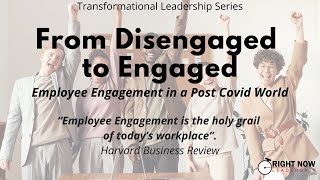
Rick Torrison from RightNow Leadership explains how to measure employee engagement in a post-COVID workplace. He defines engagement as emotional commitment, not just satisfaction, and walks through a checklist to identify disengaged workers. The 2021 trends he covers include mental health support, work-life harmony, and human-centered HR practices.
Questions this video answers
April 13, 2021.
34% of U.S. employees were reported as disengaged.
35% of managers and leaders (as cited).
Replacing an employee costs as much as 1/2 to 2 times the person's annual salary (speaker's cited range).
He cited a pre-COVID U.S. productivity loss estimate of $483 billion to $605 billion in one year.
Chapters
Still says starting.
If you can hear me and you are in the room, we are. Okay. I love technology, guys. So welcome to everybody who's online and coming in. Welcome to the people in the room. We're excited that we're here today. I appreciate you guys being here and we're gonna have it. We're gonna have a great hour, a packed hour of amazing information we believe is gonna help add value to you, your business and your relationships. Everybody online, thank you and welcome. I'm going to invite a couple people to give you a welcome. We did this in partnership with Metter Staffing Services and the economic alliance you're going to start. Chad. Yeah. She's ready to introduce me. And you know, so all you guys online, I'm going to tell you right now, take a deep breath. This is as good as it gets. It's going to be real. We're going to have a good time. But let me invite my good friend Chad Burke with the Economic alliance to welcome you and, and then we'll hear from Kristen.
Thanks, Rick. On behalf of the Economic Alliance, Chad Burke. We want to welcome everybody online and here in person. Economic alliance, as you probably know, is Economic Development Corporation serves the Houston Ship Channel region. We've got 11 cities, Harris county, the Port of Houston, over 250 companies that really work and lead this organization. So we were very happy to partner with Rick and with MEDR Staffing to provide this service just as an added value that you can bring to your company and your employees. And so I know Rick does a fantastic job and MEDR does a wonderful job in the staffing personnel part of this industry that we work in. So on behalf of the alliance, welcome. I'll turn it over to Christy now with Metter Stacking. Christy.
Awesome. Thank you, Chad. I am just so proud to be connected with the economic alliance. I am also grateful to work for Meta staffing services. At Metter. Our partnerships are just as important and blended with our clients as it is in the community. Serving is truly just the core value of motor staffing. And everything that we do, we serve by providing professional placements as well as temporary and long term placements for openings that you might have at your company. And because of our 52 years of serving in the community in the staffing industry, then we have an extensive database of top talent available for you. And speaking of talent, certainly if you know of someone looking for employment, please point them our way. We're always happy to be of help to do our very best to find them employment. I hope that you keep Metter in mind and that also you see this as another added value service for both economic alliance Houston Ford region as well as metter staffing services. I would like to then welcome as this added value service Rick Torson with RightNow Leadership for his fourth session on leadership training.
Thanks, Christy. Oh, look at that. There's a clap in the room. Oh, you guys have become my favorite. So I have added. So you guys that aren't with us online, we're going to start the presentation real quick. I just want you to know that if I could turn the camera around and let you see the people in the room, got about a dozen. Their tables are full of candy and gold nuggets and nerds. I mean, we do it right here, plus a little light lunch. So if you're not here next year, we would love you to be here.
I don't think we can. We can't.
Oh, it's as high as it.
I'm sorry. We're good, everybody. Okay, so we're going to. We're going to jump in, we're going to drop some stuff, and if you don't have your notes, I want you to grab those and print them. Our team is going to drop those in for you. We're going to start the presentation and we're going to go through from disengaged to engage employee engagement in a Covid reality. So it ought to be interesting. So I'll make sure my team's good. We've got everything in there and the slides are up. So thank you guys and welcome. This is. This is our third, right? Chrissy said four. I'm thinking this is just the third one. This is our third and we do have a fourth one. Schedule plan. We'll talk about that later. But this is our fourth transformational leadership series lunch and learn on employee engagement. We've been responding to the surveys that we put out to you guys in industry. We with the alliance and with Metter staffing, we asked what are your greatest needs, your greatest concerns or your greatest challenges? And we built these trainings around your responses. So this is one of those responses. If you receive value from this. We did the disc last month. I'm an I. I like encouragement. I like relationship. So if you guys have received value, you guys online just put value in there. And how many of you guys have been here before? I've seen a bunch of you. Have you received value today on the things that you're doing here? Okay. Awesome. We've got a great team that's putting this together, our passion and desire is to make sure that you walk away with some, not just information and not a sales pitch but information that's going to help you enact and change and engage in your life and your teams today. So that's our desire and that's our passion. For those of you guys that are in person, thanks again. You're going to be taking salad home with you from Panera. Okay. And so I appreciate you guys being here. I want to encourage all of you to consider joining us in person next month. Those you guys are online, there is room at the table. We'd love to have you here. We'd love to fellowship. So we look forward to seeing you. A quick reminder on these lunch and learns they are SHRM certified. And so you guys that are here, you can pick up your certificate before you leave if you're online. And I'll have the team put Val Smith's email in there so vsmithetter.com you can reach out to her. She'll make sure that you get your certificate, the certificate to get your SHRM credit if that's important to you. So as we get started today, much of today's content and statistics. I'm not going to quote all of my sources, but I want to give it to you on the front end. And the research was taken from different articles and studies that were done by different organizations. The Vantage Circle is one of the articles. I've taken some information from Darsana Dutta with HR Management. She's written a lot of articles and information research around the topic today. LinkedIn Learning is one of our sources, Gallup Workplace Inc. Online and others. So I just want you to know I'm not just throwing statistics and throwing information at you out of nowhere. We've done some research to provide you with the most up to date information as possible. I'm going to share a caveat with you guys as we get started. A lot of this information that we've researched and done was pre Covid the world that has changed in the last year and things that are going on is definitely going to impact this conversation. The conversation we'll have next month when we talk about hiring employees that stick. There's so many dynamics that are happening and changing on a regular basis. So as we look at this and I share some things with you, keep in mind that some of this information is being adjusted as we speak because of the culture and the world and the life that we're living in today. Okay. So real quickly for those that are new I won't go through this a lot if you've not been a part of this and you guys online. My name is Rick Torresen. I run a company called RightNow Leadership. But my most prized and important thing to me is my family. I've been married for 30 years, amazing wife, two amazing kids. But my joy and my passion is to add value to other people. I love the aha moments. I do a lot of personal coaching. I do a lot of executive coaching and team training. When someone gets something, you guys know. How many of you guys put aha in the chat? How many of you guys in the room have had an aha moment before where you've heard it a thousand times, but that next time you went oh, and it makes sense and clicks. I love being a part of that. Right. I love helping people come to those places. So that's really my heart. But let's jump in. Remember, we're going to cram a lot of information. Don't get overwhelmed by it. If you've registered, you'll get an access to the replay and so you can go back and listen or share it with other people as you want to. So Harvard Business Review is where I'm going to start. And I love this quote. It says, employee engagement is the holy grail of today's workforce. So right there, I just need to give you guys a heads up. I know you didn't know we were going to embark on a religious quest. We've got a spiritual journey in front of us, right? And showing my age. Monty Python and the Holy Grail is one of my favorite old time movies. So no coconuts for the horses. If any of you know that, if you're in my generation. But we are going to go on a quest today and we're going to talk about this idea of employee engagement. Five years ago, for those of you guys that are HR people or in the HR world, employee engagement was talked about was really just within the HR circles themselves. And they usually talked about employee satisfaction or employee discipline. And it was meant. It was the conversations were in a smaller group of people with inside of an organization. But today a critical conversation is taking place in every organization at every level. And. And it has to do with employee engagement. Employees with hiring, with retention, with culture. It is up front and in our faces all the time. It's no longer an HR conversation in the side room about disciplining or correcting an employee. The challenge is that employee engagement is really an abstract concept because it changes from person to person in respect to the world around us. And as the world is changing, the you guys all know this employee engagement is changing daily. And so it's a really relevant and timely conversation. This brings us to the question, what is it? How do you define it? And there's a lot of ways to do that, but I want to share a few things with you. SHRM did a study and if you've got your notes, I encourage you to get those out and take a look at those. I'll point you to some things in there as we go through it. But SHRM did a study and they found four different definitions describing some aspect of. Of employee engagement. And so I want to look at those a little bit. I won't read each one you've got. You can see them in your notes from Quantum Workforce. I don't believe I have a slide for this. I don't. So we'll stay right here. But Quantum Workforce, Gallup, Willis Tower, Watson and Aon Hewitt, some national and international companies. Each of those are how they define or understand employee engagement. Okay. And these are in your notes. I'm going to read Gallups. Gallup said Employee engagements. Engaged employees are those who are involved in, enthusiastic about, and committed to their work and workplace. You'll see a theme as you read through these. The Quantum workplace Employee engagement is a strength of the mental and emotional connection employees feel toward their place of work. So we're talking relational things. We're talking emotional intelligence in different aspects of what employee engagement really is. And how do we engage. It's not the systems and processes of how well they can do their tactical work. Employee engagement is really all around relationship, how they function together. That's why last month when we talked about communication and the disc and understanding how people communicate, how they're wired is so critical to having successful employee engagement. You can't engage employees if you don't understand how they're wired. Because here's the news flash. Okay, this breaking news. Not everyone is like you. I mean, they're just not. I wish that everyone was like me, but they're not. It would make life easier or maybe it would make it harder, but they're not. And if we're going to lead and lead successfully and grow our companies, we need to understand it. So pop quiz. We're in school. I taught school for 10 years. I'm an educator. You're going to be graded. Here's your quiz. Okay. Not really. I know you may not like quizzes. I want you to put your answer in the comments. You guys, I just Want you to give me kind of show of hands as we go through this. What is employee engagement? I've given you three definitions. The first one is employee engagement is the time I spend off task dealing with conflict. Okay. If you believe that's employee engagement, how you've encountered it, there you go. Second one is employee engagement is someone's idea of a bad joke. I'm going to get to why I'm saying this in just a minute. Number three. Employee engagement is the key to growing in land. To growing land. Retain leaders while increasing productivity. Now, all of you probably wanted to say A and B or A and B or both at some point as you thought about the time it takes to engage employees. If you are responsible in that, in any level, if you're leading teams or a part of a team, it can be a challenging and sometimes frustrating endeavor. But while you are engaging in A and B or you think A and B is kind of where you've been, if we're going to really deal with this, then that's not the type of employee engagement that we desire or want to engage in. C is more like what we're looking for. When we understand employee engagement rightly, and it's about retaining and growing leaders while increasing our productivity, then we're going to see success. But it's not easy. It doesn't just happen. How about another question? It's not a quiz, but I want to ask you a question, but it's equally important. Let me ask you a question. What is more difficult? Finding and hiring quality employees or retaining them? What's more difficult? You guys in the room, and you guys can put it in the chat. What's more difficult? First one. Finding and hiring quality employees. How many guys think that's more difficult? Okay, three of you. How many? You think retaining them is more difficult? Yeah. Four or five of you? Yeah. The answer is yes, they are both difficult and challenging. Next month we're going to look at the three C's of hiring employees that stick or that stay. And we're going to. We're going to talk about that next month. I'm going to bring in an expert to share what's happening in the industry and with candidates and what that looks like. Some things we can do. So what does this have to do with our topic today? And my answer for you guys is everything. Candidates. And we don't have time to do this. We'll do it over the next couple. Candidates are not looking for a job. And I don't mean that literally, except I do Candidates are out there in force. The problem is they don't want to work right now. And I don't want to get into the conversation and the discussion around the politics of anything. But the reality is when they can make more money sitting at home than they can in your office, why would they come to your office? But there are jobs out there. Ask Metter staffing. Ask any of you that are hiring. There are jobs out there. The challenge is finding those people that don't ghost you, that show up and, and that work. And so we're going to talk about that a little bit. Those candidates are. The reality, though, is for those that do want to work, they really want to work. And what they're after is an environment and a relationship within that work environment where they feel like they're going to be able to excel and they're going to be able to grow. So let's take a look at the way Forbes defines employee engagement. They say it's the emotional commitment the employee has to to the organization and its goals. So if we just use that simple definition, if you wrap your mind around employee engagement is the emotional commitment that an employee has to the organization and its goals, then the question has to become how do we do that? How do we build that commitment? What does that look like? Let's be clear as we get started. Employee engagement does not equal employee happiness. Sometimes we think it's the same thing. It's not. You can be happy at work, but not working hard towards exceeding or meeting expectations. Just doing your deal, day by day, getting by. And employee engagement, I want you guys to hear this as well. It's key does not automatically mean employee satisfaction. It doesn't mean they're satisfied at their job. A satisfied employee will show up on time, they'll leave on time, but they may never be committed to go the extra miles. And they won't hesitate to take the headhunter's call. So the problem with trying to define employee engagement by employee satisfaction is that it does not address motivation or the emotional commitment of the employee, which is what we saw in some of those definitions, is what it's all about. If employee engagement is more about motivation and emotional commitment, then how do we know an employee is motivated, engaged or not? And I want to take a look at that. So we're going to go through this. It's in your notes. You can see it. But I want to give you this as a tool. We're not going to spend a lot of time on it, but I'm going to quickly go through it. Here's what I mean by a tool. I want you to think about yourself or someone you work with, and I want to go through the disengaged to engage behaviors. You may even put yourself there and examine yourself. And there's boxes in your notes that you can check. And if you think that this applies to you or someone that you work with, you check that box as we go through it. And I'm talking about the disengaged behaviors. So you can use this in any environment to kind of get an idea. Do I have disengaged employees or am I one of those disengaged people? So think about you, your company, your teams, or yourself where you fall on this spectrum from engaged to disengaged. So the first thing is you go through. Here's the box. Okay, As I read, check. Engaged or optimistic? Disengaged or pessimistic. So if you feel you have someone who's very pessimistic, check the box. The second one is team oriented. Self oriented. Disengaged. They're going to be more self oriented. You know, someone like that, Check the box. Same person. Think of one person or yourself so you can do an evaluation. And don't put their name on here in case they see it. Third one goes above and beyond or has high absenteeism. Engaged, Solution oriented. Disengaged. Negative attitude. Engaged. Selfless. Disengaged. More egocentric. Engaged shows a passion for learning. Disengaged is focuses on monetary work. Engaged. They pass along credit but accept blame. Disengage accepts credit but passes along blame. Now, here's how you would evaluate this, and here's what I would tell you. If you have three checks under disengage, then they're borderline checking out. You need to be intentional about engaging that person and find ways to help them deal with the behaviors before they end up leaving. If you have four or more boxes checked, I'm sorry to tell you, they're already gone. They just don't know it, and you just don't know it. And it's important to understand that. And it's important as leaders to understand how do we create an environment where we don't get there but all is not lost. Before we finish today, in the next 40 minutes, we're going to talk about things you can do today, conversations you can have today to help you and your teams and each other. It doesn't matter if you're a hiring manager, a team lead, or just a member of a team. It's about how you're engaging and how you're working with your team. We all want to get up and go to work in the morning and want to go. We don't want to have to go. And if you've been feeling in all that's been going on, I have to go. I get it. And it's real and we need to understand that because it's been hard. But how do we engage that to push through the hard, to get to the good and to get people excited about coming to work and the vision that they have. And that's really what we're going to work through and what we're going to talk about as we go through the rest of this. Okay, so before we finish, I'm going to give you some real takeaways and then if you've got other questions, you can follow up with me. This is what I do professionally for companies and individuals and teams. So I would love to help you as you process through this. I want to remove any remaining doubt as we go through this as well about the importance of employee engagement. I want to read a quote that is in your margin in your notebook on the left hand side. It's from Ann Latham with Forbes. It says engagement is at best a symptom of success. Employees who are succeeding and feeling good about their contributions to your company are naturally more likely to be proud of the work your company is doing and be happy to come to work each day and feel valued. I love that quote because it's true. Let's get a little bit more practical and consider employing agent in your manager. I want to create a situation and think about a manager. Here's the question. Would you agree that an engaged leaders and managers over your teams and divisions are crucial for your company's success? Put yes in the chat. Would you guys agree? Raise your hand that engaged leaders and managers over your teams and divisions are crucial for a company's success? Yes, we would all agree with that. And then the opposite. Disengaged leaders and managers are going to cost your business in productivity and growth. Would you agree with that? So we're all on the same page now. Here's what we know from research. A manager's engagement and emotional response is contagious. A manager's engagement and emotional responses as a leader is contagious to their team. So the opposite would be true if they're engaged. What's cascading into the team? Engagement positivity. If your manager or leader is disengaged, it cascades into the team and they're going to be disengaged or dismotivated. In fact, Gallup backs this up. Gallup's analytics find it 70%. There's 70% of the variance or change in the work group engagement is caused by managers. They can demonstrate that by the study they did that said 34% of U.S. employees feel disengaged. 34% of U.S. employees feel disengaged. Then they did the same survey to managers and leaders. 35% of managers and leaders feel disengaged. You have a disengaged leader, you're going to have disengaged people. It's not surprising. With just over one third of the US Workforce engaged, that's a staggering two thirds that aren't in your companies that you're working with. It may even be you. This cascade effect is powerful and it's expensive. Gallup on this next slide estimates that replacing the employee costs as much as 1/2 to 2 times the person's annual salary. The cost to replace an employee that you lose, that you've already invested time, money, energy, emotion, training it, and then they're gone six months, a year later, and you've got to go through that whole process again. If you're an HR manager, you're a hiring manager, you know, then you know this is true. It's better to keep someone than to replace someone. Both are going to take work in the world that we're living in. Here's the numbers real quick. Actively disengaged employees. This is just before COVID Covid cost the United States economy $483 billion to $605 billion in lost productivity in one year. That's before COVID I have no idea what it looks like now, but we can all imagine what those numbers look like. So let's make it personal. If you're a hiring manager in the room or on zoom, do you know what it costs to replace an employee? If you do, just put yes. If you don't, I encourage you to go find out. Well, maybe don't go find out. You may not want to know that. Right? Because right now, that turnover and what's happening with employees, it's hard. It's tough. Okay, so we're going to. We're going to keep jumping in here. I'm going to give you some more information I think is going to be helpful as we go through here. But I want to share this next thought with you. We don't have a candidate shortage problem. We have a candidate motivation problem. And I believe that with all that's happening and all that's going on, we are struggling with motivation of employees. Not that they're not good people, not that they're not qualified, not that they're not able to. But with all that's been happening, the emotional stress, the relational stress, the businesses, the economy, sickness, all of those things are piling up. And what I hear when I work with companies is I just want them to come in and do their job. I just need them to come in and sell or get the numbers up or fill the positions or whatever it might be. And that's true, and that's what we want. But it's not that easy. It's more difficult today than it ever has been. There's not a shortage of candidates. They're out there, whether they're willing to work or not willing to work right now. And all that. That's. It's in flux. But the motivation. Can you. It'd be hard for me to imagine having a job out there that I could take and not taking it and sitting at home. But it's a different generation and we're going to talk about that. Let me give you your first three practical things that I want you to look at and you can fill. These are the blanks in your notebook on page two. You can fill. You then. So the first one is why employee engagement boosts productivity. Why should you engage in this process in your company? Learn how to do it. You'll boost productivity. Engaged employees are 21% more productive. Second one, increase customer satisfaction. You guys know this. A happy customer is a repeat customer. Is the customer's going to give you more business? Is the customer's going to come back in the door. When you engage your employees in a positive way, they'll engage their clients and customers. They will be happy and they will come back. The third one is it strengthens your company culture. I do a whole training on culture for companies because this is so critical. Every company has a culture. Here's the thing about cultures. You either said it or the strongest voice or personality in your company will set it. And that's a scary thought. Company culture is set by vision, values, and the people that work in that company. But every company has one. We may have mission and vision statements written on the wall. We may say, here's our culture. But if I walk in that place and I tell you, it'll take me five minutes to tell you if what you have in writing is true to what you have in experience, it doesn't matter what's Written down. It matters what's being lived out and what people encounter. You want to know your culture? You ask someone who visited you. Ask someone who came by and did business with you. You reach out to someone who's connected with you. Say, what did you notice? What did you feel? How were they'll tell you what the culture's like. So you want culture that creates a want to, not a have to. So what does culture, a culture of employee engagement, look like? According to Forbes, it's a workplace that's designed first and foremost around its company values. It's a whole other training we'll do. We may offer it here in the future, but I help people in companies clarify vision, establish their values, and create measurables to how to measure those values actually being lived out and worked out within. The value should be lived out within your employees together. And they should be lived out in the relationships of your vendors, your clients, your customers, and anyone who associates with you. Those values are the same in house as well as with people outside of the organization. I spent a lot of time with companies and individuals making sure they have clear and compelling values and vision. If you can't name your values and you can't measure your values, then you don't have values. You have good ideas, not trying to step on your toes, but that's the reality. And culture and employee engagement is all about that culture and the vision and values being lived out in your organization. So here's another quote I want to share with you guys. Engaged employees are happy employees. Yes. Think about yourself. If you're engaged in your community in a positive way, are you happy? Yes. We're happier because we're engaged. We feel important, valued, worth our time. Happy employees are loyal employees. They absolutely are. If they like what they're doing and they like the team they're working with, doesn't mean they get along all the time, but they feel like they've got a safe place. They are loyal. Loyal employees are productive employees. They will get the job done. They will also exceed expectations and they will help you grow the bottom line. Do I need to do any more convincing that employee engagement is important? I don't think so. Now, I'm not going to spend time, but in your notes you're going to see in the left hand column some information about this changing workplace. This is before COVID and two of the things they talk about, really that we're dealing with and we're dealing with was millennials and Gen Z. That's an interesting breed of people. Gen Z is just coming in. Millennials have been in there for a while. They're very different. What they expect, what they want and what they need is very different. We won't talk about that in this training, but I want you to understand that that's a big part of an engaged workforce, is understanding the workforce that's in your building and on your teams. Okay? So employee engagement at the end of the day comes down to leadership. And with Millennials and Gen Z, it's all Gen Z. It's all about compassionate leadership. It's all about some of the things we've just talked about. Here's what I know. People don't quit their jobs. They quit people. They don't leave their job. They're leaving their job because of something that happened or didn't happen with a boss or a co worker. They're leaving people is what's causing them to go out the door. A compassionate leader is an authentic leader that holds people accountable, leads with integrity, and shows empathy. And that's what this is all about. We'll talk about that in upcoming one. All right, so let me jump in and share with you this last half, some practical things that you can take with you, and we'll talk about this a little bit. I'm going to talk about 10 employee engagement trends in 2021. Okay, let me do a quick check in and I usually do a timeout when we do this, and I'll have one at the end. Let me do a quick check in with you. Take about 30 seconds, and I'm going to ask the group, you guys in the room, to share with me, you guys online. I want you to write this down and put in the chat for our team so they can engage with you. What is one thing you've heard? What is one thing you've learned in the first 30 minutes that you went. I didn't know that. I didn't realize that or was reinforced to you. Every time we get together, I try to do three things. I've told you guys this before. Learn something, apply it, live it in your life, and then lead it, share it with someone else. We should always be looking as leaders to learn something new, make it apply. We don't need more information. Yo, does anyone out there need more information? We don't. We need to act on the information we have. So when we learn something, we should live it, apply it to our lives. And once we do that, we should start sharing it with others. That's transformation, that's growth, that's multiplication. So right now Just do one thing for me. Write down one thing in the chat or in your notes that you learned or was reinforced in the first 30 minutes. I want to ask you guys to participate in the room. What is one thing that you heard that you went, oh, that's good. New. Or reinforce something you had. Help me out. Don't leave me hanging. Yes, ma'.
Am.
So, I mean, you didn't use these exact words, but I think you reinforced that people want and need to be valued.
Yes. Yeah. They want and need to be valued. I would ask any one of you in here, does anyone in here not want and need to be valued? Some of our levels are different because we like our little cubicles where we're by ourselves and no one bothers us. Just. But we still, in our core, were created to be valued, to be needed, not just at work, but in life. So very good.
Well, the nerds that don't really want to interact with people, and I should use that word, but their value is what they. The work that they produce, that.
I put the nerds thing on your desk just to. No, it's okay. It was a subliminal thing. Right. This is one of my favorite candies. Okay. But it's those people. We call them seeds. They're compliant people in the disc. They don't need a lot of attention. They like their own little world. They like processes and systems. But they also want to know they're doing it right. They want to know they've accomplished what you've asked them to do. They may not need a lot of fellowship, relationship and yay, ha, you know, yeehaw stuff, but they do want to know, am I giving you what you've asked for? What else? Anything else? One more. What's something that stood out to you? Yes, sir. People are not motivated right now because of everything that's going on the past year. Yeah, they're not. But here's the thing. There's a reckoning coming. We'll talk about this some next month. There's a reckoning coming. The money that they're getting paid to stay at home, I understand it. I'm not going to get political with it. But there's a point where that's all got to come back full circle. And those that chose to stay home when they had an offer to a job, when they come back and need that job, I'm not sure if that job's going to be there, but it's not for that person who didn't take the job when it was offered to them. The first time. Yes, ma'. Am.
I also liked how you said that employees now like people searching for jobs, make it like it's worth their time.
That they value that a lot more.
Because I have friends that have forgotten.
That it wasn't worth my time. I'm not going to take it.
Yeah, yeah. And the tricky thing about this. So she said that this idea that, you know, people looking for jobs saying it's not worth my time, that's so interesting, because the challenge with that is, how do you define what's worth my time? When an employee's got all these employees and they're offering $12 an hour and the person goes, well, I'm making 15 over here or 20 over here. Why would I. It's not worth my time to make 12. Right. So that's a realistic conversation. Or they won't let me come in on the hours I want or I need flex time. All of those variables right now, because of where we've been living, creates a very difficult challenge for employers. And that's who you guys are, employers to hire people. Because the expectation of what we want, we've had where we've been, what we need to do, the change, it's a lot. And I feel for you. And so my job and my passion is to come alongside and help you refine what you're saying, how you're communicating, relook and revision how you're doing, hiring and onboarding, so that when you do get that person, they're going to stay because they find value and they see a future. And that's really important. So that's really good, you guys online. I hope our team's engaging you. I can't wait to see what you guys are saying. So we're going to go through these 10 fairly quickly. So I'm going to give you some other practical things at the end. Again, this is Dynamics. Been chasing this. 2021 was a survey that was done in 2020, but in an ever changing world. So we'll talk about this a little bit. These are 10 employee engagement trends that are happening right now. So they're going on and how you engage them, how you look at them, how you decide to embrace them or what to do with them is where you're going to have to kind of wrestle. But I want you to understand what's going on across industry. The first one is culture first. It's not your skill set, it's not your education, it's not your training. You have to have that. The culture is driving employee engagement. It's moved out of HR and it's become a business goal. Culture has become a goal of business. And I'm working with more and more companies that are asking help us to clarify and define our culture. What they're really saying is helping my vision and values to not just have them on the wall, but have them in the DNA of who we are and what we do. And there's a huge difference. Every company has a culture. I talked about that. You're either gonna set it or the loudest voice will. Second one is tech advancement. Oh, my gosh. It's always been going crazy, but it is artificial intelligence and machine learning. What's happening on a daily basis in that world can be overwhelming. Some of you, you may not deal with it at all, but most every one of us are dealing with artificial intelligence, and we don't even realize it. From robocalls to following and hiring, and it's all automated and robotic and artificial intelligence that's intuitive to be able to help process people. And it's changing daily. You've got to get up to speed and understand what's happening. Third one is work, life, harmony. It's not balance. You've got to remove this idea of balance out of the picture. Balance is like it's equal. It's not. Harmony means it's getting along. It's finding synergy. It's finding a place to coexist, which may not feel balanced, but I feel in agreement right with it. I'm at peace with it, even though it's not balanced. Because the reality is balance is a myth. There's no way to balance your life. You want to, but you spend 8 hours, 10 hours at work a day. How do you balance? You're only awake another five. I mean, so balance is not what we're after. It's this harmony of understanding. This is how life is. How do I embrace it and lean into it? So that's for another conversation we'll have around work life, harmony, not balance. The next one I want to share with you. The fourth one is human resources. Not HR. Human resources. 92% of employees believe showing empathy is an important way to advance employee retention. Human resources. With the advancement of all the technology that's going on, the human interaction, the need for compassionate leadership is becoming more and more important. We noticed this in Covid. I can't. We'll have time to go into this, but what we noticed in Covid when we sent everyone home to work initially, it was awesome. Look at how great we can do. And we love it. And as time went on, most people really struggled. Productivity decreased because they needed guys. You guys that are watching this in zoom, you do a lot of zoom. Some of you are engaged, some of you are doing three other things. That's okay. But when you're in the room, I'm looking at eyes and eyes are looking at me. I'm exhibiting energy and they're giving the energy back. And that energy, just by being present changes everything. And you can't manufacture that in a remote world. It doesn't mean remote isn't part of our world anymore. It is. But what does employee engagement look like when all of your employees are remote? It's another conversation that has to be had because there's still needs that must be met or you're going to lose people. And so this human resource side of it, this understanding of emotional intelligence and, and employee engagement is so critical. Let me keep moving. I'm going to run out of time. So the fifth one, diversity and inclusion, that's one of the trends. It is expected and desired with millennials and Gen Z. They don't see color, they don't see race, they really don't, especially Gen Z. They don't see gender. They just don't. They've been raised in a world that. That's pretty blurred now for some of us. It may not be, but that workforce that's coming in, and it is, it's truly become a melting pot in this younger generation. How they see things, how they view things, from politics to religion to compassionate outreach, to ethnicity to gender bias. All the things that may drive you crazy when you see it. There's a generation entering your workforce that doesn't see it like you see it. And it's really important that we understand that. It's truly that melting pot. When you have a diverse, fair and just culture, it results in a more innovative, creative and engaged workforce. Alright, next one. Gender equality. Few more on this one. And we're about to finish up. Gender equality. This includes women's empowerment and women's safety in the workplace. It's already, and it's going to continue to become a top focus in companies. I've got a wife who's a president of a company, she's the coo and she works hard. And I watch her work and I watch other people in industry and things, and you see the disparity no matter how hard they work. And we don't have to like it, we don't have to agree with it, but it's real. And I've got a room full of women and one man in this room. I don't know the diversity of people online, but this diversity, inclusion, not just with women, but with ethnicities, is a real, real conversation that we need to have. And this gender equality is critical because the lines are being blurred and you're not going to stop the blurring of the lines. So what do you do? How do you engage bias, inequality in pay, lack of security, sexual harassment, pregnancy, discrimination. This is all there right now, happening in the workplace. And it could be in your workplace. And it's being openly challenged and it's being exposed. You've got to wrap your head around this. And it's better to be prepared than to have to react to something you weren't prepared for. Better be prepared for something you never have to deal with than to react to something you weren't prepared for. All right, next one, I want to talk about vision and pathways. Vision and pathways. So I love this. The workforce is seeking personal professional growth and opportunity more than anything else. That's what people want. They want to know their value, which is what we said here. And they want to know they can go somewhere. I don't know if you guys in your companies or if you feel it or know it, when you come in and you do the onboarding and you ask a critical question, where do you see yourself in three to five years? What is your passion? Why are you asking an employee that's just getting started? You want to know where their motivation is. You want to know what they're shooting for. You want to know how to help create a pathway for them to become your future leaders, your future managers. Succession planning in companies right now, especially in the industry here, has not been thought about a lot. And you've got older, retiring managers and leaders and team leads that have not been intentional about identifying and raising up the next people that are going to take their place. And we're going to see a vacuum and a void in good leadership. And you're going to put people in a place in a position over departments and over teams before they're ready. But it doesn't have to be that way. You can create a learning system, you can create a training system that's going to help prepare and identify people. I'd love to help you do that. There's another shameless plug, but I'd love to help you do that. So vision and pathways is critical. Employees need to know why, what and where I'm headed. Why am I here? What do you want me to do? And where am I going then? Prioritizing mental health. I could spend a whole hour talking about this and what's going on right now. But you guys have already seen it, you've already been exposed to it. You may even be going through it. It is real. What does this look like? How do we create a stress less environment? You know, they want to say stress free. I'm sorry, but stress free environments are impossible. Just embrace it. Stress free is not a reality. Stress less and ways to cope and manage and deal because we got to be able to embrace the stress. Embrace that I'm anxious, I don't sit in it. You don't wallow in it, but you embrace it and you understand. How do I not let the stress run me? How do I use that and move through it? And if we're not creating environments for that, you're going to lose your people. Acknowledging it is the first part of moving through it. Next one, a couple more on this workplace wellness. This is different. The stuff they've done here didn't fully take into consideration Covid because workplace wellness initially they talked about what it's like to work on site. Is there places for physical energy? Is there places to. To take breaks? Is what kind of real physical environment you created for your employees within the workday to be able to decompress or take a break or whatever, whatever it might be. There's companies that are putting in gyms and workout facilities and daycares and they're doing all kinds of things. But then Covid hit and now the workforce. There's still some companies and some may be yours, that your workforce isn't back in the office. You may be only operating at 2/3 or 20% or whatever it might be, and you may never get everyone back in, but you still understand they have a workplace. How are you training your remote workers to build a workplace wherever they are? A workplace that says this is where I do my work, not where I sleep or not where I do my laundry or not where I take care of my kids. I know it's not easy, but how do we assist in creating a workplace wellness program? For now, remote employees and those that are in the office, it's critical and it's one of the growing trends. Last one in. This is changing benefits. There are the changing benefits is interesting and this won't make a lot of sense unless you're in the benefits area and you're, you're setting salaries and you're working on that. But the reality with changing benefits, they need to be friendly to understanding the millennials and the genes. Gen Z's benefits are going to need to evolve. They're just going to need to evolve to be more creative. The talent acquisition system that's going on right now is changing at an alarming rate. And so you've got to get creative. You've got to think through what do these packages look like, because it isn't just about money. And for some, it's all about the money. Right. And so what is it that you need to be looking at creatively to offer your employees that can still meet the bottom line of productivity, that still meet the bottom line of doing the job without compromise? And that's a tough challenge, but it's a conversation that must be had. Gen Y is about work, life, harmony and personal fulfillment. So when you're looking at a package for a Gen Y or a Gen Z, what they desire is different than what I might desire or, you know, the millennials might desire in the workforce. Understanding that's going to help you get that win on the first go around with those employees. Okay, I'm going to stop here. And guys, if you've got questions, I'd love for you to put them in the chat. I can't get to all your questions, but I want to. But let me just ask the room in here before we go into the last section. Questions. Do you have any questions or comments about what we've done so far, what you've heard? Yes, ma'. Am.
How was that one?
I love. I love that one.
So I, I have worked in a past life at a very large corporate company and, and witnessed a lot of the visions and pathways that you talk about. And the reality is, as you work your way up the management ladder is a pyramid. There's only room for one king. And a lot of people come in and expect to be king and get frustrated when they're not right. And I think at my company, the only way they rewarded people was through management. You become, in management, there should be alternative pathways for those that are probably great workers that aren't management material. So how do you manage expectations for these people that come in and think they're going to be running the company in five years? Because of course, they're wonderful, because that's been told on their life, but the realities are probably not.
So I'm going to challenge that with two things. First off, so you guys, if you didn't hear, she's asking about, how do you manage expectations of companies that are hierarchical and there's only so much room at the top. And they come in and they say, I'm going to be sitting at the top seat one day. Two things I would say to them, I would love an employee like that because that means they're motivated, they want to go somewhere and they're gonna make a way. So that's, I would love it. I would love a hundred like that. Because the alternative is ones that don't care and they just sit there. They might be easier to manage, but there's high turnover. That puts the challenge then on the organization, the company to restructure. I'm working with several companies. There's one in this area that they took this and they went like this. And so they created more opportunity and growth in positions and said the strongest leaders in our company will be running the company in these areas. And they took the owner and the present CEO, put them at the bottom of the pyramid. That wasn't a place they wanted to be. They're thinking creatively to shift their business structures, their employee structures, what it looks like. Yes, there's an owner, yes, there's a CEO, and not everyone can be the CEO, but there is plenty of opportunity as you relook at the system and the processes to create space for these people who want to go after and get it. And the reality is you train them up, they do a great job and if you don't have a place for them, they're going to go somewhere else and so am I. But you can do it from a blessing, not a curse, right? It can be in, we don't have something for you, but we're going to offer you to X company because they can take you the rest of the way. When we see it that way, we're blessing and releasing our people that we, because our system doesn't allow them, we're actually saying to the world, look at this company, look at their culture, look how they raise people up. And then they're not afraid to release them because they've got a pipeline of people behind coming up. So it's more of the mentality, what do we tell the employee when they can't get to the top? No, what do I tell the employer? To make space at the top or to be free to train them and release them and to help them get to where they want to go? Because I'm going to want to work for that company. I may not be able to get that top seat, but I know that they're going to have my best interest, grow me and whatever I do next would be better. So that would be. That would be how I'd approach that. Okay, we're going to finish up. We only got a few minutes. I'm going to run through this last part kind of quickly. It's in your notes. These are keys to positive employee engagement. Won't go into a lot of depth, but you can run through these. Here's things that you need to address and look at within your organization. And look and see if there's one or two things that you might be able to embrace and give attention to. You're not going to give attention to all nine of these. Some you may be doing really well, some you may not be engaging at all. You decide what the priority is for your team and then begin to grab it and ask questions, dig in around and explore what it looks like. The first one is mission and purpose, a key to a positive employee engagement. We said this enough so I won't spend any more time on it. Mission, vision, values, purpose. How clear is it? How well do your people know it, and how is it impacting how they work and live in relationship together? If they can't tell you what it is, if they don't know what it is, then you don't have one. I'm just being honest. Second thing is team collaboration. How well are you building collaborative teams in your organization? You may say, well, my organization doesn't. We don't have group work. But you can still put people together to think through their own areas. You can come up with creative ways to put people in proximity of each other to help them think through their individual wrestling or challenges that their team has. We are much. I talk. I talk about this in the masterminds that I do. We're so much stronger and smarter together than we are apart. So you may not do my job, you may not be in my department, but I may be wrestling. And when I bring in three people to sit around and help me mastermind and I call it issue, or really call it opportunity processing, used to call it issue processing with a company I work with. But it's not about issues, it's about opportunities. So I bring three or four people around a table. One person presents an opportunity that they're trying to figure out. The other three people ask questions and dig in to help them creatively find a solution to what they're doing. Team collaboration. Next. One culture, work environment. We talked about that already a little bit. I'm not gonna continue there. If you want more information, you can talk to me. Open communication. We talked about this last month with our Communication series. This is the foundation to everything. I'm just going to say, if you didn't see it, get the replay, watch last month, let me know, I'll get it to you. Communication is the foundation of all success in organizations and it's the reason why organizations fail. Because we don't communicate effectively, don't understand every issue with relationship, marriages, families, kids. Communication is at the heart of it. If you clean it up. Next one. Corporate wellness and activities. We've talked about that. What are you doing to create a wellness atmosphere? Especially now when everyone's working, working, working. They're just overwhelmed. You have got to give time to figure out how do we create space to get oxygen. You got to help people get their head up above the weeds to get some breath and then they got to go back down and they got to work. Create a mentoring program. It's great for succession planning. Partner people up, give them someone older in the company that's they can go to and ask questions with. There's no authority structure here, so it's not, it's not going to jeopardize their position or evaluation. But you meant you put people together to mentor them, to give them value with each other. Let those people have got the wisdom. Start sharing that wisdom with other people. Career growth and pathways. We talked about vision for career development. Create a vision plan for your people. Let them create it and then do everything you can to help them execute it. Consistent recognition. People are all different, but you should be recognizing, encouraging, creating. They don't need a week vacation. Yeah, they want a week vacation. They could use a weekday. But we can't give everyone a week vacation. But you may be able to give them a gift card to a restaurant just because you may be able to. A pat on the back. For me, I don't need a lot of stuff, but when you come and pat me on the back or look and say, I still appreciated what you've done, I'm in. I'm that dog with that bone. You got me. I just need to be recognized and told that I'm valued. I don't need. I'd love the money, but I don't need the bonus. Don't hear me wrong, but you understand. So simple things we can do, we think, well, I can't do the big things, so I can't do anything. There's tons of things you can do. So consistent and be consistent. Create a process where they recognize each other, where you're recognizing them, where you know, just finding out how they're wired and what they like, and you just drop in, you know, pizza for lunch one day. I don't know. But it's taking time to be creative. The last one is talent fit. People learn best, engage more and perform better when their development aligns with their talents. We think because someone was great over here, we're going to promote them or put them over here. It doesn't always work that way, but we think, man, they're just great. It's like the draft that's coming up. You football people. I want the best person on the board will find a place for him in business. Doesn't necessarily work that way. You want to think that I want this best person and we'll find a place. But if you don't find a place that fits their talents, their passion, their desires, their abilities, they will become frustrated. And frustrated people create frustrated people. Okay, last time out, and then we're going to wrap up. Here's what I want you to do. Just we're not going to take two minutes on this. We'll take about a minute on this. I want you to go back and say, what is one thing you've learned? Write it down. How will you live differently because of it? And who will you share it with that you've learned it with steps of giving it away. You don't have to have it perfect to give something away. In fact, I learned better. When I talk to someone, I start giving away what I'm learning. We're dialoguing. I learned more that way. Don't need to answer all three of those right now, but I do want you to get to that first one. What's one thing you learn? We've only got five minutes left, so I'm going to ask for somebody in the room to give me one in the last 30 minutes. What's one thing that stood out to you? Can someone, someone in the room share something? Yes, ma'. Am.
Team collaboration. Our office is terrible at it. Everybody works in silos, and we have to find a way to change that.
Yeah, team collaboration. She said it's dynamic and they have to change it. And probably the nature of the business puts them in silos. So it's not that shouldn't be there, I'm guessing. But the reality is how do we build? Tear those silos down and create the team unity. Team development. Awesome. Awesome. You guys are putting those in the chat. I can't wait to see those as we go forward. Okay, like I said, guys, I don't know. I should be. Who is the Jimmy Valdano now who is the guy? Las Vegas, Nevada again, I'm showing my age. I'm a basketball guy. Final Four Discovery. He'd always carry the pal. George Thompson. John Thompson, Jerry Tarkanian. Thank you. This is really neat, guys. We carry the towel and I said I'm gonna need to get my friend Caleb, who's helped me down here to provide me a towel. Because we're providing a lot of information. If we provided some value today, will you just put a thumbs up or a value in the chat and let people know? Do you guys, are you walking away with some value today? Just a show of hands. Is there something that you're taking away? Okay, awesome. Because if not, then there's no point in doing this. This is why the alliance matter. Staffing and my company and myself have come together to, in a short hour, try to give you some real tools that you can use. But this is just the start. And so let me, let me share with you next month so you guys can get, promote, get excited about that. You'll have the link that you can register for that right away and get signed up and tell your friends. So next month we're going to talk about the three C's to hiring that sticks character, competency and culture. We're going to dig into it a little bit more, but I'm changing it up from what I've done in the past. I'm going to invite a professional to come and talk about the candidates and what's out there to give you an understanding of the dynamic that's changing every day. So I'm going to have someone share with us a little bit on the front end next week to give you a picture, a clearer picture who are dealing with candidates and employees every day, what it's looking like and where they see it going. And so that'll be a part of what's going to happen. So you're going to, we're going to address the changing hiring climate. You're going to hear experts, we're going to look at the three Cs and how you can use those through these challenging times. And we're going to share again, some practical resources and tools for you. Last thing, and I won't spend a lot of time here, but this is my passion. This is what I do. I love to come in with companies. We custom make our programs to fit around who you are, your customers, your employees, your teams, from small to large, from coaching to individuals to team development and team dynamics, communication. It's what we do. And when it comes to employee engagement, I'm looking at a tiered approach. I was working with a company through this. I work with you. Employee training, employee integration, employee engagement and employee retention. From onboarding ideas to training to succession planning, those are all the things I'd love to talk to you about. So if I can be of assistance or help you in any of that, I will. If you have questions, put them in the chat. You'll receive a follow up email with a replay link so you can watch it with a registration link and an evaluation to tell us how we're doing. This is our third one, so we're going to send an evaluation to everybody to hear how we're doing, any changes, anything else you'd like to see and then we're going to continue to go forward as long as you guys are getting value. And listen, you guys, online. We got empty seats, we got food. I won't save this. I'll buy you fresh food. We got candy, we got nerds, sweet tarts. We got it here. Come enjoy our company. Let us enjoy your company and we'll see you here next month. It is May 11, I think from 12 to 1. Look forward to seeing you guys there. God bless you guys and thanks for tuning in.