ROB HERSOV & MATTHEW PARKS: Inside COSATU’s Power: Matthew Parks on Fixing South Africa
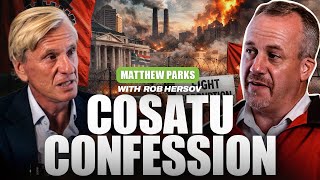
Matthew Parks, COSATU's Parliamentary Coordinator, discusses the federation's push for job creation, reform of mineral-rights applications, and a living wage around R9,500 monthly versus the statutory minimum of R4,500. He addresses state capture's damage to SARS and Eskom, education policy disputes, and COSATU's pragmatic approach to reviving South Africa's economy.
Chapters
Did you like bang your head and become a lefty, or what happened?
We used to get a lot of our oil from Iran. We stopped about 5 years ago because of sanctions, UN sanctions. You know where we get our oil from now?
Do you secretly vote DA?
I think you do.
Yes, you do. Come on, you can tell me.
We spent the first time shouting at each other, cursing each other, demonizing each other.
Definitely, I'm in that camp.
We're all guilty. All of us.
I feel like you're speaking to me.
Most people imagine the private sector to be white males, etc.
Nothing wrong with white males. The only reason they've left SARS alone and allowed Kieswetter to be affected, because that's where the money comes in. Did COSATU have a view on EWC?
What was it?
So hi everyone, it's Rob Herzog here, Truth Report. I've got a fascinating guest, okay? And I think you're probably going, Rob, what are you doing having someone from COSATU here? You know, the communist enemy destroyer of the economy. But I've been very, very keen to, uh, chat to Matthew Parks. He's quite an extraordinary guy. And, uh, we, in the pre-chat, he was telling me some fascinating things, great things actually. And we're going to raise some of them today, but Matthew, let me just tell you a quick funny story because you're wearing your Xhosa jacket. Okay. And everyone knows I'm a bit of a barbarian, a bit of a boor, B-O-O-R. Whenever I'm at an airport and I see someone in an ANC, EFF, MK, or Xhosa type jacket, I always walk up to them and say, you should be really embarrassed wearing that. And, you know, just to wind them up. Half the time they laugh at me and shake my hand and go, you're that crazy guy on YouTube. And the other half of the time they get grumpy and they walk away. But it kind of amuses me. It's my stupid little thing. But I was in, what's, Darby Stearman Airport. Yeah. Anyway, I was there a few months ago and this guy walked in in an ancy jacket. So I walked up to him and I said, you should be embarrassed wearing that. And he said, You said that to me last year at the airport. So I must, I've got to change my pitch now. Matthew, welcome to Truth Report. You're an incredible guy. I mean, can you tell us your role in COSATI? What is your role in COSATI?
My title is Parliamentary Coordinator. So basically means I handle the work of Parliament, negotiating with government, Parliament about new laws, budgets, taxes, policies. Um, we also do the work at Nedlac. So Nedlac is a statutory social dialogue forum where government, business, labour come together. So, you know, on new legislation, especially stuff about the economy, also respond to other issues in the economy too. So largely, so I do a lot of work with government, with the ANC as a ruling party, but even nowadays other parties because we have a GNU of about 10 different political parties. So I got a job basically to see how do you save jobs, how do you create new jobs. So it's always ironic when people say COSATU is a destroy jobs one. That's a lie. Our number one Priority is always create more jobs, save what we have. Um, we try to see how do we fix the state, um, at all levels, how to grow the economy. Um, but look, you don't join COSATU. COSATU is a forum or an association of trade unions. So we have unions who organize in every sector of the economy. We have unions who organize in the clothing industry. We have unions who organize police officers, medical doctors.
And you've got the most evil union of all. Education. We'll get to that.
And they all have different contexts and contradictions to manage. And our idea is to say, how do you try to address this and how to try to get government to respond? We're closely with business as well. We have fights. But in fact, during COVID we actually managed to see it. There's many things which we agree upon. We have differences. We can fight about them tomorrow. But today, can we get the economy moving?
What you do is you, are you a member of parliament?
No. So I'm a COSATU bureaucrat, so to speak. Okay. I've been at the parliament office about 15 years now. And so we go and engage members of parliament, ministers. Um, and when they do good work, we'll say thumbs up, you know, get this done. And when they do bad work, we'll give them a kick in the shins and say, stop doing this.
And COSATU is part of the tripartite alliance.
Yeah.
With the axis of evil, in my view, which is the Communist Party, COSATU, and the ANC itself.
Yeah. And look, a lot of people would say to us, even like our own members or critics on our left, would say, ah, the lines.
Is there someone more left of you guys?
The EFF, and I don't know what MKP is. I'm not sure what they are.
I think they're just the loony bin.
Families. Loony bin. Um, would say, or even other unions, like an AMCU or whomever would say, well.
Teachers.
Uh, or unions outside of COSATU would say, what have you achieved, the lines? But when you look at the other unions who are outside of COSATU, and other federations, they struggle. In fact, they would offer contracts.
Who are they actually? That's interesting. I thought all unions were part of COSATU.
So we're the majority, but you have FEDUSA, which was historically kind of a white Afrikaans trade unions in the '80s that transformed a bit since '94, but much smaller. You've got NACTU, which historically came from the PAC school of thought, but quite small. And then you have Zanizi Muvhabe, who left us about a decade ago. He formed his own kind of splinter union, Federation SAF 2. You also have Solidarity as well, which, you know, the old Afrikaner mine workers union transforms to an extent or expanded rather.
It is a union, Solidarity Tate. Yeah.
So they often would ask us to say, look, can you go and talk to the ANC ministers to do X, Y, and Z because you're friends? Okay. We'll do that. And just because we're allies doesn't mean they agree with everything we say. If we come with 10 demands, they might give us 5. And the other 5, they'll say, no, we can't do it. But also we recognize that the ANC doesn't just listen to the unions, but also listen to people in business, people in churches, so civil society, whomever.
How many members of COSATU?
It's about 1.5 million.
And they're paid up?
Paid up.
So everyone pays a monthly fee?
They pay a monthly fee to the union they join. So if you're a clothing worker, you join SACTU, you pay whatever small amount. And then I think about, I don't know, R3 of that comes to COSATU. So it's actually, we operate quite on a shoestring budget.
And how big is the staff of COSATI?
It's small. It's about 60 at a national level. We have an office in each province, we have a parliamentary office, but the real kind of infrastructure is in our different unions. So that's much larger in that regard because they've got to service members, you know, so, so like NAHAU, which organises in the public sector, has about 280,000 members. So they have a much bigger footprint. You know, SAMU, which organises municipal workers, has about 150,000 members. Which is the biggest union? The biggest is NAHAU, which is in the public sector. Then teachers follows them. After that, then you've got the police union. You've got the mine workers union. Then you've got SAKAU, which organises the retail sector, like Shoprite, Pick n Pay.
Mining?
Enium, yeah. Enium used to be our biggest union, but with the kind of the shedding of jobs in the mining sector from a million in the '80s to 400,000 a day, it's shed quite a bit. Still a big union.
Just quickly on mining, and I told you this before, 2 days ago I wrote an article in Biz News saying, dear Gwede, dear Madala Gwede, and saying how he had basically, his policies have destroyed the mining industry in South Africa. He called me this morning out of the blue, Gwede Mantashe, and he said, Rob, you know, I just want you to know, I know mining really well. We're never going to agree on ideology. He's pretty upset with the, with the article that I wrote, and I said, "Güede, listen, you need to retire. You are not building this industry. You're chasing money away. Your policies don't work. It's time to retire." You know, he's, I think he's the same age, Madalo, like me.
He's about 70 or something. He's a bit older than me, but it's, but his policies haven't worked.
And I'm sure you agree because you want to grow employment. Correct?
So we've been concerned about the mining industry because, well, decline, a million jobs, 400,000 jobs today.
It's half the size.
Even with automation, it's still a massive shrinkage. And the fact we're not attracting mining, new mining investment, we're not opening new mines. And yes, it's inevitable that one mine will reach the end of its lifespan. It'll close, it'll retrench, but then you need to have more mines in the pipeline to absorb those job losses. And we haven't seen new mines for years. I think the one we saw in Limpopo in December opening up was like the first in recent memory, which is great, but you need to get much more all the time. So we've been harping on about for the past maybe 4 years. We have to solve the mining rights application system.
It just, what's the word for that? There's a word for it.
Cadastral.
Cadastral. So tell the viewers what a cadastral is, because I think what Matthew's doing here is very, it's a crucial point in the mining industry and could really fix things. And he's very vocal on behalf of that. So tell us what a cadastral is.
Well, you'd know much more better than we are, but I think a simple layman's term is about companies, well, the mineral rights are owned by the state and you apply as a businessman to tap into those mineral rights. You get permission, so to speak, to go and mine them, et cetera, et cetera. You know, you do the registration and so forth. But if you have companies queuing for years to get the application sorted out, and we had heard horror stories, I think in one office that applications couldn't be processed because there was no toner for the printer. So the most elementary stuff just not working. Um, you know, we've been harping on it for years, sort of the cadastral just so we can get mining in. That's all the department really has to do.
And why isn't the Minister of Mines doing it? Why aren't you doing this? It's simple.
Haven't heard a single explanation. I think last year it was announced that a Canadian company has been given the rights to sort of the cadastral. I think they're starting the rollout we saw last, or that was April, I think last year we saw the rollout starting in the Western Cape. I don't know why they're wasting time, maybe because it's the smallest province in terms of mining, they want to check teething problems. But for our limited knowledge, it should not take so long to sort out a simple application system. And when you have billions of rands waiting, and we see us being displaced from the '80s to now as, you know, mining giants towards a middling mining power, that's scary. And when you have 42% unemployment and you see mine workers every time being shed, shed, shed. For us, it's quite scary. And that's, for us, it's a simple thing to fix. You know, fixing Eskom or Transnet or Metro Railways is far more complex. Fixing municipalities or crime is very difficult stuff. This to us is a low-hanging fruit. Correct. And for the iPhones, we kind of said, we, but for us, it's one of our priorities this year, just get it done. And we know mining doesn't happen overnight, but if you get the system right, then in, you know, 2, 3, 4, 5 years, you'll begin to see the fruits.
I mean, come on, Gwede, the easiest thing you can do before you retire, which I've encouraged you to retire this morning when I spoke to you. But, uh, don't look so nervous, Matti. I'm sure he'll call you. Um, but I mean, it's, it, the State Department, I've told the story a few times, 2 years ago came and had a meeting with me and they asked me a question. They said, Rob, do you think the ANC is incompetent or malevolent? And I said, wow, that's an interesting question.
Why?
Said, because we've got the fisheries agreement, AGOA, and we can't even get them to fill out the forms. Are they just incapable of reading for meaning? And what is it? And I said, well, let me think about it, but I think it's quite a bit of both. I think the ideology is the malevolence, and there's a huge amount of the Peter principle, people being promoted above their competence, like Werder. And it just seems to me My opinion, okay? You, you don't have to respond to this. In Professor William Gumede's work on BEE, I had an interview with him a month or so ago. Extraordinary man. He said 100 people have extracted a trillion rand from the economy through BEE, 100 people only, and 47 people have become multi-billionaires through the mining industry, through being given, you know, BEE cadres. Um, 47 people in the mining industry alone. And my instinct is Guedes and the ANC just don't care. They just don't care. They're enriching themselves and their friends to the detriment of the business community and the workers.
Yeah. So, um, look, I doubt William Guedes' claims of 100 persons because when people ask him, give us the 100 person names, he can't. Mathematically, the numbers don't add up.
Interesting.
Um, But look, I mean, I think first the point would be, I think the objectives for us are right. You can't go from 3.5 centuries of institutional discrimination, disempowerment, etc. Then just say, well, good luck. Let's hope the market sorts it out.
You want economic growth.
And we also want transformation.
And you want employment.
And transformation too. Because you look at some of the stats, they're scary. Most mining companies would be, you know, white-owned. Most senior management in the private sector would be white males, etc. Um, but I think for us— nothing wrong with white males, but you needed to transform and also broaden the cake, not just keep the status quo.
But surely if it's a growing cake, sure, makes it easier to do, whereas the ANC's policies are a shrinking cake.
Look, for us also, there's been a bit of a myth around BEE that it's only the 30% equity partner or shareholder scheme. People often forget there's two other components to it. Which we actually quite enjoy. There's one component called the Employee Shareholder Ownership Program where actual workers become shareholders.
ESOP.
ESOPs. Irrespective of race, black, white, doesn't matter.
Okay, I'm in favor of that.
So working on that because that's how you transform people from working class to middle class. That's how you put money in workers' pockets. It's how you boost workplace productivity because if you have a stake in the company's success, you'll work harder. It's win-win. It's generational empowerment. We're keen on that. There's been about half a million people who have benefited through ESOPs. We're keen to see how to expand it.
Half a million?
Half a million. We're keen to actually see how to expand that. We're not so much concerned about individuals because that's not our dog in the fight. We don't want to hear about billionaires, we want to hear about average workers. So if you talk to Solidarity, for example, they love ESOPs because their members also benefit.
I'm a believer there too.
And that for us is real empowerment. You want to talk socialism? Well, that's actual socialism because then people actually own the means of production, so to speak.
It's worker participation.
Yeah.
Alignment.
The other one which we like as well is the equity equivalence. I like that too. Because we know some companies from overseas, because their own legislation, rules, whatever it might be, they can't do the shareholder option. It's fine. But can they fund schools? Fund schools. Can they hire local workers? Can they support local businesses, local goods, you know, procurement? I'm in favor of that too. And the first is a no-brainer. So when we've engaged colleagues in the US who scream about And 30% short, we say, well, look, if you don't like it, that's fine. There's two other options. Look at the ESOPs, they like that because it speaks to the American dream, middle class dream. Equity currency, like, but any investor will inevitably hire local workers, will support local businesses, will be happy in terms of corporate social investments to invest in local schools, local communities. So if you don't like this, do that. But I think in the whole kind of political bunfights we love to engage in, we We fixate on this one. We're not saying we mustn't fix it. We agree. You should have a discussion, you know, once empowered, always empowered. You know, maybe we have that discussion. Should Tokyo Sekwale still be qualifying in that regard if he's already sorted, you know?
And you agree with that?
We'd agree with that. So we're happy to have those kind of discussions. The objectives we think broadly we need to keep, and especially the ESOPs and the equity equivalents, those we think we should be elevating those.
I want to have a fight with you on COSATI because you're the enemy. You're being too sensible.
The other thing we're quite keen on, we were quite involved in the public procurement. It's now an act, a parliament. Right. We're keen on it for two reasons. One, to bring transparency to public procurement, to reduce the space for corruption, wasteful expenditure, etc. Because the more transparency that—
I'm going to praise you because you've spoken out a lot against corruption. But surely the ANC is the leader of corruption in this country, the promoter of corruption, the endorser of corruption, and yet you're in the tripartite alliance. How does that fit?
Well, in fact, sadly, we found that corruption has become a cancer across society. There's no part of society that's not touched by it. So you look at political parties today, because they're all ruling in effect now.
The ANC brought it in in such a meaningful way and promoted it.
So, no, no, sure.
They're very responsible.
So it was there even before under the National Party. You had dubious things. Remember the, um, Got a Louis Leite and the other kind of adventures. Yeah. There was other— But look, I think for us, the defining moment was at Polokwane when we elected a certain chap called Jacob Zuma.
Him.
And he just— I think corruption was always there. Maybe it was at like 10%. Yeah. And he just basically said, this can become the new norm. Normalised it and then dismantled the institutions which had been quite effective before in dealing with and nipping the bud. Agreed. And then that decade has cost us a huge price. I think, you know, Zuma's decade of—
Destruction.
State capture, corruption. And unfortunately Cyril comes in and basically his decade is to undo the previous decade. So he's inherited the worst.
But he hasn't done that.
There has been some green shoots, not enough, but you can see it. And I think at times Cyril's strength is that he's a decent person. He's a lawyer, so he wants to follow process. He's a constitutionalist, must follow the systems. Whilst you and I would love to see Nuremberg show trials and be hung from the nearest tree. Yes, we would. But you can see some green shoots. There's still huge, huge amounts. But like, if you look at the South African Revenue Service, that is at the epicentre of state capture because they went to a certain politician and said, can you explain your tax records? And he couldn't. So they were dismantled. But you can see SARS has transformed. Under Kiswetter, they fired about 500 people involved in corruption. They've hired new skilled professionals, accountants, forensic auditors, etc. They've invested in their IT capacity and they're delivering. They're exceeding revenue targets. So remember how under Madiba and Mbeki, their successes were built upon the work SARS under Plato?
If you were a cynic, sure. A cynic.
And being cynic is correct.
You would say the only reason they've left SARS alone and allowed Kieswetter to be affected, because that's where the money comes in. Whereas the money goes out and is wasted through Gwede Mantashe, Fikile Mbalula, and all the idiots like that.
So, but remember, does Zuma—
Nobody's—
Zuma dismantled SARS. He did.
He destroyed everything. I agree.
Because it was getting too close to home. There was a chap called Tom Moyane who used to have— SARS was imploding. Yeah. And when he was the commissioner of SARS, it was imploding. So at least we can see that SARS is progress. I mean, you can see at Eskom, we're not out of the woods yet, still on very thin ice, but given where we were a year ago, 12 hours of load shedding a day.
I agree with you. I give huge credit to Mthetho Nyati and Dan Maracane. What fantastic executives, non-political, focusing on fixing operations. And everyone gives credit to Andre de Ruyter, but I think the real credit goes to Dan and Mthetho. And even though the balance sheet's a disaster, electricity's too expensive, operationally they've done a very good job.
No, I mean, it's huge. Remember we had 12 hours of load shedding a day 2 years ago?
I remember.
What is it? That was on closure.
It was 6 in the Cape. Cape's better run.
I think it was the one time, the January that we peaked at 12, or what's the opposite of the word for peak? And we haven't had it for what, 2 years now? There's still issues. There's cable theft, there's people not paying the electricity bills, there's vandalism, but it's a hell of a lot better than where we were. Even at Transnet, I mean, remember Transnet was imploding too. The same WhatsApp group of state capture. The budget shortfall in two medium-term budget statements ago, or three, was about 55 billion rand. Half of that was because of transit, just not being able to get the mining companies' goods through the ports. You know, we had mines basically buying or renting spare land from farms next door or whatever, just to store the coal or the iron ore, etc. But you've seen progress there. It's not at where it was in '94, but you can see there's a positive movement. I think they've improved production, productivity by about 11% in the last year or two. Our metro rail imploded during COVID for reasons that belong in a cartoon book. But the lines of—
I've done a few cartoons, but I don't know if you've seen them.
Scary cartoons. I don't know if you've seen them. But metro rail is reopening lines. And the nice thing about what they're doing, because everything was destroyed literally, as they rebuild a station and the lines in between the next station, They got full-time security there 24/7 to secure that line. So you don't kind of allow it to go backward to where it was.
Give me your numbers on COSATU. Are they increasing or decreasing? I heard membership numbers are coming down, and that probably is a result of less employment, less economic growth, fewer members.
It's both. We had a significant membership loss when NUMSA left us about 8 years ago. NUMSA was our biggest union, had about 300,000 members.
They went independent.
They went to SAFTU, to Vavi's union. We had another union called FAO, which organized in the food sector, also about 100,000 members, they left. So that's where most of our job losses came. There has been some in the mining sector for the issues we've been discussing. Some sectors have done well. Clothing has actually begun to recover from the devastation in the '90s, and largely because of a very close partnership between the union, industry through the bargaining council, and government to saying, how do you stabilize the sector? How do you actually grow it? And so we need to do more of that kind of work. So it's largely stabilized, um, but it hasn't grown either. So it's a, it's a mixed bag, so to speak.
And the next question I wanted to ask you was on living wage versus minimum wage. It seems like an anathema to me. We've got such out of control unemployment. Surely it would be better to remove minimum wage and allow people to actually get a job and you know, be in the workforce, we could then massively lower unemployment numbers. I know there'd be people who would be paid less, but there'd be some form of coordinated bargaining between employer and employee, probably through COSATU, for lower wages, but at least it's a wage.
So the minimum wage is a recent phenomenon. It came around 2019. So that's what, 6 years ago? Unemployment was still sky high before then. Um, and we had a, you know, crisis. Remember there was that uprising in Dudorans about 10 years ago where farm workers were getting paid a little R6 an hour. Could barely buy half a loaf of bread. So we thought, look, there has to be— and a minimum wage is separate from a living wage. That's a very different concept.
So just explain to the viewers, what is a living wage? And then what is the minimum wage in terms of rand?
So living wage is kind of like what a family needs to survive to buy the basic essentials, electricity, food, transport, water, clothing. And that's kind of estimated to be about R9,500 in South Africa per month.
For a family.
For a family, right, got it. And even then, that's absolute basics, but it's survival. So minimum wage is about half of that. It's just the legal limit below which you can't pay anything.
€4,500?
Yeah, so it's an hourly calculation, per person. It's an hourly calculation, but yeah, if you calculate on a month's average, it'd be about €4,500. We had quite intensive discussions around it about 2017, 2018 at NEDAC between ourselves, Business and Labour, Oh, sorry, government rather. We had to do quite a bit of research to say, what is the appropriate level? Shouldn't be too high that it creates job losses, especially for vulnerable sectors like farm workers, domestic workers, and so forth. It shouldn't be too low that it makes no difference to people. The compromise was around R20 over all that time. It's been increased with inflation since. Farm workers and domestic workers were pegged at a lower level for a few years to allow a transition to avoid a big shock to the system. R18, R15, they've equalised since. And we also made provision that if a company can't afford it, they can apply for an exemption. They just have to provide financial statements to prove, yes, indeed, I can't afford it. So it can't be a question of Rob just being, you know, miserly, etc. Show that you can't get it and you'll get an exemption. I think about 2,000 companies have applied for exemptions and they do get it. But also trying to slowly, not in a big bang, address inequality issues, put a little bit of money in people's pockets so they can buy the essentials. Which the other thing is also, it's not a moral argument, it's an economic argument. Companies produce clothes, shoes, food, restaurants want to sell meals, but if workers can't afford it, then who's going to buy it? You're not going to get tourists coming to Makro to buy shoes. We need to get workers to have the money. So it's trying to, it's not going to resolve poverty inequality, but it's one kind of tool to try to alleviate it. And we looked at, you know, examples in the US. Europe. We know those are difficult to compare. We looked at Brazil where it's worked quite well. So we've had discussions and often we were actually able to find consensus with business and the Minimum Wage Commission. What's a fair increase? So this year it's a CPI plus 1.5. So I think it's been a useful thing. But we also need to have a discussion about, and it might be a bit too soft-headed for you, about the wage gap. We have one company which has been in the headlines this past Christmas holidays, Modus, retrenching, I think it's going to be about 85 staff, cutting the salaries of about 900 staff. But that company made a profit last year about R2.5 billion. The CEO had a salary of R35 million. So what's in their broader discussion? And not just them to pick on them, to be fair, it's across.
It's just a case study.
Just a case study. And you have the same discussion in the retail sector. Mining sector, insurance, banks. You know, are there alternatives to avoid retrenchments? Could a CEO maybe not take 35 million or whatever? Could he take maybe 20 million or 25 million? Make sure we keep those cashiers, the salesmen employed, et cetera, et cetera. So, but look, I mean, we need to have some sort of discussion because we also can't continue to be the world's, you know, skunk as the worst unequal society in the world. It doesn't mean that you can only do this thing through legislative intervention. You have to create jobs. You've got to grow the economy because that's the fundamental. That you said.
Glad you said that.
This is just putting a bit of plaster. Yeah. Fundamental solution is how to grow the economy. So that's what we've been very focused on. How do you sort out Eskom? How do you sort of transit materials and network industries? How do you get the cadastro working? Because you can't sustain a country where you have 4 out of 10 South Africans who can't find work. That's the fundamental issue. Everything else is icing.
Tell me about your involvement, Khosatu, when it comes to the politicians paying themselves more money than anyone else in South Africa proportionately. Where did you stand on that one?
So we've raised it every year because you have this creature called the Public Office Bearers Remuneration Commission. So they look at public representatives, so members of parliament, legislators, councils, including ministers, etc. Including lawyers. Including— they also cover the judiciary in terms of judges and magistrates. It's unfortunate they've clubbed the two together.
Yeah.
We've long been grumpy and irritated by increases for politicians. We've always made a noise at, you know—
Are they unionized?
No, they're not. Okay.
So you're representing the country in this discussion.
We're representing the country, we're representing nurses. Okay. A nurse will take, it'll take her 25 years to earn what a politician makes in one year, a minister makes in one year. We're representing a police officer who earns so little. He can't afford his own house, can't afford a car, yet he must risk his life every day trying to deal with well-resourced criminals. And also would represent taxpayers. And everybody's a taxpayer. There's always a myth that it's only the wealthy pay taxes. It's not true. Anybody who buys sweets at a shop pays for electricity.
Sales tax.
Yeah.
But so where did you stand on this? So politicians wanted to be paid way more than they deserve.
So the commission said that this year they should give them a 4.1% increase across the board. We said, no, that's nonsense. We thought politicians should show a bit of humility, take a 0% increase. And we were particularly irritated by municipal councillors because the state and local government is a disaster, to put it politely. Yes, the city of Cape Town might be well run largely, but there is challenges within the city of Cape Town as well. But you go to some other municipalities where they don't pay the staff for 3 months at a time, where they don't pay pension funds, they don't pay taxes, water, road, sanitation are—
And yet they want an increase.
They want an increase. So I said, well, what's the solution?
So how do you deal with that? I mean, there's— Central or government, national and municipal.
So he said, let's separate, let's give magistrates an inflation increase of 3.5% because those people, they go to university, they get their legal degrees, they go practice and the advocates who appear before them in court earn far more than they would. So you want to avoid a brain drain of a skilled profession. So similar to doctors, you need to pay doctors a salary which is competitive with the private sector, otherwise you will lose them. You don't want to see further backlogs in the court system, which is already a major impediment to dealing with crime. But we said politicians know they should forego any increase. We made a noise deliberately because every year the Commission makes these recommendations which we feel are excessive, tone deaf. Fortunately, the President normally ignores the Commission. He either gives us 0% or he gives us 1 or 2%, something which is far more modest. And the Minister for Finance actually agreed with us. He said, look, let's separate magistrates from politicians. Give magistrates, he said 4.1, which we're fine with. We think it should be 3.5 though. He said give politicians 3.5, which we don't agree with. Because also this year we had a, well last year now, we had a circus at Parliament where they said, the state doesn't have money, let's have a 2% VAT hike. Then they got, it was a whole drama, 3 budgets in 1 year. Then they got a tax increase by not adjusting income tax brackets for inflation. Bracket creep for the second year in a row. So basically we're increasing taxes upon working middle-class families, but we have money for politicians to get an increase. Now for us, we just thought it's immoral, it's politically tone deaf, shouldn't do it. So we made a big noise about it. Ministers were very unhappy with us across party lines, which is a good thing then. I guess so. So hopefully the president, we are engaged with the presidency, that they should reject the commission's report. Proposal. At the very least, give politicians 1 or 2%, something which sends a message to society, you're hearing society's frustrations. But we need to have a conversation. The other thing we've raised that, well, if you want to give politicians increases, why don't you do what you do for public servants, have a performance management system? Because if a council can't provide basic services, they can't get unqualified audits, audited reports from the AG, they can't pay salaries or taxes, then what exactly are you rewarding them for.
So let me ask you about BELA, for example. So on BELA, on the one side, you've got the very evil teachers union, the worst of the worst, okay, in your portfolio. And then you've got Solidaritat, also union, and fighting on the BELA issue. I mean, do, does Cosatu take a view on issues like BELA, issues like EWC, and issues like our is lamified foreign affairs policy. Do you have views on that or because it's not directly in the—
We do. So like on the ballot, we had a lot of discussion that like with the different unions. So aside from our fold, but the other unions as well. In FEDUSA, it is NAPTOSA. It's also SAW, which is the Afrikaans Teachers Union. We had discussed quite a few things. People often, unfortunately, because of our politics are so polarised, Bella is much more than the one issue that people talk about, which is language. One of the things we were very excited about is making Grade R a form part of the school curriculum. So kids must now go to Grade R. The idea is to give them a better foundation when they go to Grade 1, longer-term improvements, etc., etc. So we were quite keen on that because that's, you know, long-term investment in education.
How old are kids in Grade R?
They would need to be 5 or 6.
5 or 6.
I think Grade 1 is 6 or 7. And that's a useful thing. Other things, it was about giving teachers more powers to search kids, especially in places like Cape Flats, kids' bags or lockers. Are you bringing alcohol? Are you bringing drugs? Are you bringing weapons into schools? Because many of our schools, many of our teachers, they live in fear of their lives. Even in primary schools, you go to a place like Haderfeld and the teacher tries to enforce discipline in the classroom, the kid just says, I'll go fetch my brothers in a gang.
Or I'll sort you out.
Yeah. There's other issues about making sure that school governing bodies are held to accountable on corruption and so forth. So good things. We try to also find what's the right balance around the issue of language, admissions, etc., etc. And that's a delicate issue and that needs to be, we need to have more discussions about it because the idea is not to displace Afrikaans. Afrikaans is an official language, must be promoted, respected, protected. But just to try to find the right balance where you have no other school available to kids who are not Afrikaans speaking, can you have a dual thing?
And so you have input on policy?
Yeah.
And then let's take foreign policy.
Foreign policy too, we've had lots of discussions. I mean, so for example, we got involved in the kind of relation with the US for the past 4 years. How? We went to the US maybe in 2022, just for some Africa Leadership Summit. And we thought, let's have a discussion around AGOA because nobody was discussing AGOA. It was coming to expire in about, what, 3 years' time. And we went to Congress, met with Democrats, and they punched us in the face about Ukraine. And we raise it with ministers and government that we have a problem with our bilateral relation with the US. Our embassy is understaffed, it's weak. We're not paying attention to this strategic relationship. Doesn't mean you must love the US, that's fine. But it is the world's biggest economy.
Right.
It's our second or third trading partner.
Second, after China.
Yeah, depending if you count the EU as a bloc or not. But yeah, it's a big boy. And our citrus, our agricultural exports, our multi-manufacturing exports, mineral exports are linked to the US. Investment from the US is key here. There's 600 companies, probably hundreds of thousands of workers. That was under Biden, we could see those issues. We spent a lot of time working with the US colleagues in the unions, in Congress, in government to just calm down things, resolve it. Then an election took place, new president, new basket of irritations. So I think we've been to the US about 10 times in the last 3 years trying to—
As Kusatu? Yeah.
Okay. We'd always go, most of them would go with government and business. So it's kind of like a social partner thing. So we went in 2023 with the Minister for Finance, you know, Godongwana, Minister for Trade, Patel, and so forth. Colleagues in business too, you know, people like Adrian Enthoven, Rick Minow, etc., etc. I know them both. We went with A wonderful chap called Johann Kutter from AgriSA in March this year. Because look, we have the same interests. We want to see trade, want to see investments, want to see South African goods going there and US investments coming here. There's jobs linked to it. And so when there's bilateral irritations, it doesn't help. So we work quite a bit to see how do you address the issues? How do you put in place a reset package? How can we have a longer-term thing? So we need good relations with this relationship with the US, but just like we need a good relationship with the EU, with Russia, with Brazil, with China.
So yesterday, that's everybody. Donald Trump announced 25% tariffs on any country trading with Iran. I mean, it makes no sense whatsoever to even someone with half a brain for us to be doing business with Iran. So we check entirely ideological.
So I don't think we do much business with Iran.
I know, but we used to do business.
I think it's minimal. So I checked, um, we used to get a lot of our oil from Iran. We stopped about 5 years ago because of sanctions, UN sanctions. You know where we get our oil from now? Venezuela. No, I think Texas. Yeah, baby. Drill, baby, drill. But look, I think our point is that—
But I just want to know, does Casati kind of, can you say, guys, makes no sense to—
No, we do all the time. And we might not always do it publicly. When we see things popping up that we think government needs to be aware of or that we're not happy with, we will call government and say, this isn't a smart move. We did a statement after the G20 drama when Trump issued a statement, you know, criticizing us and we were offering the US government just in our response, let's just be calm, let's be measured. So even when Ibrahim Rasul was PNG'd, we had discussion with the government to say, can we have a calm response? Let's not be emotional because when you look at the strategic long-term goal, The issue is not just today's emotions. The issue is longer term, having a decent relationship, having investments, and also recognizing real power.
But Cyril and the gang don't seem to care about having any relationship with America. They do everything possible to poke the bear in the eye or the eagle in the eye.
They do. They've done a lot of work behind the scenes quietly to try to calm things down. It's not always easy because also much of the US politics is fractious and is noisy between Democrats and Republicans and within Republicans you've got billionaires.
Bipartisan on their pissed-offness with South Africa.
It is, but for different reasons, also different levels. Um, but also here we've got fractious, noisy politics, so it's also difficult kind of walk in a tightrope for the president too, to say, well, okay, I can manage this, I can't manage that. But the fact that government has now said to the Iranians, you can't be part of the naval exercise.
Did that happen?
It happened.
So the Iranians didn't run away, we told them.
Basta. Good. It's a signal. The fact that, you know, there's been a lot of tweets at 2 in the morning and often government has not responded. I'm not saying government's been perfect. I think there's been times it's been clumsy, but, you know, to be fair, government has got to manage different contradictions. We've also tried to tell government, you know, maybe we need to be more forceful putting South Africa first. Hallelujah. So we protect our jobs. Protect investments. Oh, we shouldn't get into other countries, punch-ups with other countries.
So Matthew, let me ask you a question. So when you're dealing, you're sitting one side of the table and business is dealing on the other side of the table. Are they a bunch of patsies and you'd kind of walk around the corner with your team and laugh at them and say, these are a bunch of lefties, softies, cowards, colluders?
I wish that was the case. Oh really?
So they've got a bit of spine. Doesn't feel like it.
No, they do.
I mean, Neil Froneman, tough.
I love him.
You know, but anyone else?
No, look, I mean, I think for us, we have lots of differences, but we saw during COVID um, where we had like, you know, literally a couple of days to prepare for a pandemic and a global shutdown.
Yeah.
That we have a lot, we have a lot of issues we disagree with. That's natural, but there are a lot of issues we agree with. So we work quite closely with business around helping the UAF to release money. To help nearly 6 million workers who are not getting paid because if we had a lockdown, waitresses can't earn a salary because the restaurant is closed. So how do we get some money so they can pay for electricity, they can buy food for their families? We were close to business around getting the UF money out, helping government. We were close to business around rolling out the health and safety campaign because you need to have workplaces being safe for workers to go back to work, like mining sector and so forth. We do quite a lot of work together on the vaccination rollout as well. And if we found is that where there's a, where there's a high level of union membership, where there's a stronger collective relationship between business and workers, there's more successful. Mining sector, I think, had about 99% vaccination rate. It was among the first to get back to work because it was now safe to do so.
And we were keen to get vaccinated.
Yep. And we had a lot of discussions, say, who's most at risk? It's nurses, health workers who were really exposed to it and had high levels of mortality. We said, okay, who else? Police officers have got to be on duty, defense force personnel. Then we also said, okay, in the economy, which are most at risk? We said, well, mining, deep underground.
Confined areas.
Confined areas. A lot of, I mean, historically a lot of it.
Breathing the same air.
But we need to get mining back because that's the backbone of the economy. The retail sector, pick and pay, etc.
Matthew, did COSATI have a view on EWC and was it, did you, what was it?
We did, we had, because it was part of a decade of discussion. There was a previous bill and I think with hindsight we could see that we should have just gotten that bill through. The second round, we tried to find out the balance between the two because in most instances expropriation will be for a teacher's house to expand, a road to make a freeway or to build a dam, to move a community, to build power stations, etc. And we also said, look, We will not always have a scenario where our friends run government. We might have one day another party which we don't like running government, which doesn't— unintended consequences, which can play fast and loose.
Correct.
So we had the existing 1975 Act, which is still in play because the new law hasn't come into effect. And so we're trying to find what is the right balance. A lot of cases got dragged out for years, riled up in court cases. So there's a much clearer timeframe. There's much more clear Guidelines around what is the rights of the government, whether responsible government, and also of the property owner too, because most property will be somebody's house. And none of that has been taken away. There's a clear role for courts, but it also said, look, the courts shouldn't be the ones determining property value. They should be the ones resolving grievances. And then so there's another law which is called the Land Valuator, which is to say, what is the value of the land? Because often you had some companies, private owners who came with like mala mala, said, no, my farm is worth 800 million rand. So we need to find the right balance, but also, you know, on the issue of conversation, so look, 99% of it will be market related. There's only 5 instances where it's to take the, what's the site, social media, the new conversation. Something for us was no brainer, emergency access to farmland where there's a fire, disaster management. The issue of abandoned— first, the two main things why you needed it was abandoned buildings. Like you look at Joburg.
Correct. Half of Joburg is abandoned.
Abandoned buildings. The owner died, no one can trace who's the—
Or it's been occupied illegally.
Yeah. Or what the value of the owner was is far outstripped by arrears of rates. So we need to deal with that kind of Nigerian hijacking buildings. The second one is that we had— why the state is the biggest landowner, about 30%, right?
Correct.
So why should this housing department compensate a department of water for land if the state has limited resources? There was a case in Cape Town, not to pick on Cape Town, but I think housing wanted some land by Strandfontein. The city said, we can give it to you, but give us 250 million rand for it. So if the city is broke and there's a desperate need for land for housing, for SMEs, etc.
No, listen, we all agree with that. I mean, every country has expropriation with compensation. We've been stupid enough as a country to put it in without compensation, just scaring away foreign direct investment and scaring a lot of property owners that in the public interest, and you get a lunatic like Fekile Mbalula or a gangster like Paul Mashatile, they can just, you know, do whatever they like. And that's the worry.
But yeah. So on that law, it wouldn't allow the, like, so, but we know, look at The minute you have to start explaining something in public, you've lost the case because you shouldn't have to explain anything in public. But like a farmer in Worcester would not be at risk because he has got a bond with Absa. He can show, I paid 20 million rand for this farm. It's a productive farm. It really be about state land, abandoned land. We hope. We hope. But we think there is space to tighten it, even through regulations to make it crystal clear. But it is before the Constitutional Court. I suspect it'll further tighten it. And that can be a good thing because look, I think to your point, which is right, is that if you're having to explain stuff, we have 197 countries in the world. If investor hears noise in this country, they're going to invest somewhere else. So we need to address that.
So Matthew, what question haven't I asked you that I should have asked you?
I think maybe one thing is that what last year maybe taught all of us is that we need to tone down the noise. We've become very polarized as a society. We speak past each other, not to each other. Everybody from left to right. Yeah. And at the end of the day, we all need, have a vested stake in making South Africa work, fixing South Africa. So I think that's what all of us are guilty of. We spend too much time shouting at each other, cursing each other, demonizing each other.
Definitely, I'm in that camp.
We're all guilty. All of us are guilty.
I feel like you're speaking to me.
Even ourselves too. No, we're all guilty. And I think we kind of, and I imagine the rest of the world is looking like, look at these guys, these are crazy, they're busy punching each other, they're screaming about white genocide or this or that. And so I think we should spend a bit more time saying, how do we fix things in the country? And there is green shoots, you know, the SARS, the Eskom, the Trans, the Metro, getting off greylisting. the rating agencies.
You guys were actively involved in helping that.
Yep. Getting the legislation through parliament, et cetera. How do we build upon and exploit those? And also how do we like fix the other things, the cadastrals? How do you?
That's a, I'm bang on working with you.
How do we have a discussion with the banks and the pension funds, investment funds and say, how can we invest more in infrastructure, in roads or university beds? Well, you know, when we had the VAT fight with government this year, which we didn't support. We asked the government, but if you're short of 50—
You didn't support the increase?
Didn't support it because we said there were alternatives. We asked government, if you have a trillion rand investment infrastructure package, why can't you take 50 billion rand off of it for university beds or electricity power stations and ask the PIC to do that? Because that's within their mandate. They can do it, but they don't need to give you the money. They can do it and they'll recover their return on investment because when somebody sleeps in a university bed, somebody's going to pay for it. They'll get their return on investment.
So Matthew, how does a nice, well-brought-up boy from Melrose and Athol end up running Casati or being one of the top guys in Casati? Because it seems anathema for a private schoolboy from a good family and a good upbringing. Did you like bang your head and become a lefty or what happened?
I mean, I think a couple of things. Um, look, I came from Catholic family, so My father wanted to be a priest, gone to Jesuit seminary, but fortunately for me, he dropped out of it. But I think, you know, growing up in the '80s and going to, you see apartheid in your face in Joburg.
You're 50 years old now?
Yeah.
Yeah, okay. So '70s, you were born '70s?
Yeah, in the '70s. And then you could see that, you know, school, why are black kids treated differently? Very few of them, like a handful could come to, I went to, you know, Catholic school. You could see the kind of conditions Black people would live through in the camp, right? Also, my father had been a journalist as well, so then he'd also kind of see firsthand the police abuses, people being killed, the raids into neighboring states, etc. We often had activists on the run from the police come and hide out at our house because it's in a white suburb.
You became a young activist.
Yeah, so I think that is it. My father had to leave in the '80s. He had a friend who I I think it worked at the National Intelligence Service, who kept an eye out on the hit list of who were going to be killed. And my father's name was there and he said, okay, I will warn you when you need to.
Do you still have access to that list?
I'm kidding. Well, the people, yeah, who did unfortunately were killed, you know. Webster and—
And did you go to university here?
Yeah, I went to UCT.
And then what?
What did you do after that? I did social science at UCT and UWC. Then after that, I worked for the ANC. I'd always been involved in the ANC, worked on the ANC during the TRC time as well, worked for NGOs dealing with disability, health, and so forth. And then eventually got to Parliament about 25 years ago.
You were a member of Parliament?
No, no, worked for Parliament itself doing research on foreign affairs, defense.
Okay.
And then went to the—
For the ANC?
For Parliament itself.
For Parliament, okay.
So all parties. Works in the provincial legislature in the Western Cape. And then when the DA took charge, they wanted to bring their own caders in. Yeah.
So, but their caders are competent.
Most, maybe, so some, yeah, at least you admit.
Do you secretly vote DA? I think you do.
No.
Yes, you do. Come on, you can tell me.
No, it'll always be ANC. But I think you'll find the people who are most frustrated with the ANC are ANC members. Because this is the ideals, this is what people sacrifice so much for. Then when you see people misbehaving badly.
Corruption.
Zuma, etc. The exact opposite of what people struggled for. So if you go to an ANC Congress, you'll see people are furious at ministers, at councillors.
But what are you going to do in 2029? Because Prince Machele says the ANC will be irrelevant and gone. Let's say the ANC were gone. And the political party— this is a tough one. And you only had the political parties that exist today. I think more new ones are coming. Who would you vote for?
No, unfortunately, I think the ANC will still win.
He's going to duck this one.
Of course I would. No, I think the ANC will look— ANC is still the largest party.
But it won't be in 2029.
I think so. I think we make a mistake assuming that there's alternatives to the ANC. MK is not an alternative.
No, I agree.
It's a family scandal. EFF is not an alternative.
I agree.
Um, we can leave it like that. We don't have to go further. The other ones.
Bratty mice.
Yeah. Or they have failed to kind of— I'm not saying the ANC hasn't got its weaknesses, etc., but you need a stable anchor. Because if you look at some of the municipalities where it's just been coalition chaos, look at Nelson Mandela Bay.
Yeah.
Mayors change every month, every year.
And what's going on in KZN? I mean, what's going to happen there?
So you need a stable anchor on the ANC before the Zuma craziness. Was a stable anchor for the country, did a lot of good work. Um, nothing perfect, but look at Mandela and Baker administration, a lot of major positive changes. Cyril obviously had a terrible task trying to clean up the mess, etc. But I always thought the ANC would have about 30 years in office. Um, 31 now. Because I think inevitably society does want to see change incumbents. Because we were different than Europe, you know, Europe, a party gets 2 terms in office, they start messing around, they get kicked out. They go and clean themselves up for two terms, they come back. We don't have that scenario here for historical reasons. But I think that what you see in like Joburg, Tshwane.
Yeah, big change coming.
Coalition chaos. It makes it difficult because it takes time for a mayor to understand the portfolio, to get to grasp with what needs to be done, to see changes. And if you're having this kind of revolving chairs, doesn't help.
Maybe it's just part of the democratic process and everyone's going to learn and there's It's a moment of dislocation.
But I think we must be positive about South Africa. We are.
I try.
We'll be, we'll be. I think all of us, because it's easy to be, the headlines of the day will always be negative. You know, newspapers need a negative headline, but there was a lot of good kind of positive things happening.
Yeah.
Not enough.
Not enough. We need more green shoots. Yeah.
But there are things.
Yeah.
Sometimes we're amazed. You know, there was a story last year. I forget the name of the company, Gibela, I think, if I'm right, which manufactures the passenger rail trains. So last year, I think they had built the 300th passenger rail train. Yeah. Yeah. Okay. In some remote town, I think Niger or something. The target is 600 by 2030. We did a statement saying, hey, fantastic. This is a good news story. There's jobs, there's creating manufacturing opportunities. We'll get trains which fit our train platforms.
Very nice.
You create export opportunities to neighboring countries too, so they don't have to buy the trains in China. Et cetera. Makes sense for them. With this statement, no media covered it. I was like, but this is a fantastic good news story.
So my buddy Teddy Kuzwayo, also Michaelhouse old boy, wants to set up a good news network. And I think it's a lovely idea.
We should. Yeah.
Come on, Teddy, you could do that.
If you look at the US, the US just sees us punching each other in the face, screaming at each other. They see negative headlines. So why would they want to come and invest in a country which Well, we said it's, it's follow up. It's not just that.
It's EWC and BE and overregulation and the unions. Oh, sorry. Matthew, it's been fantastic talking to you. I really appreciate it. I thought, uh, no one at Cassati would dare come and meet me. You know, you're the evil incarnate was my idea, but I've actually enjoyed talking to you. You're a sensible, decent guy. I do think you secretly vote DA. You don't have to admit it. Um, final question. Are you a singer or a dancer?
Fortunately, neither.
No, you can't be neither. If you had to be, which would you be?
No, I'd be neither.
Matthew, nice meeting you. Stay in touch. A farmer, I love that.
More from Robert

MAGNUS HEYSTEK & ROB HERSOV: How to Protect your Offshore Money from the South African Government



BNC#8: Rob Hersov Q&A - A brutal reality check on leadership, voters, and the economy






South African Scientist Exposes The Scary Truth Behind The National Water Crisis
