ROB HERSOV: Why Weak Men Are Destroying Nations with DREW BIRCH
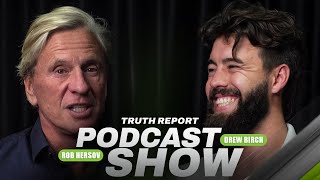
Drew Birch, a former hunter and crypto worker turned Christian evangelist, founded Advantage, a school program teaching young men fitness, addiction recovery, and faith. He argues that feminization and wokification have weakened men and destabilized nations, citing South African decline as evidence.
Chapters
We're saying don't hurt our women, and that's a great message, but I think we need to say what's wrong in the hearts of our men that that becomes their outlet. People are often born into religion and they spend their lives defending it but never ask the hard questions. And the truth doesn't mind being questioned. If we have young men who are strong enough to stand on their own two legs, who don't come out of high school being castrated by pornography and cheap sugar and cheap entertainment, focused and dialed in and effective, they can look around and say, hey, what's wrong with our country? In that moment, the rest of the attackers ran away. This man went down. I decided to try and keep him alive. I thought he wasn't going to make it. And I said to him, do you know Jesus?
Hi, everyone. Rob Hurstov for The Truth Report. We've got a fantastic young man here, Drew Burch. And I met Drew recently, and he's now part of The Truth Report family. But he's doing something extraordinary in South Africa, and I want you to know about it and hear about it. So Drew, welcome to Truth Report.
Thanks, Rob.
Yeah, and I met you through your dad, Rob Birch. He's a cool dude. I went up with a whole lot of dads and 11-year-old sons who were all at school together to the Royal Karoo Farm where Rob Birch, Drew's dad, taught the boys how to do gun safety, how to clean guns, how to load guns, how to look after weapons. And then they fired handgun, shotgun, sniper rifle, and they had a really good time. And at the end of the 2 days, they were invited, would you like to go and shoot an animal? And one of the sons and dads said yes. The other said, maybe we'll wait a year or 2. It was a lovely, lovely weekend. I really enjoyed meeting your dad, but he introduced me to you, Drew. So Drew, you are 30 years old, married, 4-month-old daughter, and you live in San Francisco. Yep.
Based in San Francisco. Love the lifestyle. I love traveling to Cape Town, but it gets a bit claustrophobic sometimes. And so I enjoy that part of the country. Unfortunately, it's not the Western Cape. We don't have the same infrastructure. But I get to surf. I get to skydive. I get to shoot my guns. And there's some jiu-jitsu with the boys. And that fills the tank. So I enjoy the side of the country.
And Drew, just give me a little background of where did you grow up and a little bit where you went to school and that story.
I grew up on a dairy farm at a young age. And then St. Francis local from puberty. Woodridge for high school, went to Stellenbosch, was in Vulcano for 2 years just before everything came out about how much fun we were having there. Great time, wouldn't bash it at all. I think the media misconstrued a lot of what's going on over there. Studied accounting and didn't want to go corporate, so went up into Africa, spent some time in Uganda and Northern Rhodesia.
Did you finish your degree?
I did. I started off with a focus in economics, progressed to a CFA-aligned degree. And then I just got disenfranchised with the way that fractional reserve banking works and how the system works and decided I didn't like the idea of making money by moving numbers on a screen and that I could perhaps add more value by building business itself. And so progressed to management accounting, which is business-focused accounting.
You graduated at Stellenbosch. And what did you do at— did you— were you— any sports, any hobbies, any interests?
I rode. And I fought. I love combative sports. I love sports that challenge the mind. And yeah, so I trained it that way. Now I run, and I run an event called the Gargons Challenge. We run 4 miles every 4 hours for 2 days. We run about 76 kilometers over the 48 hours, and we raise funds for charity. And I found that's really great for mental development, for having a cookie in the cookie jar, as Gargons likes to say. And then grateful for the personal development side of the psyche.
So you finished university and then you went up to East Africa.
Yeah.
Tell us a little bit about that.
Populated, not as wild as you think it's going to be. People are plentiful, food is plentiful, and yet the people are poor. Chinese making massive inroads into Africa, taking massive grounds there and building infrastructure and taking, you know, mineral rights in return. Beautiful wildlife that will only be reserved by hunting.
Okay. So what did you do there that got you to that conclusion? You were up there as a professional hunter.
Yeah, I was doing dangerous game hunting. And then hand in hand with that, I was working in the anti-poaching units because all of the anti-poaching work that happens on these reserves, which is double the area to what is covered by natural reserve. In other words, your Addo Elephant Park, your Krugers, double that space is used for hunting and thereby protected by hunting money. And so we're doing anti-poaching work, picking up snares, taking out poachers, and wanted to be an advocate for hunting. I thought that as a young man, I was going to be a Cameron Haines talking about why we need hunting and the importance of it. And then felt something in my heart as a 23-year-old saying, you're not going to advocate for hunting, you're going to advocate for the hearts of men. And didn't know how that was going to happen, but progressed and here we are today.
And you're a man of faith. Tell us, was that from an early age or did you discover your faith later on?
So I was raised an eldest child, front row of the church, and I'm rebellious by nature. And so when I was at varsity, I went full send. I was as much a party boy as you can imagine, as much a womanizer and a jolla as you can be. I don't think I went to more than a dozen classes in my first year. I definitely self-studied my qualification and had fun and socialized the rest of the time. And in the season asked a lot of questions. And I feel that people are often born into religion and they spend their lives defending it, but never ask the hard questions. And the truth doesn't mind being questioned. It's a lie that doesn't like questions. And so I spent 3 years reading Dawkins and Hitchens and trying to find holes in this Christian faith that I could argue. And eventually, after 3 years, I had to conclude that those the truth and it's where I would align, it's the hill that I would die on. And it has become a fundamental part of how I live my life and what drives me.
So I had a great chat to a guy called Charlie Law, who's been on a Truth Report podcast. And Charlie Law reminded me of that great movie with Fiennes in it, where they choose the Pope. It's a relatively recent movie. And a lot of the candidates to be the next Pope, It's a movie. We're questioning their faith, questioning God, and that's a good thing. And Feynman said, if it was all proven, you wouldn't need faith. So the beautiful link between man and God is that faith, the belief that you test yourself all the time, which strengthens your Judeo-Christian basis. So tell me what you're doing now. You came back to South Africa. Age 20-something, and you'd lived up, you'd done the whole SDR life, yeah? Sex, drugs, rock and roll?
That's it.
And rock and roll.
Drum and bass at the time, but yeah.
And you went a little bit too hard.
Yeah, same shit. Yeah.
And you came to the conclusion that that probably wasn't where you want to be.
Yeah. I had come to Cape Town for a season and was part of a crypto startup. And the founder died of a heart attack and I started a media company that was doing remote wine tastings. And I had my first pitch to the client. And 2 days before I was doing lines with my friend at the polo club and realized I can't do this. Bombed out on the pitch, hit rock bottom and was so angry with myself because it was only my own actions and decisions that had taken me to this point and just realizing something's got to change. And that started the journey towards where we are today. And it took a long time before anybody took it seriously. But now we write and we speak and we coach and we're getting to have impact.
And tell me about the program. It's called Advantage.
That's it.
And you founded Advantage.
Yes.
And why? What is the thesis originally? Why did you feel you needed to found it? And what is it?
Yeah, so it happened organically. It was never my intent to be the guy that talks about performance enhancement or addiction therapy or these vices that hold man back. I just had faced them myself, was prepared to say as much, and found that every other man was in the same spot. And so I found that if we could remove these vices and make men as powerful as they possibly could be financially, mentally, physically, that they could then be the pillars of protection and provision that their families need, that their communities need. And so today, I think that that is a mission that supersedes me and that pulls me forward, that excites me. And that's something that I could commit my life to, is seeing young men made powerful so that they can be everything that they were created to be and have the impact and leave the legacy that they're meant to leave.
So this is muscular Christianity.
That's it.
And you're combining faith with being a real man.
That's it.
It's interesting. Jordan Peterson said something that resonated with me and a lot of other people. He said, a good man is not a kind and a gentle man. A good man is a dangerous man who keeps that piece under control. Yeah.
A weak man can't be a good man. A good man is one who is strong, who has the ability to wield himself and then is meek in that. And I think that is something that is lacking amongst men. Talking about gender-based violence, for example, why are men so angry? We're talking about the result and the consequence of that anger. Why is the anger there? Why are men so angry that they're taking it out on their wives? Is it because they have no hope in this country? Is it because they're drugged up and trying to escape from their reality? That that becomes an outlet of their rage. We're saying don't hurt our women, and that's a great message, but I think we need to say what's wrong in the hearts of our men that that becomes their outlet, that they would hurt those who they are supposed to protect and programmed to provide and protect for.
So there's some dynamics that I want to raise now which we can talk about. The one is the rapid feminization of society, the demographic change. Yeah. Where women now dominate certain sectors.
Yeah.
So psychology, medicine, increasingly law, book publishing, journalism, education.
HR.
HR. All of these areas that have become increasingly important. I mean, the HR tail wags the dog in a lot of the corporates. A lot of the CEOs are too terrified to do things 'cause the HR department says that's illegal or that's immoral. Or you're going to get into trouble. And it's the wokefication of society, which is entirely related to the feminization of society. So as women have gained incredible influence, particularly in certain areas, so society has been feminized. And there's an extraordinary author and podcaster called Helen Andrews. And I know you've watched some of her podcasts. But she came out relatively recently with a book called Boomers, which is basically saying that the feminization of society is a bad thing. It's created wokeness, women equal wokeness, and men have been weakened, disenfranchised. But another thing is that I looked at an interesting statistic that men's testosterone levels have collapsed. Over the last 20 years. Now, a lot of people call it the soy boys, you know, all these kind of lefty feminized soy boys who drink too much soy. And, you know, when we talk about rugby and the Springboks winning all the scrums, you know, people in the scrum don't eat salads, they eat meat. But when I look at all these trends and my wife's a Kiwi, I adore her. And I look at New Zealand and I go there a lot. New Zealand and Canada of the Western countries have been very feminized. Justin Trudeau is basically a woman, but Jacinda Ardern spent 8 years in power and woke-ified New Zealand. And I look at New Zealand's rugby results and everybody thinks it's because South Africa is on the uprise or England's on the uprise or France is on the uprise. But I think it's New Zealand's becoming feminized. It's the most woke country other than Canada. Everyone's a politician, bureaucrat, regulator, lawyer, or HR director. It's very rare to find entrepreneurs and real men in New Zealand. And the last bastion of masculinity in New Zealand are the mighty All Blacks, the incredible rugby team. But I think they're being feminized out. I think New Zealand is potentially over as a great rugby nation.
Yeah, looks like it.
And the proper real men countries, like South Africa, France, you know, that haven't been wokified yet are going to be dominating the rugby world. So long thesis from me. A lot of people ain't going to like it. What's your view?
I think yet is the great word to put in there. We haven't been feminized yet. And I think unfortunately, if you're looking at our schools, it is happening. And that's where it starts. It starts at our schools. It starts at our universities. It starts with our young people. And we need to pull them back from the ledge. What does give me hope is that men all around the earth are moving further away from liberalism. They've been pushed away by liberalism. They're moving right. They're moving conservative. They're going less and less tolerant. And I think that the pendulum is swinging back. Gen Z is far more right than liberal. They're far more conservative in their worldview and in their action. And I think that does give me an an element of hope. But I think you're right. I think what we're seeing, um, by the All Blacks is a bleed-through of their culture, which has been feminized. It's been the result of a nanny state for too long. And women being in power, every time we see that throughout history, the result's not good. As soon as you have social justice movements and women in politics, your empire starts to collapse. And it looks like we've had a lot of women in power lately over a time when we needed strong resolve, not responding to fear with bad action impulsively. And we had the wrong leadership in place and now we suffer the consequence of that.
So I'm not saying that these are bad things, women getting into these positions of influence and power. It's a good thing. But the flip side is do not feminize and weaken masculinity. And you know, the lefties come out to this expression, toxic masculinity. I mean, that's cultural Marxism. That is such garbage. And it's, those are for people who do gender studies and rubbish like that.
Yeah.
So we need real men. We need a man to be a man and a woman to be a woman. And it's a beautiful thing when they come together. But how are you— tell me what your program does. Now tell me about Maritzburg College.
Yeah, Maritzburg College has been a favorite spot to go and visit. I've been back 4 times over the last—
as a speaker.
As a speaker. Over the last 3 or 4 years and to give the same talk. They always want me to come back and say, please just do that same talk again. You can do all the other talks.
And what's the talk?
This one addresses addiction, specifically porn and the impact that it has on young men and why we need to cut off those vices. And I think that it's an interesting talk to give to high schoolers. Don't touch your willy for 45 minutes often gets laughed down. You would think so, at least. But arriving in Maritzburg College, speaking to 1,000 boys, I received 300 direct messages from these boys saying, that was incredible. That was life-changing. We haven't had a talk like this before. Thank you for changing my life. And that has impact, gives fulfillment. But also, I think speaks to where we are as a society and as a culture that the men are so ready to hear that. I think we've got a tinder-dry environment. And certain thought leaders over the last couple of years, as much as you might not agree with who they are personally or how they make their money, Tate, for example, has stirred up the hearts of the next generation of fighting age male and has said to him, don't be a degenerate, make some cash, get fit, get strong. And so when I was in high school, we never had that message. All we did was listen to watch Blue Mountain State and Project X was about a house party. Instagram had just come about in 2013. No one was saying, hey guys, you can be better, you can be more, you were meant for more. And I think that is a message that at least has kind of precipitated through the youth right now. And so when I get to talk to them, this tinder-dry environment, they're ready for that spark. And when the spark hits, I think the response is effective.
So how does Advantage work as a program? You sign up with schools.
Yeah.
To create a lecture series for the students, correct?
I travel to schools, I spend the day, I do a series of 3 or 4 talks, and it can be in larger groups initially and training down to smaller groups where it becomes more one-on-one work or personal development work. We speak about why you need to be effective, and then we give them the tools as to how to be effective, how to cut off vice, but how to enhance your performance as a young man and how to find that direction in life. And that drive. And so I travel as a speaker. There's a big part of my heart that wants to have impact in the youth of the nation. And then I work one-on-one with guys who are struggling to let go of certain addictions, generally in the international market. But we do have a strong community of young men in the country that are all building themselves, are aware of their reality of where we are as a nation in our time and space, and then what they need to do, how they need to build themselves to prepare for the season ahead and for the responsibility that they have ahead.
So part of it is countering addiction and dealing with those issues that are very hard to discuss, very hard to deal with. But the other segments are what? Health and fitness, nutrition, mental health.
Yes. Financial.
Financial.
Yeah.
And faith.
That's it. So we build on a foundation of faith. That's our worldview. And we have 3 pillars that are our elements of power. We want to be powerful financially. It's our leverage point for the rates at which we can do work is greatly increased. If I have finance to throw at something, I want to have wealth. It's a good measuring stick and it's something to utilize. I want to be mentally strong. I need to have high stress tolerance. I need to be able to cut off what doesn't serve me without being entrap by it. I need to be able to deal pragmatically from a place of logic and not be caught up in emotions. So I have to be able to have control of my emotional state. And then physically, I need to be able to live life to the full and be strong enough and effective enough to bear the weight of responsibility as a man, that is to protect your family as well.
And how does it work? Do you get a— you identify a school, So let's say Bishop's or St. John's or Woodbridge. You then, does the school contract with you to come and do it? Or do you get an old boy, old girl as a sponsor?
I would love to see past students saying, this is the culture we need at our school. Please come and talk here. And running it that way, that would be fantastic. For the most part, it's me saying to the school, Here I am. This is what I do. If you think this is worth your time, pull me in. Generally, I need to visit at least once, and then we build the relationship from there because the response has been so crazy. It's been incredible to see how the young men are responding to the message. And so just getting the foot in the door, I think, is the biggest first step. Schools get approached by a lot of people who want to come and speak. And if they don't know who you are, they kind of think, flip, what's this guy going to say? And why would we pay them to be here? But as soon as they know the impact that you can have, it's a quick turnaround.
So Maritzburg College is a great case study. Do you have other schools that you've been to?
Yeah. Yeah. St. Andrews, Woodridge, over here I've been to Weinberg. I have been to more than two dozen schools over the last year, I would say.
And it's boys only?
I work with men. I think that that is where I'm able to speak into effectively. I can say what the teacher can't say. I can say what the parent can't say. They know that I'm authentic. I'm not pulling punches. I'm not trying to be two-faced and gloss over who I am and what I have done as a man, the mistakes that I've made. And so I'm able to connect with the young men more effectively, I think, than some. And if we can get the men on board, then the women will follow as well. I think the men set the standard. The men are the ones who are able to enforce their views. And I think that that's why the culture moves with men. Women tend to be, as you said, more liberal, slightly more work. They do tend to have a more feminizing take on reality and on systems and on politics and on family. And so if we can get the men staunch and set and intolerant and unmoving, unwavering, then we can move that society.
Because women tend to prioritize feelings over facts, which is always dangerous in the legal area. And also safety and security over risk-taking. Whereas you want boys to skew much more to facts and risk-taking. Those are boys. Those are men. They make men. They make the great males that have done great things in the society. How much does it cost? A school or an old boy to fund you, let's say you go to Michaelhouse, my school.
For the entirety of the day, you have about 3, 4 hours of talk in that. You're looking at about 16, 17K. And that's with travel and everything. That's ex-travel.
So 16,000 Rand for a full day program. Okay, so to all the old boys of schools, if you really want to make a difference at your school or old girls, Boy school. Contact Drew. Where? What's the website?
Drew@advantage.today.
Okay, so we'll put that down in the link. But reach out to Drew and say, you know, this is the school, me and some buddies happy to fund a program and get them signed up. Because I think it's very important for the young men today to understand what it takes to get their lives in order at a teenage— I guess that's your prime area— at a teenage phase of their life and position themselves for the future as men, as real men.
And I think it's important to talk into the greater picture of why we need men to be strong again. Our country is on the cusp of failure. And we need radical intervention by young people. That's where your turnaround always happens. It's the young people. If we have young men who are strong enough to stand on their own two legs, who don't come out of high school being castrated by pornography and cheap sugar and cheap entertainment, who can come out and aren't fragile, can take on a fight, who are courageous and integrous and loyal and meek and kind, but focused and dialed in and effective, they can look around and say, hey, what's wrong with our country? What needs to happen here? The people in leadership positions don't carry the values that they should be carrying as leaders. They're not integrous. They're stacking their own pockets. They're not just incompetent. They're corrupt too. And whether I'm in a township or in a mansion, I can see the truth for what it is. I can put aside the emotions and the lies that I've been fed by politicians who want to cause divide by saying, hey, listen, the fact that you're in a shack is because the white guy system from 30 years ago, not the fact that I've been stealing billions while breaking the system, perhaps on purpose. Right. And if we can get guys to see the truth, see that values matter, suddenly we can have a coalition formed that doesn't look at the color of your skin or the tribe that you come from, right? That can unify. And if people can unify around common goal, because we all want the same thing— I want to be able to provide for my family and I want to be able to protect my offspring. I want a better country for my daughter. We all want that. If we can unite under common values, right, as young people, we can start to move and take back our country. But we need strong men who are dialed in and able to make that stand, who aren't distracted and apathetic.
So we need the return of muscular Christianity. Let's talk about faith for a bit. There seems to be a return to faith, to the Judeo-Christian basis of our civilization, the bulwark against evil. Which is Judeo-Christian civilization. And are you seeing more and more young people finding faith, returning to Christianity?
Yeah, Chris Williams, well-known podcaster, was just commenting on this, saying the move of young people back to faith is extraordinary. It's unprecedented. And I think it's hard times creating strong men and and the strongmen are coming back now. And I think that what we're going to see is a generation that is less tolerant of evil and of injustice. And I think that the way that we unify, because we can't unify on culture and race, I think when Mandela came out and said, let's build a nation together, a rainbow nation, he had the right words and he meant well, but you haven't had homogeny. And we need to find a way to have real unity And the best way to have real unity, I think, might just be faith. And I think if we can come together under a Christian banner and look at the values that built the West, right? Christian values made the West strong. And the West has forgotten their Christian identity, and so they've forgotten their Christian history, and now they're being overrun by parties who haven't forgotten their history. Islam retains its identity. They remember the Crusades. It was them against these Western Christians. And so they are now coming and they take over by jihad or they take over by immigration, but they are taking over. And it's because they've moved back to an intolerance, right? And they have their minds focused. They're locked in, they're dialed in.
Do you know South Africa's between 1.6% and 2% Muslim? It's as small as that, but they have outsized influence. And in most cases, negative influence.
Negative influence, but they are aggressive, they're intolerant, they're not worried about your feelings. They're coming in to get stuff done, and the Christian man needs to have the same attitude. We need the attitude of the Crusader who is unapologetically Christian, holding on to his values, uniting with his brothers regardless of your skin color and your race or your culture, and saying, let's go, let's build back our country, let's work under these values that that work and let's make something happen.
I agree with you 100%. I mean, I wrote an article on the Islamification of Africa as the greatest threat to peace, security, and civilization in Africa, but it applies worldwide.
Yeah.
So you're going to focus full-time on Advantage, A-D-D-V-A-N-T-A-G-E, dot today. Today.
That's it.
And that's going to be your full focus now. And it's an NGO?
Yeah, we travel as a speaker, as a group, we're building a movement. And so we've got a culture shift we're trying to bring about. The one element is a one-on-one service that helps men break off addiction. But the relevant move within South Africa is that of a culture move. And as a speaker and a thought leader to be able to bring about that move and rally the troops. I think that's it. It's just waking up the young men and getting them alert, getting them dialed in. And we have a load of young men who are so bought into that movement already. And that's exciting to see. We've got guys who are committed and bought into the vision and want to see themselves grow, their brothers grow, and their country grow as well.
So let's skip drinking the soy and get back to eating steak and be a real man.
Red meat and raw milk.
Red meat and working out and being healthy and getting up early and working hard and going to church. No, I think this is very important. And Drew, in your podcast discussions, you can talk deeply about the Firearms Amendment Act. You can talk deeply about martial arts. You can talk about health. You can talk about fitness and nutrition. And you can talk about your belief in God. So those are your main topics.
Yeah.
Yeah.
Making men strong and making men powerful. The reason why is that they can have impact and leave legacy. Want to run a good race that at the end of the race we can hear, well done, good and faithful. That's all that drives me is I want to have impact and leave legacy. I think the best way to do that is see cultures change. And I think one of those elements is men being able to protect themselves. And so right now, the very relevant topic is the fact that our government is trying to strip us of our rights, the right to be able to defend yourself, not just against the criminal, but against a tyrannical government perhaps. They're not taking away guns from legal gun owners because legal gun owners are causing a problem right now. We're not the ones committing crimes. Your crimes aren't committed by a legally registered firearm. They're committed by government weapons that have been lost, police weapons that have been lost and stolen. And so that's not where the—
Spanish, German, French, Italian.
Yeah.
Do you know in the Second Amendment, the right to bear arms in America, one of the provisions is the right to bear arms to protect the individual against the tyranny of the state.
Yeah.
And that's exactly the case here. If the ANC disarm us, they control us.
Yeah. And I think you'll see what happened in the UK. You had a disarmament happening in '94, '95, and now you get arrested for saying something bad on social media.
Dirty words.
Yeah.
Yeah.
Yeah. And I think we'll see something very similar over here. The one thing that does give me hope is that it's another unifying problem for South Africans. This isn't a white man's problem, having their guns taken away. Everybody else has guns.
Safety and security problem.
But it crosses the cultural lines. The Zulus and the Indians and the Xhosa, they love their guns too. They've all got guns too. And I think if the government tries to take those guns away, they're going to see some pushback.
And Drew, you had an incident. You were attacked, weren't you?
Yeah.
So tell us the story.
Yeah. So 2, 3 years ago now in George, walking back from a social event.
At night?
At night, 2 AM. I had organized an Uber. Uber dropped me, but my home was 3 kilometers away. And I thought, you know, I can protect myself. I might as well take a walk.
Were you carrying?
Yep, luckily, if I hadn't been, I'd be dead. Ambushed by 3 men, surrounded me, and the one gentleman who had my back left said, "Ach, kann ich euch skitten?" which is prison slang for "I'm going to stab you." But I heard the word "skitten," looked for a gun, and have this screenshot memory of those different plastic-handled butcher knives. You've got red handles, white handles, green handles, of a red-handled knife being thrust at my neck. Managed to block it, and it was a wrestling match. He didn't manage to get it in me. Luckily, I managed to get my arm up. The man in front of me had a hockey stick, and then it was a 3-on-1 wrestling match.
And did you draw your gun?
Managed to make space, managed to get it out, and put rounds downrange. Not cool, calm and collected. I wasn't John Wick. I screamed like a bit of a girl. Luckily, I had been training, and it was muscle memory. Put 5 rounds into one of the guys.
Killed him?
Didn't kill him. He went down. Put another round into another one of the attackers and subsequently found out that he didn't make it. But in that moment, the rest of the attackers ran away. This man went down and kind of thinking about my options now. Do I go home? Do I like, what do I stay here? Decided to try and keep him alive. And so this man is bleeding out. He had a sucking chest wound. I thought he wasn't going to make it. And I said to him, do you know Jesus? And he replied, "Eh." And so I started performing CPR and pressure to the wound and kept him alive until his friends came back and took a position behind me. I'm crouched on the ground over this guy, putting pressure on the wound and thinking to myself, these guys are going to attack me again. Had my phone out and there was a fourth person to the party, a woman who wasn't part of the attack but was part of this gang. Started asking her questions. Why were these guys attacking me? Like, what are they doing? And she acknowledged that they were gangsters, they were high, that they were looking for somebody to hurt. And kept this guy alive for a bit. He wasn't passing. Kept talking to the girl.
What a weird scenario. They're standing around you now. Yes.
And I'm worried they're going to go at me again. And eventually I think I need to get this guy up to the hospital. I'm going to try and move this guy. So I pick him up onto my shoulders and carry him back onto the road and start trying to wave down cars. And the first car doesn't stop, obviously. And the second car is a cop. And they pull over and they kind of leave him on the pavement for about 40 minutes until the ambulance gets there. And eventually I'm put in handcuffs. And now I'm stressing. The only white guy on the scene, 9 or 10 cop cars. And they all come and ask me the same question. Where are you going? Who are you? You know, I'm telling them, came from here, going there, these guys jumped me. And eventually I see they're, they're on my side now. They understand the situation. They show me the weapons. They say, you're going to be fine. Just, these are the guys, there's the weapons, you're going to be okay. Until I went to jail. And it's 2 AM on a Saturday and I'm being read my rights and I'm going into a cell for the weekend because you only get out on the Monday, right? And that was the scariest part. Hard for me. I think as any South African man, your, your biggest fear is going to, to South African jail. And walked in and there were 8 men in the cell and they looked at me and said, what are you in for? And I said, oh, some guys tried to mug me, so I took them out. And they left me alone. And I crashed. The adrenaline dump is way, way more hectic than that of a buffalo hunt, way more gnarly than skydiving. Slept for 6 hours, woke up, put push-ups and praying. Eventually got a call because nobody knew that I was there, and the head of the police station came in and said, we're gonna let you go, just give us your statement. As long as all the gunshots are from the front, it's obvious self-defense, you're free to run. And then his family, the guy who I had shot 5 times, came to the police station and said, that guy's a scully, he deserved it, he's been hurting people there for ages, you're not his first victim. You're okay. We don't hold it against you.
Your dad also had an incident, didn't he?
He had a shooting accident. He had a hunting accident. No one was trying to kill him on purpose, but someone thought he was a kudu and put a—
And that can happen too.
Yeah, and put a.30-06 round into his sights.
So I love the comment, push-ups and praying. Maybe that should be your logo for Advantia. So everybody, you're going to see and hear a lot of Drew Birch going forward. I'd love you to go and look at Advantage, ADD Vantage, see his program and see if you and some friends can sponsor him to come to your old school. I'm talking to the men here and help the future of male South Africa rediscover its Christian strength, its moral strength, and save South Africa's future. So Drew, lekker to have you on board. Welcome to Truths Report.
Thanks for talking to me. Appreciate you.
Alrighty.
More from Robert

MAGNUS HEYSTEK & ROB HERSOV: How to Protect your Offshore Money from the South African Government



BNC#8: Rob Hersov Q&A - A brutal reality check on leadership, voters, and the economy






South African Scientist Exposes The Scary Truth Behind The National Water Crisis
