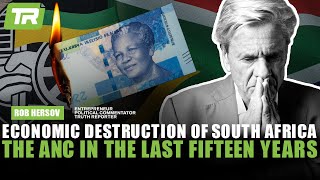
Robert Basil Hersov argues the ANC has destroyed South Africa's economy over fifteen years. The JSE returned under 200% while the Nasdaq gained 1,400% and the S&P 500 gained 800%. Debt is projected to reach 80% of GDP, credit ratings fell to junk, and skilled workers including Hersov's own sons are leaving the country.
Chapters
I'm going to tell you about the economic destruction of South Africa by the ANC in a mere 15 years. So welcome to today's deep dive into one of the most devastating economic stories of our time. I'm going to bring you an explosive analysis that exposes how our economy, South Africa, has been systematically destroyed over the past 15 years by the ANC. And the numbers aren't just disappointing, they're catastrophic. And the implications reach into every South African household, affecting your savings, your investments, and your children's future. And I'm going to tell you how a country that was once the economic powerhouse of Africa became a tale of mismanagement, corruption, and missed opportunities, thanks to the ANC. And this isn't just about statistics. It's about the systematic destruction of a nation's wealth and your children's future. So let's start with a headline figure that should make every South African sit up and take notice. South Africa's economy has underperformed emerging market peers by a staggering 43% over the past 15 years. But what does this mean for ordinary citizens? While you were watching your retirement funds stagnate and your property values decline, investors in other markets were getting rich. The Nasdaq, America's technology-heavy index, surged an incredible 1,400% during this period, and the broader S&P 500 climbed 800%. Even global emerging markets rose— the index anyway— rose 400%. Meanwhile, South Africa's Johannesburg Stock Exchange managed pathetic returns of less than 200%. If you had invested R100,000 in the Nasdaq 15 years ago, you'll have over R1.4 million today. But the same investment in the JSE would be worth less than 200,000 rand. This isn't just underperformance, it's wealth destruction on a massive scale. But here's what makes it more tragic. This wasn't inevitable. From 2002 to 2008, South Africa was actually an economic success story. The economy grew at a robust 4.5% annually, and the rand strengthened dramatically from 13 rand to the dollar to 6 rand 50 to the dollar. Government debt was a manageable 25% of GDP, and unemployment, while still high, was in the low 20s, and real wealth was being created across all communities in South Africa. So what changed? The answer lies in a critical turning point that most South Africans don't fully understand. The year 2010 marked the beginning of South Africa's economic tsunami. To understand why, we need to recognize that the earlier boom years weren't the result of brilliant ANC economic planning. Not at all. They were largely due to pure luck. But, you know, we take luck when we can get it. When China joined the World Trade Organization in the early 2000s, it created massive global demand for raw materials. There was the raw material superboom, exactly what South Africa had in abundance. Commodity prices soared and South Africa rode the wave. In addition, the 2010 Soccer World Cup here in South Africa provided additional momentum through infrastructure spending, masking the underlying problems that were already emerging. But once that commodity supercycle ended, with the 2008 global financial crisis, South Africa's structural weaknesses became glaringly apparent. And instead of using the boom years to diversify the economy and build sustainable institutions, like a sensible government should have done, the evil and moronic ANC government had been busy deploying cadres throughout the system and laying the groundwork for what would become state capture. The decline in South Africa since 2010 has been relentless. South Africa's credit rating plummeted from investment grade to junk status, a humiliating journey that few countries have experienced in peacetime. Foreign investors who had poured money into the country during the boom began a mass exodus that continues today. And government debt has exploded from that manageable 25% of GDP to a projected 80% within the next 2 years. Today, more than 20% of every tax rand collected goes straight to debt servicing, and that's money that could have been spent on education, healthcare, or infrastructure. Our currency has collapsed, making everything from fuel to food more expensive. And let's look at the property markets, both residential and commercial. They've crumbled. You try to sell a house in Johannesburg right now. And the brain drain has accelerated as skilled professionals of all races seek opportunities elsewhere. Both my sons, older sons, are living abroad. And it's actually hard to find parallels for such systematic economic destruction by a government in peacetime. The ANC's basically brought war to South Africa's economy. And South Africa's downward trajectory compares to Argentina after World War I, when that country went from being one of the world's largest and most successful economies to a serial defaulter under successive socialist governments. And compare our country's destruction by the ANC to Cuba under Castro and modern-day Venezuela as other examples of ideologically driven economic destruction. But here's what makes South Africa's case unique. Unlike countries that collapse due to war, civil unrest, or external shocks, South Africa's destruction has been self-inflicted, or rather ANC-inflicted. There's been no war, no natural disasters, no external invasion. This has been a deliberate policy choice. First under the gangster Jacob Zuma. I, Jacob Geleitshiki Zuma, swear that I will be faithful to the Republic of South Africa. And continuing under the smarmy and incompetent Cyril Spineless Ramaphosa. The irony is actually quite bitter for all of us to swallow. Just take Vietnam as an example, which was literally bombed back to the Stone Age, but has rebuilt and prospered. While South Africa has managed to destroy its economy through sheer ANC mismanagement and corruption. Without dramatic change, which there's no evidence of under the ANC, or even the GNU for that matter, I expect the collapse to accelerate over the next 5 to 10 years. Only the DA-run Western Cape might escape the worst outcomes, while the rest of the country, increasingly resembles other post-colonial African states: poor, ungovernable, with criminal cartels controlling large parts of the economy. The brightest minds and most mobile capital will continue fleeing the country, creating a vicious cycle of decline. I'm certain that foreign exchange controls will be reintroduced as the ANC government desperately tries to stem capital flight. That's coming. And this isn't just an economic story. It's a human tragedy. Millions of South Africans have seen their wealth destroyed, their opportunities diminished, and their children's futures compromised. And that's a polite word, compromised. The numbers don't lie. While the rest of the world got rich, South Africa got poor. And the ANC stole South Africa to death. The question now is whether this trajectory can be reversed, or whether we're witnessing the slow-motion collapse of what was once Africa's most promising economy. What does the malevolent and incompetent ANC do when they hit rock bottom? They keep digging. And to wrap up, I've only two things to say, and that's: Futsack ANC, and it's time to put South Africa first.