Trump’s Return: Boom or Bust for SA?
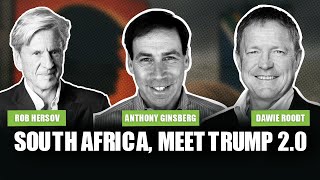
Economist Davi Ruit and investor Antony Ginsberg discuss a potential US-South Africa trade deal under Trump. US officials have moved 80% of the way on tariffs, but Black Economic Empowerment and expropriation policies remain obstacles. Lowering tariffs from 30% to 10-15% could protect 100,000 to 200,000 jobs.
Chapters
So, hi, Truth Report. Here we are with two serious rock stars, from my perspective anyway. We've got Davi Ruit in, I would guess, Pretoria.
I am indeed, yes, Rob. Hi.
And we've got Antony Ginsberg in, I was going to say Communist California, but that's just my political view.
How's it? Good morning. Nice and early here. Thanks for having me.
Have you had your coffee?
Still busy with it.
So Anthony, you are, um, um, a famous South African living in California. You've been in America quite a long time now and you run your own investment company, GINS Global, correct?
Correct. Uh, like you, Rob, I survived on Wall Street for a number of years. Uh, the old Solomon Brothers, you remember from the '90s and '80s, lies, poker.
I do.
And look for Barclays.
And you're in Los Angeles. Yeah.
Yeah, we run the ETFs, Robin, and mutual funds, and we're pretty involved still with Wall Street. I still work with boys from JP Morgan and others, and that's where some of the feedback comes from. I've been trying to help our South African friends, uh, in the, in the background to get this trade deal over the line, hopefully.
Well, why don't we start there? Because Davi and Antony, what I thought we'd do instead of just talking about how bad South Africa's financial situation is, have a look at it from a US South Africa perspective. And why don't you tell us, Anthony, what's the update on South Africa's tariffs and trade deal? Is there a trade deal underway?
Yes, there is. The good news is, and I've got to give credit where it's due, Parks Tau, the Trade Minister, actually has been trying rather hard. He was just in DC again. I think he's operating possibly with one hand tied behind his back, Rob, in Derby, but The good news is they've moved it along on the narrow trade issues. Uh, I think the Americans have moved probably 80% of the way. There are some, um, as you know, broader issues such as BEE and, uh, the whole market-related expropriation without compensation, which we can get to, but the Americans frankly won't engage with. They don't understand. I think I've mentioned before, I'm married to an American. They're quite direct folks. They don't understand why South Africa hasn't sent an envoy here or an ambassador here for the last 6 or so months. The prior ambassador was an ill lady for some years, I believe. So South Africa has a very low profile. And of course, the Oval Office meeting that occurred some months ago was a very bad advertisement for SA, sadly. So I've got mates on Wall Street and elsewhere who said, my goodness, is it really that dangerous down there? And, you know, are people getting murdered left, right and center? So it wasn't a great advertisement for SA, but there's a lot of goodwill here. You know, Rob, there's a huge reservoir of goodwill. So I think the trade deal can actually get done. It requires a couple of tweaks at the margins when it comes to things like the BEE and EWC expropriation. I think they can get it across the line. I mean, this 30% rate is exorbitant. It's going to put a lot of SA citrus farmers and the auto industry either out of business or really seriously on the back foot. We've got to put our best foot forward here. The publicity has not been great. It's been pretty damn negative, Rob.
So, Davie, tell us, is the 30% in place? What is the impact currently? I mean, it's only been in place for 2 months.
Is that right?
3 months?
Yeah, Rob, to be quite honest, I don't really know what is going on. I just learned a lot from Anthony just now because my impression was that basically nothing is happening. And people are just waiting and see if something is going to happen. But I'm very happy and very glad to hear that something is at least seems to be, something seems to be happening. Rob, I think the context is very important here, and that is that the South African economy hasn't been growing or hardly growing for a very long time. My estimates for economic growth, I've just increased it a little bit. It was about until about 2 weeks or so ago, it was probably about 0.6, 0.7% economic growth for the year in total. So now it's probably going to be a little bit better, 0.8 or 0.9%, slightly better rate of economic growth. And we can talk about why that is so, but still we're talking about economic growth around about 1%, uh, in an environment where the population is growing at about 1.5%. Now, this has been going on for, for more than 15 years, for about 17 years. So on a per capita basis, we are poorer today than more than 15 years ago. So if it— what's the impact of these 30% tariffs going to be on the South African economy? And I think my rough calculation is And again, I don't really know because I don't know what the outcome is going to be. The eventual outcome is going to be, but my rough calculation is that we could lose, say, 0.1, maybe 0.2% of economic growth, which in itself is not that much. So this is not the end of the world, but with an economy that is hardly growing, it is a big deal. Now we're talking about a big deal. So everything adds up. I mean, um, we, we've, we don't have electricity. We have very high levels of investments in the economy. We've got this and that and the other. And all of those are weighing on economic growth. So the impact is not that much, but it actually is given the fact that the South African economy is already growing. I'm very glad to hear that Anthony reckons that there could be some sort of deal, but to try to answer your question on whether there is going to be a deal, I just do not know. My impression is that hardly anything is happening.
So Anthony, the question I wanna ask, and you already raised it, is the Americans are keen to do a deal. There must be other countries doing the same. There are probably conference rooms in Washington and abroad with Americans dealing with countries. A lot of countries got in first, got their, their selves sorted out. My view is Trump wants a no-tariff world, and this is, he's trying to straighten things out. But the big question is the stumbling blocks we all know when the three amigos, Kornemölder, Theo de Jager, and Gerhard Pape and Friss came to, went to Washington and came home and said, there are 3 things the Americans want in order to do a deal. One, remove the entry tax on companies, which is effectively BEE. Two, EWC, you've gotta get rid of it, repeal expropriation without compensation. And the third was make farm murders a priority crime. With regards to trade, I would think the first two are probably the most important.
It's not that difficult to deal with the, uh, the EWC issue with the market expropriation. If you could have a market-related payout, Rob, there are over 620 American companies already there. I'm actually friendly with, uh, Jamison Greer, who is the US Trade Minister. He's, until very recently, his, um, law partner is a chap I know. I'm actually interviewing him for one of these YPO events coming up. They're pretty pragmatic. They said, look, we're looking at everything through a commercial diplomacy lens. You guys in SA have got a growing trade surplus with South Africa under Agoa. It's not a good deal for the Yanks. We've got to change this story. We're happy to unleash capital. I mean, our friends on Wall Street and elsewhere are sitting on bucketloads of capital. The stock market has essentially doubled here. Our mutual funds, ETFs are generally at all-time highs. We have a tech fund, Rob, that's up like 70%, uh, since the Liberation Day tariffs. Just things like, uh, S&P 500, uh, MSCI World, these are index funds that we typically run, are all at or near high. So the Americans are feeling pretty chuffed with themselves. I mean, yes, there are issues here. We can talk about trade deficits all day long and the current account deficit, even the budget deficit Trump inherited is a mess. There's a 6%, uh, budget account. Deficit annually here, which is not sustainable. So through the Chinese lens, they're on the back foot, the Americans. So almost a $400 billion a year trade deficit with the Chinese. So they look at South Africa, it's much, much smaller. It's a couple of billion dollar deficit. It's not a big deal. It's more geopolitically. They don't want SA to fall into the hands of the Chinese. So you talk to these former trade ministers, they said, and as long as we could actually maintain South Africa in the Western fold, we'll do a deal. It's not that complicated. Let's tweak the, uh, expropriation issue and give market-related payouts to American companies. I think it was just a comment about the Eskom or your Minister of Trade down there talking about expropriating land potentially if, you know, Eskom or electricity requires it. As long as there's a market-related payout, I honestly think you can overcome that. Just on the BEE front, there's a very interesting case study in India where they narrowed PE, as you probably know, to more like the public sector and to certain areas in particular. And it was very cleverly done by the, uh, the Indians to attract FDI, foreign direct investment. And that's what South Africa could do. It could really unleash foreign direct investment. I believe the current investment rates down there are quite pathetic. There was a report, I believe in your Business Day this week, saying SA companies alone are sitting on over a trillion, uh, dollars or more. Um, Yeah.
Yeah.
Well, it's actually more. Davi, it's 2 trillion rand, isn't it? Yeah.
The companies are sitting on 2 trillion rand. Yes, that's true. But if they spend that 2 trillion rand, then the 2 trillion rand will go into the economy and circle around a bit and end up back in the balance sheets of the companies in any event. So that doesn't really— the money in the bank doesn't, doesn't say anything because you don't spend the money and the money disappears. It goes somewhere and it ends up somewhere else on another balance sheet. So that is, that's not the, that's not what I, what I'm looking at. What I'm looking at is the relative valuation of certain assets. And what has been happening, just by the way, Anthony, what we have been seeing recently is there's a South African bond market which is hugely attractive. I mean, the real yields on the South African bond market is probably the highest in the world. It's come down quite a lot now, but we have seen significant inflows from abroad. In especially the bond market, the equity market has suffered quite a lot. Just by the way, I spoke to the CEO of the JSE today. I spoke to her today, Leyla Fourie, and she's quite optimistic and she reckons that everybody's calling the bottom on the JSE. Of course, she would say that, that's her job. But the JSE recently also seen some inflows coming from abroad. Unfortunately, what we do not see— but I'm talking about really the short term now— but what we do not see, we do not see foreigners coming and build new factories in South Africa. And that's what we need. We need actually bricks and mortar kind of stuff. In fact, the local guys also not investing in bricks and mortars. But I, I've had a, had a look at the evaluation of the JSE, for instance. And we have to remember that the JSE, about 50% or even more of the JSE is actually internationally owned. So the JSE is not a local bourse. It's an international bourse. The JSE is more than 300% of the South African GDP, just by the way. The only, the only market in the world that's bigger than South Africa, I think it's the only one, is the, is the, um, the Hong Kong market. The Hong Kong market is something like 1,000% of their GDP. So if you look at 300% of GDP, the South Africa, the capitalization of the JSE, it might sound as if the JSE is very much overvalued. But that's not the case. It is not the case because the bulk of that money is actually earned internationally. So I'll just leave that one for a moment. The second one, coming back to the bond market, the bond market with those very, very high yields and with inflation being, uh, inflation expectations being anchored lower and the relatively high short-term rates as well, just imagine what's going to happen to the South African financial markets if we get a government that starts saying the right things. I can quite easily see a 20% run on equities. I can easily see a 200, even 300 bps run on the bond market. Now that is going to be a tremendous boost to the South African economy. Of course, many other things need to happen as well. And maybe just let me just make another comment, a last comment. And that is you started off by saying Park Stuyvesant has got one hand, the tied behind his back, and you refer to expropriation, for example, that is, that's one of the things that's tying his hand, one hand behind the back. Now, maybe they will eventually make some changes to that, and maybe they can change the law a little bit here and there, but we have to understand that we've got an ANC here that, that in their hearts, their ideology, their religion, if you like, is that they are a bunch of socialists. That's what they are. And you can even give them, call them a bunch of communists, and you can give them all sorts of other names. And if they do make some changes to some of these policies or even legislation, uh, it's at best going to be temporary, or their hearts are not going to be in that. I think the point I'm trying to make, if we really want to fix South Africa, we must get rid of the ANC. Now, I know this is not the ANC bashing session, Rob. I know that's what we spoke about. But that is the reality, that, that, that, that's the obstacle. That is the problem. It's the ANC and their religion, and their religion is far left, and that's not going to change.
So I want to ask Anthony a question here, quite important one, because you mentioned that the two things, EWC and BEE, but you said for American companies, what we need in South Africa is the removal of EWC or expropriation with compensation. And on BEE, we want it scrapped and find some new way of transformation that's fair and even. You mentioned it's not just for American companies. I mean, the ANC wouldn't— Park Sour wouldn't do that, would they?
I'm actually concerned, you know, Darby talks about a great return for Americans in fixed income. I know over the years, despite what the JSE may have said today to you, there's been a huge outflow of American ownership on the JSE in terms of equities. Perhaps if you exclude the the platinum and the gold and a couple of the, the rand hedge stocks. What worries me is that when you, when you tilt towards China, they're happy to sell more cars all day long to South Africa. I believe of the top 10 car sellers now in South Africa, maybe Chinese are, are 3 or 4. They never were before. And there is a history of China dumping cheap goods. You've got Temu, you've got Shein, you've got these other cheap, low-cost goods that probably are hurting the likes of Truworths and others. I saw recent numbers that the share price of something like Truworths has barely moved maybe in a decade. Um, I'm not sure how well Woolworths is doing either. That's a concern. And the other big issue on the American side is you can't get Wall Street Rob to unleash money with pending sanctions. You've got this Ronny Jackson bill that you know all about in the House of Representatives. That's the lower house. And then you've got the Senator Jackson's similar pending Magnitsky Act targeted sanctions bill in the Senate. Man, when I'm sitting here, you have to say, esh, you know, really, this is a, a bit of a humor. South Africa has to vakaskroek when it comes to these two sanctions bills, because that alone would also prevent American mutual fund managers. The likes of the BlackRocks and Fidelities are nervous to deploy too much capital when a country is potentially on the brink of, of a sanctions list. So that's another thing we've got to actually address.
But there's the, there's the Congress, uh, Congressman Ron Jackson, and there's the Senate, which is Senator Kennedy of Louisiana.
That's right.
And the bills are almost identical. They're not quite the same, but if it goes through both houses, they'll be coordinated. My question is, as far as I know, those both those bills are targeting individuals and not the country, but maybe I got that wrong.
No, no, you are right. But it just sends a hell of a negative message to my friends on Wall Street. They're looking at this thing saying, you know, we don't invest in Russia, Ant, because of the same reasons. There's a Magnitsky Act targets A lot of Putin's top boys as well, but it's, it's hell of an off-putting, I think, look, it's a shot across the bow. Doesn't mean that these bills will actually ultimately be signed into law by President Trump, even if they go through the Senate and the House. The whole story is the guy brought it through in the House, Ronnie Jackson, was the former White House physician. He's very close to Trump. These are signals and messages. It's like the smoke out there, you know, essentially come and do a deal with us. We'll get rid of these sanctions bills, probably, if we can actually get a pragmatic arrangement with SA. At the moment, SA doesn't seem to be in the Western camp as much. There are these geopolitical forces separately that are going on, whether it's regarding the Middle East and other places, Iran. And I think the Yanks want to see that America and South Africa are actually on the same page.
Is it bipartisan, Antony? It's not just the Republicans. I mean, a lot of Democrats have said—
That's a good point. Just very quickly on that, it passed through the House of Representatives on a bipartisan vote in the— they have a committee, a Foreign Affairs Committee. A lot of Democrats voted for it. So you're absolutely right, Rob, it's actually bipartisan. It's not— there are a couple of holdouts on the Democratic side. Not all of them voted unanimously, but it's definitely more across the board than people would imagine.
Foreigners hold approximately 25% of South African Rand-denominated bonds. It's, it's up actually. It was, it used to be at 20%, it's up to 25% now, or just below 25%. That is a hugely powerful position for the West to be in. I, I, I would suspect that the bulk of that is, is held by the Europeans and not by the Americans, but still, uh, most of this is held by the, by the West, the Europeans and Americans, obviously. So that's one point I just want to make, and that is something that is hugely powerful. You weapon that can be used against South Africa. So if we, if we, if South Africa doesn't toe the line, uh, that, that means financial sanctions can really hurt South Africa if Donald Trump decides to, to, to prevent Americans from buying our bonds. That's one point. Another point I think that, that we should, a narrative that I think we should try to change, and that is everybody's talking about BEE in South Africa. We do not have BEE. That is untrue. We do not have BEE because if you look for, for instance, do you guys know that a third of South African children are malnourished? Do you guys know that 3,000 kids died the past 5 years in South Africa in state hospitals, uh, from hunger? That the majority, if I'm not mistaken, probably all of them are black kids. Many of them are stunted because they are not properly fed. Now, if you want to empower a specific group, you start with what really matters. You start off by giving them food to start off with. By having all these rules to have shareholding in big companies, that is not empowerment. If the majority of your kids or a large chunk of your children go to bed hungry, we do not have black economic empowerment. If you want black economic empowerment, you will create a safe environment. You will give them world-class education. You will clean up the pavements and give them electricity and water. That is empowerment. And that's, that is a drum that I think we should start beating more and more. We do not have black economic empowerment.
So true. Professor Gumede came out with that report. I haven't read it and I need to. And he said 100 families have taken a trillion rand out of the economy through BEE. So basically it's not black economic empowerment. Patrice Mosepe, Salam Loko, Mohsen Ghorshang, and another 97 people have benefited. And it's now they're talking about broad-based black economy. They realized that the 100 families have taken pretty much everything they can. They're trying to rejig it. So they're pretending to help the broader South African population.
If you talk to Americans and you say to them, look, would you be willing to contribute towards a skills levy or Building some schools or some, uh, redevelopment. They're not averse to that at all, but, uh, giving up 30%, uh, shareholding, they can't understand that for a second. But if you actually said to them, look, you've got to pay some sort of fees or levies, uh, to help upskill South Africans or help hospitals, help the malnourished. Absolutely. There's a tremendous amount of goodwill there. So that's the good news. Also, Rob, you know, the White House is full of private sector guys. None of these guys who are the Commerce Secretary, Howard Lutnick, the Treasury Secretary, Scott Bessen, these are all longstanding Wall Street executives. You've got more than two dozen, um, basically private sector guys in very senior positions. These are dealmakers. Uh, they're pragmatists. And I think that part of it is actually the good news for SA. We could actually get this deal over the line. The guys aren't ideological really. They want to get Uh, SA, they need Africa. They need that part of, uh, Africa to not fall into the hands of, uh, let's say the East. And, uh, there is goodwill, but, and at the end of the day, they're dealmakers. Uh, and again, they haven't come to the political machinations. Most of these guys weren't even hardcore Republicans in the Bushy days that you and I know from the '90s. I mean, these guys are very moderate, very middle of the road. Some of them were frankly even Democrats. There's even stories that Donald Trump used to vote as a Democrat part-time in New York when he was living there. So this is a middle-of-the-road administration in the sense of actually doing deals. It's not some hell-bent, massive right-wing conspiracy.
Something that, that I, that I think South Africa should be very concerned about. And that is the deal in the Middle East. And that is part of the reason why the United States is not very happy with South Africa. And that's opposition, uh, with, uh, regarding Israel. Now, there was this big party in Egypt and everybody and his dog was invited. And South Africa and Africa, there were a lot of Arab countries involved and a lot of Islamic countries involved, invited in Egypt. And everybody's very happy because of this peace deal in the Middle East. But South Africa was not invited. Now, if there's somebody that's very close or supposed to be very close to the Palestinians, it certainly is South Africa. And we were not invited. So this gamble of trying to get some goodwill, international goodwill, or scoring some points somewhere, or trying to be on the moral right side of history, certainly did not pay off for us, for South Africa. We were not even invited to the party.
Very, very true. It's a big slap in the face. And, you know, Donald Trump's not coming to the G20 meetings in Johannesburg at the end of November. Maybe Marco Rubio will come. We don't know, but I heard some news yesterday from a friend high up in the State Department. He said the number one on the American piss-off, pissed-off list, Venezuela, but close as number two, South Africa. Antti, what's happening in Venezuela right now? I mean, America's deploying some military assets close to Venezuela. You know, they've had knocking out some drug boats. The CIA is super active there. What's going on? Because South Africa sounds like South Africa is next on the list.
Boy, no, they've been aggressive, man. Actually, we had an admiral just resign from the Pentagon over it because he's a bit upset that they actually, instead of arresting these guys in these drug boats, have actually been shooting them out the water and killing a whole bunch of guys. There's some commentary here, including on Fox News, that we should actually be arresting these guys and understanding who the drug kingpins are behind what's going on. But essentially, the Pentagon has basically been shooting them out of the water. The fact that the Venezuelan opposition lady won the Nobel Peace Prize is also helpful. To the American cause. So although Mr. Trump would have preferred to have won, he may win it next year. But yes, Venezuela is top of the list because it's been going on for years and years. As we know, Maduro actually lost more than one election and remains in power. So you see America helping Argentina and your friend Javier Milei significantly. There's currently something like a $20 billion swap, as you know, for, for Argentina in regards to helping, uh, uplift the peso there, which is interesting news. So they could be doing something similar for South Africa if we were in the, uh, the right cards. I'm positive that, um, just a few tweaks here and there, honestly, uh, Rob, when it comes to Israel, I know South Africa doesn't have an exchange of ambassadors. When it comes to ambassadors, again, it's a signal. We don't have anybody here for the last 6 months engaging with, uh, the Yanks. When you look at the UK where you've lived for years, Japan, these guys have got massive trade delegations living almost in Washington, D.C. The Japanese guy came a dozen times to get that trade deal over the line. Korea's about to get a trade deal signed possibly in the next week or so. It's very close. Mexico, Canada, they've all got guys camping out literally on the White House lawn. Uh, by comparison, we don't have an ambassador representing the country. So it's just very difficult. Um, to put our best foot forward at the moment.
America hasn't appointed, I believe they've recently in the last week made a lot of appointments internationally, but Brent Brazell, who's supposed to be the guy sent to South Africa, has not been approved yet.
That's partly because the government is shut down, technically speaking here. So there's unfortunately a delay. I don't think it should be that long a delay. He's actually a good guy, Brent Brazell. He will help. Engage with the guys in Pretoria. So I'm hoping that'll happen before Christmas. But as you know, in America, the system is every ambassador has to actually be approved through a Senate vote. It's quite a formal process. And his hearing has been delayed, not for political reasons. Frankly, every time a new president comes in, you've got hundreds of ambassadorial appointments. They finally only started appointing a few to other African countries, I believe Namibia, possibly Kenya as well. But boy, if we could get a business-friendly ambassador on the other side here in D.C. who can speak the game of Wall Street and engage doing trade missions. And also, I mentioned to you what our friend from Tanzania has done. She's got sister agreements with Dar es Salaam and Houston, the city of Detroit. There are tons of things, but that's a long-term game. So we have the short-term game of getting the deal over the line, but then long-term, you really need to have ambassadors for South Africa in the UK, elsewhere, they can engage on trade matters. It shouldn't be a pensionable office. You shouldn't be putting guys out there to posture who are just going to party all night and drink champagne bottles. It's really, you want someone who can engage with business in these ambassadorial roles.
Anthony, I just want to ask you two things because you will know this better than me. The first one is that, is this actually legal for Americans to shoot those Venezuelan ships? Because it's not a terrorist organization. I think you alluded to that. That's the first question. And the second question, Donald Trump also made it clear that if Xavier Millet loses the election, that $20 billion is not going to come his way. Uh, and, and the approach in Venezuela, I think, is wrong. I think Xavier Millet, and I think he's an amazing guy, he's absolutely— but he made a mistake. He should have let the peso go. He should have let the peso go. And you do not— you never ever defend a currency. I mean, that is like That's like, like showing a wounded antelope to a bunch of wild dogs. You do not do that. You let it go. Always.
Yeah, you're right. And actually, the Wall Street Journal editorial report here actually confirms or endorses what you're saying. It's a slippery slope. They actually thought that what Scott Bessen, the Treasury Secretary, did with Argentina last week is just a short-term issue ahead of the congressional elections. Milei actually, as a president, is there for a couple more years. These are interim, uh, elections there that they wanted to get the message across quicker. But ultimately, uh, Wall Street's saying you need a, a dollarized, possibly like Ecuador, which since the early 2000s, Ecuador's dollarized their economy quite well. And they're saying because of the huge use in Argentina of dollars, if you go to Argentina, people have got dollars under their beds. They're actually using dollars on the black market all the time. They say dollarize the economy. They don't know why Malianis, Economics Minister haven't agreed to dollarize the economy long. So that might be the next step after the election. They just wanted to get a quick message out. I think the election is in the next couple of weeks. So it was a bit of a rush job, this swap facility. When it comes to Venezuela, there's some disagreement about the legality of what it means to be shooting, um, you know, drug smugglers out of, uh, the Caribbean waters. So that's not 100% clear, but it does seem excessive. And I mentioned to you that one of the admirals who was in charge of the Caribbean for the Pentagon, has actually just retired. He basically resigned just this week. So, you know, there are mixed messages on that. Look, at least South Africa can learn from these lessons. I actually think SA is— if you look at where we are right now, we're in a better position perhaps than we were during the Middle East crisis. The fact that the Gaza war is basically over for the moment, that probably helps SA. Okay. Americans want more engagement. They honestly don't understand what the delay is. We're sending more trade delegations, sending a full-time ambassador, you know, basically upping our trade mission here and getting cracking with, um, it's not just the White House, it's also the private sector. We've got no engagement really from government side with Wall Street, with the Fortune 500 guys. Let's get some trade missions going and build more goodwill.
We're talking about Argentina and I see the problems that they have in Argentina, which are very similar to South African problems. But there's one problem we do not have, and that's an overvalued currency. So, so that's what they have. They've got it. That's their problem. And I can tell you, we do not have that. And I think our governor of the Reserve Bank did an absolutely brilliant job. And that is by keeping interest rates relatively high and supporting the currency by doing that. But not only that, but also not using our reserves to defend the currency when the currency came under pressure. And inflation expectations have been coming down. Quite a lot, and that's more important than actual inflation. Inflation expectations drive actual inflation. So that has been coming down quite nicely. And recently he made the comment that if the rand gets too strong, and I don't believe that is the right thing to say either, but if the rand gets too strong, he would actually start accumulating more reserves. Currently, South African reserves are standing at $70 billion, the highest ever. It's never been this high. And so it can be done. So it's not everything wrong in South Africa. The South African Reserve Bank is in excellent, capable hands, and it could have been so much worse. We could have been similar to Argentina today.
That's very interesting. I just think that there's a lot of misunderstanding on the American side about what's actually going on in SA. They can't understand if you've had no GDP or barely GDP growth of 1% a year for a decade, surely the country would be more engaging and wanting to strike deals and then build trade missions and be really on the front foot when they see other guys coming back and forth from Korea and Mexico and Japan, you know, half a dozen times. And then SA doesn't have a person permanently. I mean, the UK got that deal, frankly, over the line, which is a hell of a good deal. It was about a 10% tariff deal. Rob and Darby, they got that because they had a guy on the scene, Pedro Mandelson, you'll remember, who actually spoke the language of trade and he got in there, boom, bang. And it took about a month and a half, 2 months, and they got the thing done. I think that's what SA also needs to do.
So I got asked by, about a year ago, by a senior member of the State Department. He said, Rob, I've got a question. Do you think the ANC are malevolent or incompetent? And I said, wow, that's quite a question. Why are you asking? He said, because AGOA, the fisheries agreement, doesn't seem like they know how to fill out the paperwork and send it back to us. It's just nothing's happening. And I said, well, let me think about it. I said, I would probably say it's 80% incompetence and 20% malevolence. And I think that there are these medalas in the cabinet at the second and tertiary level, the CADA or cadre deployments has taken place. You've got thousands of people who've been put in positions of power and influence and control of budget. Getting things done that have absolutely no idea what they're doing. I mean, they, I won't call them stupid, but I'll just say not trained and, you know, incompetent. And that level of people needs to go away. I think in the ANC, there are good people. Look at finance, treasury, Ramaphosa, you know, and other people that have been appointed to the head of Eskom. Eskom team are doing very well.
They're there.
They just haven't graduated the Madalas out of the way. So the ideology is malevolent, but I think it lacks leadership.
We actually got fat and happy in South Africa with AGOA. AGOA was a hell of a sweetheart deal for South Africa. Essentially, South Africa is about the biggest country in Africa that took advantage of AGOA. These are landing exports from car manufacturing to the citrus farmers, other kinds of fruits, etc., manufacturing garments. Duty-free at zero. I mean, literally landing at zero tariff. So we've had a sweetheart deal. There is a new world reality. But if we could just get those 30% tariffs into the 10-15% range, it will still unlock a lot more exports. I mean, Darby's an expert on this. We still need to boost exports. You can't really ignore the US. I know it's not necessarily massive for daily GDP, but I'm told up to 100,000 to 200,000 jobs are on the line, Darby, if this a goer and the trade deal essentially don't come through at some point?
Here's the thing, Anthony. So we bashing government here and we bashing the administration and calling them incompetent. And I agree with all those sort of things. But, you know, looking at the motor industry specifically in South Africa, the motor industry in South Africa is hugely subsidised. There's a very complicated whole mechanism behind it, but it basically comes down to the South African motor car consumer that, that subsidizes those exports. That's our motor industry. Now the motor industry, just by the way, they won't be able to compete with the American, or rather the Chinese. The new Chinese guys are going to kill them anyway. But despite, despite this massive subsidy, they simply couldn't still not yet establish an industry that can compete internationally. So. So why is that? And I'm trying to figure that out. So the private sector received this huge subsidy for many years now, and still they cannot live without the subsidy. So why, why is that? I think the only answer I can think of is that motor car industry is not for us. That's not what we're good at. The Chinese are good at it. We are good at something else. We are good at growing oranges and we are good at tourism and we're good at all sorts of other things. But we're not good at motocross.
Look at the steel industry. It's been relying on subsidies.
And I think what we should perhaps be looking at in South Africa, and that's what the Indians are doing, is maybe sort of guide South Africa more into the, more in the service industry kind of development. Because we're not good at heavy industry. We have been deindustrializing primarily because of the wrong macroeconomic policies by government. Yes. But we have been deindustrializing because South Africa is far away from the big markets. It's a, we cannot compete that easily. We don't have to, we don't have the technology. We have to import the technology. We don't have the people. We don't have the local markets. The Chinese have that. The Americans have that. The Europeans have that. It's difficult for South Africa. And if we want to really be part of the modern economy, we have to look at it diff— this differently. And I think what the Indians are doing is perhaps the kind of model that we should be looking at as well.
You know, the mining charter. And guérima taxa.
Mining is the second index. Correct.
We should be heavily investing in mining because $20 billion and more has gone to other countries because of BE, mining charter, overregulation, trade unions. If we reignited our mining industry and opened up oil and gas, you know, you know, I believe in fracking, but all the nimbys in the Karoo hate me even talking about it. But you know, the oil and gas, Mozambique, Namibia, you know, we've got We've got gas, massive gas resources off the coast.
And don't underestimate agriculture. Agriculture is a, can be, I mean, there's so much potential in agriculture, not only in South Africa, but in the sub-region as well. But you're absolutely right. Minerals. That's the place to, to invest in.
Well, Rob, given your heritage, man, you know the history. When you look at Anglo Voort and Anglo American, there was a ton of money here. JP Morgan actually lent money to the Oppenheimers, um, at, you know, a century ago. That's why it's called Anglo American at the end of the day. I know it's a shell of what it was, but you can't ignore Western capital, man. If you had attractive FDI, foreign direct investment incentives to come into South Africa, I mean, the Indians and other countries have got tremendous incentives to attract people who want to build factories or actually bring capital in. They're not going to tax you on day one. They'll let you have accelerated depreciation. There are certain tax incentives that actually have worked around the world, even the Chinese. With their special economic zones, believe it or not, they often called export processing zones or EPZs. I got involved years ago in Walvis Bay, helping them with Namibia, having certain tax reductions. I think you've got something in Kouga, Kouga in the Eastern Cape that's tried, but it didn't provide all the incentives that typically are provided. There are these zones you could provide as a way to unleash investment and perhaps be less restrictive, exclude the BEE issues, exclude the EWC expropriation. You can actually do the, this is what Deng Xiaoping did in China. He created these zones to mirror Singapore, to mirror other successful places. So you could actually create opportunity zones to attract more foreign direct investment. I don't think SA is seen as a particularly attractive place for foreigners in terms of the incentives to actually set up businesses. The Chinese come in, will flood the market with Shein or Temu and these cheap dresses and fabrics and even the cars. That they have excess capacity in Chinese factories. So that's an issue that they just flood the market with the, you know, with goods. It's a different kettle of fish with the Americans. They actually are buying, you know, heavily produced goods from South Africa that create jobs. I think the trade between the US and South Africa is much more favorable towards SA jobs than the Chinese trade. So just trying to move across to the east, it's a hell of a different kettle of fish, I would say.
If it was me, and this will upset Davi, I'd make the Western Cape the special economic zone, and I'd move the American embassy from Pretoria to Cape Town, and I'd put the Nimitz outside Simon's Town. Then we'd be in good shape.
I don't like special incentives. I don't like, I don't like special deals and things like that. Make the whole place a special economic zone. So, because the moment you start giving specific industries, you, governments, politicians are not good at picking champions.
Right.
So don't, don't do that. Just, just remove the obstacles. That's the answer.
We're going to wrap up quite soon, but I wanted to just say there's some hope that's come out of this conversation by Anthony telling us that Park Tower is rolling up his sleeves and making an effort. And there is a wall of money keen to come into South Africa if a sensible deal gets played. Put in place, and Darby's saying if that wall of money comes in, the stock market will boom, bonds will be, go through the roof. It's all ready to go. And if the ANC, France Cronje says if the ANC had half a brain, they would shift to the center, be friendly to America, and they'd get reelected with over 50% in 2029 by just doing this, because the country will will take off like a rocket. Is that a good summary?
I think the trade minister and others will be seen as heroes if they can get this deal from 30% tariffs down to, let's say, 10 or 15. And there actually could be in the pound seats, as you say, they move a bit more towards the centre and just at the margins, honestly tweak things. This EWC, just make it market-related payouts for businesses. Problematically, Americans are very knowledgeable. They understand there was a new labour rate. Quick, we haven't touched on it. Penalty at every level of, um, the businesses. There are certain quotas now that are apparently being, uh, discussed. So that may send the wrong message. We've just got to make sure that we don't have new negative regulations on the labour front coming through.
Even, even if we, we get the Americans to scrap the tariffs down to zero, it's not going to make much of a difference to South Africa's growth trajectory. That's not the— we have to be much more bold, and we have to put measures in place to get that wall of money coming into South Africa and make other deals. That's what we need to do. The tariffs, the tariffs is a bit of a sideshow. We need to do something else. And the only way that we're going to do something else is to really completely change the way that they, that we're thinking about economics and the way they think about business. And I can't see this coming from the current government.
Guys, that's fantastic chat. Let's do it again. Final question. Antony, can we ever get you back to South Africa?
Yeah, I'm hoping to see you guys and have an old Castle Lager, perhaps early next year, man. Uh, look, I think there's a lot of goodwill. We've got tons of expert diaspora South Africans on Wall Street and other places who frankly have got the ears of top leaders in this country, including friends in the White House. There are a couple of South Africans who are in very senior positions there. So I think I could probably do a bit more good here opening up doors and goodwill. Again, I agree with Gerdau. It's not all just about the tariffs. It's about making South Africa a more investor-friendly place and unleashing growth. You need foreign capital, whether it's from the City of London or it's Wall Street. I mean, there's a hell of a great opportunity. So I remain optimistic, but we've got to buck us crick, as they say.
Rob, may I ask Anthony a question? Do you still bryne?
Absolutely, man. I'm a Boer from De Aar and Oudtshoorn. My family had farms in the middle of nowhere out there. And I miss my droewors and I miss my biltong. I have to be honest.
Look what I got on my desk. Biltong. So guys, a final question to each of you. Davie, you're first. Are you a singer or a dancer?
No, I sing and dance.
You have to be honest.
I do both.
You have to pick one.
Well, then I'm a dancer.
Anthony?
I'm not a great singer, but I can still sing 'Hakon Blokkies' from David Cromer. And I hope the Springboks continue to beat the All Blacks.
Guys, love it. We'll chat soon. Thank you both.
More from Robert

MAGNUS HEYSTEK & ROB HERSOV: How to Protect your Offshore Money from the South African Government



BNC#8: Rob Hersov Q&A - A brutal reality check on leadership, voters, and the economy






South African Scientist Exposes The Scary Truth Behind The National Water Crisis
