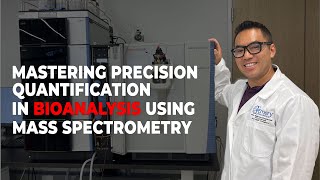
Dr. Andrea Libbe (Associate Director of Chemistry, Emery Pharma) summarizes Emery Pharma's analytical and bioanalytical chemistry services, offering R&D, GLP, and GMP support. The video outlines a typical test-method workflow: selecting sample preparation based on analyte and matrix (tissue, blood, serum, plasma, urine, cell culture media, biomass, plant material), applying techniques such as sonication, organic extraction, protein precipitation, filtration, solid-phase extraction, and derivatization, and choosing instrumentation (HPLC-UV, triple-quadrupole LC-MS/MS, charged aerosol and evaporative light scattering detectors). Benefits of triple-quadrupole LC-MS/MS (very low limits of detection—picogram/mL, faster run times, identity confirmation) are noted. Methods are validated following USP, ICH, and FDA guidance covering system suitability, specificity, linearity, precision, accuracy, LOD/LOQ, and robustness. Contact: emerypharma.com.
Chapters
My name is Dr. Andrea Libbe, Associate Director of Chemistry here at Emory Pharma. We provide our clients with R and D, GLP and GMP support in the areas of chemistry and biology. We routinely develop and validate new test methods and apply them to serve our clients needs. These test methods can be used to analyze pharmaceutical products, raw materials or conduct stability studies. Additionally, these test methods can be adapted to analyze analytes in biological material such as urine or tissue samples from animal or human studies. Let's review a typical test method. The choice of sample preparation and the parameters of the analytical method will depend on the analyte or analytes of interest. Our team of analytical scientists used their years of experience to choose the most suitable approach to get high sensitivity, selectivity and accuracy. Sample preparation is a crucial part of meta development. We work with clients who need sample analysis of animal and mammalian tissue, whole blood, serum, plasma, urine, cell culture media and biomass, and even plant material. For each of these sample types, methods are needed to extract the analyte of interest from the sample matrix and to clean up any substances that may interfere with the analysis. We use a range of approaches to achieve depending on the aniline. This may include sonication to break up tissues, extraction with organic solvents to remove salts, protein precipitation, selective filtration to remove high molecular weight molecules, solid phase extraction, derivatization and other steps. Once the samples are ready, they can be analyzed on the instrument of choice. At Emory Pharma we develop HPLC methods with a range of detectors for compounds that absorb UV light. HPLC with UV detection is a great choice for sensitive and accurate quantitation. We can measure the target compound's UV vis spectrum with a spectrophotometer to determine the maximum absorbance wavelength. This wavelength can be used to detect the compound in the sample. HPLC with tandem mass spec detection or LCMS Ms. Is another versatile tool that allows detection of analytes at low concentrations. Compounds are ionized and fresh, fragmented and specific ions are filtered to detect only those belonging to the analytes of interest. The filtering and fragmentation of ions utilized in a triple quad LC Ms. Instrument has several advantages. These are very low limits of detection for quantitation of the molecule down to picogram per ML levels, faster run times, which means higher throughput analysis and identity confirmation due to characteristic fragmentation of ions in the three quadrupoles. In some cases, other detectors are more suitable for detecting compounds of interest. One example is if they do not absorb light or if they do not ionize well. A charged aerosol detector, as well as evaporative light scattering detectors can be used. These allow us to analyze a broad range of large and small molecules, including polymers, surfactants, and other compounds that are not amenable to detection via hplc, uv, or lcma. Once developed and optimized, our analytical methods are validated to ensure the quality of the results. We follow guidelines from the usp, ich, and FDA for method validation, which include the following system suitability, specificity, linearity, precision, accuracy, limit of detection, limit of quantitation, and robustness. Our team of analytical scientists are ready to assist you with your analytical chemistry needs. For more information, please see our website emerypharma.com.