Bioanalytical method validation vs. analytical method validation by Dr. Ryan Cheu, director of chem.
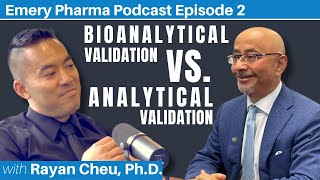
Dr. Ryan Chu explains how bioanalytical method validation differs from analytical method validation, covering instrumentation, sample prep, and the unique challenges of working with rare biological matrices. Regulatory requirements and instrument qualification are central to getting validation right.
Chapters
Let's start with your introduction.
Sure.
A little bit more detail on your background.
No, of course. So my name is Ryan Chu. I'm the director of Chemistry here at Emory Pharma. Prior to coming here, I'm actually born and raised in Honolulu, Hawaii, so. But I got my bachelor's at Santa Clara University down in South Bay in biochemistry. Following that, I did a few years of analytical chemistry work at Genentech prior to sort of being inspired by the sciences and pursuing further education. So I got my PhD at the University of Washington in pharmaceutical sciences. So I am a pharmacokineticist by training. I studied under Dr. Nicole Klatt where we really focused a lot on drug metabolism, particularly in the context of the microbiome. I continue some of that work as a postdoc at the Miller School of Medicine in Miami. But I've been here at Emory for, I think, a little over four years now. So I definitely can relate to the energy that I feel from you every day.
Right. So I think the topic I'd like to focus on today is a question that comes up a lot, whether it's clients or even our internal team. Method validation as it relates to bioanalysis, or method validation as it relates to just analytical chemistry. Can you distinguish between the two and what are the differences? How do you do method development for, say, analytical chemistry versus a bioanalysis method validation? Sure, it's a lot of.
Yeah, there's a lot of things going.
On there, but it's. It's a. It's really a compounding sort of a concept for many people, including myself. But sure, I'd like to explain.
Yeah, there's a. There's a fair amount in that question. But in general, it's important to remember that both analytical, bioanalytical, they're very similar in terms of guidance documents out there, in terms of what you're actually trying to do. That being said, so analytical is the much broader umbrella term. It's really about sort of developing a method that you're comfortable producing reliable results for a wide range of substances, whether it's drugs, compounds, impurities, whatever it may be. Bioanalysis, however, is sort of subsection within analytical chemistry. So it's now looking at sort of quantitation of drugs, metabolites. But unlike analytical chemistry, this subset is doing that quantitation in a biological matrix, whether that's more commonly like plasma, serum. You can even have more specialties such as urine, tissue analysis, feces. So really those are the distinguishing terms. And there are guidance documents for both of these. That are separate for what considerations that you'd have to have for each one of those things. But. But I see the confusion because they are very similar. But really, bioanalysis is a subset of analytical chemistry.
And do you use the same equipment for analytical method validation versus bioanalysis method validation? So can you explain what instrumentation you use, what sample preps are involved, how do you prep your samples, et cetera? Sure.
So there is no guidance specifically for what type of instrument to use. But that being said, for analytical chemistry, typically most companies, most scientists are sticking to HPLC with UV detection. That's usually good enough because you're typically just looking at a single analyte in some sort of neat matrix. So there's not really any chances of potential interference for that subsection of bioanalytical. Because now you're looking at these complex matrices, you could have interference. And oftentimes it's challenging to sort of differentiate between these endogenous matrix effects, so things that are already existing there and the analyte of interest. So therefore, newer technology such as mass spectrometry, particularly one subset of that being triple quads or tandem mass spec, where you're now able to specifically and selectively choose your analyte of interest in these complex matrices. So with that complexity comes differences in sample prep that you talked about. So for bioanalysis, there are many different sample prep techniques, ranging from some very simple protein precipitations to some more advanced separation techniques or isolation techniques, where you're in essence extracting the analyte of interest or the compound of interest from the matrix itself to sort of limit that interference that we're talking about. But back to your original question of instrumentation, you typically would associate analytical chemistry with hplc, UV or uplc, UV and mass spec for more bioanalysis type of work.
So a typical example being, for example, you want to do a method development for a drug, let's say you have an API, active pharmaceutical ingredients, or you have pill. What steps do you go through for that analytical method validation? Sure.
So it often depends if this is a novel API or something that's already out there, and there's sort of USP documents or USB guidances to sort of drive that method development. But in general, you basically would solubilize the API in some solvent that it's dissolvable in, and then you would basically dilute to an appropriate concentration range and run it in your HPLC system. You would develop some sort of relationship between signal that the instrument would give off and concentration. And from there you could do any sort of assessments for impurities or quantitation. It does become a little more challenging once that matrix changes. So you go from that raw tablet to now someone who's taken that tablet and trying to extract that from whatever matrix you're interested in. So that's where that differentiation comes in between analytical and bioanatical.
So is it easier to extract API from a tablet matrix as opposed to API from a blood or plasma or bone or skin? Absolutely. Explain. So some of the intricacies.
Sure. I mean, absolutely. So actually the order you do is actually you would develop an analytical method first. So you would actually go through the process of, hey, just in a neat solution or in a neat solvent, so just the tablet alone, how can we actually detect it? And that method development is a lot more straightforward because you don't have any interference. The only analyte in there is the analyte you're interested in.
But you have matrix in the pill, you have pills matrix.
So typically there are excipients. As you pointed out, the excipients tend to be things that would have much less interference causing effects. A lot of times excipients are chosen for that reason is that they have low effects on the body. They're going to have low challenges with analytical detection. That being said, the same challenges you're faced with for just looking at a tablet or a pillar are now exacerbated in the context or in the presence of a more complex matrix. So therefore any challenges that you have for the analytical, you're going to have for bioanalysis on top of the actual matrix of the biological fluid. So really the process is analytical method development, first sort of avoiding or solving any of those issues you brought up and then moving to bioanalysis, where now, because you've already solved those excipient issues that you said, you now can focus on trying to solve those biological matrix effects.
I hear a lot about matrix effect. You know, can you explain how you assess matrix effect and in the context of a validated method, sure.
So biological matrices are going to have a matrix effect no matter what you do. So that effect could be anything from masking your analyte signal, to enhancing the signal, to suppressing the signal, to interfering with your signal, whatever, it can actually be. So understanding those effects are absolutely crucial to do accurate quantitation. Because if you don't know those things, how are you going to actually tell you what's in it? So a lot of times people can do a variety of different techniques. One of the techniques that we employ here at Army Pharma is recovery studies. So you actually take that biological matrix, you add a known amount of the analyte of interest. So let's say, I say, okay, we're going to have X amount. I run through my analysis. How much did I get out compared to that initial X? So that would in essence give you a recovery percent recovery. So you'd understand what sort of matrix effects you have. That being said, with sample prep, you're going to see a wide variety of matrix effects, fortunately for the bioanalysis guidelines. So this is the M10, which came out, I believe, in November of this past year. They don't actually specify any specific acceptance criteria as long as your matrix effect is something that's reproducible. So even if it's something that, say, suppresses your signal 50%, if you're achieving the sensitivity that you want and It's a consistent 50% that you have an understanding for, then you're in the clear. And then another really good technique is the use of an internal standard. And that really sort of helps you normalize any of that variability that you may see.
I'm sure you've done a lot of challenging bioanalytical type projects here at Emory. Without mentioning any clients names, can you kind of elude to some of the challenges that you have as it relates to maybe rare matrices, rare matrix, or, you know, basically, you know, obviously to develop a method, you try to buy the matrix and put in the API into it and then try to look at your recovery and all that. What if the matrix is very rare or very expensive to buy? Let's say it comes from the eye. Let's say it comes from, you know, a certain part of the body, you know, bone marrow or whatnot. And you want to assess that. How do you do that?
Yeah, no. So what you're bringing up is a very common challenge. You know, oftentimes people think of PK studies or pharmacokinetic studies from just plasma or blood, which is an easily accessible matrix. Right. It's very easy to draw blood from us. We could do that, you know, very, very simply. But when you deal with these sort of unique matrices, so I think you brought up the eye. So we have had experiences using both aqueous and vitreous humor in your eye. So those are extremely difficult to obtain. They are very expensive. So one way to work around that is the use of a surrogate matrix. So in essence, you would have to prove that the sample prep that can extract effectively from the humor, from these aqueous humors can actually do it in this surrogate matrix. So, for example, if I was to say, hey, I have a sample prep a and I can do this in plasma, can that same sample prep effectively work in, let's say, aqueous or vitreous humor? If you can prove that that sort of translation exists, then moving forward, anytime you do quantitation, you're allowed to use plasma as that sort of matrix moving forward. But again, you have to prove that you can sort of translate that methodology. But once that's done, that's a really effective way to sort of work around these rare matrices.
Right. And I understand we're publishing on that methodology soon, so hopefully that will be a publication that goes out with your name on it and some of our other team members.
It's actually under review right now by the journal, so it's been sent off to the reviewing committee. So, you know, we look forward to the feedback from, from the community, the scientific community on that study. But yeah, it was a challenging one, I would say, but we found a viable workaround.
Is there any question that I should have asked regarding bioanalysis and validation that I didn't ask?
You know, I think you sort of touched on, you know, the challenges of those rare matrices.
Right.
But I think oftentimes when people sort of do these bioanalysis method validation, they come into questions about, you know, acceptance criteria, right? So, like, where does those, those things come from? So acceptance criteria is really something that you have to set before you do the validation. It's saying that whatever result of whatever test I'm doing, this is the allowable sort of acceptable criteria for what we would deem as passing or failing. How do you actually come up with those acceptance criteria? It's actually very challenging. So oftentimes people sort of look to these guidance documents and fortunately for bioanalysis, they do have a very clear guidance about what's acceptable and what's not. And again, that's in that M10 document. But on the flip side, from our earlier conversation, you'd asked about analytical chemistry. So in the actual ICH Q2 R1 for analytical chemistry, or, excuse me, analytical method validation, they do not have any acceptance criteria for that. That's something that you define yourself through the studies that you previously do. So it's important to understand your method before you do the validation. Like the validation is not a way to understand your method. You should have a good understanding before moving to validation. And that's going to prevent a lot of problems and a lot of challenges that labs have when they're unprepared because they're not exactly sure how their method is going to respond. So that's an important characteristic to have to know what your method is going to do.
Before, yeah, we talked a lot about validation. Can you just briefly explain why you want to validate a method and why it's important in the context of an R and D method? You know, often you have. We have an R and D method that a client has or we develop, and the client says, oh, you know, I don't want to spend the time know, validating the method. Why is it important to validate the method? Or why is it important to at least take a look at some of the parameters of a validated method? And how is it different with a regulated project where you go through a whole slew of activities to validate the method? So if you could define what it is, what is validation for those of us that are listening and, you know, want to understand validation? Sure.
You know, I think before we get there, a common pitfall, people think, is when something is done under R and D, it implies that it's sort of not as good. Right. That it's a bad method. That's certainly not the case. Right. A good R and D method really can successfully fit the purpose of what you're trying to do, very similar to a validated one. The only difference is that an R and D method hasn't undergone the sort of testing for the. Any sort of robustness or any sort of changes, and it's never been tested against any of that acceptance criteria. So, drawing back to your question, so validation is important because it's really defining is the method that I'm using, whether it's analytical or bioanalytical, is it suitable for its intended purpose? So can it do this? Because I want it to do this. Right. That's the goal. And in order to prove that it can do that, you need to validate it under certain criteria with acceptance criteria to make sure that the results that you generate are accurate, that they're reliable, and most importantly, they're consistent. Right. So you undergo sort of robustness testing to make sure that if anything changes, your method can still do what it was intended to do. And then again, with validation, you test these different parameters to make sure that you have that sort of coverage. Without that testing, the method would be considered R and D strictly because if something were to change, you cannot guarantee without the test that the method.
Can you give some examples in the context of a clinical trial sample that's, let's say, coming from New York, you know.
Yes.
What. What Parameters are involved in making sure that the sample that's taken from, the specimen that's taken from a patient, it actually arrives here. And, you know, what are considerations that you take into account?
Sure. So you're talking about a bioanalysis study here with serum. So the first thing that you would have to think about, or not one of the first things you'd have to think about really is stability, right. How stable is this analyte in serum? So what are the criteria for bioanalysis is stability? How should the sample be stored, how should it be shipped? Following that, things like sensitivity. So now your limit of detection, right. What sort of concentration are you expecting to see in this plasma? All of these things would fall under validation. Similarly, in serum, there's a lot of different proteins, enzymes. Are they going to interfere with your ability to detect this analyte in this person's plasma or bladder serum? There's variability from a biological perspective, right? You and I, very different. You know, you may have in different biological factors that may be playing a role in your sample. Do we understand how that variability in your blood or your serum, how is it different from mine? Is that going to affect our ability to actually do the testing? Those are some of the considerations. There are a handful, obviously more, but it all draws into the ability for you to understand your method for its purpose. And that's why we highly recommend for any clinical trial, you have to validate your method. Because once the trial starts, if you don't have this understanding, how can you stand behind your data as being something that's reliable, reproducible and consistent? You know, so I think even just wanting to add a little bit to that sort of, we touched on that biological variability. So one of the biggest challenges you see with sort of bioanalysis is how do you account for that variability? There are vendors and resources out there where you can purchase human plasma. How do I know that this human's plasma, that, I mean, this donor, let's say, is going to be the exact same? Because as you know, there are tremendous differences both in our genetics, epidemiology, things like that. So one way to do that is you actually can pool multiple lots of subjects or volunteers. Right. So you can kind of get a rough understanding. You know, sample size is another way to sort of do that. You can do spiking studies and that's another way actually tying it back to our, you know, one of your earlier questions about how we can actually assess matrix effects is doing some sort of spiking studies. There are interviews, inter and intra assay variability Studies you can do as well. But really validation is just about trying to encompass everything as best as you reasonably can. So in the event that something potentially unexpected arises, you feel confident that your method can sort of not necessarily adapt, but your method can capture any of those changes and still give you those accurate, reliable results that you need.
So, you know, obviously in the context of a regulatory sort of a method validation on a regulated project, let's say data, it's a safety data that's getting submitted to the agency, or it's a clinical trial data and so forth, what role instruments play and whether the health of the instruments. You know, we often talked about qualified instrument. The instrument needs to be qualified, needs to be qualified. What does that mean? Sure. And, and how does that, you know, what happens if the instrument is not qualified? Does that mean the data is generating as suspect or can you kind of educate us on that?
Sure. So qualified instruments are required for doing any sort of validated work, particularly if you're going to submit these data to regulatory agencies. What it simply means on a high level scale is that your instrument has been tested by some protocol again, so some sort of validation protocol for your instrument now to make sure that it's performing well, that it's accurately and consistently giving the results or the output that it should be giving out. That being said, if an instrument is not qualified, it doesn't mean that the data is poor or bad. There are inherent checks that you can do on instruments. So for mass specs there are performance checks you can do, tuning checks that you can do very similar to performance checks on HPLC modules. But again, qualified instruments are required for any, any sort of testing that involves regulatory agencies. So it's an important factor and something that needs to be done on a regular basis with appropriate documentation, typically from a sort of quality assurance perspective and not something that scientists necessarily are directly involved with.
And what is method suitability? You know, often even if they qualify, it's a qualified instrument. You guys conduct a method suitability. What does that mean? And can you give me an example?
Sure. So you know, method suitability, system suitability, they're very related in terms of that. It's basically a test that you do prior to running your actual sequence. So your sequence here would be any sort of samples or standards or blanks or whatever that's part of the run that's going to give you data. So prior to running that, you need to make sure that your method or your system is quote, unquote suitable. So you would again do this as part of defining your validation. Oftentimes it's. It's doing injections of your analyte, doing that multiple times, having multiple injections, doing that, and making sure in this case that your signal or any sort of peak that's generated, how consistent is that peak area? How consistent is the retention time? So again, when that peak comes out, is it the same size every time? Does it come out the same time every time? And there are certain thresholds that would indicate that your system is performing well. Because if you start seeing variations in response or variation in retention time, that typically is alluding to some instrument, potential instrument issues that you want to get ahead of. Because again, when you have that data generated, you want to be able to say, this is reliable, this is accurate, and you need that system suitability to confirm that, hey, my instrument's performing well. Therefore any data that I'm generating is going to be, you know, again, that. That sort of accurate data that you're looking for.
Very good. Thank you, Ryan. I think this was a great, very educational for me and I'm sure for anybody who's listening to this video podcast, I hope to talk to you about other, you know, potential opportunities where we can discuss perhaps in vitro release testing assays, in vitro penetration assays, perhaps talk a little bit about biologics and what goes into biologics testing, peptide mapping, Perhaps it will be somebody else, perhaps it will be Perjita or others.
No, it's good to have that. I think in general, you know, one of the things that we pride ourselves is, you know, any sort of client engagement that we do is it's the opportunity to sort of teach.
Right.
You know, that's something that's stressed from an early. From early on in your sort of training through graduate school is, you know, having knowledge for yourself is great, but being able to share it with others is actually, you know, a lot, very rewarding. And we value that with our clients and sort of not just generating data for them, but being a part of their story. So oftentimes that does involve sharing information. So these are actually really great. And I do want to add that, you know, any sort of extra details or any sort of additional information from this talk. We actually have a great YouTube video that, you know, that I. That I sort of starred in. So I would suggest, you know, any of our listeners to check out our YouTube channel. We do have a seminar series there and as well as some educational videos. So. But yeah, this was. This was great. So thanks for having me, I guess.
Thank you so much. All right. Sam.
More from Dr.

Hippocrates said, let thy food be thy medicine #obesity #metabolicsyndrome #lustig #shorts #health



Bill Wilson, MD: Why GLP-1 Drugs Are Overpriced—and How Compounding and Competition Could Fix It

Nitrosamine in Pharmaceutical Products? A Deep Dive into Risk Management by Ron Najafi, Ph.D.

The Subcellular Processes That Belie All Chronic Disease. The Hateful (or Grateful) Eight #lustig

Bill Wilson, MD: GLPs May Reverse Carb Syndrome—Helping Patients Reach Zero and Sustain with Diet

Why Everything You Knew About Obesity Is Wrong | Dr. Robert Lustig on Sugar & Metabolic Syndrome

Robert Lustig, MD: How Fructose Fuels Fatty Liver, Oxidative Stress, and Metabolic Disease #fructose

Robert Lustig, MD: The 3 Types of Fat Fueling Insulin Resistance and Disease #insulin resistance

Bill Wilson, MD: GLPs May Reverse CARB Syndrome. Helping Patients Reach Zero and Sustain with Diet