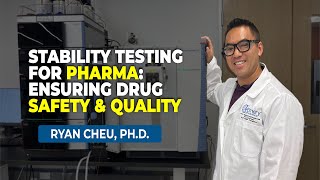
Ryan Chu, director of chemistry at Emery Pharma, explains how stability testing ensures drugs maintain quality and potency over time. The tests measure how heat, light, and humidity affect medications and are required by regulators before a drug can reach patients.
Chapters
Welcome to our Embry Pharma video series. My name is Ryan Chu. I'm the director of the chemistry team here at Embry Pharma. Today I want to talk about stability testing. You know, what is it? Why is it important? And how we here at Emory Pharma can help you along the regulatory path by notably doing stability testing. So to sort of introduce the idea of stability testing, let's say you're going shopping or you're looking at your local pharmacy, your Walgreens, your cvs, and you think to yourself, you know, how do they determine the shelf life of these drugs? Right? Like, how long does it last? Where do these, all these numbers come from? That's what stability testing is. So it ensures the product that you're looking at or you're buying is safe. It's efficacious throughout the life cycle. And we're going to talk about how they determine that life cycle in subsequent slides. In early R and D, when companies are developing their drug formulations, right. How do they know what formulation works? How do they know how long it lasts for? Right. By capably testing stability testing throughout the life cycle, you're able to catch these weaknesses throughout the R and D process early on because you don't want these issues to come up later throughout the drug development cycle. And then finally, why does it matter? This is simply a requirement by global agencies, regulatory agencies, for any product approval. So Emery Pharma, we do this, we can provide comprehensive stability testing for you to ensure your product maintains a high quality and agrees with regulatory compliance. So what does jet stability testing generally involve? Right. So it typically involves monitoring degradance. Right? Does your actual compound of interest degrade over time? Does it get less? What impurities could be forming? Are these impurities potentially dangerous? Are they relevant? What concentrations are they being formed at? As we talked about, stability testing means determining the shelf life. How long is this product stable for? At room temp, does it need to be refrigerated? Does it need to be frozen? In what sort of situation are you able to understand shelf life? Then finally, stability testing is all about generating regulatory ready data. This is going to be submitted for IND packages. You're going to need this information to move forward. So as we talked about, we want to talk about ICH compliance, stability studies, right? So they're typically, ICH designates five unique zones depending on where you plan on manufacturing your drug, where you plan on shipping your drug to, or even plan on storing it. So zone one is really our temperate climates. This is about 21 degrees Celsius and 45% relative humidity. Some notable examples of where this occurs are places like Northern Europe, Canada, some parts of the United States. Zone two is our subtropical climate. So again, about that 25 degrees Celsius, a little bit of lower 60% relative humidity. Again, there's going to be some overlap with Zone one and Zone two, which is why some of the locations tend to overlap that as well with other parts of the US or even now Southern Europe as well. Zone three is going to be a little hotter. Right? So this is our hot and dry climate. So this is going to be a little elevated temperature at about 30 degrees Celsius, a little lower relative humidity, about 35%. So this is places like potentially the Middle east or even places like Australia. Zone 4 is really designated to two separate categories, Zone 4A and Zone 4B. So Zone 4A is going to be our hot, very similar to Zone three, but this time it's going to be our humid areas, right? So now we're looking at 65% relative humidity. This is places like Brazil or even India. And then finally our zone 4B, this is our very, very hot, our very humid climate. So again, 30 degrees Celsius, 75% relative humidity. These are places like Central Africa, Southeast Asia. So here at Emory, we have the capabilities of doing ICH testing across all of these zones, and we ensure that our studies comply with U.S. european and global market regulations. So the question becomes, how long do you want to do these studies for? Right. I can set my drug product at least one of these zone conditions, but how long do I leave it for? So a lot of it depends on what's the question you're asking and what study type you're looking for. So really, there are four different study types you can possibly do. The first is long term. So typically long term is going to be at the most temperate climate, typically our zone one, zone twos. So again, we have an example here of 25 degrees Celsius, plus or minus a few degrees, and then again about 60% relative humidity. This is something where you're looking for a prolonged duration, 12 months past a year, because this is ultimately determining what the shelf life is. So you think about your products at CVS or Walgreens Target. This is how they're coming up with that sort of expiration, that shelf life date. For intermediate study types, we're going to elevate that condition a little bit. So this is now our zone three, zone four. So we have about 30 degrees Celsius, higher humidity, about 65% these are typically done in a shorter duration, about six months. This is really just providing additional or supplementary data if your long term stability data starts to show variability. So it's good to do these studies in tandem. So, so you have always more data, right? You can never have enough data when trying to look at stability studies. Finally, we have sort of our accelerated stability testing here. So this is gonna be at our highest temperature, this is gonna even exceed the 30 degrees seen with zone 4 to actually 40 degrees. We're going to our highest relative humidity at 75% and we're doing this for about six months. Again, really what this is done for is sort of a predictor. This is really gonna tell us what sort of long term stability we can sort of predict. The biggest value is that it's faster, right? We don't have to wait 12 months, 18 months, two years. We can sort of do this accelerated study where we slightly stress the conditions to get a better predictor of how it's going to behave long term. Finally, one of the last sort of study type is going to be our forced degradation. So really this is exposing your drug product to very high temperatures, extremely high humidity, different types of UV light, oxidative stress, acid base hydrolysis, and really this is done sort of as needed. What I mean by that is you're trying to identify degradation pathways. It really is to sort of validate any of your stability indicating methods. So we, we at Emory have a lot of experience sort of ascertaining what type of study is necessary. I would encourage you to reach out to us as we can help you determine what's going to be the most appropriate for your specific study. So finally, what else can we do? Right? So beyond the stability testing, we do have advanced analytical capabilities here along with the ability to develop validated or validate your methods. So all of Our methodologies follow ICH Q2R2 analytical guidelines for method validation, where again, we're assessing a variety of different parameters such as specificity, selectivity, precision and accuracy, sensitivity and method robustness. What types of instruments do we have? Well, we've got a bunch, right? So in terms of our state of the art instrumentation, we have lots of different liquid chromatography based instruments, HPLCs, UPLCs, tandem mass specs, high resolution mass specs. Really whatever you may be looking for, we probably have that instrument. In addition to that, we also have a GCMS with both FIB capabilities as well as headspace for any sort of residual solvent or volatile impurity analysis. You may be interested in we have UV vis spectroscopy if you're interested in any drug release or formulation performance testing. And with our HPLCs we do have ion chromatography if you're interested in counter ion analysis or any sort of excipient stability testing. And just to reiterate, we are a regulatory compliant facility. Our methods comply with Q1, AR2, FDA, EMA, USP and EP requirements. So again, why partner with us? There are a lot of other competitors out there. A lot of people do stability testing. We like to provide comprehensive stability testing where we partner with you. As I mentioned earlier in those zone stability studies. We're not just going to be a lab that just will do these tests for you. We'll walk with you through the process, develop whatever experiments you need, whatever types of tests you're looking for. We have cutting edge analytical instrumentation. We have a lot of experience with impurity profiling and stability assessments. All of the data we generated is regulatory compliant. And yeah, I would recommend that if you are interested, please contact us for any sort of customized tailored stability testing solutions. We have our information here on the bottom of the website as well as in the information below this video. I would encourage you to reach out to determine how we can work together for your stability testing project. Thank you.