Elucidating and Translating The Role of Glycans in Health and Diseases
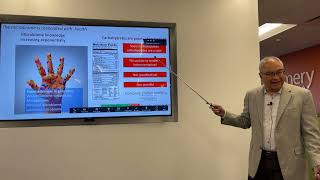
Professor Carly Torrebria (UC Davis) gives a seminar on the importance of glycans (the glycome) in biology and nutrition, explains why carbohydrate structural analysis lags behind genomics/proteomics, and presents high-throughput mass-spectrometry methods his lab developed to profile monosaccharide composition and glycosidic linkages across foods. He demonstrates functional consequences of glycosylation by chemically remodeling cell-surface glycans and measuring altered bacterial adhesion and infection, summarizes work on human milk oligosaccharides (secretor vs non-secretor phenotypes) and their relationship to Bifidobacterium infantis and infant health (clinical translation, Evivo), and describes a plant polysaccharide atlas (“glycopedia”) and a Fenton-chemistry based cleavage method (FitDog) that yields defined oligosaccharides for LC–MS structural analysis and linkage-resolved food glycomics.
Foreign.
Good afternoon, everyone. Thank you for joining us with this guest speaker series at Emory Pharma. It is my pleasure to welcome you all and most importantly, welcome our guest, Professor Carly Torrebria from UC Davis. Dr. Labria went to school at UC Irvine and then he. He moved to the Bay Area to do his PhD at UC Berkeley. And then over lunch, we learned how he took a Trans Siberian Railway to do his Alexander von Humboldt postdoc at the Technical University in Berlin, after which he joined UC Davis, where he has been there for nearly 30 years, more than 30 years now. He has had a prolific research career. He's a standout authority on glycomic research, both on the clinical as well as on the nutritional sides. As you know, probably we won't hear it today, but he has done excellent work to show how glycosylation is a process and then glycans can be used as disease markers, specifically in cancer. His lab has then moved his focus more towards the nutritional side where he's. And I'm sure you are aware of it, but nutritional oligosaccharides, oligosaccharides in our food have a tremendous effect, consequential effect on both nutrient availability as well as down to gut microbiome health. And we are really excited to hear Professor La Brea's take on it. I'm not sure if he's going to include it, but he has also done seminal work in understanding oligosaccharides in human milk and how that can be utilized to develop better milk now that we are in this age of engineered food. So welcome, Professor Labria. We are really excited to hear your talk.
So I'm going to sort of show you some of the more current things that we're doing in the group. I'd like to start out with this slide. And it's important because we know that carbohydrates are really abundant. In fact, it's the most abundant biopolymer in nature. A lot of it is locked up in plants, a lot is in bacteria. And it turns out that in other organisms, and if you think about it in animals and people, we're actually a very small part of it. Right. And so you have the most abundant component in nature. But the big question is, if it's so abundant, why aren't we studying it more? Why are we focused on the genome? Why are we focused on the proteome and not so much on the glycome? Well, it's because it's been very difficult and the methods for Carbohydrate analysis has really not been as advanced as it is for the proteome or the glycome. And it's because it's very difficult. The structures are not like the proteins and the proteins and in the genes, the sequence is the structure. In carbohydrates, there's a lot more than just the sequence. In fact, there's no sequence. It really is a structure. So you really have to determine this like a chemical structure. But it's really important because it's found everywhere. And in humans and in animals, it's found on the surfaces of our cell. So we always like to say that we're sort of sugar coated. We're like M&Ms, right? We have this layer of sugars, but that sugar is really important because all interactions, whether it's with ourselves, with ourselves, between bacteria, virus, happens through that glycan layer called the glycocalyx. And that glycocalyx can be represented in this way. And so you have your membrane and you have the proteins. And these proteins are not just polypeptide chains, but they're modified by these glycans. And so if you have a glycan, that's an asparagine, that's called an N glycosylation, because asparagine is an N. If you have it on a serine or threonine, those are called O glycosylation and those are O glycans. There are also glycans on glycolipids, like glycosphingolipids on GPI anchors, for example. And then there's also free floating oligosaccharides called an hyaluronic acid. And so what we've tried through my tenure at Davis is really to determine structures of these things so that we can understand these interactions here. Right? And just something Even more relevant, COVID 19, for example, will bind to these sugars as they come and infect the cells. So it's a really important part of the process. One of the things that we could do is we can modify the surfaces of cells. So if we go back to that layer, we can change what the cell shows in terms of its glycosylation. So we can remodel it. So, for example, this is a cell line that is. I don't remember what it is, but it's somewhere here. But this is a glycomic profile of this cell line. So what this is is that it's an LC Ms. Chromatogram, which you have Here. And each of these peak represent a structure. And there's about 300 to 400 structures here. And we can annotate each of these structures here. We just annotated the most abundant one. And so the pattern here looks really different because the types of compounds here represent what's on that cell surface, right? So if the glycans are really important, we should be able to change them and affect the characteristics of the cell. And what we want to do is change them in such a way that we're not really changing the polypeptide scaffold, we're only changing the glycosylation. We could do that by a series of inhibitors. So for example, if we add this inhibitor, which is a modified sialic acid, with a fluorine here, what we can do is we can shut down sialation. Sialated products come in the later part of the chromatogram and you can see that they all disappear. And so now we have a cell line. They look very similar, but now there's no sialic acid. It's missing one type of sugar. We can do the same thing with fucose. There's another sugar and we can shut it down. And so now we have no. I'm sorry, this cell line has no fucose. And if we feed it fucose, we can fucosylate it. So now we have a fucosylated oligosaccharide on the surface. If we add in this combination the fluorine, sialic acid and the fucose, then we've shut down sialation, and now we can only have fucose. And if we feed it this inhibitor, we can shut down the production of complicated oligosaccharide or complex type structure. And now we only have this. So now we have a system for varying what the shell of this sugar of the cell looks like and figure out what are the different properties. And we've done this with different cell lines, and I don't talk about it here, but if you take a cell line like this, and it's a cancer cell line, and if you make it like this, then it's more metastatic, right? The cells travel faster, they migrate more easily, and. And they spread from the tumor a lot more quickly. So changing just the glycan, not the protein, has profound effect on the properties of the cell. So now we have these different coating in the cell, and the question then is, how do their properties differ? And one way you could look at these things is by how they adhere to Bacteria such as Salmonella. Right. So different cells, different cell types have different glycosylation. And so that would also mean that if we have different cell types and different glycosylation, the infection will be different for these different types of cells. Okay. And so now we have these different cells, and we can sort of look at how they interfere with adhesion. Right. So in this case, for example, this is our control. Right. And if we change the glycosylation to, let's say we have just this type here, you could see that the adhesion goes up. Okay. So we've made this cell type more adherent to different type of bacteria. If we change it in such a way that we have this glycosylation, then we've made the cell more easily invaded. Right. So again, we didn't change the polypeptide surface here. We've changed only the glycosylation. And yet we've changed the property of the cell by making it a lot more easily infected or less infected by changing the cell. So this is just to illustrate. So this is actually data from my lab, but it just illustrates to you how changing the glycosylation can really affect the properties of these different cells. Again, these are just more experiments here. Yeah. So we're looking at, in this case, salmonella infection. We've looked at different types of infective agents, and they sort of behave differently. So, for example, in some cases, when it's highly silated, you'll get better infection. In some case, when it's fucosylated, you get better infection. But in this particular case, we see that fucose will actually affect the glycos, the invasive properties. So one of the things that we did was can you prevent a bacteria from binding? And in fact, if you add in fucose, so this is just the free monosaccharide, you see that initially that it adheres, but then eventually you could titrate it out so that the invasion or the adhesion actually decreases. And so we can do these types of analysis. All right. So that's actually just a sort of an introduction to why glycosylation is important and how if we change the glycosylation, we can actually change the properties of cells. Right. Because what I want to talk to you today about is not the aspect of diseases, but I want to talk to you about nutrition and food. Food is getting looked at in very different ways today than it was even a few years ago. There's a lot of omics, methods, that can do this. The genomic revolution has also touched food. But one of the big issues with food is that we haven't really looked at the carbohydrates very well. So you know that we can sequence microbes, we can do metagenome, we could tell the families, we could tell all the different types of microbes that are there. And the microbes from what we found interacts with the carbohydrate. So microbes are one of the most abundant organisms in nature. You have the most abundant polymer in nature and it would make sense that they would get together. Right. And so we've made advances in this part, but what the microbiome interacts with in the food are the carbohydrates. And the problem is carbohydrate analysis is quite primitive to say, you know, to use a crude term. So we haven't updated carbohydrate analysis. A lot of it was developed in the 60s, very sort of slow step wise process. A lot of it was not quantitative, it's not very specific. So for example, we can do protein profiling on microgram, but to do monosaccharide composition you need almost grams, right? And so carbohydrate analysis has been really quite poor. And as I've said, we can sequence the genome quite well. So you have, in the old days you had the Sanger sequencing and today we do next gen sequencing and we can do many genes at once. Edmund Degradation was in the old days single peptide sequencing and now we can sequence multiple proteins at once with carbohydrate analysis. Until recently it hasn't, we haven't really progressed as much. So we go back to the Hakumuri method which permethylates it and breaks it down and then you do GC Ms. But what we've been trying to develop in our lab, in the community in general is really next generation glycomic where we can do fast and rapid throughput methods to look at monosaccharide analysis and linkage compositions. Right. And a lot of it requires a lot of advanced mass spectrometry. So my lab, we're primarily a mass spectrometry lab. These are the kinds of tools that we have, as I mentioned earlier, we used to have old FTICRs, but now we have orbit traps to give us the high resolution, we have QTOF to give us the sort of a profiling. And for quantitation we use triple quads. And so one of the earliest things that we've looked at with food is human Milk. Right. And this is sort of a method that we've developed over several years. And this is sort of the epitome of this method. And what it is, is it's a. This is an LC Ms. Chromatogram. Each of these are a single peak. And if you've noticed, we've annotated a lot of the structure, so we can monitor 300 structures and we know about 100 of them. Exactly Right. And when you analyze the milk of mothers. And so this was our first foray into food, Right. Because we realized that food was really important in early nutrition, and even adults, of course. And so mothers produce these oligosaccharides. And one of the mysteries of this was what do they do? So there was a lot of theory about why there was human milk oligosaccharides, but until you can get what the structures were, you couldn't really test those theories. When you started looking at the analyzing these oligosaccharides, what you found was that you can separate mothers into two phenotypes. Right. So if you're one type of mother, you will produce these oligosaccharides, which has these two fucosylated species. That's the. A red triangle that's pointed down that tells you it's a one, two linkage. On the other hand, if you're a different type of mother, you don't produce that in very large amounts, if at all. And so these are the types of oligosaccharides that you would produce. And so we can phenotype mothers into one or either one of these groups. So does oligosaccharides. Do they each have a unique mass? No, they're isomers. How do you identify them? The tandem Ms. Is quite unique. The retention time is quite unique. And yeah, mainly retention time and tandem ms, a lot of them have different masses, but there are isomers. So. So, and that's what makes carbohydrates quite difficult compared to metabolomics and proteomics. In proteomics, there's no isomer. In metabolomics, there may be a few isomers, but not very common. But in carbohydrates, if this 1, 2 fucose is 1, 3 fucose, it would have identical masses. The fragmentation will be somewhat different and the retention time will be somewhat different. Right. And so that's why we needed to do separation. Okay. But so once you have a profile like this, what we did was we started throwing it at bacteria because one of the theory was that this was food for the gut microbes. And what we found was that there was one bacteria, this bacteria, Bifido infantis, had all the enzymes to break up oligosaccharides, but it didn't break up bacterial oligosaccharides, it didn't break up plant oligosaccharides, it broke up human milk oligosaccharides. And so this bacteria had actually evolved with us to be fed by the mother. So what we did was we're part of this big sort of project by the Gates foundation to look at milk from different parts of the world. We looked at it from North America, which disappeared here, and then Asia and Africa here. If you look at the red, here is one phenotype of that I showed you. And the blue is a different phenotype. The, the blue are called secretors. So if you secrete your blood type in your milk, in your saliva, then you're a secretor. If you don't secrete your blood type, then you're a non secretor. Okay? And it all depends on this structure. This is called 1,2 fucose. So if you're so your blood type will have 1,2 fucose. And if you secrete your blood type, you're a secretor. Okay? So that's the marker for the secretor. And it's almost 100%. If you're a secretor, you will have this. If you're a non secretor, you either will not have this or very little amount of this. All right? And so if you look at different parts of the world, we used to think that there were 20% non secretors, but that's because we mainly studied American and European milk. Okay? But if you studied milk from different parts of the world, like In Brazil, it's 36% non secretors. If you go to India, it's about 35% non secretors. Right. And then Bangladesh, it was about 20% non secretors. These are just, you know, individual sites. But if you go to the Americas, the US about 22%, very similar to the European. But if you go to South America and look at some indigenous tribes, there are no non secretors. And if you follow the path of human migration, so this is where Africa was supposed to be, you go through Asia. The Americas were the last places that we populated. Right. And so that means that as we traveled all the way here, certain population was wiped out. The secretors were wiped out from South America. And you can ask yourself what would wipe out a population? Diseases. Right? So it turns out cholera. If You're a secretor, you're much more robust, you have a much more robust response to cholera than a non secretor. Well, why are there non secretors then? Well, virus seems to be non secretor, seems to be less affected by virus. So for example, the hiv, more secretors relatively get infected with HIV than non secretors. So there are certain diseases that if you're a non secretor, you're protected and other diseases where if you're a secretor, you're protected. Right. Again, the importance of carbohydrates in this case. And so what we did was as we studied human milk, we studied it because we were able to separate it. One of the things that we and our collaborators found is that in developing countries, this bacteria is disappearing. So in the US only about 10 to 15% of infants have this bacteria in their gut. If you go to underdeveloped countries, it's an 80%. And so antibiotic use and things like cesarean section, these types of action will decrease this bacteria. And once it decreases, and the mother is sort of the sort of the keeper of this bacteria, and once it disappears, then it disappears in future generation. Right. And so what we did was we actually decided to start a company to bring back this bacteria. And so the company is called Evolve, it's now called Infinite because the sort of the effort, the focus has changed. But you can buy their product Evivo, you can get it on Amazon, and it's being used in a lot of clinical studies. One of the things they found, for example, is that in the Oregon health system, they were using this, the nicu, and necrotizing enterocolitis is the second leading cause of death in the NICU for preterm infant. When they used this, they found that they can totally eliminate necrotizing enterocolitis from their cohort of babies. And so this bacteria will actually acidify the gut. In the early industrial revolution, infants had a ph of their feces of about 4.5. Today, infants have feces of about 6.5, almost close to 7. When the gut is acidified, things like E. Coli can't compete. Okay, so at low ph, this bacteria thrives, whereas all the pathogens are so diminished. So you also diminish antimicrobial genes with this. It turns out that you also sort of modulate the immune system, so you make it. So autoimmune diseases also then diminish. And so this is actually an active area of research. There are several clinical trials ongoing, but in the meantime, it's also available for Sales. We thought mammals are so clever. We take advantage of this non digestible fiber that mothers produce so that we can use it then to get a bacteria to babysit our infants. That is very clever. And we thought we were unique until we started looking at this plant. Right. These are land raises in Mexico. They're really tall plants. They're like 10ft tall. And if you look at, they have aerial roots. If you've ever seen corn, they have roots up in the air. Well, this root secretes a mucin, right? And what this mucin does is that it attracts a nitrogen fixing bacteria. So the nitrogen bacteria gets attracted and the bacteria actually eats the mucins, it falls to the ground and then it fertilizes the plant very much like what the infant is with mother's milk. Right. So the strategy of using bacteria to help you has been around for a long time. And in fact, plants were doing it. And so one of the things that we did, our project was to try to figure out what the structure of this mucilage was. And so again, human arrogance. We thought human milk oligosaccharides is really difficult. And in fact, it's so difficult that it took us 80 years to figure out what all the structures were and then figure out what it did. Well, this is the plant version of milk oligosaccharide, and it's far more complicated. And so the question then is, how do you elucidate this structure? And so what we did was we systematically went through it, we took this and we sort of. We broke it apart using acid hydrolysis. And then we went in there and actually systematically characterized these things, just like we did with the human nuc oligosaccharides. And then what we came up with was that this is the structure for this polysaccharide. So what's unique about this? It has a lot of fucose. It's almost like mother's milk. Mother's milk has fucose. That's this red triangle. And this one has it. Also, if you eat bread, rice, or any of these things, there's not a lot of fucose. Fucose you only find as a food in breast milk and then never again. Right. So we have other stories about that too. We just published a paper recently that it turns out that fucose actually gets incorporated in the brain. So it's important in brain development, but it's also, you can perhaps use it for Alzheimer's, because when you have circulating fucose in the brain and it actually Rescues damaged neurons. So there's a lot of interesting things going on here. But anyway, we developed this method to determine the structure. And so when we were doing this, we were looking for methods that could help us analyze these plant polysaccharides. And it turns out that there was none. The method for analysis of carbohydrates involved per methylation and GC mass spec. It took weeks for you to do that analysis. It was very slow. And you couldn't do it like on a 96 well plate. Right. And so this is where we thought, let's try to redo the analysis of plant carbohydrates. Okay? And really, when you're looking at plants in the carbohydrates, it's not the genome anymore because these are all these plants all have the same genome, but they clearly are very different, right? You can just look at them and say they're different. And so you can do this throughout all kinds of vegetables that have all the same species but have very different properties. So the gene is not enough. We can't just characterize the genome of plants. We really have to understand their metabolites, right? So this is human milk oligosaccharide. And we said it was very complicated. We can separate into two phenotypes. And so. And again, it took us a long time to figure out what they did. What do plants do? What do plants polysaccharide do other than give us glucose? They actually do other things. And so to understand what they are, we have to know what their structures are. But if you look at the potato, the potato is actually far more complicated than human milk oligosaccharide. The lowly potato actually has much more complicated structures than the human milk oligosaccharide. And so the question is, also, if we know that there's a complement microbiome to human milk, is there a complement microbiome to the potato? Is there a complement microbiome to rice, to bread, to broccoli? Right. Or whatever polysaccharide there is. And the only way we could do that is if we know what these structures are. And so we went about characterizing these things. Not only do you have to know the polysaccharide, you also have to know the monosaccharide and the oligosaccharides. Right? But we also need to know the polysaccharides. And so over the years, we've been systematically characterizing the glycome. We could do free oligosaccharides in human milk. Oligosaccharides, we could do N and O glycans, we can do glycoproteins. Now we can do intact glycosphingolipids or glycolipids. The last frontier for us was can we do carbohydrates? It turns out no one can do carbohydrates. To do one carbohydrate structure, if you found a new one, would take several groups, lots of NMR and years to actually just figure out what the structures are. Right. So we wanted to speed up that process. All right, so the method that we came up with is to first, let's say you have oligosaccharides or polysaccharides. One of the first, the easiest way to determine the structure is to do a monosaccharide composition. And then we need to do, after we do the monosaccharide composition, we have to figure out what the glycosidic linkage is. And the glycosidic linkage is really how if you have two glucose, is it alpha 1 4, is it beta 1 4, is it 13121 6? So there's many different possible combination, but what we need to do is try to figure out what those linkages are. So what we need just to characterize the carbohydrate first is to give you the monosaccharide composition really crudely and then the glycosidic linkages that are involved. And so our method now is rapid throughput. It's on a 96 well plate and it goes like this. So you take your polysaccharide, you do an acid hydrolysis to give you the monosaccharide, we label that with this derivative pmp and then we get something like this, right? And then what we'll do is we'll do LC Ms. Using mrm, right, With a triple quad. And when you do that, then what you get is that this is fructose, this is rhamnose, this is ribose, this is glucose, lacturonic acid, xylose. And you can see, so we can do this. If you can see this, this is zero, this is one minute. So it's like a four minute run in this process. We can automate it. We now use robots to do this. And so now we've just increased the speed. We can look at food from the monosaccharide composition. This is the mass spec, we use a UPLC 96 well plate. We do MRM, get the precursor ion, get the fragmentation in the production. And this is the kind of thing, monosaccharide composition that we can have use area under the peak to quantitate. Right. And then we create calibration curves. So this is quantitative absolute quantitation. Okay. On a seven minute run. So this is our method. This is the current method. So this takes about three days of preparation. And that's sort of sequential. Right. Ours, if we want to do 100 plates, it'll take two days. We have to derivatize. Our limited detection is femtomol instead of micromole. We could do this on a 96 well plate. The separation time is 2.2 minutes instead of 33 minutes. And 100 samples will take you three and a half hours, whereas here it'll take you 53 hours. All right, so what do you get when you do this and you look at, say 2,000 foods? Well, now for the first time, you can look at 2000 foods. What this is, is so blue here is glucose. And each of these lines stands for one compound. Right? And so what you can have is you essentially have a, what we call our glycopedia of foods. Right. And so if I take this cutaway view here, so this is at the 50%, you can see that say, you know, we essentially went to all the markets, including the ethnic ones. And so some of this I don't actually know, like what's a. I know what a hayashi persimmon fruit is, but I don't know what a sugo long cucumber flesh is, for example. And so we also looked at like the peel and so on. So this is sort of a misnomer. 1500 foods here means different parts of the food also. But you do get different types of things. But what's more important is that you do get something like this where you can determine the amount of glucose, the amount of ribose and so on. Right. So now we can do this. We can characterize food. And this is now the linkage of the same monosaccharide. So the way we coded this is that blue is glucose, but if it's a dark blue, it's a terminal glucose. If it's a lighter blue, it's 14 glucose, 1, 3 glucose, and so on. So just different types of linkages. And you can do the same thing with arabinose, fucose, rhamnose, and so on. So this is now essentially every food that we could gather. And you could see that we can characterize it now in really this manner. So now you can actually group foods according to their monosaccharide composition and their linkage composition. So you can have, for example, this here. These are mainly things that are high in, I believe, galactose or glucose. Yeah, these are galactose. There are things that are rich in glucose, starches, for example, and so on. But you can get this kind of information and this condemned sort of guide diet. Right. I was at a conference and they were doing this study where they were feeding. These clinical studies are expensive. And they were trying to figure out what's the best way to help malnourished children. Do you feed them lentil or do you feed them garbanzo beans just so that they can get the right microbiome? Well, why would you pick lentil and garbanzo if you don't know what their structures are? And so now you can use this to sort of guide clinical trials as to what you should be feeding and why. Right, so now we can. The monosaccharide composition, for example, for starches like amylose and amylopectin, we can figure those out. And then the linkages then will also help us sort of figure out what the polysaccharide compositions are. Right. But as importantly, we know from human milk that a certain microbe has enzymes that will cut up a certain linkage. So what that means then is that if you're eating cucumber and you eat cucumbers regularly and cucumbers have a certain structure, you start to build up a certain bacteria that will favor digesting that cucumber, right? Well, how would you know that? Well, you could look at the enzyme on the cucumber, which you can. I mean, on the microbe, and you can match that to the linkages that are here, and you can actually figure out that combination of cucumber and microbe. That's why you have thousands of bacteria in your gut, is because humans eat a large, diverse amount of different things. And if your gut is healthy, what this means then is that you have a nice correlation between the kinds of things that you eat and the microbes in your gut that are breaking down that fiber. And that's why fiber is important. All right, so this is sort of interesting because rice, as you would imagine, is mainly glucose, right? Especially when they take out the bran. The bran is actually much more interesting because the bran will give you the much more complicated saccharides. But when they. When they mill it, you get this primarily. So what this tells you then is that it's mainly starch because it's 1,4 glucose. And this is terminal glucose. Right. However, one of my collaborators brought this rice from Italy. This is a black rice and this is unique because it has starch, but then it has this 1, 3 linkage. So the microbiome that this, if you were to eat this rice all the time, your microbiome will be quite different because you have this one linkage here that aren't present here. Right. So I think in the future we're going to be able to direct which microbiome we want by the food that we eat. Okay, so how many of you here have done proteomics? Yeah, we've done some, right? We know that the magic recipe for proteomic is addition of trypsin because it cleaves and gives you peptides. There is no trypsin for carbohydrates. And the reason for that is because if you have a mannan chain versus a glucose chain, it's a different enzyme. Right? So there's no one enzyme to do it. And so this is part of the reason, actually the main reason, why we don't have proteomics for glycomin, for carbohydrate, because we can't cut it up, we can't stick it into our mass spectrometers, we can't even make it soluble. So one of the holy grails of this is can we get an enzyme that will break down any oligosaccharide, any polysaccharide? And so we came up with a method that we call FitDog, which is Fenton's initiation towards defined oligosaccharide group. So we call our method fitdog. And what it is, is it's a Fenton based chemistry. Fenton is 100-year-old chemistry. And what we did was we optimized it so that we can get from a polysaccharide, defined oligosaccharide. So it's actually very specific for that. The product that you produce is very specific for that polysaccharide. And so now we have these short oligosaccharides. Now we can go crazy with the LC ms, right? And this will work on any polysaccharides. And so now all we need to do is determine these structures and then we can reconstruct what that is. But we can also take a known one and we can quantitate. Do you know how they quantitate polysaccharides? Right now they weigh it. Right. And so now we can do this with mass spec. And everybody knows mass spec is always superior Right. That's not just a mass spectrometrist talking to you. But okay. Anyway, all right, so this, for example, is beta glucan. Right? Beta glucan, heart healthy, found in your oats. If you do a fit dog process of that, this is what it looks like. This is actually, in this case, I believe it's a mixture of. Yeah, Anyway, Right. So now, previously, you can't take a mass speck of this. Now you can. And these are characteristics of beta glucan. So if we see beta glucan and other food matrix, these peaks will identify that. So these are different polysaccharide. This is curdlan, cellulose, amylose, galactan, manan. You can see how each of them has a very well defined signature. Right. And then. So this shows you that there are isomers, I believe, and we can, of course, separate those out, and then we can determine what the composition is. And so here is then a. This is wheat bran. And we've done the fit dog process on this. We've characterized this. And what we figured is that it has amylopectin and amylose. It has cellulose, something that I can't read, xylans, arabinoxylans, arabanans. But it didn't. But. And some beta glucan. You see that for the first time, we can tell you what the composition, the polysaccharide composition is of whatever it is you're eating. Why is that important? Because there's a microbe that will eat this with a specific enzyme. And so if you're eating wheat bran a lot, there are microbes that will break that down for you. Okay. Oat bran will look like this and so on. So we could do this. So coconut flesh has this yellow. Cornmeal is mainly amylose. Yam leaves is amylose. Arabinoxylan. Bok choy leaves is amylose, arabinoxylan, cellulose, guava flesh. One of the things that we find is that there's cellulose in everything. Right. And so I think, particularly foods that are supposed to be good for you, like artichoke, cauliflower, or broccoli, they're rich in cellulose. And I think the reason why they're healthy is because they just displace starch, and so you can't digest them. And so you're essentially eating paper. Right. So which is not a bad thing. Right. Because then you're not eating starch. All right, so this is. I have here. This is artichoke the outer leaf, you can see this is mainly cellulose. So we broke down this artichoke here, but we also didn't tell you what's all the different polysaccharide that's in there. Right. Baby broccoli leaf is mainly cellulose. Again, good for you, because you can't digest it and so on. So you can. You can quantitate now, because we can put in standards, we can do LC ms, and then we could tell you precisely how much cellulose, how much starch there is for the first time in what you're eating. Right. And so the other research that we're doing then is, so now we've made all these bioactive oligosaccharides. What do they feed? Well, so this is a study by my collaborator, David Mills. We gave him all these different oligosaccharides, and he fed them. And we find that depending on the bacteria, they will eat different types of oligosaccharides. Right. So now we can actually personalize your health. We could tell you which polysaccharide you should eat based on what bacteria you have, or vice versa. If you want a certain kind of bacteria to proliferate because they're good for you, then here's what you should be eating. Right. So I think the future of food is really, you know, determining what these structures are. So with that, I'm going to end. This is the picture of my group pre Covid. We keep forgetting to take new pictures. So all these people are actually mainly gone, and also all the funding agencies that have brought us here. And that's all. Thank you. It.
More from Dr.

Hippocrates said, let thy food be thy medicine #obesity #metabolicsyndrome #lustig #shorts #health



Bill Wilson, MD: Why GLP-1 Drugs Are Overpriced—and How Compounding and Competition Could Fix It

Nitrosamine in Pharmaceutical Products? A Deep Dive into Risk Management by Ron Najafi, Ph.D.

The Subcellular Processes That Belie All Chronic Disease. The Hateful (or Grateful) Eight #lustig

Bill Wilson, MD: GLPs May Reverse Carb Syndrome—Helping Patients Reach Zero and Sustain with Diet

Why Everything You Knew About Obesity Is Wrong | Dr. Robert Lustig on Sugar & Metabolic Syndrome

Robert Lustig, MD: How Fructose Fuels Fatty Liver, Oxidative Stress, and Metabolic Disease #fructose

Robert Lustig, MD: The 3 Types of Fat Fueling Insulin Resistance and Disease #insulin resistance

Bill Wilson, MD: GLPs May Reverse CARB Syndrome. Helping Patients Reach Zero and Sustain with Diet