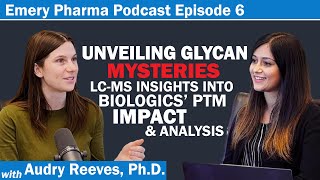
Podcast episode where Dr. Ana Najafi (Emory Pharma) interviews Dr. Audrey Reeves about glycans: what glycans are (sugars that form branched, protein-linked post-translational modifications), why they matter for antibody-based biologics (can alter immunogenicity, efficacy, and proteolysis), analytical advances (high-resolution LC–MS/Orbitrap enables identification and site-localization), engineering challenges (cell-line genetics and culture conditions), and emerging applications (glycan-targeted cancer therapeutics).
Chapters
You might be familiar with, you know, your blood sugar levels and kind of that relationship, that glucose place, you know, with your blood, maybe diabetes. So even by itself it's, it's pretty widely known that sugar plays a really important role.
Good morning everyone. My name is Dr. Ana Najafi. I'm the director of strategic pharmaceutical development here at Emory Pharma. Thank you for joining us for Emory Pharma's podcast series. I'm joined here by Dr. Audrey Reeves. Today we're going to be talking about all things glycans, ADCs, mass spec. Dr. Reeves, maybe you could start off with just an introduction on yourself.
Thanks so much, Anna, for that nice introduction. My name is Audrey. I studied chemical biology at Berkeley. I graduated about a year and a half ago and my focus there was on post translational modifications. I did a lot of synthetic chemistry and mass specific. I kind of spearhead a lot of the high res mass spec here at Emory Pharma. But I also have a lot of experience in industry studying glycans as well. They're very interesting post translational modification as you know, we'll get into today and I'm really excited to talk with you about these topics. Thank you.
I'm really excited also. So I thought we could just start off with if you could tell our listeners, you know, what is a glycan and why are they so important for us to study.
Of course, glycans are really just a fancy way for scientists to say sugar. So even the sugar that you're familiar with, you know, that you stir into your coffee, so that's glucose, you may be familiar with that. And there's actually quite a few different other types of sugars that you might be less familiar with. Some of them can have just weird different chains and they play just a really important role in our body. So going back kind of to glucose, the one that most people are really familiar with, you might be familiar with your blood sugar levels and that relationship that glucose plays with your blood, maybe diabetes even by itself. It's pretty widely known that sugar plays a really important role in our health. But it's actually a lot more complicated than that as a lot of science is. But to start out on this, glycans, they don't only just float around in our blood like glucose, they can actually make some semipermanent bonds with the proteins in our body. And those are called post translational modifications. Those are modifications that happen after a protein has been made. It's actually not even as simple as glucose binding to a Protein. What makes glycans so special, interesting and challenging is that they can bind to each other and form these really strange. The term that we use is branched structures. And I kind of wrote down a really interesting example that I personally think is pretty interesting. But you can imagine the protein as kind of the soil and the tree trunk of your glycan. This one in particular that I'm talking about is a sugar molecule called galactose, and on top of that is one called Glcmak, and on top of that is another galactose, and on top of that are two more different glycans, Galnac and Fucose. So that's really complicated. Right. And that's actually one of the more simple ones. And that's actually what. So if you are a type A blood like me, that's what makes you type A, is that glycan. And that is, I really like to use that as kind of an introduction to how glycan, how important they can be, even how complicated they are. So you might also be familiar if you were to give, you know, if I were to get type B blood infused, that would be really bad for me. Right, right. Immunologically, exactly. Your body just mounts this attack. It recognizes this as foreign. But the only difference between type B blood and type A blood is one glycan. So type B blood is that same really long structure I outlined. But one of those glycans at the top is different. That's the only difference. And that can result in someone, you know, dying from receiving the wrong type of blood.
Right.
Which really to me just emphasizes how, how important these glycans can be in our bodies.
Yeah, it sounds like these little sugars can have a really big impact on our body in general. So how do glycans play a role in the design efficacy of antibody based therapeutics?
Yeah, thanks for bringing that up because that's something that we are really interested in. Emory. A lot of antibody based therapeutics or just other sort of biologics. Because biologics such as antibody based therapeutics are composed of amino acids that makes them susceptible to post translational modifications when they're inside of a living system, whether that be a patient or the system that you use to generate that antibody, such as a CHO cell or a yeast strain. This is still a really active area of research, but in regards to glycans on these sort of biologics. But there's definitely been some really interesting trends. Some of them make a lot of sense. If you've engineered an antibody in a non human strain and you get non human glycans on that antibody, that can result in heightened immunogenicity inside the patient, insufficient efficacy. So it's really important to monitor those sorts of things. And alternatively, the presence of certain glycans has actually, on these biologics, has actually been observed to slow proteolysis of the generated biologic, which, you know, is really, really great if you're working to design these types of medicines.
Right. So it sounds like they can be favorable or unfavorable depending. And especially, you know, when bringing immunogenicity into the picture, it sounds like they're generally unfavorable in that situation. What would you say are the challenges when challenges associated with engineering glycans? You know, I know you mentioned, you know, cho cells and depending on the cell line, but you know, especially when it comes to optimizing ADCs.
Right. So that's a big thing about glycans. And I think why the field still kind of feels in its infancy is because they are so challenging in there, or so almost chaotic in the way that they can kind of form. It's been challenging to analyze them until semi recently when mass spec has kind of caught up to that sort of analysis. In a way, that variability makes them really challenging to observe by other standard techniques. And on the other hand, generating these biologics with the glycans in desired locations requires the generation of very specific cell lines to be able to place those glycans where you would like them. So it's kind of a complex issue on a couple of different ends.
Right. That's interesting. So depending on the cell line, you may, you know, you may choose to go with one cell line because it's more geared towards producing a more favorable glycan. Is that fair to say?
Yes. In a way, you actually end up having to add the required genetic machinery to the cell line. To the cell line. Exactly. To be able to upregulate that machinery and add the type of glycans. And perhaps you need to feed the cells a certain type of food to give it the sort of glycans that you're wanting it to have as well.
Very interesting. So maybe you could discuss some of the recent advancements and techniques for analyzing and characterizing glycans. I know that mass spec is extremely favorable. Why is that?
Yeah, mass spec's definitely the gold standard when it comes to analyzing glycans. You'll see a lot of work in the glycomic sphere. That's where the glycans are actually intentionally removed from the proteins before analysis. And that gives us really good analysis, really good information on what glycans you have. But in my opinion, even more powerful than that, we can see both what glycans we have and where they are on our proteins. So we get that localization and structure of glycans at the same time. And that has required these high res mass spec instruments, just like our thermo based orbitrap that we have here at Emory Pharma that allows us to analyze these post translational modifications such as glycans on peptides within these complex matrices such as blood or serum. We're able to identify these post translational modifications.
I have one last question for you Dr. Reeves. Besides therapeutic antibody based treatments, what are other areas within biotech where the importance of glycans is gaining recognition and what potential applications do they hold?
I'm so glad you asked that question because I'm really, really fascinated with this area right now. We're in a really exciting time. Like I mentioned, glycans, the field still feels almost in its infancy as we've acquired these techniques to analyze and learn more about them. One that is of particular interest to me that I have a background in is cancer based therapeutics. It's been really well studied that glycans are just weird on cancer cells. They're much shorter, they're truncated compared to healthy cells. And that's been used by a lot of different people to try to use that to target cancer cells selectively because that makes them different from healthy cells. Right.
So they can be used as a target and also as a therapeutic. That's very interesting.
Exactly.
So it sounds like glycans just have a whole, you know, realm and field dedicated to studying them. They can be very, very complex. Well, thank you so much Dr. Reeves for taking the time to speak with me today. I know our listeners, our clients learned a lot from you. You know, for any glycan ADC related inquiry, bioanalysis services, as well as just mass spec services in general, please contact infory. You can also reach out to us via our website and submit a request for proposal.