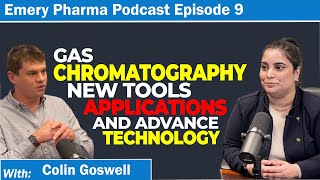
This content was created by Dr. Ron Najafi. This content was uploaded by Dr. Ron Najafi. This is a YouTube video titled "Podcast: 9 Gas Chromatography Uncovered: Theory Meets Application #analysisservices #gcms #chemistry" featuring an educational podcast episode recorded on February 5, 2024. The discussion is led by Prazitha Pandey, Assistant Director of Chemistry at Emory Pharma, and Colin Gazelle, a research scientist specializing in analytical chemistry. They explore the principles, detectors, and real-world applications of gas chromatography, particularly focusing on GCMS and GCFID techniques.
Chapters
Second way a sample can be introduced is by headspace sampling. And what that means is the vial itself is heated and the volatile compounds within the sample are vaporized. And then that vapor is injected directly into the GC column.
Welcome everyone to another educational episode of Emory Pharma podcast. My name is Prazitha Pandey and I'm assistant director Chemistry at Emory Pharma. I'm an analytical scientist with a background in proteomics and metabolomics. Today we have a privilege about learning a gas chromatography, which is a widely used technique across various industries. With Mr. Colin Goswell, why don't we start with your introduction.
Thank you, Brigitte. Yeah, like Brigitte mentioned, I'm Colin Gazelle, a research scientist here at Emory Pharma, specializing in analytical chemistry. Gained a bit of an expertise in various analytical techniques and instrumentation, one of which being gas chromatography, topic of today's discussion. And with today's discussion, like to kind of dive into the principles what gas chromatography is, some advantages it has to offer and some of the real world applications. So yeah, with that, excited to kind of dive into the world of gas chromatography.
Thanks, Colin. To begin our discussion, can you please describe what is gas chromatography and what's the principle and how is it used?
So gas chromatography is a very, I would say, powerful analytical tool to separate and analyze compounds within a mixture. Kind of operates on several fundamental principles. First being that the sample must be vaporized before it is injected into the GC instrument. That can happen in one of two ways. First way is just a direct liquid injection where alipod the sample is directed into the GC inlet which is heated and vaporizes a sample before it's introduced to the GC column. Second way a sample can be introduced is by headspace sampling. And what that means is the vial itself is heated and the volatile compounds within the sample are vaporized. And then that vapor is injected directly into the GC column. And in both instances, the vaporized compounds are injected into the GC column, which separates the compounds from each other. How that works is the mobile phase, which is an inert gas like helium or nitrogen, will move the compound through the column, which is packed or coated with a stationary phase. Each compound will react differently with that stationary phase. And then we'll elute from that compound at different times. And this separation can also be enhanced by varying the temperature of the column, sometimes referred to as temperature programming. And then when the separated compounds elute from the Compound, they are sent to the detector. Two common detectors in the world of gas chromatography are the flame ionization detector, or GCF ID for short, or the mass spectrometer, which would be GC Ms. For short.
So you just mentioned about the two detectors. I would be very keen on knowing what these two detectors are and what are the differences in them.
Yeah, great question. So we'll go over the first detector that I mentioned, the gcfid. That again, that's flame ionization detection. How that works is as the compounds come out of the column, they are sent to the detector and mixed with a hydrogen flame. The compound and the hydrogen are exposed to a hydrogen airflame, which ionizes the carbons within your compound of interest. Let's say the now ionized carbons have a positive charge that also frees up some electrons. That free electrons and the positively charged carbons create a current, and that current is measured by the detector, by the fiddle. And the current is directly proportional to the amount of compound within the sample.
That's very interesting. So why would you choose one detector over the other? Why would you choose mass spec over FID or FID over mass spec?
Sure. Yeah. Maybe before that I can talk a little bit about how the mass spec actually works and is different from the fid. So just like the fid, the compounds are coming out of the column into the detector. So with mass spec, the compound is subject to electron ionization, where the compound is bombarded with electrons. This creates or this ionizes the compound and also fragments the compound and makes smaller ions from that parent molecule. What the mass spectrometer does is filter all those ions and those fragment ions based on their mass to charge ratio, which is detected by the mass analyzer and gives a proportional response to the amount of ions that are actually present, resulting in a mass spectrum, which is obviously different from the fid. And to answer your question, on some of the advantages of one over the other, what I'll say about GCFID is that it is a very powerful quantitative tool because, again, that current that it generates is proportional to the amount of the compound that is actually present. So with gcfid, you get really good sensitivity, really good linearity, making it a very powerful quantitative tool. GC Ms. Is also a very powerful quantitative tool in the same sense that the amount of ions that it picks up is proportionate to the amount of iron ions that are present in the sample. But where I think GC Ms. Has its advantages over GCFID is in the Qualitative aspect. Because of that mass spectrum that the mass spectrometer generates, you are able to gain structural information and information of the parent molecular weight which can be used to characterize. So something I did want to add on to differences between GCMS and GCF ID is the ability to use library matching software with gcms, which you are not able to do in GCF id. And how you're able to do that is because the mass spectrometer generates a mass spectrum for each compound present in your sample. And you're able to the software that you use, this mass spectral library matching software is able to match that unknown spectrum to its library of known spectrum for all the compounds within its library. And the software will generate a list of compounds that are potential matches to your unknown. And the software will also give you a few different scores or probabilities that indicate how likely your unknown compound is one of the known compounds that you see in the library.
Great, thank you. I'm really curious to know why GC is used over any other analytical techniques such as LCMS or nmr. Why, why would BGC more relevant for these samples than other techniques?
Sure, yeah. I can give a couple of instances of why I've chosen GCMS over lcms. One such instance, the reason this has come up a few times in my time here at Emory Pharma, where we will have a very complex, or for lack of better word, dirty sample that for LC ms, where you would need that direct liquid injection that that the sample is not suitable for direct liquid injection and would require extensive sample cleanup. So rather than performing that extensive sample cleanup and then using LC ms, you could instead use the headspace sampling option for the GC ms, which again, like I mentioned earlier, with the headspace sampling, it just heats up the vial, the volatile and vaporizes the volatile compounds within that sample. And then the headspace sampling injector just. Takes the vapors from the headspace, injects that directly into the gc and with that you circumvent the need for extensive sample prep. So it is does save quite a bit of time. Another instance or reason that I've used GCMS over LCMS is because with GCMS we can utilize the. What we have here is the NIST mass spectral library. So with that NIST mass spectral library, especially when doing qualitative analysis, we are able to to match each of the mass spectrum of the compounds we see within that sample to potential known compounds. So using the NISMS spectral library, we're able to actually identify the unknown compounds within the sample versus LC Ms. We would just have their parent molecular weight, let's say. So it gives you a lot more information during a qualitative analysis than you might see in LC Ms.
I see. So GC with Ms. And with FID seems to be very versatile analytical tool. Can we discuss some of the real world application that uses GC or some of the areas of industry that actually uses GC technique?
Yeah, great question. Yeah, I can speak on a few different applications. I've used a couple of different industries I've worked in just in my time here at Emory Pharma. So some, some analyses I've done, I've done using GC ms, done quantitation of major components of reagents used in that these reagents used for bio bio processing also have done a qualitative analysis of complex mixtures in which our client was not sure of what the components of that mixture are. So using just direct liquid injection GCMS and that headspace GC Ms. With that NIST mass spectral library, able to identify previously unknown components of that complex mixture of that sample. In terms of real world applications, the GCMS is wide variety of applications in a, you know, wide range of industries. Just off the top of my head I know it is great for analyses of extractables and leachables. It can be used in forensic science, the petrochemical industry, environmental analysis, obviously you know, pharmaceuticals, biotechnology and that's just listing off a few off the top of my head. But I know has a wide range of applications in a wide range of industries.
Thank you Colin. This was indeed very educational. Is there anything you want to add at the end that I might have missed to ask or if you would like to provide some more information, go ahead.
Yeah, no, just want to say thanks for meeting with me and thanks for discussing the exciting world of gas chromatography. And for the listeners, if you have any upcoming projects that GCMS might help solve your problems, we would love to hear about your project. We would love to hear from you. You can go to our website@mriefarma.com and submit a request there or you can email us@infomrypharma.com but we'd love to hear about you, love to hear about your projects and how we can.